Home Blog Page 4319

Peso drops further following faster Aug. US consumer inflation

BW FILE PHOTO

THE PESO declined further against the dollar on Thursday as the US consumer price index (CPI) continued to pick up in August.

The local currency closed at P56.765 versus the dollar on Thursday, weakened by 4.50 centavos from Wednesday’s P56.72 finish, data from the Bankers Association of the Philippines’ website showed.

The local unit opened Thursday’s session stronger at P56.665 per dollar. Its intraday best was at P56.65, while its weakest showing was at P56.78 against the greenback.

Dollars traded went up to $1.17 billion on Thursday from the $1.02 billion on Wednesday.

The peso was dragged down by faster-than-expected August US consumer inflation, Rizal Commercial Banking Corp. Chief Economist Michael L. Ricafort said in a Viber message.

“The peso weakened after US core inflation came in hotter than market expectations,” a trader likewise said.

US consumer prices increased by the most in 14 months in August as the cost of gasoline surged, but the annual rise in underlying inflation was the smallest in nearly two years, likely giving the US Federal Reserve cover to leave interest rates unchanged next Wednesday, Reuters reported.

The mixed report from the Labor Department on Wednesday was published a week before the Fed’s policy meeting and followed data this month showing an easing in labor market conditions in August. Economists, however, believe officials at the US central bank will continue to signal an additional rate hike this year given the stickiness in services inflation.

The US CPI went up by 0.6% in August after rising by 0.2% in the last two months.

In the 12 months through August, consumer prices picked up by 3.7% after rising by 3.2% in July.

For Friday, the trader said the peso could rebound ahead of a potentially softer US retail sales report.

The trader sees the peso ranging from P56.60 and P56.85 a dollar on Friday, while Mr. Ricafort expects it to move from P56.65 to P56.85. — AMCS with Reuters

Stocks up on bargain hunting, Fed pause hopes

BW FILE PHOTO

PHILIPPINE SHARES rose on Thursday on bargain hunting and as markets expect the US Federal Reserve to keep rates steady next week, even after US consumer inflation picked up in August.

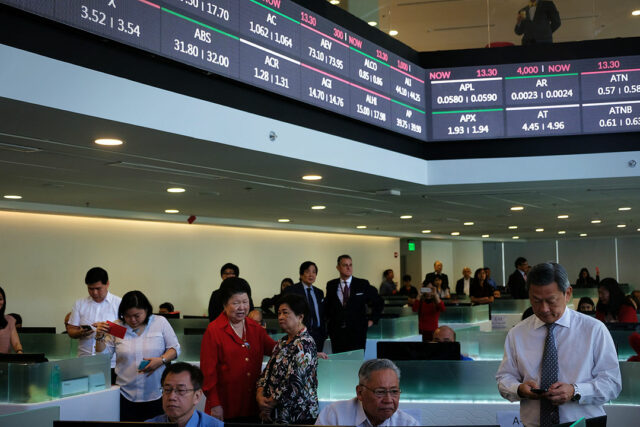
The benchmark Philippine Stock Exchange index (PSEi) went up by 59.22 points or 0.96% to end at 6,208.40 on Thursday, while the broader all shares index increased by 22.50 points or 0.67% to close at 3,353.31.

“Stocks rebounded as bargain hunters came in when the local equities market became technically oversold,” AB Capital Securities, Inc. Vice-President Jovis L. Vistan said in a Viber message.

“Aiding market sentiment was the hope that the US Fed is unlikely to raise their benchmark rate this month. This, despite higher August inflation reported last night,” he added.

Philstocks Financial, Inc. Research and Engagement Officer Mikhail Philippe Q. Plopenio said in a Viber message that investors saw bargain-hunting opportunities after the PSEi dropped to the 6,100 level on Wednesday.

“Helping in the climb were the expectations that the Federal Reserve would keep policy rates unchanged in its next meeting after the US August core inflation rate continued to decline to 4.3% from 4.7% in the preceding month,” he said.

US consumer prices increased by the most in 14 months in August as the cost of gasoline surged, but the annual rise in underlying inflation was the smallest in nearly two years, likely giving the Federal Reserve cover to leave interest rates unchanged next Wednesday, Reuters reported.

The mixed report from the Labor department on Wednesday was published a week before the Fed’s policy meeting and followed data this month showing an easing in labor market conditions in August. Economists, however, believe officials at the US central bank will continue to signal an additional rate hike this year given the stickiness in services inflation.

The US CPI went up by 0.6% in August after rising by 0.2% in the last two months.

In the 12 months through August, consumer prices picked up by 3.7% after rising by 3.2% in July.

“At home, many cheered the local banking industry’s nonperforming loan ratio for July as it remained steady at 3.43% on a month-on-month basis and was lower than the same period of last year’s 3.57% despite a high interest rate environment,” Mr. Plopenio added.

All sectoral indices went up on Thursday. Holding firms rose by 84.75 points or 1.44% to 5,942.05; mining and oil climbed by 108.42 points or 1.04% to 10,502.07; services went up by 14.14 points or 0.93% to 1,523.15; property increased by 19.99 points or 0.78% to 2,566.62; financials gained 5.68 points or 0.31% to end at 1,795.72; and industrials added 26.23 points or 0.29% to close at 8,843.82.

Value turnover declined to P3.81 billion on Thursday with 411.99 million shares changing hands from the P4.73 billion with 740.94 million issues seen on Wednesday.

Decliners and advancers ended at 92 each, while 35 names closed unchanged.

Net foreign selling dropped to P11.74 million on Thursday from P436.53 million on Wednesday. — SJT with Reuters

Singapore investors invited to co-finance with Maharlika

RTVM

PRESIDENT Ferdinand R. Marcos, Jr. on Wednesday urged Singapore businesses to explore projects co-financed by the Maharlika Investment Fund (MIF).

He made the remarks at a business roundtable in Singapore, during which he also urged investors to look into the Philippine renewable energy industry.

“We look forward to exploring co-financing opportunities with foreign investors, with multilateral institutions, and with other sovereign wealth funds around the world,” he was quoted as saying in a Palace statement on Thursday.

“To our partners in Singapore, I offer you the assurance of our greatest efforts in supporting businesses as we work together in achieving our economic agenda and making the Philippines your destination of choice for investment,” he added.

In the question and answer position of the 10th Asia Summit hosted by the Milken Institute in Singapore earlier in his visit, Mr. Marcos said he considers the MIF fund a pathway towards reducing dependence on foreign loans.

“We… started to worry about borrowing,” he said. “Although our borrowing in terms of GDP (gross domestic product) is not as high as maybe our neighboring countries, we are at about 62.3% up to 63% of GDP… for us that is high.”

He said the wealth fund could drive “economic development through strategic investments both domestically and overseas.”

Philippine debt as a share of GDP stood at 61% at the end of the second quarter, above the 60% threshold considered by multilateral lenders to be manageable for developing economies.

Mr. Marcos also assured that Maharlika will be run not by “politicians” but by professional fund managers.

Rent-seeking by politically connected groups is among the biggest risks to the MIF, Enrico P. Villanueva, a senior lecturer at the University of the Philippines Los Baños, said in a tweet.

Mr. Marcos signed the Maharlika bill into law in July, amid concerns raised by economists over its financing and management.

The fund will be managed by the Maharlika Investment Corp. (MIC), which will have authorized capital of P500 billion.

Some P125 billion worth of funding will come from the National Government (P50 billion), Land Bank of the Philippines (P50 billion) and the Development Bank of the Philippines (P25 billion).

The National Government will source its P50-billion contribution from 100% of the dividends of the Bangko Sentral ng Pilipinas for the first two years, and a 10% share of Philippine Amusement and Gaming Corp.’s income for five years. 

It will also take 10% of the revenue from the gaming operations of other government-owned gaming operators and regulators; proceeds from the privatization of government assets; and other sources such as royalties and/or special assessments for five years.

Mr. Villanueva urged the public to remain vigilant, asking for a review of the implementing rules and regulations and monitoring of the impact of fund transfer from government financial institutions to the MIC.

The public should also subject the MIC Board to scrutiny, track news and activities of the MIC, and closely monitor its financial and governance reports, he added.

At Wednesday’s roundtable discussion with Singapore businessmen, Mr. Marcos also encouraged investment in the Philippines’ renewable energy industry, innovation economy, and infrastructure.

He highlighted the raising of the foreign investor ownership limit to 100% in the exploration, development, and utilization of solar, wind, hydro, and ocean energy resources.

“The policy change comes as the Philippines seeks to attract foreign investment to boost the renewable energy sector and to meet our long-term climate targets,” he said.

“With this development, I encourage our Singapore partners to consider the Philippines and take part in the country’s goal of increasing the share of renewables in power generation and offering lower-cost and cleaner energy to the general public,” he added.

He also called for investment in financial technology to help the Philippines achieve its goal of 50% digital retail transactions by the end of 2023. — Kyle Aristophere T. Atienza

Raw sugar prices expected to remain stable, SRA says

FACEBOOK.COM/VICTORIASMILLINGCOMPANY

THE Sugar Regulatory Administration (SRA) said it expects the farmgate price of raw sugar to remain stable after starting to decline in February 2022.

“Since February 2022, farmgate prices for raw sugar have declined to P60 per kilogram and it has maintained (its price) to date,” Administrator Pablo Luis S. Azcona said in an Laging Handa briefing on Thursday.

“Thursday is our bidding day and hopefully (the farmgate price) remains at P60 per kilo,” Mr. Azcona added.

He said that retail prices for refined sugar have remained stable since February last year at P80 per kilo to P110 per kilo in supermarkets.

“For now, we are pushing to improve production; since farmgate prices are already stable, we have seen an increase in area (planted to sugar) in various places, which is a good sign.

According to the regulator’s Sugar Order No. 1, raw sugar production was estimated at 1.85 million metric tons (MT) during the 2023 to 2024 crop year.

Mr. Azcona has said that this would mainly be driven by a 3,000 hectare increase in total area planted to sugar, which would mean a 50 thousand MT jump in output for the year.

“Input costs for fertilizer have also increased. Farmers are now spending more since they are hopeful for a stable farmgate price,” he said.

He added that the SRA is continuing its block farm program, in which it organizes smaller farmers tilling one to two hectares into consolidated farms of 30 hectares of more.

“We also hand out cash assistance for their startup capital, as well as new tractors… That’s all to improve small farmers’ mechanization and production levels,” he said.

The regulator has received 80 tractors and other farm equipment from the Japanese government’s Non-Project Grant Aid.

It will hand out 51 tractors to sugarcane farms in the Visayas, with Negros Occidental getting 24 units, Negros Oriental 11, Iloilo six, Leyte four, and Cebu and Capiz three each.

The SRA also received 48 sugarcane planters, 48 lateral flail mowers, and five power harrows. — Adrian H. Halili

BoI-approved investments hit P725.93B, nearing 2022 total

THE Board of Investments (BoI) said registered projects in the year to date hit P725.93 billion, with the total close to exceeding the P729 billion worth of investments tallied over the full year of 2022.

The BoI said the estimate for approved projects covered the January to Sept. 12 period, with foreign investors accounting for P426.04 billion.

Ceferino S. Rodolfo, BoI managing head and Trade undersecretary, said in a Viber message that around 80% of the projects involve renewable energy, while the remainder mostly have to do with telco infrastructure.

“What is really strong now are game changers related to sustainability and digitalization,” Mr. Rodolfo told  BusinessWorld.

The electricity, gas, steam, and air conditioning industries accounted for P557.84 billion of the total, while the information and communication industry generated P95.51 billion worth of investment.

Around 35,086 jobs are expected to be generated from the projects, 22,016 of which are in administrative and support service activities.

The Western Visayas captured the larger slice by project value with P307.14 billion worth of projects, while investments in Region 4A or Cavite, Laguna, Batangas, Rizal, and Quezon amounted to P165.5 billion.

The BoI said there were no approved projects in the Bicol Region or Region 5 which comprises the provinces of Albay, Camarines Norte, Camarines Sur, Sorsogon, Catanduanes and Masbate.

At the deadline, the BoI had not replied to a query regarding its confidence in achieving its investment registration targets for the year.

In February, Trade Secretary Alfredo E. Pascual raised BoI’s investment target by 50% to P1.5 trillion.

Mr. Pascual told reporters last week that he is confident that the BoI will be able to achieve and even surpass its P1.5-trillion investment target. — Justine Irish D. Tabile

Five ACEN floating solar projects set for expedited ‘green lane’ processing

THE Board of Investments (BoI) said it endorsed five ACEN Corp. floating solar projects for “green lane” treatment, gaining access to an expedited application and licensing process for investments that are deemed strategic.

The five projects are to be built on Laguna de Bay.

Green lane processing is authorized by Executive Order No. 18 or Constituting Green Lanes for Strategic Investments.

ACEN’s SolarAce4 project will be built on 100 hectares of the lake’s surface off Santa Cruz, Laguna and is expected to produce 140 megawatt peak (MWp) of clean energy.

The 200-hectare AC Laguna Floating Solar Power Plant will be built off Victoria and Pila, Laguna and will generate 280 MWp.

AC Subi will occupy 200 hectares off Victoria and Santa Cruz, Laguna, and is expected to produce 280 MWp.

GigaWind1 Floating Solar Power Plant will be built on 200 hectares off Kalayaan and Paete, Laguna and will generate 280 MWp.

The Ingrid Floating Solar Power Plant will be built on 100 hectares off Lumban, Laguna. It is expected to produce 140 MWp of clean energy.

The BoI said that ACEN’s five RE projects “are consistent with the Philippine government’s mission to accelerate the growth of eco-friendly investments.”

Ayala group’s ACEN specializes in renewable energy with solar and wind farms across the Philippines, Australia, Vietnam, Laos, and India.

It aims to be the largest listed renewable platform in Southeast Asia and is hoping to build 20 gigawatts of renewable capacity by 2030. — Justine Irish D. Tabile

Electricity spot prices fall in Luzon, Visayas in early September

BW FILE PHOTO

ELECTRICITY spot market prices fell in Luzon and the Visayas in early September as power demand declined, the Independent Electricity Market Operator of the Philippines (IEMOP) said, while prices in Mindanao increased.

“This decline is primarily attributed to ample supply margins and tamer demand compared to the summer months,” the IEMOP said in a statement.

In a virtual briefing, Isidro E. Cacho, Jr., IEMOP’s head of corporate strategy and communications, said that the average spot market price in Luzon declined to P4.12 per kilowatt hour (kWh) in the first two weeks of September, from P5.53 per kWh in August.

In September so far, average supply increased 3.72% to 13,394 megawatts (MW), while demand fell 3.80% to 9,119 MW.

In the Visayas, the average electricity spot market price likewise fell to P5.93 per kWh in September from P6.18 per kWh previously.

Supply levels hit 2,329 MW, down 2.92%. Demand dropped 1.18% to 1,850 MW.“Meanwhile, in Mindanao, a decrease in the average supply margin of 358 MW, attributed to the deration and outage of some generators, led to a price increase from P4.82 per kWh in August to P5.81 per kWh in September,” it said.

The spot market serves as the venue where energy companies can buy power when their long-term contracted power supply is insufficient for their customers’ needs.

“We foresee that, if those predicaments or situations of supply and demand continues… then we expect the prices to be sustained in the current level, if not lower. Hopefully, that’s what will prevail,” Mr. Cacho said.

As of the first half, Mr. Cacho estimated more than 4,000 identified contestable customers from the Retail Competition and Open Access (RCOA) and the Green Energy Option Program.

“If we pegged it at 4,000, we are seeing that half of the expected contestable customers are already participating in the RCOA or competitive retail electricity market,” he said.

Meanwhile, Mr. Cacho said that the trial period for the reserve market is still ongoing and targeted for completion by the end of the month.

In June, the Department of Energy directed the IEMOP to commence trial operations for the reserve market, while awaiting for the approval of the price determination method from the Energy Regulatory Commission.

“Although the marching orders to us is to ready it anytime… until the end of the year, we will (undertake) final preparations. Hopefully, we get to launch it before the year ends,” he said referring to the commercial launch. — Sheldeen Joy Talavera

Game developers report orders of $7 million from German trade show

GAMESCOM

PHILIPPINE game developers reported $7 million worth of initial orders at a three-day trade show in Cologne, Germany, the Department of Trade and Industry (DTI) said.

DTI Export Marketing Bureau Director Bianca Pearl R. Sykimte said that creative services are expected to contribute to the economy by generating high-value jobs.

“We share and support the aspiration of the game development industry to further expand and thrive in international markets including Europe,” Ms. Sykimte said in a statement.

Aside from the export sales generated last month, the companies were also able to identify sales leads valued at up to $20 million during the trade mission, which took place between Aug. 23 and 25.

Sylvie Bétemps Cochin, chief of office for Asia and the Pacific of the International Trade Centre, said Philippine enterprises have shown great potential in the gaming industry.

“We hope that this participation will foster stronger business linkages and opportunities for them to tap into the European market and beyond,” Ms. Cochin said.

The companies attending the Gamescom 2023 trade show were Razer Gold, Ranida Games, Taktyl Studios, Fizzbuzz, Inc., Emottoons Animation Studio, Yang Yang Mobile, Pixel Mafia Ltd., Animation Vertigo, Startrace Studios OPC, Buko Studios, and GameOps, Inc.

“The Philippines is strategically positioned towards becoming a leading hub for game development in the Asia-Pacific region by 2028,” Ms. Sykimte said.

Last year, the Philippine gaming industry posted $75 million in revenue and employed 8,000.

Earlier this year, five game development companies reported $1.67 million worth of actual sales and potential leads at the Nordic Game 2023 trade show in Sweden. — Justine Irish D. Tabile

DoE signals annual review of power firms’ use of energy storage systems

NGCP.PH

THE Department of Energy (DoE) signaled plans to conduct annual reviews of the power industry’s use of energy storage systems (ESS).

In a draft circular, the DoE said the review is designed to ensure the optimal use of ESS.

The DoE quoted the draft as saying that “in increasing the portfolio of existing ESS units and facilities and thereby help achieve a desirable sustainable, reliable and efficient level of generation capacities and AS (ancillary services) in the Philippine Grid, there is a need to issue additional policies and mobilize key government agencies and entities.”

The DoE said an operational review of electric power systems will be held on March 15 every year, to be conducted in two phases.

It also plans to conduct diagnostics and simulations on the grid to evaluate the impact of renewable energy (RE) projects coming online before 2030.

This is also to assess the potential for pump-storage hydropower plants and ESS to achieve RE targets.

The government aims to increase the share of RE in the energy mix to 35% by 2030 and 50% by 2040.

The DoE has asked the Energy Regulatory Commission to issue the rules for implementing the circular. — Sheldeen Joy Talavera

Responsible sourcing already embedded in current PHL fisheries laws, BFAR says

PHILSTAR

RESPONSIBLE seafood sourcing (RSS) practices are already encouraged in current fisheries policy, the Bureau of Fisheries and Aquatic Resources (BFAR) said.

At a briefing at the United States Agency for International Development’s (USAID) Sustainable Seafood Summit, BFAR spokesman Nazario C. Briguera said fisheries law recognizes the need for RSS.

RSS is a USAID-BFAR project which started in 2018, with the goal of reducing illegal, unreported and unregulated fishing (IUUF).

“If we are going to analyze it the concept of RSS is actually embedded in our existing law, the Fisheries Code, because there is no such thing as RSS if you have poor compliance with your fisheries laws,” Mr. Briguera added.

Republic Act No. 10654 or the Amended Fisheries Code of the Philippines addresses IUUF.

“We just need to increase compliance with our fishing laws. Kapag wala kang illegal fishing na nangyayari eh di responsable ang pag-aani ng stocks mo (If there is no illegal fishing, the harvesting of fish will be responsible),” he said.

He said that the agency also implemented the Malinis at Masaganang Karagatan (Clean and Bountiful Seas) program to encourage fisheries protection and conservation.

“It is an incentive program for the local government units to scale up in terms of coastal resource management,” Mr. Briguera said.

“So, there are already existing mechanisms that are actually leading to RSS,” he added.

Sustainable Fisheries Partnership Senior Program Manager Rebecca Andong said responsible fishing is mostly self-regulating.

“The RSS standard is self-regulation. It is led by the private sector, so there is no need to have a policy to implement it; because they have accountability in their business processes,” Ms. Andong added.

She said that the organization is also collaborating with local government units to reinforce sustainable sourcing practices. — Adrian H. Halili

China reverts to swarming tactics; US admiral eyes more EDCA bases

PHILIPPINE STAR/WALTER BOLLOZOS

By Kyle Aristophere T. Atienza, Reporter

THE ARMED Forces of the Philippines (AFP) reported the “concerning resurgence” of China’s swarming tactics within Philippine boundaries of the South China Sea on Thursday, as a top United States admiral eyed access to more bases in the country under the Enhanced Defense Cooperation Agreement (EDCA).

Citing its air patrols on Sept. 6 to 7, the AFP Western Command said three areas within the country’s exclusive economic zone (EEZ) in the South China Sea have experienced “heightened China swarming activity.”

The biggest swarming — involving 23 supposed fishing vessels of China — was spotted in Iroquios Reef (named Rozul Reef by the Philippines), which is located south of oil- and gas-rich Reed Bank, the AFP WESCOM reported.

“Additional swarming was observed in Escoda (Sabina) Shoal, where five Chinese fishing vessels were present, and in Baragatan (Nares) Bank, with two Chinese fishing vessels recorded,” it added.

The military stressed that such swarming activity by China has implications on the Philippines’ “maritime security, fisheries conservation, territorial integrity, and preservation of the maritime environment.”

“These activities have been a source of tension in the West Philippine Sea (covering the country’s EEZ) and contributed to instability in the region,” the AFP WESCOM statement said.

Last Aug. 24, the Philippine Navy reported that 33 Chinese fishing vessels were also spotted swarming Iroquios Reef. “Previous swarming incidents in the area have also been followed by reports of massive coral harvesting,” the military said.

The latest Chinese swarming activity was reported days after the Chinese Coast Guard, backed by Beijing’s maritime militia and navy vessels, attempted to block a Philippine resupply mission to Second Thomas Shoal (Ayungin Shoal) through dangerous maneuvers.

“Another thing worth noting with the last resupply mission, it has become more obvious that the Chinese maritime militia is now taking orders from the Chinese Coast Guard to actively block the entrance of Philippine vessels,” Philippine Coast Guard spokesman for the West Philippine Sea Jay Tarriela said in a television interview Thursday.

“Before, these Chinese maritime vessels were very covert in taking orders from the Chinese Coast Guard. Now, it’s very obvious,” Mr. Tariela said.

MORE US ACCESS TO PHL BASES RECOMMENDED
Meanwhile, the United States may seek access to more military bases in the Philippines under EDCA, according to the chief of the US Indo-Pacific command.

The Philippines has this year increased the number of bases accessible to the US military from five to nine, a move that has riled regional power China, which sees the arrangement as provocative and likely to raise tensions.

On Thursday, Admiral John Aquilino said he and AFP Chief of Staff Romeo Brawner, Jr. had discussed further expanding the number of bases US forces could access under the defense and security agreement between the two countries.

“General Brawner and I made recommendations to our senior leaders for the consideration of additional sites, but there’s still work to do there,” Mr. Aquilino said, stressing that the US was operating in the country at the invitation of the Philippines.

The closer US defense ties with the Philippines after a period of decline has caused concern in China that Washington has Taiwan in mind in its efforts to boost its military presence in the region.

The United States says it intends to bolster an already strong alliance and improve the defense capability of the Philippines.

Mr. Brawner said the purpose of EDCA was training exercises and humanitarian and disaster response, key planks of a decades-old alliance between the two countries, and not related to regional security threats.

“All of these joint operations, even the selection of our EDCA sites, have nothing to do with the other countries in the Indo- Pacific region, meaning the threats that could come out from these countries,” he said.

Mr. Aquilino also said the two countries were seeking to complete an agreement on boosting their intelligence sharing.

DFA: PHL LAWS NEEDED TO DEFINE TERRITORY
In the Philippine Congress, lawmakers are busy enacting laws establishing the country’s maritime zones and defining boundaries — all crucial in cementing Manila’s position to exercise economic rights in the South China Sea in line with international law, the Department of Foreign Affairs (DFA) said.

“These laws will establish the rights and duties of the Philippines as an archipelagic state including areas where the Philippines can exercise sovereignty and jurisdiction,” Foreign Affairs Undersecretary Eduardo A. de Vega told a Senate Special Committee on Maritime and Admiralty Zones on Thursday.

“The establishment of the maritime zones would provide the necessary foundation and framework for the enactment of subsequent laws pertinent to the rights and obligations of the Philippines over our maritime zones,” Mr. De Vega said.

Gregory B. Poling, director of the Southeast Asia Program and Asia Maritime Transparency initiative at the Center for Strategic and International Studies, told the same hearing that Manila’s claims over the disputed waterway are already well grounded on international law.

“Elaborating that in domestic legislation only further clarifies the issue,” he said. “It doesn’t change the Philippines’ claims.”— with John Victor D. Ordoñez and Reuters


LWUA gets measly budget increase amid El Niño year

LOCAL WATER UTILITIES ADMINISTRATION FACEBOOK PAGE

By Beatriz Marie D. Cruz, Reporter

A MEASLY increase of P16.4 million was approved for the 2024 budget of the Local Water Utilities Administration (LWUA) even as water districts grapple with an annual water system loss of 30%.

While the LWUA’s approved budget of P364.43 million for next year is an increase from this year, it still stands less than half of its P828.55-million budget in 2022.

To note, the LWUA oversees 532 water districts, of which 244 have high levels of non-revenue water (NRW). This also includes water that is not billed or is lost through leaks or illegal connections.

In August, LWUA Chairman Ronnie L. Ong said water districts yielded an average NRW of 29.34%, which results in a 488-million cubic meter water loss annually or more than half the 850-million cubic meter capacity of Angat Dam.

Reducing the NRW would help lower production costs and water supply interruptions, which could help reduce water rates, Mr. Ong explained.

That is why the LWUA’s budget must be sufficient to address water leakages amid the emerging El Niño weather pattern.

The Philippine Atmospheric, Geophysical and Astronomical Services Administration (PAGASA) announced in July the onset of El Niño. It estimates a more than 56% probability of a moderate to strong El Niño in the fourth quarter of this year.

Also in July, PAGASA predicted that 36 provinces may experience dry spells or below normal rainfall conditions for three months, noting that the El Niño phenomenon may persist until January 2024.

This poses an extended effect on water supply as summer sets in and rainfall expected to replenish the dams may set in by June or July next year.

Mr. Ong also said that some water districts have pipes made of asbestos — a toxic substance — that were installed way back during the Japanese occupation in the mid-20th century.

The House of Representatives previously committed to help the agency reduce its water system loss.

“The ongoing deliberations of the House committee on appropriations on the proposed P5.768-trillion budget for 2024 is the perfect opportunity to explore solutions, including the rehabilitation of water supply systems and modernization of the LWUA,” Speaker Ferdinand Martin G. Romualdez said in August.

The LWUA is a specialized lending institution that promotes, finances and oversees the development of water supply systems in cities and municipalities outside Metro Manila.

State auditors previously flagged the LWUA for unused subsidy funds from the National Government for 2009 to 2017 worth P140.66 million for projects that have been completed or yet to start had not been returned to the Bureau of Treasury (BTr).

The LWUA is an attached agency of the Department of Public Works and Highways.

ADVERTISEMENT
ADVERTISEMENT