Home Blog Page 429

New Mazda CX-60 unveiled, priced from P2.89M


The Mazda CX-60 attained a 50.48km/Lge fuel economy result in the Department of Energy Eco-Run 2025. — PHOTO BY KAP MACEDA AGUILA

By Kap Maceda Aguila

IT’S QUITE astonishing to note that more Mazda CX-60 units have been sold in the Philippines than anywhere else in the world, with the exception of Japan. The number exceeds 800, according to Mazda Philippines President and CEO Steven Tan in a release from the company. “(The figure is) a testament to it being well-received by Filipino buyers,” he averred.

Mazda Philippines formally revealed the refreshed version of the CX-60 last week to members of the media. Positioned as a premium SUV, the CX-60 is said to “(offer) new refinements, making it even more unmatched in every way. These (changes) are much more than skin-deep, and is part of our commitment to continuous improvement.”

The enhancements, said the company, are in pursuit of the “perfect Mazda Jinba Ittai (horse and rider in one body) experience of car and driver in complete harmony.” To better the ride, the rear suspension now features more pliant rear springs and new bump stops for “improved compliance,” and dampers get increased rebound rates to help with vertical motion. Fitted to the front suspension are dampers with firmer compression rates and relocated front knuckle mounts for better stability, especially on difficult terrain.

Meanwhile, “recalibrated steering and stability systems also improve overall balance,” added the release.

The front-engine, rear-wheel-drive mechanical layout, continued Mazda Philippines, “(distributes) the lateral and longitudinal workload between the two axles.” Placing the powertrain units at the center also aids in transmitting power to the road surface more efficiently. Versus similarly sized SUVs, the CX-60 is also said to boast a more compact turning radius of 5.4 meters — just a little wider than the MX-5’s.

The Skyactiv-Drive eight-speed automatic transmission gets control and hydraulic valve improvements “for smoother, more responsive combustion-engine-to-electric-motor transitions and a wider gear range for the best balance of enjoyable driving dynamics and environmental performance.”

A new 3.3-liter, six-cylinder engine — either gas or diesel — is under the hood of the CX-60, with both powerplants promising less vibration, with a smooth and quiet engine tone at low speeds, and “a clean and engaging sound” at full throttle. It delivers 284ps and 450Nm (gas); 254ps and 550Nm (diesel), with both engines utilizing Mazda Hybrid technology featuring a 48-volt hybrid system with a lithium-ion battery pack.

Further improvements are made to NVH (noise, vibration, and harshness) levels through thicker and denser sound insulation material on the dashboard and “increased coverage that now includes the upper part of the cowl.” The trunk side trim also gets enhanced sound insulator coverage, and a new steering column joint and reinforced doors reduce unwanted interior vibrations.

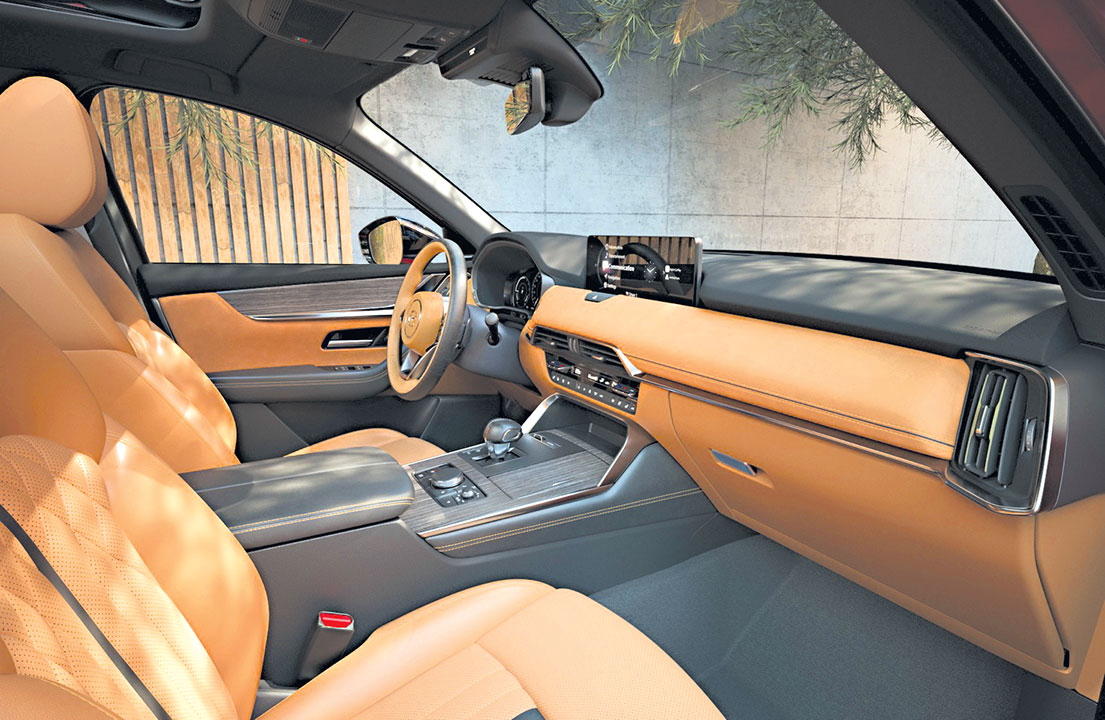
A 12.3-inch digital instrument panel, 12.3-inch infotainment center display, and a 10.4-inch head-up display put “everything right where it is needed,” while the Mazda Commander Control knob has been “optimally positioned” to “allow operation with the user’s arm resting comfortably on the center arm rest.” The unique Driver Personalization System makes it easy for drivers to set their ideal driving position. “After entering the driver’s height data via the infotainment center display, the automatic driving position guide uses a camera to detect the location of their eyes. It then automatically adjusts the seat, steering wheel, Active Driving Display, and door mirrors to match the driver’s eye position,” said Mazda Philippines.

Facial recognition technology is used to register driver preferences. “Once the driver is detected, the Mazda CX-60 automatically restores more than 250 stored settings to match preferences, including vehicle, audio, and climate control settings. The system stores settings for up to six different users, plus guests.”

Both variants have a frameless auto-dimming rearview mirror, front seat ventilation, wireless device charging, ambient lighting, panoramic sunroof, and dual-zone climate control with rear vents. The latest-generation Mazda Connect allows passengers to connect wirelessly via Apple CarPlay and Android Auto, and content is pumped through a 12-speaker Bose Sound system.

All Mazda CX-60 variants feature 20-inch aluminum alloy wheels with 235/50R20 tires, a panoramic sunroof, and a hands-free power tailgate with height memory adjustment. The 3.3L AWD HEV Turbo showcases the signature Mazda design with its machine-cut alloy wheels, bar-type grille, bright chrome on the front fenders, side window molding, and exhaust finishers. The 3.3L AWD HEV Turbo-D Sport receives black metallic alloy wheels, a dark honeycomb grille, dark side-window molding, dark exhaust garnish, and black side-view mirrors.

Perhaps most surprising, compared to elsewhere in the region, is pricing. Mr. Tan said that the asking price of P2.89 million for the Mazda CX-60 3.3L AWD HEV Turbo and P2.99 million for the Mazda CX-60 3.3L AWD HEV Turbo-D Sport — inclusive of a five-year free service plan which covers the periodic maintenance at six-month/10,000-kilometer intervals, for up to five years or 100,000 kilometers, whichever comes first — is much more affordable than in countries such as Singapore, Malaysia, Thailand, and Indonesia.

Every purchase includes a three-year bumper-to-bumper warranty and a five-year hybrid battery warranty. Sales of the new CX-60 commenced last Thursday, Jan. 15.


Style (01/19/26)


MUJI launches Kapok collection for S/S26

THIS season, MUJI Philippines will be launching a new clothing collection made with kapok, a natural fiber derived from the nuts of a tree native to tropical regions of Southeast Asia. Kapok grows with minimal water and fertilizer, requires little to no pesticides, and has a reduced environmental impact. The cotton-like fibers extracted from its kernels have traditionally been used as stuffing for cushions and garments. With a total of 13 new styles for men and women, nine styles from the collection will be available in all MUJI Philippines’ stores (excluding pop-up stores) and online (mujiph.com) starting this month. The remaining four styles will arrive in the stores later. The collection includes shirts, coveralls, and double-gauze blouses in various colors such as dark navy, medium gray, natural, blue stripe, off-white, light yellow, light blue, gray stripe, black, and khaki, perfect for pairing with pants or layering with dresses for versatile looks. Kapok fibers are hollow, lightweight, and airy, making it the lightest natural fiber in the world and a unique MUJI material for comfortable, functional, and sustainable clothing. With a breathable and hypoallergenic fabric structure, it provides excellent moisture absorption and heat retention. Its soft, airy feel and easy-to-wear designs make it ideal for daily life and the weather in the Philippines. The new kapok collection can be found at the MUJI stores in Estancia Mall, GH Mall, Festival Mall, Glorietta 3, SM North EDSA, SM Mall of Asia, Uptown Mall, Shangri-La Plaza, Greenbelt 3, Power Plant Mall, Central Square, and mujiph.com.


Benilde student show celebrates 10th year

SINULID, the annual culminating event which showcases the skills of the graduating Fashion Design and Merchandising (FDM) students of the De La Salle-College of Saint Benilde (DLS-CSB), marks not only 10 years of creative excellence, but also the 30th anniversary of the FDM program. Themed “Awanggan,” derived from the words awan (zero) and hanggan (limit), it is an archaic Tagalog term which means limitless. This year’s edition features over 270 looks. The showcase is divided into three acts — Takipsilim, Hating Gabi, and Bukang Liwayway (dusk, midnight, daybreak). It presents a diverse range of ensembles, from ready-to-wear to contemporary and the avant-garde. The Sinulid: Awanggan runway show will be held at the PNB Financial Center Banking Hall along Diosdado Macapagal Blvd. in Pasay City on Jan. 31, 6 p.m. Over 90 creations will likewise grace a digital exhibition, which is set to premiere a day after. For updates, visit @sinulid.benilde on Instagram.


Fendi releases Lunar New Year capsule collection

TO CELEBRATE the 2026 Lunar New Year and the start of the year of the Fire Horse, Fendi presents a special capsule collection. Drawing inspiration from the color-blocking and floral motifs featured on the Spring/Summer 2026 runway, the capsule collection is designed for both women and men, reinterpreting elements of good fortune. The women’s ready-to-wear features three classic FF logo knit pieces in light blue, reimagined with uniquely crafted color-block trims in pink and yellow. The women’s accessories introduce two new BFF Mini charms, enlarging the miniature family that debuted in Fall/Winter 2025-26 and continued into Spring/Summer 2026. Existing characters present new dressings and details that combine the red hue rich with New Year symbolism, and the auspicious signs of persimmons and peanuts. A special BFF Maxi charm, part of a limited series, mirrors the mini version’s look with luxurious materials and intricate details, from the mink hair and leather dress to the shearling accents on the shoes. In fashion jewelry, the delicate gold finishing of the EverRound Fendi logo merges with the lucky red of the leather bracelet as an auspicious emblem of prosperity and enduring happiness. The men’s ready-to-wear includes a blue nylon windbreaker, a blue cotton hoodie, and a white cotton T-shirt, adorned with the Fendi logo inspired by the floral themes of the Spring/Summer 2026 collection. The collection is available in selected FENDI boutiques and on fendi.cn this month.


Uniqlo launches Disney embroidery

UNIQLO has announced the launch of Disney embroidery designs at the Re.Uniqlo Studio in-store repair and remake service. Starting this month, customers can personalize their favorite Uniqlo items with eight exclusive embroidery designs featuring popular Disney characters including Mickey Mouse, Minnie Mouse, Donald Duck, and Daisy Duck. This service is available at Re.Uniqlo Studio locations for Uniqlo products purchased in the past or on the same day (excluding collaboration products). These cost P250 per icon, with the lineup including Mickey Mouse, Minnie Mouse, Donald Duck, and Daisy Duck in two color palettes, along with their silhouettes. The service is available at Re.Uniqlo Studio counters at the Uniqlo Manila global flagship store in Glorietta, Uniqlo SM Mall of Asia, and Uniqlo BGC High Street.

Rates of BSP securities slip

PHILIPINE STAR/IRRA LISING

YIELDS on the central bank’s short-term securities fetched a lower average rate on Friday as the offer was met with strong demand.

The one-month Bangko Sentral ng Pilipinas (BSP) bills attracted P129.759 billion in bids, exceeding the P90 billion placed on the auction block and P111.393 billion in tenders for the same offer volume the week prior.

This was equivalent to a bid-to-cover ratio of 1.4418 times, higher than the 1.2377 ratio seen previously.

This led the BSP to make a full P90-billion award of its offer.

Accepted rates ranged from 4.65% to 4.85%, narrower than the 4.665% to 4.94% seen during the previous auction. This brought the average rate of the 28-day papers to 4.8099%, down by 1.09 basis points week on week from 4.8208%.

The BSP has not auctioned off the 56-day bills for nearly three months or since Nov. 3.

The central bank uses the BSP securities and its term deposit facility to mop up excess liquidity in the financial system and to better guide short-term market yields towards its policy rate.

As of mid-November 2025, the BSP’s monetary operations have siphoned off P1.5 trillion in liquidity.

Of the total, 42.4% were absorbed through BSP securities, 34.6% from the overnight reverse repurchase agreement, 17.6% through overnight deposit facilities and 5.4% via term deposit facilities.

The BSP bills also contribute to improved price discovery for debt instruments while supporting monetary policy transmission.

In August 2025, BSP Governor Eli M. Remolona, Jr. said they are gradually shifting away from the issuance of short-term papers to manage liquidity as they want to boost activity in the money market.

The central bank started auctioning off short-term securities weekly in 2020, initially offering only a 28-day tenor and adding the 56-day bill in 2023.

Data from the central bank showed that around 50% of its market operations are done through its short-term securities. — Katherine K. Chan

Bridging gaps in autism care: Advocating for an inclusive health policy

STOCK PHOTO | Image by Wagner France 3D Design from Freepik

Misinformation undermines public trust in vaccines by fueling fear, exaggerating safety risks, promoting conspiracy theories, and casting doubt on health authorities. This drives vaccine hesitancy, reduces vaccination uptake, and jeopardizes disease control. Providing credible and science-based information increases vaccine confidence, leading to higher vaccination rates and fewer illnesses, hospitalizations, and deaths.

In December 2025, a World Health Organization (WHO) global expert committee on vaccine safety announced the results of a new analysis which found no causal link between vaccines and autism spectrum disorder (ASD). This reaffirmed the WHO’s longstanding position that childhood vaccines do not cause autism.

The myth that vaccines cause autism began with a fraudulent 1998 study that has been conclusively disproven and retracted from the journal in which it was published. Hundreds of well-designed studies have since shown that vaccines are not linked to autism. The methodologically flawed paper was not a proper scientific investigation but a case series of only 12 carefully selected children, many of whose parents already believed the MMR (measles, mumps, and rubella) vaccine was the cause of their children’s autism. It was later revealed that the study’s author had a significant financial conflict of interest, having received funding from lawyers pursuing lawsuits against vaccine manufacturers. The author was subsequently stripped of his medical license in the UK for dishonest and irresponsible behavior.

Autism, also known as ASD, encompasses a diverse range of neurodevelopmental differences characterized by variations in social communication, interaction, and sensory processing. In 2021, about one in 127 people worldwide were autistic. Scientific evidence suggests that certain environmental factors can increase a child’s likelihood of being autistic. These include advanced parental age, gestational diabetes during pregnancy, prenatal exposure to heavy metals or air pollutants, prematurity, severe birth complications, and low birth weight.

A wide range of support, beginning in early childhood and continuing throughout the lifespan, can improve developmental outcomes, autonomy, and well-being for autistic individuals. Timely and evidence-based psychosocial support in the early years helps strengthen communication skills, facilitate learning, and build community participation. Routine monitoring of child development should be an integral part of maternal and child health services. Once a diagnosis is confirmed, the WHO strongly recommends that autistic children, adolescents, and adults — as well as their caregivers — receive appropriate information, services, referrals, and practical support tailored to their unique and evolving needs.

Despite significant progress in awareness, many autistic people continue to face barriers to healthcare and social services. According to the WHO, autistic individuals have significantly higher rates of unmet healthcare needs compared with the general population. The agency further recommends that interventions for people with autism and other developmental disabilities be designed and delivered with the meaningful participation of the people living with these conditions, a principle widely embraced in disability rights movements under the slogan “Nothing about us without us.”

In the Philippines, the Philippine Health Insurance Corp. (PhilHealth) is strengthening efforts to collaborate with disability and patient advocacy groups. In June 2025, PhilHealth hosted a dialogue with disability advocates, including the Autism Society Philippines (ASP), to address critical gaps in health and rehabilitation services for children and youth with disabilities.

The discussion centered on the implementation of Republic Act 11228, which mandates automatic PhilHealth coverage for all Persons with Disabilities (PWDs). According to the ASP, the provision of rehabilitation and assistive technology services for children with disabilities under the PhilHealth Children’s Benefit Package has been hindered by a shortage of accredited rehabilitation facilities and professionals.

Rehabilitation practitioners who participated in the dialogue expressed their commitment to help PhilHealth develop clear and practical accreditation guidelines for private rehabilitation centers and practitioners. They were also encouraged to register for accreditation with eKonsulta, PhilHealth’s digital platform for its Konsulta program that provides free primary care services to members.

The research-based pharmaceutical industry welcomes these positive steps, as we believe health policy should focus on strengthening primary care. Early screening, diagnosis, and support services anchored in primary care are pivotal in easing the burden of mental and neurological conditions, including autism. These reforms not only improve access to essential services, they move the country closer to a more inclusive and responsive system of care.

As the country observes Autism Consciousness Week, let us continue working together to build a future where autistic children, adolescents, and adults are empowered to thrive with dignity, supported by families, educators, and communities who are never left behind.


Teodoro B. Padilla is the executive director of Pharmaceutical and Healthcare Association of the Philippines, which represents the biopharmaceutical medicines and vaccines industry in the country. Its members are at the forefront of developing, investing and delivering innovative medicines, vaccines, and diagnostics for Filipinos to live healthier and more productive lives.

EU, Mercosur sign trade deal after 25 years of negotiations

REUTERS/CESAR OLMEDO TPX IMAGES OF THE DAY

ASUNCION — Top officials from the European Union (EU) and the South American bloc Mercosur signed a free trade agreement on Saturday in Paraguay, paving the way for the EU’s largest-ever trade accord after 25 years of negotiations.

The agreement, designed to lower tariffs and boost trade between the two regions, must now gain the consent of the European Parliament and be ratified by the legislatures of Mercosur members Argentina, Brazil, Paraguay and Uruguay.

European Commission President Ursula von der Leyen and European Council President Antonio Costa joined the presidents of Mercosur countries at Saturday’s ceremony, with the exception of Brazilian President Luiz Inacio Lula da Silva, who sent his foreign minister.

The deal received the green light from most European nations last week, despite concerns from farmers and environmental groups, who fear a surge of inexpensive South American imports and increased deforestation.

Ms. Von der Leyen, who met with Mr. Lula before heading to Asuncion for the signing, said the deal would create the largest free trade zone in the world.

“This agreement sends a very strong message to the world. It reflects a clear and deliberate choice. We choose fair trade over tariffs. We choose a productive, long-term partnership over isolation,” she said.

Just before the ceremony on Saturday morning, US President Donald Trump vowed to impose increasing tariffs on eight European nations if the US is not permitted to purchase Greenland.

“This agreement will help both our blocs navigate an increasingly turbulent political environment without abandoning our values, marking a true milestone in shoring up our economic security,” Mr. Costa said.

While Mercosur officials have expressed reservations about certain regulations within the pact, Mr. Lula affirmed on Friday in Rio de Janeiro that it will unlock greater opportunities and stimulate more trade and investment for both parties.

Brazil’s government said in a statement that the deal is “emblematic of Lula’s efforts to expand and diversify markets,” adding that South America’s largest economy is also negotiating agreements with the United Arab Emirates, Canada and Vietnam, besides the expansion of a tariff-preference pact with India. 

Trade between the EU and Mercosur, which encompasses a market of 700 million people, reached a value of 111 billion euros in 2024. European Union exports mainly consist of machinery, chemical products, and transport equipment, whereas Mercosur’s exports are concentrated in agricultural goods, minerals, wood pulp, and paper. — Reuters

Red-letter year

PHOTO BY ANGEL RIVERO

Heading up to Tagaytay as Mercedes-Benz PHL braces for a busy milestone year

TWO THOUSAND Twenty-Six is an exceptionally significant period for Mercedes-Benz. It marks 100 years since the brand was formed. In June 1926, Benz & Cie. merged with Daimler-Motoren-Gesellschaft to become what was then known as Daimler-Benz AG. This officially formed the Mercedes-Benz we know.

This year also marks the 140th anniversary of Carl Benz filing his patent for a three-wheeled vehicle with “gas-engine drive” back in January 1886 — which was, in fact, a patent for the first automobile. Here’s a fun fact: Many people even fondly refer to this patent as “the birth certificate of the automobile.”

And it doesn’t end there. This year also commemorates 50 years since the presentation of the Mercedes-Benz W123 model series — the foundational predecessor of today’s modern E-Class. These and several other milestones are all part of the Three-Pointed Star’s historical celebrations this 2026. There is a lot to look forward to in the coming months.

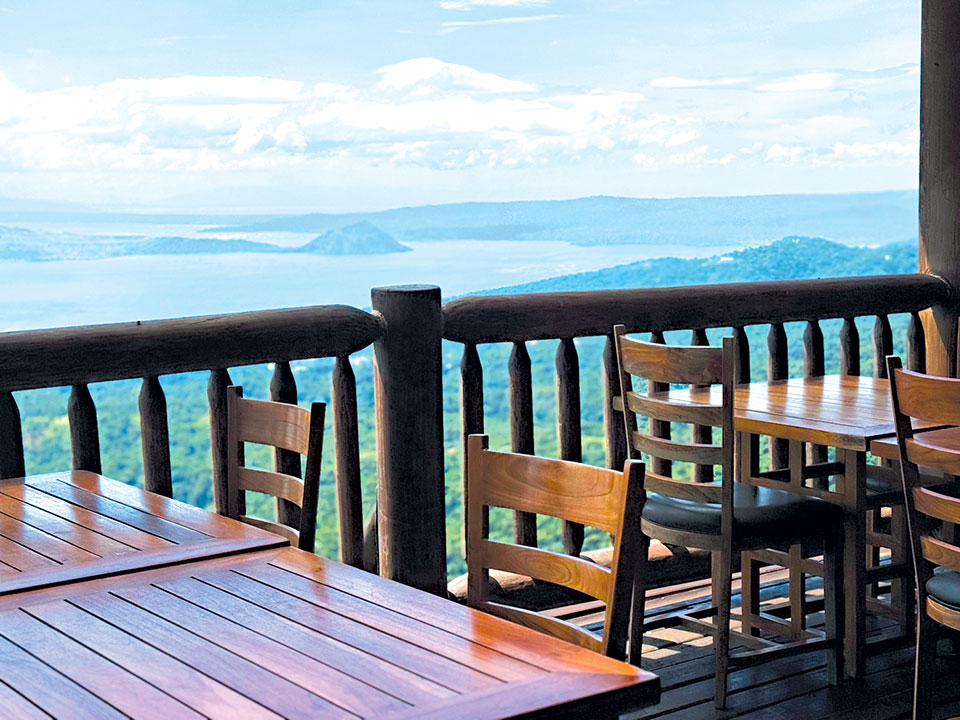
What has Mercedes-Benz been up to, before the eventual start of these festivities? Well, last year, Mercedes-Benz Philippines, through the management of Inchcape, launched several electrified models in the country as part of its EQ lineup, alongside the goal to further enrich the local market’s luxury segment with more electrified choices. We even got to drive some of them to the long-famous Highlands Steakhouse in Tagaytay Highlands — itself now also celebrating 20 years since it opened, becoming one of the much-coveted steakhouses within easy reach of the metro.

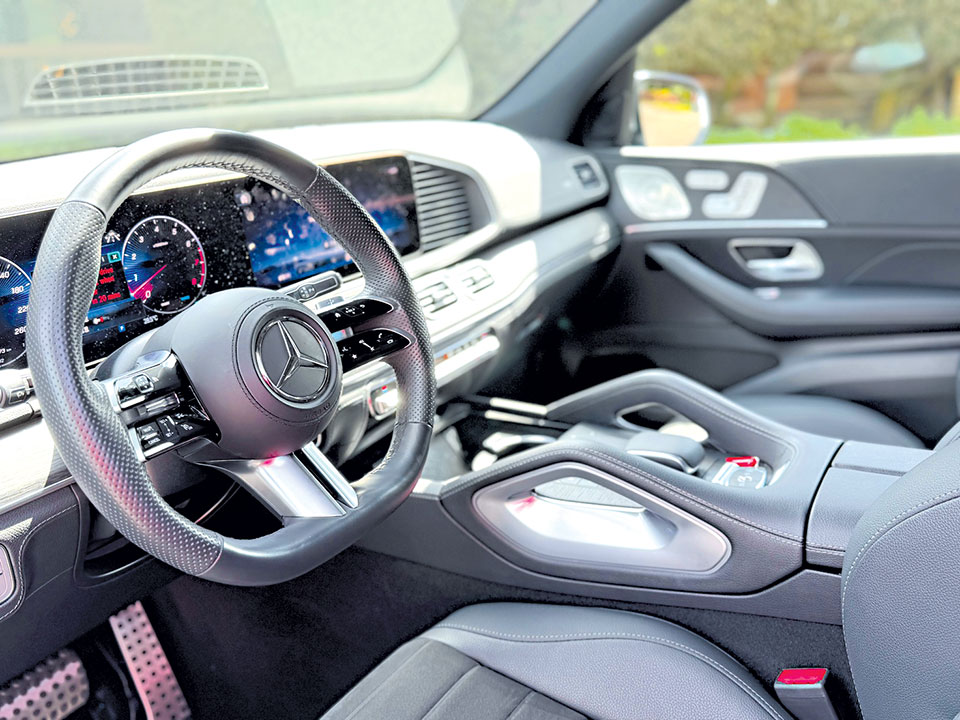
During this drive, we took the Mercedes-Benz Philippines top sales performer, the GLE Series, specifically the GLE 400e 4Matic Plug-in Hybrid and the GLE 450 — alongside the GLC 350e Plug-in Hybrid — out for a casual spin. We started at the brand’s Greenhills dealership early on a regular weekday and threaded through EDSA’s congested lanes until we got to the South Superhighway.

The GLE SUV has long been the brand’s best-selling model for good reason. It is practical, versatile, offers generous cargo space, and boasts all the usual luxuries and prestige associated with Mercedes-Benz. The vehicle is comfortable to drive and ride as a passenger, has good sound insulation, and feels planted and safe at high speeds. Of course, it has electronically adjustable front seats and its proprietary MBUX multimedia system that supports intelligent voice control. It also has the marque’s valuable driver-assist systems and even a cool transparent bonnet feature that gives the driver a virtual view beneath the car.

The GLE 400e 4Matic Plug-in Hybrid carries a 2.0-liter gasoline engine with an electric motor and battery system, matched with nine-speed automatic transmission. It has sporty front seats, dual 12.3-inch displays, real nice AMG sport pedals, and a swanky 15-speaker Burmester Surround Sound System. The car has a Dynamic Select Drive Program so that driving modes can be adjusted based on where the vehicle is or what it’s doing — city traffic, highway cruising or climbing hills. A good 252hp will take you through mountain resorts — such as the aforementioned Tagaytay Highlands — with ease. Whenever the moment calls for additional power, the combustion engine kicks in via MB’s 9G-Tronic automatic transmission. An 11-kW AC charging system also makes energy collection a breeze. The 21-inch AMG multi-spoke light alloy wheels look great.

But I have to admit that I found the GLE 450 (which is equipped with the same AMG appointments but with a regular internal combustion engine) to be sprightly and a tad bit more fun to drive. But they’re both awesome and almost practically twins. It just comes down to preference.

Meanwhile, the GLC 350e Plug-in Hybrid with EQ hybrid technology had notably strong electric-only driving range. Its well-engineered regenerative braking system helped extend the electric driving range even further. In fact, with this car, you can probably avoid using fuel for all but the longest commutes. It is also compatible with Type 2 sockets.

The GLC 350e is a smooth-riding SUV with the same comfortable and feature-rich cabin as a non-hybrid GLC. For instance, it has a 360-degree exterior camera system, rear A/C vents, rear USB charging ports, and pretty cool multicolor interior ambient lighting for when it starts getting dark. Even driving in low-light situations is improved with its adaptive high-beam system that carves you out a clean path of visibility. In a nutshell, the vehicle exudes the typical well-rehearsed poise of German engineering. No wonder it also remains one of MB Philippines’ best-selling series.

Stay tuned for more exciting news and festivities from Mercedes-Benz this eventful 2026!

PhilWeb-Hann partnership boosts positioning, minimal near-term earnings impact — analysts

Gaming Area

PHILWEB CORP.’S new operational tie-up with Hann Casino Resort strengthens its position in the Philippines’ regulated e-gaming sector, but is unlikely to meaningfully boost earnings in the near term, according to analysts.

“The PhilWeb-Hann partnership modestly improves PhilWeb’s positioning in regulated e-gaming but does not materially change its earnings outlook,” F. Yap Securities investment analyst Marky Carunungan said in a Viber message.

The deal is an operational and technology collaboration, he added, with no equity joint venture or direct gross gaming revenue exposure, keeping PhilWeb in a fee-based, asset-light role.

“Based on Hann briefings last year, management indicated that its online gaming operations remain small and have yet to gain meaningful traction, with revenues still largely driven by its land-based casino business. As such, any contribution to PhilWeb is unlikely to be meaningful in the near term,” Mr. Carunungan said.

Toby Allan C. Arce, head of sales trading at Globalinks Securities and Stocks, Inc., said that while the partnership won’t immediately lift PhilWeb to the scale or revenues of large integrated resort operators, it reinforces the company’s niche as a compliant technology and platform provider for premium land-based gaming assets rather than mass-market or offshore competitors.

“Against peers that are either heavily exposed to brick-and-mortar casinos or purely online platforms, the partnership allows PhilWeb to anchor its digital gaming operations to a strong, reputable integrated resort brand. This association enhances credibility with regulators and players alike and helps differentiate PhilWeb from smaller or less established e-gaming operators,” he said.

Mr. Arce added that the tie-up expands PhilWeb’s revenue streams by leveraging Hann’s customer base and brand for cross-platform engagement between physical and digital gaming, aligning with hybrid industry models where online platforms complement integrated resorts.

He noted that the partnership reinforces legitimacy, consolidation, and ties with established operators, potentially attracting risk-averse customers and institutional capital. “Over time, this could support steadier, more predictable revenue growth compared with standalone online gaming models that rely heavily on promotions and rapid customer churn,” Mr. Arce said.

Analysts also flagged regulatory risks, including policy changes, tax adjustments, and overhangs that could limit online growth and monetization.

“Revenue growth will depend on execution, regulatory consistency, and the pace at which regulated e-gaming adoption expands locally. PhilWeb remains exposed to policy shifts, taxation changes, and evolving regulatory frameworks that can quickly alter economics in the gaming sector,” Mr. Arce said. 

He added that reliance on a limited number of major partners may concentrate operational and revenue risk if market conditions or strategic priorities change. “Competition from other licensed e-gaming operators and integrated resorts pursuing their own digital strategies could also limit upside if the market becomes crowded.”

Mr. Carunungan said that while online gaming remains a structural growth driver, regulatory overhangs persist and marketing remains constrained, limiting monetization, particularly for operators without established digital ecosystems.

He added that with PhilWeb under a tender offer, investor attention is likely focused on the tender’s progress and regulatory hurdles rather than small gains from new partnerships.

In October, Gregorio Araneta, Inc. (GAINC) sold its 57% controlling stake in PhilWeb to holding companies Nexora Holdings, Inc. and Velora Holdings, Inc. The transaction covered 829.57 million common shares for P1.8 billion, or P2.17 per share.

At the local bourse on Friday, PhilWeb shares fell 2.12% to close at P6.93 apiece. — Alexandria Grace C. Magno

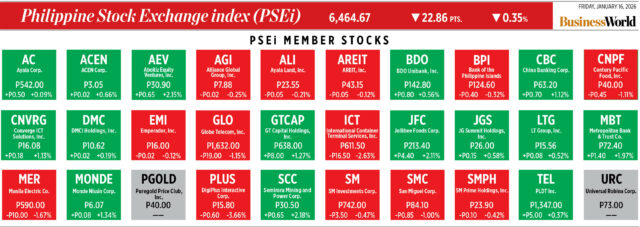
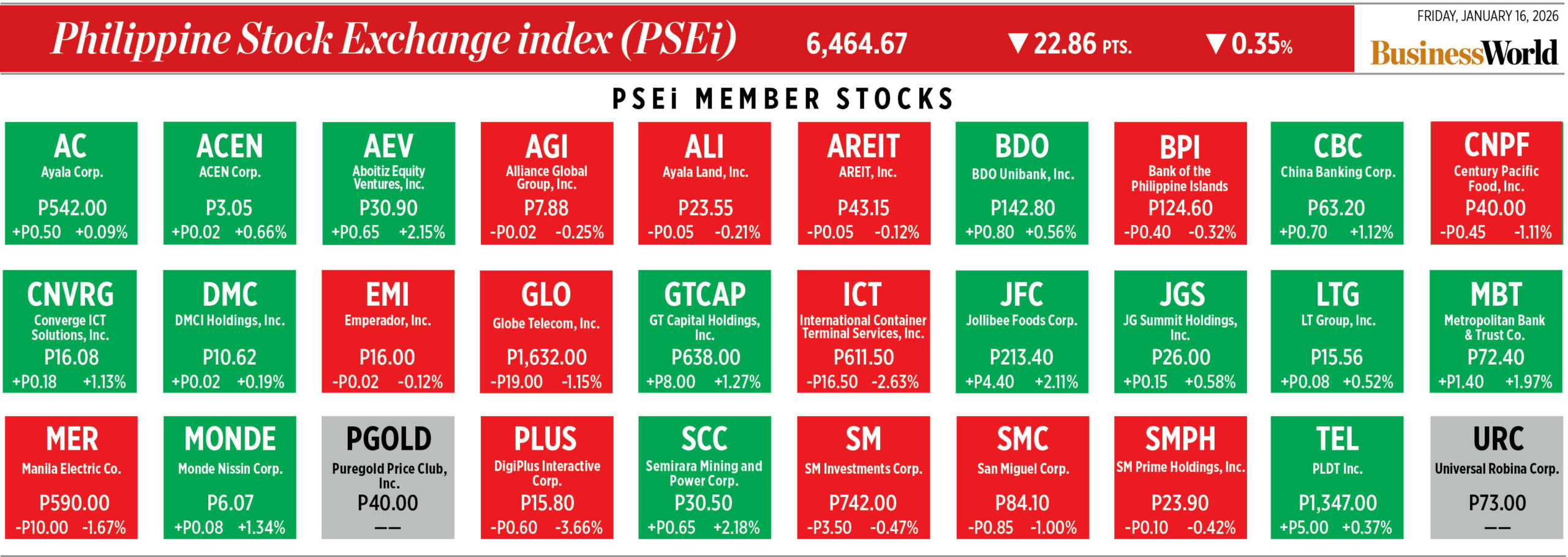
How PSEi member stocks performed — January 16, 2026

Here’s a quick glance at how PSEi stocks fared on Friday, January 16, 2026.


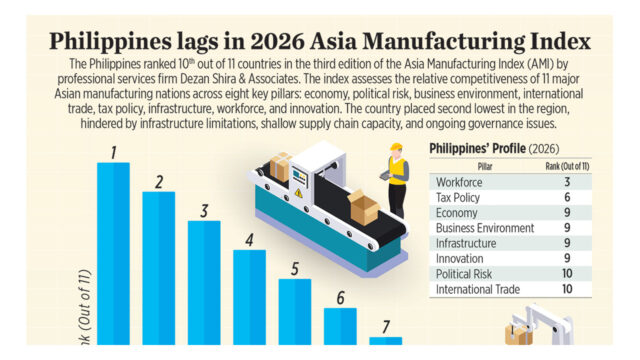
Philippines lags in 2026 Asia Manufacturing Index

The Philippines ranked 10th out of 11 countries in the third edition of the Asia Manufacturing Index (AMI) by professional services firm Dezan Shira & Associates. The index assesses the relative competitiveness of 11 major Asian manufacturing nations across eight key pillars: economy, political risk, business environment, international trade, tax policy, infrastructure, workforce, and innovation. The country placed second lowest in the region, hindered by infrastructure limitations, shallow supply chain capacity, and ongoing governance issues.

Stocks may drop as players book gains from rally

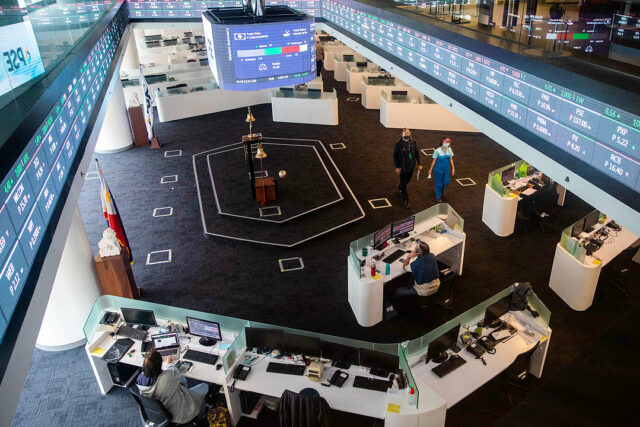
REUTERS

PHILIPPINE SHARES could decline this week as investors continue to book their gains from the market’s recent rally and with the peso’s weakness weighing on sentiment.

On Friday, the Philippine Stock Exchange index (PSEi) fell by 0.35% or 22.86 points to end at 6,464.67, while the broader all shares index edged down by 0.22% or 8.37 points to close at 3,652.33.

Meanwhile, week on week, the PSEi climbed by 116.53 points from its Jan. 9 finish of 6,348.14, marking its fourth consecutive week of gains.

“The local market continues with its bullish move, extending its rally to a fourth straight week. Other numbers are also encouraging with net value turnover averaging P6.64 billion, reflecting quite strong conviction. Net foreign buying is already on an 11-day streak amounting to P5.61 billion,” Japhet Louis O. Tantiangco, Research Manager at Philstocks Financial, Inc., said in a Viber message.

“The local bourse rallied [last] week, buoyed by bargain hunting in index heavyweights and rate-sensitive names. Confidence took its support from a potential February BSP (Bangko Sentral ng Pilipinas) rate cut and cheap valuations,” 2TradeAsia.com said in a market note.

BSP Governor Eli M. Remolona, Jr. this month said that a cut remains on the table at the Monetary Board’s Feb. 19 meeting, even as he noted that the policy rate of 4.5% is already “very close” to where they want it to be, signaling an imminent end to their easing cycle.

The Monetary Board has lowered benchmark borrowing costs by a total of 200 basis points since this current rate cut round began in August 2024.

Meanwhile, analysts have said that the central bank could still ease further to help support domestic demand as prospects have weakened due to a wide-ranging corruption scandal that has stalled both public and private investments, dragging economic expansion.

For this week, Mr. Tantiangco said profit taking could weigh on the local market, adding that valuations remain at bargain levels despite the market’s recent climb.

“The peso’s weakness, if it extends, may also challenge the local bourse,” he said.

On Thursday, the peso slumped to a new record low of P59.46 versus the dollar. It rebounded on Friday, closing the week at P59.35.

“On a positive note, hopes that the BSP would cut rates in their February meeting may give the market support. Investors are also expected to be on the lookout for further catalysts,” Mr. Tantiangco said.

He added that the market remains “bullishly biased” as it is now trading above its 10-day, 50-day, and 200-day exponential moving averages.

He put the PSEi’s support at 6,400 and resistance at 6,600.

For its part, 2TradeAsia.com placed the PSEi’s immediate support at 6,350 and resistance at 6,500-6,600. — A.G.C. Magno

Watchdog flags graft risks across PHL health and education spending

PEOPLE raise their placards during the 2nd Trillion Peso March at the People Power Monument in Quezon City on Nov. 23, 2025. — PHILIPPINE STAR/MIGUEL DE GUZMAN

By Chloe Mari A. Hufana and Adrian H. Halili, Reporters

CORRUPTION risks in the Philippines’ 2026 national budget are shifting beyond infrastructure to health and education spending, a budget watchdog said, warning that weak safeguards during implementation could expose some of the government’s biggest social programs to political interference.

Social Watch Philippines said allocations approved by Congress for education facilities and health assistance warrant closer scrutiny as the P6.793-trillion General Appropriations Act moves from legislation to execution, particularly after a recent graft scandal involving public works projects.

“Corruption risks are not unique to infrastructure agencies,” Alce C. Quitalig, senior budget analyst at Social Watch Philippines, said via Viber. “The education and health sectors likewise contain questionable budget provisions that warrant close scrutiny.”

The group flagged funding increases added by lawmakers to the Department of Education’s basic education facility program beyond the agency’s original proposal, as well as allocations for the Department of Health’s (DoH) Medical Assistance to Indigent and Financially Incapacitated Patients approved at the bicameral conference stage.

President Ferdinand R. Marcos, Jr. signed the 2026 budget on Jan. 5 after vetoing P92.5 billion in unprogrammed funds. The spending law was passed amid heightened concern over corruption following revelations of misuse of public works funds.

One reform included in the budget was the removal of politicians’ guarantee letters for the DoH program, ending the requirement for endorsements to access hospital bill assistance. The DoH is set to issue revised guidelines by February to simplify procedures, widen coverage and reduce political influence in aid distribution.

Education again received the largest share of the budget, in line with constitutional requirements, with a record P1.345-trillion allocation. The health sector was allotted P448.125 billion, also its highest on record.

Corruption risks in these sectors are structural given the scale of procurement, logistics and documentation involved, said Hansley A. Juliano, a political science lecturer at the Ateneo de Manila University.

“Even during the 1990s, corruption and overpricing of procurement persisted, either to launder money or facilitate patronage,” he said via Facebook Messenger. He added that urgency in delivering health and education services creates pressure points where rules could be bent.

As implementation begins, Mr. Quitalig said the President has broad authority under the budget to enforce accountability, including the power to suspend or withhold expenditures when public interest requires. The challenge, he said, lies in enforcement.

The central issue is implementation — whether these provisions are enforced in good faith or circumvented, ignored or violated in practice, he pointed out.

Social Watch Philippines urged stronger citizen oversight, calling for wider use of budget monitoring, procurement observation, participatory audits, and transparency seal data. It also pushed deeper institutional reforms, including full civil society membership in the state’s bids and awards committees, passage of a Freedom of Information law, and a national budget transparency platform that tracks outcomes.

Despite existing safeguards, the group said restrictions on cash aid distribution and limits on political branding in government projects remain weak, warning that poorly framed implementing rules could entrench patronage practices if left unchecked.

Sustainable accountability, it said, depends on stronger enforcement by the Executive branch, sustained legislative oversight and active public participation in monitoring how funds are spent.

‘LEGISLATIVE CORRECTIONS’
The Senate should begin examining projects that combine large budgets with weak oversight mechanisms, said Ederson DT. Tapia, a political science professor at the University of Makati.

“These include major transport projects with repeated cost overruns, digital and ICT (information and communications technology) systems procured under claims of innovation but shielded from scrutiny, and climate-related infrastructure where urgency often substitutes for accountability,” he said in a Messenger chat.

The Senate Blue Ribbon Committee could also look into social welfare programs and other forms of infrastructure, including public roads, said Anthony Lawrence A. Borja, an associate political science professor at De La Salle University.

“It should veer off to other public projects like social welfare programs,” he said via Messenger. “Looking into other forms of infrastructure would also be good, especially public roads.”

Mr. Borja added that the Senate body should take a broader approach and coordinate closely with government investigative bodies.

“If the Senate committee wants to show it is serious about accountability, investigations should be more comprehensive and in lock step the work of agencies like the Office of the Ombudsman,” he said.

The Blue Ribbon Committee has been investigating irregularities in flood control projects since August, following reports that government officials and senior lawmakers might have received multibillion-peso kickbacks from funds allocated for flood mitigation.

The hearings have become a key source of leads for the government’s anti-corruption drive, with testimonies used as bases for filing cases against officials and contractors.

Mr. Tapia said the Senate panel might already have fulfilled its fact-finding role on flood control projects and should begin wrapping up the inquiry.

“Closure should be accompanied by clear attribution of responsibility, documented referrals to enforcement agencies and a short list of legislative corrections,” he said. “Otherwise, ending merely becomes another form of forgetting.”

He warned that extended hearings could detract from the Senate’s legislative work, including reforms related to the budget process, climate adaptation and social protection.

“Excessive investigation can paradoxically weaken the capacity of Congress to correct what it has exposed,” Mr. Tapia said. “We should pay more attention to building and strengthening institutions.”

Joy G. Aceron, convenor-director of transparency group G-Watch, said the flood control investigation remains relevant but should now focus on policy failures.

“The Senate needs to start zeroing in on the policy issues that led to the plunder, since Senate hearings are in aid of legislation,” she said via Messenger.

She said lawmakers should examine weak accountability systems and how contractors exploit procurement rules, adding that both areas need legislative action.

Senator Panfilo “Ping” M. Lacson, who heads the Blue Ribbon Committee, said hearings are set to resume on Jan. 19.

The next hearing will tackle the so-called Cabral files, which allegedly detail budget insertions, infrastructure projects and kickbacks linked to flood control and other public works.

Storm Nokaen batters eastern Philippines as it moves offshore

PAGASA

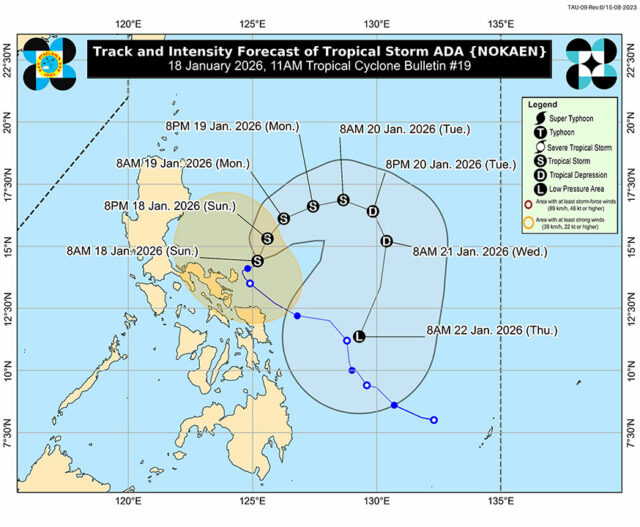
TROPICAL STORM Nokaen, locally known as Ada, is expected to track farther away from land while maintaining its strength over the next 24 hours, though the state weather bureau warned that strong winds, rain and rough seas would continue to affect large swaths of eastern Philippines as the northeast monsoon intensifies.

Ada was last seen on Sunday about 140 kilometers (km) northeast of Virac, Catanduanes, slowly moving east-northeast with maximum sustained winds of 75 kilometers per hour, according to the Philippine Atmospheric, Geophysical and Astronomical Services Administration (PAGASA).

The storm was forecast to continue moving northeastward through Monday before shifting into a looping track over the Philippine Sea east of Luzon, it added.

It said Ada was likely to remain a tropical storm as it stays offshore before weakening into a tropical depression by Tuesday and further slowing into a low-pressure area by Thursday as monsoon winds strengthen.

An earlier weakening remains possible, it added, while cautioning that heavy rain and strong winds could still occur outside the forecast track and confidence cone.

Wind Signal No. 2 was expected to stay in place over Catanduanes and parts of Camarines Sur, with Signal No. 1 covering portions of southern Quezon, the Bicol Region and Northern Samar, posing minimal to moderate risks to life and property.

Beyond the storm’s immediate circulation, enhanced monsoon winds were forecast to bring strong to gale-force gusts to northern and eastern Luzon, Bicol and parts of Eastern Visayas through Tuesday.

Coastal flooding remained a concern in low-lying communities in Camarines Sur, Catanduanes, Albay and Sorsogon, where storm surge of up to two meters was possible within the next 24 hours.

At sea, rough to moderate conditions were forecast to persist along the eastern seaboards of Luzon and parts of the Visayas, prompting warnings for small vessels to avoid sailing as authorities brace for lingering weather disruptions even as the storm gradually weakens.

The storm’s forecast positions showed a continued drift away from land: by 8 p.m. on Sunday, Ada was expected to be 425 km east of Infanta, Quezon; by 8 a.m. on Monday, 500 km east of Baler, Aurora; and by 8 p.m. on Monday, 565 km east of Casiguran, Aurora. 

On Tuesday, it was projected to be 705 km east of Casiguran in the morning and 830 km east of Central Luzon by evening.

By Wednesday morning, Ada was expected to be 810 km east of Southeastern Luzon and then 390 km east of Guiuan, Eastern Samar by Thursday.

Meanwhile, Ada had already triggered flooding, landslides and transport disruptions, according to an 8 a.m. situation report from the National Disaster Risk Reduction and Management Council.

More than 10,000 people had been affected, with evacuations underway in several regions. It was earlier reported that two died in Region 5.

Authorities reported flooded communities in Bicol and Caraga, damaged roads and bridges, power interruptions and the suspension of sea travel in dozens of ports, leaving thousands of passengers and cargoes stranded. — Chloe Mari A. Hufana

ADVERTISEMENT
ADVERTISEMENT