Home Blog Page 4271

The secret sauce to profit

PAWEL CHU-UNSPLASH

When one thinks of a company’s sustainability, usually we just think of the business case, especially for micro-, small- and medium-sized enterprises (MSMEs). How profitable is the business? How sustainable is the model? But do we also give some thought to what makes companies last?

A study on Publicly-Listed Companies (PLCs) in the Philippines was launched by the Institute of Corporate Directors (www.icd.ph), led by its Board Diversity and Inclusion (BDI) Committee Chair Helen de Guzman and Dr. Conchita Manabat. It revealed that diversity in boards does contribute to a positive return on equity (ROE).

While the Philippines reported on having more women in boards as a key development, two other ASEAN member-states contributed their studies at the forum: The Singapore Institute of Directors (SID) and the Institute of Corporate Directors Malaysia (ICDM). It was a welcome realization that there are striking similarities among the three institutions’ findings.

Diversity is often thought of as having women on boards, because the traditional composition of boards are men in dark suits, usually the family patriarch and his sons. But the ratios of women and men are no longer the only measure of diversity. Here are other factors mentioned by the speakers:

1. Age. Although having seniors and a higher average age (at 62-65 years old range) on boards is recommended, this means having more than one generation at the table. They recommend a 15-year difference or getting Baby Boomers, Millennials, and Gen Z together to reach this sweet spot of average age recommendation.

2. Skills and Expertise. There must be a variety of specialties, not just business management or financial prowess. In today’s age of technology, experts in other disciplines make a board more agile to respond to today’s challenges.

3. Tenure. The Singapore experience emphasized a maximum term of nine years for a board independent director, and a board composition where three members are new every three years. This, of course, presumes a board of nine or more members.

The ICDM also shared that they have a pool of over a thousand candidates, including first time directors, whose expertise in a field may be useful to most old companies who want to be in step with new trends in business. This pool may be what we need and will be addressed by our organization, the NextGen Organization of Women Corporate Directors (www.nowcdphils.com) who will now invite C-suite women to think of corporate directorship as a career move.

We have a NOWCD member who was recruited by surprise because of her experience in retail. She had never been an independent director until recently. And she brings to the table her vast experience in specialty retail. Another member sits on an Advisory Board of one of our Armed Forces. She brings marketing expertise to an otherwise traditional service organization, whose work is never appreciated because the public does not know what they do. So, these are examples of women who are recruited to join boards for their expertise in their field (e.g., Marketing, Retail, etc.). It also counts a lot that they are women, because the sweet spot for boards to be profitable is to have a 50:50 ratio as observed by the Singapore Institute experience.

In the same forum, however, a gentleman reacted about having women, pushing women all the time. The panelists then explained that there are other dimensions to diversity but that having women seems to be the most popular in the Philippines as traditional companies do tend to have all-male boards. Even to us ICD fellows, we found new ideas in what Mr. Shai Ganu of SID shared. It is not just diversity in gender. The other factors are: age, tenure, board independence, cultural ethnicity (especially in international companies), international experience, domain or functional expertise, and industry expertise.

For functional expertise, the speakers suggest more than five areas of expertise in a board to prevent groupthink. So, this also means Independent Directors need not be only business and finance experts; there is room for diverse persuasions like marketing, technology, retail experience, sustainability expertise and maybe even experience in a relatively new field like blockchain and cryptocurrency, AI and ChatGPT.

Other tips from Mr. Shai Ganu: Conform, Perform and Transform. This means that Board directors must help in addressing legal issues, moral issues, and, of course, business issues. The role of the Board is increasingly focused on three areas: Conformance, Performance, and Future-Proofing the company.

The ICD did well in inviting Michelle Kythe Lim of ICDM to give another ASEAN perspective, and this time suggesting that even first-time directors must be encouraged to contribute their expertise even if they do not yet have the experience of serving on Boards. They gather over a thousand candidates ready for deployment as subject matter experts, and many are in new fields of expertise. In yesteryears, we always thought board seats were reserved for finance experts, business management experts and auditors. Not anymore. Today, we need diversity in age, gender, and even international exposure or experience.

With ICD giving the Professional Directors Program (PDP) and NOWCD gathering more women, Philippine PLCs will very soon have a good selection of candidates to season their otherwise traditional boards. And C-suite professionals may find a career after retirement or even as an alternative route while still young and employed. This could be a side hustle in the terms of today’s youth, and a learn-while-you-earn kind of move for most subject matter experts.

Remember the points raised by Shan Ganu and test your board composition against it. It will be fun looking for new directors and giving your company a jolt to adapt to the future.


Chit U. Juan is co-vice chair of the MAP Environment Committee and is a member of the MAP Diversity, Equity and Inclusion Committee. She is president of NOWCD and chair of the Philippine Coffee Board, and a councilor of Slow Food for Southeast Asia Advocate for organic agriculture.


map@map.org.ph

pujuan29@gmail.com

Gov’t awards T-bills with higher rates

BW FILE PHOTO

THE GOVERNMENT made a full award of the Treasury bills (T-bills) it offered on Monday with higher rates due to hawkish signals from both the local and the US central banks.

The Bureau of the Treasury (BTr) raised P15 billion as planned via the T-bills as total bids reached P40.202 billion, or more than twice the amount on offer.

Broken down, the Treasury made a full P5-billion award of the 91-day T-bills as tenders for the tenor reached P10.045 billion. The three-month paper was quoted at an average rate of 5.595%, 4.3 basis points (bps) above the 5.552% seen last week when accepted rates ranged from 5.5% to 5.624%

The government also raised P5 billion as planned from the 182-day securities as bids for the tenor reached P16.28 billion. The average rate for the six-month T-bill was at 5.968%, up by 2.9 bps from 5.939% seen last week, with accepted rates at 5.945% to 5.988%.

Lastly, the BTr borrowed the programmed P5 billion via the 364-day debt paper as demand for the tenor stood at P13.877 billion. The average rate of the one-year T-bill rose by 4.6 bps to 6.119% from the 6.073% quoted last week. Accepted yields were from 6.085% to 6.199%.

At the secondary market before Monday’s auction, the 91-, 182- and 364-day T-bills were quoted at 5.6102%, 5.9444%, and 6.0960%, respectively, based on PHP Bloomberg Valuation Reference Rates data provided by the Treasury.

“The Auction Committee fully awarded bids for Treasury bills (T-bills) at today’s auction. The 91-, 182-, and 364-day T-bills fetched average rates of 5.595%, 5.968% and 6.119%, respectively. The auction was 2.7 times oversubscribed, attracting P40.2 billion in total tenders,” the BTr said in a statement on Monday.

“With its decision, the Committee raised the full program of P15 billion for the auction,” it added.

The T-bill rates moved up on Monday due to hawkish signals from both the US Federal Reserve and the Bangko Sentral ng Pilipinas (BSP), said Rizal Commercial Banking Corp. Chief Economist Michael L. Ricafort in a Viber message.

“Tendered rates moved up following the hawkish rhetoric of various Federal Reserve officials last week, bolstering views of elevated US policy rates for a prolonged period of time,” a trader likewise said in an e-mail.

The Fed last week kept its policy rate unchanged at a range between 5.25% and 5.5% during its policy meeting.

It has hiked rates by a cumulative 525 bps since it began its tightening cycle in March last year.

Meanwhile, BSP Governor Eli M. Remolona said in an interview with Bloomberg TV that the central bank might raise its benchmark rate again at its next meeting on Nov. 16 and hinted at the possibility of future rate hikes.

“We’re not convinced it would be the last one. It won’t be the last hike in the cycle,” he said. “We’re still in a hawkish stance.”

The Monetary Board on Thursday maintained its policy rate at 6.25% for a fourth straight meeting.

Interest rates on the overnight deposit and lending facilities were also left unchanged at 5.75% and 6.75%, respectively.

The BSP has raised borrowing costs by 425 bps from May 2022 to March 2023.

On Tuesday, the BTr will offer P30 billion in reissued three-year Treasury bonds (T-bonds) with a remaining life of two years and 11 months.

The BTr wants to raise P180 billion from the domestic market this month or P60 billion via T-bills and P120 billion via T-bonds.

The government borrows from local and foreign sources to help fund its budget deficit, which is capped at 6.1% of gross domestic product this year. — Aaron Michael C. Sy

ICTSI units receive large vessel in Mexico, Colombia

RAZON-Led International Container Terminal Services, Inc. (ICTSI) said its units in Mexico and Colombia had received their largest ship, marking what it called an “operational milestone.”

In a media release on Monday, ICTSI said CMA CGM Alexander Von Humboldt, a 396-meter-long vessel which it claims to be the first of its size to operate in Latin America, was received at Contecon Manzanillo S.A. (CMSA) in Mexico and Sociedad Puerto Industrial Aguadulce (SPIA) in Colombia.

“We have prepared for this moment in recent years, designing and sizing our terminal to be able to serve these ships. It is our obligation to ensure that Mexican foreign trade has competitive and efficient maritime logistics,” José Antonio Contreras, chief executive officer of CMSA, said in a media release on Monday.

CMSA is ICTSI’s business unit operating at Port of Manzanillo. The company said it is Mexico’s gateway to the Pacific coast as it is strategically located at the largest industrial areas, making it closer to major consumer markets.

The arrival of the vessel signifies the company’s capability to adapt to new ports and growing maritime dynamics, Álvaro Otero, general manager of SPIA, said.

SPIA is ICTSI’s joint venture container terminal project with PSA International Pte Ltd. (PSA) in Buenaventura, Colombia.

Last week, the listed port operator announced that it is anticipating to complete the expansion of its port in Melbourne, Australia following the arrival of its new quay cranes from China.

ICTSI’s unit, Victoria International Container Terminal (VICT) said the cranes are part of its 235-million Australian dollar expansion investment that will boost its capacity by up to 1.25 million 20-foot equivalent units.

The listed port operator currently operates over 30 terminals in 20 countries across six continents.

At the local bourse on Monday, shares in the company climbed by 20 centavos or 0.1% to end at P204 apiece. — Ashley Erika O. Jose

DMCI Homes plans to launch residential units for Solmera Coast

AN ARTIST’s illustration of Solmera Coast. — COMPANY HANDOUT

DMCI Homes is set to launch the residential phase of its new leisure project in San Juan, Batangas.

This after the company said reservation sales for Solmera Coast have reached P5.6 billion since it was launched in August.

In a statement, DMCI Homes said 93% of Solmera Coast’s launched inventory of around 800 condotel units have already been reserved as of Sept. 15.

Unit sizes range from 34 to 91.5 square meters (sq.m.). Prices for studio, one-bedroom, and two-bedroom units are between P7.1 million and P17 million.

The condotel units are spread across three mid-rise buildings, Matahari, Kartika, and Bumi, which are scheduled for occupancy in February 2027, May 2027, and August 2027, respectively.

DMCI Homes Vice-President for Project Development Dennis Yap said the company is planning to offer residential units in the last two buildings, Nusa and Asri.

“In light of the outstanding sales performance of the condotel units, we’re excited to unveil the next buildings of Solmera Coast. The residential units, located in the Nusa and Asri buildings, will provide a unique beach park living experience for those seeking a beach park lifestyle,” Mr. Yap said.

Solmera Coast is the flagship project of DMCI Homes under its leisure brand, DMCI Homes Leisure Residences.

It has a unique beachfront location, and also offers five swimming pools, a game area, a gym, two restaurants, and a convention center. — Cathy Rose A. Garcia

The political price of rice

PHILIPPINE STAR/KRIZ JOHN ROSALES

In 2019, Gotabaya Rajapaksa, promising progress, stability, and security, was elected president of Sri Lanka. In his third year in office his mishandling of the sharp increase in food and fuel costs drove hundreds of thousands of people to stage protests, many virulent and violent. On July 14, 2021, demonstrators stormed the presidential palace, demanding his resignation. Rajapaksa fled the country via a military aircraft.

In 2022, Ferdinand “Bongbong” Marcos, Jr., promising unity, wind-power energy, and rice at P20 per kilo, was elected Philippine president. He is now on his second year as president and his promises have yet to be fulfilled. Not only that, the price of rice, the staple of millions of Filipino families, has been rising from the P39.43 for regular-milled rice and P43.77 for well-milled rice, the prices in 2022 according to the Philippine Rice Research Institute.

The global price of rice soared after India, in July this year, banned the export of white rice. India accounts for over 40% of global trade of rice. Rice inflation in the Philippines surged from 4.2% in July to 8.7% in August. As part of government efforts to address the increasing price of rice, President Marcos Jr. issued Executive Order No. 39, imposing a temporary price ceiling of P41 per kilo for regular-milled rice and P45 per kilo for well-milled rice.

To make up for the retailers’ loss in revenue, each retailer will be given a subsidy of P15,000. The retailers said that the P15,000 subsidy is equivalent to a few sacks of rice. A 25-kilo sack of rice costs between P2,000 and P2,500. The subsidy of P15,000 can buy only seven sacks at P2,000, only six sacks at P2,500. They say the subsidy would run out before the temporary price cap expires.

To arrest the surge in the price of rice, Finance Secretary Benjamin Diokno proposed a temporary slash of the tariff rates for rice imports. Federation of Free Farmers National Manager Raul Montemayor said that a slash in tariff rates would induce rice traders to collude to pay lower farmgate (what the traders pay farmers) prices for their harvest in response to competition from cheaper imported rice.

If tariff rates are slashed, Mr. Montemayor said the retail price of rice may go down by P7 per kilo. If that happens, the price of palay (unmilled rice) would drop by P4.44 per kilo. Based on the 2022 palay production of 17.75 million metric tons, that would be equivalent to a loss of about P88 billion for the farmers. That could push the farmers to abandon rice production altogether. As we are not rice self-sufficient, that development would bring about a food crisis beyond the government’s capacity to resolve.

Ironically, Secretary Diokno objects adamantly to the proposal of the transport sector to suspend both the value-added tax and excise tax on fuel to moderate inflation. Transport inflation quickened from -4.7% in July to 0.2% in August. Fuel prices have gone up by a total of P71.85 per liter for gasoline and P17.30 for diesel since the second week of July. As of yesterday, gasoline in the neighborhood station sells for P70.35 a liter, diesel for P70.20 a liter.

There is supposed to be a rollback of P0.14 on the price of gasoline and P0.69 on diesel effective today. That is so picayune a price adjustment that it would not have any effect on the transport sector’s dire situation.

While jeepney operators have petitioned the Land Transportation Franchising and Regulatory Board for a fare hike to help them cope with the rising cost of fuel, they are not optimistic about the agency granting them the increase. They know that the agency officials know that the majority of Metro Manila commuters cannot afford another fare hike. That is the finding of the survey conducted by The Passenger Forum, a network and mobility advocacy group.

Random interviews of jeepney drivers by broadcast reporters, also reveal that many jeepney drivers are seriously considering looking for less demanding and less stressful livelihood. A drastic reduction in transport service in Metro Manila would slow down economic activity as blue-collar workers and rank-and-file office employees would have difficulty getting to their workplace on time, if they get there at all. The capital region is the heart of the Philippine economy.

Are queues for rice rations forthcoming? Are protests like those staged against Sri Lanka’s president just two years ago about to explode and possibly pressure the President to flee?

ALL IN THE FAMILY
That brings to mind the stories of authoritarian heads of state whose rules were cut short by people power or by extermination but whose scions rose to become heads of the same states. Other than the Ferdinand Marcoses, senior and junior, there were the Parks of South Korea, Chung Hee and his daughter Geun-hye; the Bhuttos of Pakistan, Zulfikar and his daughter Benazir; and the Gandhis of India, Indira and her son Rajiv.

Park Chung Hee was general and president of South Korea from 1963 to 1979. His rule brought about rapid economic growth, but at the cost of human rights and political freedom. He imposed restrictions on personal freedoms, suppressed the press and political dissent. He organized the Korean Central Intelligence Agency (KCIA) for the purpose of monitoring closely the activities of the political opposition.

On Oct. 17, 1972, Park declared martial law. When, in 1979, he dismissed the leader of the opposition party from the National Assembly, the Koreans erupted in violent protests. On Oct. 26, 1979, Park was assassinated by the head of the intelligence agency he himself formed, the KCIA.

Twenty-eight years later, his daughter Geun-Hye ran for president, promising the right to pursue happiness, a democratic economy, and customized welfare services for the Korean people. She was elected. But in December 2016, she was impeached by the National Assembly on charges related to influence peddling. She was removed from office and put in jail.

Zulfikar Ali Bhutto became president and army commander-in-chief on Dec. 20, 1970. He served as prime minister from 1973 to 1977. In January 1972, Bhutto nationalized all major industries. He adopted a labor policy that increased workers’ rights and the power of trade unions. The government took over a million acres of land for distribution to landless peasants. He convened the National Assembly and prodded the legislators to write a new constitution.

Bhutto deployed 100,000 troops to suppress protests. He was accused of masterminding the murder of political opponents. In July 1977, Bhutto was arrested by troops under the order of General Zia. On April 4, 1979, Bhutto was hanged.

In August 1988, Zia died in a mysterious plane crash, resulting in a power vacuum in all of Pakistan. In the elections of that year, Zulfikar Ali Bhutto’s old party, taken over by his daughter Benazir, won the biggest number of seats in the National Assembly. On Dec. 1, 1988, just nine years after her father was ousted, Benazir Bhutto was elected prime minister.

She served two terms, in 1988-90 and 1993-96. She drew foreign investment in the country and introduced social programs. But Pakistan continued to experience an unstable economy and a decline in law and order. She was forced to step down in 1996. She was assassinated in December while campaigning for a seat in parliament.

Indira Gandhi served as prime minister of India for three consecutive terms, 1966-1977. and a fourth term from 1980 to 1984. During the early 1980s, Sikh separatists vehemently demanded autonomy. In June 1984, Gandhi ordered the Indian army to attack and oust the separatists who occupied and fortified the Sikhs’ holiest shrine. At least 450 Sikhs were killed in the incident. Five months later Gandhi herself was killed by her own Sikh bodyguards.

Her son Rajiv was sworn in as prime minister on the same day. As prime minister of India from 1984-89, Rajiv Gandhi reformed the government bureaucracy and liberalized the country’s economy. But his attempts to discourage separatist movements worked against him. When his government got involved in a number of financial scandals, he resigned as prime minister in November 1989. In May 1991 Rajiv was assassinated while campaigning for the next round of parliamentary elections.

Park Geun-hye, Benazir Bhutto, and Rajiv Gandhi met the same fate as their famous parents. They fell from grace. Will Bongbong Marcos meet the same fate as his father?


Oscar P. Lagman, Jr. is a retired corporate executive, business consultant, management professor and an avid sports fan.

Mexican police cuff crooked ‘demon doll’ Chucky

CHUCKY the evil doll from the 1990 film Child’s Play 2. —IMDB.COM

MEXICO CITY — Handcuffed, a knife still sticking out of his overalls, the Chucky doll hunches against the wall as police hold him by his bright orange hair to take his mug shot.

In a bizarre twist, Chucky and his owner were taken into lock-up in a town in northern Mexico earlier this week.

The puppet master, identified only as Carlos “N” under Mexican norms, allegedly used the “demon doll” to scare people and demand money, local media reported.

Both were charged with disturbing the peace and putting others’ integrity at risk.

One officer at the police department in Monclova, in Coahuila state, was seen laughing as she held up the long knife taken from Chucky.

Mexican media reported the officer who put Chucky in cuffs was later reprimanded for not taking her job seriously.

Carlos “N” was later released, local outlets reported, though the Chucky doll’s whereabouts are still unknown. — Reuters

BSP disqualifies one more money service firm  

BW FILE PHOTO

THE MONETARY BOARD has banned one more firm from securing a license with the Bangko Sentral ng Pilipinas (BSP) after it was found operating an unregistered money service business (MSB).

In a circular letter signed by BSP Assistant Governor Arifa A. Ala on Sept. 22, the central bank disqualified Riyben Foreign Exchange, which was operated by Benjamin De Guzman San Juan and was located in Tagaytay City, Cavite.

“The above disqualification is pursuant to Section 901-N of the BSP’s Manual of Regulations for Non-Bank Financial Institutions,” the BSP said in a statement.

This is also a “part of the BSP’s efforts to address the proliferation of entities engaged in the operation of unauthorized MSBs,” it added.

Pawnshops, along with foreign exchange dealers, money changers, and remittance agents, are considered as MSBs by the BSP.

Earlier in June, the BSP disqualified six firms from securing a license with the BSP after they were also found operating unregistered MSBs.

These are Bontoy Money Changer, Nurul Money Changing Services, Globexmc Foreign Exchange Services, J-Mar Foreign Exchange Service, Mariada Money Exchange Services, and Money Changer.

In February, the Monetary Board banned Kidlat Fast Cash, Inc. and Tong’s Money Changer from registering with the BSP.

Pawnshops and MSBs are seen by the BSP as access points for the financially unserved and underserved areas in the country.

As of end-December 2022, BSP-registered money service businesses had 7,584 head offices and branches nationwide. — Keisha B. Ta-asan

Vitarich plans to expand its farm product plants

VITARICH CORPORATION FACEBOOK PAGE

LISTED Vitarich Corp. is planning to expand its network of farm product plants through partnerships, its top official said on Monday.

“We are actually in the middle of planning for our road map, and we are identifying the areas for growth… possibly [in] North Luzon,” Vitarich President and Chief Executive Officer Ricardo Manuel M. Sarmiento said in an interview with ANC.

Mr. Sarmiento added that the company’s planned manufacturing site would “not necessarily” be company-owned as it eyes partnering with local businesses.

“Part of our strategy is to partner with other businessmen, especially localized in the region. That usually is a good mix,” he said. He did not give out further details on the company’s expansion plans.

The company currently has two feed mill facilities and a poultry dressing plant in Central Luzon, a feed mill and a dressing plant in Davao, and another feed mill in Iloilo.

“These are the ones that are company-owned,” he said.

“But in other regions, like Region 1, Southern Tagalog, [General Santos], and the other regions where we operate, we operate through a partnership,” he added.

Meanwhile, Mr. Sarmiento said that the company is expecting “better” growth for 2024, compared with this year.

During the second quarter, the company reported a P38.9 million net loss, a reversal of the prior year’s P144.04 million in attributable net income.

Its revenues went up by 3.4% to P3 billion for the three-month period from P2.9 billion the previous year.

Vitarich is a manufacturer of animal feed and food products and a poultry integrator in the Philippines.

On Monday, shares in Vitarich slipped by 1.82% or a centavo to close at P0.54 apiece. — Adrian H. Halili

SMDC, RLC Residences receive top awards at Dot Property Philippines Awards 2023

SM Development Corp. (SMDC) and RLC Residences nabbed the multiple honors at the recently held Dot Property Philippines Awards.

SMDC received eight honors, including Developer of The Year 2023.

RLC Residences collected eight awards, including Best Developer Metro Manila and Best Developer Cebu. Its premium project Le Pont Residences in Bridgetowne Destination Estate received  The Philippines People’s Choice Award for Project of the Year.

Brittany Corp. received the award for Best Developer Luzon, while Pueblo de Panay was named Best Developer Visayas.

“There is genuine excitement around the Philippine real estate market. The Dot Property Group platform has seen a significant year-on-year rise in search for property within the Philippines from both domestic and overseas property seekers,” Adam Sutcliffe, Dot Property Group Director, Events and International Markets, said in a statement.


Here’s the full list of winners:

Developer of The Year 2023 – SM Development Corp. (SMDC)

The Philippines People’s Choice Award for Project of the Year 2022 – Le Pont Residences from RLC Residences

Dot Property Philippines Awards 2022 developer winners:
Best Developer Metro Manila – RLC Residences

Best Developer Luzon – Brittany Corp.

Best Developer Cebu – RLC Residences

Best Developer Visayas – Pueblo de Panay

Dot Property Philippines Awards 2023 project winners:
Best Starter Home Condominium – Amaia Steps Alabang from Amaia Land Corp.

Best Affordable condominium Development – Zeal Residences from SMDC

Best Mid Range Condominium Development – Primeworld District from Primeworld Land Holdings, Inc.

Best Loft Type Condominium Development – My Enso Lofts from PH1 World Developers, Inc.

Best Luxury Condominium Development – Le Pont Residences from RLC Residences

Best Smart Home Condominium Development – SYNC from RLC Residences

Best Lifestyle Condominium Development – Sands Residences from SMDC

Best High End Lifestyle Condominium Development – Mantawi Residences from RLC Residences

Best Affordable Housing Development – PHirst Park Homes Batulao from PHirst Park Homes, Inc.

Best Township Development – Provence by Vista Estates from Vista Land & Lifescapes, Inc.

Best Mixed Use Development (Office and Modern Residential Development) – Ice Tower from SMDC

Best Smart Urban Community – Sierra Valley Gardens from RLC Residences

Dot Property Philippines Awards 2023 investment winners:
Best Investment Property Metro Manila – Park One from Golden Topper

Best Investment Property North Luzon – Primeworld Enclave from Primeworld Land Holdings

Best Investment Property South Luzon – Hope Residences from SMDC

Best Investment Property Central Luzon – Joy Residences from SMDC

Best Investment Property Bohol – Royal Oceancrest Panglao 2 from Primary Homes, Inc.

Best Investment Property Cebu – City Clou from Golden Topper

Dot Property Philippines Awards 2023 design winners:
Best Condominium Architectural Design – Mint Residences from SMDC

Best Condominium Landscape Design – Leaf Residences from SMDC

Special Recognition Award for Innovation – RLC Residences

Philippines’ Best Real Estate Agencies 2023:
Pinnacle Real Estate Consulting Services, Inc.

Luxe Realty and Development Corp.

Palawan Real Property PRP Real Estate Development, Inc.

88 Victorious Real Estate Consultancy Services, Inc.

Philippines’ Best Property Management Company Kondo Ko Property Management

R&B star Usher to headline 2024 Super Bowl halftime show

A PUBLICITY photo for Usher’s Park MGM Las Vegas residency show Usher: My Way. —MGMRESORTS.COM  

GRAMMY-WINNING artist Usher will headline the halftime show at the 2024 Super Bowl in Las Vegas, Nevada, the National Football League (NFL), Apple Music and label Roc Nation announced on Sunday.

The 58th Super Bowl is scheduled to take place at Las Vegas’ Allegiant Stadium on Feb. 11, 2024.

“It’s an honor of a lifetime to finally check a Super Bowl performance off my bucket list,” Usher said in the statement. “I can’t wait to bring the world a show unlike anything else they’ve seen from me before.”

Since the release of his debut album in 1994, Usher Raymond IV has sold over 80 million records worldwide, climbing atop music charts and bringing home eight Grammy awards, considered by many to be the most prestigious awards in the music industry.

Billboard magazine crowned him the second most successful artist of the 2000s.

“U Got It Bad,” “OMG,” and “Yeah!” are among the 44-year-old singer’s chart-topping hits. Usher is currently performing in Las Vegas as part of his residency show Usher: My Way.

“Usher is an icon whose music has left an indelible mark on the cultural landscape throughout his career,” NFL Head of Music Seth Dudowsky said in the news release announcing the decision.

Last year’s Super Bowl Halftime Show, headlined by R&B star Rihanna, was the most-watched halftime performance of all time, organizers said.

Iconic artists including the Rolling Stones, Beyonce, Stevie Wonder, Prince, and Bruce Springsteen have taken the Super Bowl stage over the years. — Reuters

Financing growth: a rice tariff cut, an MUP pension cut, and reforms in excise tax in mining, oil, and coal

(Part 4 of a series)

There were lots of business developments last week, but I will comment on just the four issues below. The reports in BusinessWorld on each subject will provide more context about the issues:

1. Rice price control and tariff reduction: “DoF defends plan to cut import tariffs on rice” (Sept. 19), “Rice import tariff cuts should not depress farmgate prices — NEDA” (Sept. 20), and, “Key Palace meeting to review rice price controls next week” (Sept. 21).

2. The military and uniformed personnel (MUP) pension reform bill: “Key MUP pension reform clause out” (Sept. 20), and, “House version of MUP reform may still pose fiscal risks” (Sept. 22).

3. Mining tax reform: “House OK’s mining fiscal regime bill” (Sept. 19), “Margin-based mining tax bill in line with industry guidance” (Sept. 19), and, “Miners see fiscal bill boosting investment, gov’t revenue” (Sept. 24).

4. Proposed suspension of the oil excise tax: “Lawmaker pushes 50% tax cut on coal, other oil products” (Aug. 20), “Gov’t to lose up to P73B from fuel tax suspension” (Sept. 20), and, “Lawmaker calls for relaxation of biofuel requirement to ease oil prices” (Sept. 21).

Before I discuss these, the economic managers — Finance Secretary Benjamin Diokno, Economics/NEDA Secretary Arsenio Balisacan, and Budget Secretary Amenah Pangandaman, issued a statement last Friday, Sept. 22, about a recent survey on the declining trust of the performance of the Marcos Jr. administration. They argued:

“As surveys are primarily based on perceptions, not facts, let it be clear that on GDP growth, the Philippines’ real GDP growth of 5.3% in the first semester of 2023 in fact proved to be highest among emerging markets in the ASEAN-6, beating Singapore, Malaysia, Indonesia, Vietnam, and Thailand. It was also the third fastest growing economy among Asian countries with available GDP data…”

The economic managers are correct.

In a table, I expanded the comparison of growth performance to more countries. Groups A and B are the big East Asian economies plus India, Group A countries are the fast-growing and Group B countries are the slow-growing Asians in 2023. Group C countries are the biggest economies of North and South America, and Group D countries are the biggest European economies except Russia.

The Philippines had the third fastest GDP growth in the first half (average for first and second quarters or Q1 and Q2) of 2023 among these countries.

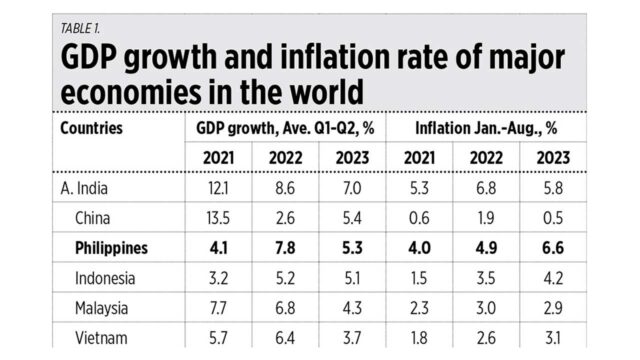
When it comes to commodity prices, the Philippines indeed has the highest inflation rate in 2023 among major Asian neighbors (see Table 1).

So, with the bad global and regional economic environment, the Philippines’ growth of 5.3% (6.4% in Q1 and 4.3% in Q2) was already high, so the economic team and the administration deserve praise and commendation. But since this fact is grossly if not deliberately omitted, one can suspect that the attacks on growth deceleration have some element of a political hit job.

The same can be said about our inflation rate. There is the possible deliberate omission of two points. One, our high inflation this year is based on low inflation last year, whereas it is the reverse for Thailand, South Korea, and Singapore. Two, the Americas and Europe have high inflation in 2023 based on already high inflation in 2022, this would be horrible news if this happened in the Philippines.

Now on to No. 1, food inflation and rice trade liberalization. The proposed tariff reduction from 35% (ASEAN-origin like Thailand) and 50% (non-ASEAN origin like India) to zero and 10% is a brilliant move by the economic team. The purpose of import tariffs is to make cheaper goods from abroad become expensive at home in order to protect domestic producers, but this penalizes domestic consumers. The economic team is correct in this move. Their priority is mainly protecting the consumers, helping reduce inflation without necessarily abandoning the food producers. Certain farmer organization leaders are wrong in their continued “penalize rice consumers” lobby.

On No. 2, the MUP pension reform, the House version is practically no reform because full indexation of the pension is retained, and only new recruits will start contributing to the fund. Why call it pension reform when there is no reform? The Senate should consider the following: all incumbent MUPs should contribute to their own future pensions, indexation should be discontinued or disallowed, and pensioners should contribute to the fund via taxation of the monthly pension.

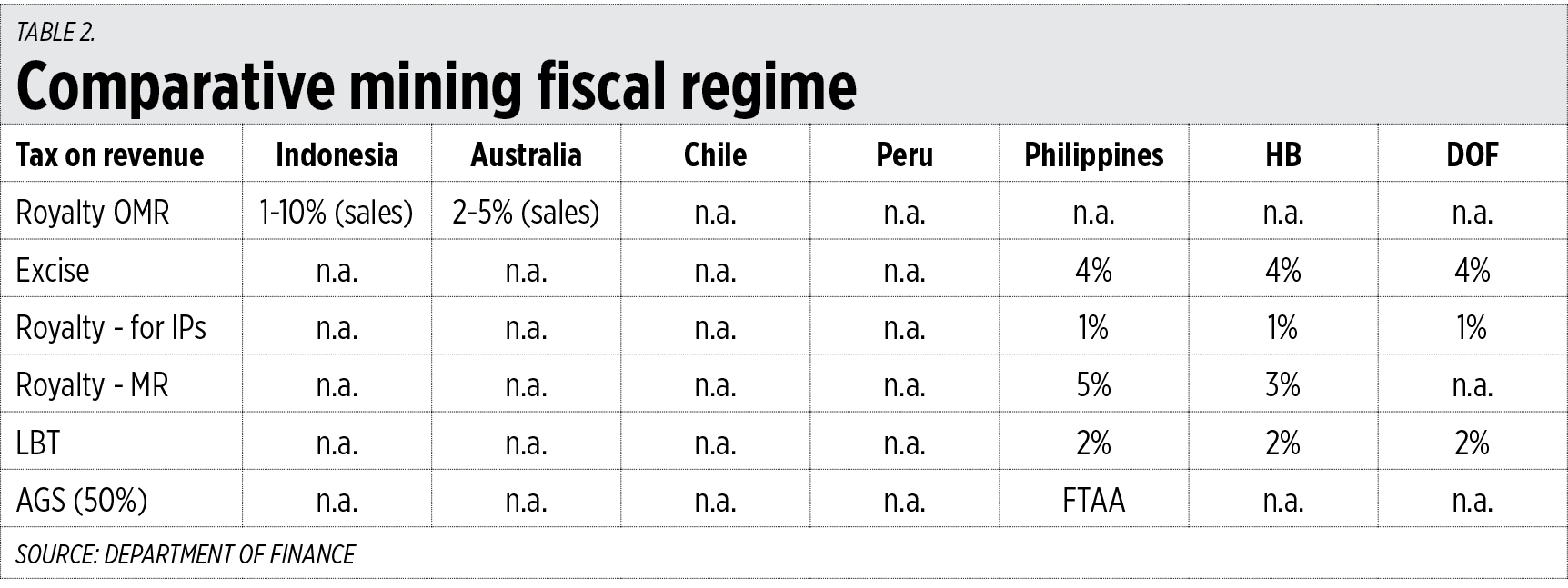
On No. 3, mining tax reform, I was one of the speakers and discussants in the panel on Day 2 of the Mining Philippines 2023 conference last week, Sept. 19-20, at Edsa Shangri-La Hotel. The main presenter was Department of Finance (DoF) Undersecretary Karlo Adriano. Mr. Adriano recognized that the country’s mining tax system is complicated and non-attractive to many potential players who could come in. Consider one of his slides: on top of taxes are two royalties for indigenous people (IP) and on mineral reserves (MR) (see Table 2).

So, the four DoF proposals are: 1.) simplify the mining fiscal regime, 2.) raise the royalty tax outside mineral reservation from zero to 3%, 3.) raise the windfall profit tax from zero to 1-15%, and, 4.) provide thin-capitalization, ring-fencing, transparency, and accountability.

I support the DoF’s proposed reforms. In particular, the shift in taxation from gross revenue to profitability like windfall profit, and the simplification of tax payment, both proposals are good.

Finally on No. 4, the proposed suspension of fuel excise tax, I support this — provided that any projected revenue reduction should be covered by a corresponding spending cut by the same amount, and/or that some existing VAT exemptions should be lifted and those businesses and services should pay VAT.

I argued for these when I was interviewed by Cito Beltran last Thursday, Sept. 21, in his daily program Agenda on Cignal TV, One News Channel.

The other proposal, to cut the coal excise tax, is also good. Before the TRAIN law of 2017 (RA 10963), the coal tax was only P10/ton, then this became P150/ton. Coal power provides about 63% of total electricity generation in the Philippines versus wind+solar’s contribution of only 2.8% of total power generation. So, if we want cheaper electricity, the cost of coal as fuel should decrease, not increase. In future bills amending the TRAIN law, this should be put on the table.

A cut in energy taxes does not necessarily lead to overall revenue losses. Cheaper energy means lower cost of doing business in the Philippines, which will attract more investments and businesses that will pay other taxes and expand overall revenue generation.


Bienvenido S. Oplas, Jr. is the president of Bienvenido S. Oplas, Jr. Research Consultancy Services, and Minimal Government Thinkers.

minimalgovernment@gmail.com

Sustained growth seen for thrift banks until yearend

CHAMBER of Thrift Banks (CTB) President Cecilio D. San Pedro is expecting the double-digit growth in assets, deposits, and loans seen by thrift banks in the first half to be sustained until the end of the year.

“As reported by the central bank governor, we are on the rise. We have a modest gain in both the assets and liabilities side, deposit-taking, [and] we’re [also] growing the MSME (micro, small, and medium enterprises) loans,” he said to reporters on Friday.

Based on data from the Bangko Sentral ng Pilipinas (BSP), the thrift banking industry’s first-half net income grew by 27.1% year on year to P9.83 billion.

BSP Deputy Governor Chuchi G. Fonacier noted in a video message on Friday that the industry’s net profit growth had exceeded the pre-pandemic compounded annual growth rate, which averaged 5.3%.

The growth translated into a return on assets and return on equity at 2% and 12.8%, respectively, or higher than the 1.3% and 9.3% posted a year ago.

The industry’s net interest margin improved to 7.1% at the end of June from 6.2% a year ago.

Ms. Fonacier noted the latest margin was above the pre-pandemic range of between 5.4% and 5.8%.

The sector’s gross loan portfolio rose year on year by 14.1% to P647.7 billion as of end-June, mainly driven by the household sector.

Ms. Fonacier noted significant growth in salary-based, general-purpose consumption loans, and motor vehicle loans, which grew by 44.3% and 8.5%, respectively.

Loans to other sectors such as real estate, manufacturing, and wholesale and retail trade also rose year on year by 3.2%, 15.3%, and 2.3%, respectively.

Thrift banks’ nonperforming loan (NPL) ratio stood at 7.2% as of end-June, easing from the 7.8% reported a year ago. Meanwhile, NPL coverage ratio was higher at 63.4% from 63.2%.

On the funding side, deposits grew by 1.1% year on year to P717.2 billion.

“These figures suggest that thrift banks continue to enjoy the confidence of depositors and point to room for the thrift bank industry to grow further,” Ms. Fonacier said.

As a result, the consolidated assets of thrift banks grew by 2.2% to P949.7 billion in end-June.

In a panel discussion, BSP Assistant Governor Arifa A. Ala said it is unlikely that the reserve requirement ratio (RRR) for thrift banks will be cut from the current 2%.

She said at this point, the central bank does not see yet the need to further cut the reserve requirement, which she said “is quite low at 2% already.”

However, Ms. Ala said the BSP could consider cutting the RRR depending on the outlook for growth and inflation.

In June, the Monetary Board cut the reserve ratio for thrift banks by 100 basis points (bps) to 2%.

The RRR for big banks and nonbank financial institutions with quasi-banking functions were also cut by 250 bps to 9.5%,

For digital banks, the RRR was cut by 200 bps to 6%, and by 100 bps to 1% for rural and cooperative banks. — Aaron Michael C. Sy

ADVERTISEMENT
ADVERTISEMENT