Home Blog Page 4241

Funding approved for preliminary work on DoTr main office PPP

THE Project Development and Monitoring Facility (PDMF) Committee has approved funding support for the project preparation phase of the Department of Transportation’s (DoTr) central office building project, which will be executed as a public-private partnership (PPP).

“The project is expected to address the current and future office space requirements of the DoTr, as it envisions to have all of its offices housed within a single location to eliminate unnecessary transport and coordination cost, improve internal administrative efficiency, and increase transparency and accountability through enhanced access by the public and other stakeholders of DoTr,” the PPP Center said in a statement.

The funds will support project preparation and transaction advisory services, including “financing, design, construction, and operations and maintenance (O&M) of a mixed-use, multi-story, green-design and gender-responsive building, and ancillary facilities,” it added.

“The DoTr office building project is being proposed for PDMF support to ascertain its viability for PPP implementation,” it added.

This will cover the preparation of the pre-feasibility study and preparation of bid documents and assistance, among others.

The PDMF is a revolving fund managed by the PPP Center to “enhance the investment environment for PPPs and develop a robust pipeline of viable and well-prepared PPP infrastructure projects.”

The PDMF Committee is chaired by the National Economic and Development Authority with the Department of Finance serving as vice chair.

Its members include the Department of Budget and Management and PPP Center, which also serves as the PDMF Secretariat. — Luisa Maria Jacinta C. Jocson

Senate ratifies ease of paying taxes bill — bicam report

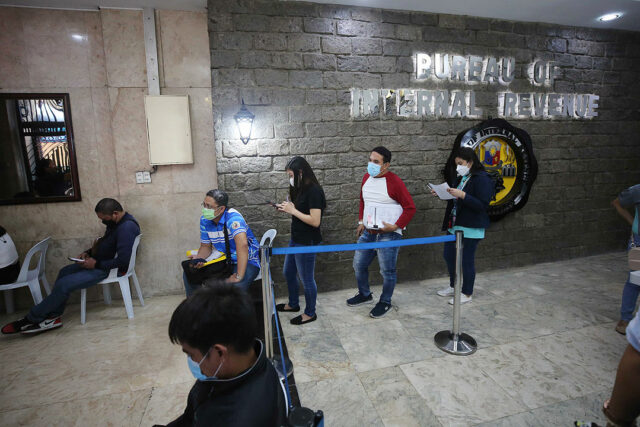
People line up to file their income tax returns at the Bureau of Internal Revenue office in Intramuros, Manila, April 18, 2022. — PHILIPPINE STAR/ RUSSELL A. PALMA

THE Senate ratified the Bicameral Conference Committee report late Wednesday on a priority bill seeking to make taxpaying easier.

In plenary session, Senator Sherwin T. Gatchalian, who led the Senate contingent to the bicameral session on Wednesday, said the reconciled version of Senate Bill No. 2224 and House Bill No. 4125 provides for taxpayer classification, a file-and-pay anywhere mechanism, exemptions for micro taxpayers from withholding taxes, a reduction in the penalties for micro and small taxpayers, and exemptions for overseas Filipino workers from filing income tax returns.

Mr. Gatchalian, who wrote the Senate version of the measure, said the proposal aims to modernize tax administration by removing outdated procedures which would improve the efficiency and compliance with tax obligations.

The Senate passed the measure on third and final reading on Monday, while the House of Representatives passed the counterpart bill in September. — John Victor D. Ordoñez

Up, up and away?

Years ago, I wrote about the dangers of the extreme measures employed by governments worldwide to stave off the impact of the global financial crisis and a global recession. In so doing, governments and central banks had to tread a dangerous path between quantitative easing and monetary tightening, and it seemed only a matter of time before a recession, inflation, or even deflation resulted from such policies.

Now it appears that these dangers are being realized left and right. The global economy is now experiencing a slowdown, exacerbated by geopolitical tensions, a looming trade war between the US and China, and by oil and grain supply shocks brought about by the Russian invasion of Ukraine. While the West is experiencing slower growth and a heavier fiscal debt burden, Russia is experiencing serious inflation and its currency’s value is plunging. Even China has recently fallen into deflation, in a manner eerily similar to Japan’s own encounter with falling prices, ending its post-war economic boom when its asset price bubble burst in the 1990s.

The Philippines, once a bright spot in the region, has not been spared — with inflation and sporadic supply shocks and shortages, particularly in essential consumer goods and food. In fact, the Philippines is now experiencing the highest inflation since the global financial crisis of 2008, and if this remains elevated, further erosion of household purchasing power is inevitable.

What has the government done about this? The Bangko Sentral ng Pilipinas (BSP) has repeatedly announced its readiness to act as necessary to address any inflation risk. However, much in the same manner as central banks in advanced economies, the BSP also decided to increase interest rates, based on the same inflation-targeting model that guides the economic policy model of many central banks.

This response would be proper in case inflation were actually caused by excessive demand, as increased interest rates would suppress consumption and investment through monetary tightening. One may even argue that the current inflation is the tail end of various stimulus programs and cash aid given by the government during the pandemic, which would have added to existing demand stimulus.

On the other hand, with interest rates at near 16-year highs, households may also be facing higher debt servicing costs, since many households took out loans as a result of the COVID-19 pandemic, prodded in no small measure by relatively low interest at that time. Now, the cost of servicing such debt will be higher, resulting in further reduction of disposable household income, thereby lowering demand, especially for non-essentials.

Worse, increases in interest rates will sooner or later end up affecting investment and slowing down the economy. This is because higher interest rates increase the costs of borrowing, and when this is passed on to the consumers, prices correspondingly increase, compounding the problem. In fact, the possibility of higher prices (inflation) existing simultaneously with recession or stagnation, a phenomenon called stagflation, is looming larger as well.

In view of these, monetary tightening can only be considered as a stop-gap measure to address excessive inflationary pressures, that may have been brought about by abnormally high demand or even an excess of money circulating in the economy due to large loans taken and then spent by the government in recent years. If employed too long, the risk of harming the economy through forceful suppression of demand and investment is increased.

Nonetheless, there is some hope in sight. Unlike China, which was prone to deflationary pressures due to an aging and stagnating population, as well as an export-dependent economy that naturally weakens in the event of a trade war or global recession, the Philippines has a young and booming population, as well as an increasingly younger workforce. This, among others, blessed the Philippines with a domestic consumption and demand-driven economy, which actually makes it resilient in the face of a worldwide recession as long as purchasing power is maintained and the workforce is adequately employed.

Thus, the Philippines could greatly benefit from increasing productivity while maintaining high employment. Stimulating the economy and reining in unemployment may seem counter-intuitive, if not difficult, in the face of existing inflationary pressures and a looming global recession — but often the long-term solution is obscured by present or existing crises. However, such a solution may only be achieved by a government that is responsible and focused, a productive and cooperative private sector, and a compliant taxpayer base.

Needless to say, the government must be able to collect the proper amount of taxes to fund the necessary programs and expenditures. Even if taking out loans is necessary, it must make sure that any or all funds obtained are fully put to productive use, and not wasted on non-essentials or useless programs or worse, lost to graft and corruption. Reckless spending through debt financing must also be avoided at all costs since the country’s debt burden — which now stands at P14.2 trillion — is colossal. Adding any more will only result in higher debt service payments, which will further decrease available funds in the future.

Given the enormity of these challenges, everyone must work hand in hand. Better transparency on the part of the government in its spending will also improve prudence and accountability on its part, and this in turn should encourage support and compliance from the private sector and taxpayers alike. Otherwise — like Odysseus trying to navigate the treacherous waters between Scylla and Charybdis of old — the ship we may call the BRP Philippines may risk falling into inflation, stagnation, or worse, both, with disastrous consequences for us all.

The views or opinions expressed in this article are solely those of the author and do not necessarily represent those of Isla Lipana & Co. The content is for general information purposes only, and should not be used as a substitute for specific advice.


Jaffy Azarraga is a director at the Tax Services department of Isla Lipana & Co., the Philippine member firm of the PwC network.

+63 (2) 8845-2728

jaffy.y.azarraga@ph.pwc.com

Removal of China’s floating barrier a reaction, not provocation — Manila

SCREENGRAB FROM PHILIPPINE COAST GUARD FACEBOOK PAGE

By John Victor D. Ordoñez and Kyle Aristophere T. Atienza,  Reporters

MANILA’S REMOVAL of a floating barrier installed by the Chinese coast guard in the area claimed by the Philippines in the South China Sea was a reactionary measure and should not be treated as provocative action against China, the Philippines’ defense chief said on Wednesday.

“They (China) are provoking us and we are just reacting,” Secretary Gilbert C. Teodoro, Jr. told a Senate hearing on the proposed Department of National Defense (DND) budget for next year.

“This (Scarborough Shoal) is ours under international law and they are blocking our fishermen by installing the barrier,” he added.

On Tuesday, Chinese Foreign Ministry Spokesperson Wang Wenbin warned Manila to steer clear of provocations, accusing the Philippines of “intruding” in Chinese waters.

“China firmly upholds the sovereignty and maritime rights of Huangyan Island, and we advise the Philippine side not to provoke and cause trouble,” he told a news briefing.

China was reported to have installed a 300-meter (980-ft) floating barrier at Scarborough Shoal, which Filipinos call Bajo de Masinloc, last Sept. 22.

The Philippine Coast Guard (PCG) removed China’s floating barrier on Monday upon the order of President Ferdinand R. Marcos, Jr.

China typically installs floating barriers when they monitor a large number of Filipino fishing boats in the area, the PCG said, citing accounts from fishermen.

At the same hearing, Senate President Juan Miguel F. Zubiri said the DND and its attached agencies should expect a “drastic” increase in its P229.9 billion proposed budget for 2024.

“We won’t allow ourselves to get bullied by our neighbors in the north,” he said.  “We hear you loud and clear and we need more defense pending in our Armed Forces of the Philippines (AFP) modernization project.”

The committee submitted the DND’s proposed budget to the plenary subject to deliberations. The Defense department has a proposed allocation of P1.2 billion, while the AFP gets the bigger chunk at P221.65 billion, and civilian agencies with P7.1 billion.

The Philippine military’s western command said on Tuesday that from now on, Manila is keeping an eye on the possible installation of Chinese barriers in other Philippine features in the South China Sea.

Armed Forces of the Philippines Western Command Commander Alberto Carlos made the statement as he noted the return of Filipino fishermen to Second Thomas (Ayungin) Shoal and Iroquois (Rozul) Reef.

The Philippine government is now “closely monitoring” Scarborough Shoal following China’s installation of a floating barrier in the area “because what happens there will also happen” in Second Thomas Shoal, he told reporters on the sidelines of a forum on the country’s maritime framework.

“There’s already a template for them to follow now,” he said. “If it happens also in Ayungin, it’s automatic that we’ll remove it.”

At a separate hearing of the Senate Special Committee on Maritime and Admiralty Zones, Solicitor General Menardo I. Guevarra said proposed legislation seeking to establish Philippine maritime zones must ensure provisions do come in conflict with international conventions.

“As a general proposition, (including a provision on) reciprocity and mutual respect seems to be acceptable,” he told the hearing. “I think that is fair with all parties concerned.”

Congress reallocating intel funds for agencies monitoring China’s incursions

PHILIPPINE COAST GUARD PHOTO

By Beatriz Marie D. Cruz, Reporter

MEMBERS of Congress agreed on Wednesday to reallocate confidential and intelligence funds (CIF) to agencies in-charge of surveillance and intelligence gathering on China’s incursions into the Philippines’ maritime territories.

“Given the recent provocative incidents in the congested areas, we have decided to reallocate — as part of the budget process — confidential and intelligence funds to other agencies chiefly responsible for intelligence and surveillance activities such as the National Intelligence Coordinating Agency (NICA), National Security Council (NSA), Philippine Coast Guard (PCG), and the Bureau of Fisheries and Aquatic Resources (BFAR),” the congressmen said in a joint statement.

They said that the agencies are “better positioned” to counteract security threats, protect territorial waters and ensure the rights and access of Filipino fishermen to traditional fishing grounds.

The Senate also committed to reallocate confidential and intelligence funds to relevant security agencies by cutting the CIF in proposed budgets of other civilian agencies.

“We have agreed in the Senate to do the same,” Senate President Juan Miguel F. Zubiri said. “We also will be reallocating funds that we feel are not necessary for the use of certain agencies and allocate them to our intelligence community as well as our coast guard and AFP (Armed Forces of the Philippines).” 

PCG: DEPLOY SCIENTISTS
At a Stratbase ADRi forum on the Philippines’ maritime framework, PCG Spokesman for the West Philippine Sea Jay Tristan Tarriela urged the country’s task force handling issues involving the South China Sea to prioritize the deployment of scientists to areas vulnerable to national security threats.

“It is recommended that the National Task Force for the West Philippine Sea instruct marine scientists affiliated with public institutions to prioritize research in areas with national security implications,” he said in a speech.

“It is important for our marine scientists to heed the national government’s call to investigate the deteriorating conditions of corals in locations such as Rozul Reef, Escoda Shoal, and other areas,” he added.

He also urged Filipino marine scientists to proactively collaborate with foreign institutions in conducting marine scientific research, noting that internationally renowned maritime institutes possess “technological advantages and employ more advanced approaches.”

“Therefore, leveraging these collaborations could greatly enhance our research efforts in these critical areas.”

Mr. Tarriela said the “support and firsthand information” from the fishing industry are essential in identifying areas that have already been destroyed or devastated.

“Due to limited resources, it is impractical for us to cover the entire West Philippine Sea and simultaneously assess the condition of its seabed,” he noted.

At the same forum, Acting Australian Ambassador to the Philippines Moya Collett shared ongoing efforts between Manila and Canberra to restore damaged coral reefs in several parts of the West Philippine Sea, including waters of Zambales and Palawan provinces, as he noted the two country’s commitment to the United Nations High Seas Biodiversity Treaty, a historic global treaty on the world’s oceans.

“Both of our countries are committed to promoting an open, secure and prosperous region where international law and sovereignty are respected,” she said. “We are also committed to protecting the marine environment which is critical to supporting the lives and livelihoods of our two peoples.”

The move “represents the mutual interest of Manila and Canberra to not only solidify their cooperation in the traditional security realm, but also in the non-traditional security sphere,” Don Mclain Gill, who teaches international studies, said in a Facebook Messenger chat.

“Therefore, the growing Philippines-Australia partnership is multifaceted and crucial for the stability and sustainability of the Indo-Pacific.”

Chester B. Cabalza, founder of Manila-based International Development and Security Cooperation, recognized Australia as “a powerhouse in terms of environment protection and biodiversity conservation as seen in their Great Barrier Reef Marine Park.”

The West Philippine Sea is important for Canberra because it is  “a metacenter in the world’s ecological biodiversity,” he said via Messenger chat. with Kyle Aristophere T. Atienza

Senate panel swiftly passes Ombudsman and CoA budgets

PROPOSED BUDGETS of the Commission on Audit (CoA) and the Office of the Ombudsman for 2024 breezed through the Senate Finance Committee on Wednesday with deliberations terminated swiftly amid little questionings.

“We will favorably endorse your budget to the plenary without any prejudice to any augmentations,” panel chair Senator Juan Edgardo “Sonny” M. Angara said at the close of the budget hearing for the CoA as no further questions were raised after the presentation.

CoA’s proposed P13.36-billion budget will be used mostly for personal services amounting to P13.179 billion, which includes P636 million in retirement and life insurance premiums and P690.55 million for maintenance and other operating expenses (MOOE). A separate P126.85 million is earmarked for capital outlay.

No opposition was voiced out even for the P10 million in intelligence funds included in the CoA budget.

Under the 2024 National Expenditure Program (NEP), CoA’s budget was reduced by P800 million from its initial request of P14.17 billion, which would have increased to over P500 million the allotment for the construction projects and funding for equipment and other machinery.

At the same hearing, Ombudsman Samuel R. Martires said his office can operate without confidential funds, despite an allotment of P51.47 million for the purpose.

“If it will only taint the reputation of the Office and of the Ombudsman itself and its officers, I am even willing that this be scrapped,” he said in response to Senator Aquilino Martin “Koko” D. Pimentel’s inquiry on whether or not taking the intelligence funds away would affect the agency’s operations.

“I dare not have a confidential fund during my term of office,” Mr. Martires said

Under the Ombudsman’s proposed P5.05-billion budget for next year, P1.31 billion is intended to hire more employees; P76.87 million for pension benefits; P392.22 million for capital outlay requirements; and P389.63 million for retirement and other forms of benefits. — John Victor D. Ordoñez

Imported veggies hurt Benguet

BW FILE PHOTO

BAGUIO CITY — Benguet vegetable farmers and traders are dismayed that imported vegetables are flooding the Philippine market, prompting them to urge the Department of Agriculture (DA) office in Cordillera to take action on their behalf.

Members of the League of Associations at the La Trinidad Vegetable Trading Area, Inc. believe the big and continuous importation of vegetables is a result of the Regional Comprehensive Economic Partnership (RCEP) taking effect.

The RCEP is a free trade agreement between member-countries of the Association of South East Asian Nations (ASEAN) with Japan, South Korea, China, Australia and New Zealand, which facilitates easier exchange of big volumes of products and services.

Imported carrots, potatoes, broccoli, and cauliflower have already flooded Metro Manila; Sariaya, Quezon; and Batangas — markets long served by Benguet vegetable producers.

The league has asked the help of DA Cordillera head Jennilyn M. Dayawan and the Benguet Provincial Board led by Benguet Vice Governor Ericson L. Felipe, warning that losing the market for their produce “will eventually kill the local vegetable and farming industry.”

The league said if importation continues at this rate, the country will suffer from economic dislocation of countless farmers and traders, including their families. — Artemio A. Dumlao

Center to reform ex-terrorists

COTABATO CITY — Officials are looking forward to an easier reintegration into society of hundreds of former Abu Sayyaf terrorists in Sulu with the impending completion of a P25-million reformatory center in the province.

“It is essential to the efforts of the military and the Philippine National Police to make these former enemies of the state become productive for them to thrive in peace in their barangays in Sulu,” Army Major Gen. Steve D. Crespillo, commander of the military’s Western Mindanao Command, told reporters on Wednesday as he expressed thanks to the office of Bangsamoro Local Government Minister Naguib G. Sinarimbo for initiating and bankrolling the project in Barangay Langhub, Patikul town.

Mr. Sinarimbo, who oversees the Rapid Emergency Action on Disaster Incidence contingent, said the facility will be completed in six weeks and shall function as a center for religious reorientation and livelihood education for Abu Sayyaf members who have returned to the fold of law.

The office of Sulu Gov. Abdusakur Mahail Tan, Sr., chairman of the multi-sector provincial peace and order council (POC), and the municipal governments under his administration, had worked out the surrender of 518 Abu Sayyaf terrorists and supporters in the past three years.

Patikul, one of the 18 towns in Sulu, was the scene of deadly clashes between Abu Sayyaf terrorists and government troops from the 1980s until 2020.

In a session earlier this month, the Sulu POC declared the province “Abu Sayyaf-free” via a resolution based on extensive assessments by local government units and peace-advocacy groups helping the Tan administration maintain law and order in the province. — John Felix M. Unson

BI arrests wanted Indian

BAGUIO CITY — An Indian man, wanted for various alleged fraudulent activities, was captured by Philippine immigration agents at a restaurant in Bantay town, Ilocos Sur on Tuesday.

The 22-year-old Indian is already an overstaying and undesirable alien, according to Bureau of Immigration (BI) records cited on Wednesday by BI Fugitive Search Unit (FSU) Chief Rendel Ryan Sy.

He said the Indian government has been hunting its citizen here in Manila for various crimes including false representation of himself as Chief Advisor at the Embassy of India in Manila.

It was also learned that the foreigner was previously arrested in this city for fraud and has the same record of rimes in Davao City.

BI Commissioner Norman Tansingco said the operation against the foreigner was coordinated with the Philippine National Police’s (PNP) Foreign Intelligence and Liaison Division and other local police units. — Artemio A. Dumlao

Kapihan Cult still under probe

THE POLICE Regional Office 13 (PRO13) said on Wednesday that it is not only investigating but also helping multi-sectoral leaders in providing clarity and closure to the controversy surrounding the so-called “Kapihan Cult” in Socorro town, Surigao del Norte.

Brig. Gen. Kirby John B. Kraft, PRO13 director, said they are “focusing extensive attention on this issue” and “investigating this, particularly for the possible human trafficking” as alleged in a recent statement by Sen. Ana Theresia “Risa” N. Hontiveros-Baraquel that brought to light questionable activities of the group, officially known as the Soccoro Bayanihan Services, Inc. and led by Jay R. Quilario.

Also on Wednesday, the Our Lady of Perpetual Help Parish in the same town on Bucas Grande Island clarified that the group is not affiliated in any way with the Catholic church and deemed it “an insult” to the faith that its leader uses the Santo Niño in their indoctrination.

“Jay Rence claims to be the reincarnation of god and even uses our beloved Santo Niño in their indoctrination,” read the statement signed by parish priest, Rev. Fr. Christian E. Funtanares, OSA. “Their belief in the Santo Niño is doubtful since their God is not Jesus but Jay Rence.”

Ms. Hontiveros-Baraquel had quoted former members of the Kapihan Cult who served as “friar-priests” of Mr. Quilario, whom they call “Señor Agila,” that exploitation, forced labor, and child sexual abuse allegedly goes on within the group.

Although the group is nestled on a hilltop, it is believed to have greater numbers than the Catholics who comprise only 20% of the island’s population.

Mr. Kraft said the police are in close coordination with the local government and the regional Department of Social Welfare and Development office in investigating the group’s activities. — John Felix M. Unson

Alex Eala assured of bronze medal in beating Okamura

ALEX EALA — POC-PSC MEDIA POOL

HANGZHOU, China — Alex Eala pulled off one of the biggest comeback wins in tennis history of the Asian Games with a  0-6, 7-5, 6-0 win over Japanese Kyoka Okamura Wednesday, Sept. 27 that assured Team PHL another bronze medal at the Olympic Tennis Centre here.

Ms. Eala, seeded No. 4, looked like a beginner in the first set as she committed numerous turnovers — some were basic mistakes — not to mention Ms. Okamora’s solid game from the baseline.

She even lost her first serve in the second, giving Okamura a 2-0 lead.

Good thing, Ms. Eala found her second win and rallied furiously to win the second set which proved enough to take the fight out of her Japanese rival.

The third set was a different story as it was Ms. Eala who dictated the tempo on the way to posting another win that could go down as one of the highlights of a flourishing career.

The victory arranged the 18-year-old Filipina sensation a semis date with top seed Zheng Qinwen of China, who survived a close opening set to beat Park Sohyn of South Korea, 7-6 (4), 6-0.

Ms. Qinwen is the very same who made it to the quarters of the US Open in New York after beating last year’s runner up Ons Jabeur of Tunisia.

While Ms. Eala is ranked No. 192, the Chinese top seed is rated No. 23 in the latest ITF rankings.

The last time a country won a medal in the continental showpiece was 17 years ago — courtesy of Cecil Mamiit and Eric Taino won two bronze medals in the Doha edition.

Her job is not yet done for the day as she and Francis Casey Alcantara are scheduled to battle top seed Yuki Bhambri and Ankita Ravinderkrishan Raina of India in the third round of the mixed doubles event later in the afternoon. — POC-PSC media pool

Gilas face Thais, eye second win in Asian Games

SBP.PH

HANGZHOU — The trajectory arc gets steeper for Gilas Pilipinas as it takes on Southeast Asian Games rival Thailand on Thursday, Sept. 28, in the men’s basketball competition of the 19th Asian Games here.

Game time is at 11 a.m. (Manila time) at the Zhejiang University Zijingang Gymnasium, with the Philippines out for a momentum-building followup to its 89-61 opening victory over Bahrain and former PBA import Wayne Chism at the Hangzhou Olympic Sports Center Gymnasium last Tuesday.

Thailand, led by ex-UCLA Bruin Tyler, will be looking to rebound, meanwhile,, from a 97-63 thrashing at the hands of Jordan and TNT Giga import Rondae Mr. Hollis-Jefferson last Tuesday.

Mr. Hollis-Jefferson, who will be rejoining TNT for the 2023-2024 PBA season once the Asian Games is over, played 30:06 minutes against the Thais, scoring 20 points on 6 of 15 from the floor with 7 rebounds, 2 assists and 3 steals.

Gilas head coach Tim Cone was talking about getting his hands on the video of the Jordan-Thailand game even before he had walked off the court after their match against Bahrain.

“We need to break down their game,” said Mr. Cone. “We saw them [Thais] in the Southeast Asian Games, but we’re not matched up against them. They were knocked out by Cambodia. So we hope we’ll have a better feel of Thailand than we did. We gotta ‘cause Thailand’s a much stronger team than Bahrain.”

The Philippines won the men’s basketball gold medal in the SEA Games, beating host Cambodia in the final.

As on the eve of the game against Bahrain, Mr. Cone presided over a film viewing of the Thailand-Jordan game with spliced clips of the Thais’ top players other than Lamb, who was  3 of 14 from the field, including 2 of 10 beyond the arc. His 2 rebounds were among the lowest for the team.

In his place, 5-foot-8 guard Frederick Lish had 13 points on 6 of 19 from the field but was abysmal from outside, going 1 of 9 in treys.

The Gilas defense is expected to zero in on Thailand’s other licensed perimeter shooters like Nattakarn Muangboon, who was 3 of 7 in triples, and Jakongmee Morgan (7 pts), Naratip Boonserm (6) and Nakom Jaisanuk, all of whom took three treys each or more against Jordan.

Steady improvement as the Games move on is Gilas’ priority mindset, according to Cone.

“We gotta go up the level, we gotta continue to rise in our game ‘cause we’re gonna play a tougher opponent each time out,” he said.

“I mean, from Bahrain to Thailand to Jordan, and perhaps to the next round, whether it be Korea or Japan or whoever, and hopefully to the semis, maybe to the finals, we gotta continue to lift the level of our game, that’s important.”

A one and a half-hour practice was scheduled at 1 p.m.

After Thailand, Gilas faces Jordan on September 30  at 5:30 p.m.

“Jordan is a much, much, much better team than Thailand,” said Mr. Cone when asked to rate Gilas’ preliminary round opponents. — POC-PSC media poll