Home Blog Page 42

IBM to pay $17 million to settle US government probe over DEI

WASHINGTON — IBM has agreed to pay $17 million to settle a US government probe over the firm’s diversity, equity and inclusion (DEI) practices, which President Donald J. Trump’s administration has cracked down on during his second term in office.

The settlement marks the first resolution from the US Department of Justice’s (DoJ) unit formed last year called the “Civil Rights Fraud Initiative” to crack down on DEI policies using a civil anti-fraud law.

Mr. Trump has targeted public and private organizations — from government agencies to private universities — over DEI practices that civil rights advocates say help address historic inequities for marginalized groups like women and ethnic minorities.

In a settlement signed by the DoJ and IBM, the US government alleged that IBM’s practices included using a “diversity modifier” that “tied bonus compensation to achieving demographic targets,” among other claims.

The settlement also said IBM terminated or modified various programs and policies, but that the company denied engaging in unlawful conduct.

“This agreement is neither an admission of liability by IBM nor a concession by the United States that its claims are not well-founded,” the agreement said.

The White House casts DEI as anti-merit and discriminatory against groups like white people and men. Mr. Trump has signed executive orders asking federal contractors and subcontractors to eliminate DEI.

Many US companies scaled back or modified diversity policies after Mr. Trump’s orders. — Reuters

Tesla’s supervised self-driving software gets Dutch okay, first in Europe

AMSTERDAM/SAN FRANCISCO — Dutch regulators approved the use of Tesla’s self-driving software with required human supervision on highways and city streets in a European first for the electric car maker, which hopes to see similar action from the rest of the European Union (EU).

Wide full self-driving (FSD) adoption is central to Tesla’s growth strategy. Much of the company’s $1-trillion valuation hinges on Chief Executive Officer Elon Musk’s bet that artificial intelligence (AI)-driven self-driving software and robotaxis will become a major revenue stream.

The Netherlands’ approval for the technology, called Full Self-Driving Supervised, which can steer, brake and accelerate a car, follows more than 18 months of tests and analysis by the Dutch vehicle authority RDW.

“Proper use of this driver assistance system makes a positive contribution to road safety,” RDW said in a statement on Friday, adding that it would also submit an application for the technology to be used throughout the EU.

Tesla is also counting on self-driving software to boost vehicle sales, which have slowed in Europe due to its aging electric vehicle lineup and Mr. Musk’s far-right political rhetoric that has alienated some consumers. Tesla’s sales in Europe rose in February for the first time in more than a year.

“I expect FSD approval by the Dutch authority and subsequent European regulators will lead to improved sales in Europe over the coming months as consumers are excited to try FSD,” said Morningstar analyst Seth Goldstein.

Tesla shares rose about 0.7% in aftermarket trading on Friday. Its shares have fallen 23% this year, lagging the US stock market.

“We’re excited to bring FSD Supervised to more European countries soon,” Tesla said in a post on social media platform X, adding that it will start rolling out the technology in the Netherlands shortly.

The software is already available as a subscription for US drivers, where it is also facing consumer lawsuits and federal investigations after crashes and reports of traffic violations.

RDW said the EU sets stricter requirements for safety during vehicle approvals than the US. “This means that the FSD Supervised version in the US is not comparable to the FSD Supervised version in the EU,” it said, without providing further details.

AIMING FOR EUROPE-WIDE ADOPTION
Tesla is the most popular maker of electric cars in the Netherlands, with around 100,000 Model 3 and Model Ys combined that would be eligible for FSD software.

Many companies are working on self-driving systems. Most use several hardware sensors to track the driving environment, while Tesla relies primarily on cameras and AI.

Other carmakers including Mercedes, Ford, and BMW have introduced “hands-free” driving technology on select highways and at limited speeds, mostly in Germany. Tesla’s is the first that will be usable in a wider range of situations.

RDW said it would now submit the application for authentication within the entire EU to the European Commission. All member states will then vote on the application, which requires a majority within the responsible committee for the system to become valid EU-wide.

If it does not win a majority, individual countries may still decide to allow it. Tesla said last month it was anticipating possible EU-wide approval during the summer. — Reuters

Metro Retail Stores Group, Inc. to hold Annual Stockholders’ Meeting on May 4 via Zoom


Spotlight is BusinessWorld’s sponsored section that allows advertisers to amplify their brand and connect with BusinessWorld’s audience by publishing their stories on the BusinessWorld Web site. For more information, send an email to online@bworldonline.com.

Join us on Viber at https://bit.ly/3hv6bLA to get more updates and subscribe to BusinessWorld’s titles and get exclusive content through www.bworld-x.com.

Crease-less foldable Oppo Find N6 to launch in PH soon

Oppo's hinge engineering and Auto-Smoothing Flex Glass work together to deliver a crease-free screen. — EDG EVA

Chinese tech brand Oppo on Friday announced that its new flagship foldable, the Oppo Find N6, is set to arrive in the Philippines soon.

The device has drawn significant attention since its global launch in March for its virtually crease-free display.

“So here at Oppo, we continue to push innovation and industry-leading capabilities,” Jubilius Yu, integrated marketing communications (IMC) officer at Oppo Philippines, said during the Oppo Find Series pre-briefing event on Friday.

“And we’re truly excited for everyone to experience them through our newest Find series,” he added.

The crease-free display of the new Oppo Find N6 has been made possible through the company’s precise hinge engineering and Auto-Smoothing Flex Glass, which work together to deliver a flat and smooth touch experience, Oppo said on its website.

The hinge system uses Oppo’s second-generation Titanium Flexion Hinge, which incorporates 3D liquid printing and Clover Balance Pivot technology.

BusinessWorld had a chance to get an early hands-on with the company’s new flagship foldable, and it is indeed virtually crease-free from every angle, as seen in the photos.

Under the hood, the Oppo Find N6 is powered by Qualcomm’s flagship Snapdragon 8 Elite Gen 5 chip, which on paper can handle highly demanding games and multimedia applications.

Both the inner and cover displays are capable of adapting from 1 to 120 hertz, and both offer up to 1,800 nits of peak brightness, according to Oppo.

As for its cameras, they are co-developed with renowned camera brand Hasselblad. It features five cameras, including a 200-megapixel (MP) main lens, 50MP ultra-wide lens, 50MP periscope telephoto lens, true color camera, and a 20MP front camera.

Other key features include a 6,000mAh typical battery capacity with 80-watt fast charging.

The Oppo Find N6 comes in two colors: Stellar Titanium and Blossom Orange.

Official pricing and promotions will be announced upon its arrival in the Philippines.

For updates on the device, readers may check Oppo’s official website and social media pages. — Edg Adrian A. Eva

Australia, Singapore leaders pledge closer energy ties to tackle global supply shock

REUTERS

SINGAPORE/PERTH — Australian Prime Minister Anthony Albanese held talks in Singapore on Friday with counterpart Lawrence Wong, in which they vowed closer cooperation to ensure energy security in the face of disruptions caused by the Middle East conflict.

Asia’s oil trading hub of Singapore is the largest supplier of petrol and a major supplier of diesel and jet fuel to Australia, where tight domestic supplies of diesel are rattling the farming and mining sectors, its key users.

The leaders said they agreed to ensure the flow of essential supplies including diesel and LNG, making “maximum efforts” to boost their energy security.

“We reaffirmed our commitment to working together, particularly during crises, to support a resilient, rules-based multilateral trading system that underpins stability during periods of global disruption,” they said in a joint statement.

SOME AUSTRALIAN PETROL STATIONS RUN DRY

Panic buying has caused several petrol stations to run dry across Australia, which has limited stockpiles and far-flung distribution networks.

Australia supplies about a third of Singapore’s imports of liquefied natural gas, while getting about 26% of its refined fuel from the city-state, Mr. Albanese said.

“It’s vitally important that we coordinate our response to the global fuel crisis and cooperate,” he said during a joint news conference with Wong. “This is a win-win.”

Singapore had no plans to curb exports despite the global energy shock, Mr. Wong added.

“We didn’t have to do so even in the darkest days of COVID, and we will not do so during this energy crisis,” he said. “It won’t happen.”

Friday’s commitments would be reflected in a legally binding protocol to their existing free trade pact, said the leaders, who visited an LNG terminal and the Singapore Refining Co in the city state.

CLOSURE OF THE STRAIT OF HORMUZ

Australia is among the Asian countries worried about fuel supplies after Iran closed the Strait of Hormuz, through which about a fifth of the world’s oil and gas transited before the Middle East conflict.

Ship traffic along the Strait remains at a near standstill despite a fragile peace deal between the US and Iran.

Australia, which uses roughly a million barrels of oil a day and imported 84% of its petroleum product demand last year, has two refineries, down from eight in 2005.

Singapore is a major refining center in Asia with three refineries that have combined capacity of about 1.2 million barrels per day, though refineries have cut output after crude supplies were disrupted by the closure of the Strait of Hormuz.

Statistics from insurer NRMA late in March showed Singapore accounted for 54.7% of Australia’s petrol imports, or close to 6 billion liters. South Korea was second with 22.5%, and India third, with 11.5% or 1.25 billion liters.

Mr. Albanese and Foreign Minister Penny Wong have held talks with Asian counterparts on fuel supplies since early March.

Australia has said it has held talks with Brunei, China Indonesia, Japan, Malaysia, and South Korea, among others. — Reuters

Dubai limits foreign flights until May 31, letters show, hitting Indian airlines hardest

REUTERS

NEW DELHI — Dubai has restricted foreign airlines to just one daily flight to its airports until May 31 due to the Iran crisis, igniting revenue loss fears among Indian carriers that had planned more flights than airlines from any other country, letters show.

The Federation of Indian Airlines (FIA), which represents top carriers IndiGo, Air India and SpiceJet, has asked India to push Dubai authorities to lift the curbs and, failing that, to consider reciprocal measures on Dubai carriers including Emirates and flydubai, according to a letter it sent to the Indian government on March 31.

Indian carriers are already under financial pressure from higher fuel prices and longer routings to Western destinations because they have been banned from using Pakistani airspace since last year following military tensions between the two neighbors.

In a private email to airlines on March 27, seen by Reuters, Dubai Airports said carriers would be allowed one round trip per day to Dubai International Airport (DXB), normally the world’s busiest international travel hub, and the smaller Al Maktoum International Airport (DWC) during the summer season between April 20 and May 31, extending restrictions implemented after the war began.

“Carriers continue to be limited to one rotation per day, until capacity allows more to be facilitated … Additional slots will be allocated if capacity is available,” it said.

The FIA told the Indian government the curbs were not being applied to Dubai’s airlines such as Emirates and flydubai, creating an uneven playing field that could lead to “substantial” revenue losses.

Dubai Airports and Dubai’s media office did not respond to repeated requests for comment. Flydubai said its flight schedules were approved by the relevant authorities. Emirates did not respond to a request for comment.

The measures come after Emirates and other Gulf airlines have long complained about India’s bilateral air service agreements that cap the number of seats that can be deployed between countries. Indian authorities have said such pacts protect Indian airlines in the cutthroat market.

INDIAN CARRIERS HARDEST HIT BY CAPS

India was the largest source of passengers for DXB in 2025, with 11.9 million travelers passing through the hub.

The Dubai caps will hit Indian airlines the hardest, according to April and May schedules data from Cirium.

Air India and its budget carrier Air India Express have scheduled more than 750 flights into DXB in that period. IndiGo has 481, followed by Saudia and Gulf Air, which planned for 480 and 404, respectively. India’s SpiceJet had planned 61.

The one-flight-per-day cap would mean 30 or 31 per month for each foreign airline, versus the hundreds of daily flights being flown by Emirates and flydubai according to Flightradar24 data.

IndiGo told Reuters in a statement that the Middle East crisis and the new Dubai extended restrictions “significantly constrained” its operations as it had an approved summer schedule of 15 daily flights from India to Dubai.

“As a result, a significant portion of IndiGo’s capacity and aircraft time is currently underutilized,” IndiGo said in its first comments on the crisis.

Air India, SpiceJet, and Indian authorities did not respond to requests for comment.

Other major airlines such as Lufthansa, Singapore Airlines, and British Airways had far fewer flights to Dubai than Indian carriers before the crisis began and have canceled all flights to the city until at least May 31.

They are instead adding more non-stop Asia-Europe flights to take advantage of strong passenger demand that has pushed up prices. — Reuters


DigiPlus elevates BingoPlus Philippine Open to International Series stage

The BingoPlus Philippine Open will feature a formidable roster of international champions, headlined by homegrown ace and ArenaPlus Ambassador Miguel Tabuena.

DigiPlus Interactive Corp., the country’s premier digital entertainment provider behind BingoPlus, ArenaPlus, and GameZone, is solidifying the Philippines’ presence on the global sporting map, securing the staging of  world-renowned International Series (IS) for a second straight year.

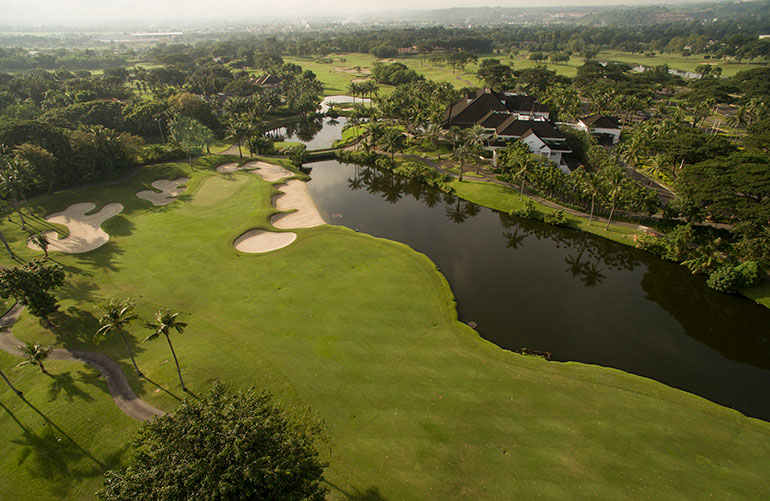
Building on the success of the 2025 showcase, DigiPlus, through its pioneering brand BingoPlus, is stepping up as title partner for the Philippine Open when it tees off Nov. 12 to 15 at Manila Southwoods Golf and Country Club in Carmona, Cavite, officially part of the global tournament’s action-packed calendar.

“By securing the BingoPlus Philippine Open’s place within the International Series, we are building a sustainable ecosystem for the Filipino athlete,” DigiPlus chairman Eusebio H. Tanco said.

“This is ‘Entertainment for Good’ in action, as it utilizes our platform to create opportunities for Filipino talent to excel on the global stage while also showcasing the Philippines as a premier destination not only for sports, but also tourism,” he added.

Launched back in 2022, the International Series marks an evolution for the prestigious Asian Tour. Backed by massive funding from LIV Golf, the series consists of several elevated tournaments designed to provide a platform for elite talent, allowing players to earn promotions to the high-stakes LIV Golf League.

Manila Southwoods Golf & Country Club

The Philippine Open is Asia’s oldest national championship, and with DigiPlus and BingoPlus powering the showcase, the meet is poised to rejoin prominent golf tournaments around the world.

The BingoPlus Philippine Open will feature a formidable roster of international champions, headlined by homegrown ace and ArenaPlus ambassador Miguel Tabuena. His success as a LIV Golf League World Card is the ultimate testament of Philippine potential at the pinnacle of the sport.

Beyond the immediate gains for sports tourism, the November showpiece marks a turning point for Philippine golf, as it accelerates the development of the sport and elevates it onto the world stage.

More updates on the tournament will be shared on official DigiPlus and BingoPlus platforms in the coming weeks.


Spotlight is BusinessWorld’s sponsored section that allows advertisers to amplify their brand and connect with BusinessWorld’s audience by publishing their stories on the BusinessWorld Web site. For more information, send an email to online@bworldonline.com.

Join us on Viber at https://bit.ly/3hv6bLA to get more updates and subscribe to BusinessWorld’s titles and get exclusive content through www.bworld-x.com.

Myanmar’s new president sees challenges ahead, eyes ASEAN detente

Flag of Myanmar | STOCK PHOTO | Image by www.slon.pics on Freepik

MYANMAR’S new President Min Aung Hlaing said on Friday his government has many challenges to overcome and seeks to improve the country’s international standing, including normalizing ties with Southeast Asian bloc ASEAN after five years in the cold.

In his inauguration address, the former military chief who was the architect of a 2021 coup that led to civil war and international sanctions said his government would strive to spur foreign investment and domestic business growth as part of “effective, long-term strategic plans” for resource-rich Myanmar.

“Myanmar is now well on its way toward democracy but the new government has a lot of challenges to overcome,” Min Aung Hlaing told a parliament packed with lawmakers from an army-backed party and legislators hand-picked by the military.

“The new government will implement a roadmap based on democracy and federalism … our priorities are democracy and peace.”

His speech lasted less than 20 minutes and lacked specifics on his agenda, including what steps would be taken to end Myanmar’s international isolation, or tackle the raging civil war in which the military is accused of widespread atrocities against the civilian population. It denies wrongdoing.

ROCKY PATH TO PRESIDENCY

Min Aung Hlaing, 69, was elected president by parliament a week ago, formalizing his grip on power after a coup that ended a decade of tentative democracy and triggered an exodus of foreign investors from what was once one of Asia’s most promising frontier markets.

His rocky but carefully choreographed journey from top general to civilian president follows an election won in a landslide by a military-formed party that had no viable opposition, with critics and Western governments dismissing the vote as a sham designed to prolong armed forces rule behind a veneer of democracy.

The coup and ensuing crackdown on nationwide protests led to an intervention by the 11-member Association of Southeast Asian Nations, which later barred the junta from attending its summits, prompting fury from the generals who called it a violation of the bloc’s non-interference policy.

“We will enhance international relations and strive to restore normal relations with ASEAN,” Min Aung Hlaing said in the speech, which more than 50 foreign delegates attended, including from Russia, China, and Thailand, among the few countries that maintained engagement with the junta.

AMNESTIES UNDER CONSIDERATION

The ceremony included the swearing-in of Min Aung Hlaing’s new cabinet, which consists of holdovers from the junta era and retired officers of the military, which has ruled Myanmar directly for five of the past six decades.

In his speech, Min Aung Hlaing said that to promote peace and reconciliation, “appropriate amnesties” would be taken into consideration, but did not elaborate.

Thousands of junta opponents remain in detention, the most notable, Nobel laureate Aung San Suu Kyi, the 80-year-old leader of the elected government that Min Aung Hlaing overthrew.

Asked by reporters what would be his first acts as president, a smiling Min Aung Hlaing, dressed in civilian attire, said he would seek to achieve stability, peace, and development for Myanmar.

“I urge everyone to be united and to work hard,” he added. — Reuters

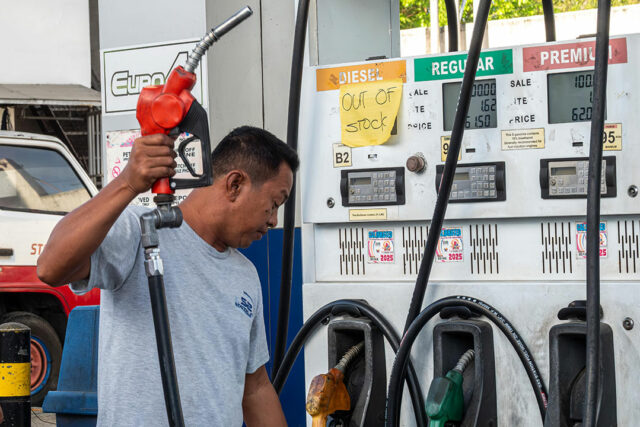
DoE eyes fuel price rollback next week

MOTORISTS queue at a gasoline station along Norzagaray Road in San Jose del Monte on Sunday, March 8. Oil companies are set to roll out staggered price hikes starting Tuesday, March 10, 2026. — PHILIPPINE STAR/RYAN BALDEMOR

The Department of Energy (DoE) said on Friday that fuel prices may roll back next week after consecutive weeks of price hikes, as the United States and Iran enter a two-week ceasefire.

“Based on the trend within the past four days, there is a rollback,” Energy Secretary Sharon S. Garin said in Filipino during a press briefing.

However, she noted that the decrease in fuel prices depends on how global price trends develop on Friday evening. Official figures are likely to be determined by Saturday, after the last trading day of the week.

“If something happens today that could lead to a spike, there could be changes in the computation,” she said. “I don’t want to be speculative because we might get a different price, but we’re hoping and praying for a rollback.”

Of the targeted 318 million liters of oil, Ms. Garin said the Philippine National Oil Company has already procured 165 million liters or 1.042 million barrels from Malaysia, Singapore, India, and Oman.

149 million barrels arrived last week, and 300 barrels are expected each week throughout April. “That’s already confirmed. I think the first 300 is already on its way, and it is staggered so our storage is spread out,” said Ms. Garin.

She clarified that the department has neither discussed nor considered fuel rationing yet. “What we have issued as a directive from the DoE is no hoarding.”

The Land Transportation Franchising and Regulatory Board (LTFRB) will also conduct a pilot run in Metro Manila for its P10-per-liter fuel subsidy program for Public Utility Vehicle (PUV) drivers nationwide.

The fuel subsidy program will cover up to 150 liters per vehicle per week at 14,000 gas stations nationwide until July 2026.

142,698 jeepney and UV express drivers are expected to benefit from the program’s initial P1.5-billion budget.

“With the rollback, plus the additional subsidy that will be provided by the LTFRB, it will be a big help, especially for public transportation,” Ms. Garin said.

Global Petrol Price, a global energy price database, said the Philippines ranked second-highest globally in gasoline price surges and third in diesel price hikes since the Middle East war began.

As of Monday, Global Petrol Price said diesel fuel in the Philippines is P128.80 per liter, a 112.9 % increase from a month ago. Meanwhile, gasoline is priced at P94.3 per liter, up 65.7 % from P56.90 last month. — Almira Louise S. Martinez

Tropical Storm Sinlaku to enter PAR as early as Wednesday

DOST-PAGASA FB

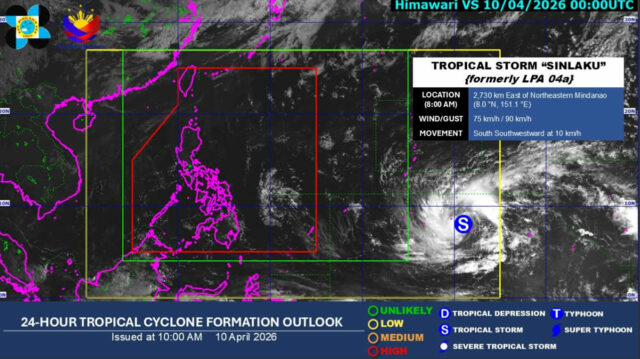
Tropical Storm Sinlaku (international name), which will be locally named Caloy, is likely to enter the Philippine Area of Responsibility (PAR) as early as Wednesday, according to the state weather bureau on Friday.

“It is possible that it may enter our PAR next week, between Wednesday and Thursday,” Leanne Marie Loreto, weather specialist of the Philippine Atmospheric, Geophysical and Astronomical Services Administration (PAGASA), said in a 5:00 am press briefing in Filipino.

Sinlaku was last located 2,730 kilometers east of northeastern Mindanao, moving south-southwestward at 10 kilometers per hour (kph), PAGASA said in its seperate 10:00 am tropical cyclone monitoring.

It intensified into a tropical storm on Thursday night, packing maximum sustained winds of 75 kph and gustiness of up to 90 kph during the monitoring period.

PAGASA said the storm may intensify into a typhoon and is not ruling out the possibility of it reaching super typhoon strength.

“We are seeing a lower chance of landfall… It is more likely to veer away or just skirt within the Philippine Area of Responsibility,” Ms. Loreto said.

She added that as Sinlaku enters PAR, it may cause rough sea conditions along the eastern section of the country due to strong winds.

Mr. Loreto also said that the forecast is still subject to change and the public is encourage to continuously monitor updates from PAGASA.

Meanwhile, in a separate threat potential forecast, PAGASA said Sinlaku is expected to generally move northwestward from Thursday until Wednesday next week.

It is likely to maintain this trajectory and “will pass through the northeastern portion of the PAR before recurving towards the southeastern coast of Japan” from April 16 to 22, PAGASA said.

Sinlaku, which will be named Caloy upon entering PAR, is the country’s third tropical cyclone this year and the first for the month of April.

PAGASA earlier said that around eight to 16 tropical cyclones are likely to form and enter PAR from April to September this year. — Edg Adrian A. Eva

[B-SIDE Podcast] VUL DEMYSTIFIED: Getting to Know a Misunderstood Insurance Product

Follow us on Spotify BusinessWorld B-Side

A fear of investing among many Filipinos has carried over to the insurance industry, where many are hesitant about variable unit-linked (VUL) insurance, since some advisors position it primarily as an investment vehicle.

In this episode of BusinessWorld B-Side, Sun Life Head of Insurance Investments Ivan Corcuera talks about the true value of VUL insurance, how it functions, and when it is best utilized.

Interview by Beatriz Cruz
Audio editing by Jayson John Marinas

Follow us on Spotify BusinessWorld B-Side

Philippines’ FDI net inflows slide to 4-month low in January

US dollar bills are seen on a light table at the Bureau of Engraving and Printing in Washington in this Nov. 14, 2014 file photo. — REUTERS

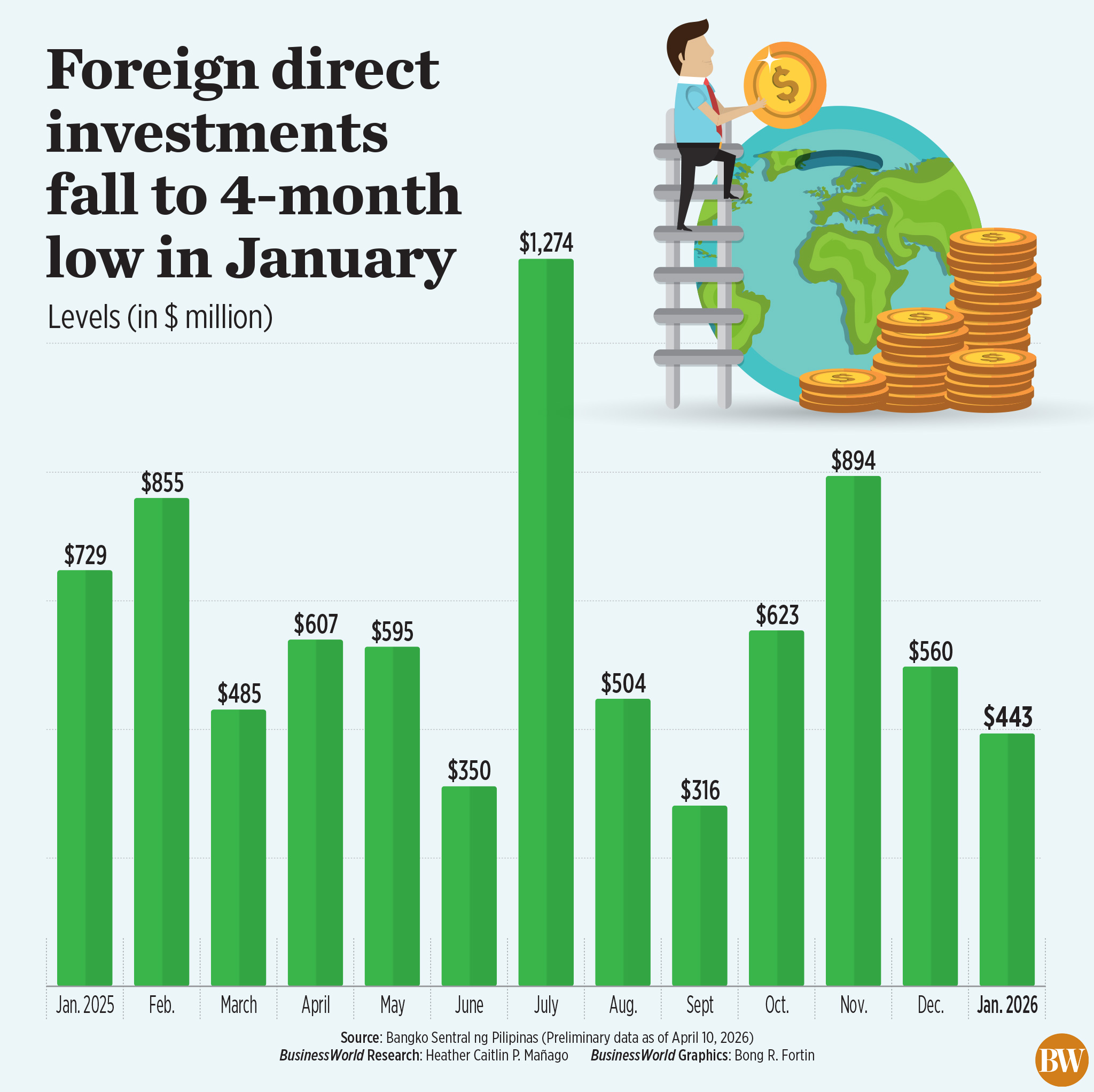
NET INFLOWS of foreign direct investments (FDI) slumped to a four-month low in January as geopolitical risks dampened investor sentiment, the Bangko Sentral ng Pilipinas (BSP) reported.

Preliminary data from the BSP showed FDI net inflows fell by 39.2% to $443 million in January from $729 million a year ago.

Month on month, net inflows declined by 20.9% from $560 million in December.

January saw the lowest monthly FDI net inflow since the $316 million in September 2025.

“This suggests that rising geopolitical risks are weighing on investor sentiment,” the BSP said in a statement.

BSP data showed foreign investments in debt instruments dropped by 38.4% to $320 million in January from $519 million a year ago.

FDI in equity and investment fund shares slid by 41.1% to $123 million in January, from $209 million a year ago.

Net equity other than reinvestment of earnings declined by 19.9% to $70 million from $88 million a year ago. Placements dipped by 8.8% to $93 million in January, from $102 million a year ago, while withdrawals jumped by 57% to $22 million in January from $14 million a year ago.

On the other hand, reinvestment of earnings plunged by 56.8% to $53 million in January from $122 million a year ago.

In January, Japan was the main source of FDIs, “with most inflows directed to the manufacturing industry.”

The BSP said equity placements were mainly from Japan, the United States, and South Korea. These were invested mostly in manufacturing, real estate, and wholesale and retail trade sectors.

FDIs account for foreign investors’ investments in local businesses where they hold at least a 10% equity capital, as well as investments by a nonresident subsidiary or associate in its resident direct investor. It can be in the form of equity capital, reinvestment of earnings or borrowings.

The BSP’s FDI data cover actual investment flows, compared to the Philippine Statistics Authority’s foreign investments data which include investment commitments that may not be fully realized in a given period.

Union Bank of the Philippines Chief Economist Ruben Carlo O. Asuncion said that the weaker January FDI “reflects continued investor caution amid elevated geopolitical risks, tight global financial conditions, and uncertainty over the global growth outlook, which appear to have weighed on intercompany funding flows.”

Mr. Asuncion said the current Middle East conflict may affect FDI inflows this year.

“Going forward, the ongoing Middle East tensions add to downside risks for FDI, as they could prolong volatility in energy prices and further dampen investor sentiment, suggesting near‑term inflows may remain uneven,” he said.

The central bank sees FDI net inflows reaching $7.5 billion by yearend, lower than the $7.791 billion net inflows seen in 2025. — Justine Irish D. Tabile

ADVERTISEMENT
ADVERTISEMENT