Home Blog Page 4180

For a fresh face

Avignon Clinic unveils Syndeo HydraFacial skincare treatment

THOSE with multiple skin concerns on any part of their face or body might find skincare a daunting task with many stresses. A visit to the dermatologist or the aesthetician, and the ensuing treatments they recommend, may seem like a huge hassle.

This scenario is what Avignon Clinic hopes to put a stop to, by offering an advanced, streamlined skincare procedure called the Syndeo Hydrafacial. It cleanses, extracts, and hydrates the skin in one treatment. First patented in the US as a hydraderm abrasion device in 2022, the aesthetic company behind it, Hydrafacial, is based in Long Beach, California.

In the Philippines, the Avignon Clinic has been around since 2019. With clinics in Bonifacio Global City, Quezon City, and Baguio City, its newest addition aims to give its many Filipino clients the latest technology in skincare.

Benedict Sy, co-founder and president of Avignon Clinic, thanked everyone at the Hydrafacial launch for continuing to seek out wellness and self-care solutions with them throughout the pandemic. “This new product is definitely going to be loved by many,” he assured.

One of Avignon Clinic’s longtime clients, model and Binibining Pilipinas International 2021 Hannah C. Arnold, told BusinessWorld that day that after she had first tried the treatment, she now actively seeks it out.

“I love that it is all in one. I’ve tried so many different treatments before that I used to come in and just ask for anything they have that is available,” she said. “The fact that everything is already in the Hydrafacial machine is amazing.”

The treatment actually has three steps, according to Gene Burdette, Hydrafacial’s director of portfolio and product management for Asia Pacific.

It starts off with surface cleaning, as with all facials. Then it continues on to the satisfying second step — deep cleaning — where dirt and debris are extracted from one’s pores.

Ms. Arnold shared that while it is gross to see all the gunk accumulate in the jar that collects whatever the suction cleans out, it’s ultimately a comforting process.

“It’s good to see how well they can clean your skin,” she said.

The machine can then be customized to deliver serums for the client’s specific skincare concerns, be it brightening dark spots, treating acne, or reducing wrinkles for an anti-aging effect.

The Syndeo Hyrdafacial is for people of all ages and skin types for this very reason, said Mr. Burdette. Because each step can be tailored per person, from the amount of treatment to the level of suction, it produces better results.

Depending on the optimizations included in the overall procedure, the treatment can cost from P5,000 to up to double or triple that — pricey, but it “delivers a quality experience.”

“It’s also the easiest device to use, allowing the provider to focus more on the treatment than messing around with the system,” he added.

However, the best thing about it is it can be used to treat skin on any part of the body, not just the face — “from head to toe, or how I like to call it, scalp to sole,” said Mr. Burdette. — Brontë H. Lacsamana

SRA batting for P2-billion budget to finance sugar industry dev’t

FACEBOOK.COM/VICTORIASMILLINGCOMPANY

THE Sugar Regulatory Administration (SRA) said it is batting for funding of P2 billion in 2024 to help it implement the Sugar Industry Development Act (SIDA).

“What we are trying to do now is before the year ends, is to try to seek approval for the 2024 budget so when the new year starts, we can start moving,” Administrator Pablo Luis S. Azcona said at a briefing last week.

Currently 50% of SIDA funds go to the construction of farm-to-market roads (FMR). The remaining funds are allocated to research and mechanization, socialized credit, block farm development, with 10% dedicated to scholarships.

“Currently, the block farm… scholarship and FMR (budgets are) fully utilized… The part that we hope we can fully utilize is socialized credit,” he said.

He added that the regulator is also pushing to improve soil laboratories to boost sugar production.

He pushed for more scientific methods of farming to make the industry more cost-efficient and globally competitive.

Mr. Azcona said that one of the reasons for the decline in SIDA funding was a three-year delay in purchasingof P500 million worth of machinery and equipment.

He added that this has been remedied by overhauling the procurement process.

SIDA, also known as Republic Act 10659, seeks to raise the competitiveness of the sugarcane industry and improve incomes of farmers and workers. — Adrian H. Halili

Community participation?

MARIO PURISIC-UNSPLASH

“Community participation” is one of the most hallowed concepts in rural reconstruction and development. It is regarded as the golden standard of people’s ownership and agency. Without community participation, development solutions become imposed from above and fail to be sustainable.

What happens, then, when community participation revolves around the involvement of poor and marginalized people in illicit and illegal activities? When poor Filipinos engage in illegal logging, illegal fishing, or smuggling across maritime borders, are they principals, accomplices, or victims of a crime? When hostages taken by kidnappers are kept in a remote village for months, are the local households who cooked food and cared for the hostages community participants and willing collaborators who are exercising their agency in a crime?

This phenomenon is by no means confined to the Philippines. As I discovered in my research, it happens too in many countries worldwide. Interestingly, there appear to be patterns of similarities and differences when the shadow economies of Mindanao are compared to illicit crop growing in Afghanistan, Myanmar, Colombia, and Bolivia. Philippine Rural and Reconstruction Movement (PRRM) President Edicio dela Torre acknowledged this adverse form of community participation and then asked if its direction could be changed and how.

One approach to tackling this question is to unpack, deconstruct, and restate the problems across the commodity chain and avoid a one-size-fits-all analysis. A commodity chain comprises the steps when an agricultural commodity or a natural resource — whether licit or illicit — transforms from production to consumption. The problems at each step or link in the chain can then be restated while the balance of interests and the balance of harms are reconsidered. New ways of approaching rural reconstruction can then be developed.

In the case of illicit crops, the first step in the commodity chain is cultivation. The problem at this step, as conventionally stated, is their growing. However, what needs to be asked is why poor peasants choose to grow illicit crops despite the risks it brings into their lives. Analysis of their contexts shows that the more fundamental problem is their economic marginalization and exclusion, thus they resort to illicit crops as their kapit-sa-patalim (translated as “holding on to a knife,” the equivalent to the saying “living on the razor’s edge”) strategy. The focus, therefore, should be on resolving their conditions of marginalization and exclusion to change the direction of their community participation.

The second step is the processing of the harvests. Criminologists typically state the problem as the existence of makeshift and jungle labs that transform opium gum into a morphine base, then heroin, and coca leaves into a coca base and then cocaine. The easy availability of precursor chemicals is flagged as a key part of the problem. A theme that has been ignored, however, is underemployment in rural areas.

The processing of illicit crops is very labor-intensive. When harvesting opium gum, for example, a peasant farmer needs to hire additional part-time farm workers. Processing coca leaves into coca paste is back-breaking work that household labor cannot supply. So why not restate the problem, and raise the issue of rural underemployment as well in addressing this second step? The existence of seasonal, migratory, and part-time rural workers may be the critical explanation why illicit crop growing emerges in some but not in other places.

Once the product is processed, the third step comes – cross-border smuggling and trafficking. It requires a longer elaboration, but the short version is that drug traffickers and other criminals, including corrupt public officials, also rely on the tools (company registration, asset registers, bank accounts) as well the enablers (lawyers, bankers, and accountants) for tax evasion and avoidance. Cracking down on tax avoidance schemes by introducing reforms, such as public registers of company beneficial ownership, will be critical in fighting cross-border drug trafficking.

When the product reaches its target markets for wholesale distribution, authorities often rely on price theory to predict trends in the drug market. Thus, tougher law enforcement means drug supplies will be removed from the market, forcing a consequent rise in prices and a decrease in demand. But this theory has been beset by a puzzling empirical anomaly: historically, the prices of heroin and cocaine have been declining despite intensified law enforcement globally. In addition, drug traffickers typically do not raise prices when faced with stronger law enforcement: they would rather switch smuggling routes, change delivery schedules, pay more bribes, or adjust purity — while keeping prices fixed. Hence, what needs to be considered is that drug lords prefer predictability to price changes.

The fifth step in the chain — retail distribution — is typically attributed to street-level criminality. An alternative analysis is to consider smart economics and a range of regulation options over prohibition.

There is much to learn from the experience of the alcohol ban in the US at the beginning of the 20th century. Prohibition created mafias and gangsters like Al Capone; regulation moved the control of alcohol from criminals to legitimate businesses that could be monitored.

Another example is the aftermath of the Opium Wars in China from 1839 to the 1860s. China, which officially banned opium, lost two wars to the British armada, which enforced the interests of British traders and investment houses — the world’s first drug cartels — in selling Indian-grown opium in China. But India soon lost out when Chinese farmers and merchants started growing and trading opium themselves, and not only made the product cheaper but also of better quality. In other words, import substitution, not military force, defeated the British-India opium trade.

The final step in the chain is consumption. Although China’s smart economics won the competition by the 1900s, it created widespread addiction and abuse throughout the region, including the Philippines.

After decades of prohibition, countless laws, and many wars on drugs, the problems remain. An alternative approach championed by harm reduction proponents is to manage addiction and abuse as a public health rather than a criminal crisis. Criminally charging drug users will barely reduce demand; they need to be offered public health solutions instead.

Groups like NoBox Philippines advocate strongly for the de-stigmatization of people whose lives include drugs. NoBox’s Maria Inez Feria suggests that instead of viewing them solely as passive recipients, subjects to be studied, problems to be solved, or “criminals” to be dealt with, development practitioners should see and engage with them as individuals with rights and dignity, and as potential partners in finding solutions. In other words, this is an area where community participation is essential.

Other groups, like the Addictus Research and Intervention Center, led by Jun Estacio of UP Manila, provide advice on longer-term harm reduction solutions, including ensuring sustainable after-care treatment following rehabilitation programs.

During the PRRM forum, I cited an example of why attitudes and public policy on drug use should change — the story of Manny Pacquiao, who rose from street-level drug user to world boxing champion.


Eric D. U. Gutierrez PhD is now an independent consultant who lives in Germany with his family. He is a registered Filipino voter at the Philippine consulate in Frankfurt.


Isuzu delivers Class 3 PUVs to Calapan

PHOTO FROM ISUZU PHILIPPINES

ISUZU PHILIPPINES CORP. (IPC) delivered 15 units of the NLR77 PUV Class 3 vehicle to the MIMAROPA Transport Cooperative, which serves commuters from Calapan City to Pinamalayan in Oriental, Mindoro. A first-time buyer of Isuzu, the cooperative decided to upgrade to the Isuzu model “to cater to the increasing number of commuters in the area and to align with LTFRB franchising guidelines for long-distance routes.”

MIMAROPA Transport Cooperative Chairman Albert Cayetano said, “We choose Isuzu because of its renowned durability, fuel efficiency and the fact that it is very easy to maintain. These modern PUVs will improve the quality of service that we provide to our customers in the area.”

The vehicle is powered by a 4JH1-TC Blue Power diesel engine that is durable and “very easy to maintain.” IPC claimed that parts are available nationwide, so users need not worry about vehicle downtime. Its body is built by Centro, and can accommodate up to 23 passengers. Compliant with PNS guidelines, the model is equipped with GPS, CCTV, speed limiter, dashboard camera, Wi-Fi, and automated fare collection system for the convenience of both the driver and passengers.

IPC Vice-President for Sales Yasuhiko Oyama said, “In Isuzu, we listen to our customers, so that we can provide the best business solutions. Considering the route and operational condition of the cooperative, the Isuzu NLR77 PUV Class 3 proves to be the best fit for them. Aside from our durable products, it is our excellent after-sales support that we strengthen the most, especially for fleet customers. We always make sure that our parts are readily available nationwide, and that we have dealership in strategic locations, then for those really far-flung, we service them via our Mobile Medic trucks. We know how important it is that their vehicle would have less downtime, so we support them as soon as possible.”

For more information, visit www.isuzuphil.com.

T-bill, bond rates may go up on rising oil prices

BW FILE PHOTO

RATES of Treasury bills (T-bills) and bonds on offer this week could climb further amid rising global crude oil prices due to the conflict in the Middle East.

The Bureau of the Treasury (BTr) will auction off P15 billion in T-bills on Monday, or P5 billion each in 91-, 182- and 364-day papers.

On Tuesday, it will offer P30 billion in reissued seven-year Treasury bonds (T-bonds) with a remaining life of six years and nine months.

T-bill and bond yields may track the increases seen at the secondary market on Friday due to higher global crude oil prices caused by the conflict between Israel and Palestine, Rizal Commercial Banking Corp. Chief Economist Michael L. Ricafort said in a Viber message.

At the secondary market on Friday, the 91-, 182-, and 364-day T-bills went up by 15.92 basis points (bps), 13.52 bps, and 6.47 bps week on week to end at 5.8711%, 6.1458%, and 6.3085%, respectively, based on PHP Bloomberg Valuation Service Reference Rates data published on the Philippine Dealing System’s website.

The seven-year bond also rose by 3.67 bps week on week to yield 6.5122%.

Oil prices rose on Friday, with crude soaring nearly 6%, on safe-haven buying driven by the escalating Middle East conflict as Israel urged civilians to leave the northern Gaza Strip, Reuters reported.

Brent crude surged by 7.5% in the week since the conflict began, posting its highest weekly gain since February, as investors priced in a chance of escalation in the world’s top oil producing region.

Yields could also be affected by policy signals from the Bangko Sentral ng Pilipinas (BSP) and US Federal Reserve, a trader said in an e-mail.

BSP Governor Eli M. Remolona, Jr. last week said the Monetary Board is open to hiking borrowing costs by 25 bps in their meeting next month following faster-than-expected September inflation.

The Monetary Board has kept the benchmark interest rate at 6.25% for four straight meetings after it hiked borrowing costs by 425 bps from May 2022 to March 2023 to help tame inflation.

Its next meeting is on Nov. 16.

Meanwhile, the Fed kept its benchmark rate unchanged at the 5.25% to 5.5% range at its Sept. 19-20 meeting. It has hiked rates by a cumulative 525 bps since it began its tightening cycle in March last year.

The Federal Open Market Committee will hold its next policy review from Oct. 31 to Nov. 1.

Last week, the BTr raised just P12.518 billion via the T-bills, short of the P15-billion program, even as total bids reached P22.564 billion.

Broken down, the Treasury borrowed only P4.788 billion via the 91-day T-bills even as tenders for the tenor reached P6.898 billion. The average rate of the three-month paper rose by 10 bps to 5.806%. Accepted rates ranged from 5.74% to 5.875%

The government raised just P4.41 billion from the 182-day securities, despite bids for the tenor reaching P7.646 billion. The average rate for the six-month T-bill was at 6.115%, up by 9.2 bps, with accepted rates at 6% to 6.175%.

Lastly, the BTr awarded P3.32 billion in 364-day debt papers, below the P5-billion plan, despite demand for the tenor reaching P8.02 billion. The average rate of the one-year T-bill rose by 9 bps to 6.305%. Accepted yields were from 6.275% to 6.325%.

On the other hand, the reissued seven-year bonds to be offered on Tuesday were last auctioned off on Sept. 12, where the government raised just P9.877 billion out of the planned P30 billion. The papers fetched an average rate of 6.37%.

The Treasury wants to raise P150 billion from the domestic market this month, or P60 billion via T-bills and P90 billion via T-bonds. — AMCS with Reuters

Globe says unit set to build generative AI products

BW FILE PHOTO

GLOBE TELECOM, Inc. said its corporate venture builder,  917Ventures, is set to build generative artificial intelligence (AI) products as it taps more technologies for its telco-to-techno strategy.

“We are building generative AI products to strengthen our tech capabilities. For 917Ventures, the goal is to really strengthen our telco-to-techco strategy and to build the next generation of great companies in the country by maximizing all of the assets of the Globe Group,” Vince Yamat, 917Ventures managing director, said in a media release on Sunday.

It will also continue to expand its digital health product—KonsultaMD, 917Ventures said, adding that it has an optimistic outlook for its B2B software as a service.

“Generative AI holds the potential to revolutionize how people and organizations create, innovate, and operate, making processes more efficient, personalized, and forward-thinking,” 917Ventures said.

Many companies have been tapping generative AI as part of its growth strategy. Globe’s telco to techno strategy refers to its plan of entering into fintech, health tech, edutech, climate tech, adtech, shared services, investments and entertainment.

By the fourth quarter of the year, 917Ventures expects to launch in Metro Manila its smart scooter and battery-swapping technology, which is its collaboration with Ayala Corp. and Gogoro.

“With its strategic move into generative AI, coupled with its ongoing initiatives in various sectors, 917Ventures continues to solidify its position as a leader in technological innovation and entrepreneurship,” it said. — Ashley Erika O. Jose

Style (10/16/23)


Coach opens new store at Greenbelt 5

COACH recently opened its new store on the ground floor of Greenbelt 5 Mall in Makati. The space was designed to create an elevated shopping experience that blends the house’s heritage design language with expressive aesthetic pops that evoke the playful spirit of today’s generation. The store will house the latest Coach Shine collection, which introduces the iconic Tabby and new Penn bag available in metallic and patent iterations, as well as the “Coach Shapes” bags in playful and expressive silhouettes. It also includes a curation of Coach men’s pieces at the house’s pop-up store.


Philip Stein offers PHL-exclusive Disney watches

TO MARK Disney’s 100th year, luxury watch brand Philip Stein has partners with the House of the Mouse to mark this milestone with limited edition watches, exclusively available in the Philippines. The two timepieces feature Mickey Mouse, one which showcases Mickey donning a classic barong on the dial. The other design features Mickey in his signature ensemble — in striking red shorts, large yellow shoes, and white gloves. The watches feature a 38mm case size that can be worn by any gender, stainless-steel bracelet, quartz movement for precision, 3ATM water resistance and scratch-resistant sapphire glass for everyday use, and a luxurious mother-of-pearl dial. They also come with Philip Stein’s proprietary Natural Frequency Technology, that is meant to bolster the body’s innate bio-magnetic field. Since it’s a limited edition offering, each Disney x Philip Stein watch comes individually numbered — there are only 500 in existence. The timepieces also come in special Disney-themed boxes featuring Mickey Mouse on the label and an added small button in the shape of Mickey’s iconic mouse ears. The collection is exclusively available at Philip Stein boutiques nationwide.


Fendi reimagines the classic Peekaboo

FENDI gives the classic Peekaboo bag a colorful twist as it adds shearling to its signature interlace workmanship. Designed by Silvia Venturini Fendi — Fendi Artistic Director of Accessories and Menswear — since 2008, the Peekaboo has become a hallmark expression of Roman craftsmanship fused with an intimate sense of Fendi womanhood. It embodies sophistication, excellence and, Fendi’s DNA of mastery of materials. The new capsule collection has the ISeeU Medium spiced up by delicate touches of dusty tones for the bicolor versions, matching white with taupe, a warm brandy color and taupe, and dark brown with light blue, while a brighter shade of pink dresses a ton sur ton interlace. The Peekaboo ISeeU Petite versions follow the same color palette, but instead features a plain shearling quadrant. Complementing the bags, matching shearling straps enhance the full look of the Peekaboo, while Nano Peekaboo charms and a golden chain strap can be mixed and matched to accessorize the bags. It takes around 15 hours of handwork to craft a Peekaboo ISeeU Medium including the hand-drilling of 630 holes, and each bag uses around 4.5 meters of shearling and leather. The Small version requires 11 hours to be crafted, with 412 holes and more than three meters of shearling and leather. The bags will be available in Fendi boutiques worldwide and on fendi.com this month.


Uniqlo x JW ANDERSON collection launches in Nov.

UNIQLO will launch the 2023 Fall/Winter Uniqlo and JW Anderson collection on Nov. 10. This collaborative collection takes its inspiration from a rich tapestry of British traditions and the camaraderie of university life. “For this season, I set out to blend classic British styles and vintage collegiate-inspired outfits with more modern elements and technical fabrics for a contemporary streetwear look. I have always loved adding unexpected twists to traditional styling, and I am very pleased with what we and UNIQLO achieved with this latest collaboration,” designer Jonathan Anderson said in a statement. The collection includes a trench coat whose oversized fit works well with unisex styling, while the women’s duffle coat is in a classic, yet in-trend short length. Another traditionally preppy item for everyday wear is a women’s Oxford Shirt incorporating JW Anderson embroidery on the chest. Boa fleece parkas in deep base hues and checkered patterns, and knitwear with forest animal motifs, offer seasonal touches. The collection also includes HEATTECH socks, a light and fluffy souffle yarn knitted beanie, and other functional winter essentials. All in all, the collection features 12 items for women, 12 for men, and four accessories. The full line will be available at the Uniqlo Manila Global Flagship Store, Uniqlo SM Megamall, Uniqlo C3 Annex, Uniqlo Alabang Westgate and online through uniqlo.com. Select items will be available in all Uniqlo stores nationwide.  View the items at the special UNIQLO and JW ANDERSON website: https://www.uniqlo.com/ph/en/contents/collaboration/jwanderson/23fw/


Ever Bilena’s colorful solution to chapped lips

EVER BILENA Plus has launched the new Serum-Infused Tinted Lip Balm to give dry lips the TLC (tender loving care) they need with an added touch of color. The new EB Plus Serum-Infused Tinted Lip Balm is formulated with Vitamin E, shea butter, and hyaluronic acid that help soothe and hydrate lips while giving a pop of color. It comes in four shades: Latte (light terracotta), Bloom (a mauve-y red), Toast of New York (mauve), and Naked (nude pink). This Korean-made tinted lip balm is also vegan, cruelty-free, and paraben-free. The Ever Bilena Plus Serum-Infused Tinted Lip Balm is available for P245 on Ever Bilena’s official Shopee and Lazada stores, Watsons branches nationwide, and all leading department stores nationwide.

Design Week Philippines goes nationwide

NOW ON its 12th year, Design Week Philippines returns with simultaneous events in five cities across the country — Quezon City, Makati, Mandaluyong, Pasig, Pasay, Cebu, and Iloilo — and the provinces of Surigao del Norte, Rizal, Pangasinan, Negros Occidental, Leyte and Cavite. from Oct. 14-21. The week-long event will feature talks, workshops, and tours, with a lineup of over 40 speakers and at least 50 events. It is expected to draw 7,000 participants. The first activity is a lecture series called “The State of Philippine Design” with speakers including Gil Carungay who chairs the MATIC Hub in Cebu City; Haraya del Rosario-Gust, the pioneer of creative process outsourcing in the country; and fashion designer Emi Englis, who co-founded the Davao Fashion and Design Council Foundation. The Artisan Showcase in Leyte includes the ResiDisenyo collection. Meanwhile, Design Sari Sari is an eclectic marketplace that will serve as a melting pot for makers, independent retailers, and communities of creatives and artisans to be able to promote their products. “Design Playground” is an exhibition that explores the power of design to heal, transform, and innovate.  Design Live: Music a rave-type party, will close out the Design Week Philippines festivities for this year. Workshops during the week include Designing your career: Folio Reviews, a one-on-one consultation for students and aspiring designers; Designing the Design Studio; Co-designing with community; and Designing for well-being, among many others.

As farmgate prices drop, sugar farmers deal with dwindling earnings for their cane harvest

PHILSTAR FILE PHOTO

By Adrian H. Halili, Reporter

THE decline in sugar farmgate prices is squeezing small farmers, who have no choice but to take what traders are willing to bid for the cane they harvest from their handful of hectares.

Loreta Inson, a sugar farmer from La Carlota City, Negros Occidental, told BusinessWorld that traders offered about P30,000 for the 13 metric tons of sugarcane harvested from her land.

“From our 38.5-hectare farm, we were able to harvest about 13 metric tons of sugarcane…we spent about P25,000 on fertilizer, labor, and hauling,” she told BusinessWorld.

She said she netted between P4,000 and P5,000 from the sale.

“Whatever is left we would use it again for capital because sugar prices are low… If prices were steady, maybe we could break even,” she said.

Ms. Inson said that with the onset of the dry conditions brought on by El Niño, yields are likely to decline.

Farmer incomes are on the line with every government decision to import sugar, adding to the supply of the commodity, which in turn reduces their bargaining power with the traders buying their crop.

The government, in turn, blames high sugar retail rices for its import decisions, suggesting that it has had to weigh the interests of producers against those of consumers.

Against this backdrop lie allegations of price manipulation somewhere along the supply chain, with the low farmgate prices not showing in the retail selling prices.

Vimaca Farmers Producers Cooperative Regional Manager and Corporate Secretary John Pedrosa said imports are mainly behind the decline in selling price for raw sugar.

“At the start of milling season, there were about 10 million bags of refined sugar with an additional of 2 million coming in, so you can just imagine how its going to affect the prices (at the farm level). There are excessive imports of refined sugar and it has also affected the cost of raw,” Mr. Pedrosa told reporters in a briefing organized by the Sugar Regulatory Agency (SRA) over the weekend.

He said importers are selling the commodity at a much lower price than domestic sugar, reflecting the more efficient sugar industries of the source countries.

As such, imports effectively deny domestic farmers access to a segment of the consumer market, leaving Philippine farmers to sell mainly to processors, the main market for raw sugar.

He said instances of “failure of bidding” are not uncommon if the prices offered by traders are too low.

“Sometimes we just give advances to the planters so that they have money for the next bidding round; that’s the worst-case scenario,” he said.

The SRA reported that raw sugar is trading below its target of P3,000 per bag. Raw sugar is averaging between P2,500 to P2,700 per bag.

SRA Administrator Pablo Luis S. Azcona said that even though farmgate prices for sugar are declining, retail prices remain stable.

Mr. Azcona added that the SRA is also looking into possible price manipulation, ordering an investigation into sugar held in warehouses.

The SRA last week, delayed the release of about 150,000 metric tons of imported sugar to ensure fairer prices for farmers.

Johnny’s, the ‘Moonies,’ and the Japanese media’s influence

JOHNNY & ASSOCIATES headquarters in Minato, Tokyo (1998–2018) — EN.WIKIPEDIA.ORG -MOMOTAROU2012

THE RECENT downfalls in Japan of the Unification Church and J-pop agency Johnny & Associates, Inc. seem to be, on the face of it, victories for justice: Two odious groups that used their outsized clout for years to cover up noxious acts have at last been hobbled, if not eliminated.

The country won’t miss the church, whose followers are often derisively called  “Moonies,” after founder and supposed-messiah Sun Myung Moon. It’s now set to be dissolved in Japan after an investigation into its forced donations. Nor will it mourn Johnny’s (as the agency is known), which is changing its name, structure, and management after a decades-old sexual abuse scandal perpetrated by its founder, Johnny Kitagawa. Few could have predicted 18 months ago that both institutions, whose tentacles run deep into Japanese society, would be chopped down to size. Though each will live on in other forms, their impact will be severely diminished.

While their fates are well-deserved, the methods of their undoing, and the media’s role in it, were quite different. And there will be consequences for the convenient, news-fueled rush job that felled the Unification Church only because it was elevated in the public sphere by the most high-profile assassination in modern times.

There was introspection from the Japanese media for its failure to investigate well-established rumors of Kitagawa’s sexual abuse of aspiring pop stars. The downfall of Johnny’s came only as the result of a BBC investigation, albeit built on the work two decades ago by the Shukan Bunshun weekly magazine. It was long overdue; his victims may have numbered in the hundreds, with Kitagawa using his influence to keep them quiet until his death in 2019.

The media failed to expose him in life partly because of TV networks’ closeness and dependence on his stable of stars. It’s tempting to draw on stereotypical outlines of Japanese society — perhaps invoking hierarchical relationships, a seniority-based culture and sontaku — but the story is sadly familiar anywhere, usually featuring a powerful figurehead to whom too many were willing to turn a blind eye. There are numerous similarities to the Jimmy Savile scandal in the UK, which likewise had been whispered about for decades but only came to light after his death. The simple fact in both cases is the media and the public, for the most part, simply didn’t want to know.

Japanese media outlets have been asking themselves what happened. But there has been no such introspection for its complicity in another scenario — that of the eerily similar attack on Prime Minister Fumio Kishida in April, less than a year after Shinzo Abe was murdered. This is why the dissolution of the Unification Church announced this week is concerning: Like Johnny’s abuses, the church’s connections to power and onerous tactics were well known, at least by those in the know. It was only after Abe was killed — by an attacker who blamed his impoverished upbringing on his mother’s lavish donations to the church — that the media, and thus the authorities, became interested.

The church’s links with the ruling Liberal Democratic Party became a national scandal, threatening to take down Kishida’s government — even though his involvement with the sect was nonexistent, and Abe’s was tenuous at best. (He wasn’t a member; the shooting suspect, Tetsuya Yamagami, decided to target the former premier after seeing a video message Abe delivered to a church affiliate in 2021.)

Yamagami’s ultimate target was the church nonetheless. And in that respect, he was more successful than he could have dared to dream. While some politicians indeed had a curiously close relationship to the religion, many who were tarred with having “ties” did nothing more than send congratulatory telegrams or show up at meetings the church participated in — in other words, the type of glad-handing of prospective voters that every politician must engage in. Attending a meeting isn’t an endorsement; many attend events organized by those they don’t agree with, and perhaps even despise.

That nuance was lost in the media pile-on, which some have described as the modern equivalent of fumi-e — the practice during shogun-era Japan of forcing suspected Christians to tread on images of Jesus Christ or Mary to prove they weren’t devotees. In a cynical level of maneuvering, targeting the church to save their own skins, the LDP forced its members to cut ties despite the constitutional rights to freedom of religion, association, and assembly.

That’s not how justice should work, even if the UC’s fate is deserved, and it benefits voters to know who is influencing their politicians. It’s unclear what separates the church from other cultish “new religions” that haven’t been targeted, or why its supposed influence on policy is such an issue while it’s not in the case of, say, the Soka Gakkai Buddhist sect, whose political arm is the Komeito party, the junior partner in government. And it’s ironic that in a country where, before World War II, assassinations were a common political tool, no one has stopped to consider the ramifications of beatifying Abe’s killer to the point where the church will now be dissolved.

We should be intensely wary of the precedent that this threatens to establish: Going about things the “proper” way, as with Johnny’s — with police complaints, media tip-offs, and evidence — could take years, even decades, for justice to run its course. If you want fast results, Yamagami has shown the way. The security procedures that doomed Abe seem to be little changed, and the suspect required little more than a 3D printer and luck.

Kishida’s attempted killer may have lacked on the last part, but it’s impossible to look at the two cases and think that one wasn’t inspired by the other. Just as the industry has reconsidered its failure in the case of crimes like Johnny Kitagawa’s, it should reflect on its involvement in promoting the manifestos of assassins.

BLOOMBERG OPINION

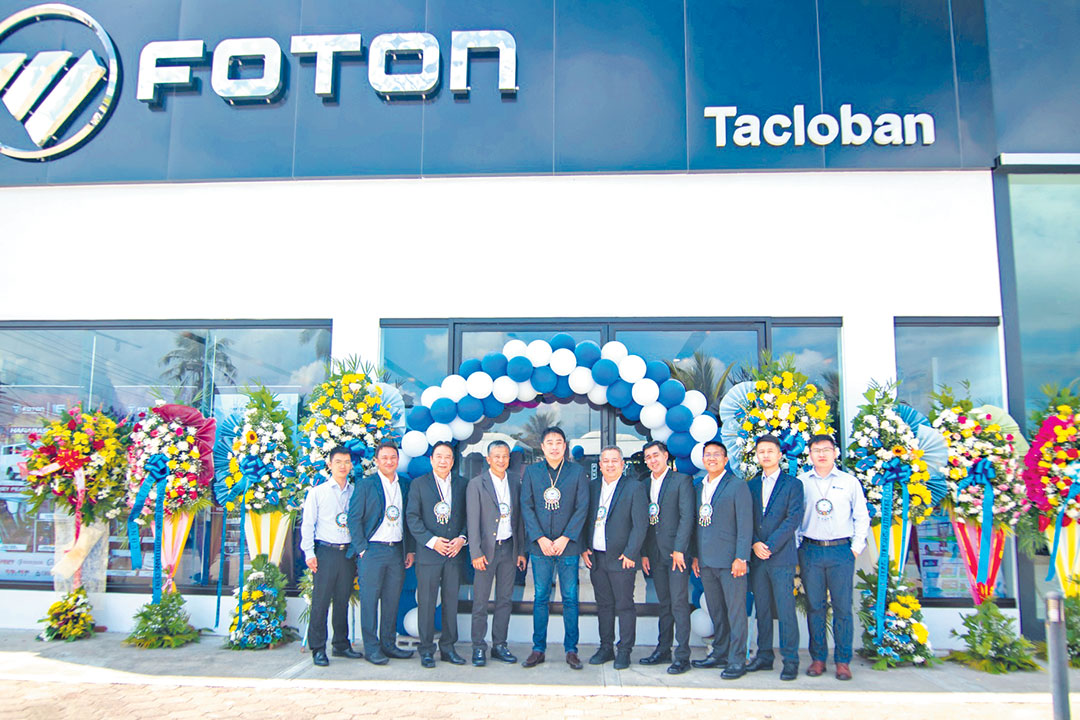
Foton Tacloban now open

Executives of Foton Philippines and Foton Tacloban pose in front of the showroom.

FOLLOWING what it described as the “rapid growth of new businesses and enterprises outside Metro Manila and the rest of Central Luzon,” Foton Motor Philippines continued to expand its dealership network with the opening of Foton Tacloban.

The largest commercial vehicle manufacturer in Asia is now in Eastern Visayas, with a brand-new showroom that can accommodate three display units, a modern and spacious reception area, and a fully equipped service area in the heart of Leyte and Samar.

Said Foton Motor Philippines Chairman Rommel Sytin, “We are honored to have the opportunity to help drive the region’s mobility with our wide range of commercial vehicles, which are now more easily accessible to the people, businesses, and local government units of Tacloban and its neighboring towns.”

“We look forward to rendering our world-class vehicles and service to the people of Leyte and Samar, and helping empower the lives and businesses of the people of these vibrant provinces,” added Foton Motor Philippines General Manager Levy Santos.

Topcars Autoworld Corp. is the company behind Foton Tacloban. “I would like to express our heartfelt appreciation to Foton Philippines for the appointment as dealer for the provinces of Leyte and Samar,” said Foton Tacloban Chairman Willard Chan. “This appointment will help us serve and address the growing demands of the auto industry and align with government directions for a safe and quality transport services for the commuting public,” he added.

With the availability of a “generous inventory” of automotive spare parts, Foton Tacloban offers easy and convenient access to genuine parts at affordable prices. Foton Tacloban also promises to provide reliable and hassle-free after-sales support, accompanied by well-trained technicians and a comprehensive array of automotive service equipment.

Foton Tacloban is located along National Highway, Barangay Pawing Palo, Leyte with contact numbers 0919-845-2376 and 0975-973-3248. For more information, call the sales hotline at 0999-999-9998, or go to https://www.facebook.com/FOTONPhilippines.

BSP approves four regular branches in the 2nd quarter

BW FILE PHOTO

THE BANGKO SENTRAL ng Pilipinas (BSP) approved less regular bank branches in the second quarter versus a year ago, according to a circular letter signed by BSP Deputy Governor Chuchi G. Fonacier on Oct. 11.

The Monetary Board approved applications for new banking offices of five banks in the second quarter, with two being thrift banks and three being rural banks.

Among the five banks that applied, the BSP allowed China Bank Savings, Inc. to put up two regular branches in Cavite.

The Monetary Board also allowed First Isabela Cooperative Bank to set up two regular branches — one in Tarlac and the other in Pangasinan. 

The four regular branches approved in the second quarter were less than the five permitted in the same period in 2022, but more than the three approved in the previous quarter.

Meanwhile, there were 39 branch lite units (BLUs) approved in the April-to-June period this year. The applications were from BPI Direct BanKO, Inc., A Savings Bank, Lifebank – A Rural Bank, and Rural Bank of Escalante (Negros Occ.), Inc.

The 39 BLUs approved in the second quarter was below the previous quarter’s 75 applications but above last year’s 34 approved BLUs.

Sixteen lenders also opened new banking offices in the second quarter. There were nine regular branches that opened for the first time during the period, while banks opened 42 BLUs.

Universal and commercial banks, namely China Banking Corp., Hongkong and Shanghai Banking Corp., and Security Bank Corp., opened three regular branches in the second quarter.

Rural and cooperative banks opened six regular branches. These were BOF, Inc. (A Rural Bank), Cooperative Bank of Bohol, First Imperial Business Bank, Inc. (A Rural Bank), and Rural Bank of Rizal (Zamboanga del Norte), Inc. — K.B. Ta-asan

D&L Industries targets sustained good corporate governance

LISTED D&L Industries, Inc. is aiming to sustain its good corporate governance practices after its recent citation from the Institute of Corporate Directors (ICD), according to its top official.

“As a company, it’s our top priority to uphold the highest standards of good corporate governance. We see it as the solid foundation for a sustainable and lasting organization,” D&L President and Chief Executive Officer Alvin D. Lao said in a statement over the weekend.

Mr. Lao said this as D&L Industries was recently recognized by the ICD, alongside other Philippine publicly listed firms, with the Golden Arrow award for good governance practices under the ASEAN Corporate Governance Scorecard (ACGS).

The recognition marks the fourth consecutive year that D&L Industries has received the award from the ICD.

According to D&L Industries, the ACGS looks at the performance of companies on facilitating the rights and equitable treatment of shareholders, ensuring transparency and accountability via the timely disclosure of material information, and maintaining the board’s accountability to the companies and their shareholders, among others.

The ICD is a nonprofit national association of corporate directors and other stakeholders engaged in corporate governance. The group seeks to be the key catalyst in the Philippine corporate governance ecosystem for inclusive and sustainable development.

D&L Industries has business interests in product customization and specialization for food, chemicals, plastics and consumer products for original design manufacturing industries. The company is engaged in activities such as the production of customized food ingredients, specialty raw materials for plastics, and oleochemicals for personal and home care use.

Shares of D&L Industries were last traded on Oct. 13, closing unchanged at P6.40 apiece. — Revin Mikhael D. Ochave