Home Blog Page 4142

PhilMech to provide P95.4M worth of rice processing equipment to N. Ecija farmers

THE Philippine Center for Postharvest Development and Mechanization (PhilMech) said it will deliver P95.4 million worth of rice processing systems to farmers in Nueva Ecija.

In a statement, PHilMech said signed several agreements to deliver equipment to the farmers, representing the first batch of such deliveries this month.

PhilMech will also deliver about P61.4 million worth of equipment to the local government of Muñoz, Nueva Ecija. The package will consist of two recirculating dryers and a multi-pass rice mill.

The province will also receive two six-ton recirculating dryers and a 1.5-ton per hour multi-pass rice mill worth about P18 million.

The agency has also signed agreements with Quezon, Tarlac, and Bulacan provinces to provide equipment to rice farmers.

PhilMech has turned over P43 million worth of machinery to Tarlac, and to two municipalities in Bulacan.

Parts of Quezon will also receive equipment valued at P16 million, consisting of a 12-ton recirculating dryer and a 1.5-ton per hour multi-pass rice mill.

PhilMech supplies equipment to modernize rice farming using funding from the Rice Competitiveness Enhancement Fund. — Adrian H. Halili

Japan donates vaccine logistics equipment valued at P260 million

THE Japan International Cooperation Agency (JICA) said it provided P260 million worth of cold chain equipment to the Department of Health (DoH) to preserve the efficacy of vaccines kept in storage.

“This cooperation aims to strengthen the Philippines’ cold chain management and logistics for an efficient vaccination system in cases of outbreaks,” JICA said in a statement.

The donation includes eight refrigerated vans, 17 delivery vans, 17 pickup trucks, 18 wing vans, 500 biothermal packaging systems and 140 ice pack freezers.

“JICA is always in solidarity with the Philippines especially in facing crises such as COVID-19. Our cold chain and logistics support in the vaccine rollout and delivery even to the remotest areas aims to ensure that no one is left behind,” JICA Chief Representative Sakamoto Takema said.

“Our lesson from COVID-19 is that safe and effective vaccinations in record time boosts the population’s resilience, and stimulates economic activities,” he added.

The equipment and vehicles will be deployed at DoH facilities nationwide.

In 2022, JICA donated an earlier batch of cold chain equipment to the Philippines.

According to the Japanese embassy in the Philippines, Japan has provided over $100 billion in COVID-19 support. These include vaccines, medicine, equipment, technical assistance, and budgetary support, among others. — Luisa Maria Jacinta C. Jocson

World Bank urges Asia-Pacific to improve EdTech accessibility

REUTERS

LEARNING outcomes in the East Asia-Pacific region can improve with the use of educational technology (EdTech), which however be made more accessible and be accompanied by improved teaching quality, the World Bank said.

“Low levels of engagement with learning during school closures overall were compounded by unequal access to EdTech,” it said in its ‘Using Education Technology to Improve Student Learning in East Asia Pacific: Promises and Limitations’ report.

Some 41% of respondents to a study in the Philippines reported engagement in online or mobile learning activities when schools were closed. In the rural Philippines, this was only 25%.

The World Bank also cited a joint survey with the Center for Global Development (CGD), which showed that more than half of the decision makers at the education and finance ministries in the Philippines, Indonesia, Laos, Mongolia, and Vietnam acknowledged that EdTech “did not benefit all children equally.”

“Among those who did not find EdTech effective, 37% cited a lack of access to electronic devices (PC/tablet/laptop) as the primary cause,” it added.

A survey also determined that 18.9% of Filipino households said that the lack of access to devices was the main barrier to learning during the pandemic.

“The evidence is clear that investing in hardware like laptops, tablets and computers without complementary investments in connectivity and most importantly teacher training are unlikely to improve learning,” the World Bank said.

It cited recommendations such as using remote instruction in the event of short supply of high-quality teachers; exploring the use of Artificial Intelligence interventions; and developing and expanding interventions using assistive technology for learners with disabilities, among others. — Luisa Maria Jacinta C. Jocson

BIR assessments related to employee reimbursements

Employees can sometimes find themselves in the position of having to pay for business-related expenses out of their own pockets. Such transactions can include transportation expenses and office supplies, for which they would later seek reimbursement from their employers.

Regardless of how business practices change, there remain firm rules in place that will affect how taxpayers or employers approach these “business-related expenses” in terms of deductibility. Some of the most common Bureau of Internal Revenue (BIR) audit findings have to do with expenses which were not subjected to expanded withholding taxes (EWT) and expenses that were improperly substantiated, leading to the disallowance of a Value-Added Tax (VAT) claim. Hence, the following questions arise:

1) What happens during BIR Audits? and

2) How should employers treat such expenses moving forward?

WHAT HAPPENS DURING BIR AUDITS?
BIR-driven Tax Assessments typically start with the issuance of a Letter of Authority (LoA), in which the assigned examiner compares the expenses reported on the taxpayer’s books, such as the audited financial statements or the taxpayer’s trial balance, against the expenses claimed in the tax returns. Any resulting difference could lead to a deficiency tax if caused by a non-deductible expense or unaccounted income.

One of the most common findings by the BIR are expenses that were not subjected to EWT pertaining to employee reimbursements. As a result, a deficiency in EWT remittance plus penalties and interest will be exacted by the BIR on the taxpayer, with such expenses possibly disallowed as deductions from gross income in the income tax return (ITR).

HOW SHOULD EMPLOYERS TREAT SUCH BUSINESS-RELATED EXPENSES?
In order to appropriately identify how taxpayers can resolve such issues, let us look into the regulations related to the withholding of employee-reimbursed business expenses. Section 2.78.1 6(b) of Revenue Regulations (RR) No. 2-98 as amended, states that any amount paid specifically, either as an advance or an item to be reimbursed for travel, representation, and other bonafide ordinary and necessary expenses incurred or reasonably expected to be incurred by the employee in the performance of his duties are not compensation subject to withholding, if the following conditions are satisfied:

(i) It is for ordinary and necessary traveling and representation or entertainment expenses paid for or incurred by the employee in the pursuit of the trade, business or profession; and

(ii) The employee is required to account/ liquidate the foregoing expenses in accordance with the specific requirements of substantiation for each category of expenses pursuant to Sec. 34 of the Tax Code. The excess of actual expenses over advances made shall constitute taxable income if such amount is not returned to the employer. Reasonable amounts of reimbursements/ advances for traveling and entertainment expenses which are pre-computed on a daily basis and are paid to an employee while he is on an assignment or duty need not be subjected to the requirement of substantiation and to withholding on compensation.

Now that we are enlightened as to what will form part of the employees’ taxable income, let us move forward as to the effect of such reimbursements to the employers.

SUBSTANTIATION AND WITHHOLDING REQUIREMENTS
Accordingly, for taxpayers to legitimately claim such ordinary and necessary expenses, Section 34 of the National Internal Revenue Code (NIRC) as amended, specifies that to claim a deduction from gross income, the taxpayer must substantiate with sufficient evidence, such as official receipts or other adequate records, (i) the amount of the expense being deducted, and (ii) the direct connection or relation of the expense being deducted to the development, management, operation, and/ or conduct of the trade, business or profession of the taxpayer.

Furthermore, Revenue Memorandum Circular (RMC) No. 72-2004 clarified that taxpayers classified as top 20,000 corporations (TTC)/as large taxpayers (LT) should subject payments made to their regular suppliers which were shouldered by their employees/agents to an EWT of 1% on purchase of goods or 2% on purchase of services. The RMC further clarified that the sales invoices/official receipts should be in the name of the persons whom they represent and that the corresponding certificate of taxes withheld at source (BIR Form No. 2307) is issued. There is another option for taxpayers to eliminate the complexity of the administrative task of compliance, one of which is for taxpayers to issue a company credit card to employees, since no withholding is required for transactions paid with company-issued credit cards.

Moreover, should the taxpayer/employer fail to subject such employee reimbursements to EWT, it would not only give rise to various tax penalties but, as a significant effect, a possible disallowance of such expenses against gross income. Nevertheless, as a remedy should the BIR raise a non-withholding or under-withholding issue resulting in the disallowance of the expense, Revenue Regulations (RR) No. 6-2018 reinstated the provisions for deductibility as stated in RR No. 14-2002. In the said RR, any income payment that is otherwise deductible under the Tax Code will now be allowed where no withholding was made, as long as the withholding agent pays the tax (or the difference between the correct amount and the amount of tax withheld, in the case of an erroneous under-withholding), including the interest and surcharges incident to non-withholding (or under withholding), at the time of audit/investigation or reinvestigation/reconsideration. In a Court of Tax Appeal decision, the Court held that the audit/investigation or reinvestigation/reconsideration had been concluded when the Final Decision on Disputed Assessment (FDDA) was issued. It is prudent, therefore, to settle the deficiency withholding tax at least before the issuance of the FDDA to be able to claim the related expense.

In addition, with the consideration of audit findings related to VAT, taxpayers should also keep in mind the appropriate invoicing requirements as part of the substantiation requisites since improper supporting documents and improper invoicing requirements could as well result to audit findings related to VAT. Commonly, such findings pertain to 1) failure to support purchase of services with an official receipt and as well failure to support purchase of goods transactions with a sales invoice, 2) failure to separately indicate the input VAT in the receipt, and 3) failure to properly indicate the required taxpayer’s information such as the registered name, taxpayers identification number (TIN), the registered business address, and the business style or trade name of the taxpayer in the Sales Invoice (SI) or Official Receipt (OR).

Due to the complex nature of the substantiation and invoicing requirements, companies could issue a policy regarding employee reimbursements, denying reimbursement if employees fail to meet the substantiation and invoicing requirements.

Finally, due to the growing complexity of day-to-day business transactions and as businesses move towards globalization, it is time that the BIR issues guidelines to ease the process of withholding taxes on employee reimbursements. Until then, taxpayers staying updated with and informed of the tax rules won’t be sufficient to keep up with the evolution of business and tax practices. Taxpayers should as well become proactive in conducting their internal tax compliance audits in order to revisit internal tax policies and align with the ever-changing landscape of Philippine taxation. As stated by the Greek philosopher Heraclitus, the only constant thing in life is change.

Let’s Talk Tax is a weekly newspaper column of P&A Grant Thornton that aims to keep the public informed of various developments in taxation. This article is not intended to be a substitute for competent professional advice.


Cydnie C. Hieras is a senior in charge of the Tax Advisory & Compliance Practice Area of P&A Grant Thornton. P&A Grant Thornton is one of the leading audits, tax, advisory, and outsourcing firms in the Philippines, with 29 Partners and more than 1000 staff members.

Tweet us: @GrantThorntonPH

Facebook: P&A Grant Thornton

pagrantthornton@ph.gt.com

www.grantthornton.com.ph

Philippines files protest vs China over collisions

SCREENGRAB FROM PHILIPPINE COAST GUARD FACEBOOK PAGE

By Kyle Aristophere T. Atienza, Reporter

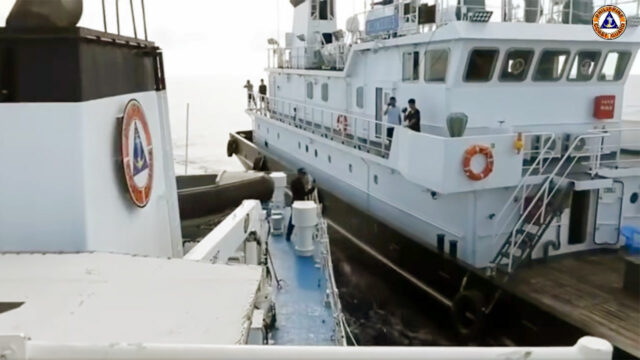
THE PHILIPPINES on Monday filed a diplomatic protest against China and summoned its envoy in Manila after Chinese ships on Sunday collided with Philippine vessels trying to deliver food and other supplies to Filipino troops at Second Thomas Shoal in the South China Sea.

President Ferdinand R. Marcos, Jr. met with security agencies to “discuss the latest violation by China in the West Philippine Sea,” the presidential palace said in a statement, referring to areas of the South China Sea within the country’s exclusive economic zone.

“He instructed the Philippine Coast Guard to conduct an investigation, as mandated by international maritime laws, into the events that transpired during the rotation and resupply mission to Ayungin Shoal by vessels of the China Coast Guard,” it added.

The incident is “being taken seriously at the highest level of government,” it said, adding that the Chinese Coast Guard’s “dangerous, illegal and reckless maneuvers” had damaged a Philippine vessel.

The United States reaffirmed its 1951 Mutual Defense Treaty with the Philippines, which compels both sides to defend each other in case of an armed attack.

The US State Department said the Chinese vessels violated international law by “intentionally interfering with the Philippine vessels’ exercise of high seas freedom of navigation.”

“The unsafe maneuvers on Oct. 22 and the PRC water cannoning of a Philippine vessel on Aug. 5 are the latest examples of provocative… measures in the South China Sea to enforce its expansive and unlawful maritime claims, reflecting disregard for other states lawfully operating in the region,” it said in a statement.

It reminded China that a provision in the 1951 US-Philippines Mutual Defense Treaty extends to armed attacks on Philippine armed forces, public vessels and aircraft anywhere in the South China Sea. 

The Chinese Embassy in Manila said it had lodged stern representations to the Philippines over the “trespassing” of the Philippine vessels at Second Thomas Shoal.

It repeated China’s call for the Philippines to stop “causing trouble and provocation” at sea and end “groundless attacks and smearing” against China.

The Philippine Foreign Affairs Department had summoned Chinese Ambassador to the Philippines Huang Xilian but he was out of town, spokesperson Ma. Teresita C. Daza told a news briefing.

The diplomatic protest was given to the Chinese Embassy’s deputy chief of mission in a meeting on Monday morning, she added, noting that the usefulness of the communication mechanism created earlier this year to cool tensions between the two countries was “rather limited.”

Ms. Daza said the Chinese vessels’ dangerous maneuvers against the Philippine resupply mission on Sunday had “put into serious doubt the sincerity of the Chinese side” on the South China Sea issue.

“Ayungin Shoal is part of our exclusive economic zone and continental shelf, and we have sovereign rights and jurisdiction over it,” she said in a separate statement.

China Coast Guard vessel 5203 collided with an Armed Forces of the Philippines-contracted indigenous resupply boat 13.5 nautical miles (25 kilometers) east-northeast of BRP Sierra Madre, the National Task Force for the West Philippine Sea said on Sunday.

A Chinese maritime militia vessel had also bumped a Philippine Coast Guard patrol vessel that was escorting the resupply mission about 6.4 nautical miles northeast of the shoal, it said.

BRP Sierra Madre is a World War II-era ship that the Philippines deliberately grounded at the Second Thomas Shoal, which the Philippines calls Ayungin, in 1999 to assert its sovereignty claim. The shoal is within the country’s 200-nautical mile exclusive economic zone.

‘DISASTROUS RESULTS’
The embassies of the US and Canada in Manila condemned the Chinese vessels’ action, saying these put the lives of Filipino crew at risk.

Unaizah Mae 2, one of the two boats contracted by the Armed Forces of the Philippines for the mission, was damaged by the collision, though nobody was hurt, Philippine National Security Council spokesman Jonathan M. Malaya told the same briefing.

He repeated his call for China to stop its “provocative actions,” warning that its continued attempts to block Philippine resupply missions could have “disastrous results.”

The damage amounted to “more than a scratch,” Philippine Coast Guard spokesman Jay Tristan T. Tarriela said, but the boat’s “seaworthiness” would be assessed further once it’s back in port.

“It’s not because of the damage that she incurred that she wasn’t able to deliver [the supplies] but because of the two Chinese maritime militia vessels and the Chinese Coast Guard from behind,” he said.

Despite the damage, the Chinese vessels did not stop “pushing” the boat away from Second Thomas Shoal, he added.

“The Chinese Coast Guard didn’t care whether she was damaged or whether she was unseaworthy,” Mr. Malaya said, noting that the maritime militia vessels were bigger than the two Philippine vessels that escorted the resupply boats.

Mr. Tarriela said five Chinese Coast Guard ships participated in the “shadowing, dangerous maneuvers and blocking” of the resupply mission, while eight Chinese maritime militia vessels blocked the Philippine ships.

Two Chinese Coast Guard vessels started tailing the Philippine Coast Guard’s BRP Cabra at 9 p.m. on Saturday before the AFP-contracted civilian vessels could even reach the area, Mr. Tarriela said.

When the mission started on Sunday morning, two Chinese militia vessels surrounded BRP Cabra to separate it from the supply boats. After the militia vessels trapped the escort ship, the Chinese Coast Guard crossed into the path of the Philippine boat Unaizah Mae 2, resulting in the collision.

The Sunday mission was partly successful, with only the Unaizah Mae 1 being able to deliver supplies to BRP Sierra Madre, Philippine officials said.

At a separate news briefing after Mr. Marcos’ meeting with security officials, Defense Secretary Gilberto C. Teodoro, Jr. accused China of “deliberately obfuscating the truth” after the incident.

This was a “serious escalation of the illegal activities being conducted by China in the West Philippine Sea.”

He belied China’s claim that it practiced restraint. “Any unbiased person will see that this is not restraint, and there was another attempt to distort the narrative.”

At the same briefing, Philippine Coast Guard Vice Admiral Ronnie Gil Gavan said the Chinese actions were clear violations of collision regulations.

He said the coast guard would investigate the incidents and submit a report to the President through the Transportation department.

The incident bodes ill for the future of Philippines-China relations, said Joshua Bernard Espeña, who teaches international relations at the Polytechnic University of the Philippines.

“We can expect Philippine-China relations to be at an all-time low under the Marcos administration,” he said via Messenger chat. “Agitating China is one thing, but deterring China is another.”

He said the government should get more serious about acquiring capabilities for the military, while boosting ties with its foreign allies.


Philippine lawmakers hit China for blocking boats trying to deliver supplies

BW FILE PHOTO

PHILIPPINE senators on Monday denounced “dangerous maneuvers” of the China Coast Guard that allegedly caused collisions with Philippine ships on a resupply mission at Second Thomas Shoal in the South China Sea.

“China’s latest act of aggression poses a credible concern that could heighten the tension not only between the Philippines and China but could also be a potential flashpoint in the region,” Senator Mary-Grace Poe-Llamanzares said in a statement.

“As we firmly assert our rights in our waters, fortifying our relations with like-minded states must continue to thwart similar belligerent actions.”

Senator Joseph Victor “JV” G. Ejercito said the government should fast-track the modernization of the Armed Forces and other defense agencies to boost the country’s capacity to safeguard its maritime interests.

“We cannot and will not allow such incidents to jeopardize the safety of our people, particularly those who serve in our Armed Forces and the Philippine Coast Guard.”

On Sunday, Senate President Juan Miguel F. Zubiri said China’s Coast Guard should abide by international law and respect the Philippines’ freedom of navigation under the United Nations Convention on the Law of the Sea.

“I am one with peace-loving Filipinos in strongly condemning this latest abhorrent action of the China Coast Guard and Chinese maritime militia that put in danger the lives of our brave countrymen who were on a routine resupply mission to our troops in Ayungin Shoal,” he said in a statement.

Senator Ana Theresia N. Hontiveros-Baraquel said China has no right to bully and risk the lives of Philippine Coast Guard officers.

“The 2016 Arbitral Award has resolutely invalidated China’s claims in the West Philippine Sea, making this incident a clear violation of international law,” she said, referring to areas of the South China Sea within the country’s exclusive economic zone.

She said the Philippine Coast Guard has every right to be in the South China Sea, adding that China has no right to drive away Philippines troops, hurt or bump Philippine boats working within the Philippines’ own territory.

“Chinese vessels have chased, blocked and harassed our Philippine Coast Guard daily, 24/7 every single time we conduct our resupply mission to the BRP Sierra Madre,” Ms. Hontiveros-Baraquel said. “They should answer for that.”

She called on the international community to join the Philippines’ condemnation of China’s “most recent violence against the Filipino people.” “Our nations should not stop fighting for the rule of law. It is the only way to have a chance at true peace and stability across the region and the world.” — John Victor D. Ordoñez

DFA: 59 Pinoys in Lebanon want to come home amid war

A view shows houses and buildings destroyed by Israeli strikes in Gaza City, Oct. 10, 2023. — REUTERS

FIFTY-NINE Filipinos in Lebanon want to come home amid the worsening war between Israel and Iran-backed Islamist group Hezbollah, according to the Philippine ambassador to Lebanon.

Philippine authorities met with Filipino community leaders on Sunday to check on their situation, Philippine Ambassador to Lebanon Raymond R. Balatbat told CNN Philippines on Monday.

He said water and food supply in Lebanon was still enough for residents to get by, but they expect a shortage if the conflict worsens.

The Philippine Embassy in Lebanon on Sunday opened applications for Filipinos seeking repatriation via its Facebook page.

“We heard that a number of Lebanese families living near the southern border with Israel have already left the area and have come here to Beirut, so there is a lot of uncertainty and that’s causing panic among people here,” Mr.  Balatbat said.

The Philippines on Saturday placed Lebanon under Alert Level 3 amid the hostilities, calling on Filipinos to come home.

Foreign Affairs Undersecretary Jose Eduardo A. de Vega on Sunday said there were about 17,500 Filipinos in Lebanon, most of whom are domestic workers.

“Filipinos are being informed that there is a program for repatriation and are advised to go home,” he told ABS-CBN Teleradyo. “We are trying to avoid repatriation during gunfire and conflicts.”

Israel launched extensive air strikes in Gaza after Hamas militants backed by a barrage of rockets stormed from the blockaded Gaza Strip into nearby Israeli towns, killing 1,400 people, mostly civilians, in a surprise attack on Oct. 7.

Israel has also enforced a blockade and deployed tens of thousands of its troops for a ground assault on the Palestinian enclave.

Mr. De Vega on Sunday said Israel was still under Alert Level 2, while Gaza was under Alert Level 4 or forced repatriation.

Hezbollah, which is allied with Hamas, and Israeli military forces have been exchanging fire at the Lebanese-Israeli border in the past few weeks, in the worst escalation of violence in the area since a 2006 war between Israel and the Islamist group.

The Hamas-run Gaza Health Ministry has said about 4,137 Palestinians have died and more than 13,000 wounded during the war.

On Oct. 20, Hezbollah launched anti-tank missiles across the border, prompting the Israeli Defense Forces to launch air strikes against Hezbollah in Lebanon, killing 19 Hezbollah fighters.

“The intensity and frequency of the military exchanges, the mortars, the artilleries, the missile exchanges between Hezbollah and Israel have been increasing in frequency over the past few days,” Mr. Balatbat said.

“Foreigners are urged to leave by their embassies and a number of airlines have been cutting down the flights to Beirut,” he added. — J.V.D. Ordoñez

LTFRB tells House to let private sector aid PUV modernization

PHILSTAR FILE PHOTO

By Beatriz Marie D. Cruz, Reporter

THE LAND Transportation Franchising and Regulatory Board (LTFRB) on Monday asked Philippine congressmen to let it tap the private sector for the state’s transport modernization program in the absence of a budget from Congress next year.

“The [reform] provision [that Congress can provide is] a legislative framework for the PUV modernization program such that there would be an appropriation for the continued implementation of the PUVMP (Public Utility Vehicle Modernization Program),” LTFRB officer-in-charge Mercy Jane Paras-Leynes told the House transportation committee.

“If the legislative framework would take time, then maybe allowing us to tap other private or educational institutions, [and] non-government organizations to continue with the study of the routes and so that the rationalization of the routes would be more holistic and more integrated,” she said.

Transportation Secretary Jaime J. Bautista said in September that the PUV modernization program will continue despite receiving zero funding for next year.

The committee also cited in contempt Jeffrey G. Tumbado, a former executive assistant to suspended LTFRB chairman Teofilo E. Guadiz, III.

Mr. Tumbado told congressmen that he has no evidence linking Mr. Guadiz III to corrupt practices in the LTFRB, noting that this was only his “opinion,” but said he heard about the alleged acts within the agency from transport operators.

President Ferdinand R. Marcos, Jr. suspended Mr. Guadiz III on Oct. 9 for alleged corruption in the agency. This came hours after Mr. Tumbado said in a press conference that Mr. Guadiz and other transportation officials received money in exchange for franchises, routes, special permits and other documents from the agency.

Two days later, Mr. Tumbado recanted his statement and issued a sworn affidavit as a public apology to Mr. Guadiz. However, when asked during the Monday committee meeting if all the statements in the affidavit were true, Mr. Tumbado said in Filipino: “Not everything written there is true… as I said, my mind was confused back then.”

At the hearing, Mr. Guadiz said that the LTFRB is not the sole authority in approving PUV franchises.

“No single person has the power to approve franchises. We need the LGUs (local government units), the DoTr (Department of Transportation), and we need also other government agencies, it’s not LTFRB alone,” he told congressmen.

CBCP leaves anti-Red task force

PHILSTAR FILE PHOTO

A PANEL of the Catholic Bishops’ Conference of the Philippines (CBCP) has withdrawn its membership in the government’s anti-communist task force as it seeks to keep its independence.

Priest Jerome Secillano, executive secretary of the CBCP Public Affairs Commission, said the panel will still maintain its engagements with the task force but would opt to “preserve” its independence.

“If we will be the lone voice in the body, making all these claims, making all these suggestions, our inputs might get diluted,” he told ABS-CBN’s Teleradyo, noting the importance of an outsider’s view.

“Even without that membership, we continue to have engagements with them, because we are able to relay to them our concerns, when for example there are church people who are allegedly red-tagged,” Mr. Secillano said. “We are grateful because they take notice of it, and they do something about it.”

Last August when the CBCP’s inclusion in the task force was announced, Church leaders were among those who criticized the development, deplored the government agency’s history of red-tagging many personalities, including church workers and other human rights advocates.

But on Sept. 1, Kalookan Bishop Pablo Virgilio David who heads the CBCP said it was the panel, not the order of bishops, that joined the task force “as a private sector representative.”

Mr. David, 64, has been vocal against the rights abuses being committed by Philippine security forces, especially under former president Rodrigo R. Duterte, who created the National Task Force to End Local Communist Armed Conflict (NTF-ELCAC). — Kyle Aristophere T. Atienza

Next priority: maritime zones

AN AERIAL photo of Philippine-occupied Thitu Island, locally known as Pag-asa, in the contested Spratly Islands. — REUTERS

THE PHILIPPINE Senate plans to pass a priority bill seeking to establish Philippine maritime zones after it approves the 2024 national budget next month, a senator said on Monday, citing the need to fast-track the measure amid tensions with China in the South China Sea.

“We have to pass this measure and the inclusion of the Philippine Rise in our territories is imperative, and the definition of the exclusive economic zones would need refinement,” Senator Francis N. Tolentino said at a Senate special committee hearing on maritime and admiralty zones.

He said fine-tuning and eventually approving the measure has become more urgent, following the recent collision of a Chinese vessel with private Philippine vessels trying to deliver supplies to Filipino troops at the Second Thomas Shoal in the South China Sea, adding that establishing Philippine maritime zones is long overdue. 

He said the measure must include provisions on what to do about other states building artificial structures in Philippine waters. — John Victor D. Ordoñez

Births, deaths, marriages fall

PHILIPPINE STAR/MIGUEL DE GUZMAN

THE PHILIPPINES’ birth, death and marriage rates declined by 25.1%, 22.8%, and 33.2%, respectively, in the first four months of 2023 compared with the same period last year, the Philippine Statistics Authority (PSA) reported on Monday.

Data from January to April showed a total of 327,176 new births, which are significantly lower than the 436,808 registered births in the same period in 2022.

Death statistics, on the other hand, were 174,597 for the same period this year as compared with the previous year’s 226,050.

For marriages, the count fell to 115,159 for a decline of a third of the 172,459 registered marriages in the same period last year.

All this year’s figures took into account registered births, deaths and marriages as of the cut-off date of June 30. 

PSA data by the regions showed that Calabarzon (Cavite, Laguna, Batangas, Rizal and Quezon or Region 4-A) accounted for the most registered births in the given period at 52,605 or 16.1% of the total nationwide. This was followed by Central Luzon (Region 3) with 40,677 births for a 12.4% share of the total, and then Metro Manila (National Capital Region or NCR) with 30,279 births or 9.3% share.

For deaths, Calabarzon also topped the regions with 28,511 or 16.3% share of the total deaths in the country, followed by Central Luzon with 23,533 or 13.5% share, and Western Visayas with 18,262 (10.5%).

Again, Calabarzon logged the biggest number of recorded marriages at 20,358 or 17.7% share of the total tally in the Philippines, followed by Central Luzon with 16,548 or 14.4% share, and NCR with 12,946 or 11.2% share of the total.

The PSA vital statistics report is a consolidation of the data tallied from the city or municipal Civil Registrars, the PSA’s Provincial Statistical Offices, and the Office of the Civil Registrar General. Abigail Marie P. Yraola

Speaker heralds jobs from Saudi

SPEAKER Martin G. Romualdez during the opening of the 19th Congress at the House of Representatives in Quezon City on July 25, 2022. — PHILIPPINE STAR/KRIZ JOHN ROSALES

SPEAKER Ferdinand Martin G. Romualdez said on Monday that his cousin the President’s trip to Saudi Arabia last week will be generating over 200,000 jobs for Filipinos.

“This visit reaffirms the commitment of our government to support and protect the rights and welfare of our overseas Filipino workers, who have played a pivotal role in enhancing the lives of their families and the entire nation,” Mr. Romualdez said in a statement.

He said one of the major agreements signed was a $3.77-billion deal made was between the Association of Philippine Licensed Agencies for the Kingdom of Saudi Arabia and the Saudi-based Al-Jeer Human Resources Company (ARCO).

He said that the job opportunities would help Saudi Arabia diversify its economy, improve infrastructure, advance digitalization, and create competitive business environments, also known as Saudi Vision 2030.

Mr. Marcos’ trip to Riyadh last week with Saudi business leaders at the 2023 ASEAN-Gulf Cooperation Council Summit brought in $4.2 billion in investment pledges.

He added that Saudi business leaders expressed “keen interest” in the Maharlika Investment Fund, which Mr. Marcos said was operational by yearend despite suspension of its implementing rules and regulations (IRR) for further study.

Filipino firm EEI Corp. also signed an agreement valued at $120 million with Al Rushaid Petroleum Investment Company & Samsung Engineering NEC Co. Ltd., which will establish a 500-person construction training facility in Tanza, Cavite, which is 43.6 km away from the capital region.

The House leader said that the facility will train Filipinos’ skills in masonry, carpentry, electrical, welding, equipment management, warehousing, and steel fabrication beginning next year and will train more than 15,000 in the next five years.

Two separate agreements with an estimated worth of $191 million was also signed between Maharah Human Resources Company of Saudi and Filipino firms Staffhouse International Resources Corporation and E-GMP International Corporation.

The agreements aim to onboard 10,000 Filipino workers to Saudi Arabia yearly until 2030.

Mr. Romualdez said that the President’s meeting with Kuwaiti Crown Prince Sheikh Meshal last week could resolve labor issues between the two countries.

“This encounter brings hope for the restoration of diplomatic relations between our two nations, which had previously been strained due to labor issues and the need to protect the welfare of Overseas Filipino Workers,” he said in a separate statement on Sunday.

Mr. Marcos at the weekend said that the ban on the deployment of Filipino first-time household workers to Kuwait would end soon.

The ban was enforced after the murder of OFW Jullebee Ranara, who was reportedly abused and killed brutally, then left in a desert by the 17-year-old son of her employer in January. — Beatriz Marie D. Cruz

ADVERTISEMENT
ADVERTISEMENT