Home Blog Page 4

Swedish government boosts energy, fuel subsidies in election year spring budget

A SWEDISH FLAG hangs outside a store on a busy street in Stockholm, Sweden, July 14, 2023. — REUTERS

STOCKHOLM — Sweden’s government will cut fuel taxes and hike electricity subsidies in its spring mini-budget, it said on Monday, as it strives to ease the pain for households of higher energy bills driven by the war in Iran.

The extra spending, coming ahead of a parliamentary election in September, will total 7.7 billion crowns ($825 million) and comes on top of a bumper 80 billion in new spending already announced in September last year in the full-year budget bill for 2026.

“It is a signal that we will do whatever it takes to … dampen the blow to households of what is happening now,” Finance Minister Elisabeth Svantesson told reporters.

Oil prices have soared since the United States and Israel launched attacks on Iran and there are concerns a long-lasting conflict could push up inflation, hit growth and lead to higher interest rates.

The temporary boost to electricity subsidies for households in the spring budget will cost 2.4 billion crowns and the cut to fuel taxes 1.6 billion. The government has asked the EU to approve a further cut in fuel taxes worth around 8 billion crowns.

Other measures include more money for Sweden’s space program, healthcare, and job creation.

ELECTION BOOST
Swedes go to the polls in September and the ruling coalition currently trails the left bloc in the polls despite promises of tax cuts and more money for schools, healthcare and defense this year.

Households are still feeling the effects of the period of high inflation sparked by the pandemic and the war in Ukraine, alongside US President Donald Trump’s tariffs, with the Iran war now convincing many to hold on to their savings.

While the government can afford to be generous — Sweden’s public finances are rock-solid — Ms. Svantesson said the next administration would need to be careful not to push debt too high.

A right-of-center government — which could include the populist, anti-immigration Sweden Democrats for the first time — would continue to focus on supporting households and on policies to boost jobs and businesses while keeping a lid on new spending. The left plans major tax hikes, she said.

“I hope that Swedes see that what we need is calm, not a four-year experiment by a left bloc with doesn’t agree on anything,” Svantesson said.

“Higher taxes … are not the way to get more growth.” — Reuters

Trump calls Pope Leo ‘terrible’ in unusual, direct attack on Church leader

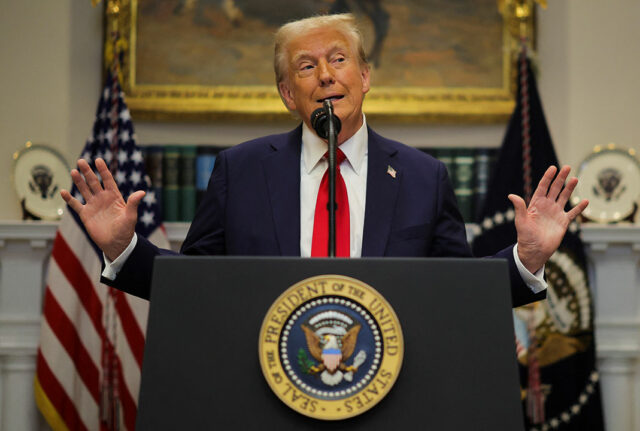
U.S. President Donald Trump delivers remarks at the Roosevelt room at White House in Washington, US, Jan. 21, 2025. — REUTERS

WASHINGTON/ROME — US President Donald Trump forcefully criticized Pope Leo late on Sunday in an unusual, direct attack on the leader of the 1.4-billion-member Catholic Church that drew immediate rebuke from believers.

The president, in an apparent response to the pope’s growing criticisms of the US-Israeli war on Iran and the Trump administration’s hard-line immigration policies, said Leo was “terrible”.

“Pope Leo is WEAK on Crime, and terrible for Foreign Policy,” Mr. Trump wrote in a post on Truth Social.

Catholics on social media quickly lambasted Mr. Trump for attacking the leader of their Church, who they believe is the successor of St. Peter, one of Jesus’ 12 apostles.

“There is no ambiguity about the situation now,” Massimo Faggioli, an expert on the papacy, told Reuters.

He compared the comments to efforts by the leaders of Germany and Italy during World War Two to draw the late Pope Pius XII to support their causes.

“Not even Hitler or Mussolini attacked the pope so directly and publicly,” said Mr. Faggioli.

Archbishop Paul S. Coakley, president of the US Conference of Catholic Bishops, said he was disheartened by Mr. Trump’s comments.

“Pope Leo is not his rival; nor is the Pope a politician. He is the Vicar of Christ who speaks from the truth of the Gospel and for the care of souls,” he said in a statement.

POPE LEO VOCAL ON WAR AND IMMIGRATION ISSUES
Leo, originally from Chicago, is the first US pope. Known for choosing his words carefully, he has emerged as an outspoken critic of the Iran war in recent weeks and decried the “madness of war” on in a peace appeal on Saturday.

Last year, he questioned whether the Trump administration’s hard-line immigration policies were in line with the Church’s pro-life teachings.

“Someone who says, ‘I am against abortion but I am in agreement with the inhuman treatment of immigrants in the United States’, I don’t know if that’s pro-life,” the pontiff said in September.

Mr. Trump wrote in his post Sunday that “Leo should get his act together as Pope”, later telling reporters he was “not a big fan” of the pontiff.

Mr. Trump’s broadside against Leo also accused him of being “weak on nuclear weapons,” several days after the pope said the US president’s threat to destroy Iranian civilization was “truly unacceptable.”

In a speech on Palm Sunday last month in St. Peter’s Square in the Vatican, the pope said God rejects the prayers of leaders who start wars and have their “hands full of blood,” calling the conflict in Iran “atrocious.”

Leo has also called on Mr. Trump to find an “off-ramp” to end the conflict and “decrease the amount of violence.”

In his post, Mr. Trump suggested that Leo was only elected to lead the Catholic Church last year “because he was an American, and they thought that would be the best way to deal with President Donald J. Trump.”

The Vatican did not immediately respond to a request for comment. The pope is due to leave on Monday for an ambitious, 10-day tour of four countries in Africa.

Leo has called for “deep reflection” about the way migrants are being treated in the US.

The pope’s call for a more compassionate approach to immigration – a sentiment expressed by several of Leo’s predecessors – stands in contrast to the stance of Mr. Trump, who has argued that the US must curtail immigration from developing countries to reduce crime.

“He’s a very liberal person and he’s a man who doesn’t believe in stopping crime,” Mr. Trump told reporters on Sunday night.

Mr. Trump also had a rocky relationship with Leo’s predecessor, Pope Francis, who criticized Mr. Trump’s immigration policy proposals when he first ran for president and suggested Mr. Trump was “not a Christian.”

Mr. Trump had called Francis “disgraceful” in early 2016. — Reuters

Philippines’ Marcos suspends excise tax on kerosene, LPG

PHILSTAR FILE PHOTO

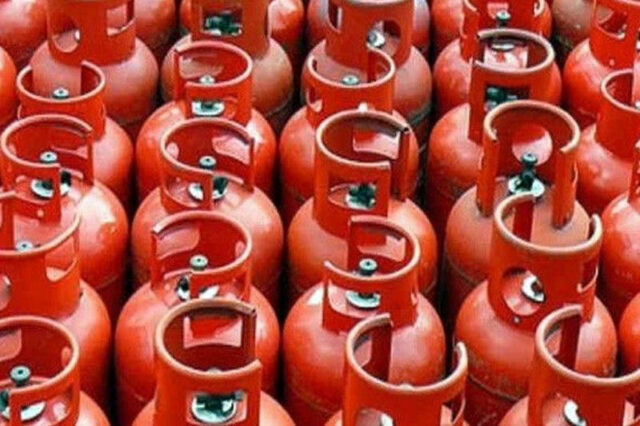
MANILA — Philippine President Ferdinand Marcos Jr suspended taxes on kerosene and liquefied petroleum gas (LPG) on Monday to help consumers cope with rising fuel costs.

Congress had granted Marcos emergency powers to adjust fuel taxes, one of several measures the Philippines has undertaken to cope with a sharp surge in oil prices driven by the Middle East conflict. — Reuters

NCR building materials retail price growth accelerates in March

PHILIPPINE STAR/ RUSSELL PALMA

By Isa Jane D. Acabal, Researcher

Retail price growth of construction materials in the National Capital Region (NCR) accelerated to a 15-month high in March driven by the ongoing war in the Middle East.

Data from the Philippine Statistics Authority (PSA) showed the annual growth rate of construction materials retail price index (CMRPI) in NCR increased to 1.3% in March, from 1.2% in February and a year ago.

This was the strongest reading in over a year or since the 1.5% growth recorded in December 2024.

For the first quarter of 2026, the CMRPI growth averaged 1.3%, higher than the 1.2% average growth a year earlier.

The CMPRI is based on 2012 constant prices.

The PSA attributed the expansion in March to higher annual increase seen in tinsmithry materials at 2.3% from 1.9% in February and 1.6% a year ago.

Faster yearly increases were also noted in masonry materials (1.5% in March from 1.1% in February), painting materials and related compounds (2% from 1.8%), and miscellaneous construction materials (1.3% from 1.1%).

The index of carpentry materials ended flat (0%) in March from a 0.2% drop in the previous month.

Electrical materials, meanwhile, slowed to 2% in March from 2.1% in February. Plumbing materials likewise eased to 0.4% from 0.8%.

Jonathan L. Ravelas, a senior adviser at Reyes Tacandong & Co., said the uptick in the retail prices of building materials in March reflects “cost pass-through, not overheating demand” driven by the ongoing war in the Middle East.

“Metals, chemicals, fuel, and logistics costs edged higher, and suppliers are gradually passing these on, especially in tinsmithry, masonry, and finishing materials tied to renovation activity in NCR,” he said in a Viber message.

The Middle East conflict, which began at the end of February, brought oil price shock as well as disruption in supply chain and tourism. As a net importer of oil, the Philippines is grappling with mounting inflationary pressures as global energy prices surge.

Mr. Ravelas sees retail price growth of construction materials to remain in low single digits in the coming months, unless a commodity shock happens or when peso further weakens.

“For now, this is manageable cost pressure — not a construction inflation scare,” he added.

Philippines warns of ‘sabotage’ after cyanide seizure in disputed South China Sea atoll 

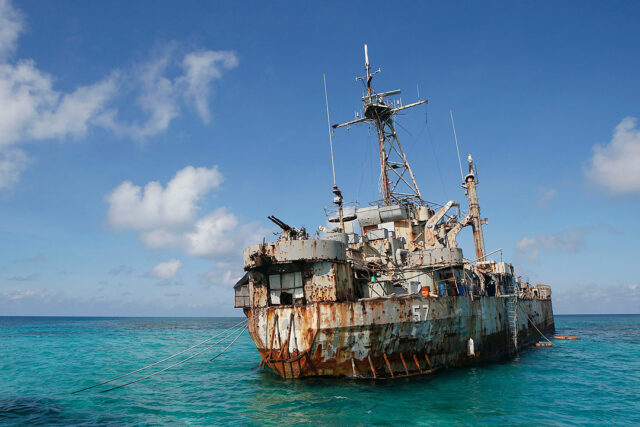
THE BRP SIERRA MADRE, a marooned transport ship which Philippine Marines live in as a military outpost, is pictured in the disputed Second Thomas Shoal, part of the Spratly Islands in the South China Sea. — REUTERS

MANILA — The Philippines discovered cyanide on Chinese boats operating around a disputed atoll in the South China Sea, security officials from the country said on Monday.

Authorities said laboratory tests confirmed the presence of the highly toxic substance in bottles seized by the Philippine navy in operations at Second Thomas Shoal last year.

Officials warned the cyanide could have had serious consequences for marine life and weakened the reef supporting a warship that Manila grounded on the atoll to reinforce its maritime claim.

“We wish to underscore that the use of cyanide in Ayungin Shoal is a form of sabotage that seeks to kill local fish populations, depriving Navy personnel of a vital food source,” Cornelio Valencia Jr., National Security Council spokesperson, told a press conference using the Philippines’ name for the atoll. Mr. Valencia added that cyanide could damage the reef and “ultimately compromise” the warship’s stability.

The Chinese Embassy in Manila did not immediately respond to a request for comment.

The Philippines has accused China of disrupting resupply missions to troops on the vessel, including a June 17, 2024, incident that turned violent and resulted in a Filipino sailor losing a finger. China has denied allegations of aggressive conduct during such encounters and accused the Philippines of trespassing in its waters.

The June confrontation later led to a provisional understanding for resupply missions to the grounded ship.

China and the Philippines held high-level talks last month over the South China Sea, exploring preliminary steps towards oil and gas cooperation, and confidence-building measures at sea, including communication between their coast guards.

The Philippine foreign ministry said in a statement on Monday the scope of the coast guard cooperation would be limited, and “does not contemplate cooperation in sensitive operational areas,” adding that there had been no discussions on joint patrols.

China claims nearly all the South China Sea, including areas claimed by Brunei, Malaysia, the Philippines, and Vietnam.

A 2016 ruling by an international arbitral tribunal found Beijing’s sweeping claims had no basis under international law, a decision China rejects. More than $3 trillion in annual ship-borne commerce travels through the key waterway. — Reuters

House pushes fuel tax credit for immediate price relief

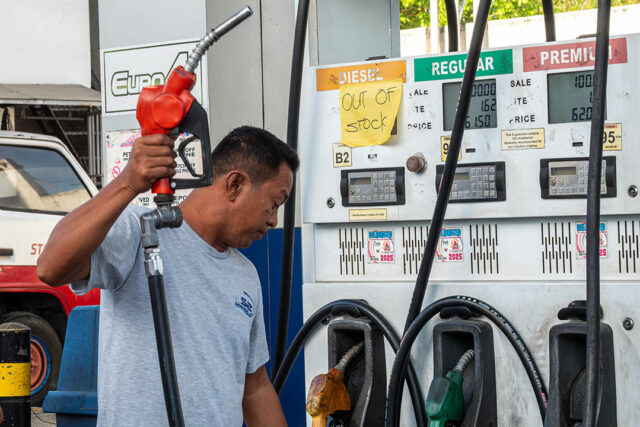
MOTORISTS queue at a gasoline station along Norzagaray Road in San Jose del Monte on March 8, 2026. — PHILIPPINE STAR/RYAN BALDEMOR

Congressmen are pushing a tax credit scheme to allow immediate fuel price cuts, challenging the Department of Finance’s (DoF) position that suspending excise taxes may only apply to future imports. 

Marikina Rep. Romero Federico “Miro” S. Quimbo, who heads the ways and means committee, said the government should ensure the public feels the relief “right away.”  

He proposed at a House of Representatives hearing on Monday that fuel companies be granted tax credits for excise taxes already paid on existing inventories so they could cut pump prices without waiting for new shipments. 

He estimated potential reductions of about P10 per liter for gasoline, P6 for diesel and P4.50 for kerosene as early as the day after a presidential directive. 

The proposal runs counter to the DoF’s position that applying tax relief to fuel already in the country would be difficult. 

“It will be hard with regard to administrative feasibility, the removal of the excise stocks, the inventories that are here in the Philippines,” Finance Undersecretary Rolando T. Ligon, Jr. told the hearing. The direction they are looking at is to apply it to “upcoming importations.” 

Mr. Ligon said implementing tax relief on fuel already in storage poses technical and administrative challenges, citing the complexity of adjusting taxes on existing inventories. 

He said once a directive is signed, implementation could take effect within one to two days through issuances from the Bureau of Customs. 

President Ferdinand R. Marcos, Jr. has yet to decide whether to halt or cut fuel excise taxes under a law that empowers him to do so. 

Mr. Quimbo also asked the DoF to explain why a tax credit scheme would be unworkable, noting that the Bureau of Customs maintains records of inventory and tax payments. 

Discussions on fuel tax measures come as volatility persists in global oil markets amid tensions linked to the Strait of Hormuz and the US-Israel war on Iran. 

Energy Undersecretary Alessandro O. Sales said diesel prices are expected to drop by P20 to P21 per liter on Tuesday due to market movements, but warned that conditions remain unstable. 

He said prices could climb to P130 to P170 a liter if hostilities resume, while a longer-term resolution could bring diesel prices down to P75 to P90 a liter over several months. — Erika Mae P. Sinaking 

Hungary’s conservative icon Orban defeated by center-right opposition

People celebrate following partial results on the day of the Hungarian Parliamentary election in Budapest, Hungary, April 13, 2026. — REUTERS

BUDAPEST — Hungary’s veteran nationalist leader Viktor Orban lost power to the upstart center-right Tisza party in Sunday’s national election after 16 years in office, marking a setback for his allies in Russia and US President Donald Trump’s White House.

Mr. Orban, 62, was celebrated by conservatives across Europe and the United States as the mastermind of the “illiberal” model of democracy, but lost favor at home with voters who grew weary of economic stagnation, international isolation, and oligarchs amassing wealth.

His landslide defeat handed Tisza’s Peter Magyar, 45, a comfortable majority in Hungary’s 199-seat legislature, opening the door for meaningful reforms of a system critics in the European Union said subverted democratic norms.

With nearly all ballots counted, Tisza was set to win 138 seats, more than the two-thirds majority Mr. Magyar would need to undo Mr. Orban’s constitutional overhaul and combat corruption.

Record turnout on Sunday underscored how many Hungarians saw the election as a watershed moment for their country.

“We have done it. Tisza and Hungary have won this election,” Mr. Magyar told tens of thousands of supporters who danced and cheered alongside the elegant Danube River embankment in central Budapest.

Many held candles while loudspeakers blasted Frank Sinatra’s “My Way” as Mr. Magyar walked towards the stage. “Together, we have replaced Orban’s system and together we liberated Hungary, we have reclaimed our country,” he said.

Mr. Magyar had cast the election as a choice between “East and West”, warning voters that Mr. Orban and his confrontational stance towards Brussels would take the country further away from the European mainstream. Mr. Orban countered that Tisza would drag Hungary into an unwanted war with Russia, a charge Mr. Magyar denied.

“The election result is painful for us, but clear,” Mr. Orban said at the Fidesz campaign offices. Some of his supporters who had gathered outside cried while watching his speech on TV screens.

SHOCKWAVES FOR THE EU AND BEYOND
The end of Mr. Orban’s 16-year rule will have significant implications not only for Hungary, but for the European Union, Ukraine and beyond.

Many European leaders are hoping for an end to Hungary’s adversarial role inside the EU, possibly opening the way for a 90 billion euro ($105 billion) loan to war-battered Ukraine that was blocked by Mr. Orban.

Mujtaba Rahman, a managing director at Eurasia Group, said Mr. Magyar will be able to deliver on his promises to clean out corruption and remove Fidesz loyalists from key positions.

“Regarding Ukraine, Magyar will agree to pave the way for 90 billion euros to flow to Ukraine. He was extremely cautious pre-election, but without the need now to try to appease Fidesz voters, we think Hungary will cautiously move more into the European mainstream on most subjects.”

Some diplomats in Brussels cautioned issues such as migration may remain thorny. “Hungary will continue to be a challenging partner, but a partner with whom the other member states can work,” one said.

Ukrainian President Volodymyr Zelenskiy congratulated Mr. Magyar on Sunday and pledged to work with him to strengthen Europe and uphold peace and security. “It is important when a constructive approach is victorious,” Mr. Zelenskiy wrote on Telegram.

Defeat for Mr. Orban could also mean the eventual release of EU funds to Hungary suspended over reforms that Brussels said undermined democratic standards, something closely watched by financial markets.

“Hungary has chosen Europe. Europe has always chosen Hungary,” European Commission President Ursula von der Leyen, the top EU executive, said after partial results were released.

Mr. Orban’s exit would also deprive Russian President Vladimir Putin of his main ally in the EU and send shockwaves through the West’s right-wing circles, including the White House.

Mr. Orban had won public endorsements from the Trump administration, culminating in a visit to Budapest by Vice President JD Vance last week, as well as from the Kremlin and far-right leaders in Europe.

But his campaign was shaken by media reports alleging his government colluded with Moscow on diplomatic and political matters.

Mr.Orban, who denied any wrongdoing, said his goal was to protect Hungary’s national identity and traditional Christian values within the EU and its security in a dangerous world.

“It’s incredibly exciting,” said 24-year-old Dorina Nyul, who attended the Tisza election night event. “It feels like this is our first and last chance in a really long time to actually change the system. And it’s, I can’t even describe the feeling.” — Reuters

Samsung launches Smart Wash Business Solutions to support growth of commercial laundry sector in the Philippines

In photo: Stephanie Chua-Go, head of Division Home Appliances; Roman Han, president of Samsung Electronics Philippines Corp.; Franklin Chan, president of CYA Industries, Inc.; Mark Chan, business development manager, CYA Industries, Inc.; Jonathan Nazareth, head of Samsung Commercial Laundry, CYA Industries, Inc.; Joseph Lee, business manager, Home Appliances; and Jayson Angeles, strategic business head, Home Appliances

In its bid to support the development of more efficient, scalable and technology-driven commercial laundry operations in the Philippines, Samsung Electronics Philippines officially introduced its Commercial Laundry Washer and Dryer via Smart Wash Business Solutions, held last March 25 at the SMX Convention Center.

Convening industry partners, entrepreneurs and other stakeholders, this was done in partnership with CYA Industries, Inc, the company’s authorized distributor for its commercial laundry solutions in the Philippines. From concept development and financing to installation and supply chain management, this synergy provides a comprehensive and streamlined approach for business owners who want to enter the commercial laundry industry.

In his welcome remarks, Roman Han, President of Samsung Electronics Philippines, underscored Samsung’s continued leadership in innovation and its mission to enhance everyday life through intelligent and durable products.

“Our innovations’ core mission is to enhance daily life for everyone, whether at home or at work. We achieve this by designing technology that caters to the needs of the market while prioritizing customer experience and durability,” he said. He also highlighted the company’s focus on fostering strategic partnerships to help drive business opportunities in emerging sectors.

To further emphasize the power of Samsung’s new innovations, Samsung Electronics Philippines Strategic Business Head for Home Appliances Jayson Angeles detailed its capabilities in improving operational efficiency, reliability, and overall business performance. Powered by Samsung SmartThings, the system enables real-time monitoring, remote management, and performance tracking, allowing operators to optimize usage and streamline operations.

Designed to deliver consistent cleaning performance while optimizing water and energy consumption, Samsung’s Commercial Laundry Washer and Dryer are equipped with durable components and smart diagnostics, which helps minimize downtime, improve machine longevity, and support sustainable business operations.

Franklin Chan, President of CYA Industries Inc, emphasized the strength of the partnership with Samsung to the company’s capability to deliver end-to-end support.

“With our 60 years of experience and our partnership with Samsung, we are here to offer you a full circle of solutions, from concept to financing and supply chain support,” he said, adding that this will enable entrepreneurs to start the laundry business with ease.

For more information on Samsung’s Commercial Laundry Washer and Dryer and Smart Wash Business Solutions, you may visit https://www.samsung.com/ph/washers-and-dryers/commercial-laundry/ or connect with CYA Industries and other authorized partners nationwide.


Spotlight is BusinessWorld’s sponsored section that allows advertisers to amplify their brand and connect with BusinessWorld’s audience by publishing their stories on the BusinessWorld Web site. For more information, send an email to online@bworldonline.com.

Join us on Viber at https://bit.ly/3hv6bLA to get more updates and subscribe to BusinessWorld’s titles and get exclusive content through www.bworld-x.com.

US, Australia, Philippines hold second joint drills in South China Sea this year

FILE PHOTO | PHILIPPINE STAR/WALTER BOLLOZOS

MANILA — The US and Australia joined the Philippines for their second joint maritime exercises in the South China Sea this year, amid tensions with China in the disputed waterway.

The four-day drills from April 9 to 12 brought together warships, fighter jets and surveillance aircraft in a series of coordinated operations to strengthen maritime defense capabilities, the Philippine military said on Monday.

The exercises underscored the “deepening defense cooperation among the three nations and their shared commitment to regional security”, it said in a statement.

The Philippines deployed its FA50 fighter jets, while Australia contributed P8A Poseidon aircraft and the United States the USS Ashland, a dock landing ship.

The drills came ahead of the April 20 opening of the annual large-scale war games called Balikatan – or “shoulder-to-shoulder” – between Manila and Washington, which for the first time will include Japan as a full participant rather than an observer, alongside Australia.

The Philippines and China have traded accusations over a series of incidents in the South China Sea, including a recent encounter in which Beijing fired flares at a Philippine Coast Guard aircraft.

Zhai Shichen, spokesperson for China’s Southern Theater Command (STC), said in a statement on Monday that the Chinese navy conducted a routine patrol in the South China Sea over the same four days the drills were held.

“In an attempt to stir up troubles in the region, the Philippines co-opted countries outside the region to organize so-called joint patrols, disrupting peace and stability in the South China Sea,” Mr. Zhai said.

“Forces of the STC will resolutely safeguard China’s territorial sovereignty and maritime rights and interests, and firmly uphold regional peace and stability.”

Beijing has routinely opposed Manila’s joint military activities with its allied partners in the South China Sea, saying such drills heighten tensions in the region. — Reuters

Understanding VUL: Protection first, investment second

With more Filipinos becoming financially aware and investment-curious, variable unit-linked (VUL) insurance continues to generate both interest and confusion.

In a recent episode of BusinessWorld B-Side, Ivan Corcuera, Head of Insurance Investments at Sun Life Investment Management and Trust Corporation, clarified how VUL works, when it is appropriate, and why understanding its fundamentals is crucial before investing.

Mr. Corcuera emphasized that there is no one-size-fits-all solution in financial planning. An individual’s needs vary depending on life stage, responsibilities, and goals. A single professional with no dependents may not prioritize life insurance immediately, while a breadwinner supporting a family would likely require substantial protection.

“The financial advisor would identify the client’s financial needs and offer solutions that would fit the needs of that client, depending on the client’s budget. Even one product, one insurance product, can have multiple use cases. One can buy an insurance product as a means to protect their loved ones when something untoward happens to the policyholder,” he said.

A key distinction highlighted in the discussion was the difference between traditional life insurance and VUL. Traditional products are designed for pure protection, offering guaranteed benefits for a defined period or throughout the policyholder’s lifetime. VUL, on the other hand, combines life insurance with an investment component.

“One of the key differences is really the investment component. For a traditional product, it’s pure insurance. If you just need insurance, then this would be the ideal product for you. If you want the best of both worlds, then we have VULs,” Mr. Corcuera explained.

However, Mr. Corcuera underscored that VUL should first and foremost be viewed as a life insurance product, explaining that one buys a VUL because they need protection. Misconceptions arise, he noted, when VUL is marketed primarily as an investment vehicle. Historically, some clients focused on projected returns illustrated in policy proposals, expecting sustained high growth.

“We need to go back to the fundamentals of what a VUL plan is. You buy a VUL because you need life insurance. You need protection first and foremost,” Mr. Corcuera said. “You can think of the investment component as an add-on — a feature that allows the fund value to potentially grow and help pay for insurance charges over time.”

Another topic touched on in the episode is market volatility. Mr. Corcuera expounded that risk and return are positively correlated, as higher potential returns come with higher fluctuations. During downturns, he advises investors to avoid knee-jerk reactions and instead reassess goals and maintain composure.

“I think one very important skillvery important scales for an investor shouldto have would beis keeping their composure. And I would always advise clients and advisors to reassess before doing anything rash. In fact, some of our advisors would actually tell our clients to increase contributions or do what we call top-ups during market downturns to capitalize on lower prices,” he said.

Beyond understanding product features and navigating market fluctuations, Mr. Corcuera stressed that effective financial planning ultimately depends on meaningful conversations between advisors and clients.

“For me, good guidance starts with listening and asking the right questions. A good financial advisor would typically ask: What are your financial goals? What are your priorities? Do you have dependents relying on your income? Are you focused on protection? Do you want wealth accumulation? What capacity do you have to pay premiums?” Mr. Corcuera stressed.

Listen to the full episode here: https://open.spotify.com/episode/5xxS2xsQ4P9z8DB1XTUOLF?si=bMtVFSdGSfSGIiiQJu3PwA 


Spotlight is BusinessWorld’s sponsored section that allows advertisers to amplify their brand and connect with BusinessWorld’s audience by publishing their stories on the BusinessWorld Web site. For more information, send an email to online@bworldonline.com.

Join us on Viber at https://bit.ly/3hv6bLA to get more updates and subscribe to BusinessWorld’s titles and get exclusive content through www.bworld-x.com.

US military to block ships from Iranian ports after talks yield no agreement

A 3D-printed oil pump jack and a map showing the Strait of Hormuz and Iran appear in this illustration taken March 2, 2026. — REUTERS

MIAMI/ISLAMABAD — President Donald Trump said on Sunday the US Navy would start blockading the Strait of Hormuz, raising the stakes after marathon talks with Iran failed to reach a deal to end the war, jeopardizing a fragile two-week ceasefire.

The US Central Command said US forces would begin implementing the blockade of all maritime traffic entering and exiting Iranian ports at 10 a.m. ET (1400 GMT) on Monday.

It would be “enforced impartially against vessels of all nations entering or departing Iranian ports and coastal areas, including all Iranian ports on the Arabian Gulf and Gulf of Oman,” a CENTCOM statement on X said.

US forces would not impede freedom of navigation for vessels transiting the Strait of Hormuz to and from non-Iranian ports, and additional information would be provided to commercial mariners through a formal notice prior to the start of the blockade, it said.

Mr. Trump said in a post on social media the US would take action against every vessel in international waters that had paid a toll to Iran, and begin destroying mines that he said the Iranians had dropped in the Strait, a choke point for about 20% of global energy supplies that Iran has blocked.

“No one who pays an illegal toll will have safe passage on the high seas,” Mr. Trump wrote, adding: “Any Iranian who fires at us, or at peaceful vessels, will be BLOWN TO HELL!”

Iran’s Revolutionary Guards responded to Mr. Trump by warning that military vessels approaching the Strait will be considered a ceasefire breach and dealt with harshly and decisively, underlining the risk of a dangerous escalation.

Iran’s Parliamentary Speaker Mohammad Baqer Qalibaf, who led his country’s delegation to the talks along with Foreign Minister Abbas Araghchi, said Mr. Trump’s new threats would have no effect on Iran.

“If you fight, we will fight, and if you come forward with logic, we will deal with logic,” he said in comments carried by state media.

The weekend talks in Islamabad, which followed the announcement of a ceasefire on Tuesday, were the first direct US-Iranian meeting in more than a decade and the highest-level discussions since the 1979 Islamic Revolution.

IRAN BEMOANS ‘MAXIMALISM, SHIFTING GOALPOSTS, AND BLOCKADE’
Mr. Araghchi said Iran had engaged in good faith but had “encountered maximalism, shifting goalposts, and blockade” when just inches away from an “Islamabad MoU.”

“Zero lessons earned,” he added. “Good will begets good will. Enmity begets enmity.”

Speaking after the talks, Vice President JD Vance, who headed the US delegation, said: “The bad news is that we have not reached an agreement, and I think that’s bad news for Iran much more than it’s bad news for the United States of America.”

Six weeks of fighting has killed thousands, roiled the global economy and sent oil prices soaring as Iran prevented traffic through the Strait. Oil prices jumped above $100 per barrel early on Monday.

Mr. Trump said on Sunday the price of oil and gasoline may remain high through November’s midterm elections, a rare acknowledgement of the potential political fallout from the war.

A few hours after Mr. Trump’s comments, Mr. Qalibaf took to social media to post a map of Washington-area gasoline prices and the comment: “Enjoy the current pump figures. With the so-called ‘blockade’, Soon you’ll be nostalgic for $4–$5 gas.”

The dollar jumped against other major currencies on Sunday, as investors sought the relative safety of the currency after the talks failed to yield a deal, plunging markets into a seventh week of uncertainty.

MORE NEGOTIATIONS?
In an interview with Fox News after his post about the Strait, Mr. Trump nevertheless said he believed Iran would continue to negotiate and called the discussions “very friendly.”

“I do believe they’re going to come to the table on this, because nobody can be so stupid as to say, ‘We want nuclear weapons,’ and they have no cards,” Mr. Trump told Fox News from his golf course near Miami, Florida.

Mr. Trump also said NATO allies he has criticized for failing to back the war he launched along with Israel on February 28 wanted to help with the operation in the Strait.

There was no immediate comment from Washington’s allies.

A US official said Iran had rejected Washington’s call for an end to all uranium enrichment, the dismantling of all major enrichment facilities and the transfer of highly enriched uranium.

The two sides also failed to reach agreement on the US demand that Iran cease funding for Hamas, Hezbollah, and the Houthis as well as fully open the Strait, the official added.

Mr. Qalibaf blamed the US for not winning Tehran’s trust, despite his team offering “forward-looking initiatives.” Iran’s President Masoud Pezeshkian, who discussed the talks in a call with Russian President Vladimir Putin, said Tehran wanted “a balanced and fair agreement.”

“If the United States returns to the framework of international law, reaching an agreement is not far off,” he told Mr. Putin, Iranian state media reported.

Iran’s semi-official Tasnim news agency said “excessive” US demands had hindered reaching a deal. Other Iranian media said there was agreement on a number of issues, but the Strait and Iran’s nuclear program were the main sticking points.

Despite the stalemate, three supertankers fully laden with oil passed through the Strait of Hormuz on Saturday, shipping data showed. They appeared to be the first vessels to exit the Gulf since the ceasefire deal. — Reuters


Pope Leo to begin 10-day Africa tour on mission to spotlight continent’s needs

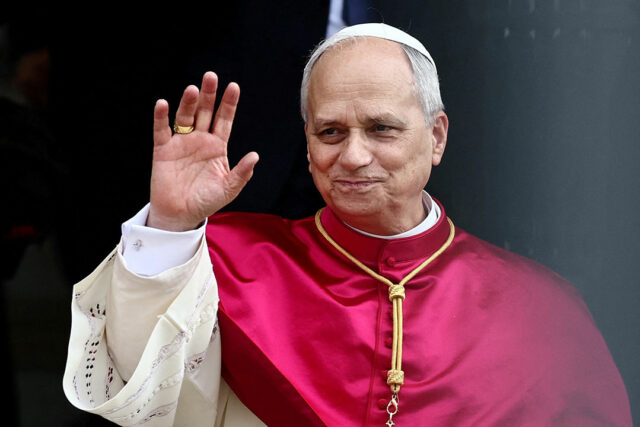
POPE LEO XIV waves as he leaves the basilica of Saint Paul Outside the Walls in Rome, Italy, May 20, 2025. — REUTERS

VATICAN CITY — Pope Leo begins an ambitious 10-day tour of four countries in Africa on Monday urging global leaders to address needs on the continent where more than a fifth of the world’s Catholics live.

The first US pope heads to Algeria for two days before continuing to Cameroon, Angola, and Equatorial Guinea in a whirlwind tour to 11 cities and towns, traversing nearly 18,000 km (11,185 miles) over 18 flights.

The pope is making the visit with a mission “to help turn the world’s attention to Africa”, Cardinal Michael Czerny, a senior Vatican official and close adviser to Leo, told Reuters.

The pope, who has emerged as an outspoken critic of the Iran war, has made only one big overseas trip since being elected last May, visiting Turkey and Lebanon in November and December. He visited Monaco in March.

Leo, aged 70, relatively young and in good health for a pope, is undertaking one of the most complicated tours arranged for a pontiff in decades.

More than 20% of the world’s Catholics live in Africa, according to Vatican statistics. The three sub-Saharan nations the pope is visiting have populations where more than half identify as Catholic.

Algeria, though, is an overwhelmingly Muslim country with under 10,000 Catholics among its population of some 48 million people. This is the first time it will host a Catholic pope.

POPE TO GIVE 25 SPEECHES ON MULTITUDE OF TOPICS
Leo’s tour is the 24th by a pope to Africa since the late 1960s.

He is expected to touch on many topics in 25 planned speeches over 10 days, Vatican spokesperson Matteo Bruni told journalists on Friday, given that the four nations face diverse issues.

Likely topics include exploitation of natural resources, Catholic-Muslim dialogue, and dangers of political corruption, said Mr. Bruni.

Cameroon and Equatorial Guinea have presidents who have been in power for decades and have been accused of human rights abuses, which they deny.

The biggest event of the itinerary will likely come in Cameroon on Friday, when the Vatican said some 600,000 are expected for a Mass in the coastal city of Douala.

Comfortable in several languages, Leo is expected to speak Italian, English, French, Portuguese, and Spanish during the trip.

Landing in Algeria in mid-morning on Monday, Leo will address the country’s political leaders before visiting the Great Mosque of Algiers in only his second visit to a mosque as pope.

He will travel on Tuesday to Annaba on Algeria’s northeast coast, for a visit to the ruins of the ancient town of Hippo.

The site has special meaning to Leo, who is a member of the Augustinian religious order. The order is inspired by the teachings of fourth-century St. Augustine of Hippo, a major figure in the early Church. — Reuters