Home Blog Page 3872

Tequila’s dignity: A’toda Madre Mezcaleria goes online

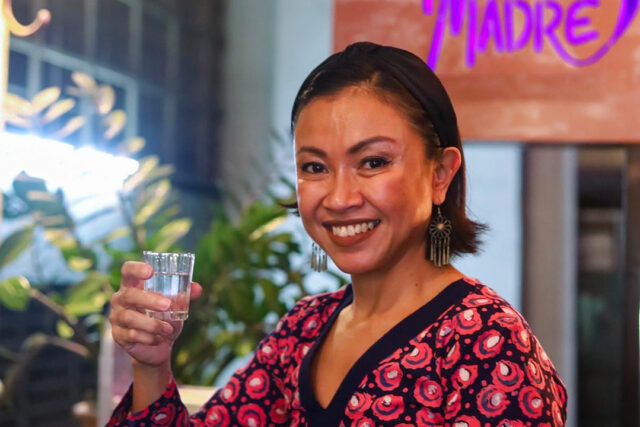
WINDI TAPAWAN, owner of A’toda Madre Mezcaleria, is the first and only certified agave spirits master in the Philippines and in Asia.

A’TODA MADRE MEZCALERIA only meant to make an announcement of its online bottle shop, www.atodamadretequila.com, on Dec. 5. That means that scores of brands of tequila and mezcal can now be bought online and delivered to your doorstep (including Derrumbes Mezcal, Don Julio, Los Vecinos, 1800 Tequila Blanco, Rey Campero, Clase Azul Reposado, Codigo, and Patron). However, A’toda Madre owner Windi Tapawan, the first certified Master of Agave Spirits in Asia, also gave us a deeper understanding of tequila and mezcal, and we are now wont to give a little more respect to the spirit.

We know tequila as a culprit behind many a headache and a cause for erratic behavior, but in Ms. Tapawan’s hands, the spirit gets a little more dignity, without losing any of its reputation as a drink for good times. For example, Ms. Tapawan led us through six agave spirits, each displaying complexities in its notes: one had notes of chocolate, another had smoky notes from its roasting process pre-distillation, while our favorite, Codigo 1530 Rosa Blanco, smelled like 4711 cologne, and had a little bit of a snap at its sip and had notes of black pepper and roses.

She dispelled some tequila myths: for example, more mainstream brands may be labeled with the word “mixto,” meaning it’s only made with 51% agave spirits, and the rest are other ingredients. It’s this mix that gives the signature tequila headache.

She also gave us a primer on the difference between tequila and mezcal: tequila is only made from the Blue Weber Agave plant, and can only be called “tequila” when it’s made in one of five Mexican states certified to make tequila: Guanajuato, Michoacán, Nayarit, Tamaulipas, and Jalisco. Mezcal’s world is a little more hazy: as long as its made from an agave plant, it could be called mezcal — about 20 varietals are used to make it; and some are even from wild strains — so there are many permutations to make it.

Asked if one can grow agave plants here, Ms. Tapawan said yes, although the ones grown here are smaller and are usually for ornamental purposes.

Finally, she pointed out that it was Filipinos who went to Mexico during the Galleon trade who taught Mexicans how to distill alcohol: she pointed out a label on the bottle that said that the mezcal had been made using a Filipino-Arabic still, the technology borrowed from our own methods of distilling lambanog (coconut liquor) from our own plants.

On a more melancholy note, we found out that when an agave spirit is called a spirit, it really gives up the ghost. An agave plant takes a minimum of seven years to grow before it is ready for harvesting. Unlike grain or grape, once an agave plant is harvested, it dies. “When you have a bottle of good mezcal, respect it,” said Ms. Tapawan. “A plant literally died to give that.” As we went through the vessels of mezcal and tequila — some were served in earthenware cups, while some were served on tiny glasses that got their origins from votive holders in church — she said to enjoy each sip, because, “You may never have it again.” Tequila and mezcal, a mind-eraser we thought originally, became that night a unique record of a plant’s life, a memento mori and reflecting mortality and temporality.

While A’toda Madre opened in 2014 as one of the country’s first tequila-centric bars (Ms. Tapawan herself disputed that they were the first, citing a predecessor in Cebu, and Tequila Joe’s, though she argues that the mainstream bar had more mass-market brands), Ms. Tapawan, its former marketing consultant, took over the bar after the demise of one of its founders in 2017. The bar was transformed into the country’s first mezcaleria, offering a wider array of what the agave plant could offer. She learned the business from the ground up, and earned her certification as a Master of Agave Spirits earlier this year in Mexico from the Agave Spirits Institute.

Asked why she had a passion for these specific spirits, she points to their character and when and how they’re served. “It’s a happy drink. It’s not like Scotch where it’s very heavy. You drink them in Scotland, where it’s cold and you sit there in a corner in front of a fireplace.”

As for tequila and mezcal, she said, “With one single drop, you get all these flavors. You get transported.”

Their website, www.atodamadretequila.com, is now online, although one can get a more immersive experience with an Agave masterclasses and tastings at A’toda Madre at the Sunette Tower, Durban St., Makati. — Joseph L. Garcia

Manila Water inks P7-B loan deal with LANDBANK for project funding

MANILA Water Co., Inc. has signed a 10-year term loan facility worth P7 billion with state-run Land Bank of the Philippines (LANDBANK) to fund its projects, the listed company announced on Wednesday.

“The loan will be used to partially finance Manila Water’s capital expenditure (capex) projects,” the east zone concessionaire told the local bourse.

The loan will be used to finance the projects under the approved rate rebasing for 2023, the company said.

Of the capex spending of P11.28 billion as of October, approximately P3.63 billion was allocated for service accessibility, P3.53 billion for water security, P2.73 billion for environmental sustainability, and P1.39 billion for service continuity.

In February, Manila Water also signed a term loan facility worth P3 billion with LANDBANK, intended to be used to fund its general corporate requirements and capex.

The company announced last week that it would implement the second tranche of the rate rebasing adjustments, as approved by the Metropolitan Waterworks and Sewerage System (MWSS).

MWSS approved an increase of P6.41 per cubic meter for Manila Water and a hike of P7.87 per cubic meter for Maynilad Water Services, Inc.

The rates will take effect on Jan. 1, 2024.

Manila Water customers in the east zone who consume 10 cubic meters will pay P34.13 more every month, while those consuming 20 cubic meters and 30 cubic meters will see their monthly bills go up by P76.68 and P187.01, respectively. Low-income customers consuming less than 10 cubic meters will pay P2.96 more every month.

The water company is currently seeking approval for the extension of its revised concession agreement with the MWSS from 2037 to 2047 to coincide with its 25-year legislative franchise.

In line with the extension application, Manila Water has committed to allocate P1.15 trillion for investments, primarily to ensure the continuous provision of water and wastewater services to its customers.

Manila Water serves the east zone network of Metro Manila, covering parts of Marikina, Pasig, Makati, Taguig, Pateros, Mandaluyong, San Juan, portions of Quezon City and Manila, and several towns in Rizal province.

At the local bourse on Wednesday, shares in the company went down by P0.14 or 0.76% to close at P18.36 apiece. — Sheldeen Joy Talavera

Meralco adjusts terms for 1,800-MW capacity procurement

MANILA Electric Co. (Meralco) said it has amended the terms for bidding on the 1,800-megawatt (MW) capacity procurement.

In a media briefing on Tuesday, Jose Ronald V. Valles, Meralco’s first vice-president and head of its regulatory management, said that this aligns with the recommendation of Energy Regulatory Commission (ERC) Chairperson Monalisa C. Dimalanta.

“Under the ToR (terms of reference), any bidder can offer a maximum of 1,800 megawatts, so she recommended to cap it to a certain level,” he said.

In response to the recommendation, Meralco decided to set a maximum offer of 1,200 MW and a minimum of 150 MW for the bidding process, Mr. Valles said.

With the recommended offer, at least two bidders may win in the competitive selection process (CSP), he noted.

The CSP requires contracts between power generation companies and distribution utilities to undergo price challenges, a process aimed at lowering electricity costs.

Meralco sought the guidance of the ERC to proceed with the opening bid next week.

“As of now tuloy, but we have written the ERC chair, that because there are recommendations and that we have already incorporated to the TOR, we’re seeking guidance if we can proceed with the bid opening on Dec. 27,” Mr. Valles said.

The CSP aims to find new suppliers for the electricity that were supposed to be supplied by Excellent Energy Resources, Inc. (EERI) and Masinloc Power Partners Co. Ltd. (MPPCL) — two subsidiaries under San Miguel Power Global Holdings Corp. (SMPGH).

Their contracts with Meralco were “terminated earlier this year,” the company said. The ERC approved the termination after their power supply agreement application went beyond the date by which it should have been approved by the regulator.

The two companies under SMPGH were supposed to start delivering Meralco’s needed capacity by 2024 and 2025 after securing the supply contracts in 2021.

Six entities have expressed interest in participating in the bidding, which are: GNPower Dinginin Ltd. Co., First NatGas Power Corp., SP New Energy Corp., Mariveles Power Generation Corp., EERI, and MPPCL.

Meralco’s controlling stakeholder, Beacon Electric Asset Holdings, Inc., is partly owned by PLDT Inc.

Hastings Holdings, Inc., a unit of PLDT Beneficial Trust Fund subsidiary MediaQuest Holdings, Inc., has an interest in BusinessWorld through the Philippine Star Group, which it controls. — S.J. Talavera

The 20th Grand Wine Experience: A post event review

After what seemed like an almost eternity-long absence for wine enthusiasts like me (when in reality it was only three years), the 20th Grand Wine Experience made its successful comeback on Nov. 17 at the Marriott Grand Ballroom in Newport City.

Like thousands of Metro Manila dwellers who had made their annual pilgrimage to the Grand Wine event since 2000, I couldn’t wait to be at the venue. I made it to this year’s event at around 6:30 p.m., early by the usual standards though officially this event opened at 5 p.m. This year, it seemed that Grand Wine patrons came in earlier, as the crowd was sizeable even at the time I arrived, which was previously not the case, especially since we are notorious for our “Filipino Time.”

WHAT WAS THE USUAL
Being that it was the 20th staging of the extravaganza, the Grand Wine Experience organizers — the Joseph siblings from the country’s top wine importer, Philippine Wine Merchant (PWM) — have already gotten the success formula right. As I noted since the inception of the Grand Wine Experience, this is one huge, authentic social-drinking party for the wine trade and its practitioners! There was no selling, no food and wine pairing, no presentations, no sequencing, no pretention and, best of all, self-pacing.

Other than missing a year in the mid-2000s, and then the pandemic years of 2020 to 2022, the Grand Wine Experience has been very much part of the Philippine wine culture since the start of this millennium. With this regard, this 2023 version of Grand Wine Experience was no different. Below were the usual things as expected, and as the adage goes: if it ain’t broke, don’t fix it.

Wines being poured: I really don’t know if there were 1,000+ wines and spirits in the event as advertised, but fortunately, the usual reliable suspects were there, notably renowned wine brands imported by PWM themselves: Montes, Trapiche, Saint Claire, Wente, Coppola, Yalumba, Pirramimma, Vasse Felix, Bouchard Pere & Fils, Bolla, Marques de Murrieta, Champagne Marguet and much more. Like in the past, the icon wines of each of this brand were still not openly displayed but were in special hidden stashes, to be poured only at the discretion of the organizers for control purpose.

Hosting and Entertainment: For as long as I recall especially when Marriott was the chosen venue, the hosts of the event had been the triumvirate of Johnny Revilla, Robi Joseph, and Ines Cabarrus-Habayeb — three genuinely wine-knowledgeable and passionate hosts who can relate to the crowd. The musical entertainment was provided by the Mel Villena band, another safe bet as the backdrop chill sound for wine enjoyment.

Grand Wine Buffet: Though the event was more about wine and “quality” inebriation, the food side had always been a “savior.” You can’t appreciate and taste as many different wines as you want on an empty stomach, and there were indeed plenty of delicacies and choices which Marriot’s long-tenured Executive Chef Meik Brammer had once more delivered. But I missed having the human-size edible chocolate sculpture which was in a previous Grand Wine event.

WHAT WAS UNUSUAL
The higher priced tickets and the emergence of more sake selections and spirits brands were among the unexpected and perhaps less than usual things at the 20th Grand Wine Experience. But none was as noteworthy as, for the first time, not having the presence of the eldest of the four Joseph siblings that started this all, Robert “Bobby” Lim Joseph.

Missing a Joseph: Usually every Grand Wine Experience starts with an opening toast from the four Joseph siblings that created this tradition, but this year, one of the pillars, eldest brother Bobby, was no longer around. Bobby passed away in June 2022, after bravely battling stage 4 kidney cancer for 20 years. Not seeing Bobby Joseph at this event was particularly strange, to say the least. He was surely missed, but the rest of the brothers — Ralph, Ronnie, and Raymond — were nevertheless their usual gracious selves, chatting and drinking with their guests who by now were more like family and friends than mere acquaintances.

The Sake Portfolio: Thanks to the youngest Joseph sibling Raymond’s exploits in sake, it seemed that the sake section has been getting more and more traction from Grand Wine patrons. And why not? Over the last few months, I myself have tasted some of the best sakes in town, bought in by PWM, including Masumi (my favorite), Hakkaisan (especially the Snow-aged Junmai-Daiginjo), and Dassai. With Japan being a popular Filipino travel destination, I can see sake culture making it here sooner than later. Very good vision from Raymond and rest of PWM.

Higher Ticket Price: It was a jaw-dropper when the ticket price was first announced. After all, it was P6,500 the last time the event was held in 2019, and three years later, it was P8,500 — a huge P2,000 jump of over 30%. While we all know of the current inflation, the amount still created an early shock wave, but then, when we think of it, Spiral at the Sofitel already charges around P5,000 for their dinner buffet without the wine. The question next for calculative individuals was whether one could drink P3,500 (P8,500 less P5,000) worth of alcohol to justify the cost — and the answer should be a resounding “yes.” If one chose and drank the right alcohol at Grand Wine, it would be worth the ticket price, not to mention being in the company of similar-minded people.

Fewer Wines, Better Selection: Honestly, I think this year’s Grand Wine featured fewer everyday drinking wines than it did in 2019. The wine selection seemed smaller in quantity in lieu of more spirits and sakes being featured, but better wines were being poured. Gone were the days when I saw some entry level wines making it to the list. Like all my previous Grand Wine Experiences, except for 2013, I would always stay up till midnight or closing — whichever came first. (On Nov. 15, 2013, I was already inside the Grand Wine event when I got a call from one of my siblings that my mom was rushed to the ICU, so I just went to congratulate the Joseph brothers and left for the hospital immediately. My mom, Rosa Ang Lao, would sadly pass away two days later on Nov. 17 — this year’s Grand Wine Experience fell exactly on her 10th death anniversary). And the reason I stay late always is because no one wants to leave a good party when the party is not yet over, and at these annual Grand Wine gatherings, the party somehow never stops, wines never stop pouring, and you will always encounter somebody you know who you want to catch up with, and before you realize it, it is past midnight already.

Congratulations once more to Ralph, Ronnie, Raymond, and the rest of PWM. While I would have loved to see more new faces, but the old familiar faces and genuine camaraderie built from the wine business were and would always be a welcome sight. And, yes, my liver may have been a bit messed up from the indulgence, but I have survived anew to tell my tale!


Sherwin A. Lao is the first Filipino wine writer member of both Bordeaux based Federation Internationale des Journalists et Ecrivains du Vin et des Spiritueux (FIJEV) and the UK-based Circle of Wine Writers (CWW). For comments, inquiries, wine event coverage, wine consultancy, and other wine related concerns, e-mail the author at wineprotege@gmail.com, or check his wine training website https://thewinetrainingcamp.wordpress.com/services/.

Term deposit yields slip on Fed rate cut bets

YIELDS on the central bank’s term deposit facility dipped on Wednesday after the US Federal Reserve signaled that it would cut rates in 2024.

The central bank’s term deposit facility (TDF) attracted bids amounting to P324.325 billion on Wednesday, above the P230 billion on the auction block but lower than the P391.323 billion seen a week ago for a P270-billion offer.

Broken down, tenders for the seven-day papers reached P194.105 billion, higher than the P120 billion auctioned off by the central bank and the P215.64 billion in bids for a P140-billion offer seen the previous week.

Banks asked for yields ranging from 6.6% to 6.65%, narrower than the 6.59% to 6.6875% band seen a week ago. This caused the average rate of the one-week deposits to decline by 2.98 basis points (bps) to 6.6329% from 6.6627% previously.

Meanwhile, bids for the 14-day term deposits amounted to P130.220 billion, higher than the P110-billion offering but lower than the P175.683 billion in tenders for a P130-billion offer seen on Dec. 13.

Accepted rates were from 6.625% to 6.68%%, narrower than the 6.6% to 6.6975% margin recorded a week ago. With this, the average rate for the two-week deposits inched down by 1.93 bps to 6.6563% from the 6.6756% logged in the prior auction.

The Bangko Sentral ng Pilipinas has not auctioned off 28-day term deposits for three years to give way to its weekly offerings of securities with the same tenor.

The term deposits and the 28-day bills are used by the central bank to mop up excess liquidity in the financial system and to better guide market rates.

TDF yields went down on Wednesday as the US central bank has finally signaled that it would cut rates by 75 bps in 2024, Rizal Commercial Banking Corp. Chief Economist Michael L. Ricafort said in a Viber message.

The US central bank kept the Fed funds rate steady at the 5.25%-5.5% range for a third straight time during its last meeting for the year on Dec. 12-13.

It raised rates by a total of 525 bps from March 2022 to July 2023.

The Federal Open Market Committee will hold its first policy meeting for 2024 on Jan. 30-31.

“Thus, any Fed rate cuts for 2024 could be matched locally and could lead to lower local interest rates, bond yields, and borrowing costs/financing costs for consumers, businesses/industries, government, and other institutions,” Mr. Ricafort added.

The BSP last week kept its policy rate steady at a 16-year high of 6.5% for a second straight meeting but said it remained cautious amid lingering upside risks to inflation.

The Monetary Board has raised benchmark interest rates by 450 bps since it began its tightening cycle in May 2022. — Aaron Michael C. Sy

Dining In/Out (12/21/23)


Favorite restaurants reopen at Shangri-La Plaza

FAVORITE dining destinations are coming back to Shangri-La Plaza mall. Via Mare, Cafe Lyon, and Healthy Shabu-Shabu are reopening and will be dishing up crowd favorites soon. La Creperie is now expanding with its very own store at Level 2. Known for its classic Filipino fare, Via Mare will soon open its doors at The Ledge on Level 6, Main Wing. Cafe Lyon will be serving its Filipino-French comfort food in its new location soon at Level 1, North Wing, right beside cake and bake shop Bake House and burger joint Raging Bull Burgers. Healthy Shabu-Shabu is all set to make its Shang comeback also at The Ledge on Level 6. Meanwhile, Wine Story has restarted operations at Level 1 (near OWNDAYS). For updates and inquiries, follow Shangri-La Plaza on Facebook at www.facebook.com/shangrilaplazaofficial and on Instagram @shangrilaplazaofficial.


Red Ribbon offer Holiday Cakes

AS THE holiday season is in full swing, Red Ribbon offers three cakes to brighten up celebrations. They are: Black Forest; the New Holiday Chocolate Dedication Cake, its moist chiffon chocolate cake made special with a limited time holiday design (available in stores starting Dec. 22); and the New Red Velvet Bliss, a festive red and white cake design with red and white chiffon cake layered with creamy icing infused with cream cheese (already available in select stores nationwide). Prices start at P679.


Four Points by Sheraton Palawan opens in Puerto Princesa

FOUR POINTS by Sheraton, part of Marriott Bonvoy’s portfolio of 31 hotel brands, announces the brand’s entry into the Philippines with the opening of Four Points by Sheraton Palawan Puerto Princesa in Palawan. The new hotel is located along Sabang Beach, about 70 kilometers or 90 minutes drive northeast of Puerto Princesa City, and is inside the Subterranean River National Park, a UNESCO World Heritage site. The area offers many opportunities for adventure, from its 8.2 kilometer-long Underground River to explore, the Sabang Mangrove Forest to paddle through, jungle paths to hike, crystal-clear waters to snorkel in, and day trips by boat to the nearby isles. The hotel offers 168 guest rooms, each featuring the signature Four Points by Sheraton Four Comfort Bed, modern marble-floored bathrooms, complimentary Wi-Fi, as well as balconies with scenic views of the mountains and beaches. Suite rooms offer increased flexibility with 47 square meters (sq.m.) and a 65-inch flat-screen TV. It has two restaurants and a pool bar, which offer a true farm-to-table dining experience featuring the best of local ingredients. Guests can dine outdoors by the sea at Evolution, the hotel’s all-day dining restaurant with an open kitchen and live cooking stations. Italian restaurant Il Fiore also features al fresco seating, where guests can enjoy upscale Italian cuisine and creative cocktails with the fresh ocean breezes of Sabang Beach. The best accompaniment for every meal is a local craft beer straight from the tap, courtesy of the Four Points by Sheraton signature Best Brews selection, which showcases the area’s culture and authentic flavors through locally brewed beers. The hotel’s 1,367-sq.m. swimming pool, with the Pool Bar right in the middle, is the ideal spot to relax and sip cocktails. The hotel also has a 24/7 fitness center, sauna, and children’s playground. For events, the hotel offers outdoor open-air setups, perfect for weddings, parties, and concerts. Indoor venues for meetings will be available in 2024, offering complimentary fast Wi-Fi and equipped with the latest audio-visual technology. This season of year-end celebrations, the hotel is offering a special rate for guests staying on Dec. 24-25 and Dec. 31, 2023-Jan. 1, 2024. These Christmas and New Year’s Eve promotions include a Deluxe Garden view room, breakfast for two, and dinner for two. Rates start at P18,100++ per night. Stays can be booked at FourPointsPalawan.com. For more information, visit FourPointsPalawan.com.


Bicol’s iconic hotel reopens for the Xmas Season

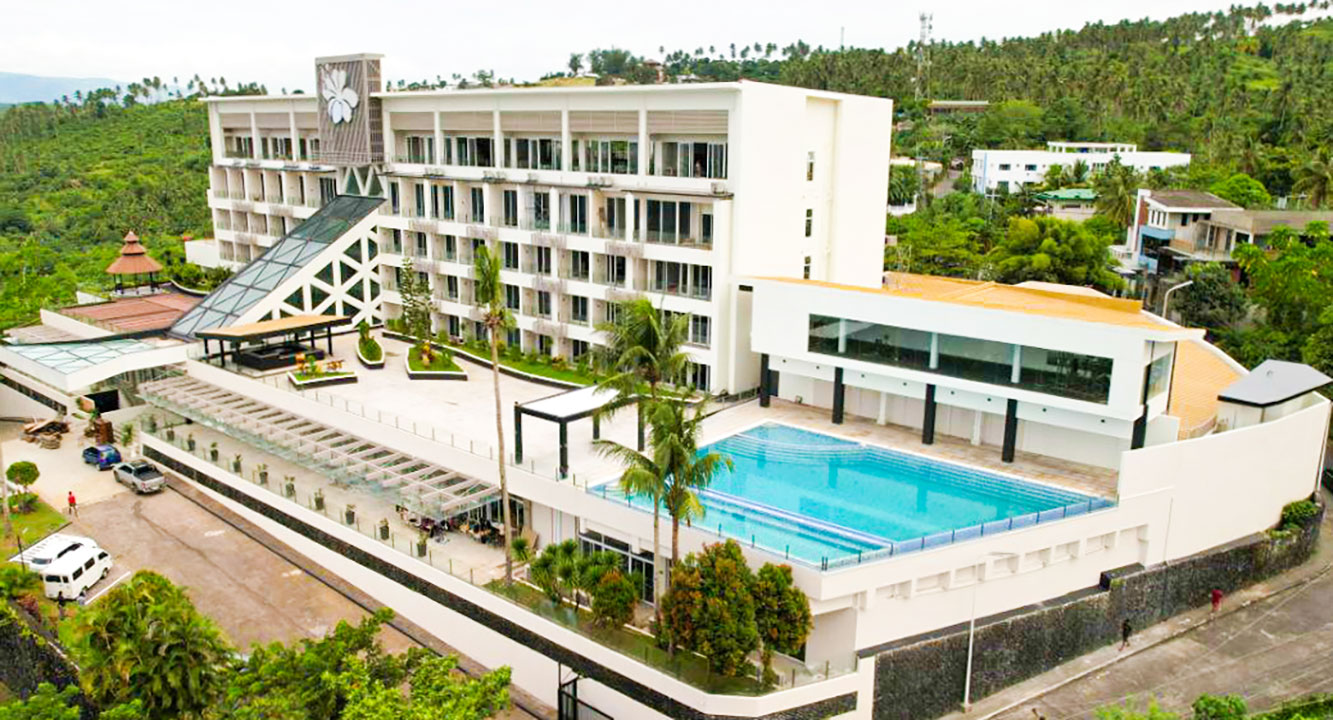
THE Oriental Legazpi, the iconic hotel of the Bicolandia, recently reopened after a makeover, just in time for the Christmas season. The four-star hotel boasts of 104 well-appointed rooms, including six executive suites, and the Mayor’s Suite and Governor’s Suite. Sitting on top of Taysan Hill overlooking Legazpi City, it boasts of a breathtaking view of Mayon Volcano, Albay Gulf, and the city proper. The hotel has a gym, an infinity pool, a Zen-inspired Legazpi Garden, and The Spa which offers signature massage treatments. Guests can enjoy the all-day dining Mayon Imperial Restaurant, Beana’s Nook for a more intimate feel, and the Volcanic Grill which is ideal for a watering hole nightcap while gazing at the stars and Mayon’s night-time silhouette. As a Noche Buena treat, The Oriental is offering the Yuletide Feast with a selection of regional, Filipino, and international dishes for P1,299 for adults and P899 for children. The dinner experience is enhanced with the Symphony of Lights and Sounds featuring the Oriental Fire Dancers, and carol performances by a local violinist and pianist. The Twinkling Night Specials promo runs until Dec. 31. The hotel can arrange island-hopping, ATV adventure around Mayon, butanding (whale shark) interaction, scuba diving, and customized tours around the Bicolandia with its partner tour operator accredited by the Department of Tourism. Van transfers to and from the city proper and the Bicol International Airport can also be arranged for guests’ convenience. For updates and latest offerings, visit legazpi.theorientalhotels.com or follow The Oriental Legazpi on Facebook or Instagram.


Manami Resort’s Magic of White Christmas

THE FIRST and only luxury nature resort in Sipalay, Negros Occidental, Manami Resort unveils a white Christmas is reimagined amidst the backdrop of sun-kissed sands and crystal-clear waters. The Spanish-inspired Noche Buena dinner on Dec. 24, priced at P3,000++ per person, promises to be a highlight. Guests will be treated to a dinner accompanied by live music and the light show by Bailes de Luces from La Castellana City, along with special fire dance performances. The festivities continue into the New Year with the resort’s Media Noche event on Dec. 31. For P3,750++ per person, guests can enjoy a Mediterranean buffet in a setting adorned with white Christmas decor. The evening will be elevated with live music, a fireworks display, and a toast to new beginnings. Manami Resort also offers the Choco Mallows beverage for P580++, and the Yuletide Elixir cocktail, a blend of vodka, amaretto, vanilla, milk, and Baileys, for P480++. Hotel reservations can be made by contacting the resort team at 0917-178-2611 or via e-mail at reservations@manamiresort.com. For more information visit manamiresort.com, facebook.com/ManamiResort, or instagram.com/manamilife.


Classic Christmas from Sugarplum Pastries

CHEF LOVELY JIAO of Sugarplum Pastries brings back her Christmas Classics, a collection of favorite holiday treats and sweets. Headlining the selection is the Meringue Tower, a structure of chocolate truffles, candy canes, and cinnamon cookies. The season-inspired Cookie-Do is a DIY set which comes with a big cinnamon biscuit in the shape of a Christmas tree as well as cookies in the form of stars and presents, three piping bags of green, red, and yellow frosting, rainbow sprinkles, and candies, as well as Sugarplum’s signature chocolate smash balls with a wooden mallet for added fun. The menu likewise includes Cakesicles, chocolate-coated truffle cakes adorned with characters from Santa Claus and Rudolph the Red-nosed Reindeer to a Snowman and Gingerbread Man. The Yuletide-inspired Macarons, on the other hand, are elegant meringue sandwiches filled with salted dulce de leche, white chocolate, or strawberry. The Brownie Cheesecake is a blend of creamy and salty flavors, complemented with dark and gooey brownie bites, whereas the Dark Maria is a serving of moist dark chocolate topped with strawberries. The Peach and Mango Tres Leches is a melt-in-the-mouth sponge cake soaked in evaporated, condensed, and whole milk finished with whipped cream and mangoes and peaches. Perfect as gifts or tokens for this season of giving, the Christmas Trio offers an all-in-one package that includes the Banana Loaf, Dark Maria, and Chocolate Chip Oatmeal Cookies. The Christmas Sampler features an assortment of macarons, cakesicles, and cinnamon cookies. Completing the line-up are staples made special this Christmastime: Cheesy, buttery Ensaimada; Banana Bread with dark chocolate topped with toasted walnuts; and INF Cookies with cashews, walnuts, and almonds. Armed with a culinary degree from De La Salle-College of Saint Benilde School of Hotel, Restaurant, and Institution Management, Ms. Jiao has honed her skills at the Makati Shangri-La and F1 Hotel Taguig.


Bridgetowne offers lights, music, and good food

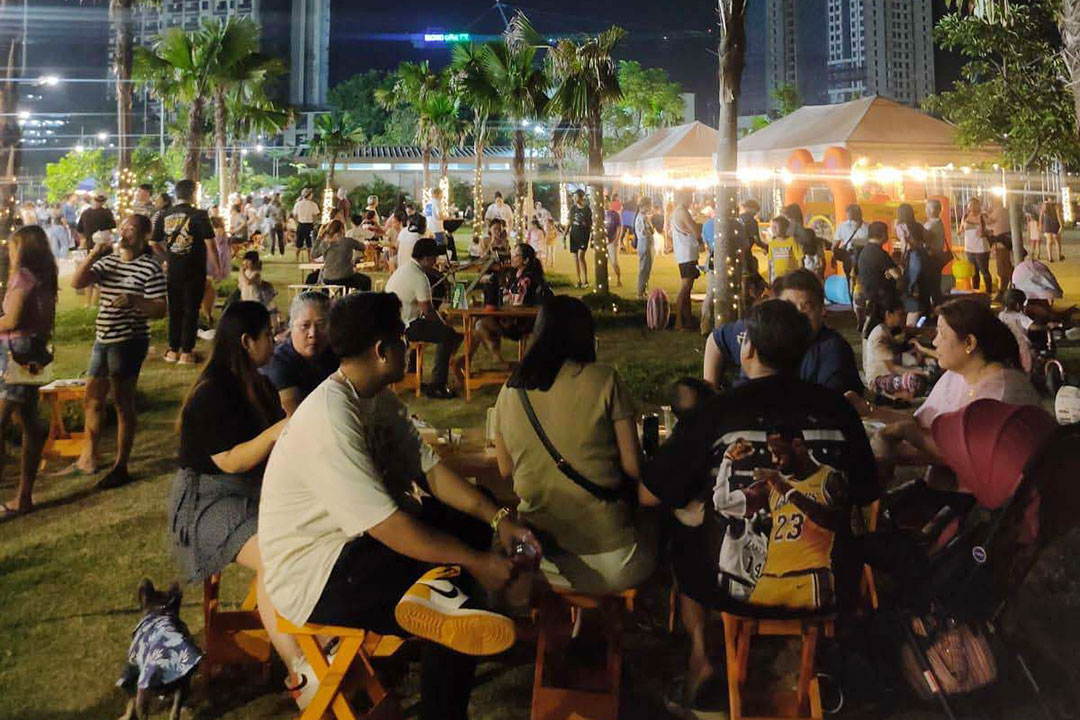
BRIDGETOWNE, Robinsons Land’s destination estate, offers lights, music and food in a wide-open space this season. Earlier this month, Mercato Central opened an outpost at Bridgetowne near the property’s football pitch. With almost two dozen food stalls to choose from, visitors are spoiled for choice. This Christmas season, the stalls are open for business Tuesday to Sunday, while in January it operates from Thursday to Sunday, 4 p.m. to midnight until March. Buskers provide entertainment, nightly. Among the vendors are Heaven Shake, Nutrifresh and Face Buko, Juice Factory, Kraft Coffee, Hungarian, John Crispy, Lyn’s Bibingka, El Angelicious Empanada, JD’s Takoyaki, It’s A Wrap, Uncle Kims, Kchase Korean Street Food, Cheng’s Grill, Guagua’s Best, Bagnet Rice Patong, 921 Smoking Hot, Mongolian, Cocina Berenguer, and Chicago. Once dusk falls, Bridgetowne lights up, offering picture-perfect backdrops starting with the gigantic The Victor statue which is festively illuminated. A second art installation, Lambat, depicts a fishing couple at the precise moment when they cast their net. Brigetowne will also holding its first New Year Countdown on Dec. 31, featuring some of the country’s top bands — Sandwich Motherbasss with DJ Loonyo, MC Pao Avila, DJ Jet Boado DJ Alondra. Hosted by Kaladkarin and Princess Legaspi, the event will start at 9 p.m. Entrance is free.


Richmonde Hotels offer holiday specials

THIS YEAR, Eastwood Richmonde Hotel and Richmonde Hotel Ortigas will offer festive buffets, staycation packages, and year-end parties at best value. A merry banquet spread awaits diners of Richmonde Hotel Ortigas’ Christmas Eve Dinner Buffet at the Richmonde Café on Dec. 24, 6 to 10 p.m., and priced at P1,680 net with coffee or tea. At Eastwood Richmonde Hotel, the Christmas Eve Dinner Buffet of Eastwood Café+Bar is highlighted by a variety of carvings such as roast turkey, prime rib, roasted leg of lamb, porchetta, and salmon wellington, among others. Buffet is at P1,999 net per person with a round of iced tea, soda, Smirnoff Mule, red or white wine, plus coffee or tea, and is served from 6 to 10 p.m. To further lift holiday spirits, carolers will serenade the diners and hotel gift certificates will be raffled off. Gather the family to say goodbye to 2023 and usher in another year with an all-night affair on Dec. 31 at Richmonde Hotel Ortigas starting with a New Year’s Eve Dinner Buffet from 6 to 10 p.m. at the Richmonde Café featuring an international spread of festive fare for P1,980 net. After Media Noche, it is time for the New Year’s Eve Countdown Bash which starts at 9 p.m. at the hotel lobby. The event features live music from Infinite Vibes, a cocktail buffet, and three rounds of drinks with choices ranging from cocktails and beer, to iced tea, soda and chilled juices, plus sparkling wine for toasting as the clock strikes midnight. Tickets to the countdown party are P1,380 net each. Get big savings with the New Year’s Eve Dinner Buffet and Countdown Bundle priced at P2,880 net per person. Meanwhile, Eastwood Richmonde Hotel turns back the clock while moving forward to greet the new year with a Music Revival Party to Countdown to 2024 that starts at 9:30 p.m. on Dec. 31, with stand-up comic Jeremie to warm up the crowd with comedy, interactive games, and a raffle draw. The High Pitch Band lights up the stage with pop and dance music. Guests can fill up on the cocktail buffet spread and free flowing beer, cocktails, and non-alcoholic drinks, all for P1,999 net per ticket. This is followed by the Eastwood Richmonde’s New Year’s Day Brunch Buffet at the Grand Ballroom on Jan. 1 from 10 a.m. to 2 p.m. for P1,699 net. All buffet offers and countdown tickets are free for children five years old and below while children six to 12 years old get a 50% discount on the full price. Meanwhile, Richmonde Hotel Ortigas brings Holiday Wonders with room rates starting at P3,700 net (room only) and P4,500 net (with breakfast buffet for two) for bookings this December until Jan. 14, 2024 (except Dec. 24 and 31). On Dec. 24, celebrate Christmas with room package rates from P5,000 net with breakfast buffet for two, and P7,500 net with breakfast buffet and Christmas Eve dinner buffet at Richmonde Café for two. On Dec. 31st, book accommodations for as low as P5,500 net with breakfast buffet for two, P7,000 net with breakfast and New Year’s Eve countdown party tickets for two, P7,800 net with breakfast and New Year’s Eve dinner buffet for two, and P9,800 net for the works — breakfast, dinner buffet, and countdown party for two. Guests can also enjoy a 15% discount on dine-in orders at Richmonde Café and in-room orders from Room Service, plus on December weekends, complimentary hot cocoa at the lobby and drinks at the pool. For the hotel’s Catholic guests, a mass is scheduled at the 3/F function room on Dec. 25 and Jan. 1 at 10:30 a.m. Meanwhile, stay within Eastwood City from now until Dec. 30 (except Dec. 24 and 25) and enjoy the family-friendly activities it offers. The Season’s Splendor room packages include accommodations for as low as P4,600 net for a night’s stay and P4,200 net per night for two nights or more. To include breakfast buffet for two persons, add P1,100 to the rates. Stay on Dec. 24 at P8,800 net and your stay on Dec. 25 is 50% off or just P4,400 net. Rates already include breakfast buffet for two. The Christmas Eve room package starts at P11,300 net and come with breakfast buffet and Christmas Eve dinner buffet at Eastwood Café+Bar good for two persons. On Dec. 31, book a room with two tickets to the hotel’s countdown party and brunch buffet for two for as low as P12,700 net. Enjoy an extended holiday from Jan. 1 to 15, 2024 for as low as P5,500 net with breakfast buffet for two. All room and package rates are inclusive of taxes, Wi-Fi access, complimentary use of the pool, and parking for one vehicle on a first come, first served basis. For inquiries, table reservations, and countdown party ticket purchases, call Richmonde Hotel Ortigas’s Food & Beverage Department at 0917-534-4352, e-mail fbsup@richmondeortigas.com, or message the hotel’s official accounts on Facebook and Instagram. For inquiries and table reservations at Eastwood Richmonde Hotel, contact its Food & Beverage Department at 0917-821-0333, e-mail fb@eastwoodrichmonde.com or send a message via Eastwood Richmonde Hotel’s official Facebook page. For inquiries and room reservations, call Richmonde Hotel Ortigas at (632) 8638-7777 or 0917-859-7914 on mobile or Viber, e-mail stay@richmondeortigas.com, or log on to www.richmondehotelortigas.com.ph, and Eastwood Richmonde Hotel at 8570-7777 or 0917-531-6867 on mobile or Viber, e-mail stay@eastwoodrichmonde.com, or log on to www.eastwoodrichmondehotel.com.ph.


Sonos speakers now available in PHL

SONOS MOVE 2

US-BASED audio product brand Sonos has launched in the Philippines its new speakers, the Era 100, Era 300, and Move 2, its local distributor said.

Sonos speakers are available at its exclusive distributor Mod Audio Philippines’ physical and online stores, as well as its official retail partners Power Mac Center and SM Appliance Center, it said in a statement.

The Sonos Era 100 is priced at P16,990, while the Era 300 and Move 2 are available for pre-order for P31,990 and P30,990 respectively. Reservations can be done by messaging Mod Audio Philippines’ Facebook or Instagram pages.

“Sonos, the wireless home sound system brand, introduces three new audio devices to fill your experiences with astonishingly brilliant and clear sound — the Sonos Era 100, Era 300, and Move 2. With these innovations, Sonos continues its commitment to reinventing sonic experiences through first-of-its-kind technology and impeccable design, allowing users to fill a room with rich sound,” Mod Audio Philippines said.

“With Sonos devices, you have everything you need to experience brilliant sound whenever, wherever,” it added.

The Sonos Era 100, which features “finely tuned stereo sound and rich bass lines,” can be connected via Bluetooth, Wi-Fi, and Airplay, the company said.

“Weighing just over 2kg, Sonos Era 100’s size allows users to place the speaker in any part of the room, and even pair with a second device for an even more immersive audio experience,” it said.

“Despite its compact design, the Sonos Era 100 packs a punch to allow sound to permeate your surroundings. Powering the Sonos Era 100 to create a full sonic experience include two angled tweeters, which balance left and right frequencies; a midwoofer 25% larger than in the Sonos One for rich bass; and custom waveguides to amplify soundwaves. Users can easily control and adjust their soundscapes, like volume, bass, and treble, through intuitive touch controls or through the Sonos App,” the company added.

Meanwhile, the Sonos Era 300 offers a “more immersive spatial audio experience” as it has six drivers placed on its front, sides and top and supports Dolby Atmos sound.

“Adding to the clean aesthetic of any home while simultaneously enabling a realistic surround sound experience, the Sonos Era 300 boasts a first of-its-kind design, balancing visual appeal with the pioneering technical specs. Inside the device are four tweeters meant to ensure faithful playback across a range of frequencies, from wall to wall, and floor to ceiling fully enveloping the space. Dual woofers and custom waveguides round out the interior specs for a balanced bassline and widely spaced audio output,” the company said.

The Era 300 can likewise be connected via Bluetooth, Wi-Fi, an auxiliary cable, or touch controls, among others.

Lastly, the Sonos Move 2 can be used indoors and outdoors as it adjusts its sound based on the acoustics of the location, the company said.

“Among its upgrades include a more powerful battery, allowing users to enjoy up to 24 hours of non-stop playback. Plus, its Wireless Charging Base with a more compact adapter makes charging more convenient. The Sonos Move 2 boasts 30% more energy efficiency and also comes with a replaceable battery, extending the life of the speaker,” it said.

“Inside the Move 2, the new and improved acoustic architecture includes dual angles tweeters for stunning sound on each side and one midwoofer with precisely-tuned bass lines… It boasts not only IP56 rating for dust and water resistance, but is also made with shock-absorbent materials to protect the device from drops. At just 3kg, the speaker is easy to bring along for all your getaways,” it added.

Mod Audio Philippines said the Era 100 now uses less energy than the earlier model Sonos One, and the Era 100 and Era 300 are made with post consumer-reycled plastics. The speakers also come in 100% recyclable packaging. — BVR

RLC’s Frederick Go steps down, Lance Gokongwei to take charge

FREDERICK D. Go is stepping down as the president and chief executive officer (CEO) of Robinsons Land Corp. (RLC), effective January next year, following his appointment as Special Assistant to the President for Investment and Economic Affairs, the listed company announced on Wednesday.

In a regulatory filing, RLC stated that its board of directors has accepted Mr. Go’s resignation as president and CEO, as well as a member of its board of directors, effective Jan. 8, 2024.

The company’s board has also approved the appointment of RLC Chairman Lance Y. Gokongwei as president and CEO, and Executive Vice-President Faraday D. Go as a member of the RLC board, starting next month.

In separate disclosures, Mr. Go is also resigning as chairman and member of the board of RL Commercial REIT, Inc. and Altus Property Ventures, Inc., although the two companies have yet to announce who will be replacing Mr. Go.

He also serves as the director of power utility giant Manila Electric Co., and Cebu Air, Inc. 

RLC’s management changes will not have an impact on the company’s performance and operations, analysts said, adding that investors are seen to be confident in the leadership.

“We don’t think this will shake things up at RLC. The rest of the senior management team remains intact, and investors are confident in the leadership of Mr. Gokongwei as the new CEO,” China Bank Capital Corp. Managing Director Juan Paolo E. Colet said in a Viber message on Wednesday. 

“Although it was quite a surprise to the market, Mr. Go’s skills will be of great use in government. RLC is still in the highly capable hands of Mr. Gokongwei,” Regina Capital Development Corp. Head of Sales Luis A. Limlingan likewise said in a Viber message. 

As the company’s board has approved the recent changes, RLC is expected to continue its current strategies and plans, Mr. Colet said, adding that the company’s stock should perform well over time.

On Monday, Malacañang announced the issuance of an executive order creating an office responsible for strategic advice on economic concerns, including inflation and investment opportunities.

The Office of the Special Assistant to the President for Investment and Economic Affairs will be headed by Mr. Go, giving him a secretary-level post.

For the third quarter, RLC recorded an attributable net income of P3.06 billion, up by 49.3% from P2.05 billion a year ago on higher revenues for the period.

The company’s third-quarter gross revenue rose to P10.58 billion, climbing by 27.9% from the P8.27 billion previously.

At the local bourse on Wednesday, shares in RLC gained 32 centavos or 2.04% to end at P16 apiece. — Ashley Erika O. Jose

We should know better by now

ISAAC QUESADA-UNSPLASH

The state of public health emergency due to COVID-19 ended in July 2023 with President Ferdinand Marcos, Jr. issuing Proclamation No. 297. More than four months later, here we are again dealing with some sort of “emergency” given the rising number of COVID cases and that of other respiratory illnesses.

As I noted in a column in July, despite the government’s cancellation of the state of public health emergency, we should not completely abandon all COVID protocols. I had noted then that measures like distancing and masking should still be observed at the personal or individual level in specific settings. And, we should all be reminded that safety is everybody’s responsibility.

Obviously, distancing and masking are already optional and not mandatory. But it should already be second-nature to people by now to put on a mask when in crowded places, or when with cold or flu symptoms. People must also remember that while the state of emergency has ended, COVID and other illnesses continue to exist.

I can only assume that at this point, vaccine protection has waned for most people. In this line, perhaps people, particularly those with comorbidities, should consider availing themselves of available COVID-19 and flu and pneumonia vaccines. COVID-19 still exists, and there is no assurance that the number of cases would not surge again.

One report indicated that the seven-day COVID positivity rate in Metro Manila increased to 21% as of Dec. 17 from 13.4% on Dec. 10. This is based on data from the Department of Health (DoH). That is one positive case in every five people who underwent RT-PCR testing for COVID-19 in the National Capital Region. Of course, what this data did not capture were the number of people who tested positive using antigen tests at home.

For now, most COVID cases are said to be mild, and the number of hospital admissions related to COVID remains manageable. However, there is no doubt that the number of cases is on the rise at a relatively fast pace. Previously, for COVID pandemic management, the threshold set by the World Health Organization (WHO) was a positivity rate of 5% or below. At present, it is at 21% in Metro Manila.

With this, it was unsurprising that the Department of Labor and Employment (DoLE) is again encouraging companies not just in Metro Manila but nationwide to make use of work-from-home (WFH) schemes and other measures that can prevent the spread of COVID and other respiratory illnesses, noting that “safety is of utmost importance.”

DoLE also noted that WFH is nothing new, and that there are existing guidelines for employers on flexible work arrangements, including WFH. While WFH is a management prerogative, the exercise of that prerogative should not prejudice workers, DoLE noted. The number of COVID-19 cases was already expected to go up further, so preventive measures are necessary.

WFH may be a good idea from now until January as many employees have opted to go on leave, anyway. And Dec. 25, 26, 30 as well as Jan. 1 and 2 are all non-working days for most workers. Employers can spread a little more Christmas cheer by allowing their employees to spend more time at home with their families, while still doing the required work.

Confirmed COVID-19 infections nationwide have reportedly risen by 50% over the past week, with the seven-day average cases going up to 389 from 260. But the national average hospital bed occupancy for COVID-19 cases is still low, says Health Secretary Ted Herbosa. But this is not to say that things will not take a turn for the worse.

From experience, COVID can mutate very quickly and new strains can spread quite fast over a short period of time. The Christmas season is of particular concern as people tend to go out more, and colds and flu are more common during this time of year. A lot of travel also occurs during this period, allowing for the entry of viral strains from abroad.

At this point, surveillance is key. Families, workplaces, hospitals, and health officials all need to be more vigilant. There were many lessons learned from 2020 until 2022 with respect to dealing with the COVID pandemic, and one can only assume these lessons were not lost particularly on the health officials and the healthcare industry.

Lockdowns are a thing of the past. People will insist on going about with their lives, despite the risks to public health. However, people are not necessarily powerless as experience shows that interventions like masking, distancing, proper ventilation, proper washing of hands, and sanitizing hands with alcohol all help control the spread particularly of respiratory diseases.

With Christmas just around the corner, and holiday gatherings expected to last until next month, it is safe to assume that the number of COVID cases will continue to rise. While this scenario applies to respiratory illnesses in general, also given weather conditions, there is greater concern when it comes to COVID and pneumonia particularly for the elderly and those with comorbidities.

The least that people can do is to wear masks while in public, to limit their attendance in gatherings, and to prefer venues and occasions held in well-ventilated areas. More important, to always keep their hands clean. To the extent possible, people should also avoid crowded areas and major events previously referred to as “superspreaders.” Personal restraint and personal discipline are crucial factors now more than ever.


Marvin Tort is a former managing editor of BusinessWorld, and a former chairman of the Philippine Press Council

matort@yahoo.com

Italian food historian cooks up carbonara controversy

Italian food historian Luca Cesari holds up a plate of carbonara made using a recipe from the 1950s.

ROME — Food is a serious business in Italy, part of the national identity, as illustrated by a row that has broken out over how to make carbonara pasta sauce.

Luca Cesari, a food historian and author from Bologna, faced a stream of online abuse after he posted a video on Instagram in which he presented what he said was the original version of carbonara, considered a classic of Roman cooking.

Ditching the usual ingredients of Italian pecorino cheese and cured pork cheek to be mixed with eggs to create a creamy sauce, the carbonara presented by Cesari was made with Swiss gruyere cheese, garlic, bacon, and scrambled eggs.

Cesari said he had gone back to the original recipe published in an Italian cookery magazine almost 70 years ago and was trying to show how the recipe evolved over the decades.

“I simply remade the 1954 carbonara, the first one featured in the Cucina Italiana magazine. It’s not my fault if that was the carbonara recipe!,” he told Reuters.

“Over the years, a series of different recipes for carbonara have emerged, including those with raw ham in the ‘50s. In the USA you could even find versions with clams or mushrooms.”

Alberto Grandi, another food historian who has come under fire for questioning established Italian culinary traditions, leapt to Cesari’s defense.

In his own Instagram video, he denounced a sort of “gastronationalism that prevents us from reasoning calmly about the themes of our cuisine.”

Other examples of what Italians consider food heresy are pairing pasta with ketchup sauce, or adding pineapple to pizza, together with a de facto ban on ordering cappuccino after lunch.

Cesari remains unbowed and is ready to whip up more culinary controversy.

“That was only the first video… I’m preparing a new one on the traditional Neapolitan pizza from the 1800s with clams!.” — Reuters

Bill seeks to allow local government units to deal with private banks

UNPLASH

A LAWMAKER has filed a measure seeking to allow local government units (LGUs) to conduct banking activities with private banks.

“This legislative measure seeks to empower LGUs with the choice to conduct banking activities with private financial institutions, while instituting adequate safeguards to protect public funds,” Cebu City Rep. Eduardo R. Rama, Jr. said in House Bill No. 9724.

The proposed law would allow LGUs to engage in banking and other financial transactions with their preferred banks, whether a private universal or commercial bank (U/KB) or a qualified government financial institution (GFIs).

The Bangko Sentral ng Pilipinas (BSP) and the Department of Finance (DoF) must set defined criteria for private U/KBs before they are allowed to transact with LGUs.

The BSP must then provide a shortlist of private banks eligible to transact with LGUs.

Mr. Rama noted that local governments in countries like the United States and the United Kingdom are allowed to deposit public funds in private financial institutions with adequate safeguards.

He added that GFIs’ “investment portfolios may not offer the same breadth of options as those of private banking institutions.”

U/KBs will be mandated to implement risk management measures and safeguards against unauthorized access, fraud and cybersecurity threats. It should also maintain accurate records and allow an oversight committee to conduct audits.

A private U/KB cannot engage in banking activities with an LGU if its official or major shareholder is within the fourth civil degree of consanguinity or affinity with any elected local official.

Members of the oversight committee must have one representative each from the DoF, the BSP, the Department of Interior and Local Government (DILG), and the Commission on Audit.

The panel must also contain one advisory participant from the private banking institutions — as nominated by the Bankers Association of the Philippines — and from a recognized nongovernmental organization or advocacy group focused on financial inclusion and consumer protection, to be nominated by the DoF, the BSP, and the DILG.

Currently, the DoF only allows LGUs to maintain government funds with qualified GFIs like the Land Bank of the Philippines and the Development Bank of the Philippines.

A similar bill filed last year by Senator Sherwin T. Gatchalian said LGUs can only transact with U/KBs if a GFI cannot provide specific banking products and services, if they are not accessible within a 20-kilometer radius, or if there are security and safety risks in transacting.

The bill is currently pending in both the House and Senate banks committees. — Beatriz Marie D. Cruz

Alibaba rolls out LLMs with Tagalog support

ALIBABA Group’s research institute DAMO Academy has rolled out its artificial intelligence (AI)-powered large language models (LLMs) called SeaLLMs, which include support for Tagalog and other Southeast Asian languages.

“The models represent a technological leap forward in terms of inclusivity, offering optimized support for local languages in the region including Tagalog, Vietnamese, Indonesian, Thai, Malay, Khmer, Lao, and Burmese,” Alibaba said in a statement late last week.

“The conversational models, SeaLLM-chat, exhibit great adaptability to the unique cultural fabric of each market, aligning with local customs, styles, and legal frameworks, and emerging as an invaluable chatbot assistant for businesses engaging with SEA markets,” it added.

LLMs are a type of generative AI meant to help produce and predict text content.

Alibaba said SeaLLMs have 13-billion-parameter and 7-billion-parameter versions and are meant to cater to the “linguistic diversity” of Southeast Asia. SeaLLMs are now open-sourced on AI community Hugging Face and can be used for research and commercial purposes.

“In our ongoing effort to bridge the technological divide, we are thrilled to introduce SeaLLMs, a series of AI models that not only understand local languages but also embrace the cultural richness of Southeast Asia,” Lidong Bing, director of the Language Technology Lab at Alibaba DAMO Academy, said. “This innovation is set to hasten the democratization of AI, empowering communities historically underrepresented in the digital realm.”

“Alibaba’s strides in creating a multi-lingual LLM are impressive. This initiative has the potential to unlock new opportunities for millions who speak languages beyond English and Chinese. Alibaba’s efforts in championing inclusive technology have now reached a milestone with SeaLLMs’ launch,” said Luu Anh Tuan, assistant professor at the School of Computer Science and Engineering at Nanyang Technological University, which is a partner of Alibaba in multi-language AI study.

The SeaLLM-base models went through pre-training on a data set including Southeast Asian languages to ensure understanding of local nuances and native communication contexts, Alibaba said.

“This foundational work lays the groundwork for chat models, SeaLLM-chat models, which benefit from advanced fine-tuning techniques and a custom-built multilingual dataset. As a result, chatbot assistants based on these models can not only comprehend but respect and accurately reflect the cultural context of these languages in the region, such as social norms and customs, stylistic preferences, and legal considerations,” it added.

“A notable technical advantage of SeaLLMs are their efficiency, particularly with non-Latin languages. They can interpret and process up to 9 times longer text (or fewer tokens for the same length of text) than other models like ChatGPT for non-Latin languages such as Burmese, Khmer, Lao, and Thai. That translates into more complex task execution capabilities, reduced operational and computational costs, and a lower environmental footprint,” Alibaba said. — BVR

ADVERTISEMENT
ADVERTISEMENT