Home Blog Page 3870

NLEX, Blackwater fighting for PBA survival

Games Friday
(Smart Araneta Coliseum)
4 p.m. — NLEX vs Blackwater
8 p.m. — Meralco vs Barangay Ginebra

FOR NLEX and Blackwater, the order of the day is fighting for survival. For heavyweights Meralco and Barangay Ginebra, it’s staying in play for coveted positions in the PBA Commissioner’s Cup playoffs.

With such a backdrop, the Road Warriors (2-6) and the Bossing (1-7) go all out for a pivotal win in their 4 p.m. encounter today at the Smart Araneta Coliseum to continue in the race for the quarterfinals.

This as the Bolts, running third at 6-1, and the Gin Kings, sitting at fifth at 4-3, engage in a rivalry tiff at 8 p.m. with identical intentions of boosting their drive for a Top 4 and twice-to-beat incentives in the Last-8.

The magic number for a hassle-free passage to the quarters is six wins and both NLEX and Blackwater better climb out of their skids running four and seven games, respectively, and pick up wins or else run out of road.

The Road Warriors hope trade acquisition Robert Bolick has already gotten his footing after spending more practice and bonding time with the likes of Stokley Chaffey Jr., Sean Anthony, Matt Nieto, Rob Herndon and Brandon Rosser ahead of the crucial tussle. Bolick debuted with nine markers in their 97-113 loss to TNT last Dec. 20, just two days after arriving at NLEX from NorthPort via trade.

Blackwater’s situation is actually worse.

If the Bossing absorb their eighth defeat, it’s virtually game over for the charges of Jeff Cariaso, who have never tasted victory again after starting the tournament victorious against Converge, 103-84, last Nov. 8. — Olmin Leyba

Nueva Ecija routs Novaliches, 96-74, leads President’s Cup

FACEBOOK.COM/PILIPINASSUPERLEAGUE

UNDEFEATED Nueva Ecija walloped Novaliches QC Warriors, 96-74, and zoomed to the solo lead in the Pilipinas Super League President’s Cup late Wednesday night at the Filoil EcoOil Centre in San Juan.

The Capitals banked on a 27-16 start and never looked back, leading by as many as 32 points for their seventh straight win in as many games.

Bobby Balucanag fired 15 points, six rebounds and two assists as all other 11 players scored in the coast-to-coast win of Nueva Ecija, which created a little separation from Quezon and Biñan with similar 6-0 slates.

Emman Calo chipped in 12 points while Axel Doromal had 10 for the Bong Cuevas-owned ball club, also known as Rice Vanguards in the MPBL.

“Same intensity from our first to third group that’s why we got the lead and sustained it all throughout the game,” said head coach Jerson Cabiltes as Nueva Ecija is looking good in its redemption tour so far after losing its throne in the MPBL.

But the Capitals are far from satisfied, warned Cabiltes, with a lot of squads also sporting perfect records entering a long break for the Holidays.

Seasoned anchors Michael Mabulac and Will McAloney as well as ace guard Michael Juico did not play for Nueva Ecija in the match but it hardly mattered as the Capitals dominated the Warriors, highlighted by an 81-49 lead early in the fourth.

Deo Timajo (22), Jhonnel Bauzon (12) and Rojay Santos (11) paced the Warriors, who slid to 3-4 at 11th place. — John Bryan Ulanday

Clippers’ Harden

Skepticism was prevalent when the Clippers traded for James Harden in the first week of the 2023-24 season. To be sure, there was ample reason for the second-guessing. Conventional wisdom pegged their new acquisition as fool’s gold, having seen the destruction he wreaked in his wake. In successive years, he forced his way out of the Rockets, Nets, and Sixers — ostensibly because he felt their objectives ran counter to his own. In short, he was looking out for Number One. As he himself argued in a presser immediately after his latest change of address, “I’m not a system player. I am a system.”

For a while there, it looked as if the Clippers would find cause to regret their move. Harden posted pedestrian numbers in his first five games for the blue and red. Not coincidentally, all led to losses; blowouts to the Knicks and Mavericks were interspersed with inexcusable setbacks to the otherwise-inconsistent Nets and incomplete Grizzlies and Nuggets. The general consensus was that too many cooks invariably spoiled the broth. In the midst of the swoon, P.J. Tucker — who was included in the deal with the Sixers — could not help but note that “There’s not enough basketballs on the planet for this team, really.”

All the same, Clippers head coach Tyronn Lue saw enough improvements since Harden’s arrival to believe that a turnaround was in short order. He also kept tinkering with the lineup in search of a winning rotation, which not coincidentally, had Russell Westbrook coming off the bench and Tucker riding the pine. And since he made the changes, the results cannot be denied: nine straight victories to catapult them to fifth in the highly competitive Western Conference. So confident have they become that they didn’t even need Paul George yesterday against the Mavericks to keep their win streak intact.

Admittedly, Harden’s stats this season are the lowest of his career outside his sixth-man days with the Thunder. That said, there can be no discounting his contributions to the Clippers’ cause. His mere presence places pressure on the defense and has enabled Kawhi Leonard to puncture the hoop with consistency. He has even coaxed former Thunder teammate Westbrook into accepting a significantly reduced role. The former Most Valuable Player awardee is sporting his worst line since being drafted fourth overall in 2008, and yet professes to be happy. “I’ve been in the league so long, I understand the definition of true sacrifice and understanding what that looks like … This is a team game, and I know the most important goal. That’s to win a championship.”

Which, in the final analysis, is how the Clippers’ decision to go all in with Harden will be judged.


Anthony L. Cuaycong has been writing Courtside since BusinessWorld introduced a Sports section in 1994. He is a consultant on strategic planning, operations and human resources management, corporate communications, and business development.

North Korea warns of nuclear attack if provoked with nukes

SEOUL — North Korean leader Kim Jong Un said Pyongyang would not hesitate to launch a nuclear attack if an enemy provokes it with nuclear weapons, state media reported on Thursday.

Mr. Kim made the remark as he met with soldiers working for the military’s missile bureau and congratulated them over Pyongyang’s recent launching drill of an intercontinental ballistic missile (ICBM), KCNA news agency said.

He said the test demonstrated the loyalty and strong stand of the armed forces and was” a clear explanation of the offensive counteraction mode and the evolution of the nuclear strategy and doctrine of the DPRK not to hesitate even a nuclear attack when the enemy provoke it with nukes,” KCNA reported.

DPRK is the abbreviation for the North’s official name, the Democratic People’s Republic of Korea.

North Korea said this week it had tested its newest ICBM on Monday to gauge the war readiness of its nuclear forces against mounting US hostility.

The top diplomats of the United States, South Korea and Japan on Wednesday issued a joint statement condemning North Korea’s recent ballistic missile launches and urged Pyongyang to engage in “substantive dialogue without preconditions”.

Mr. Kim said Monday’s launch showed the military’s high mobility and rapid attack capability, and called for efforts to further strengthen its combat efficiency, KCNA reported.

In a separate statement, Mr. Kim’s sister, Kim Yo Jong, condemned the United Nations Security Council (UNSC) for holding a meeting over the ICBM launch, saying it was an exercise of the country’s right to self-defense.

“The UNSC should place heavy responsibility on the irresponsible behavior and act of the US and the ROK, which have aggravated the tension on the Korean peninsula through all sorts of military provocations all year round,” she said.

ROK stands for South Korea’s official name, the Republic of Korea.

The United States, South Korea and Japan staged a joint air drill involving a US strategic bomber near the Korean peninsula on Wednesday, the latest US strategic asset to be deployed as part of Washington’s pledge with Seoul to boost defense readiness. — Reuters

Gaza children dizzy from hunger as war impedes food deliveries

Palestinian children carry pots as they queue to receive food cooked by a charity kitchen, amid shortages in food supplies, as the conflict between Israel and Hamas continues, in Rafah in the southern Gaza Strip Dec. 14, 2023. — REUTERS

RAFAH, Gaza Strip — The children displaced to south Gaza were craving chicken, but all their mother had left to feed the family for the day was a tin of peas donated by a man who took pity on her when he saw her crying.

Left homeless by Israel’s military offensive against Hamas, like most of Gaza’s 2.3 million population, Tahany Nasr was in a tent camp in Rafah focused on one thing only: how to find enough food and water to get everyone through another day.

She said her children had lost weight and were getting dizzy spells because they were not eating enough.

“I’ve been begging to feed my children and don’t find anything. I go to Social Affairs, they say go to the mosque. I go to the mosque, they say go to the Affairs,” she said, referring to Gaza’s welfare ministry which normally organizes distributions of basic goods like flour to people in hardship.

Hunger has become the most pressing of the myriad problems facing hundreds of thousands of displaced Gaza Palestinians, with aid trucks able to bring in only a small fraction of what is needed, and distribution uneven due to the chaos of war.

Some trucks have been stopped and looted by people desperate for food, while swathes of the devastated territory are beyond their reach because access roads are active battlegrounds.

Even in Rafah, which has a crossing to Egypt through which aid trucks enter and is an area where the Israeli army has told civilians to seek refuge, the dearth of food and clean water is so severe it is causing people to lose weight and get ill.

“We have started to see people coming in emaciated,” said Samia Abu Salah, a primary care doctor in Rafah.

She said weight loss and anemia were common and people were so weak and dehydrated they were more susceptible to chest infections and skin conditions. Babies and children were particularly at risk, and their growth would be affected.

A MEAL OF ONIONS
“My children just told me today that they were craving chicken. Where would I find them chicken? Where? Do I know? May Allah save us,” said Ms. Nasr, breaking down in tears as she spoke.

“We haven’t received any food in two days. How do I fool my children? With some pasta? Some lentil stew? If I could find it!” she said, adding that sometimes she had resorted to making meals out of only onions.

Ms. Nasr went into her tent to fetch the tin of peas she said a kindly man had given her, even though he had bought it for himself. “This is it. This can is all we have for a whole day,” she said, holding it up, her voice rising in anger.

Far from being an extreme case, the account given by Ms. Nasr echoed stories told by many interviewees who spoke to Reuters in Rafah and elsewhere. People spoke of eating only once a day, of inadequate meals with insufficient nutrition, of rationing water, of children getting diarrhea from drinking dirty water.

The war was triggered by Hamas fighters who stormed into southern Israel from Gaza on Oct. 7, killing 1,200 people including babies and children and capturing 240 hostages of all ages in the deadliest day of Israel’s 75-year history.

Israel has responded with a military assault on the densely populated, Hamas-run Gaza Strip, which has killed nearly 20,000 people, mostly women and children, according to health officials there, and wrought a humanitarian catastrophe.

Maha Al-Alami, a displaced woman sheltering in a school in the southern Gaza city of Khan Younis with eight children and grandchildren, said everyone was traumatized by the experience of hunger.

“I’m telling you, once the war is over, God willing, the Palestinian people should sit before psychiatrists,” she said. — Reuters

EU targets 3 porn sites under new content rules

A EUROPEAN UNION’S flag flutters outside the European Commission headquarters in Brussels, Belgium, Oct. 15, 2020. — REUTERS

STOCKHOLM — The European Union (EU) on Wednesday added three adult content companies — Pornhub, Stripchat and XVideos — to its list of firms subject to stringent regulations under new online content rules.

The new rules, known as the Digital Services Act (DSA), require companies to conduct risk management, undergo external and independent auditing, and share data with authorities and researchers.

In April, the EU designated five Alphabet subsidiaries, two Meta Platforms units, two Microsoft businesses, X and Alibaba’s AliExpress among 19 companies under the rules.

Such designated companies will have to do more to tackle disinformation, give more protection and choice to users and ensure stronger protection for children or risk fines of as much as 6% of their global turnover.

“Pornhub, Stripchat and XVideos meet the user thresholds to fall under stricter #DSA obligations,” the bloc’s industry chief Thierry Breton said. “Creating a safer online environment for our children is an enforcement priority under the DSA.”

While the big tech companies had user numbers exceeding the 45-million threshold needed to be designated as very large online platforms (VLOP), Canada-based Pornhub said it had 33 million average monthly users as of July 31, falling below the required level.

The designation can be based not only on the user numbers reported by the company, but also on information from third parties or alternative sources, a senior Commission official said.

The Commission can make the designation if it has reasonable certainty that such companies meet the threshold, added the official, who spoke on condition of anonymity.

XVideos had earlier said it has 160 million uses in the EU. Stripchat claims to have over 500 million users globally.

XVideos and Stripchat did not immediately respond to requests for comment.

Several governments such as Germany, France and the UK have tried to rein in the porn websites by pushing for localized regulations.

Within four months of the designation, Pornhub, XVideos and Stripchat will have to adopt measures to protect users online, including minors, and mitigate any systemic risks stemming from their services, the Commission said in a statement. — Reuters

‘Daigou’ goes corporate as retailers seek new ways to reach Chinese shoppers

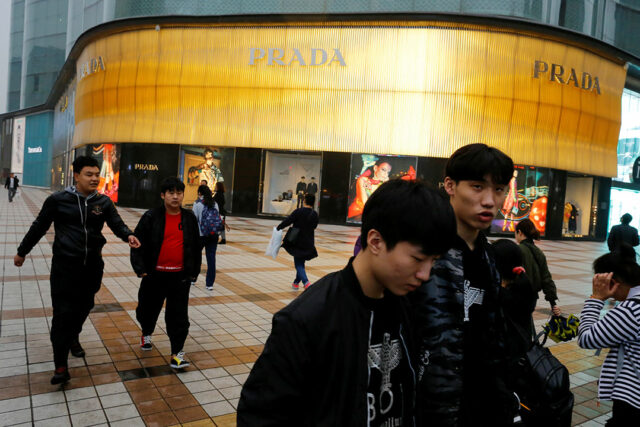
PEOPLE walk past a Prada luxury fashion boutique in Beijing, China, Oct. 15, 2018. — REUTERS

SHANGHAI/SYDNEY — The pandemic-era drop in overseas travel by Chinese tourists and students has been a boon for Gen-Z focused online shopping platform Dewu.

The platform where users once mainly bought and sold trendy sneakers to each other has morphed into a marketplace for retailers of all sorts of branded and luxury goods.

Dewu, also known by the English name Poizon, now has 150 million active users, and hosts what retail consultants Re-Hub estimate to be nearly three-quarters of China’s luxury cross-border “daigou” trade that was once largely plied by individual shoppers.

“We’re getting more formal in that we’re allowing some of these larger retailers and developing the tools for the larger retailers to sell into our marketplaces,” said Jeff Unze, general manager for the San Francisco office of Poizon Global.

Daigou translates as ‘buying on behalf of.’ Before the pandemic, millions of Chinese made a living by either traveling abroad and buying items that were cheaper overseas and then reselling them inside China, or shipping items into China.

Trade by daigou was a key sales driver for many global brands including Estee Lauder, a2 Milk and Kirin Holdings-owned supplements and vitamins brand Blackmores, until pandemic-related travel restrictions ground the industry to a halt.

But, unexpectedly, these restrictions actually worked to boost the overall cross-border grey market trade, with wholesalers and platforms like Dewu taking over from individuals. The trade has grown by 40% from 2019 levels to an estimated $81 billion this year, consultants Re-Hub say.

IT’S DAIGOU BUT NOT AS WE KNOW IT
Persistent price differences between markets like Europe and China mean consumers can expect discounts of around 40% for some products, said Thomas Piachaud, the Shanghai-based head of strategy at Re-Hub. This is an obvious draw for Chinese shoppers whose travel options are limited by cost, the slow resumption of flights and lengthy wait times for visas.

“I think we have to level up our idea of daigou,” Re-Hub’s Mr. Piachaud said. “Essentially there’s this chain from global retail to Chinese consumers not directly from the brands. That’s the professionalization of daigou at work.”

While this more formal form of daigou can help retailers and wholesalers move inventory from markets like Europe, where consumers are battling high inflation and a weak economy, it can also mean missed opportunities for brands to sell directly to consumers.

Vivi, a 22-year-old student from Nanjing who declined to use her last name for privacy reasons, first bought a Prada bag on Dewu in 2021 and has since also bought other items, including a Louis Vuitton bag and Balenciaga sneakers.

“I chose Dewu to buy luxury because it has a cheaper price than brick-and-mortar shops,” she told Reuters.

END OF AN ERA
Estee Lauder estimates up to 40% of its total sales to Chinese consumers was processed by daigou before the pandemic. Daigou trade also accounted for one-third of annual retail sales for the Australian vitamins and dietary supplement sector said Blackmores chief executive officer Alastair Symington.

But like the trade, the brands that once relied on daigou are also changing their retail strategies to reach Chinese consumers more directly.

Blackmores has already started selling directly to Chinese consumers by partnering with online market places such as Alibaba’s Tmall Global and JD Global and PDD Holdings’ Pinduoduo, Mr. Symington told Reuters.

“Over time, our intention is that we will move into brick and mortar so we will move into retail stores maybe over the next sort of two to three years,” he added.

New Zealand’s baby formula producer a2 Milk is also shifting to boost sales through cross-border e-commerce to make up for slumping daigou trade, it said in its recent earnings release.

Luxury outerwear brand Canada Goose opened two new stores in China last quarter, boosting the total permanent outlet numbers in the mainland to 21, as recovery in Chinese travel overseas remain weak.

But for some, the end of the old-style daigou means also means an end to their livelihoods.

Felix Fu, who owns a gift shop in Sydney, used to pack hundreds of boxes from 8am to 11pm daily to air ship health supplements, milk power and UGG branded boots to China.

“After COVID, a lot of brands here have opened up shops in China, either online or offline. They no longer need daigou, so most of the daigou shops have closed down,” he said, adding turnover in his store shrank by two thirds from the pre-pandemic levels of a little over A$1 million ($655,000) and the shop is barely profitable. — Reuters


‘SIM registration’ is most searched news in PHL — Google

REUTERS

Google Philippines on Tuesday said that ‘SIM registration’ topped this year’s news searches. 

Following were ‘precinct finder’ due to the recent Barangay and Sangguniang Kabataan elections, and ‘persona non grata’ after the public uproar over a drag performance by Amadeus Fernando Pagente, stage-named Pura Luka Vega, resulting in their arrest. 

Additionally, the ‘Israel-Hamas war’ ranked fifth on the list, indicating significant international events that are highly recognized by Filipinos. 

“Filipinos use Google search to stay informed about current events, both locally and globally,” Mervin Teo V. Wenke, communications and public affairs head at Google Philippines, told reporters on the sidelines of the company’s Year in Search 2023 briefing. 

He noted that the Year in Search was compiled from large aggregates of anonymous data in the Philippines from January to the fourth quarter of this year, with specific dates undisclosed.

“Movies is one of the few categories cutting across the region,” Mr. Wenke said on comparing results in the Philippines to its Southeast Asian neighbors. 

Top searched movies include Oppenheimer, John Wick: Chapter 4, Barbie, Insidious; The Red Door, and The Menu. 

“But K-drama is a unique category to the Philippines,” he added. “This speaks volumes of Filipinos’ love for hallyu or the Korean wave.” 

This included peak search hits on K-dramas Duty After School, Moving, The Glory, Twinkling Watermelon, and King the Land. But the local series Maria Clara at Ibarra landed the second spot among shows in general. 

For sports, basketball still dominated the top ten queries amid other major sports events in the country this year. 

Top searched female personalities included British actress Katy Louise Saunders, Filipino actress-model Cristine Reyes, British actress Millie Bobby Brown, South Korean actress Lee Da-in, and Filipino model-actress Issa Pressman. 

For top searched male personalities: South Korean actor-model Ahn Bo-hyun, Japanese actor Mackenyu, Filipino actor-model Marco Gumabao, American actor Taylor Lautner, and American football player Travis Kelce. 

However, Mr. Wenke stressed that the top search queries are only reflective of Filipinos’ interest, and not the popularity of a certain term over the other. 

Google has improved its search experience powered by generative artificial intelligence (AI). “We will continue to leverage the power of AI to improve our products and services next year,” Mr. Wenke said. 

“AI inspires us to further deliver our mission and help more people around the world lead better lives,” he added. — Miguel Hanz L. Antivola 

EU to investigate Chinese biodiesel dumping allegation

REUTERS

PARIS — The European Union said on Wednesday it would begin an anti-dumping investigation into biodiesel imports from China, which the bloc’s industry says has slashed domestic production.

In August, it began investigating whether biodiesel from Indonesia was circumventing EU duties by going through China and Britain. The latest investigation, prompted by a complaint from producer group the European Biodiesel Board (EBB), will cover the period from Oct. 1, 2022 to Sept. 30 2023.

The probe will take up to 14 months, with the possibility of provisional duties being imposed within eight months.

“EU producers have submitted evidence of biodiesel imports from China coming into the EU at artificially low prices and claim that these imports are seriously harming their industry because they cannot compete with such low prices,” the European Commission said in a statement.

China’s mission to the EU and the Chinese Chamber of Commerce did not immediately respond to requests for comment.

China has been the biggest biodiesel exporter to the 27-member bloc in 2023, the EBB said in a separate statement.

“In 2023, Chinese dumped imports have caused a collapse in the market and production sites closed in several member states,” the EBB added.

In addition to the possible transit of Indonesian biodiesel, there were structural imbalances in biodiesel trade with China, with prices not reflecting the advanced or waste-based biofuel categories that most cargoes have been classified as, it said.

Biodiesel is among the alternative fuels promoted to reduce carbon emissions in transport. The EU’s industry, which the Commission says is worth 31 billion euros ($34 billion) a year, has been the subject of regular disputes with trading partners.

It can be made using palm oil and shipments from Indonesia have been caught up in EU measures to restrict imports of commodities linked to deforestation.

In a separate trade dispute with Beijing, the Commission launched in September a probe into Chinese electric vehicle imports it says are benefiting from state subsidies.

China criticized the EU probe, calling it a “naked protectionist act”. — Reuters

Exporters explore air freight options as Red Sea chaos deepens

Location of the Red Sea as seen in a screenshot from Google Maps.

LONDON/MADRID — Exporters are scrambling to find ways to get key consumer goods to buyers including by air as a wave of attacks in the Red Sea adds to ocean freight supply chain problems elsewhere.

Iran-backed Houthi militants in Yemen have stepped up attacks on vessels in the Red Sea since Nov. 19 to show support for Hamas as Israel’s military offensive in Gaza continues.

The attacks have disrupted a key trade route that links Europe and North America with Asia via the Suez Canal and pushed container shipping costs sharply higher as companies seek to move their goods via alternative, often longer, routes.

Companies are now trying to switch to so-called intermodal transport to maintain global supply chains, which involves a combined sea and air route, said Jan Kleine-Lasthues, Chief Operating Officer Airfreight with leading German freight forwarder Hellmann Worldwide Logistics.

That means goods being transported first by sea to a port in Dubai, from where they are moved by air freight, he said.

“This alternative route allows customers to avoid the danger zone in the Red Sea and the long voyage around the southern tip of Africa,” Kleine-Lasthues told Reuters.

Many retailers, particularly in the fashion industry, had previously changed their import planning, shifting to sea freight as the predominant mode of transport, he said.

Hellman has seen increased demand for combined air and sea routing for consumer goods like apparel as well as electronics and tech items, he said.

“Given the current situation, it is likely that many shipments are stuck in containers in the Red Sea or delayed due to diversions around the Cape of Good Hope. This delay is likely to impact on retail operations in Europe and the Americas as it comes as a surprise,” he said.

Tailwind Shipping Lines, a subsidiary of German discount supermarket chain Lidl, which transports non-food goods for Lidl as well as goods for third-party customers said it was shipping goods around the Cape for the time being.

“Our aim is to remain as close to our schedule as possible,” it said.

Some companies might opt to use air freight for especially urgent or critical items, but the expense means it is not a blanket solution, said Paul Brashier, Vice President of Drayage and Intermodal for supply chain group ITS Logistics.

Container freight prices on the Asia to north Europe routes have risen 14% since diversions were announced last week, according to analysis from global freight platform Freightos.

“This not only incurs additional time and expense, but also exacerbates the environmental impact through increased fuel consumption,” said Jeb Clulow, partner in law firm Reed Smith’s transportation industry group.

The timing of these security issues compounds difficulties for operators as there are already disruptions through the Panama Canal due to drought, Clulow added.

ECONOMIC IMPACT
Some 35,000 vessels sail through the Red Sea region annually, moving goods between Europe, the Middle East and Asia, representing about 10% of global GDP, said Corey Ranslem, CEO of British maritime risk advisory and security company Dryad Global.

“Under an extended threat you will see the price of fuel and goods into Europe increase substantially because of the increased costs of diverting around Africa which can add roughly 30 days to a transit depending on the arrival port,” he said.

If there are extended disruptions, the consumer goods sector will face the largest impact, S&P Global said in a report.

Shipping companies remain in the dark over a new international navy coalition being assembled by the United States aimed at stablizing the area.

A Spanish fashion industry source told Reuters that shipping lines were telling customers that a lot was riding on the U.S.-led task force and whether it can prevent more attacks and make the route safe again.

It is critical that European companies are able to use the Suez Canal again to ensure supplies of clothes from Asia, the industry source said. — Reuters

US proposes more limits on making money off children’s data

ADAM SZUSCIK-UNSPLASH

WASHINGTON — Big tech companies, like YouTube owner Alphabet among many others, would face further limits on how they use children’s data to beef up profits under a proposal put out by the Federal Trade Commission on Wednesday.

The FTC said in a notice of proposed rule-making that it was considering changing the Children’s Online Privacy Protection Rule to put more restrictions on when and how companies could monetize children’s data.

It would also limit how companies can use notifications to nudge children to stay online. The rule affects companies which collect personal information about users under age 13.

“Kids must be able to play and learn online without being endlessly tracked by companies looking to hoard and monetize their personal data,” said FTC Chair Lina Khan in a statement. “The proposed changes to COPPA are much-needed, especially in an era where online tools are essential for navigating daily life.”

Since many platforms and websites on the internet are free, companies rely on advertising to pay bills. They try to tailor that advertising by using information about users which indicate what they might be interested in.

Critics have accused the platforms of failing to address mental health harms done by algorithms used by the platforms to keep young people engaged.

Under the proposed changes, companies would have to get “separate verifiable parental consent” to share most information about children with advertisers and other third parties.

The proposed changes would reinforce that companies cannot ban children from an activity if they decline to allow collection of personal data and would allow school districts to bar companies that provide educational technology for using any information it collects for a commercial purpose.

The FTC said that it would accept comments on the rule for 60 days.

Neither Alphabet nor Meta immediately responded to a request for comment. — Reuters

South Korea to relax holdings threshold of capital gains taxes

A MAN walks along a nearly empty street in Seoul, South Korea, July 12, 2022. — REUTERS

SEOUL — South Korea will relax the threshold for major shareholders who are subject to capital gains tax to those holding 5 billion won ($3.83 million) worth of listed stocks, eased from current 1 billion won, its finance ministry said on Thursday.

Starting January 2024, investors holding more than 5 billion won of shares in a single company will be considered a large shareholder who will need to pay capital gains tax of 20% to 25%, the ministry said in a statement.

“This measure takes into account the capital market situation, such as the high borrowing costs environment and heightened internal and external uncertainty, and is designed to ease market volatility caused towards the year-end stock sell-offs to avoid taxes,” the ministry said.

Easing of the capital gains tax rule comes ahead of the general election slated for April 2024, when the government often attempts to appease retail investors to win votes.

South Korea on Nov. 5 said it is banning stock short-selling until June 2024 to improve rules and systems, temporarily boosting share prices but inviting criticism that it will make the market less transparent and reduce liquidity. — Reuters

ADVERTISEMENT
ADVERTISEMENT