Home Blog Page 387

PCPI backs FDA move to institutionalize Green Lanes for health establishments, products

The Philippine Chamber of Pharmaceutical Industry (PCPI), which unites Filipino-owned pharmaceutical companies to champion policies that promote innovation, affordability, and self-reliance in medicines, has expressed strong support for the Food and Drug Administration’s (FDA) efforts to institutionalize a “Green Lane” to accelerate regulatory processes for health establishments and products covered under the government’s Strategic Investment Priority Plan, Tatak Pinoy enterprises, and other national development priorities. PCPI is the biggest association of local pharmaceutical companies, with a membership of about 90 companies, including Unilab Inc., the country’s largest pharmaceutical manufacturer.

Under the leadership of FDA Director General Atty. Paolo S. Teston, the Green Lane initiative seeks to establish a regulatory pathway that prioritizes applications from qualified local manufacturers, particularly those producing essential and critical medicines. The framework is designed to provide streamlined review timelines, clearer documentation requirements, and closer coordination between regulators and manufacturers while fully upholding the FDA’s rigorous standards of safety, quality, and efficacy.

PCPI has actively supported the expansion of the Green Lane through sustained policy dialogues, public-private partnerships, and regulatory engagements with the FDA, the Department of Health, the Anti-Red Tape Authority, and other key stakeholders.

“PCPI strongly applauds the FDA’s proactive regulatory reforms, which strike a balance between efficiency and unwavering safety standards,” said Dr. Lloyd Balajadia, president of PCPI. “This initiative will generate economic value, create more jobs, and help deliver life-saving medicines to patients faster—drawing from proven regulatory models in countries such as Singapore, India, and China.”

According to Dr. Balajadia, the Green Lane marks a significant step toward strengthening the Philippine pharmaceutical industry and building a more resilient, self-reliant medicines supply chain. “It recognizes the critical role of local manufacturers in ensuring the steady availability of affordable, high-quality medicines for Filipino patients,” he added.

PCPI noted that local pharmaceutical companies play a crucial role in maintaining a stable medicine supply, particularly during public health emergencies. The COVID-19 pandemic, global supply chain disruptions, and ongoing geopolitical tensions have underscored the risks of over-reliance on imported medicines and active pharmaceutical ingredients (APIs).

“Local manufacturers are often the first to respond to sudden spikes in demand for essential medicines,” PCPI said. “An institutionalized Green Lane will allow them to bring products to market faster, while remaining fully compliant with stringent regulatory requirements.”

The chamber also highlighted the Green Lane’s strong alignment with national priorities under the Universal Health Care Law and the Philippine Pharmaceutical Industry Roadmap. By encouraging investment in local manufacturing, the initiative supports broader government goals of reducing import dependence, enhancing national health security, promoting sustainable industrial growth, and generating quality employment.

PCPI expressed appreciation for the current FDA leadership’s understanding of the realities and capabilities of the domestic pharmaceutical sector, noting that local manufacturers possess the technical expertise to produce a wide range of medicines. The Green Lane initiative, the group said, will further position the Philippines as a competitive pharmaceutical manufacturing hub in the region.

PCPI urged the swift finalization of the Green Lane guidelines through continued consultations and active stakeholder engagement, building on ongoing collaborative efforts to advance regulatory reforms that benefit both public health and industry development.

DENZA sets the stage in the Philippines

DENZA Philippines executives and Philippine dealer partners gather following the ceremonial awarding, underscoring the brand's commitment to building a strong premium new energy vehicle network in the Philippines. — Photo by Justine Millares (Visor)

Dealer recognition marks a key step toward redefining premium new energy mobility

Global premium new energy vehicle (NEV) brand DENZA reinforced its commitment to the Philippine market with a ceremonial dealer awarding and media briefing on Jan. 22, signaling a decisive step toward the brand’s formal launch and long-term growth in the country.

Bringing together leaders from the BYD Asia-Pacific Auto Sales Division, DENZA Philippines, and members of the local media, the gathering cemented DENZA’s positioning as a premium brand shaped by intelligence, refinement, and sustainable innovation — and its intent to build a meaningful presence in one of Southeast Asia’s fastest-evolving mobility markets.

Speaking on DENZA’s global direction, Liu Xueliang, general manager of the BYD Asia-Pacific Auto Sales Division, shared how the brand continues to gain traction across international markets by redefining what modern premium means in the age of electrification.

“Across Asia-Pacific, we’ve seen strong momentum for DENZA as more markets embrace premium new energy vehicles. That experience gives us confidence in the Philippines, where consumers are increasingly sophisticated and ready to engage with a brand that combines intelligent technology with refined design and comfort,” said Mr. Liu.

(L-R) Mr. Liu Xueliang, General Manager of BYD Asia-Pacific’s Auto Sales Division; Mr. James Ng, Managing Director of BYD Singapore and Philippines; Mr. Adam Hu, Country Head of BYD and Denza Philippines

For the local market, Adam Hu, country head of BYD & DENZA Philippines operations, outlined the brand’s direction and reaffirmed its long-term commitment. He emphasized that DENZA Philippines is the sole distributor of the brand locally, with a clear strategy focused on sustainable growth rather than short-term volume.

Our role in the Philippines is to build DENZA the right way — with leadership, clarity, and long-term intent. We’re not here simply to introduce vehicles, but to establish a premium brand that Filipino customers can trust and grow with over time,he explained.

Mr. Hu shared that DENZA plans to expand its dealership footprint in 2026, alongside the gradual introduction of a broader portfolio of premium NEVs across key vehicle segments. Each introduction, he noted, will be intentional and aligned with the brand’s philosophy.

“The Philippine market is advancing rapidly and is ready for a new expression of premium. Our responsibility as brand leaders is to introduce DENZA in a way that reflects local expectations while staying true to its global standards.”

A key moment of the event was the recognition of DENZA’s initial dealer partners, marking the foundation of its retail presence in the Philippines. These include DENZA Alabang and DENZA Cebu, operated by ACMobility Premium Dealership Inc.; DENZA Makati, operated by Harmony New Energy Auto Service (Philippines) Ltd. Corp.; and DENZA Greenhills, operated by E-Vantage Motors Inc. Together, these partners represent the first step in building a premium ownership ecosystem designed to support DENZA customers nationwide.


Spotlight is BusinessWorld’s sponsored section that allows advertisers to amplify their brand and connect with BusinessWorld’s audience by publishing their stories on the BusinessWorld Web site. For more information, send an email to online@bworldonline.com.

Join us on Viber at https://bit.ly/3hv6bLA to get more updates and subscribe to BusinessWorld’s titles and get exclusive content through www.bworld-x.com.

Globe seals Climate Leadership A- rating in CDP

Globe has been recognized as a Climate Leader by CDP after earning an A- score for Climate in 2025, marking the company’s entry in leadership ranking under the global environmental disclosure platform. Globe also received a B score for water security in its first year of assessment, reinforcing its environmental action in the  telecommunications industry.

CDP is a global nonprofit that runs the world’s most comprehensive environmental disclosure system, used by investors, governments, and capital markets to assess how organizations manage climate change, water security, and deforestation. Its scoring framework evaluates companies based on the completeness of disclosure, depth of risk awareness, quality of management, and evidence of leadership through strategy and performance.

The company’s A- climate score reflects years of deliberate work to understand and reduce its environmental impact. In 2021, Globe conducted climate scenario analysis to identify physical and transition risks that could affect its operations. The company also continues to maintain a  comprehensive greenhouse gas inventory covering Scopes 1, 2, and 3 and these assessments inform Globe’s science-based targets and its roadmap toward net-zero greenhouse gas emissions across its value chain by 2050.

“This CDP Climate Leader rating reflects disciplined action, strong governance, and a clear commitment to transparency,” said Yoly Crisanto, Chief Sustainability and Corporate Communications Officer at Globe. “It confirms that our climate strategy is both credible and measurable.”

Globe’s climate action spans its operations, network infrastructure, and customer experience. The company has transitioned 171 cell sites, corporate offices, and key facilities to renewable energy through power purchase agreements and has deployed more than 38,000 green network solutions, including fuel cell systems, hybrid generators, free cooling technologies, and lithium-ion batteries. These initiatives help reduce emissions while strengthening network resilience.

Sustainability is also integrated into Globe’s products and services. The company has promoted paperless billing and introduced EcoSIM cards made from recycled materials. In 2024, all postpaid SIMs procured by Globe were EcoSIMs, helping avoid the use of over 1,200 kilograms of virgin plastic. Globe’s continued promotion of eSIM adoption further reduced plastic consumption and resource use.

For water stewardship, Globe’s B score highlights concrete action. Water efficiency is a key focus at The Globe Tower, the company headquarters which houses more than half of the company’s workforce and is equipped with rainwater harvesting and water recycling systems. These systems capture rainwater, air-conditioning condensate, and cooling water, which are treated and reused as graywater for non-potable purposes such as flushing, landscaping, and facility maintenance.

In 2024, Globe reused more than 33,500 cubic meters of graywater, significantly reducing its demand for freshwater. Water conservation is reinforced through facility design and employee engagement, including motion-sensor faucets and internal campaigns that promote responsible water use.

The CDP recognition, including being named as a Supplier Engagement Leader (A Score) in 2024, adds to Globe’s growing list of sustainability milestones, including international and regional awards for ESG performance and environmental leadership. Together, these reflect a long-term commitment to responsible growth that supports climate action, resource stewardship, and resilience in a rapidly changing world.


Spotlight is BusinessWorld’s sponsored section that allows advertisers to amplify their brand and connect with BusinessWorld’s audience by publishing their stories on the BusinessWorld Web site. For more information, send an email to online@bworldonline.com.

Join us on Viber at https://bit.ly/3hv6bLA to get more updates and subscribe to BusinessWorld’s titles and get exclusive content through www.bworld-x.com.

South Korea delegation heads to Canada to lobby for submarine project

A scale model of a KSS-III PN submarine at the Hanwa booth during the Asian Defense and Security Exhibition (ADAS) 2024 in Pasay City, Manila.— ED GERONIA

SEOUL – South Korean Presidential Chief of Staff Kang Hoon-sik said on Monday he was heading to Canada with Hyundai Motor executives, alongside representatives of shipbuilders Hanwha and HD Hyundai Heavy Industries, in a bid to win a major submarine contract.

South Korea is competing against Germany’s TKMS in a race to win the Canadian project for a new fleet of submarines, estimated by industry sources to be worth more than $12 billion.

Before departing for Canada together with Industry Minister Kim Jung-kwan, Mr. Kang said given the competition against a manufacturing superpower in Germany, “We believe the prospects are not necessarily easy.”

“I hope to … directly convey the excellent performance of our submarines as well as the government’s commitment to expanding industrial and security cooperation between our two countries,” Mr. Kang told reporters.

The submarine project would be one of the biggest defense procurement projects currently underway and would translate into overall economic benefit of more than 40 trillion won ($27.62 billion) and the creation of 20,000 jobs in South Korea, Mr. Kang said.

Last week, TKMS CEO Oliver Burkhard told Reuters the German company is in talks with Norwegian and German companies to offer a multi-billion-dollar investment package to Canada in a bid to win the tender.

Hanwha Group also said on Friday it aimed to create a large number of jobs in Canada by 2040 though cooperation across various sectors, including submarines.— Reuters

Trump administration defends killing American in Minneapolis, contradicts videos

Masked law enforcement officers, including Immigration and Customs Enforcement agents, walk into an immigration court in Phoenix, Arizona, US, May 21, 2025. — REUTERS/CAITLIN O’HARA

MINNEAPOLIS — Officials in US President Donald Trump’s administration defended on Sunday the fatal shooting of a US citizen by immigration agents in Minneapolis, even as video evidence contradicted their version of events and as tensions grew between local law enforcement and federal officers.

As residents visited a makeshift shrine of flowers and candles in frigid temperatures and snow to mark Saturday’s fatal shooting of Alex Pretti, Trump administration officials stated that Mr. Pretti assaulted officers, compelling them to fire in self-defense. That account was at odds with videos recorded by bystanders.

Mr. Pretti is the second American to be fatally shot by federal immigration officers this month in Minneapolis, where Mr. Trump, a Republican, has deployed thousands of armed and masked agents in a deportation effort with little precedent.

Minnesota Governor Tim Walz, a Democrat, again called on Mr. Trump to pull federal agents out of the state, which has asked a federal judge to restrain what it says are unconstitutional excesses in Mr. Trump’s surge.

“The victims are Border Patrol agents,” Gregory Bovino, a senior Border Patrol official, told CNN’s “State of the Union” program.

That official line, echoed by Homeland Security Secretary Kristi Noem and other members of the administration, drew outrage from local Democratic leaders and law enforcement and Democrats in the US Congress, who pointed to the bystander videos that show all Mr. Pretti had in his hands was a cellphone before agents grappled him to the ground and ultimately shot him at close range.

Federal agents over the past few weeks have been met by countless angry residents protesting in the city’s icy streets, some of them blowing whistles. Thousands of people again filled the streets of Minneapolis on Sunday to protest against the surge in US Immigration and Customs Enforcement agents, chanting and waving signs saying: “ICE OUT!”

HOLDING A PHONE, NOT A GUN
Videos of Saturday’s killing verified by Reuters show Mr. Pretti, 37, holding a phone in his hand, not a gun, as he tries to help other protesters who had been pushed to the ground by agents.

Mr. Pretti can be seen filming while a federal agent pushes away one woman and shoves another woman to the ground. Mr. Pretti moves between the agent and the women, then raises his left arm to shield himself as the agent pepper sprays him.

Several agents then take hold of Mr. Pretti, who struggles with them, and force him onto his hands and knees. As the agents pin Mr. Pretti down, someone shouts what sounds like a warning about a gun.

Video footage then appears to show one of the agents removing a handgun from Mr. Pretti’s waistband area and stepping away from the group with it.

Moments later, an officer points his gun at Mr. Pretti’s back and fires four shots in quick succession. More shots are heard as another agent appears to fire at Mr. Pretti.

Darius Reeves, the former head of ICE’s field office in Baltimore, told Reuters that federal agents’ apparent lack of communication was troubling. “It’s clear no one is communicating to me, based on my observation of how that team responded,” Mr. Reeves said.

Minnesota officials say Mr. Pretti had a valid state permit to carry a concealed gun in public, which the US Supreme Court ruled was a constitutional right in 2022.

‘VIDEOS SPEAK FOR THEMSELVES’
Brian O’Hara, the Minneapolis police chief, told the CBS “Face the Nation” program that “the videos speak for themselves,” calling the Trump administration’s version of events deeply disturbing. He said he had seen no evidence that Mr. Pretti brandished a gun.

Tensions in the city were already running high after a federal immigration agent fatally shot US citizen Renee Good on January 7 after approaching her in her parked vehicle. Trump officials said she was trying to ram the agent with the vehicle but other observers said bystander video suggests she was attempting to steer away from the officer who shot her.

State and local law enforcement are investigating whether the agent who killed Ms. Good broke any Minnesota laws. The US Justice Department withdrew its cooperation from that probe, and at least a dozen federal prosecutors said they were resigning over the Justice Department’s handling of Ms. Good’s killing.

At Minnesota’s request, a federal judge issued a temporary order on Saturday night forbidding the Trump administration from destroying or altering evidence related to Mr. Pretti’s killing.

Chief executives of some of Minnesota’s largest companies, including Target, Cargill, and Best Buy, published a letter calling for the “immediate de-escalation of tensions and for state, local and federal officials to work together to find real solutions.”

In separate statements, former US Presidents Barack Obama and Bill Clinton decried the killings of Ms. Good and Mr. Pretti, with Clinton accusing the Trump administration of lying and Mr. Obama saying American values are under assault.

“This has to stop,” Barack and Michelle Obama said.

Mr. Pretti worked as an intensive care nurse at a Veterans Affairs hospital. On Sunday, more than 200 healthcare workers gathered at the site of his killing, leaving flowers and other tributes. One woman in medical scrubs, when asked what brought her out, said she had worked with Mr. Pretti and began to sob.

“He was caring and he was kind,” she said, asking not to be named for fear of retribution from the federal government. “None of this makes any sense.”

At a Sunday press conference, Minnesota Attorney General Keith Ellison recounted a story that he said was from his 31-year-old son, a nurse in Minnesota’s healthcare system.

“When he was at work today and last night, he said, ‘Look, our colleagues were crying and in tears, and they took this hit to one of their own very personally,'” Mr. Ellison told reporters.

Mr. Trump has defended the operations as necessary to reduce crime and enforce immigration laws.—Reuters

Israeli fire kills three in Gaza, medics say, as US pushes deal

A view shows houses and buildings destroyed by Israeli strikes in Gaza City, Oct. 10, 2023. — REUTERS

CAIRO — Israeli fire killed three Palestinians in two separate incidents in the Gaza Strip on Sunday, while an Israeli drone wounded four others in Gaza City, the territory’s health ministry said on Sunday.

Medics said Israeli fire killed at least two people east of Tuffah neighborhood in the northern Gaza Strip, and a 41-year-old man was killed by Israeli forces in Khan Younis, in the south of the enclave.

Earlier, medical workers said an Israeli drone exploded on the rooftop of a multi-floor building in Gaza City, wounding four civilians in the street nearby.

An Israeli military spokesperson said they were not aware of any incident in Khan Younis involving a Palestinian being killed by gunfire. The spokesperson had no immediate comment on the reported shooting in Tuffah.

In response to questions about the Gaza City incident, in which four civilians were injured, a military spokesperson later said in a written statement that a camera on the roof of a “structure” that was used to monitor and advance attacks on troops was “precisely” struck by the military.

The spokesperson did not provide any evidence to support the assertion there was a camera, or that a camera was used to monitor Israeli military movements.

US ENVOYS MEET WITH ISRAEL PM NETANYAHU

US envoys Steve Witkoff and Jared Kushner met Israeli Prime Minister Benjamin Netanyahu in Israel on Saturday, mainly to discuss Gaza, Mr. Witkoff said on Sunday.

“The discussion was constructive and positive, with both sides aligned on next steps and the importance of continued cooperation on all matters critical to the region,” Mr. Witkoff said in a post on X.

Gaza has been reduced to rubble in the war that was triggered by an attack by the Palestinian militant group Hamas on southern Israel on October 7, 2023 in which 1,200 people were killed, according to Israeli tallies.

The Gaza health ministry says more than 71,000 people, mostly civilians, have been killed by Israeli fire since then. It also says that at least 480 people have been killed by Israeli fire since a ceasefire agreement came into effect last October.

BOTH SIDES TRADE BLAME FOR VIOLATIONS

Israel has said four soldiers had been killed by militants in Gaza since the ceasefire began. Both sides have traded blame for violations of the truce.

Earlier this month, Washington said the plan had moved into a second phase, in which Israel is expected to withdraw troops further from Gaza, and Hamas is due to yield control of the territory’s administration.

Meanwhile, in Khan Younis, more than 100 people attended the funeral of a person killed by Israeli drone fire on Saturday, after holding special prayers in front of his white-shrouded body at the morgue in Nasser Hospital.

“They are liars, there is no ceasefire,” said Fares Erheimat, a relative of the dead man, during the funeral. — Reuters

Death toll in Philippine boat accident climbs to 15, hundreds rescued

The Coast Guard District Southwestern Mindanao (CGDSWM) responding to a distress incident involving a passenger vessel, the MV Trisha Kerstin 3, bound for Jolo, Sulu, Jan. 26, 2026.— COAST GUARD DISTRICT SOUTHWESTERN MINDANAO FB PAGE

MANILA — The death toll from a ferry boat accident in the Southern Philippines has reached at least 15, with 316 people rescued, the Philippine Coast Guard said on Monday as the search continued for the dozens still missing.

The accident occurred at 1:50 a.m. [1750 GMT] on Monday while the passenger vessel, MV Trisha Kerstin 3, was en route to Jolo in Sulu province after departing from Zamboanga. The PCG said the vessel, operating within its authorized passenger capacity of 352, had 332 passengers on board and 27 crew.

Search and rescue teams scouring the area in relatively calm waters have helped speed up operations, Coast Guard Commander Romel Dua of Southern Mindanao District said by phone. He said 28 remain missing.

Mr. Dua said an investigation was underway to determine the cause of the accident. Military aircraft and vessels have been deployed to assist rescue efforts, Mr. Dua added.

Mujiv Hataman, governor of the island province of Basilan, shared clips from the scene at Mindanao’s Isabela port on Facebook, showing survivors being ushered off boats, with some wrapped in thermal blankets and others being carried on stretchers.

Mr. Hataman told DZBB radio that most survivors were doing well, but several elderly passengers needed emergency medical care. He added that authorities were still cross‑checking the passenger manifest as rescue efforts proceeded.

Scores of people die each year from ferry accidents in the Philippines, an archipelago of more than 7,000 islands with a patchy record on maritime safety. — Reuters

Poll: GDP growth likely slowed in Q4

A shopper looks at various Christmas decorations for sale at a stall along Dapitan Street, Quezon City. — PHILIPPINE STAR/MIGUEL DE GUZMAN

By Isa Jane D. Acabal, Researcher

THE PHILIPPINE ECONOMY likely expanded at a slower pace in the fourth quarter of 2025, bringing full-year growth below the government’s target amid a corruption scandal, analysts said.

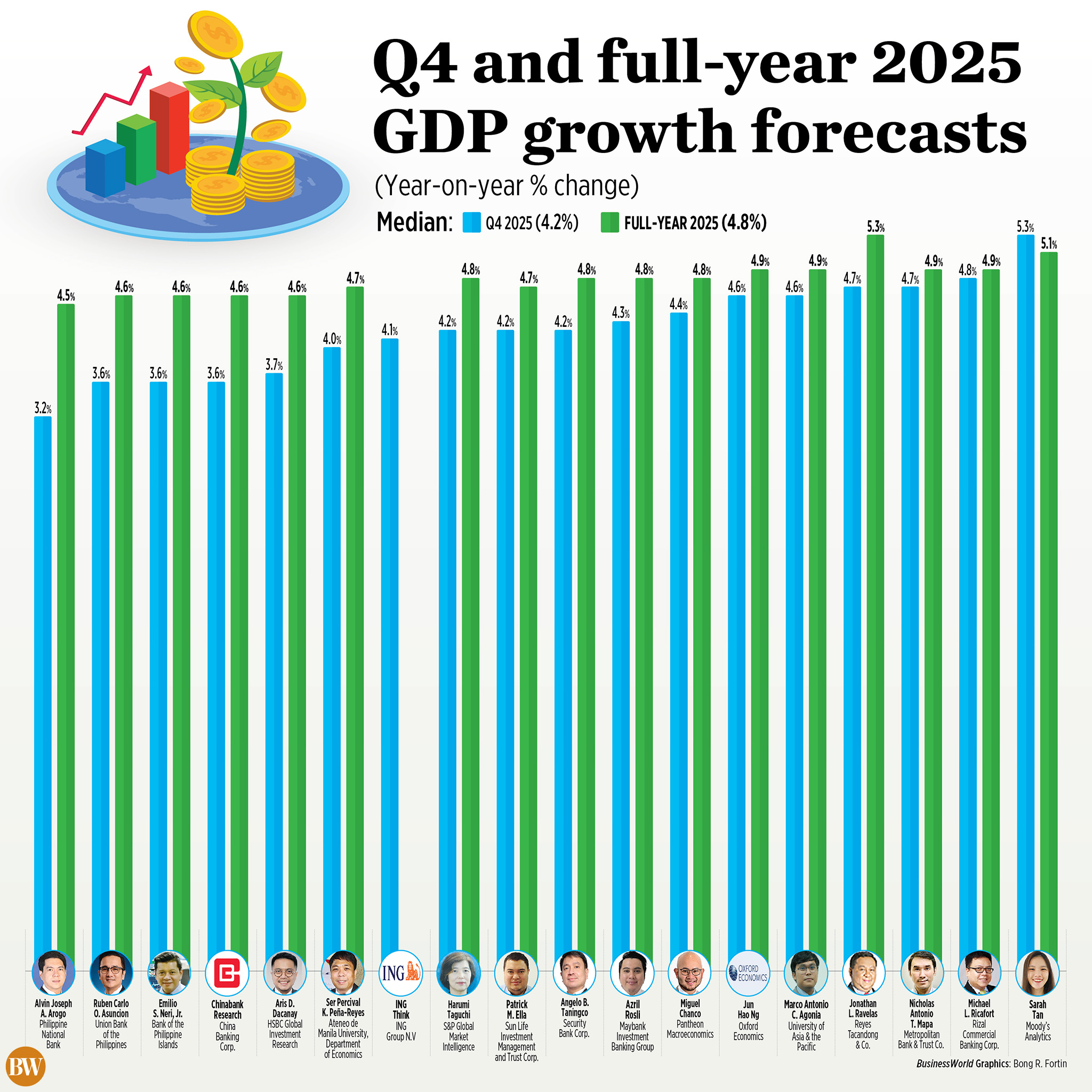
Gross domestic product (GDP) may have grown by an annual 4.2% from October to December, according to a median forecast of 18 economists polled by BusinessWorld.

If realized, the growth is much slower than the 5.3% expansion in the same period in 2024. Quarter on quarter, GDP growth picked up from the over four-year low of 4% in the third quarter.

This would put the full-year 2025 median estimate growth at 4.8%, missing the Development Budget Coordination Committee’s 5.5%-6.5% growth target.   

If realized, this would be slower than the 5.7% expansion in 2024 and the weakest since the 9.5% contraction posted in 2020.

The full-year GDP estimate is also below the forecasts of the Asian Development Bank (5%), World Bank (5.1%), International Monetary Fund (5.1%), and the ASEAN+3 Macroeconomic Office (5.2%).

The Philippine Statistics Authority (PSA) will release the fourth-quarter and full-year 2025 GDP data on Thursday, Jan. 29.

Harumi Taguchi, principal economist at S&P Global Market Intelligence, said weak government spending is the main factor that constrained growth in the fourth quarter and full year.

“We anticipate weak government spending and public fixed investment, reflecting the impact of ongoing corruption issues,” she said in an e-mail.

A wide-scale controversy linking Public Works officials, lawmakers and private contractors to multibillion-peso corruption in anomalous flood control projects dragged government spending and household consumption. The Independent Commission for Infrastructure (ICI) has been investigating these allegations.

Government spending fell for a fourth straight month in November to P498.31 billion, down by 9.6% year on year.

“On government spending, we’ll probably see more of the actual short-term damage caused indirectly by the ICI’s formation and investigations, which only really kicked off at the end of Q3. (Fourth quarter), therefore, should feel the brunt of this natural lull and hesitancy on the part of both public and private developers,” Miguel Chanco, chief emerging Asia economist at Pantheon Macroeconomics, said.

Ruben Carlo O. Asuncion, chief economist at the Union Bank of the Philippines, said the slower annual GDP growth reflected the impact of the corruption scandal.

“The weakness reflects the broad fallout from the flood control corruption probe, which dampened public construction, delayed fiscal disbursements, and weighed heavily on consumer and business sentiment through the end of the year,” he said. “High‑frequency indicators also showed sluggish household spending and soft labor‑market conditions as unemployment ticked up and job creation stalled.”

Patrick M. Ella, an economist at Sun Life Investment Management and Trust Corp., said the decline in consumer and investor confidence following the graft scandal “has translated to slow consumption and a contraction in private investments.”

“The decline in government spending following heightened disbursement scrutiny hit the economy hard in the year. The impact of government spending multipliers declined, reducing aggregate demand and hurting economic growth,” Marco Antonio C. Agonia, an economist at the University of Asia and the Pacific (UA&P), said.

Aside from weak government spending, natural disasters hampered infrastructure development and economic activity, according to Angelo B. Taningco, chief economist at Security Bank Corp.

In 2025, a total of 23 tropical cyclones entered the Philippine Area of Responsibility, as recorded by the state weather bureau.

Ms. Taguchi said natural disasters have also negatively affected agricultural production, disrupted supply chains and weighed on production, tourism, and retail sales.

“Private consumption and private investment are projected to see moderate growth, tempered by adverse weather conditions in the fourth quarter of 2025,” she added.

RATE CUTS
Maybank Investment Bank economist Azril Rosli said GDP growth was mainly due to “resilient” private consumption backed by easing inflation, rate cuts by the Bangko Sentral ng Pilipinas (BSP), and the “modest” recovery in net exports.

Inflation quickened to 1.8% in December from 1.5% in November, bringing average inflation for full-year 2025 at 1.7% — the slowest pace in nine years.

“The slowdown in inflation over the past few months was a result of favorable base effects and the sustained decline in rice and energy prices throughout the period,” Nicholas Antonio T. Mapa, chief economist at the Metropolitan Bank & Trust Co., said in an e-mail.

“The quick step to a more accommodative monetary stance likely helped jumpstart flagging investment momentum,” he added.

The BSP has reduced key borrowing costs by a total of 125 basis points in 2025, bringing the key policy rate to an over three-year low of 4.5%.

“The BSP’s interest rate cuts thus far have yet to have a meaningful impact on economic growth, and it shows how weak 2025 was overall. The transmission of rate cuts to stronger activity in the real economy is naturally quite long for emerging markets such as the Philippines, one thing that the BSP is well aware of,” Pantheon Macroeconomics’ Mr. Chanco said.

UA&P’s Mr. Agonia said rate cuts’ impact on the real economy is minimal in the short term as monetary policy actions have a one-and-a-half to two-year lag.

“Rate cuts done in 2025 will likely provide palpable boosts to economic performance only by the second half of 2026 and into 2027,” he added.

At the same time, stronger exports and a narrower trade deficit likely drove GDP growth amid “robust external demand for semiconductors and ongoing diversification efforts amid protectionist policies in the [United States],” Chinabank Research said.

Preliminary data from the PSA showed the country’s balance of trade in goods — the difference between exports and imports — narrowed to $3.51 billion year on year in November from a $4.19-billion deficit in October.

Exports rose by 21.3% to $6.91 billion in November, faster than the 20.3% growth registered in October. This was mainly driven by the 50.6% increase in electronic products to $4.19 billion.

“Moderate global growth limited our projected export growth in 2025, although the impact of US tariff increases has been milder than anticipated,” S&P Global’s Ms. Taguchi said.

RECOVERY IN 2026?
This year, economists anticipate a gradual recovery in GDP growth as the government implements catch-up spending.

“To lift growth in 2026, policy focus should shift toward stronger fiscal execution, accelerated infrastructure and energy investments, enhanced disaster resilience, and deeper structural reforms to crowd in private investment and improve export competitiveness,” Maybank’s Mr. Rosli said.

“Monetary easing alone is unlikely to deliver a meaningful growth acceleration without these complementary measures,” he added.

Rizal Commercial Banking Corp. Chief Economist Michael Ricafort said the government’s catch-up spending plans and other anti-corruption efforts are expected to boost growth in the first quarter.

“If anti-corruption measures and other related priority reforms that further level up governance standards would be taken seriously, these would be the missing and remaining important catalyst that would help improve investor confidence,” Mr. Ricafort said.

Jonathan L. Ravelas, a senior adviser at Reyes Tacandong & Co., said the economic growth can pick up to 5.6% in 2026 “if the government focuses on clean and timely spending, stronger infrastructure delivery, more predictable policy signals, and real support for agriculture and small businesses.”

Bank of the Philippine Islands (BPI) Lead Economist Emilio S. Neri, Jr. said the economy might see better numbers in the second half of 2026 if there are fewer natural disasters.

“It was disappointing, of course, as our potential growth is closer to 6% to 8%. Improving the quality of public spending by banning all forms of conflict-of-interest is what’s needed to get the economy back to its full potential,” Mr. Neri said.

Economic managers expect GDP to grow by 5-6% this year.

BSP uncertain on further easing in the near term

BANGKO SENTRAL ng Pilipinas Governor Eli M. Remolona, Jr. — BANGKO SENTRAL NG PILIPINAS

By Katherine K. Chan, Reporter

THE BANGKO SENTRAL ng Pilipinas (BSP) said another rate cut this year is uncertain amid current economic conditions, signaling a looming end to its current easing cycle.

Asked if he sees one more cut under the current easing cycle, BSP Governor Eli M. Remolona, Jr. said: “Even that cut is still a maybe. Hindi pa sigurado. (It’s not certain).”

On the sidelines of a BSP event on Friday, the central bank chief told reporters they would consider subdued inflation and tepid growth to spur demand in deciding on their next policy move.

However, Mr. Remolona noted that a weaker-than-expected output in the fourth quarter of 2025 may not automatically warrant a reduction to the key interest rate in February.

“It would help us decide (whether) to cut (but) it’s not the only factor,” he said, adding that inflation remains the top deciding factor for the Monetary Board.

The BSP has been on an easing path since August 2024. It has lowered key borrowing costs by a total of 200 basis points (bps), bringing it to an over three-year low of 4.5%.

In 2025, it delivered five straight 25-bp cuts, including its last two cuts driven by benign inflation and dim investor and consumer sentiment amid the flood control corruption scandal.

The economy slumped in the third quarter of last year to an over four-year low of 4% as the flood mess dampened government spending and household consumption. As of September, the Philippine gross domestic product (GDP) growth stood at 5%.

The BSP expects GDP growth to settle at sub-4% in the last quarter of 2025 to bring the full-year print to 4.6%. If realized, the government would miss its 5.5%-6.5% target for the year.

The Monetary Board is set to hold its first policy review this year on Feb. 19.

John Paolo R. Rivera, a senior research fellow at the Philippine Institute for Development Studies, said the governor’s tone shift implies that a sixth consecutive cut is now unlikely.

“Governor Eli’s more cautious tone signals that a February cut is no longer a base case and that the BSP is shifting toward risk management amid PHP (Philippine peso) weakness and uncertain inflation dynamics,” he said in a Viber message. “Markets may now price a shallower or earlier end to the easing cycle.”

Mr. Rivera added that the peso may gain some support if the Monetary Board decides to hold steady at its first policy review this year but noted that economic growth may get the shorter end of the stick.

“A pause at the first meeting would help anchor expectations and reduce forex (foreign exchange) pressure, but it also means less monetary support for growth, putting more weight on fiscal execution and structural reforms to carry the expansion,” he said.

The Philippine Statistics Authority will release the fourth-quarter and full-year GDP report on Thursday, Jan. 29.

Meanwhile, Rizal Commercial Banking Corp. Chief Economist Michael L. Ricafort said sluggish fourth-quarter growth and the peso’s volatility would call for another 25-bp cut next month.

“Two main factors for a possible (25-bp) BSP rate cut on the next BSP rate-setting meeting on Feb. 19, 2026: Delicate balancing act to further support economic/GDP growth especially if the latest data… would remain soft,” Mr. Ricafort said via Viber.

“(A)nother important consideration would be the need to stabilize the peso exchange rate versus the US dollar… (and) the expected Fed rate pause for now, as another (25-bp) BSP rate cut on Feb. 19, 2026 would narrow the interest rate differential to the lowest on record at (50 bps),” he added.

Mr. Remolona said they are considering the US Federal Reserve’s monetary policy moves but noted that “it’s one data point among many.”

The Fed has so far delivered 175 bps in cuts since September 2024, bringing its key policy rate to the 3.5%-3.75% range. It is set to have its first meeting this year on Jan. 27-28.

Mr. Remolona also on Friday said they would defend the peso during a P60:$1 scenario depending on its movement.

Asked if the BSP would intervene once it hits P60 against the dollar, he said: “Depends (on) how it gets there. Just because it’s P60 doesn’t mean we’ll defend it.”

The central bank will likely stick to minimal intervention just to prevent sharp swings in the local currency, the BSP chief added.

“We do what we’ve always done,” Mr. Remolona said. “We try to avoid sharp movements in the peso.”

The Palace earlier said that President Ferdinand R. Marcos, Jr. hopes the exchange rate will not reach the P60-per-dollar level.

According to Mr. Remolona, the peso might not trade at P60 versus the greenback anytime soon.

The peso fell to P59.46 against the dollar on Jan. 15, marking a fresh low for the local unit after it exceeded the previous record of P59.44 on Jan. 14.

It recovered to a P59.09 finish on Friday, gaining seven centavos from its P59.16 close on Thursday, based on data from the Bankers’ Association of the Philippines.

Vehicle sales drop by 0.8% in 2025, falls short of target

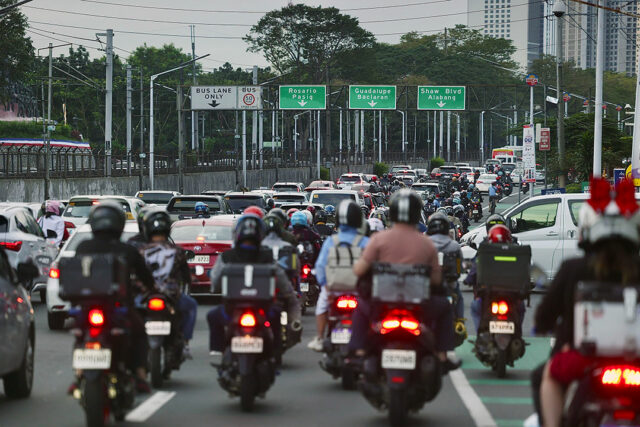
Vehicles and motorcycles ply the southbound lane of EDSA in Quezon City, Jan. 5. — PHILIPPINE STAR/MIGUEL DE GUZMAN

By Justine Irish D. Tabile, Reporter

PHILIPPINE AUTOMOTIVE SALES can reach 500,000 this year if interest rates improve after sales in 2025 fell short of the industry’s target, analysts said.

A joint report by the Chamber of Automotive Manufacturers of the Philippines, Inc. (CAMPI) and the Truck Manufacturers Association (TMA) sent on Friday showed that 463,646 cars were sold last year, down by 0.8% from 467,252 units sold in 2024.

Including other industry data, CAMPI said total vehicle sales stood at 491,395 units in 2025, up 3.7% from 473,842 a year prior.

In December alone, CAMPI-TMA members sold 42,870 units, up 2% from 42,044 units sold in the same period a year ago.

“The industry delivered a modest growth last year due to the overall unfavorable market environment during the second half caused by a number of factors such as the reimposition of excise tax on pickup trucks and several natural calamities experienced across the country,” CAMPI said.

Reyes Tacandong & Co. Senior Adviser Jonathan L. Ravelas said that the slight dip in car sales last year reflects “more of a pause than a downturn.”

“Still elevated interest rates, fuel prices, and tighter household budgets made buyers cautious, especially for passenger vehicles, which are more discretionary,” he said in a Viber message.

“That is why CAMPI fell short of the 500,000 target — demand did not disappear; it was delayed,” he added.

According to the industry report, passenger car sales dropped by 23.1% to 92,924 in 2025 from 120,770 in 2024.

In December alone, passenger car sales declined by 20.9% to 8,009 from 10,125 units sold in the same period a year prior.

Commercial vehicle sales, which accounted for almost four-fifths of the total industry sales, rose by 7% to 370,722 in 2025, from the 346,482 units sold in 2024.

In December alone, commercial vehicle sales increased by 8.6% to 34,861 from 32,109 units sold in the same month in 2024.

“The underperformance of passenger vehicles reflects shifting consumer preferences and structural changes in the market,” said Toby Allan C. Arce, head of sales trading at Globalinks Securities and Stocks, Inc., in a Viber message.

“Buyers are increasingly favoring used vehicles, ride-hailing, or shared-mobility options, particularly in urban areas where traffic congestion and ownership costs reduce the appeal of owning a private car,” he added.

Michael L. Ricafort, chief economist at Rizal Commercial Banking Corp., said that the decline could also be attributed to the faster growth in motorcycle sales in recent months.

“[They] have become a cheaper alternative transport for some Filipinos in terms of lower acquisition costs, maintenance costs, fuel consumption, and space requirements,” he said in a Viber message.

He said that demand for motorcycles has been increasing due to the “boom in delivery and motorcycle taxi services.”

Broken down, sales of Asian utility vehicles jumped by 7.2% to 87,731, while sales of light commercial vehicles went up by 7.2% to 271,630 units.

In 2025, sales of medium-duty trucks slipped by 7.1% to 3,690, while sales of light and heavy trucks grew by 3.6% and 20.5% to 6,783 and 888 units, respectively.

“Sub-segments such as the 1Ton+ multi-purpose vehicles contributed to the industry’s 2025 performance, with a 76.6% increase compared to 2024,” CAMPI said.

“Models in this category include Toyota Tamaraw, Mitsubishi L300 FB, and Isuzu Travis, among others,” it added.

Toyota Motor Philippines Corp. remained the market leader, with sales of 229,447 units in 2025, up by 5.2% from 218,019 units in 2024. It accounted for 49.49% of the market share.

Mitsubishi Motors Philippines Corp. ranked second with a market share of 18.72% after sales fell by 2.6% to 86,808 units from 89,124 units a year ago.

In third spot was Suzuki Phils., Inc., whose sales increased by 7.9% to 21,984 with a market share of 4.74%.

Rounding out the top five were Ford Motor Co. Phils., Inc., which saw a 22.2% drop in sales to 21,784, and Nissan Philippines, Inc., which saw a 23.2% decline in sales to 20,571 units.

OUTLOOK
Meanwhile, Mr. Arce said the industry can reach 500,000 sales this year, but the outlook is still sensitive to economic and policy developments.

“Reaching the 500,000 mark in 2026 will likely depend on a combination of lower financing costs, improved affordability, and a clearer value proposition for consumers, rather than a broad-based surge in demand across all vehicle segments,” he said.

In particular, he said the central bank’s easing monetary policy has the potential to “unlock pent-up demand from consumers who postponed purchases in 2025.”

“Continued infrastructure development, fleet modernization, and stronger business confidence could support commercial vehicle sales, while broader availability of more affordable models and improved supply chains may help revive passenger vehicle demand,” Mr. Arce said.

However, he said that “any renewed inflationary pressures, slower economic growth, or delays in interest rate cuts could again weigh on consumer sentiment.”

“Looking to 2026, hitting 500,000 units is achievable if financing conditions ease and income growth improves,” said Mr. Ravelas.

“The main challenges remain inflation, exchange rate volatility, and expensive credit — but if these ease, 2026 could be the year pent-up demand comes through,” he added.

Electric and hybrid vehicles may also boost industry sales this year.

Data from CAMPI and TMA showed that 32,489 EVs were sold in 2025, accounting for 7.01% market share.

Including other available industry data, EV sales hit 58,905 units, which reflect 12% market share.

“Combined battery, plug-in hybrid, and hybrid EV sales grew 142.5% versus 2024,” said CAMPI President Jose Maria Atienza in a statement on Friday.

“This highlights the public’s growing acceptance and demand for electrified technologies,” he added.

Mr. Ricafort said that better weather conditions in 2026 could help increase demand for cars.

He also cited the increased demand for EVs and hybrid vehicles as potential sales growth drivers amid increasing competition, which is helping “reduce prices and increase options for Filipino buyers.”

Marcos admin to stick to deficit targets

PHILIPPINE STAR/JOVANNIE LAMBAYAN

THE MARCOS administration will stick to the fiscal deficit targets, Finance Secretary Frederick D. Go said, while analysts warned this may be more challenging amid expectations of weaker revenue collection.

Asked if the government tweaked its deficit ceilings, Mr. Go on Friday told reporters no changes were made to the targets.

The government set the deficit ceiling at P1.65 trillion or 5.3% of gross domestic product for 2026. For 2027, the deficit ceiling was set at P1.6 trillion or 4.8% of GDP, followed by P1.55 trillion or 4.3% of GDP by 2028.

The Development Budget Coordination Committee has trimmed the targets of the revenue-generating agencies this year, potentially affecting fiscal consolidation efforts.

The Bureau of Internal Revenue’s (BIR) revenue collection target was cut by 4.14% to P3.431 trillion this year, while the Bureau of Customs’ (BoC) target was trimmed by 1.07% to P1.003 trillion.

The BTr’s cash operations report, which includes the December and full-year fiscal deficit figures, will be released on March 3.

In the first 11 months, the budget deficit widened to P1.26 trillion, about 80.92% of the P1.56-trillion full-year 2025 target.

Meanwhile, analysts warned that weak revenue collections from the BIR and BoC could make it more difficult for the administration to keep the 2026 deficit within target.

Jonathan L. Ravelas, a senior adviser at Reyes Tacandong & Co., said cutting the BIR and BoC’s collection goals by around P160 billion makes it more difficult to bring down the deficit to 5.3% of GDP.

“It basically means the government has less revenue cushion, so if spending isn’t tightened or offsetting revenues don’t materialize, the deficit will widen,” he said in a Viber message on Sunday. 

Rizal Commercial Banking Corp. Chief Economist Michael L. Ricafort said the government’s 5.3% fiscal deficit target for 2026 will be “challenging to achieve” amid lower projected revenue collections.

Pressures such as slower economic activity, geopolitical risks, and local political noise could dampen tax receipts and widen the budget gap, he said in a Viber message over the weekend.

PRIVATIZATION
Meanwhile, Mr. Go said he has directed the Privatization and Management Office (PMO) to look at government assets based on what is more “realistic” to sell.

“I asked them to get back to me to arrange it according to what they believe is more realistic,” the Finance chief added.

Based on the 2026 Budget of Expenditures and Sources of Financing, proceeds from the government’s privatization program are expected to surge to P101 billion in 2026 from P5 billion last year. — Aubrey Rose A. Inosante

Grab acquires Chinese AI Robotics startup Infermove

Singapore-based Grab Holdings Ltd. announced the acquisition of Infermove, a Chinese AI robotics company, marking a significant strategic move by the Southeast Asian ride-hailing and delivery giant in the artificial intelligence robotics sector. The acquisition aims to enhance Grab’s automated delivery capabilities for both the “first mile” and “last mile” of logistics operations.

Founded in early 2021 by Aaron Lu in a Santa Clara garage in California, Infermove later established offices in Beijing and Suzhou, China, focusing on research and development (R&D) as well as manufacturing. As a startup specializing in autonomous driving systems for unstructured environments and mobile manipulation robots, its product portfolio includes sidewalk delivery robots with upper-limb manipulation capabilities and personal mobility robots.

Leveraging driving data from non-motorized vehicles such as delivery riders’ electric scooters, Infermove is training mobile robots capable of adapting to complex real-world physical environments. Through imitation learning, reinforcement learning technologies, and self-developed end-to-end algorithms, the company enables robots to exhibit human-like operational capabilities in intricate last-mile delivery scenarios. Its proprietary “Rider Shadow System” allows crowdsourced collection of robot training data using last-mile mobility devices like electric wheelchairs and riders’ electric scooters, addressing the industry-wide challenges of slow, costly data acquisition and over-reliance on simulated or demonstration data in embodied intelligence.

Founder Aaron Lu was recently named to the “2025 Forbes 100 Most Influential Chinese Elites” list, reflecting international recognition of his technological innovation and business leadership. Some earlier reports mentioned Mr. Lu holds multiple advanced degrees in biomedical engineering, economics, and computer science from Harvard and other top US universities.

Prior to founding Infermove, Mr. Lu led the fully autonomous driving program at Silicon Valley-based AutoX (now renamed to Tesor Auto), overseeing the R&D, validation, and regulatory approval of the company’s first fully autonomous robotaxi product. In July 2020, he led the team to successfully develop the second ever L4-level autonomous taxi approved for fully driverless operation on public roads in California, US, second only to Alphabet’s Waymo.

Despite its relatively short operational history, Infermove has achieved rapid progress in commercialization. Currently, its Carri series robots have partnered with major delivery platforms in China, including Meituan, Ele.me of Alibaba, Sam’s Club, and Dada of JD.com.

Simultaneously, the company has established pilot projects with local corporate clients in overseas markets such as Singapore, Japan, and Australia.

A source from Grab’s Beijing office revealed that Suthen Thomas, Grab’s chief technology officer, announced the acquisition of Infermove to the entire company during the global All Hands meeting in December.

During the meeting, Mr. Thomas showcased several of Infermove’s latest robot products, stating that the company’s technology and commercialization progress in embodied delivery robots were impressive. He added that following the completion of the acquisition, Infermove will continue to operate as an independent entity under its original team, with Mr. Lu, as the key founder, reporting directly to him.

This acquisition represents a crucial step in Grab’s efforts to advance automation within its expanding delivery and mobility network in Southeast Asia and beyond. Amid rising labor costs and sustained growth in on-demand delivery demand, robotics technology and artificial intelligence have become key drivers for enhancing service reliability and maintaining profit margins.


SparkUp is BusinessWorld’s multimedia brand created to inform, inspire, and empower the Philippine startups; micro, small and medium enterprises (MSMEs); and future business leaders. This section will be published every other Monday. For pitches and releases about startups, e-mail to bmbeltran@bworldonline.com (cc: abconoza@bworldonline.com). Materials sent become BW property.

ADVERTISEMENT
ADVERTISEMENT