Home Blog Page 3834

Colliers sees better Philippine office take-up in 2024

STOCK PHOTO | Image by Adolfo Félix from Unsplash

By Ashley Erika O. Jose, Reporter

THE Philippines’ office property market is expected to improve in 2024 on better demand for office spaces and as companies resume their real estate plans this year, Colliers Philippines said.

“Net take-up will remain in positive territory for 2024,” Kath Taburada, senior market analyst at Colliers Philippines, said in an e-mail. “In terms of office demand and net take-up, we will continue to experience improvement in Metro Manila.”

Expansions and new setups accounted for 70% of transactions as of the third quarter of last year, Ms. Taburada said, adding she expects the net take-up to be sustained this year.

“This indicates that companies are now rolling out their real estate plans that were put on hold by the pandemic or were previously in a wait-and-see situation,” she added.

In a report, Colliers said the take-up is mainly due to the demand from traditional and outsourcing companies, with more workers expected to work in offices.

Ms. Taburada said the net take-up this year is projected to reach 300,000 square meters (sq.m.), 36.4% higher than in 2023.

Tenants are also seen to continue using so-called flight-to-value techniques due to the availability of lower priced quality office spaces in prime locations.

This year’s office supply is expected to reach 538,000 sq.m., while office vacancies will be at 22%, according to the report.

“In 2024, we expect occupiers to continue implementing flight-to-value strategies as more Grade A office buildings are to be delivered,” Ms. Taburada said. About 600,000 sq.m. of office space is expected to be completed this year, she said.

In 2023, the office market gained momentum in terms of demand and net take-up after recording a net take-up of 153,000 sq.m. in the third quarter.

“Two years after the start of the pandemic, the office market finally saw a turnaround in 2022 when it first saw a positive net take-up,” Ms. Taburada said. “In the previous year, we recorded a net take-up of 110,000 sq.m. The positive net take-up is attributed to office demand outpacing nonrenewals and pre-terminations.”

The information technology and business process management (IT-BPM) industry is expected to remain the key driver of the country’s office market growth in 2024, Colliers said, citing the projection of IT and Business Process Association of the Philippines’ (IBPAP) 7-8% growth in staffing this year.

“The office market is seen to benefit from this growth.”

New and existing tenants are also seeking new locations outside Metro Manila for their expansion plans, including Cebu, Pampanga, Laguna, Davao, Iloilo, and Bacolod.

“Incorporating satellite offices in their real estate strategy has become an imperative to retain talent, as some of their employees have already returned to their provinces during the pandemic,” Ms. Taburada said.

Meralco share price boosted by takeover of SP New Energy

PHILIPPINE STAR/ MICHAEL VARCAS

By Abigail Marie P. Yraola, Researcher

THE share price of Manila Electric Co. (Meralco) rose last week on news of its takeover of SP New Energy Corp. with a P15.9-billion investment and after announcing a 650-megawatt (MW) energy supply deal for the summer.

Data from the Philippine Stock Exchange (PSE) showed 513,320 Meralco shares worth P251.7 million were traded from Dec. 27-29, making the listed power distributor the 10th most actively traded stock. Local financial markets were closed on Dec. 25-26 for the holidays.

Meralco shares closed at P399 each on Friday. The stock price rose by 2.8% from a week earlier. For the year, the stock increased by 33.5%.

The prospect of easing lending rates drove Meralco share prices up, Aniceto K. Pangan, a trader at Diversified Securities, said in an e-mail. “The move to acquire a majority stake in SP New Energy may further enhance the growth of Meralco with projected 3500-megawatt solar panels.”

Meralco Chairman and Chief Executive Officer Manuel V. Pangilinan has taken over the Leviste-led SP New Energy with a P15.9-billion investment from generation unit MGEN Renewable Energy, Inc. (MGreen), according to news reports.

In a regulatory filing, MGreen said it had completed the acquisition by paying the P8.89-billion balance. It will hold 15.7 billion common shares and 19.4 billion preferred shares in SP New Energy, giving it a total voting interest of 50.5%.

MGreen is the renewable energy development arm of Meralco unit Meralco Powergen Corp.

The listed distributor is said to be seeking to buy 650 MW of critical supply to ensure reliable service in the summer.

The company is waiting for the Department of Energy’s (DOE) approval of the terms of reference for separate contracts for a 400-MW interim power supply agreement and a 250-MW peaking supply deal.

Meralco plans to make available its 250-MW peaking supply between February and July, subject to approval by the Energy department. The company is looking at getting bid submissions by Jan. 23 and delivering the power by Feb. 26.

Mr. Pangan attributed the stock’s growth to double-digit income growth, which was driven by its generation business.

In the third quarter, Meralco’s attributable net income jumped by 58.9% to P10.55 billion from a year earlier, even as consolidated revenue fell by 4.2% to P110.41 billion. Its nine-month income rose by 43.7% to P28.4 billion, while consolidated revenue grew by 6.5% to P335.31 billion.

Mr. Pangan said investors and traders might consider Meralco if global interest rates continue to ease on subdued inflation.

He expects Meralco earnings to have risen to P12 billion in the fourth quarter, with a full-year net income of P40 billion. “Immediate support is at P382 per share, while immediate resistance is at P399 per share.”

Metro Manila Film Festival 2023: Deserving winner

Movie Review
Firefly
Directed by Zig Dulay
MTRCB Rating: PG

THE WINNER for Best Picture at the 2023 Metro Manila Film Festival’s Gabi ng Parangal, Firefly, truly deserved it, and then some more.

At the core of the story is the relationship between a boy (Tonton, played by Euwenn Mikael Aleta, who grows up to be Anthony Alvaro, played by Dingdong Dantes) and his mother (Elay, played by Alessandra de Rossi). The two bond over Elay’s tales of an island of fireflies, where one can make a wish. Anthony Alvaro has become a successful children’s book author, and recounts the stories behind his books in a series of flashbacks.

(Spoilers ahead!)

Elay dies early on in the film, and Tonton sets off to find the island to bring his mother back to life. He rides a bus and meets his own merry band: Billy, a teenage grump (Miguel Tanfelix); ex-con Louie (Jeffrey Quizon), and teenage con artist Erika (Ysabel Ortega). After getting kicked off the bus, the three have to get Tonton to where he needs to be.

The film is lovingly shot mostly in natural light, and the effect is almost curative against the seasonal blues. Each scene, bathed — even saturated — in such light, almost reaches out from the screen, allowing the audience an immersive experience. The film discusses a lot about light (as in the fireflies, and then some), so it makes sense for sunlight itself to appear almost as another character. The film shows stunning views of Bicol, as well as a stunning view of Manila Bay, so a Filipino viewer can suddenly begin to have more affection for this land. Not only does the film show the country in such sun-kissed glory; it shows these islands almost in a magical light, and one suddenly feels that fantastic stories can happen, right here.

Young Mr. Aleta took home the Best Child Performer award this year; deservedly so. The boy has an air of both innocence and adventure that draws one in and makes one want to know what happens to him. Alessandra de Rossi, meanwhile, stole the screen in the 20 or so minutes that she appears. While she appears only in flashbacks and narrations after her death, her presence has a pull that makes one understand and love her as much as her son in the film does. Another standout performance was Jeffrey Quizon’s, playing a remorseful ex-con returning to his family. It was a delight watching him, with a face so much like his father’s (the late “Comedy King” Dolphy), and the same sad air of a tragic clown (we noticed that he furrowed his brow just like his dad).

We think that everybody of all ages should see this movie. The movie feels like kids’ adventure movies of yore, where children could change their lives with a bike and a dream. It would remind children that there is wonder in the world still; and other worlds to explore, right here at home. For adults, it’s a nice-enough movie to think about our whys, and a way to restore some hope and innocence. — Joseph L. Garcia

AC Health eyes more mergers

HEALTHWAYMEDICALNETWORK.COM.PH

THE healthcare arm of Ayala Corp. is eyeing more mergers and acquisitions (M&A) in 2024 as it seeks to expand its presence across the country, according to its top official.

“We do have a rich pipeline of M&A opportunities that we are looking at around the country across our group — hospitals, clinics, pharmaceuticals,” Ayala Healthcare Holdings, Inc. (AC Health) President and Chief Executive Officer Paolo Maximo F. Borromeo told reporters last week.

Jaime E. Ysmael, Healthway Medical Network chief executive officer, separately told reporters they expect two to three M&As. Healthway Medical Network is the unified hospital brand of AC Health.    

“We want to be the majority (owner) or at least have a path to majority (ownership) at some point in time,” he said. “But it should be chunky investments.”

AC Health now has six hospitals after inaugurating the Healthway Cancer Care Hospital in Taguig City and partnering with the Far Eastern University-Nicanor Reyes Medical Foundation for the management of their university hospital. 

Aside from M&As, Mr. Borromeo said AC Health is also keen to participate in public-private partnerships (PPP), adding that the company may bid for the P6-billion University of the Philippines-Philippine General Hospital Cancer Center.

“Where there are opportunities for us to participate via PPP, we will do it, as we are looking at participating in the PPP of the PGH Cancer Center,” he said.

The center, which is touted to improve the PGH cancer facility, will have a 300-bed capacity. The awarding and signing of the contract for the cancer center is set for this quarter.

Mr. Ysmael said smaller PPPs with local government units would also be explored. “We’re also looking at smaller PPPs with LGUs, either to manage their dialysis centers or even their ambulatory centers. These are smaller PPPs are more meaningful because we’re helping them to improve their healthcare system.”

AC Health’s portfolio includes the pharmacy chain Generika Drugstore, pharmaceutical importer and distributor IE Medica and MedEthix, multi-specialty clinics, ambulatory centers and full-service hospital network Healthway, and healthcare aggregator app KonsultaMD. — Revin Mikhael D. Ochave

Managing ASEAN for ASEAN

FREEPIK

In 2014, a group of about 20 women came together in Hanoi, Vietnam to found the ASEAN Women Entrepreneurs Network or AWEN. Headed by a strong leader named Madame Nguyen Minh Thi Tuyet, we formed friendships with like-minded women leaders from the 10 ASEAN member-states. After two years, the Philippines headed AWEN and I noticed, every other member had two or more business groups headed by equally headstrong ladies, and I had to think of a creative way to manage these women. Some were candidates for government positions or as we say, political leaders, while others were dyed-in-the-wool entrepreneurs leading businesses in renewable energy, consumer retail and manufacturing.

How do you manage a diverse group of women leaders? Let them all have a voice, was my thought bubble. We then thought of a coalition for every country, grouping three to five or more organizations under one umbrella. We formed the Philippine Women’s Economic Network or PHILWEN. With PHILWEN’s SEC papers tucked under my arm, we trooped to Cambodia and sold the idea of a coalition to the Minister of Women Affairs.  She listened and as they say, the rest is history. They formed CAMWEN or the Cambodia Women Economic Network.

Meanwhile, to promote networking with other member states, we organized seminars and conferences and invited everyone to the ASEAN Summit in Manila. The women were very pleased as they met former President Fidel Ramos or FVR, they sat with Vice-President Leni Robredo and met many dignitaries, along with Joey Concepcion’s group handling the ASEAN BAC or Business Advisory Council. Joey hosted us at his residence where our AWEN delegates met our business community with MAP members, the diplomatic corps and Philippine business community.

After our chairmanship of AWEN, Thailand took the reins until and during the pandemic, which led us to virtual meetings and fewer than usual face-to-face sessions. All along, we (PHILWEN) would represent AWEN in ASEAN BAC’s Joint Business Council meetings as our Filipino colleagues would always invite us to these important sessions.

What are these meetings about and how does one manage such groups? ASEAN works on policies and though it is not a very speedy process, things get done to benefit member-states as long as you understand the ASEAN framework.

As managers, we have to be mindful of cultural differences even if we are similar in looks and even if we can just speak English (ASEAN’s official language) and get away with speaking in idioms. We need to check if they actually understand what we are saying by checking back and putting ideas on paper.

Though we share many commonalities, like products, agriculture and even what songs and movies we patronize, much meaning is lost in translation. So we need to manage groups by being more prudent when we speak and more mindful of other people’s understanding of our tone and voice.

In a recent trip to Indonesia, the hosts and visitors agreed on everything when the music was played and everyone was asked to dance. There is a “dance” in the figurative sense of the word, too. Like courtship, we gently glide into the conversation and not haphazardly make declarations that may cause discussion failure. And no agreement can be reached despite both parties’ wanting to agree or agree to disagree. In the ASEAN way, tread lightly. This is why caution is the key.

In managing one ASEAN, we have to look at the benefits of coming together. We appreciate policies, like the ASEAN Free Trade Agreement (AFTA) allowing the flow of products from one country to another in the region. At a recent coffee conference where the European Union Deforestation Regulation was discussed, the ASEAN members in the conference simply agreed. We will sell to ASEAN if other countries are giving us a difficult time to enter their shores. ASEAN for ASEAN became the battle cry as the conference came to a close.

When you meet groups from other ASEAN member-states, engage them in a healthy discussion built on cooperation and change in policies for everyone’s benefit in the region, not elsewhere. As the ASEAN Coffee Federation (ACF), we are now sought by international coffee organizations because we have two producer-countries that can move the needle in global coffee production (Indonesia and Vietnam). Should these two countries stop coffee exports, many global importers will cry foul. That is a powerful stance ASEAN can take.

In the women’s groups, AWEN is poised to make sure that PHILWEN and other coalitions will make a positive change in regional policies toward gender equity, equality and women’s rights in free markets. The region will listen to its women leaders and give a voice not only on social issues but on economic issues as well.

So how do we manage ASEAN? We work together with our coalitions and deliver the influence to make regional commerce more viable and prioritize trade among ourselves. Only when we do this can ASEAN mean anything to our business, our community and our country.

You can join regional associations as a manager, as an entrepreneur or as a professional. There are many ASEAN groups like AWEN and ASEAN BAC, and you may find a group or coalition for your sector, so everyone can leverage ASEAN’s mighty power as a unified and united force.


Chit U. Juan is co-chairperson of the MAP Environment Committee and a member of the MAP Committee on Diversity, Equity and Inclusion. She was AWEN chairperson from 2016 to 2018 and is now a PHILWEN trustee and member of AWEN’s Advisory Council. She is also first vice-president of the ASEAN Coffee Federation.

map@map.org.ph

pujuan29@gmail.com

Metro Manila Film Festival 2023: Messed up and loving it

Movie Review
Kampon
Directed by King Palisoc
MTRCB Rating: R-13

ONE can make an effective, if lazy horror flick with several jump scares lined up like ducks at a shoot. However, truly masterful works of horror exist to subvert ideas about things we love and depend on. Kampon uses a combination of gore, jump scares, and queasy dread for a story that sits uncomfortably in the mind long after the movie has ended.

There are few things more sacred to the Filipino than family, and Kampon raises a menacing eyebrow to this ideal. Ex-cop Clark (played by Derek Ramsay, perhaps a nod to his turn as a cop in anti-piracy ads) and his wife Eileen (played by Beauty Gonzales) long for a child but are unable to conceive. Pressure and passive-aggressive praise from friends and family don’t help the situation, and Eileen slides further into a slump. One night, a child named Jade (Erin Espiritu) appears at their doorstep, claiming to be Clark’s long-lost daughter. Both reluctantly take in the child, but Eileen gradually begins to warm to her, while a guilty Clark’s resentment for this girl festers every day. The girl, meanwhile, shows a measure of control over dark forces, and strange things begin to happen in their house.

(Spoilers ahead!)

This film is messed up, and we mean that in the best way possible. Ms. Gonzales, known for her telenovela roles, turns out to be an effective ingenue. We dread along with her as the child slowly addles this mother figure, and when revenants summoned by the child carry her off to a terrible fate, she does so in a lovely white dress that emphasizes her role in all of this as an unwilling pawn. Mr. Ramsay plays his character well, which means that we sat on the fence whether to love him or hate him. On one hand, he effectively plays the role of a protective father figure, but then, the things he’s protecting his family from are all mostly his fault. What these say about Filipino parental figures is up to your interpretation.

As for the child actor, Ms. Espiritu, well: she has the air of a young Anne Curtis (now a big star), and shows amazing restraint and skill in a demanding role. The thing is though, despite the terrible things we see her do in the film, the young girl registers on the screen as an object of sympathy still. Together with an intelligently written script, the three twist the image of home and family, and one leaves the theater with some revulsion.

Horror isn’t horror without special effects, and there is some relief in that the film employs elegant restraint in their use. Sure, there’s gore and guts and twisting necks, but the camera lingers on them for seconds only, respecting the audience to piece the rest with their own imaginations, leading to true horror. Several times during the film, this writer found himself holding up a hand to block the screen: both to shield the eyes from what comes next, but also an entreaty for the horrors to stop — therefore making this film a true terror. Even the “zombies” in the film have a calm, if unconvincing, serenity and dignity to them, leading one to actually sympathize with them. This would have been a stumbling block in another film, but it works in Kampon.

The film might usher in a new era of horror in this country, and help sweep away some of the schlock and unintentional comedy that marks many of our horror films. We invite everyone to watch this to see the beginning of what could be a horror renaissance.  Joseph L. Garcia

Opportunities and challenges for Philippine retail

People walk past a Samsung store inside a mall in Pasay City, July 7, 2017. — REUTERS

THE retail sector is one of the more stable segments of the Philippine property market. We attribute this to the Philippine economy being driven by personal consumption, with household spending covering more than 70% of the Philippine economy. The retail sector is also driven by remittances from Filipinos working abroad.

The Philippine regulatory environment has become more accommodating to foreign retailers planning to enter or expand in the Philippines. We are seeing greater interest from foreign retailers planning to locate in the country, contributing to greater absorption of retail space across the Philippines and potential increase in lease rates, which should benefit property firms with retail foothold.

This piece lays out recommendations on how mall operators and retailers can future-proof their businesses amid the waning impact of revenge spending and increasing cost of basic commodities. Retail stakeholders should also look at global economic and geopolitical issues that might hamper the sector’s growth.

INNOVATIVE USE OF SPACES TO ENTICE MALLGOERS
Colliers believes that mall operators should reactivate their event spaces or activity centers and attract more mallgoers by organizing events such as trade fairs, exhibits and concerts to drum up retail interest.

Meanwhile, food and beverage (F&B), clothing and footwear retailers should consider opening pop-up stores, especially those testing the Metro Manila retail market which is starting to rebound post-COVID. This is particularly important for foreign players that are planning to gauge the local market’s reception.

FUTURE-PROOF HIGH-DENSITY RETAIL SPACES
High-density retail spaces such as food courts and family entertainment centers were greatly affected by COVID lockdowns. Now that restrictions have eased and consumers are starting to go out and gather, Colliers recommends that retailers continue encouraging social distancing measures and implementing regular sanitation and other health and safety protocols.

Now is an opportune time to ramp up marketing of these high-density retail spaces. These retail spaces also raise consumer traffic and entice mallgoers to stay longer and spend more.

LAUNCH OF RETAIL REITS
Colliers believes that property developers with retail footprint should consider divesting malls into their real estate investment trust (REIT) portfolio, especially now that the retail segment is recovering. Malls generate recurring income and are now a viable REIT asset class as vacancy rates are stabilizing and lease rates are starting to go up.

In our view, developers should carefully assess which retail outlets to add to their REIT portfolio and should consider projected mall space absorption as well as profiles of retailers willing to take up brick-and-mortar spaces.

Developers should take advantage of renewed interest from foreign retailers as well as continued expansion of Philippine economy mainly driven by personal consumption. Foreign players that have previously pulled out of the Metro Manila market are making a comeback and this is indicative of the sector’s rebound.

LOCK IN SPACE IN PRIME LOCATIONS
Colliers believes that retailers should be quick in securing mall spaces in key business districts across Metro Manila now that vacancy rates are stabilizing while rents are gradually increasing.

In our view, this trend is likely to persist in the market as footfall is rebounding across the capital region. We still see substantial vacancies in selected malls in Quezon City, Bay Area, and Alabang. Retailers should further explore the viability of opening physical space in these locations, especially in sub-locations where more office and residential buildings are likely to be completed. Looking forward, we see a heightened competition for prime retail spaces in central business districts in Makati, Ortigas Center, and Fort Bonifacio.

SEIZE THE DEMAND FROM NEW FOREIGN RETAILERS ENTERING THE PHILIPPINE MARKET
Colliers sees an improving demand for physical space from foreign retailers. We attribute this to improving consumer demand on the back of sustained macroeconomic expansion as well as enactment of measures that further relax the country’s retail regulatory environment.

Mall operators should capture demand from foreign retailers planning to enter the country by taking into account their size and fit-out requirements.

AMPLIFY HOLIDAY MARKETING INITIATIVES
Colliers believes that retailers need to amplify their online and offline strategies especially now that demand is likely to increase due to holiday spending.

In our view, the release of holiday bonuses and additional remittances from Filipinos working abroad are likely to boost Filipinos’ purchasing power in the fourth quarter of 2023 and retailers and mall operators should seize this additional push from Filipinos’ propensity to spend.

REACTIVATE ACTIVITY CENTERS AND CURATE EVENTS
In our view, mall operators should maximize the consumers’ willingness to visit brick-and-mortar mall spaces and participate in various activities held in malls’ activity centers.

Events such as wedding fairs, bazaars, and even housing summits can entice more consumers to visit malls, stay longer and even spend more. Colliers believes that mall operators and retailers should closely coordinate in curating events that will be held in malls’ activity centers.

REASSESS IDEAL RETAIL MIX
In our view, mall operators should carefully reassess the retail mix that they will be offering their consumers given the entry of more foreign retailers and expansion of local ones. This will especially be crucial for new malls that opened in the fourth quarter of 2023 and are planning to maximize holiday-induced spending from Filipino consumers.

While majority of retailers that will occupy physical mall space will be from the F&B segment, mall operators should thoroughly assess the ideal retailers that they will be featuring in their malls alongside the typical F&B, accessories, and personal care retailers.

Mall operators should carefully study which retail mix will provide them with optimal level of spending from consumers as well as sustained footfall for the long term.

RAMP UP OMNICHANNEL STRATEGY AND CASH IN ON HOLIDAY SPENDING
Mall operators and retailers should work hand in hand in improving the omnichannel shopping experience of their consumers. While Filipinos have returned to brick-and-mortar shopping, retailers should also consider the segment of Filipino shoppers that prefer to buy items online.

In our view, redesigning of physical mall spaces should be complemented by the improvement of retailers’ online shopping platforms. We forecast a continued reconfiguration of physical mall spaces and we see this trend even after holiday-induced spending in the last quarter of 2023.


Joey Roi Bondoc is the research director for Colliers Philippines.

Let’s have more biopics about Filipino heroes

This being the first working day of 2024 and my first column for the year, I thought I should start with a happy note. As a bit of a Philippine history buff, I am happy that a full-length movie about the Filipino martyr-priests Mariano Gomez, Jose Burgos and Jacinto Zamora has been made. That the movie GomBurZa reaped the most awards, among them the second-best picture, best actor and best director honors in this year’s Metro Manila Film Festival made me happier because that made many theaters in Metro Manila as well as in major provincial cities to show the film, drawing a wider audience for it.  Sadly, I cannot see GomBurZa because I am under strict orders by my doctors to avoid air-conditioned places where there is a sizable crowd.

Hundreds of thousands of Filipinos must have seen the movie by this time and learned more about the three Catholic priests, about whom very little has been written in Philippine history books. And yet their crusade for Filipinization of the Catholic dioceses or parishes and their subsequent martyrdom inspired their countrymen, notably a 10-year-old boy named Jose Mercado, who would later become known as Jose Rizal, to start a movement that called for reforms in Spanish rule, equality of Filipinos and Spaniards before the law and eventually independence from Spain.

GomBurZa the movie was the topic of the after-dinner conversation at the family gathering on Christmas Day. Someone said the movie was produced by the Jesuits of Ateneo because the three priests were all Jesuits. No one around the dinner table, and there were many, interjected a correction. And yet, they all went to prestigious Catholic schools run by religious orders and therefore should know the difference between secular and regular priests. And having gone through high school when Philippine history was an integral part of the curriculum, they should have learned that the three priests were advocating the replacement of Jesuits, Dominicans, Augustinians and other friars in parishes or dioceses with Filipino secular priests.  I had to make the correction — as politely as I could.

That shows how little is written about Fathers Gomez, Burgos and Zamora in Philippine history books. What I remember distinctly from my high school Philippine history book, written by Gregorio F. Zaide, is that the three priests were executed with the use of an uncommon device, the garrote. That is because the book had an illustration of the execution.  I don’t remember reading the reason why they were implicated in the Cavite mutiny.

As far back as 2004, I was already pushing the production of a video that would depict the participation in nation-building of national heroes other than Jose Rizal, Andres Bonifacio, Emilio Aguinaldo, Apolinario Mabini and Antonio Luna, about whom movies have been made and tomes written. I was inspired by the Department of Tourism promotional musical video “Tara Na, Biyahe Tayo.”

In the video, 21 of the country’s top singers urged viewers to see the beautiful spots of the Philippines, witness the unique festivities of some cities and savor the famous delicacies of certain towns. The excitement and zest displayed, and the wonderful music rendered by Lea Salonga, Sharon Cuneta, Freddie Aguilar, Joey Ayala, the Apo Hiking Society, Janno Gibbs and others could not but induce one to embark on the journey they suggest. And to think they lent their pricey talent and time to the Department of Tourism for free.

The example of selflessness and patriotism shown by the singers and artists behind the production of “Tara Na, Biyahe Tayo” moved me to write in this space in 2004:

“I fervently hope that the laudable example of selflessness and patriotism shown by the singers and creative geniuses behind the production of “Halina, Biyahe Tayo” is followed by other star performers and artists in the near future.  Pride in our history and culture, homage to our national heroes and the promotion of Filipino values can be the themes of future music video productions.

“The bayanihan spirit and love of country demonstrated by Broadway star Lea Salonga, Megastar Sharon Cuneta and the 19 other marquee singers should inspire others to contribute their outstanding talent to future undertakings with as lofty purposes.  It would be wonderful to hear Robert Seña, Nolyn Cabahug, Martin Nievera, Gary Valenciano, Isay Alvarez, Regine Velasquez, Zsa Zsa Padilla, Celeste Legaspi, Basil Valdes and Marco Sison extoll the heroism of Mariano Gomez, Jose Burgos, Jacinto Zamora, Marcelo del Pilar, Graciano Lopez y Jaena, Emilio Jacinto, Melchora Aquino, Gregoria de Jesus and others who displayed their patriotism during the struggle for independence from Spain.

“Pfizer, a foreign company, illustrated the meaning of corporate citizenship when it extended its assistance to the Department of Tourism in the production of the music video promoting domestic tourism. Perhaps, local companies can collaborate with the Department of Education in producing a music video promoting love of country or extolling Filipino values. Definitely, we should have more music videos with patriotic themes that demonstrate ang galing ng Pilipino (the talent of the Filipino) and the bayanihan spirit like ‘Tara Na, Biyahe Tayo’ magnificently does.”

I first developed a special interest in the saga of GOMBURZA in 1992 when a long-lost boyhood friend, Geronimo B. de los Reyes, Jr. (we were neighbors and schoolmates back in the late 1940s) called. Having read my columns that made references to certain episodes of Philippine history and to Rizal’s article “100 Years Hence,” he wanted to bounce off me his plan to build a museum for his fabulous collection of photographs of historic events, including one of the  original copies of Rizal’s execution, and of sceneries during the 50-year period between 1880 and 1930.

Over lunch, he told me that he didn’t think a museum by itself would draw people. So, he was thinking of developing a theme park around the museum to attract people who could be funneled into the museum. Mr. De los Reyes is a builder. He built Pacific Plaza on Ayala Avenue, Makati and Gateway Business Park in Gen. Trias, Cavite. I suggested Philippine history as the theme of the park. He asked me to develop the concept further. I had pencil renderings done.

At the same time, he had extensive research conducted on a significant episode in Philippine history. It was about the mutiny of the Filipino troops and workers at Fort San Felipe in Cavite, an event that had gone down in history as the Cavite mutiny of 1872. Mr. De los Reyes is a direct descendant of Crisanto de los Reyes, one of those involved in that insurrection.

That is how I got to know well the true story of the Cavite mutiny and the specific involvement of all the people implicated in the mutiny. I joined their descendants at the formal dedication in 1995 of the memorial Mr. De los Reyes had built next to the vestiges of Fort San Felipe.   

Going back to the idea of a music video on the lesser celebrated national heroes, the success of the movie GomBurZa prods me now to suggest the production of biopics instead of music videos. Maybe movie superstars can follow the example of patriotism of the top singers by accepting roles in historical drama films for significantly lower talent fees.

It would be wonderful to see Piolo Pascual, Coco Martin, Dingdong Dantes, Daniel Padilla, Maja Salvador, Bea Alonzo, Kathryn Bernardo, Alden Richards, Enchong Dee, Marian Rivera, Alessandra de Rossi, Dimples Romana and other movie stars portraying the patriotic men and women who rose against Spain at the end of the 19th century.

Perhaps, Ayala Corp., San Miguel Corp., SM Investments Corp., JG Summit Holdings, Inc., Aboitiz Equity Ventures, Inc., International Container Terminal Services, Inc., Vista Land & Lifescapes, Inc. and DMCI Holdings, Inc. can collaborate with the National Historical Commission of the Philippines in the making of history-based motion pictures like Jose Rizal starring Cesar Montano, Heneral Luna and Goyo, Ang Batang Heneral.

Happy New Year, dear reader.


Oscar P. Lagman, Jr. is a retired corporate executive, business consultant, management professor and an avid reader of Philippine history.


Rates of T-bills, bonds may end mixed

BW FILE PHOTO

RATES of Treasury bills and bonds on offer this week could track the mixed movements in secondary market yields amid expectations that central banks could begin their easing cycles this year.

The government will auction off P15 billion in Treasury bills (T-bills) on Tuesday or P5 billion each in 91-, 182-, and 364-day papers.

On Wednesday, it will offer P30 billion in fresh three-year Treasury bonds (T-bonds).

T-bill rates may track the mixed movements of comparable secondary market yields as the Bangko Sentral ng Pilipinas (BSP) remains hawkish while the US Federal Reserve is widely expected to begin cutting rates this year, Rizal Commercial Banking Corp. Chief Economist Michael L. Ricafort said in a Viber message.

At the secondary market on Friday, the rates of the 91- and 364-day Treasury bills (T-bills) rose by 8.59 basis points (bps) and 4.56 bps week on week to 5.2438% and 5.8674%, respectively, based on PHP Bloomberg Valuation Service (BVAL) Reference Rates data published on the Philippine Dealing System’s website.

Meanwhile, the 182-day T-bill fell by 0.55 bp to yield 5.5178%.

BSP Governor Eli M. Remolona, Jr. last month said the central bank is unlikely to cut benchmark interest rates in the next few months and is leaning towards keeping borrowing costs higher for longer.

The BSP will only begin policy easing if inflation settles within a “comfortable” range or the midpoint of its 2-4% target band, Mr. Remolona said.

The central bank raised borrowing costs by a cumulative 450 bps from May 2022 to October 2023, bringing the policy rate to a 16-year high of 6.5%.

Meanwhile, the US central bank last month kept the fed funds rate unchanged at 5.25-5.5% for the third straight time after it hiked borrowing costs by 525 bps from March 2022 to July 2023.

Markets expect the Fed to start monetary easing as early as March and cut rates by up to 150 bps this year.

On the other hand, the three-year T-bond could fetch rates of 5.75-5.875% as the market awaits the release of December inflation data, a trader said in an e-mail.

At the secondary market, the three-year paper saw its yield go down by 1.52 bps week on week to 5.9203%, BVAL data showed.

Headline inflation likely settled within 3.6%-4.4% in December, the BSP said last week.

If realized, the upper end of the forecast would be faster than the 4.1% print in November but slower than the 8.1% seen a year ago.

Meanwhile, the lower end would be the slowest pace and the first time the monthly print would be within the BSP’s 2-4% target range since February 2022’s 3%.

The Philippine Statistics Authority will release December consumer price index data on Friday.

The BTr wants to raise P195 billion from the domestic market this month, or P75 billion via T-bills and P120 billion through T-bonds.

The government borrows from local and foreign sources to help fund its budget deficit, which is capped at 5.1% of gross domestic product this year. — A.M.C. Sy

Queen Margrethe II announces surprise abdication on live TV

DENMARK’S Queen Margrethe II, Europe’s longest-serving monarch, will abdicate on Jan. 14 after 52 years on the throne and will be succeeded by her eldest son Crown Prince Frederik, she announced on Sunday.

The 83-year-old queen, who ascended the throne in 1972, made the surprise announcement on live TV during her traditional New Year’s Eve speech, which is viewed by many in the country of 5.9 million people.

Referring to a successful back operation she underwent in February, she said, “The surgery naturally gave rise to thinking about the future — whether the time had come to leave the responsibility to the next generation.”

“I have decided that now is the right time. On 14 January 2024 — 52 years after I succeeded my beloved father — I will step down as queen of Denmark,” she said.

“I leave the throne to my son, Crown Prince Frederik,” she said.

The queen became the longest-serving monarch in Europe following the death of Britain’s Queen Elizabeth II in September 2022. In July, she became the longest-sitting monarch in Denmark’s history.

In Denmark, formal power resides with the elected parliament and its government. The monarch is expected to stay above partisan politics, representing the nation with traditional duties ranging from state visits to national day celebrations.

Denmark’s Prime Minister Mette Frederiksen thanked the queen for her life-long dedication to duty.

“It is still difficult to understand that the time has now come for a change of throne,” Ms. Frederiksen said in a statement, adding that many Danes had never known another monarch.

“Queen Margrethe is the epitome of Denmark and throughout the years has put words and feelings into who we are as a people and as a nation,” she said.

Born in 1940 to Denmark’s former monarch King Frederik IX and Queen Ingrid, Margrethe has throughout her life enjoyed broad support from Danes, who are fond of her tactful and yet creative personality.

She is also known for her love of archaeology and has taken part in several excavations.

She became heir to her father in 1953 at the age of 31, after a constitutional amendment allowed women to inherit the throne.

In 1967, she married French diplomat Henri de Laborde de Monpezat, who served as her royal consort until his death in 2018.

The couple’s two sons are Crown Prince Frederik, who will become King Frederik X, and Prince Joachim. Frederik married Mary Elizabeth Donaldson, an Australian, in 2004. — Reuters

Real estate stress is brewing in Asian markets other than China

BLOOMBERG

SURGING interest rates and regulatory scrutiny are causing distress for builders and creditors in Asian economies from South Korea to Vietnam, highlighting the breadth of housing woes in a region overshadowed by China’s crisis.

While aggressive monetary tightening and the pandemic have had a more pronounced impact on commercial property in the US and Europe, it’s residential housing that is under more strain in Asia. One of the worst hit nations, South Korea, saw  the steepest home price slump in 25 years while a construction firm’s repayment struggle has rekindled fears of repeating the credit market turmoil in 2022.

“Countries that had high consumer debt or balance sheet burden will be areas that you want to focus on,” said Kheng Siang Ng, head of Asia Pacific fixed income at State Street Global Advisors. “Korea is one of them. Housing markets have been softening.”

Here are some places where property market risks have the potential to boil over in 2024:

SOUTH KOREA
Korea’s property market is showing the most strain after China in the region, with prices in 2023 falling by the most in a quarter of a century after years of growth. The weakness is the direct outcome of moves by the Bank of Korea — the first major Asian central bank to kick off the current monetary tightening cycle in 2021 — to push its policy rate to a 15-year high.    

Turning the weakness into a crisis was a theme-park developer’s debt blowup in late 2022 that snowballed into the worst meltdown in the country’s credit market since the global financial crisis. While a suite of government rescue measures stabilized the situation, an engineering and construction company’s request to reschedule debt in late December prompted authorities to pledge more support.

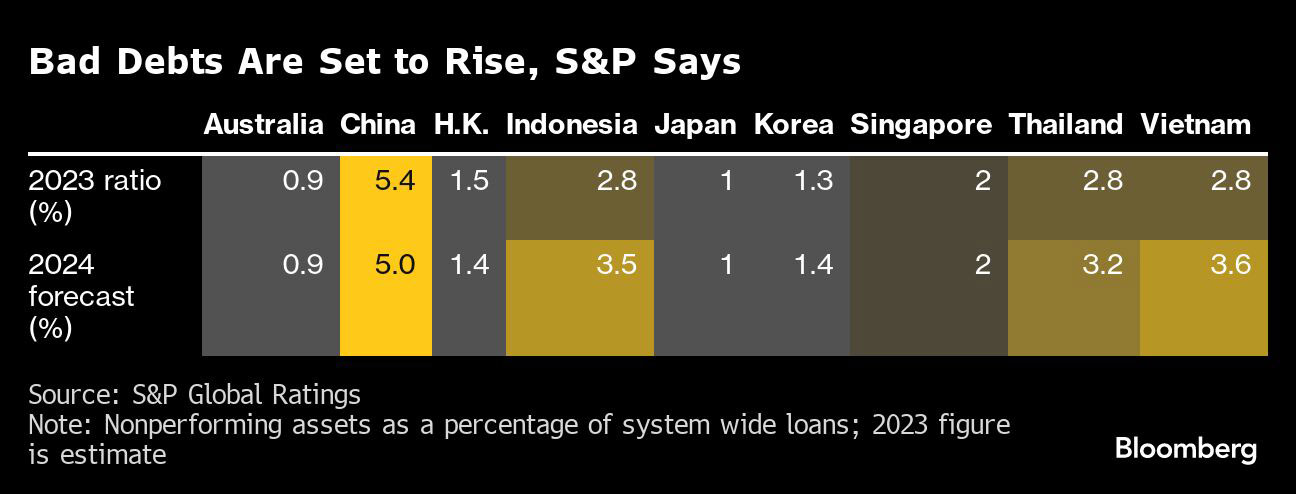
Bad debts for both households and companies are piling up and the Bank of Korea said risks related to project financing debt — a type of security used to finance construction that triggered the 2022 crisis — are likely to increase next year. Even so, officials say the country’s financial system will generally remain stable. 

The “potential restructuring of real estate project financing loans from the middle of 2024 following the election in April 2024 could raise volatility in the short-term money market at least temporarily,” said Citigroup, Inc. economist Kim Jin-wook.

INDONESIA
The local central bank’s most aggressive rate hikes since 2005 put heavily indebted home builders such as PT Lippo Karawaci and PT Agung Podomoro under pressure, as it crimped household purchasing power. A weak currency made matters worse, by increasing the cost of servicing their soon-to-mature dollar debt, forcing them to resort to asset sales to raise cash.

Fitch Ratings said at the end of November that “some kind of default is probable” on Agung Podomoro’s $132-million bond due in June 2024 after it has canceled an offer to buy back part of the unsecured notes. Refinancing risks for Lippo Karawaci, Lippo Group’s Indonesia unit, also are rising, according to Fitch, which downgraded the firm’s dollar note due in January 2025 to CCC+ in November.

But the prospect of an end to Indonesia’s policy tightening is giving dollar-denominated property notes an uplift, as investors anticipate an improvement to real estate demand.

Fitch has predicted a recovery in local corporate bond sales, citing increased refinancing needs and a more supportive economic environment. Borrowers are expected to continue to prefer shorter-tenor issuance in 2024, as there is higher demand for short-term notes amid rate uncertainty, Fitch said.

VIETNAM
The government’s ambitious anti-graft campaign upended Vietnam’s property sector already plagued by oversupply, impeding corporate bond issuance that triggered a liquidity crunch and missed payments by borrowers. But regulatory interventions and multiple interest rate cuts have slowed the downward spiral.

“Vietnam’s real estate market has had an extraordinarily challenging year, but we believe the worst of the downturn has now passed,” Michael Kokalari, chief economist at VinaCapital Group Ltd., wrote in a report. “Mortgage rates peaked at as high as 16% at some banks in early 2023 but subsequently dropped dramatically.”

Still, signs of trouble remain. Some banks have thin capital buffers and some have high exposure to real estate, according to Sue Ong, credit analyst at S&P Global Ratings.

The poster child of the property woes is Novaland Investment Group Corp., one of the country’s biggest developers, notable for having a US-currency bond. The company agreed a maturity extension on holders of its $300-million convertible note, after an interest payment failure in July.

While the price of the note picked up on news the firm had struck a deal with creditors, the note is still indicated at 36 cents on the dollar, according to Bloomberg-compiled data. That’s a deeply distressed level showing low investor expectations for full debt recovery.

Perpetual dollar bonds issued by several of the city’s developers suffered their worst selloff in years in August, amid worries about soaring financing costs and the spillover impact of China’s real estate woes. Leading the declines were New World Development, Co. — one of Hong Kong’s most indebted developers. It’s debt underperformed industry peers this year.

Behind investors’ nervousness is a local property slump that saw the city’s home prices drop to the lowest in almost seven years. Revenues from office buildings and retail space have also weakened following three years of stringent COVID curbs and the Federal Reserve’s historic monetary tightening.

Demand was so depressed that Hong Kong developers were forced to cut home prices significantly, a tactic they hadn’t deployed for years, while banks struggled to lure buyers for foreclosed homes at equally deep discounts.

“We are cautious about developers in Hong Kong with large exposure to residential and commercial properties in lower tier cities in mainland China as well as those with large office portfolios outside prime districts due to the elevated vacancy rate and continued negative rental revisions,” said Zerlina Zeng, senior credit analyst at Creditsights. “We continue to underweigh Hong Kong developers with higher leverage due to the rising HKD funding costs, which would persist in 1H24.”

AUSTRALIA
It’s a slightly different form of property stress in Down Under, where the Reserve Bank of Australia’s (RBA) aggressive tightening cycle has raised concerns over households’ ability to stomach higher interest rates.

The International Monetary Fund (IMF) has indicated the country is liable to feel the effect of higher borrowing costs, at a time when a large chunk of home loans fixed at record-low rates during the pandemic are set to be rolled over to higher, floating rates. In Australia, more than 50% of mortgages have variable rates, according to the IMF.

The RBA warned in October that a small but growing number of households were in the early stages of financial stress. About 14% fixed-rate borrowers expected to face a rise in mortgage payments of more than 60% once their maturities expire, it said.

Data from the Australian Prudential Regulation Authority on banks’ residential property exposure show new non-performing loans climbing to a three-year high though they still remain relatively low. — Bloomberg

Public warned vs two unregistered investment firms

BW FILE PHOTO

THE Securities and Exchange Commission (SEC) has warned Filipinos against investing in two entities without a license to solicit investments.

In separate advisories posted on its website, the corporate regulator flagged BNY PAL (Benta Paluwagan)/BNYPAL & Trading and Pecado, saying these are unregistered firms.

BNY PAL invites people to invest at least P20,000 via “paluwagan slots or cash benta slots,” according to the SEC.

“The scheme employed by BNY PAL has the characteristics of a Ponzi scheme, where monies from new investors are used in paying fake profits to prior investors and is designed mainly to favor its top recruiters and prior risk takers and is detrimental to subsequent members in case of scarcity of new investors,” the SEC said.

It added that BNY PAL offers various paluwagan slots and income for different maturity periods, but there is no matrix on how much income investors will get.

“Based on one of the contracts posted, BNY PAL (Benta Paluwagan)/BNYPAL & Trading offers a minimum of 30% (income) in just 10 days,” the SEC said.  

“The Securities Regulation Code requires that said offer and sale of securities must be duly registered with the commission and that the concerned entity and/or its agents should have the appropriate registration and/or license to sell such securities to the public,” it added.

Meanwhile, the SEC said Pecado or P/E Capital Assetized Digital Offerings is an interactive digital investment platform that urges the public to invest in its digital assets. It also acts as a stockbroker.

It said Pecado is wholly owned by the US SEC registered investment advisory firm Ashtree Block Ventures LLC. It is operated by Ashtree Block Ventures UAB, which is a unit of Ashtree Block Ventures.

“While Ashtree Block Ventures is a registered investment advisory firm overseas, it is not registered with the commission as a corporation or as a partnership,” the SEC said. “However, an entity named Ashtree Consultancy, Inc., an affiliate firm incorporated in the Philippines, holds a service contract agreement to manage the back-office operations of Pecado.”

A company must have a license and should be registered locally before being allowed to do business in the Philippines, the SEC said. — Revin Mikhael D. Ochave