Home Blog Page 3774

Turns out, pilots are crucial to running an airline

WIKIPEDIA

CATHAY PACIFIC Airways Ltd. is facing a crisis of its own making. While the problems started in 2020 at the height of the COVID-19 pandemic, the current drama of canceled flights and a rush to rewrite the airline’s operational handbook was foreseeable, and preventable.

The first sign of danger came in December, when hundreds of flights were canceled over the Christmas-New Year period due to a shortage of pilots. The airline blamed a higher-than-normal rate of illness. Cathay then scrapped around a dozen flights per day through the end of February — including the peak Lunar New Year period. The bigger problem, as Bloomberg News reported, is that many pilots have hit their 900-hour cap. In order to limit fatigue, international regulation limit pilots to flying no more than 900 hours in any rolling 12-month period.

Aviation operations are very systematic, flights schedules are planned months in advance, and airlines have full transparency over their pilots’ past, present, and future flight hours. That Cathay allowed so many crew to get close to the 900-hour cap indicates either a lack of planning, or more likely, an inability to prevent this from happening even months out from those limits being reached.

Cathay had been warned. In June, the pilots union said a return to the pre-pandemic level of flights wouldn’t be possible until the carrier filled an existing gap of around 1,400 experienced pilots. By August, the total flights Cathay was operating had exceeded the number of captains required to fly them — an early indicator of what eventually ensued in December. According to the union, Cathay had around one-third the number of pilots in August that it employed at the end of 2019, just before the pandemic struck.

Every airline in the world was impacted by COVID. As borders shut, flights dried up and aircraft were parked in deserts. There was nothing for pilots to do. Many were fired. Cathay closed its regional carrier, Cathay Dragon, in October 2020 and cut hundreds of pilots. All up, it reduced headcount by 8,500, or 24% of staff, across the broader Cathay group, the company announced.

It then rewrote pilot contracts with a simple ultimatum: Take the new deal or leave. With no other jobs available, over 2,600 pilots signed. Permanent cuts were made to base salaries, pension contributions, and an education allowance, the Hong Kong Free Press wrote.

Singapore Airlines Ltd. also made large-scale retrenchments, equal to about 20% of headcount. But with the help of the government, it redeployed many workers to healthcare roles and later reversed wage cuts implemented during the pandemic. As a result, staffing at Singapore Air and its affiliate Silk Air at the end of its fiscal year ending March 2023 was just 7% below the same period in 2019. It’s on track to hire 2,800 more crew by the end of March.

Even before the pandemic, Cathay’s situation was murky. Once a proud symbol of the former British colony, its return to profit in 2018 after back-to-back losses was overshadowed by pro-democracy protests the following year. Rather than help the airline cope with a drop in passengers during those months, Beijing summoned the head of Cathay’s key shareholder — the Swire Group — and demanded rectification after some staff were seen siding with protestors. While the airline did get a bailout from the government, the lack of trust seemed to escalate during COVID, including strict quarantine requirements for crew.

Airlines are all competing for pilots, but Cathay is looking desperate. Last week, the company updated its operational handbook to allow pilots to apply for promotion to captain after just 3,000 flight hours, instead of the previous 4,000. Aviators climb through the ranks by logging hours and flights, and becoming captain is the pinnacle. This adjustment appears aimed at luring pilots to the airline, or to keep them there, by making promotion easier. It also ensures the operator can keep flying. We shouldn’t assume that lowering the benchmark for promotion is less safe, but it is important to note the timing of such a move: when Cathay is short of captains.

Cathay’s actions over the past few years — even preceding COVID — make it look like an airline that’s not particularly pilot friendly. For example, its 2018 contract cut pay by around 40% and was cited by the company as a reason for its high rate of crew exodus.

Airlines knew that a pilot shortage was coming. Back in 2013, Boeing Co. forecast the global aviation industry would need to hire 498,000 new pilots over the coming decade. More than 192,000, or 39%, would be needed in the Asia-Pacific region. A year later, it bumped up that estimate by 7% to 533,000. It would raise that forecast again in subsequent years, and in the 2018 outlook — the year Cathay cut pay and benefits for pilots — Boeing noted that “the pilot labor supply has continued to tighten amid strong global air traffic growth.”

Despite clear evidence that pilots were hard to come by, and knowing that it could not operate without them, Cathay Pacific’s management approach has been to make the airline less and less attractive to cockpit crew. Recent one-time bonuses and a reduction in promotion thresholds are mere Band-Aids to the more systemic problems it unleashed upon itself.

If Cathay wants to keep flying uninterrupted schedules, and expand its operations, then the first step will be to recognize the importance of the pilots who keep the airline in the skies.

BLOOMBERG OPINION
TDF yields drop amid lower global crude prices 

Bangko Sentral ng Pilipinas main office in Manila. — BW FILE PHOTO

By Keisha B. Ta-asan, Reporter

TERM DEPOSIT YIELDS of the Philippine central bank fell on Wednesday, as global crude oil prices stayed under $80 a barrel despite rising geopolitical tensions in the Middle East.

Demand for the Bangko Sentral ng Pilipinas’ (BSP) term deposit facility (TDF) stood at P329.014 billion, lower than P360 billion on the auction block. Last week, bids reached P345.778 billion against the same offer.

Tenders for the one-week term deposits hit P171.408 billion, below the P185-billion offer. Bids hit P189 billion against the same offer last week.

Banks asked for yields ranging from 6.55% to 6.613%, narrower than 6.5% to 6.615% on Jan. 10. The average rate for the seven-day debt inched down by 0.21 basis point (bp) to 6.5856%.

Meanwhile, the 14-day deposits attracted P157.606 billion in bids, lower than P175 billion being sold by the central bank. Last week, tenders hit P156.778 billion against the same offer.

Accepted rates for the two-week debt ranged from 6.59% to 6.65%, also narrower than 6.5675% to 6.65% last week. This caused the tenor’s average rate to slip by 0.1 bp to 6.5981%.

The BSP has not auctioned off 28-day term deposits for three years to give way to its weekly sale of securities with the same tenor.

The central bank uses the term deposits and 28-day bills to mop up excess liquidity in the financial system and to better guide market rates.

The TDF yields went down on Wednesday after global crude oil prices eased to near one-month lows, Michael L. Ricafort, chief economist at Rizal Commercial Banking Corp., said in a Viber message.

Global benchmark Brent futures have stayed under $80 per barrel since last month despite rising tensions in the Middle East, Reuters reported.

On Tuesday, Brent crude futures increased by 0.2% or 14 cents to settle at $78.29 a barrel, while US West Texas Intermediate crude futures ended at $72.40 a barrel, down by 0.4% or 28 cents.

Mr. Ricafort said this was due to slower demand, with central banks globally having raised interest rates since 2022, including the US Federal Reserve and BSP.

The Fed hiked borrowing costs by 525 bps from March 2022 to July 2023, bringing its benchmark overnight rate to 5.25% to 5.5%.

Back home, the Monetary Board tightened policy rates by 450 bps from May 2022 to October 2023, which brought the key interest rate to 6.5%, the highest in 16 years. 

Lower global crude oil prices may lead to a further easing in Philippine inflation, which could prompt the BSP to start considering rate cuts this year.

Preliminary data released by the local statistics agency showed inflation slowing to 3.9% in December from 4.1% in November and 8.1% a year ago. This was the first time inflation hit the 2-4% target in nearly two years. 

But full-year inflation stood at a 14-year high of 6% in 2023. This was above 5.8% in 2022 and marked the second straight year that inflation breached the BSP’s 2-4% target.

Monetary Board member Benjamin E. Diokno earlier said the BSP could cut borrowing costs by as much as 100 bps this year and mirror future policy moves by the Fed.

The BSP will hold its first policy review of the year on Feb. 15. — with Reuters

Tech talent development seen to boost e-commerce in PHL

TRUSTPAIR.COM

By Miguel Hanz L. Antivola, Reporter

THE PHILIPPINES must leverage its technology talent to boost the rise of e-commerce, which still lags in terms of policy, community, and mindset compared to the rest of the region, an industry expert said.

“The majority of the tools that we use here in automation, around 80%, is Vietnamese software,” Nani Razon, co-founder of the Ecommerce Thrive Asia Movement and chief executive officer of Gencys Digital Trading, Inc., said in an interview with BusinessWorld.

“Based on our observation and case study, e-commerce in the Philippines is behind by five to six years in terms of technology, community, and mindset from that of Vietnam,” he added, noting Vietnam is the Philippines’ closest competitor.

Mr. Razon said there are many good Filipino programmers, but they are still doing their work using software of foreign companies.

The e-Conomy SEA report by Google, Temasek Holdings, and Bain & Co. showed the Philippine e-commerce market had a gross merchandise value (GMV) of $16 billion last year, same as Vietnam.

Indonesia recorded the highest GMV at $62 billion, followed by Thailand with $22 billion, it added.

The report cited Vietnam’s continued manufacturing and exports as key drivers for overall digital economy growth.

For the Philippines, the shift to organized e-commerce platforms from informal and unorganized is expected to benefit the industry, it noted.

There are opportunities for the government to collaborate with the private sector and build a sustainable ecosystem for e-commerce, Mr. Razon said, which should include having the necessary tech talent to develop their own software alongside a community of skilled entrepreneurs.

“[We’re] still a baby,” he said. “The community is still small in terms of numbers. When it comes to technology, we are still behind, [although] big corporations are starting to develop their own software, hiring programmers internally,” he added.

Upon reviewing the Philippine seller base of the top Vietnamese e-commerce software, Mr. Razon said he saw only 9,000 subscribers, which is indicative of only a small volume of e-commerce businesses in the country.

This pales in comparison to the 200,000 in Vietnam, he noted.

“There are still a lot of people who don’t know about e-commerce,” Mr. Razon said, adding that most traders have failed to innovate and maximize online platforms.

“Consumers also lack awareness, and there are a lot of sellers who are scammers, contributing to the stigma toward online platforms,” he said.

Mr. Razon urged the government to pass the necessary regulations for e-commerce sustainability focusing on “a proper system and processes” and not merely profitability.

“We need to reshift to the mindset that e-commerce industry is played by skilled businesses and professionals, including the programmers,” he said.

The Internet Transactions Act, which aims to tighten e-commerce regulations, was approved by the Senate on second reading in September 2023.

Senate Bill 1865, a priority bill of President Ferdinand R. Marcos, Jr., will classify entities involved in e-commerce in the Philippines as businesses operating within the country, subjecting them to domestic laws.

Elton John joins elite EGOT ranks with Emmy win

A SCREENSHOT from the show Elton John Live: Farewell from Dodger Stadium. —IMDB.COM

LOS ANGELES — Musician Elton John was elevated to the rare status of EGOT on Monday when a livestream of a concert from his farewell tour won an Emmy award.

EGOT stands for Emmy, Grammy, Oscar, and Tony — and only 19 people in history have won all four honors during their career.

Mr. John earned his Emmy for Elton John Live: Farewell From Dodger Stadium, which streamed on Disney+ in November 2022. The singer was not at the ceremony because he recently had knee surgery, producers of the special said.

“I am incredibly humbled to be joining the unbelievably talented group of EGOT winners tonight,” Mr. John said in a statement. “The journey to this moment has been filled with passion, dedication, and the unwavering support of my fans all around the world.”

The 76-year-old singer has won six Grammys over his musical career. He won a Tony for best original song for “Aida” and two Oscars for songs including “Can You Feel the Love Tonight?” from The Lion King.

Other EGOT winners include Rita Moreno, Jennifer Hudson, and Whoopi Goldberg. — Reuters

5 Filipinas spotlighted in Forbes’ 50 Over 50 Asia list

FIVE Filipinas were featured in Forbes’ “50 Over 50: Asia” list for 2024.

The list recognizes women in the Asia-Pacific region who are “proving that the years after 50 are the new golden age,” Forbes said on its website.

The recognized Filipinas include Susan P. Co, vice-chair of Puregold Price Club, Inc.; Anna Ma. Margarita B. Dy, chief executive officer (CEO) of Ayala Land, Inc.; and Esther Wileen S. Go, president and CEO of Medilink Network, Inc. 

Also acknowledged were Miriam Coronel-Ferrer, a Ramon Magsaysay Awardee, and actress Dolly de Leon.

Ms. Co is also vice-chair of Cosco Capital, Inc., involved in various sectors. She is the wife of tycoon Lucio L. Co. 

Ms. Dy is the first female CEO of Ayala Land, the country’s second-largest property developer.

Meanwhile, Ms. Go has led Medilink to connect physicians and patients in the Philippines. She also serves as a director in various Philippine corporations.

Medilink’s platform connects insurers, healthcare providers, and insured members through an electronic network. It offers services like underwriting validation, card production, eligibility checks, and claim processing.

Ms. Ferrer, a peace adviser and a former United Nations negotiator, played a key role in peace talks in the southern Philippines. She won the Ramon Magsaysay Award in November.

Ms. De Leon gained international acclaim for her role in the 2022 film “Triangle of Sadness.” She was nominated for a Golden Globe Award and starred in US-made films at the 2024 Sundance Film Festival.

Other women in the Forbes list include Chinese-born actress Lisa Lu, Singaporean sculptor Han Sai Por, Japanese environmental activist Kimiko Hirata, Singapore Power Limited Chair Leong Wai Leng, Japanese firm Suntory Beverage & Food CEO Makiko Ono, and Nobel Prize in Physiology or Medicine Winner Tu Youyou.  

“They’re exerting their influence on fashion, pharma, finance, and beyond — and they’re doing so at 54, 68, and even 112,” Forbes said. — R.M.D. Ochave 

Alternergy board clears perpetual preferred shares listing

Alternergy Holdings Corp. said on Wednesday that its board of directors approved the listing of a total of 470.4 million perpetual preferred shares.

In a regulatory filing, the listed energy company said that the board greenlit on Tuesday the listing and filing of 370.4 million perpetual preferred shares 1 and 100 million perpetual preferred shares 2 series A.

Meanwhile, the company has been preparing for the issuance of green corporate notes amounting to up to P4 billion as part of its capital-raising activities to support its renewable power projects.

Its board approved last month the appointment of BDO Capital & Investment Corp. as its mandated lead arranger for the fixed rate green corporate notes.

Since its P1.65-billion initial public offering in March 2023, Alternergy has raised a total of P3 billion in equity, according to its president Gerry P. Magbanua.

Part of this was the P1.45-billion worth of perpetual preferred shares subscribed by the Government Services Insurance System.

In December, Alternergy said that it would return the wind energy service contract for its Calavite Passage offshore wind power project in Mindoro to the Department of Energy due to feasibility concerns.

The company said that the results of the study for the offshore wind project identified “several technical issues that could potentially make the development unfeasible at this time given the available technical innovations and market conditions.”

Alternergy aims to develop up to 1,370 megawatts of renewable energy sources, including onshore and offshore wind, solar, and run-of-river hydropower.

At the local bourse on Wednesday, shares of the company fell by three centavos or 4% to close at P0.72 apiece. — Sheldeen Joy Talavera

Nuclear energy and the UPSE RPA-PDEAA lecture

Among the important developments in global energy recently was not the “surging” prices of oil, natural gas, or coal, as there was none.

From end-December 2022 to Jan. 16, 2024, these were the prices of oil, gas, and coal: WTI crude oil, $77/barrel to $72/barrel; US natural gas, $3.54/metric million British thermal unit (MMBtu) to $2.82/MMBtu; Coal (Newcastle) $390/ton to $129/ton. Meanwhile, the solar energy index was $331 to $233, the wind energy index was $299 to $276, and the EU carbon permits were $90/ton to $68/ton.

In contrast, over the same period the price of uranium went from $48.84/pound (lb) to $92.5/lb, and the nuclear energy index rose from $1,462 to $2,148. Almost double in price in less than 13 months.

So, fossil fuel prices are down — good. Financial returns on wind, solar, and the penalization of carbon emissions are down — good too. Meanwhile the prices of nuclear energy are rising. This implies that as countries and companies “transition” away from fossil fuels and “decarbonize,” they do not go towards more wind and solar. Rather, they go towards nuclear energy.

NUCLEAR POWER BY COUNTRIES
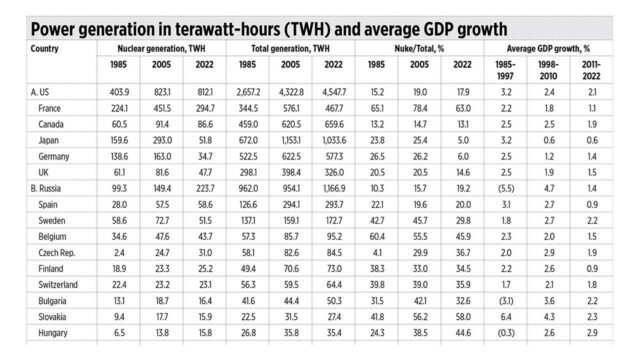
I checked the nuclear energy use of countries from 1985 to 2022 and their economic growth during the same period. I grouped them into three: in Group A are the G7 countries (except Italy which has no nuclear energy), in Group B are other European countries, and in Group C are Asian countries.

The G7 countries have either plateaued or decreased their electricity generation from nuclear (which is very high energy density, cheap, stable, and reliable) and they experienced low or declining growth. Most notable are Japan, Germany, and United Kingdom. France remains the most nuclear-intensive country in the world.

Group B countries show a mixed trend, with Russia, Slovakia, the Czech Republic, and Hungary exhibiting a rising trend in their nuclear/total generation ratio. Russia and Hungary have recovered from deep economic contractions in the early 1990s. The other Europeans have either plateaued their nuclear/total generation ratios or have seen it decline like Sweden and Belgium — which are still at high levels of 30% and 46% respectively in 2022.

Group C also exhibited a mixed trend. China, India, and Pakistan are newbies in nuclear energy, and they are just ramping up, which should have helped them keep their high average growth of 4% to 6.6% from 2011-2022. South Korea and Taiwan started using nuclear energy early, but Taiwan “denuclearized” fast as they shifted to more natural gas. South Korea and Taiwan have had slow growth in the past decade (see the table).

I added in the table the hypothetical contribution of the Philippines’ Bataan Nuclear Power Plant (BNPP) with 620 MW in installed capacity. If the average capacity factor was 85%, then its dependable capacity would have been 527 MW. So, in one day, or 24 hours, it could generate 12,648 megawatt-hours (MWH) of electricity; in one year, 4.62 million MWH or 4.62 TWH. If the BNPP had been allowed to operate in 1985, it could have contributed or added 20% to the total power generation in 1985, and 4% in 2022.

THE 2ND ANNUAL RUPERTO P. ALONZO LECTURE
The UP School of Economics (UPSE) Program in Development Economics Alumni Association (PDEAA) in partnership with the Philippine Center for Economic Development (PCED) will hold the second Ruperto P. Alonzo (RPA) annual lecture on the theme, “The Nuclear Option and Economic Growth” on Feb. 8, 3 p.m. at the UPSE in Diliman, Quezon City.

The main speaker will be Department of Energy (DoE) Undersecretary Sharon S. Garin and the discussants will be Irma Exconde (PDE Batch 37 and DoE Director), yours truly (PDE Batch 33), an anti-nuke group Asian Peoples’ Movement for debt and development, and, possibly, Dr. Caloy Arcilla of the Philippine Nuclear Research Institute (PNRI).

Prof. Ruperto “Ruping” Alonzo was a well-loved faculty member of UPSE for 45 years (1968-2013) and was named Professor Emeritus in 2016. He was the Director for PDE for many years, was UP Vice-President for Development (2005-2009), Director of the Institute for Small Scale Industries (2004-2009) and was Deputy Director-General of National Economic and Development Authority (NEDA, 1998-2001). He passed away in 2017.

The first RPA lecture was held on Feb. 8, 2023 at UPSE on the subject of Public-Private Partnership (PPP) and the speaker was Cynthia Hernandez, Executive Director of the PPP Center and also from PDE Batch 33.

The PDEAA is happy to get the corporate sponsorships of Aboitiz Power (AP), Manila Electric Co. (Meralco), and Robinsons Retail Holdings.

So far only two energy companies have expressed explicit plans to develop nuclear power in the country, AP and Meralco/MGen — great guys. The two companies have both power generation and distribution businesses. For now, they are expanding their renewable energy (RE) generation because the RE law of 2008 (RA 9513) mandates the renewable portfolio standards (RPS). But RE, especially wind-solar, have very low energy density and low-capacity factors and hence have low actual power generation despite high installed capacity.

As the insane “decarbonization” policies continue worldwide, energy companies must develop nuclear power to prevent the country from going down the road of deindustrialization and degrowth brought about by more RE.

Robinsons Retail Holdings is a big energy consumer because of their wide-ranging business units — department stores, supermarkets, convenience stores, DIY and hardware stores, appliance and electronics, toys, etc. Cheap, stable and reliable, no-blackout energy sources, regardless of the weather, will help them provide more convenience and affordable prices for their customers.

Proceeds of the corporate sponsorships will go to the planned PDEAA room at the expanded UPSE building. The 2nd RPA lecture is open to the public and media, with no registration fee, both onsite and online.


Bienvenido S. Oplas, Jr. is the president of Bienvenido S. Oplas, Jr. Research Consultancy Services, and Minimal Government Thinkers. He is an international fellow of the Tholos Foundation.

minimalgovernment@gmail.com

BDO ends peso bond offer early amid strong demand

BW FILE PHOTO

BDO UNIBANK, Inc. on Tuesday ended its offer for peso-denominated Association of Southeast Asian Nations (ASEAN) sustainability bonds amid strong demand from both retail and institutional investors, according to a stock exchange filing.

This is a week ahead of the scheduled close on Jan. 22, the Sy-led Philippine lender told the Philippine Stock Exchange on Wednesday.

BDO was looking at raising P5 billion from the one-and-a-half-year bonds, the proceeds of which will be used to “diversify the bank’s funding sources and finance and/or refinance eligible assets.”

The bonds were priced at a coupon rate of 6.025%, with a minimum investment amount of P500,000 that will increase by P100,000.

BDO said the bonds were still set to be issued, settled and listed on Jan. 29.

Standard Chartered Bank is the sole arranger of the notes and a selling agent along with BDO. BDO Capital & Investment Corp. was chosen as the financial adviser.

The bonds were the bank’s second peso-denominated sustainability bond offer after the P52.7-billion issue in January 2022. It was issued as the third tranche under BDO’s P365-billion bond program.

Proceeds from the previous issuance were used to diversify BDO’s funding sources and finance environmental and social projects.

The two-year debt was set at a fixed rate of 2.9%, with interest payable quarterly on a 30/360 basis.

BDO’s net income rose by 16.5% year on year to P18.7 billion in the third quarter amid higher interest income and lower provisions.

Its share price gained 0.07% or 10 centavos to close at P139.20 each. — Aaron Michael C. Sy

Xiaomi unveils Redmi Note 13 Series phones

TRUSTPAIR.COM

BANGKOK — XIAOMI on Monday launched here its Redmi Note 13 Series smartphones, as well as updated versions of its smartwatch and earbuds.

“Redmi Note was born to bring amazing tech to everyone. When you’re using Redmi Note, you’re actually using 10 years of experience and effort to create the best midrange smartphone,” Xiaomi International Southeast Asia General Manager Alex Tang said at the launch event.

The Redmi Note 13 Series features the Note 13 and Note 13 5G base models and the Pro models Note 13 Pro, Note 13 Pro+ 5G, and Note 13 Pro 5G.

“With significant upgrades to camera system, design, display, and processor, Redmi Note 13 Series continues to close the gap between mid-range and flagship-level smartphones, delivering all-star durability, fantastic experience, and impressive imaging capability — all at reasonable prices,” Xiaomi said in a statement.

The Redmi Note 13 has a MediaTek Dimensity 6080 processor, while the Redmi Note 13 5G features a Snapdragon 685 processor.

For the Pro Models, the Redmi Note 13 Pro+ 5G is powered by a MediaTek Dimensity 7200-Ultra processor, while the Note 13 Pro 5G features a Snapdragon 7s Gen 2 processor. Lastly, the Redmi Note 13 Pro comes with a MediaTek Helio G99-Ultra processor.

The Redmi Note 13 Pro+ 5G and Note 13 Pro 5G both have a 1.5K AMOLED display with 1800 nits peak brightness. Meanwhile, the Redmi Note 13 Pro, Note 13 5G, and Note 13 feature an FHD+ AMOLED display.

The base models Note 13 and the Note 13 5G come with a 108-megapixel (MP) main camera, an 8MP ultrawide camera and a 2MP macro camera, as well as a 16MP front camera. Meanwhile, the Pro models have a 200MP main camera.

“The reason we place such an emphasis on mobile imaging is because our users love to take photos, to tell stories about their lives, create works of art, and store cherished memories of families and friends,” Xiaomi International Product Marketing Manager TJ Walton said on Monday.

The Redmi Note 13 is priced at P9,999 for the 8GB RAM and 256GB storage variant, while the 6GB+128GB model costs P7,999.

Meanwhile, the Redmi Note 13 Pro’s 8GB+256GB version is priced at P13,999, while its 12GB+512GB variant sells for P15,999.

Lastly, the Redmi Note 13 Pro+ 5G costs P20,999 (8GB+256GB) to P23,999 (12GB+512GB), while the Note 13 Pro 5G is priced at P16,999 (8GB+256GB) to P18,999 (12GB+512GB).

Both the Redmi Note 13 and the Redmi Note 13 5G support 33W fast charging, while the Redmi Note 13 Pro 5G and the Redmi Note 13 Pro have 67W turbo charging, and the Redmi Note 13 Pro+ 5G supports 120W HyperCharge.

All Note 13 Series devices also feature an in-display fingerprint scanner, the first for Redmi Note phones.

Kunpimook Bhuwakul or BamBam from K-pop band GOT7 was announced as Xiaomi Southeast Asia’s first ambassador at the Note 13 Series launch event.

REDMI BUDS 5, WATCH 4
During the event, Xiaomi also launched the Redmi Watch 4, the Redmi Buds 5, and the Redmi Buds 5 Pro.

The Redmi Watch 4 features a square 1.97-inch AMOLED display. Xiaomi said this is the largest square form-factor Redmi smartwatch.

The smartwatch has an upgraded four-channel PPG sensor for heart rate and blood oxygen monitoring.

“Users have a choice of more than 150 sports modes, including six automatically recognized activities. Advanced features include Bluetooth® calling that allows users to answer calls by raising their hand and tapping,” Xiaomi said.

It is priced at P4,899 and comes in Silver Grey or Obsidian Black bezels with a matching strap. Users may also purchase Pastel Purple, Dark Cyan, or Mint Green straps.

Meanwhile, the Redmi Buds 5 has active noise canceling of up to 46dB with three options for background noise settings and three transparency modes.

“Redmi Buds 5 support up to 10 hours of continuous listening and up to 40 hours of use when paired with its charging case,” Xiaomi said.

The base model Buds 5 is available in Black, White, and Sky Blue and is priced at P1,899.

Meanwhile, the Buds 5 Pro costs P3,399 and has three color options: Midnight Black, Moonlight White, and Aurora Purple

The Pro model has up to 52 dB active noise cancellation, as well as up to 4kHz ultra-wide frequency noise cancellation. — A.M.C. Sy

Tickets go on sale for Venice day trippers in trial scheme

VENICE — ITALIA.IT

ROME — Tickets went on sale on Tuesday for visitors wanting to see Venice from April as part of a trial aimed at controlling the growing numbers of day trippers crowding into the lagoon city.

A one-day ticket costs €5 ($5.45) and will be valid from 8:30 a.m. to 4 p.m. local time.

The new daily admission fee will come into force from April 25, a national holiday in Italy. Tickets will be needed for the following 10 days and thereafter for most weekends until mid-July.

Visitors have to pay online (https://cda.ve.it/en/) and will obtain a QR code giving them access for a day. Anyone caught without a ticket will face a fine of between €50 ($54) and €300 ($326).

Restrictions will not apply to the lagoon’s smaller islands, such as Murano, famous for its glass-making industry.

Residents and people who were born in Venice as well as students, workers, and home owners in the city will be exempt from paying and booking a slot.

Visitors aged under 14 and tourists with hotel bookings will need to be registered and obtain a QR code, but access for them will be free of charge.

There will be no limit on the number of people entering the city, at least initially, as city authorities study the efficiency of the system.

Mass tourism and floods have long been a problem for the fragile city, known for its picturesque canals, churches, and squares.

Last year, the United Nations cultural body UNESCO threatened to add Venice to its list of World Heritage in Danger, accusing Italy of not doing enough to protect the city from the impact of climate change and mass tourism.

It later dropped the threat after giving the thumbs up to Italian efforts to address these concerns via the MOSE anti-flooding system and by the introduction of the entry fee. — Reuters

Raslag eyes to buy properties in Nueva Ecija for 2 solar projects

RASLAG Corp. will buy lots in Nueva Ecija, for an estimated P807.73 million, for its two solar projects, the solar energy developer said on Wednesday.

In a stock exchange disclosure, Raslag said its board has approved the purchase of lots with an estimated total area of over one million square meters.

The properties will house Raslag 7 and Raslag 8 solar projects located in Brgy. Liwayway, Sta. Rosa, Nueva Ecija.

“The agricultural lands shall be converted into industrial-commercial use for solar plants purposes,” the company said.

The board has also approved the selection of contractors for the 36.65-megawatt peak (MWp) Raslag 4, specifically Solenergy Systems, Inc. for operations and maintenance and Pure & Pam, Inc. for the construction of the microwave tower.

Situated in San Pablo, Magalang, Pampanga, the project has an estimated total construction cost of P1.7 billion. Of the total, about P380 million will be sourced from initial public offering proceeds, P120 million from internally generated funds, and P1.2 billion from the Bank of the Philippine Islands. — Sheldeen Joy Talavera

​Moovr expands EV fleet, eyes intercity transportation

ATHER-ENERGY-UNSPLASH

E-SCOOTER and bicycle-sharing mobile service Moovr PH is eyeing intercity transportation after introducing e-bikes to its fleet of electric vehicles (EV).

The company has improved and expanded its EV fleet to 310, from the previous 100 as of December last year, servicing Bonifacio Global City (BGC), the Makati central business district, and Filinvest Alabang.

The refreshed fleet uses Okai EB300 e-bikes and ES600 e-scooters, which both have swappable batteries and a maximum speed of 25 kilometers per hour.

“We’re hoping to bridge Makati and BGC, but we will need safe infrastructure,” Anna Moncupa, Moovr founder and general manager, told BusinessWorld on the sidelines of the company’s relaunch event on Saturday.

“It’s always going to be expanding that sphere and moving toward intercity versus intracity,” she added. “Bikers are more responsible than scooter rides in general because anyone can use the scooters, whereas you have to know how to use the bike.”

However, Ms. Moncupa noted safety as a priority before expanding its services intercity, adding that protected bike lanes and strict traffic compliance must be present first.

“Even if townships want us to [operate in their area], we’re not going to endanger our riders even if we technically don’t have the liability,” she said.

“At the end of the day, the success of the program is about the entire community and not just one rider,” she added. “The goal is to get more [onboard], so we can keep lowering our prices. We want to lower our prices.”

Moovr currently has over 1,800 monthly active riders from its more than 231,000 user base, according to Ms. Moncupa.

The rental rate for both e-bikes and e-scooters is P30 for 10 minutes. — Miguel Hanz L. Antivola

ADVERTISEMENT
ADVERTISEMENT