Home Blog Page 337

We had a lot, not a little, lamb

SCREENGRAB from Meat & Livestock Australia’s I Love Aussie Lamb event. — AUSSIE BEEF & LAMB PHILIPPINES OFFICIAL FACEBOOK PAGE

PUT TOGETHER Meat & Livestock Australia (MLA) and a dozen Tagaytay restaurants and you get a lamb-a-palooza!

Twenty-five lamb dishes from the participating restaurants greeted us on the morning of Jan. 30. We lost count of how much we ate, but we went home burping-full of both lamb and knowledge.

Last Friday, MLA held I Love Aussie Lamb, a collaboration between the body and the Tagaytay-based restaurants. Held at Elaia by Cyma, by chef Roby Goco, MLA’s “Lambassador,” the event was preceded by a butcher workshop by MLA Master Butcher Kelly Pane. The preceding event taught chefs the myriad ways one can cook lamb, beyond lamb chops and roasts.

Participating restaurants of course included Mr. Goco’s itself, but also Anya Resort, Asador Dos Mestizos, Anzani/Villa Sommet, Farmer’s Table, Gorio’s Roadside, Fatima, Reynaldo’s Smokehouse, Taal Vista Hotel, Textures by Tamayo, The Fatted Calf, and Butcher’s Steaks and Grill.

Standout dishes included the offering from Taal Vista (a lamb birria with a matching consommé; tangy), Anya’s lamb fabada (a stew with beans; comforting), Fatted Calf’s balbacua (heavy and filling in the Tagaytay chill), and their own version of lamb curry patterned after the Thais.

We also liked Tamayo’s take with lamb on perilla leaves (refreshing), and Anzani’s, with a cutlet topped up with a cool Moroccan sauce (it was certainly the most aesthetically pleasing dish). Butcher’s Steaks and Grill had a slow-braised lamb neck turned into hash; its simmering evident and falling apart in the mouth with its tenderness. Finally, Mr. Goco wasn’t to be left out at his home court with a whole roasted lamb served with a lamb paella.

Luisa Rust, senior trade commissioner of the Australian Trade Commission (Austrade) Philippines said in a speech that exports of Australian lamb in the Philippines have grown 18% year on year, culminating in 577 tons of lamb imported into the Philippines in 2025 alone. About this number, Paul Perez, MLA consultant said in an interview, “The things that we’ve planted through the years, those are seeds that are growing now.” He credits the big number to several partnerships with restaurants and chefs.

Meanwhile, Mr. Goco combats misconceptions about lamb. “Perception kasi with lamb is it’s expensive. In reality, it’s not. It’s not cheap, but with better value. But it’s not as expensive as beef,” he pointed out. “You can roast a whole lamb cheaper than a whole pig,” he said, and we’ll take his word for it, considering he had just finished roasting one.

Mr. Perez, meanwhile, pointed to the notion that lamb isn’t as popular in the Philippines due to its gamey taste. Yes, lamb has a flavor all its own, but the misconception comes from older lambs, qualified as mutton (older sheep) imported to the Philippines and passed off as lamb. He says that lamb has to be less than a year old to still be considered lamb, but strictly speaking, as soon as the lamb’s baby teeth transition into adult chompers, it graduates into mutton status.

“These misconceptions are the ones blocking it,” from becoming more popular, Mr. Perez said. “What we do now is to break down all these barriers.”

Mr. Goco talked about the nutritional benefits of lamb, including omega-3, and numerous vitamins and minerals. On food safety, Mr. Perez discussed the importance of traceability in the lamb industry (that is, knowing exactly where the lamb comes from). “It’s one of the biggest industries in Australia” after all, he said. “Anything that hits them will hit the economy of Australia.” — Joseph L. Garcia


PHL companies must brace for faster, automated cyberattacks — CrowdStrike

REUTERS

By Beatriz Marie D. Cruz, Reporter

PHILIPPINE COMPANIES must secure their systems with the help of artificial intelligence (AI) as online attacks become increasingly automated, leading to faster breaches, according to American cyber defense firm CrowdStrike.

“As adversaries weaponize AI to accelerate their attacks and scale their operations, AI-powered defenses help organizations to level the playing field and shift from reactive response to proactive threat disruption,” Fabio Fratucello, field chief technology officer worldwide at CrowdStrike, said in an e-mail.

Companies must use agentic security capabilities that can act across identity, endpoint, and cloud domains in real-time, he said.

“Organizations should consider adopting an agentic security platform that enables security teams to command and orchestrate these capabilities across the security lifecycle, connecting context and data, so agents can reason and act dynamically together in real time, and always under human control.”

This would allow them to move beyond assisted workflows to autonomous security operations, he added.

Mr. Fratucello said attackers have been injecting hidden instructions into generative AI tools to hijack agents, manipulate outcomes, and access sensitive data.

“The weaponization of AI by adversaries has accelerated attack timelines, with what once took days now taking hours or minutes, collapsing the window for defenders to respond,” Mr. Fratucello said.

Philippine companies should also adopt zero-trust security principles and continuous identity monitoring, as more attackers focus on login attempts to kickstart their attacks, the official said.

He likewise emphasized the need for authentication measures with phishing-resistant multi-factor solutions.

Companies should implement strong access policies, like just-in-time access and eliminating standing privileges, he said. Employees should also be educated to recognize social engineering, phishing, and voice phishing threats.

Cloud intrusions, or an attacker’s illegal access to an organization’s cloud computing system, jumped by 136% globally in the first half of 2025 compared to end-2024, according to the 2025 CrowdStrike Threat Hunting Report.

About 40% of these attacks were attributed to China-linked adversaries, and eCrime actors were responsible for 73% of interactive intrusions, it said.

“These threats are proliferating on a global scale, and we expect them to accelerate in 2026,” Mr. Fratucello said.

Meanwhile, CrowdStrike’s 2025 Asia-Pacific & Japan eCrime Landscape Report showed that an eCrime actor has been targeting Philippine banks and foreign exchange services.

These attackers allegedly “leverage financial transaction-themed phishing lures to deliver remote access tools and commodity malware payloads,” Mr. Fratucello said.

Holcim Philippines taps Peak Energy for solar

BW FILE PHOTO

HOLCIM PHILIPPINES, INC. is teaming up with renewable energy (RE) provider Peak Energy to build 25-megawatt-peak (MWp) solar projects, projected to reduce carbon dioxide emissions by up to 28,500 tons each year.

Under the partnership, Peak Energy will build and operate ground-mounted solar photovoltaic (PV) systems at Holcim Philippines’ plants in La Union and Bulacan.

“Combined, these RE systems are expected to generate approximately 40 gigawatt hours of clean energy annually,” the company said in a statement on Wednesday.

The first phase of the project involves the installation of a 13-MWp solar facility at the Holcim plant in Bacnotan, La Union, and a 12-MWp facility in Norzagaray, Bulacan.

“Once operational by 2027, the project is expected to reduce approximately 28,500 tons of carbon dioxide emissions per year,” it said.

The company said this reduction is expected to lower the carbon footprint of cement manufacturing at the two sites.

“This initiative aligns with Holcim Philippines’ commitment to decarbonizing its operations and reducing reliance on traditional fossil fuels,” it said.

“By integrating large-scale renewable energy directly into its manufacturing process, Holcim Philippines aims to produce low-carbon building materials more sustainably for the Philippine market,” it added.

Holcim Philippines said the projects will not require an upfront investment from the company under the terms of a 20-year power purchase agreement (PPA).

“Peak Energy will handle the funding, installation, operation, and maintenance of the solar PV systems, while Holcim Philippines will purchase the electricity produced for the duration of the agreement,” it said.

In a separate release, Holcim Philippines said it has completed a P358-million investment in an alternative fuel feeding system at its La Union plant.

“The project supports lower carbon operations by increasing the use of alternative fuels, reducing reliance on imported fossil fuel, and advancing circular economy practices through the co-processing of waste materials,” it said.

The new feeding system is expected to enable the plant to achieve a net carbon reduction of approximately 12% per ton of cementitious material produced.

“This positions Holcim Philippines to meet its carbon dioxide reduction targets and contribute to the Holcim Group’s ambition to reach net zero by 2050,” it added.

Aside from its plants in Bulacan and La Union, Holcim Philippines also operates cement manufacturing facilities in Misamis Oriental and Davao. — Justine Irish D. Tabile

Social engineering is top cyberthreat for PHL banks

REUTERS

SOCIAL ENGINEERING SCHEMES, such as phishing scams, was the top cyberthreat that affected Philippine banks in the first half of 2025, posing a persistent risk to the country’s digital payments system, the Bangko Sentral ng Pilipinas (BSP) said.

Based on the BSP’s cyberthreat surveillance in the first half of 2025, social engineering, account takeover, and identity theft accounted for 76% of the total amount lost to financial fraud in the period.

“This actually mirrors what other supervisors are seeing. We are seeing that social engineering remains the biggest driver of cyber-related threats,” BSP Deputy Governor Lyn I. Javier said during a media information session in Dumaguete City on Monday.

“So, we’re seeing phishing, vishing, and smishing — again highlighting (the) human element, exploiting the trust of the public or the people. It’s a vulnerability that these threat actors are exploiting just also to implement their schemes or the scam.”

Phishing involves the use of fraudulent e-mails, text messages or links to steal personal, financial, or account information. Vishing, or voice phishing, is a form of phishing using phone calls or voice messages, while smishing is done via text messages.

Meanwhile, hacking was the second most common cyberthreat in the banking system, making up for 13% of total losses, followed by card-not-present fraud with 8%.

Ms. Javier said cyberthreats are becoming more frequent, targeted, and more scalable.

“And as the speed increases, the losses also increase, the window of recovery narrows down, and it allows cybercrime to scale more rapidly than before,” she said.

“So… when we talk about cyber risk, it is no longer just a technology issue. It’s about trust, behavior and (an) ecosystem challenge that we all have to contribute to addressing and protecting the financial system. It directly affects consumer confidence, operational resilience, and ultimately poses risks to financial stability.”

She added that growing interconnectedness in the financial system has expanded potential attack points for cybercriminals as there are increased potential vulnerabilities that they can exploit.

This also heightens financial stability risks as a single point of failure could also affect other institutions, she said.

“Cyber risk is evolving, it’s shifting, and we also have to learn how to adapt to this development… An attack in one financial institution does not necessarily mean that it will be confined to that institution. It could affect other financial institutions connected to that bank. So, it means the services being offered to businesses and households,” she said.

“Now, the stakes become higher when cyber incidents attack critical financial market infrastructure — for example, the payments system. And then, what’s even more challenging is when they attack the accounts of individuals, of depositors, and this scales up, it could actually trigger massive withdrawals in a financial institution, triggering liquidity issues and sometimes capital issues in that financial institution because of the loss of confidence of the public in that particular bank. The trust of the public or trust of the depositors, it’s the core, it’s the foundation of banking. So, we have to take care of that trust.”

She said that while there’s no fool-proof defense against cyberattacks, the central bank and industry stakeholders continue to put in place various rules and measures to strengthen the financial sector’s resilience.

The BSP requires all its supervised financial institutions to submit regular and event-driven reports covering technology-related information as well as incidence of major cyberattacks. Ms. Javier added that they monitor potential threats through social media platforms and the cybersecurity incident database.

The BSP has also mandated banks to update their respective fraud management systems to align with the implementing rules and regulations of the Anti-Financial Account Scamming Act. It has given lenders until June 25 to comply, adding that failure to do so could result in license suspension. — Katherine K. Chan

What to wear

STOCK PHOTO | Image by Tirachardz from Freepik

WHEN there still were printed invitations, proper attire for an event was specified. Even the categories of formal and informal had sub-sections like “barn dance” or “tuxedo.” In the age of online invitations, suggested looks veer towards “smart casual,” if attire is mentioned at all.

What about office wear?

When millennials entered the work force and after the “Work-from-home” (WFH) trend extended beyond the COVID lockdown, office wear has gotten more informal. A “home alone” look is approximated, except for the pajamas.

Just as we judge a book by its cover (although we are told not to), we also use attire as a way of determining the prevailing corporate culture at the office.

Lawyers used to be reliably suited or wearing long-sleeved cotton barong even without court appearances. But with the entry of flatter organizations comes the flattening too of status dressing. Partners can be undistinguishable from executive assistants.

Maybe, it was the digital companies and their newly minted billionaires that made casual attire respectable and indicative of understated wealth. The black turtle-neck shirt filled the closets of the digital icons, including the rising aristocracy of the AI tribe. Casual attire is associated with creativity and contemporary chic.

A suit and tie may now attract jibes, “You’re on the wrong floor, Buddy.” Blazers are not considered part of a suit if they are extra tight and unbuttoned and not matching the bottoms.

Is weekend attire now acceptable in the office, and no longer just for casual Friday? Even once staid bankers now find “smart casual” more customer friendly, especially at the branch level. Suits can still be worn on more formal occasions, but without a tie.

Plain long-sleeved shirts, including soft denims, are now acceptable too. Thick denim shirts that look like jackets, especially when trimmed with fake fur, may still be considered for traveling.

The all-denim look is associated with overseas workers coming home for the holidays with long hair and accompanied by five big cartons. These economic heroes who contribute to inward remittances of foreign exchange now have access to their own airport lounge for complimentary coffee and doughnuts.

Long shirt sleeves may be rolled up until an inch below the elbow, with three folds from the cuff. Aside from denim blues, shirts can come in other subdued colors like dark blue or taupe. Plaids and pajama stripes can be worn for Halloween parties and Fridays.

Even ripped jeans with torn thighs sections (but not where the front zipper is) can be allowed, maybe for media companies and TV production staff. This grungy, hip-hop look can go with pointed boots and skateboards parked discreetly in the pantry.

Sneakers for office attire are almost prescribed as daily attire. For evening wear at product launches and recognition awards, rubber soles with leather uppers can pass muster.

While this mostly unreliable fashion guide is limited to males, a similar casual look can be drawn up for females… but not by me. Skin art for both males and females is given a pass in this modern setting. (Can I see your neck?)

The casual look projects nonchalance. It seems to liberate the wearer from concerns about the old dress codes. (Does this tie go with this suit?)

It is the CEO of an organization that sets the standard for acceptable office wear. What does he wear to meetings? This is a good guide for the underlings to follow.

Companies are decreeing casual attire to signify membership in the knowledge economy and the acceptance of a bottom-up management culture. Deciding to show up at a business lunch with bankers looking too casual is saved from being awkward only when the bankers too show up in open shirts and sneakers.

If there is a new attire for business, one must replace the old inventory in the closet. As one stocks up on polo shirts and denim pants, some thought must be given to what feels right. One must never feel awkward and out of place in his environment.

There may no longer be an “apparel police” to make sure of proper office wear, especially when meeting with clients. The attention of management may have shifted from apparel to accessories like watches, bags, necklaces… and umbrellas with the logos of luxury vehicles.


Tony Samson is chairman and CEO of TOUCH xda

ar.samson@yahoo.com

Dining In/Out on Valentine’s Day

WE’RE ROUNDING up treats and experiences for you and your number one this Valentine’s Day. From cakes and sweet treats to an evening of dance and culture, it’s going to be a good day.


Grand Hyatt Manila

THIS Valentine’s season, the Grand Hyatt Manila invites guests to celebrate love in all its forms. Couples can enjoy up to 15% savings on their stay with additional benefits for World of Hyatt members until Feb. 26. At The Grand Kitchen, guests can share the love with an indulgent buffet and roving live stations at P4,588 net per person for dinner on Feb. 13, and for lunch and dinner on Feb. 14. Music and romance come together with Love, In Full Score at The Lounge, where the Manila Symphony Orchestra performs live orchestral music alongside a four-course dinner at P4,200 net per person. Likewise, The Lounge offers “Steeped with Love,” featuring a tea set at P3,499 net for two on weekdays until Feb. 12, and a live station buffet from Feb. 13 to 15 at P2,749 net per person with free-flowing rose sangria. Guests can also savor “A Taste of Spanish Romance at The Cellar,” with fine wines and a five-course menu at P9,900 net for two, plus an optional wine pairing at P1,500 net per person. For those seeking an intimate evening under the stars, the Pool House offers a poolside cabana experience at P16,000 net for two, inclusive of a four-course meal and a bottle of bubbly. At The Peak, couples can elevate their celebration with a six-course menu at P7,000 net per person, available from Feb. 13 to 14. To complement these experiences, the hotel introduces “Tokens of Love,” a collection of Valentine’s gift items now available until Feb. 15. Flower bouquets will be offered from Feb. 13 to 15, alongside a selection of artisanal cakes, pastries, and confections. Highlights include the Valentine’s Cherry Cake (Whole) at P2,500, the Chocolate Hazelnut Whole Cake with a surprise praline box at P3,000, and the Chocolate Hazelnut Mini Cake at P350. Guests may also enjoy the Rose Raspberry Macaron, Strawberry Tart, and Strawberry Éclaire, priced from P220 to P350. For keepsakes, the Heart Shaped Macaron in a box is available at P550, while the Chocolate Teddy Bear with Pralines is P1,950. Boxes of pralines are offered in sets of nine or 25, featuring flavors such as Elder Flower Strawberry, Cherry Pistachio, Earl Grey, and Ube Creamcheese. Completing the collection is a Valentine’s Scented Candle at P980. Guests can order flowers, cakes, and gift items via Dine at Home, book a table through Restaurant Reservations. They can also call 8838-1234 or 7918-1234.


Morton’s The Steakhouse

FROM Feb. 10 to 17, indulge in an elegant limited-time five-course Date Menu that includes a starter, soup, salad, Lobster Thermidor, one’s choice of Morton’s signature USDA Prime steak, accompaniments, and dessert. As part of the Date Menu, guests can choose between the 16oz. ribeye or the 16oz Cajun ribeye, which is marinated for 48 hours. For dessert there is a choice between Morton’s Legendary Hot Chocolate Cake or a Candied Walnut Cheesecake. Diners get an exclusive V-Day plush teddy bear. The menu is available from Feb. 10 to 17 only and priced at P7,500 per head. Guests may complement their meal with wines available by the glass or bottle for an additional cost. Reserve at www.mortons.com.ph or call 0917-144-9415.


Ayala Museum

For Valentine’s, enjoy Mezcla At Night, an after-hours viewing of two exhibits — Mezcla: Interwoven Cultures and Mantón de Manila — with live flamenco performances. Terry’s Bistro brings Spanish flavors with complimentary savory bites for guests, and light drinks available for purchase. Tickets cost between P1,040 for seniors and PWDs, to P1,300. The event runs on Valentine’s Day from 6 to 10 p.m.


Summit Hotel Greenhills

THIS Valentine season, Café Summit at Summit Hotel Greenhills invites couples and food enthusiasts to experience “Valentine Symphony of Flavors,” a seven-course tasting menu available for dinner on Feb. 13 and 14. This celebration features coffee as its special ingredient to transform the ordinary into savory and sweet masterpieces. Dishes include Ember-roasted cabbage, red pepper and coffee emulsion; Mocha-rubbed filet mignon; and to finish, Espresso and mascarpone mousse. The special Valentine menu is available by reservation only at P1,800 net per person. For those seeking a hands-on experience, an exclusive Coffee Art Workshop will be held for diners on Feb. 13 only, at 6 p.m., during which participants will learn the techniques of coffee painting from Coffee Artists PH. The session will transition directly into the seven-course dinner at 7 p.m. For table reservations, call 8898-5200 and 0919-078-0790. Summit Hotel Greenhills is located at 13 Annapolis St., Greenhills, San Juan.


Honeybon

JUST IN TIME for Valentine’s Day, Honeybon is bringing back the Strawberry Matcha Mousse Cake, a dessert that balances the sweetness of ripe strawberries with the earthy richness of matcha, layered into a light and creamy mousse cake. Adding a personal touch, Honeybon’s Dedication Hearts allow customers to include messages on any of Honeybon’s cake offerings. Honeybon is located at SM North EDSA, SM Megamall, Festival Mall, and all Tokyo Bubble Tea branches. Online shopping and delivery options are available via https://honeybon.ph.


Krispy Kreme

THIS Valentine’s Day, Krispy Kreme is spreading the love with its Choc-full-of-Love, made with Ruby Chocolate, a limited-time collection of heart-shaped doughnuts and a latte made to share. The Ruby Pistachio Swirl is dipped in pistachio chocolate coating, topped with ruby chocolate swirls, pistachio-custard topping, and ruby chocolate bits. Ruby Raspberry Bliss is dipped in ruby chocolate coating, with sides coated with dried raspberry bits, and finished with berry topping. Ruby Cheesecake Dream is dipped in ruby chocolate coating, decorated with white chocolate hearts, and finished with cheesecake. All are heart-shaped. These can be paired with the Iced Ruby Chocolate Latte, made with a mix of espresso, milk, and raspberry syrup, topped with sea salt kreme, dried strawberries, and finished with strawberry drizzle. They are available in all Krispy Kreme stores nationwide and are available for dine-in, take-out, drive-through, and delivery through https://now.krispykreme.com.ph, 888-79000, and GrabFood, FoodPanda, Pick.A.Roo, OrderMo, and Groover.

ERC says Solar Para Sa Bayan may be fined up to P150M

By Sheldeen Joy Talavera, Reporter

THE ENERGY Regulatory Commission (ERC) said Solar Para sa Bayan Corp. (SPSB) could face fines of up to P150 million if it fails to justify alleged violations cited in show-cause orders issued to the company.

“The fines we can impose are P50,000 to P50 million per violation,” ERC Chairperson and Chief Executive Officer Francis Saturnino C. Juan said in a Viber message on Wednesday.

In an order promulgated Jan. 30, the ERC asked SPSB to explain three alleged violations: failing to file required applications, operating without necessary regulatory authorizations, and charging unapproved electricity rates.

The commission said it issued the show-cause orders using its investigative and quasi-judicial powers under Republic Act (RA) No. 9136, or the Electric Power Industry Reform Act of 2001 (EPIRA).

SPSB, linked to Batangas Rep. Leandro Leviste, was granted a 25-year congressional franchise in 2019 to construct, install, and operate distributed energy resources and microgrids in remote and unviable areas.

However, the franchise law requires the company to secure from ERC a certificate of public convenience and necessity (CPCN) and other permits and licenses for its distributed energy resources or microgrids.

“Despite the foregoing requirement, records show that Respondent SPSB Corp. has not, at any time, filed any application for a CPCN or any equivalent or other necessary authority, as expressly required under RA 11357,” the commission said.

ERC records also indicate that SPSB “has not applied for, nor been granted” any authority to operate, certificate of compliance, or provisional authority to operate.

Under EPIRA, retail electricity rates charged by distribution utilities in their captive market are regulated by the ERC. The commission flagged SPSB for allegedly “charging and collecting electricity rates” from residents of Paluan, Occidental Mindoro, since 2018 “without prior approval.”

The commission gave the company 15 days from receipt of the order to justify or defend the allegations, including providing sample consumer bills from 2018 until it ceased supplying power to Paluan.

Mr. Leviste has yet to respond to BusinessWorld’s request for comment via Viber and text message.

In a radio interview last month, he said SPSB’s franchise has been “ipso facto revoked” since the company ceased operations in 2022, citing government red tape and regulatory hurdles as reasons for failing to launch its planned projects.

Solar Philippines Power Project Holdings, Inc., another solar firm founded by Mr. Leviste, was fined P24 billion by the Department of Energy for failing to deliver more than 11,000 megawatts of renewable energy capacity.

The rise of disinformation attacks in the Philippines

FREEPIK

By Ram Vaidyanathan

A GROWING WAVE of fake news and disinformation is sweeping over the Philippines. According to the Reuters Institute Digital News Report 2025, 67% of Filipinos are concerned about misinformation and disinformation in online news. Not only is that figure the highest for the country since it was first included in the report in 2020, but it is also higher than this year’s global average (58%). This comes amid the increasing use of advanced technology like deepfakes enabled by AI to spread misinformation and disinformation.

To fight back against threat actors and uphold public trust, organizations and the wider society must know how to protect themselves. That rests on understanding, anticipating, and combating disinformation with strategic precision.

PREYING ON HUMAN PERCEPTION
Malicious actors have numerous reasons for spreading misinformation or disinformation. Some may want to cause polarization. Highly targeted attacks aim to divide customers, employees, and investors with controversy to weaken trust and hinder collective response. Others may use misinformation campaigns as a social engineering vector, posing as reputable companies to disseminate false or deceptive messages that trick people into falling for phishing schemes and scam platforms that collect consumer information. In severe cases, coordinated campaigns undermine institutional credibility to manipulate market sentiment or stock prices.

Ultimately, these campaigns differ from cyberattacks on IT infrastructure by targeting human perception, forcing organizations into a game of whack-a-mole where they have to repeatedly respond to false claims. The cumulative cost of this can be a major drain on resources and morale because every hour an executive spends managing a public relations crisis is an hour not spent on strategic growth.

THE DISINFORMATION PLAYBOOK
To achieve their goals, malicious actors employ common methods of disinformation such as AI-generated deepfakes, which seem authentic and are increasingly harder to verify with the naked eye. These advanced threats have drawn the attention of regulators. According to House Bill No. 3214, people or platforms that knowingly create, share, or refuse to remove deepfake content after proper notice from authorities or relevant platforms may face two to five years of imprisonment and a P50,000-200,000 fine.

With a wealth of disinformation tactics available to threat actors, organizations have their work cut out for them. Here, the best defense is a holistic strategy that can reduce risks, enhance transparency, and boost consumer and stakeholder confidence in enterprise security and credibility.

DISINFORMATION DEFENSE: A COMPETITIVE ADVANTAGE
Offering unique business partnerships is not enough to remain competitive with enterprises from around the world; local players must diligently and proactively combat disinformation. That means taking disinformation security as seriously as global peers. According to Gartner, 50% of enterprises will implement solutions to combat disinformation by 2028. This is more than 10 times the percentage in 2024.

This dramatic shift highlights a growing awareness among executives that disinformation is more than just an occasional nuisance. It is a persistent threat that can result in significant financial damage. Philippine businesses must also come to terms with this reality and ensure that they have robust protections against disinformation.

DEFENDING TRUTH WITH SMARTER TOOLS AND TEAMS
False narratives powered by increasingly affordable AI tools put organizations on the back foot if they fail to leverage the same advanced technologies. Specialized solutions ensure they have effective, organization-wide disinformation security. These include tools that integrate disinformation response into an organization’s wider cybersecurity strategy and business continuity plans. Organizations must look to AI-powered detection and monitoring solutions, which enable the evaluation and verification of the authenticity of content by analyzing digital fingerprints and detecting AI-generated elements that are undetectable to the human eye.

However, not all AI-powered tools are created equal. It is therefore critical that AI-powered tools are equipped to cross-reference claims against verified databases and to highlight suspicious activity. A system that monitors shifts across media outlets and social media in real time can alert security teams to emerging false narratives before they gain too much traction.

Of course, tools without well-trained human operators are practically useless. Organizations must therefore invest in employee training and crisis communication to help employees quickly identify false narratives and coordinate responses. Additionally, organizations would benefit most from collaborating with regulators, fact-checkers, and industry peers on defense in order to effectively secure the Philippines’ digital economy.

Disinformation can be a powerful disruptor to the Philippines’ economic ambitions. It’s not just a public relations issue; disinformation is a core business risk and should be treated as such. Leaders must act now before false narratives take root.


Ram Vaidyanathan is the chief IT security evangelist, ManageEngine.

Peso drops on heightened US-Iran tensions

BW FILE PHOTO

THE PESO weakened against the dollar on Wednesday on geopolitical concerns amid heightened tensions between the United States and Iran.

The local unit dropped by eight centavos to close at P58.97 versus the greenback from its P58.89 finish on Tuesday, data from the Bankers Association of the Philippines showed.

The local currency opened Wednesday’s trading session weaker at P58.95 against the dollar. It moved within a tight range as its intraday best was at just P58.94, while its worst showing was its closing level.

Dollars traded rose to $1.209 billion from $1.08 billion on Tuesday.

“The dollar-peso closed higher on risk-off mood after the US military reported it had shot down an Iranian drone which heightened concerns of geopolitical tensions,” a trader said by phone.

This caused global crude oil prices to spike, which weighed on the peso, Rizal Commercial Banking Corp. Chief Economist Michael L. Ricafort said in a Viber message.

For Thursday, the trader expects the peso to move between P58.90 and P59.10, while Mr. Ricafort sees it ranging from P58.85 to P59.05.

In the oil market, Brent crude futures rose 0.77% to $67.85 a barrel while US crude advanced 0.97% to $63.82 per barrel as recent events stoked concerns that talks aimed at de-escalating US-Iran tensions could be disrupted, Reuters reported.

The US military said on Tuesday it shot down an Iranian drone that “aggressively” approached the Abraham Lincoln aircraft carrier in the Arabian Sea.

A group of Iranian gunboats also approached a US-flagged tanker in the Strait of Hormuz north of Oman, maritime sources and a security consultancy said. OPEC members Saudi Arabia, Iran, the United Arab Emirates, Kuwait and Iraq export most of their crude via the strait, mainly to Asia. — A.M.C. Sy with Reuters

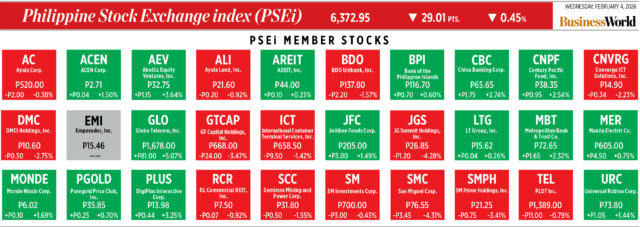
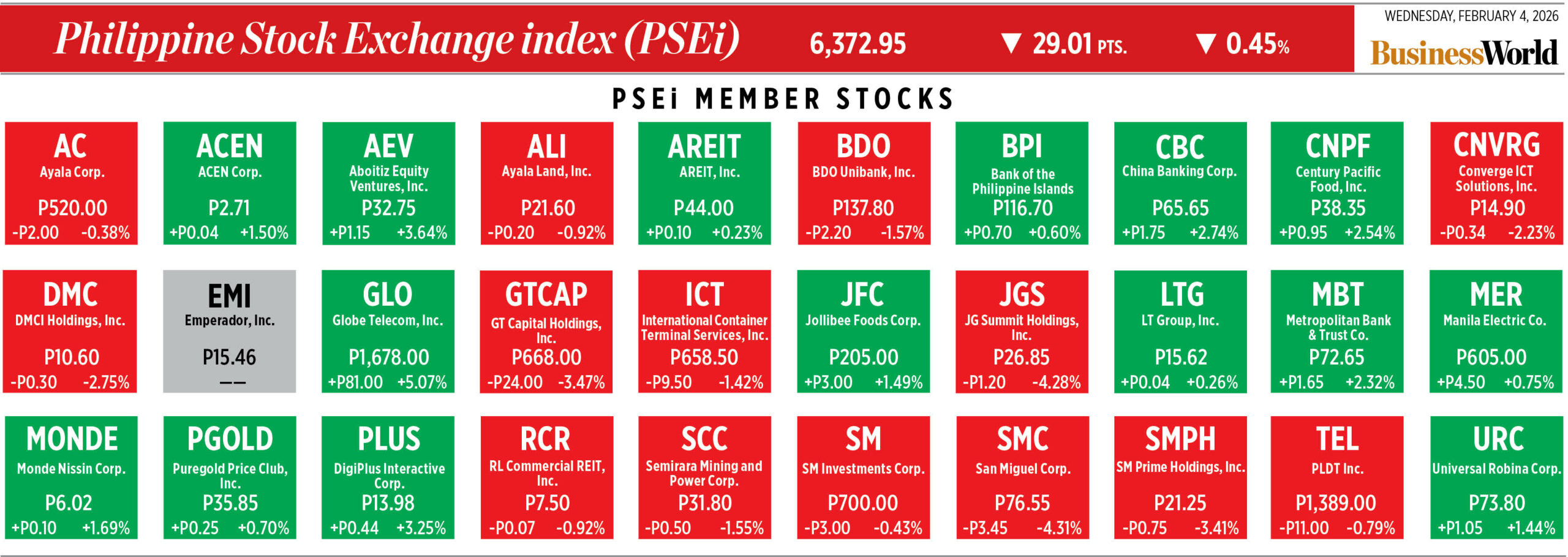
How PSEi member stocks performed — February 4, 2026

Here’s a quick glance at how PSEi stocks fared on Wednesday, February 4, 2026.


Philippines improves in Social Progress Index

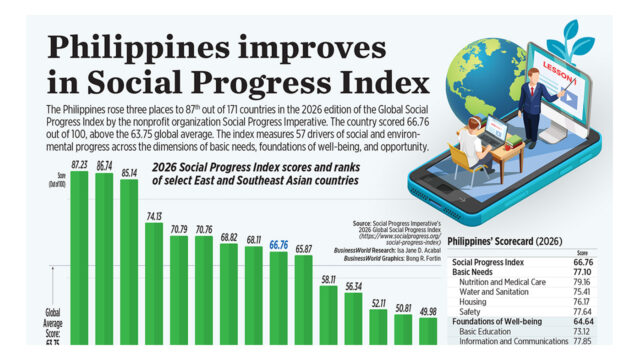
The Philippines rose three places to 87th out of 171 countries in the 2026 edition of the Global Social Progress Index by the nonprofit organization Social Progress Imperative. The country scored 66.76 out of 100, above the 63.75 global average. The index measures 57 drivers of social and environmental progress across the dimensions of basic needs, foundations of well-being, and opportunity.

Main index drops as market awaits inflation data

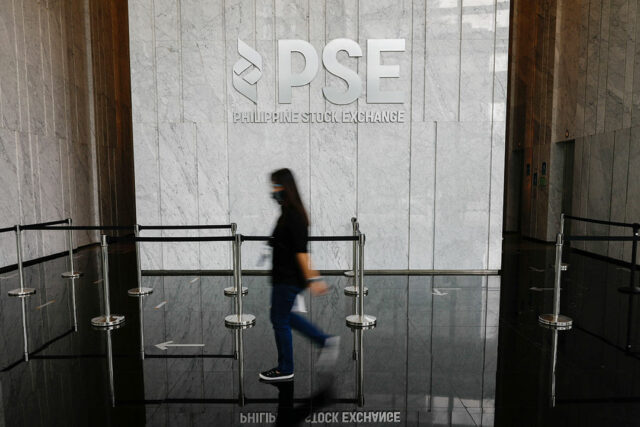
The lobby of the Philippine Stock Exchange in Taguig City, Sept. 30, 2020. — REUTERS

THE MAIN INDEX ended lower on Wednesday as investors locked in gains before the release of inflation data and as worries over the Philippine economy’s prospects affected market sentiment.

The benchmark Philippine Stock Exchange index (PSEi) dropped by 0.45% or 29.01 points to close at 6,372.95, while the broader all-share index increased 0.18% or 6.56 points to end at 3,555.

“The local bourse pulled back to the 6,300 level as investors booked profits ahead of the upcoming inflation report, taking gains amid expectations that price pressures would remain broadly stable and uncertainty over potential market reactions,” Regina Capital Development Corp. Head of Sales Luis A. Limlingan said in a Viber message.

“The local market dropped as the uncertainties over the local economy’s outlook weighed on sentiment. Investors also digested the national government’s latest outstanding debt which reached a new record at P17.71 trillion,” Philstocks Financial, Inc. Research Manager Japhet Louis O. Tantiangco said in a Viber message. “Finally, investors took a cautious stance ahead of the release of the country’s January inflation data.”

The Philippine Statistics Authority will release January inflation data on Thursday (Feb. 5).

A BusinessWorld survey of 18 economists yielded a median forecast of 1.8% for the January consumer price index, within the BSP’s 1.4% to 2.2% projection for the month. That means inflation would be unchanged from December and slower than 2.9% a year earlier.

January would also mark the 11th straight month that inflation stayed below the Bangko Sentral ng Pilipinas’ (BSP) 2% to 4% annual target.

Analysts earlier said that benign inflation would allow the BSP to cut rates further to support the economy, especially after growth slowed to a five-year low in 2025 due to the fallout from a corruption scandal that stalled both public and private spending.

Sectoral indices ended mixed on Wednesday. Property dropped by 1.45% or 32.44 points to 2,204.62; holding firms retreated by 0.83% or 42.42 points to 5,029.40; and services decreased by 0.74% or 19.81 points to 2,646.94.

Meanwhile, mining and oil increased by 1.92% or 328.87 points to 17,457.82; industrials rose by 0.91% or 82.46 points to 9,130.84; and financials climbed by 0.28% or 5.97 points to 2,125.99.

“Globe Telecom, Inc. was the day’s index leader, climbing 5.07% to P1,678. San Miguel Corp. was the main index laggard, falling 4.31% to P76.55,” Mr. Tantiangco said.

Market breadth was positive, with 104 advancers against 94 decliners, while 77 stocks were unchanged.

Value turnover inched up to P6.94 billion with 1.13 billion shares traded from the P6.93 billion with 1.15 billion issues that changed hands on Tuesday.

Net foreign buying increased to P279.62 million from P236.41 million in the previous session. — A.G.C. Magno

ADVERTISEMENT
ADVERTISEMENT