Home Blog Page 3096

PHL banks fall short of lending quota for small, medium businesses

A woman arranges bottles of vinegar at a food exhibition. — PHILIPPINE STAR/JOHN RYAN BALDEMOR

PHILIPPINE BANKS failed to meet the mandated quota for small business loans in the first quarter, data from the Bangko Sentral ng Pilipinas (BSP) showed.

Loans extended by the banking industry to micro-, small-, and medium-sized enterprises (MSMEs) amounted to P474.922 billion as of end-March.

This made up only 4.41% of their total loan portfolio of P10.77 trillion, well-below the mandated 10% quota.

Under Republic Act No. 6977 or the Magna Carta for MSMEs, banks are required to allocate 10% of their total loan portfolio for small businesses. Of this, 8% of loans should be allocated for micro and small enterprises, while 2% should go to medium-sized enterprises.

However, banks have long opted to incur penalties for noncompliance instead of taking on the risks associated with lending to small businesses.

As of end-March, BSP data showed lending to micro and small enterprises stood at P191.276 billion, equivalent to just 1.78% of their total loan portfolio and well below the 8% quota.

On the other hand, loans for medium-sized enterprises amounted to P283.646 billion, accounting for 2.63% of their total credit book.

By type of bank, universal and commercial banks disbursed P122.523 billion in loans to micro and small enterprises in the first quarter. This was only 1.33% of their total loan book.

Big banks’ loans to medium-sized enterprises stood at P235.213 billion or 2.37% of their total lending.

Thrift banks extended loans to micro and small enterprises worth P30.263 billion or 3.4% of their loan portfolio, falling short of the quota.

Thrift banks’ loans to medium enterprises hit P28.811 billion, equivalent to 4.61% of their total lending.

Meanwhile, rural and cooperative banks exceeded the quota for lending to MSMEs. They extended loans to micro and small enterprises worth P38.49 billion, equivalent to 17.74%.

Their loans to medium enterprises hit P19.622 billion or 9.29% of their loan portfolio.

Loans granted by digital banks to the micro and small enterprise sector stood at P180 million in the first quarter, comprising 1.02% of their credit book.

Digital banks disbursed P10 million to medium enterprises, equivalent to 0.07% of their portfolio.

During the pandemic, the BSP allowed banks to count MSME loans as alternative reserve compliance with the reserve requirements to help support the sector.

This relief measure expired on June 30, 2023. However, it was extended to thrift banks as well as rural and cooperative banks until Dec. 31, 2025. — Luisa Maria Jacinta C. Jocson

World Bank to support more agriculture projects in PHL

A carabao is seen on a field in Malvar, Batangas, Feb. 24, 2024. — PHILIPPINE STAR/MIGUEL DE GUZMAN

THE WORLD BANK is seeking to fund more Philippine projects that seek to bolster productivity in the agriculture sector amid rising prices of food.

“The World Bank is very supportive of agriculture and agricultural productivity in the Philippines,” Ndiamé Diop, World Bank Country Director for Brunei, Malaysia, Philippines and Thailand, told BusinessWorld on the sidelines of a forum last week.

“For us, agricultural productivity in the medium-to-long term is one of the key ways in which you can reduce food price, a key driver of overall inflation,” he said.

Headline inflation quickened to a six-month high of 3.9% in May amid rising utility and transport prices. It was the fourth straight month of faster annual inflation.

The Philippine central bank has said that the latest inflation data were consistent with its expectations that inflation could quicken through July due to the impact on El Niño on agricultural output.

“We’ve been supporting agriculture for four years, and our support has continued to be strong,” Mr. Diop said.

In November last year, the Department of Agriculture launched three World Bank-funded projects worth a combined $920 million to make the agriculture and fisheries sector more resilient to climate shocks.

These projects include the Philippine Rural Development Project Scale Up, Mindanao Inclusive Agriculture Development Project, and the Philippine Fisheries and Coastal Resiliency Project.

Mr. Diop said the World Bank is also seeking to fund projects that would plug existing gaps in education and digital infrastructure.

“This year, we do have projects in many areas. Education is one area we are supporting this year,” he said. “We are helping to rebuild schools — we call [the project] Safer School Rebuilding.”

The $500-million Infrastructure for Safer and Resilient Schools project will address the physical rehabilitation needs and boost the resilience of disaster-affected schools in the Philippines. The project is expected to cover over 3,000 schools around the country.

The Philippines is one of the most disaster-prone countries in the world. From 2021 to 2023, there were 3,484 school facilities affected by disasters nationwide, data from the Department of Education showed.

“We are [also] helping the digital sector by reducing the digital divide in the Philippines, bringing the fiber optic to the lagging regions to help those regions have better internet connectivity,” Mr. Diop said.

Only 33% of Filipino households have access to fixed internet connection, and 70% of the entire population subscribed to an active mobile broadband, according to a separate World Bank study.

For this year, the World Bank is also funding initiatives on sustainable recovery and climate change, Mr. Diop added.

“Almost every year, we’re supporting policy reforms in many areas, but also in sustainable recovery and climate change. So, all of those are projects we are preparing for and developing this year,” he said.

The World Bank was the country’s third-largest source of official development assistance in 2022, accounting for 21.18% or $6.86 billion of total loans. — B.M.D.Cruz

Striking the balance between familial and career responsibilities in the modern age

Photo from pch.vector on Freepik

For much of the 20th century, the nuclear family archetype included a working father and a stay-at-home mother. This division of labor was largely influenced by cultural norms and economic necessities. This model was reinforced by post-World War II economic prosperity in Western countries, which enabled single-income households to thrive.

However, the modern family structure is becoming increasingly flexible, allowing both parents to share responsibilities more equitably. This family dynamic shifted in the latter half of the century due to several factors, including the feminist movement, economic changes, and evolving social attitudes toward gender roles.

According to the Pew Research Center, the rising trend of stay-at-home dads is driven by several factors, such as women’s advancement in education and the workforce, economic trends, and the impact of the financial crisis.

The growing number of dual-income families, largely driven by women’s educational accomplishments, has resulted in more fathers taking on caregiving responsibilities. With the emergence of remote and flexible work arrangements, many fathers are now able to work from home while simultaneously caring for their children, thus contributing to the family income. Therefore, the trend reflects a changing societal perception of traditional gender roles and family dynamics as fathers increasingly take on a more active role in parenting and household duties.

A study published in a peer-reviewed open-access The Family Journal: Counseling and Therapy for Couples and Families, explained that the Filipino family culture has always placed extreme importance on the family as the most crucial social group in society. From a family systems viewpoint, mothers and fathers have distinct and interconnected roles and contributions within the family, with fathers being the sole breadwinners.

However, the traditional structure of a Filipino family has evolved due to the effects of globalization and migration, leading to a significant shift in family dynamics. The study claims that the increasing trend of demand in labor has resulted in many mothers seeking job opportunities. Consequently, the traditional roles of breadwinner fathers and housekeeper mothers are becoming less common, and there is a noticeable increase in the number of stay-at-home fathers.

Fathers at work

A study published in Academy of Management Perspectives has shed light on the positive work-related outcomes that can benefit organizations when fathers take an active role in parenting. The study found that more involved fathers experience greater job satisfaction and work-family enrichment. They also reported less work-family conflict and were less likely to consider quitting their jobs.

While it may seem counterintuitive, the study also revealed that more involved fathers had lowered career identity. However, this factor was balanced by the perceived support from management that they received, indicating that when organizations acknowledge and support the parenting responsibilities of fathers, they can effectively minimize the potential impact on their career identity.

The Shriver Report supports these findings, indicating that the 21st-century man prioritizes personal success within the context of family. The report suggests that many men place greater importance on fulfilling the roles of a good father, husband, son, or friend over traditional markers of success such as financial independence and professional achievements. In fact, three in five men consider personal achievement at home to be the primary indicator of success, with financial success and independence following at only 24%.

The report also highlights a generational difference in attitudes, revealing that younger men between the ages of 18-49 are more inclined to value the importance of being present in their family lives. On the other hand, older men aged 50 and above still emphasize the significance of being a provider.

Increased involvement at home

Research has consistently shown as well that involved fathers have a positive impact on their children’s development. In fact, a report published by the US-based Institute for Research on Poverty found that positive father involvement is associated with a range of benefits for children. These include higher academic achievement, greater school readiness, stronger math and verbal skills, greater emotional security, higher self-esteem, fewer behavioral problems, and greater social competence compared to children who do not have involved fathers.

Research from Children’s Bureau’s The Fatherhood Project also revealed that when fathers are involved from the start, infants develop strong emotional bonds with them, similar to those they share with their mothers.

The impact of paternal involvement extends well into the future, as children who feel emotionally connected to their fathers are twice as likely to attend college or secure stable employment after high school. These children are less likely to exhibit disruptive behaviors in school or engage in risky behaviors during adolescence. Specifically, children with engaged fathers are 43% more likely to earn A’s in school and 33% less likely to repeat a grade.

The positive influence of engaged fatherhood is also evident in the behavioral outcomes of children, with high levels of father involvement being associated with increased sociability, confidence, and self-control. Furthermore, they are 75% less likely to experience a teen birth, 80% less likely to spend time in jail, and half as likely to suffer from multiple symptoms of depression.

Conversely, the research also indicates that father absence is linked to delayed developmental milestones from early infancy through childhood and into adulthood, emphasizing the enduring impact of paternal influence.

The importance of support

The traditional concept of the “ideal worker” as someone who dedicates their life to their full-time job while their spouse takes care of the home and children is being challenged by the increasing involvement of men in child-rearing. According to Academy of Management Perspectives, this shift conflicts with the prevailing notion of the ideal worker, who is expected to prioritize work above all else.

The research indicates that men’s active participation in childcare contradicts societal expectations of masculinity, which often emphasize men’s dominance over women and traditional gender roles. Men who diverge from these norms by taking on caregiving responsibilities may face marginalization and social disapproval.

The concept of hegemonic masculinity also emphasizes traditional masculine norms, which can create barriers for men who choose to take on caregiving roles. This can lead to feelings of guilt, shame, and isolation as men struggle to reconcile their masculine identities with their new responsibilities.

Although some organizations are leading the way by offering flexible schedules and parental leave policies, many companies are slow to adapt to the changing dynamics of modern families. This lack of support from employers contributes to the growing conflict experienced by men as they try to balance their work and family responsibilities.

In response, the role of fathers will likely become even more integral to both the workplace and the home, benefiting individuals, families, and society as a whole if they are given significant opportunities.

A study by Great Place to Work found that employees who feel supported by their employers are more likely to be productive and satisfied in their roles. This support can take many forms, including flexible work arrangements, parental leave, and a culture that values caregiving roles. Hence, the support allows fathers to be more involved in their children’s upbringing and to prioritize family responsibilities without compromising their careers. — Mhicole A. Moral

There is more to Korea than Seoul and Busan

TINFOIL barbs fill a giant fishbowl at the Daejeon Expo Aquarium.

The varied pleasures of Daejeon and Sejong

By Chelsea Visto

THE CHANCE to embrace the simple charm of a quiet city attracts travelers as much as the opportunity to be immersed in the complex and often chaotic life of a busy center. It is the same for most destinations — the choice is often between the hustle and bustle of the metropolis or the hidden gems in roads less traveled.

In Korea, a tourist can opt to spend hours on end at the shopping-frenzied streets of Myeongdong in Seoul or the teeming Haeundae beach in Busan. But there is always an equally exciting alternative.

The cities of Daejeon and Sejong are definitely worth exploring — especially for frequent Korea visitors who have ventured into every nook and cranny of Gyeongbokgung Palace, enjoyed all four seasons in Nami Island, and have had enough of the thrilling rides of Everland.

Daejeon is in the central lowland valley of the Korean Peninsula while Sejong is in the west central portion. Both are approximately an hour’s drive from Seoul and are only around 30 minutes from each other by private transport.

While a day tour to either city is doable, spending several days to enjoy what Daejeon and Sejong have to offer is well worth it.

DAEJEON: KOREA’S SILICON VALLEY
As Korea is at the forefront of technology and innovation, it is not surprising that it also boasts of its own version of California’s Silicon Valley. Except that in Daejeon, they prefer to call their technology center the “City of Science.”

Daejeon is the hub for Korean technology and development, with science-oriented institutions in its midst. But even as research establishments tower over the metropolis, it has achieved a striking balance between art, culture, and science.

Whether they are looking for outdoor strolls with scenic nature views or indoor activities that offer spectacular sights, this capital city of North Chungcheong deserves a spot on a Korea tourist’s bucket list.

Near the Daejeon border is Ppuri Park, a popular family destination. The cultural site sits at the foot of Mount Mansung, far from the city center and during spring it is blooming with color and brimming with foliage.

The Romanized Korean word Ppuri directly translates to “root” in English, meaning “ancestry.”

While many Koreans share the same family names, like Park, Lee, and Kim, they may not be biologically related, given their different roots. Ppuri Park pays homage to family forebears and carves their names in their descendants’ history — stone and wooden sculptures are the park’s highlights, each representing a surname and its lineage.

Apart from sightseeing and hiking, the park offers several other activities — from navigating the swan boats on Daecheongho Lake, the third largest in Korea, to fun picnics and outdoor play areas, mostly for children. Entrance to Ppuri Park is free.

Going indoors, the Daejeon Expo Aquarium can spice up anyone’s itinerary. It has an underwater tunnel that runs beneath the Shinsegae Department Store in Daejeon, with a length equivalent to three blue whales.

The aquarium’s inhabitants include miniscule seahorses, stingrays, and different types of jellyfish. There are also dedicated tanks for clownfish and blue tangs, which inspired the pop culture icons Nemo and Dory from the animated film Finding Nemo.

The aquarium is also home to several internet-famous axolotls which draw considerable curious attention and rightfully so. The salamanders’ distinct pink color and endearing boba eyes guaranteed their becoming TikTok sensations.

Daejeon Expo Aquarium stages seasonal underwater shows, a fun experience for both kids and adults. Consider visiting in May to catch the immersive performances of real-life mermaids, who captivate spectators as they blow big bubble hearts.

The cost of admission to the aquarium ranges from 25,000 to 29,000 Korean won (approximately P1,060 to P1,200).

Shopaholics can also have their fill at the Daejeon Skyroad, which offers a great selection of take-home goodies and a bevy of restaurants for post-shopping dining.

Skyroad and its connected smaller alleys are filled with Korean beauty stores, shoe shops, and several samgyupsal places. Every few meters there are self-shoot photo studios, which Koreans popularized, and which have caught the fancy of Gen Z’s all over the world.

A quick stop at Baskin Robbins to try some of their unique ice cream flavors is recommended. The classic all-American ice cream chain has several unique flavors especially concocted for the Korean market.

For weary travelers who need a break from all the walking, exploring, and eating, the Daejeon Travel Lounge provides a respite. Found in the city center, the one-stop relaxation hub is mainly for tourists needing assistance with their travel itinerary, souvenir shopping, and general travel information which is available in English, Chinese, and Japanese.

After resting their weary feet, a tourist can gas up at the nearby Taehwajang restaurant which offers several gastronomic delights such as jjajangmyeon (black bean noodle sauce), sweet and sour pork, and a medley of Korean and Chinese dishes.

PLANTS, BEARS, AND PRESIDENTS AT SEJONG
An administrative center specially designed by the national government, Sejong is a self-governing city that values its green spaces while simultaneously developing local infrastructure. It prides itself as being a “smart city” that operates self-driving buses and artificial intelligence-powered patrol robots.

“I believe Sejong will one day be a leading city in Asia. I want the world to recognize our outstanding city,” Tourism Promotion Division Director Ahn Ki Eun told BusinessWorld.

Named after the country’s fourth king, Sejong is the youngest Korean metropolis. While smaller than most cities, it has many points of interest — a plantita paradise, a beautiful bear haven, and a repository of national history.

The Sejong National Arboretum rose to fame after it was featured in a couple of hit Korean dramas — Song Hye Kyo’s The Glory and Im Yoona’s Big Mouth — and should be the first stop of a Sejong sojourner.

The country’s first urban arboretum is home to over 1.72 million plants within a vast 65-hectare expanse. The botanical garden is eminently Instagramable, especially in spring when the flowers are in full bloom. With around 2,400 plant species, plantitas will have a field day for an entrance fee of only 3,000 KRW (P120).

The Four Seasons Exhibition Greenhouse is the crown jewel of the arboretum. It exhibits Mediterranean and tropical plants from various parts of the world. The tropical greenhouse simulates the sweltering Philippine temperatures, enabling common Filipino plants like ferns, bamboos, figs, and cordylines to thrive.

A zoo that doubles as an arboretum is a good second stop in the city. The Bear Tree Park is home to both farm and wild animals, including goats, fallow deer, rabbits, and peacocks, although the bruins are certainly the stars of the show.

A steep slope leads to the brown bears, but on the way, guests are treated to breathtaking beds of flowers and a panoramic view of colorful and interestingly shaped trees. A replica of Rodin’s The Thinker greets those who make it to the halfway mark of the trail. It is just one of many statues — mainly of bears — that dot the park.

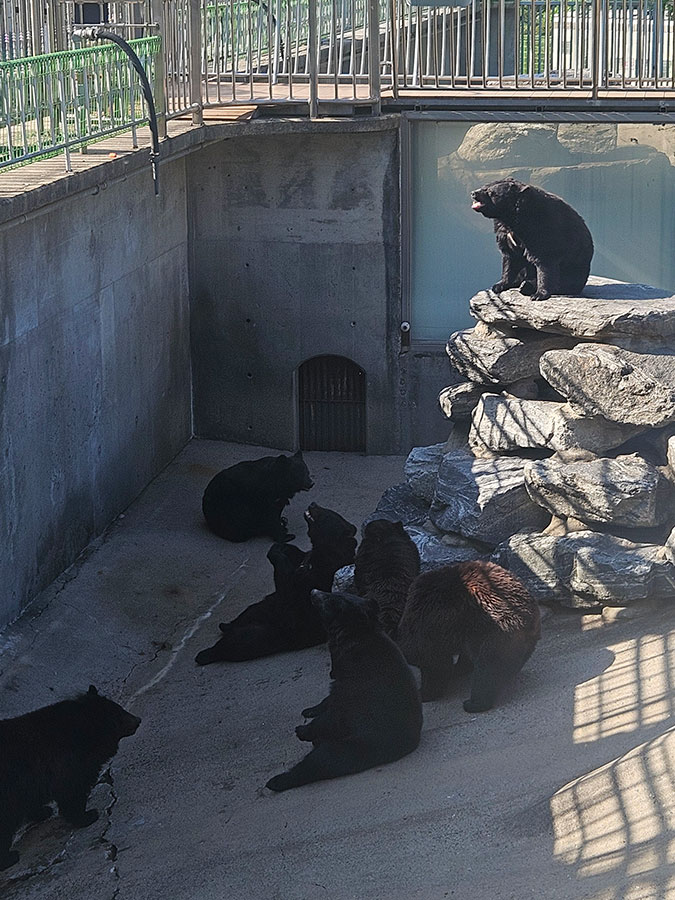
At the end of the trail are the bear cages. Definitely daunting given their size, these bruins are nonetheless charming and even amusing as they appear to beg for food or play in their makeshift pond. The bears can be fed with carrots for 2,000 KRW (P80), which is on top of the park admission of 8,000 to 13,000 KRW (P340 to P550).

The Presidential Archives is an incredibly enriching experience for Sejong visitors. The four-story building is a museum of presidential items and gifts, portraits, and over 400 carefully preserved historical records. It showcases the 13 South Korean presidents and their contributions to the country.

The facility has special rooms replicating the presidential office, reception room, and even the media room to give a feel of the daily grind at the executive department. Tourists can sit on the sofas, stand on the podiums, and take photos to their hearts’ content.

Daejeon and Sejong presents varied choices depending on the traveler’s interest and serve as a refreshing break from Korea’s more famous destinations. The Korea Tourism Organization Manila has been promoting these alternative destinations and expects these cities to be the next gateways to Korea. Currently, the budget airline Aero-K has direct flights from Manila to Cheongju while Airmark Travel can tailor-fit an itinerary based on a visitor’s travel preferences.

As tourist arrivals have not yet reached the same levels as the more popular cities like Seoul and Busan, this may be the best time to experience and delight in what Daejeon and Sejong can uniquely offer — without the crowds.


The Juans, Alamat collaborate on new heartbreak anthem

THE POP ROCK band The Juans has released their latest single, “Gupit,” a collaboration with the P-pop boy group Alamat.

The track follows the band’s previous emotion-stirring singles, each charting the path of a relationship: from “puwede ba kitang ligawan?” (Can I court you?) in February to “Napagod Na” (Tired Already) in April. This time, The Juans decided to team up with Alamat, to delve into the complexities of moving on.

For band members Carl Guevarra, Japs Mendoza, RJ Cruz, and Chael Adriano, “Gupit” is more than just a song of heartbreak — it’s an anthem of emotional courage.

“It’s different for us because it’s a melancholy story but an upbeat tune,” said Mr. Adriano, who penned the song, at the June 4 press launch in Quezon City.

“It talks about a part of our culture as Filipinos. Kapag galing sa heartbreak, nagpapagupit kasi may pinagdadaanan (Coming from heartbreak, we cut our hair to symbolize that we went through something). It’s a way of saying ‘new hair; new me’,” he explained.

The Juans frontman Mr. Guevarra added that “Gupit” talks about the “internal struggles and ways of coping and moving on after losing someone.”

Sana maka-relate sa kanta ang mga taong may pinagdadaanan (Hopefully people who are going through something can relate to the song),” he said.

The members of Alamat, composed of Taneo, Mo, Jao, Tomas, R-Ji, and Alas, were invited to contribute to the track after they shared the stage with The Juans a year ago in a concert. For both groups, working on a song together was an opportunity to blend the dramatic original Pilipino music (OPM) band style and the rap-heavy P-Pop style.

Sa music production, walang madamot sa kaalaman. Nagbabatuhan lang ng ideas (In music production, no one is stingy with knowledge. We would throw around ideas),” said Alamat’s rapper Alas.

On the process of writing the song, Alamat leader Mo added that contributing and working together came easy.

Ang bilis namin nabuo. Ang sarap lang ng ang daming utak at ang bilis namin nagawa. Naramdaman namin iyung brotherhood (We finished it so quickly. It felt good to have so many brains working together, and we finished it so fast. We felt the brotherhood),” he said.

After the song’s release, a music video will be posted that conveys the themes of heartbreak and finding the strength to move on.

Gupit” is out now on all digital music streaming platforms. — Brontë H. Lacsamana

Weaving together the cinemas of Southeast Asia

Phnom Penh-based film magazine comes to Manila

TO explore the peripheries of cinema in Southeast Asia, one would have to trace histories and feel for gaps in the words and images that have already been created on the region’s cinematic pulses.

For writer-editors Savunthara Seng and Alyssandra Maxine and designer-art director Sonich Touch, their independent film magazine MARG1N takes on this daunting task — all while weaving together marginal filmmaking and film-viewing narratives of their countries, Cambodia and the Philippines.

Their first issue, titled pirate.lov3r.2024.mkv, tackles the culture of piracy.

“To some degree, I want to push forth with MARG1N to intertwine film more with the general public. Not in the sense of ‘watch films to make you smarter,’ but more like ‘why not watch this because it’s a fun thing?’,” Ms. Maxine said at the Manila launch of the magazine on June 7.

By raising questions on viewing habits, which include downloading, stealing, and sharing, film piracy as an inevitable part of film culture can be addressed.

Between Cambodia and the Philippines, MARG1N’s first issue contains 20 pieces interlacing each other. Essays, analyses, fiction, comics, and photographs come from various Cambodian and Filipino filmmakers, actors, critics, and viewers, making up 120 pages.

Putting it together is a challenge, according to editor-in-chief Mr. Seng.

“Throughout the nine-month process of putting things together, for me, the most important thing I learned is the collaboration process. It’s easy to have people write but to actually collaborate, especially if you have a small team of three people, you have to keep faith in everyone you work with,” he said in a video message shown at the launch.

He and Ms. Maxine met online on the movie-tracking social media platform Letterboxd. She immediately accepted after he pitched the concept of a print-only film magazine where each issue explores the cinemas of two Southeast Asian countries.

Cambodian production company Anti-Archive serves as the official headquarters of the magazine.

“I thought that I wanted to do something like [the late Filipino film critic] Alexis Tioseco’s work. I have a more literary background, so I conceptualized a human angle to piracy through the perspective of young writers,” she said.

With Mr. Seng and Ms. Touch based in Phnom Penh and Ms. Maxine based in Manila, MARG1N came to life with writers all collaborating online.

The pieces range from humorous comics about downloading movies in Cambodia to a fictional report of lost Filipino films being rediscovered from pirated copies; from articles about long-forgotten Cambodian films to cross-cultural dialogues between filmmakers who pirate each other’s works.

While the topic of piracy turned off many potential funders for being “bold, provocative, and somewhat reactionary,” MARG1N thrived because of sponsors that believed in the vision, like Cambodian filmmaker Davy Chou and supporters from France, Singapore, and even Mongolia.

“My most important takeaway would be to grow communities and nurture the bonds you have with people who love film, because it’s more fulfilling than any monetary reward,” Ms. Maxine said.

She said that the second issue, now accepting contributors, will center on the cinemas of Vietnam and Singapore. The topic will be “Traces.”

“We want to expand our repertoire with something more abstract. We’re dealing with countries with tight censorship and restrictions, so ‘Traces’ gives writers and artists more leeway to interpret it however they want,” she said.

MARG1N Magazine’s first issue, pirate.lov3r.2024.mkv, is available to order via https://marg1n.com/Brontë H. Lacsamana

Alternergy secures P5.3-billion loan for Quezon wind project

ANNA JIMÉNEZ CALAF-UNSPLASH

ALTERNERGY Holdings Corp., through its unit Alabat Wind Power Corp. (AWPC), has secured P5.3 billion in financing from Rizal Commercial Banking Corp. (RCBC) to partially fund the construction of its 64-megawatt (MW) wind project in Quezon province.

“We are very pleased to finally sign the loan agreement for the project finance facility for our Alabat Wind Power Project after a very thorough due diligence period against a very tight timeline,” Alternergy President Gerry P. Magbanua said in a statement on Thursday.

He also said that the P5.3-billion loan is the largest financing facility extended by RCBC to Alternergy Group to date, since 2014.

Maria Carmen G. Diaz, Alternergy’s chief financial officer and chief sustainability officer, said that the company has so far closed P18.4 billion out of the P21-billion capital raising program.

She said that more financial closings are coming soon as part of Alternergy’s accelerated rollout of its project portfolio to 500 MW by 2026.

“This is yet another testament of the long-term partnership between Alternergy and RCBC which started a decade ago. RCBC has supported renewable energy projects, creating innovative financing solutions even back then,” RCBC Executive Vice-President and Corporate Banking Group Head Elizabeth E. Coronel said.

“We are proud to have supported Alternergy over the years and look forward to a continuing journey with them in line with our commitment to a sustainable future,” she added.

Ground mobilization of the Alabat Wind Power Project is now ongoing following the groundbreaking in early May, the company said.

Alternergy awarded the wind turbine supply contract to Envision Energy while the construction contract was awarded to China Energy Engineering Group Guangdong Electric Power Design Institute Co. Ltd.

Danish technical consulting firm K2 Management is the project’s owner’s engineer that will support the company to ensure successful and timely construction of the wind project.

In a disclosure, Alternergy said its board previously approved the subscription to nearly 74.99% of the capital stock of Olympia Solar Power Corp. (OSPC) worth P74,999.

The board also gave its approval for Alternergy to act as project sponsor of OSPC in connection with the solar energy operating contract that the latter will apply for with the Department of Energy for a potential project site in Tacurong City, Sultan Kudarat.

“As project sponsor, [Alternergy] shall guarantee the fulfillment of the obligations of OSPC under the [solar energy operating contract],” the company said.

Alternergy aims to develop up to 474 MW of additional wind, solar, and run-of-river hydropower projects in the next three years.

At the local bourse on Thursday, shares in the company went up by one centavo or 1.33% to close at P0.76 each. — Sheldeen Joy Talavera

Term deposit yields end mixed after Fed review

BW FILE PHOTO

YIELDS on the central bank’s term deposits were mixed on Thursday as the offer went undersubscribed after the US Federal Reserve kept rates steady for a seventh straight meeting and signaled just one rate cut this year.

The BSP’s term deposit facility (TDF) fetched bids amounting to P240.791 billion on Thursday, below the P310 billion on the auction block as well as the P293.309 billion in tenders for a P290-billion offer seen a week ago.

This week’s TDF auction was moved from the usual Wednesday schedule due to the Independence Day holiday on June 12. The tenors offered were also adjusted accordingly.

Broken down, tenders for the six-day papers reached P124.448 billion on Thursday, lower than the P150 billion auctioned off by the central bank and the P139.331 billion in bids for a P140-billion offering of eight-day papers seen the previous week.

Banks asked for yields ranging from 6.5125% to 6.55%, slightly narrower than the 6.5% to 6.55% band seen a week ago. This caused the average rate of the one-week deposits to increase by 0.12 basis point (bp) to 6.5357% from 6.5345% previously.

Meanwhile, bids for the 13-day term deposits amounted to P116.343 billion, below the P160-billion offering and the P153.978 billion in tenders for P150 billion in 14-day papers placed on the auction block on June 5.

Accepted rates for the tenor were from 6.5588% to 6.598%, wider and higher than the 6.55% to 6.5895% margin seen a week ago. With this, the average rate for the two-week deposits slipped by 0.12 bp to 6.5749% from 6.5761% logged in the prior auction.

The BSP has not auctioned off 28-day term deposits for more than three years to give way to its weekly offerings of securities with the same tenor.

The term deposits and the 28-day bills are used by the BSP to mop up excess liquidity from the financial system and to better guide market rates.

Term deposit yields were mixed on Thursday following the US central bank’s policy meeting, with the updated Fed dot plot indicating just one rate cut for 2024 versus their previous view of three, Rizal Commercial Banking Corp. Chief Economist Michael L. Ricafort said in a Viber message.

The Federal Reserve held interest rates steady on Wednesday and pushed out the start of rate cuts to perhaps as late as December as policy makers sketched out their view of an economy that remains virtually unchanged across its major dimensions for years to come, Reuters reported.

With growth and unemployment lodged at levels better than the US central bank considers sustainable in the long run, Fed Chair Jerome H. Powell said policy makers were content to leave rates where they are until the economy sends a clear signal that something else is needed — through either a more convincing decline in price pressures or a jump in the unemployment rate.

So far, Mr. Powell noted in a press conference after the end of a two-day policy meeting, inflation had fallen without a major blow to the economy, and he said there was no reason to think that can’t go on.

“These dynamics can continue as long as they continue,” Mr. Powell said. “We’ve got a good strong labor market. We think we’ve been making progress toward the price stability goal. We’re asking … is our policy stance about right? And we think yes, it’s about right.”

The result is the Fed accepting a slow expected decline in inflation back towards its 2% target, with the central bank’s preferred inflation measure — the personal consumption expenditures (PCE) price index — virtually unchanged at the end of this year from its current level and the number of rate cuts held to a single quarter-percentage-point reduction.

Those rate reductions are projected to gather pace next year, with Mr. Powell deferring on the timing.

Mr. Powell himself said the decision about the rate path was a “close call” for many policy makers, and that to some degree the Fed had merely traded an earlier start to rate reductions this year by tacking an additional anticipated cut onto 2025.

Still, he called the decision to start policy easing “consequential,” and the drop in expectations for this year completes a broad swing in sentiment from just six months ago when policy makers in their December 2023 forecasts envisioned an imminent kickoff to three years of steady rate reductions.

Under the current projections, absent a surprise in upcoming inflation or jobs data, the cuts would likely not begin until December, moving the Fed’s decision out of the Nov. 5 US presidential election cycle.

The Fed raised rates aggressively in 2022 and 2023 to the current 5.25%-5.5% range to curb inflation that had surged to a 40-year high in the aftermath of the COVID-19 pandemic.

Meanwhile, BSP Governor Eli M. Remolona, Jr. earlier said that while the Monetary Board closely monitors the Fed, their own policy decisions are independent of those made by the US central bank.

Mr. Remolona this month reiterated that they could begin their easing cycle earlier than the Fed, with one or two cuts likely by the second semester as they have become less hawkish than before.

The BSP has kept its policy rate at a near 17-year high of 6.5% since October 2023 following 450 bps of hikes to tame inflation. — Luisa Maria Jacinta C. Jocson with Reuters

Entertainment News (06/14/24)


Father’s Day Gift Box at Bonifacio High Street

BONIFACIO High Street has put together a gift box for Father’s Day which includes Uniqlo Airism Shirt, KS Wipes Pro and KS Foam Premium Shoe Cleaner, a four-pack of Engkanto Craft Beer, Chivas Regal 18 (700 ml), and a Bosch GO 3 Smart Cordless Screwdriver. All those who can show receipts dated anytime between June 7-15 and cover both food and non-food items from Bonifacio High Street merchants with a purchase total of P15,000 (up to three accumulated receipts accepted) will automatically be qualified to redeem the Father’s Day gift box on June 16. Receipts must be from Bonifacio High Street, Bonifacio High Street Central, High-Street South, Bonifacio South Street, One Bonifacio High Street, and One and Two Parkade. For more information, check out more details on Bonifacio High Street’s Instagram and Facebook page.


Araneta City offers Father’s Day treats

THE ACTIVITIES that dads can enjoy at Araneta City for Father’s Day include a Gadget Fair at Gateway Mall 1. Running from June 16 to June 23, this fair will showcase the latest gadgets and gizmos that tech-loving dads would appreciate. On June 16, fathers can win a new baseball cap by presenting a single or accumulated receipt with a minimum spend of P1,000. On the same day, Farmers Plaza will have a Jigsaw Puzzle Tournament, where dads are welcome to join forces with fellow puzzle-solvers in a race against time and a chance to win a cash prize and a trophy. At Ali Mall, there will be a Dad’s Zone: Relax & Play event on June 16. It offers a series of game challenges including Ping Pong Bounce, Flip the Bottle, and Tic Tac Cup. Finally, Araneta Citygoers can participate in the Best DAD Moments digital promo to win a special dining treat. By sharing memorable photos with dad at Araneta City, three lucky winners will be chosen to receive Novotel Manila Araneta City buffet vouchers.


Robinsons Malls to have Father’s Day activities

FOR FATHER-AND-CHILD bonding moments, Robinsons Malls is inviting families to check out PlayLab, the country’s first digital playground, at Robinsons Galleria Ortigas, Robinsons Galleria South, and Robinsons Galleria Cebu. On June 16, a father-and-child duo can buy two tickets from Robinsons Movieworld, which will give them one free ticket plus free popcorn and drinks. Robinsons Magnolia from June 10 to 16 will have an outdoor camping-themed car exhibit by Black Rhino and Concept One, in collaboration with True Value. All Robinsons Malls will also have Dad’s Corner and Treats for dads, where spaces and booths where exciting surprises and prizes await them.


Tugtog ng Aliwan showcases local musicians

THE ALIWAN Fiesta, the “festival of festivals,” will have homegrown musicians from the festival dance contingents competing in performing their regional festival song blended with the Aliwan Fiesta theme song on June 29. Competing groups will vie for the top spot, with a grand prize of P100,000 up for grabs. But before that, festivities kick off on June 27 with the Pasakalye Concert featuring a star-studded lineup of artists including Dilaw, Ryssi Avila, Arthur Miguel, Yes My Love, and Auxbeat. On June 28, its time for the Reyna ng Aliwan pageant, where beauty queens from across the Philippines will compete. Balladeer Daryl Ong will serenade the audience and the queens. Finally, at the June 29 Aliwan Fiesta Awarding Ceremony, rapper Tom Taus and Rocksteddy will treat audiences to dynamic performances with high-energy beats and rock tunes.


PAL adds Filipino movies to its in-flight selection

THE COUNTRY’S flag carrier Philippine Airlines (PAL) has added timeless classics and contemporary favorites from the local movie industry to its entertainment system in time for Philippine Independence Day. Its new Filipino Flicks catalogue in its inflight entertainment choices includes top-rated drama, action, romance, and comedy films. Celebrating Philippine freedom are historical bio flicks Heneral Luna and Goyo: The Boy General. Other film sin the catalogue are Four Sisters and a Wedding; Hello, Love, Goodbye; Seven Sundays; One More Chance; and It Takes a Man and a Woman. Also available are cinematic masterpieces Himala and Oro, Plata, Mata. Filipino Flicks aims to enrich the travel experience and to represent the best of the Philippines to the world through movies.


Shanti Dope releases new EP

RAPPER Shanti Dope has just dropped his latest EP called DRUGS. It is a seven-track collection that takes listeners on an introspective journey through the artist’s personal experiences and societal observations. One of its tracks, “Thug,” has been featured on Spotify Philippines’ Bago Sa Kalye, Tatak Pinoy, and Kalye playlists. The DRUGS EP stands as a reflection on contemporary society, where various forms of addiction often go unnoticed. It is out now on all digital music streaming platforms.


Bacolod Film Festival announces 10 finalists

THE 10 FINALISTS to the Bacolod Film Festival were named in a press conference at the Bacolod City Government Center. The grantees, who will receive P300,000 each to fund and finish their films, are Chelsea Tasic, Charlene Mead Tupas, Juan Carlo Miguel Araullo, Georgia Mari Elardo, Zack Verzosa, Pau Ortaliz Santos, Banjo Hinolan, Willbryan Garcia, VinJo Entuna, and Oscar Villanueva. They are expected to shoot their projects until August and premiere the completed films in September at SM Bacolod and Ayala Capitol Central Cinemas. Soon they will be joining different activities such as workshops, film screenings, and talkback sessions.

Japanese firm bags LNG supply contract from First Gen

LOPEZ-LED First Gen Corp. has awarded Japanese company TG Global Trading Co. a contract to supply a liquefied natural gas (LNG) cargo.

The parent company of TG Global, Tokyo Gas Co. Ltd., will supply one LNG cargo of approximately 125,000 cubic meters with delivery next month, First Gen said in a statement on Thursday.

The LNG cargo will be shipped to First Gen’s wholly owned subsidiary, First Gen Singapore Pte. Ltd (FGEN Singapore), through an LNG carrier which will be unloaded into the storage tanks of the BW Batangas floating storage and regasification unit (FSRU).

The FSRU is currently berthed at the First Gen Clean Energy Complex in Batangas City. The LNG will be used by First Gen’s existing gas-fired power plants which are also located in the complex.

The awarded contract was the result of the fifth tender process for LNG cargo earlier this month. 

First Gen has four existing gas-fired power plants with a combined capacity of 2,017 megawatts that have been supplied with gas from the Malampaya field, the country’s sole natural gas provider.

FGEN LNG Corp., a subsidiary of First Gen, constructed an interim offshore LNG terminal and executed a five-year time charter party for BW Batangas to provide LNG storage and regasification services.

“[First Gen] believes that FGEN LNG Terminal will play a critical role in ensuring the energy security of the Luzon grid and the Philippines,” the company said.

Tokyo Gas announced in 2020 the establishment of TG Global “to lead the further development of the liquefied natural gas trading business of the Tokyo Gas Group.”

First Gen’s subsidiary, First Gen LNG Holdings Corp. executed a shareholder’s agreement and share subscription agreement with Tokyo Gas to acquire a minority stake in FGEN LNG.

In April, First Gen awarded a contract to Chinese company CNOOC Gas and Power Trading & Marketing Ltd. from its fourth tender process for one LNG cargo of approximately 130,000 cubic meters.

Shares in the company went down by six centavos or 0.32% to close at P18.52 each. — Sheldeen Joy Talavera

IFC invests $100M into CitySavings’ social bond issue

CITY SAVINGS BANK, Inc. (CitySavings), the thrift banking subsidiary of listed Union Bank of the Philippines, Inc. (UnionBank), has issued a social bond, with the International Finance Corp. (IFC) investing $100 million.

This makes CitySavings the first thrift bank in the Philippines to issue a social bond, IFC said in a statement on Thursday.

“Proceeds from the social bond will be used for loans to women in low and lower middle-income groups and encourage them to make investments in small businesses to supplement their family’s income in addition to payments for healthcare, education and housing,” the global development institution said.

The social bond follows The International Capital Market Association’s Social Bond Principles and the ASEAN Social Bond Standard, IFC said.

“This landmark issuance will help us expand our services to reach underserved and vulnerable segments of society, allowing us to further our mission to elevate the lives of people,” CitySavings Chief Executive Officer Lorenzo T. Ocampo was quoted as saying.

“Investing in women is not only the right thing to do, it also makes good business sense. This landmark issuance will build investor confidence and channel more capital to companies in the Philippines that promote social, economic, and gender equality,” IFC Regional Vice-President for Asia and the Pacific Riccardo Puliti said.

IFC said its investment in CitySavings’ social bond is in line with its goal to help deepen the Philippines’ capital markets for thematic bond issuances.

It also follows IFC’s investment in a $150-million social bond issued by CitySavings’ parent UnionBank. Proceeds from that issue funded 4,000 loans to micro-, small- and medium-sized enterprises to help them recover from the impact of the coronavirus pandemic on their businesses, IFC said.

CitySavings, which provides salary loans to public school teachers, government workers, pensioners, was the fourth biggest thrift bank in the country in asset terms at end-2023 with P153.408 billion, latest Bangko Sentral ng Pilipinas data showed.

Meanwhile, its listed parent UnionBank’s attributable net income dropped by 43.84% year on year to P1.98 billion in the first quarter due to one-time integration costs related to its acquisition of Citigroup, Inc.’s consumer business in the Philippines.

The bank’s shares went down by P1.10 or 2.89% to end at P36.90 apiece on Thursday.

Baby Reindeer is Netflix’s latest defamation headache

IMDB

By Jenna Greene, Reuters

IMDB

THE TRUTH may be stranger than fiction, and when it comes to television shows and movies, it can also be more expensive — at least if defamation lawyers get involved.

Last week, a woman sued Netflix seeking $170 million or more, claiming she’s the real-life version of the Baby Reindeer character Martha. Plaintiff Fiona Harvey says Netflix defamed her in the hit mini-series, which bills itself as “a true story,” by falsely portraying Martha as a twice-convicted criminal who spent five years in prison for stalking.

“Netflix grossly mischaracterized the truth,” her lawyer Richard Roth of The Roth Law Firm told me via e-mail. “There are so many untruths in that ‘true story’ that we could not list them all.”

A Netflix spokesperson said that the company intends “to defend this matter vigorously” and that it stands by series creator and star Richard Gadd’s “right to tell his story.”

A PR representative for Mr. Gadd, who is not named in the suit, did not respond to a request for comment.

Mr. Gadd in the show plays a fictional version of himself, a struggling comedian named Donny Dunn, who is stalked by Martha in a series that critics have called a “twisted spellbinder” and a “devastating examination of trauma and abuse.”

Ms. Harvey’s defamation suit is the latest in more than a dozen actions against Netflix stemming from productions inspired by real-life events, according to my search of court records, all filed by parties that say they’ve been harmed by the portrayals. Some, like suits arising from When They See Us and The Queen’s Gambit, have settled. Others, including claims based on The Laundromat, Making a Murderer, and No Limit, were tossed by judges. Others including litigation over Inventing Anna, Varsity Blues, and Surviving R. Kelly, are ongoing.

A Netflix spokesperson did not respond to a request for comment about the company’s defamation docket.

Despite the litany of cases, such suits are generally “tough to prove for plaintiffs,” Bryan Sullivan, a founding partner at Early Sullivan Wright Gizer & McRae in Los Angeles who represents plaintiffs and defendants in defamation cases, told me.

Netflix and other media companies tend to be protected by “what lay people call literary license,” in which even “true” stories may include a creative re-interpretation of actual events, Mr. Sullivan said.

Plaintiffs-side defamation lawyer Daniel Watkins said that in addition to 1st Amendment protections, state-level anti-SLAPP laws allowing defendants to counter free speech-related lawsuits make defamation cases difficult to win.

Still, the Baby Reindeer suit, which was filed on June 6 in Los Angeles federal court, may “give a lot of folks at Netflix quite a bit of heartburn,” said Mr. Watkins, a name partner at Meier Watkins Phillips Pusch.

Under defamation law, he said, a central question is whether a subject whose name has been changed is nonetheless identifiable based on the story.

To avoid litigation, the first goal for content producers “is to make sure the story is presented dissimilarly enough so that folks can’t identify the players,” he said.

But if the audience can indeed figure out who’s who, it becomes “incredibly important to make sure key facts are correct, and that any embellishments or other liberties taken with the story don’t result in defamation,” Mr. Watkins said. Like the Baby Reindeer character Martha, Ms. Harvey in her complaint said she is a Scottish lawyer living in London who is 20 years older than Mr. Gadd. Her complaint also says she was once accused in a newspaper article of stalking a lawyer, and that she patronized the pub where Mr. Gadd worked in 2014 and where much of Baby Reindeer takes place.

Moreover, the complaint says that she “bears an uncanny resemblance” to actress Jessica Gunning, who plays Martha — and who adopted an accent and manner of speaking “indistinguishable” to Ms. Harvey’s in playing the role.

Netflix and Mr. Gadd have not publicly confirmed or denied Ms. Harvey is the basis for Martha.

If Netflix figured no one would be able to find the real Martha, it miscalculated, according to Ms. Harvey’s complaint.

She claims she was outed by internet sleuths within days of the show’s release in April.

The tip-off? In the show, Martha and Donny use the rather distinctive phrase “hang my curtains” as a euphemism for sex.

In 2014, Ms. Harvey tweeted to Mr. Gadd, “My curtains need hung badly” — a message that was still publicly visible on Mr. Gadd’s Twitter account when the show, which according to Variety has attracted 84.5 million views, aired.

Ms. Harvey in the complaint said she’s been bombarded with negative messages on social media such as “You are a horrible person” and “Psycho stalker.” A TikTok post, “Fiona Harvey count your days,” got more than 7,000 likes. (Ms. Harvey did not respond to my Facebook message seeking comment.) She says she’s now “afraid to go outside.”

But here’s the key in all of these cases: Truth is a defense to defamation under the 1st Amendment.

Ms. Harvey protests that multiple events depicted in Baby Reindeer including a scene where Martha sexually assaults Donny in an alley and another where she smashes a bottle over his head, are false.

Whose version of those events is more credible may be a question for a jury to decide.

But one objectively verifiable assertion is whether Ms. Harvey spent five years behind bars for stalking Mr. Gadd and another woman. In the show, Martha did. In real life, Ms. Harvey says she didn’t, and that she has never been convicted of a crime.

If Ms. Harvey is right, Netflix lawyers may indeed have some heartburn in store as this case unfolds.

The opinions expressed here are those of the author, a columnist for Reuters.

ADVERTISEMENT
ADVERTISEMENT