Home Blog Page 3084

PHL financial system’s resources expand to P31.5 trillion as of April

BW FILE PHOTO

THE TOTAL RESOURCES of the Philippine financial system grew to P31.531 trillion as of end-April, preliminary data from the Bangko Sentral ng Pilipinas (BSP) showed.

Resources of banks and nonbank financial institutions rose by 9.9% from P28.7 trillion in the same period a year ago.

Meanwhile, month on month, resources slipped by 0.5% from P31.683 trillion recorded at end-March.

The financial system’s resources include funds and assets such as loans, deposits, capital, as well as bonds or debt securities.

BSP data showed resources of banks rose by 11.7% to P26.301 trillion as of April from P23.549 trillion a year prior.

Broken down, total resources held by universal and commercial banks increased by 11.7% year on year to P24.641 trillion from P22.069 trillion.

Resources of thrift banks stood at P1.101 trillion at end-April, up by 9.1% from P1.009 trillion in the same period in 2023.

Meanwhile, digital banks’ resources jumped by 48.5% to P101 billion at end-April from P68 billion a year prior. The BSP only started collecting data from digital lenders from March 2023 onwards.

For their part, rural and cooperative lenders held P458 billion in resources as of end-April, 13.4% higher than the P404 billion recorded in the previous year.

On the other hand, there were no updated data for resources held by nonbank financial institutions, which stood at P5.23 trillion as of end-2023.

Nonbanks include investment houses, finance companies, security dealers, pawnshops and lending companies.

Institutions such as nonstock savings and loan associations, credit card companies, private insurance firms, the Social Security System and the Government Service Insurance System are also considered nonbank financial institutions. — Luisa Maria Jacinta C. Jocson

Entertainment News (06/18/24)


BLACKPINK’s Lisa announces solo comeback

LISA (full name: Lalisa Manobal), one of the members of the iconic K-pop girl group BLACKPINK, has uploaded a content clip through her official TikTok account teasing her upcoming solo work. The new song, used as background music in the teaser, can soon be pre-saved on Spotify and Apple Music. Stay tuned to LISA’s social media pages for more information.


HBO Original series House of the Dragon set for new season

THE HBO Original drama series House of the Dragon has been renewed for a third season, ahead of the launch of the second season on June 17. Based on George R.R. Martin’s Fire & Blood, set 200 years before the events of Game of Thrones, it tells the story of House Targaryen. Season two of the hit show stars Matt Smith, Emma D’Arcy, Olivia Cooke, Rhys Ifans, Steve Toussaint, Eve Best, Fabien Frankel, Matthew Needham, Sonoya Mizuno, Tom Glynn-Carney, Ewan Mitchell, Harry Collett, Bethany Antonia, Phoebe Campbell, Phia Saban and Jefferson Hall. It is now available to stream on HBO GO.


Jeepney Jazz’s next guest is Skarlet Brown

FOR the second session of Jeepney Jazz 2024, the Filipinas Heritage Library’s music series, musician Skarlet Brown is set to perform for guests. The concert will take place on June 29, 8 p.m. onwards, in the main lobby of the Ayala Museum in Ayala, Makati City. Tickets, inclusive of food and drink, cost P1,500, with discounted tickets at P1,200 for students, teachers, and Ayala employees, and P1,000 for seniors and PWDs. Sign up via bit.ly/fhl-jeepneyjazz-skarlet.


Eddie Romero films to screen for centennial birth anniversary

NATIONAL Artist for Film Eddie Romero’s centennial birth anniversary will continue with more screenings of his digitally restored films through the CCP Cine Icons special: Eddie Romero @ 100. The Cultural Center of the Philippines, in partnership with the Society of Filipino Archivists for Film, ABS-CBN Sagip Pelikula, Cinema One, and the FPJ Archives, will mark the June celebrations by screening the fantasy film Kamakalawa. This 1981 work by Mr. Romero explores the folklore of prehistoric Philippines in an adventure of mortals to the world filled with gods and mythological creatures. It will screen at the Polytechnic University of the Philippines (PUP) Theater on June 25. It is free and open to the public, with a talkback after the film screening.


The Itchyworms to launch craft beer brand with special show

FILIPINO pop-rock icons The Itchyworms are celebrating the release of their own brand of craft beers with a music event that features some of their friends and favorites in the local music scene. “The Itchyworms: Beer o Pag-ibig?” will be graced by Ebe Dancel, Ciudad, Blaster, The Revisors, and The Itchyworms themselves. It takes place at the 123 Block on July 13, 6 p.m. onwards, co-organized by GNN Entertainment Productions. Inspired by the band’s hit “Beer,” the craft beer brand will have two variants: the light and fruity blonde ale “Beer” and the hazy, flowery, bitter-tasting “Pag-ibig.” Entrance to the event is P999 for two people, inclusive of a free six-pack of beer. Early tickets are available via bit.ly/beeropagibig.


Julia Barretto series Secret Ingredient tops Viu Philippines

VIU’s romance series Secret Ingredient, which concluded its run on June 4, marked a first-time collaboration with Julia Barretto, Lee Sang Heon, and Nicholas Saputra. The finale led the show to soar to the top spot on Viu Philippines a week afterwards. Fans can relive the characters’ culinary adventures for free, exclusively on Viu.


Barbie Almalbis, Clara Benin, and more join Munimuni concert

ACCLAIMED singer-songwriters and musicians Barbie Almalbis, Clara Benin, Keiko Necesario, and Sofia Abrogar of Any Names Okay were announced as the special guests of ALEGORYA: A Munimuni Concert, happening at the UP Theater on July 20. The folk-pop band Munimuni revealed the lineup through their social media. “Some of them already have collaborations with us, and some are collaborating with us for the first time. We are excited to see how they will be able to give a different color to our songs,” the band said. Barbie Almalbis in particular contributed vocals to the song “Tupa” on their recently released album, Alegorya.


Willie Revillame unveiIls TV5 comeback show Wil To Win

IN a surprise Facebook Live post, Filipino television host Willie Revillame recently announced the title of his grand comeback show on TV5, Wil To Win. The rebranding of his social media pages from “Wowowin” to “Wil To Win” mark the new partnership with MQuest Ventures, Inc. As with his previous shows, it will have “a commitment to deliver thrilling surprises and exciting prizes for the whole Kapatid community.” An interactive telethon on June 20 will allow fans to ask questions about the new show.

Negotiations underway for MPT Mobility’s Baguio congestion fee proposal

By Ashley Erika O. Jose, Reporter

MPT Mobility Corp., the innovation arm of Metro Pacific tollways Corp. (MPTC), said its proposal to implement a “congestion fee” in Baguio City is currently being negotiated.

“MPTC, the project proponent, is still currently undergoing negotiations with the city,” Mark Richmund M. de Leon, vice-president for Smart Mobility Solutions, told BusinessWorld in a Viber message over the weekend.

He said that congestion fees, also known as mobility fees, represent just one of its four technology-driven mobility proposals. The congestion pricing scheme involves charging drivers a fee for traveling through designated areas during peak times.

The company said the goal of charging up to P250 in mobility fees is to ease congestion. “It is not a fine or penalty, like the current number coding scheme, but rather it is to change the behavior of everyday motorists and allow redistribution of traffic across the day during off-peak hours and not be concentrated during peak hours,” Mr. De Leon said.

Baguio City Mayor Benjamin B. Magalong said the amount may be reduced further.

“The government is being transparent. The P250 fee is just a proposal, it is not final yet and it is based on a study. The stakeholders’ engagement will continue,” he said in a video statement.

In 2023, MPT Mobility secured the original proponent status (OPS) from the Baguio local government for its proposed comprehensive smart urban mobility solutions. The project, valued at P2.5 billion, aims to enhance transportation efficiency within the city.

Mr. De Leon said  the company’s proposals include a public transport fleet management system, advanced traffic management system, smart parking management system, and the mobility fees program.

“None of these components will be effective on its own, but together they make up the holistic but head-on approach to tackling the issues of traffic congestion,” he said.

Additionally, there is a proposed mechanism to redistribute revenues generated from mobility fees to enhance public transportation within the city.

He said the public transport fleet management system will give the city the capability to monitor and  ensure that the dispatch and operations of public transportation are reliable, efficient, and responsive for commuters.

“As the private sector proponent, we will also install hardware and systems on each franchised public utility jeepney required by the city to be enrolled into the system,” Mr. De Leon said. 

Under the new PPP code, the negotiations with the City Interim Code public-private partnership (PPP) committee is  until June 29.

“After which, they will decide whether our OPS will be reissued. The city is also setting up more public consultations and stakeholder engagement,” MPT Mobility said.

“We are expecting that the council will be conducting more public hearings before their approval. Only after these approval from the councils, then the comparative proposals will commence,” it added.

Nigel Paul C. Villarete, senior adviser on PPP at the technical advisory group Libra Konsult, Inc., said that implementing mobility fees might not effectively resolve congestion problems.

“MPTC’s tech-driven mobility solutions to Baguio City falls short of what should be considered ‘inclusive mobility,’” he said in a Viber message on Sunday.

Mr. Villarete said traffic congestion is a symptom of poor transport planning.

“When you have pneumonia, you will have a fever. Your sickness is pneumonia, not the fever….  in the same way ‘traffic congestion’ is not the problem, it is a symptom of the deeper problem — transport and mobility,” he added.

“The traffic might be ‘relieved’ for a short while, but it will resurface because of the deeper problem,” he said.

Rene S. Santiago, a founding member of the Transportation Science Society of the Philippines, said that congestion charging is an effective solution for addressing traffic issues.

“But without a good public transport system, it would be counterproductive,” he said.

Further, Libra Konsult’s Mr. Villarete said the government must also take a solicited scheme instead of going the solicited route.

“It will always be better and preferable, for the government, national or local, to execute PPP on public transport and mobility through solicited modes, rather than simply accepting unsolicited proposals,” he said.

MPTC is the tollways unit of Metro Pacific Investments Corp., one of three key Philippine units of Hong Kong-based First Pacific Co. Ltd., the others being Philex Mining Corp. and PLDT Inc.

Hastings Holdings, Inc., a unit of PLDT Beneficial Trust Fund subsidiary MediaQuest Holdings, Inc., has a majority stake in BusinessWorld through the Philippine Star Group, which it controls.


Metro Manila office vacancy to hit 5.7% by 2027 — CBRE

STOCK PHOTO | Image Dmitry Berdnyk from Unsplash

THE OFFICE SPACE vacancy rate in Metro Manila is now projected to drop to 5.7% by 2027, driven by the growth of the information technology and business process management (IT-BPM) sector, according to real estate services and investment firm CBRE.

This revised estimate is slightly higher than the 5.4% vacancy rate projected in the fourth-quarter briefing in February.

CBRE Philippines Country Head Jie C. Espinosa said that this projection is based on the Information Technology and Business Process Association of the Philippines forecast of an 8.5% annual increase in full-time employees.

“It will also be contingent on the traditional office space takers or non-business process outsourcing segment not dropping in terms of share of demand quarter on quarter, which usually is roughly around 30%,” Mr. Espinosa told BusinessWorld during a video call on June 8.

CBRE maintained its forecast of an 18.8% vacancy rate for 2024 and adjusted its projections to 14.9% from 15.1% for 2025 and 10.9% from 10.6% for 2026.

Mr. Espinosa said CBRE assumes that 30% of the market activity each quarter will continue to be driven by non-business process outsourcing companies making flight-to-quality decisions.

For the first quarter, IT-BPM led the demand with 52%, followed by 29% of traditional offices, 13% of Philippine Offshore Gaming Operators (POGOs), 4% for agile, and 2% for others, respectively.

CBRE reported that the office vacancy rate dropped to 19% in the first quarter of this year, down from 20.4% in the same period last year.

Mr. Espinosa said this was buoyed by transactions from shared services companies or global in-house centers setting up their back-office operations in the country, rather than typical third-party outsourcers.

“They then go for premium office space and that’s why if you look at most of those transactions happened in grade A buildings mostly in Fort Bonifacio but also in Makati,” he added.

Vacant office space decreased to 822,500 square meters (sq.m.) in the first quarter, with Makati accounting for 204,200 sq.m. and Fort Bonifacio for 127,900 sq.m.

For the first quarter, the firm recorded 128 transactions totaling approximately 1,536 sq.m., down from 133 transactions in the previous quarter.

According to CBRE, the Bay Area, which had a vacancy rate of 30.1%, has rebounded from its lowest occupancy point in the first quarter of 2023 and is no longer considered an underperforming area of Metro Manila. “The steady re-infusion of close to 80,000 sq.m. of POGO demand in this sub-district is bringing it close to sub-30 levels.”

In the first quarter, the firm observed the largest transaction in both provincial and Metro Manila areas was POGO occupying 17,900 sq.m. in the Bay Area.

However, Mr. Espinosa noted that POGO transactions still account for less than 10% of the market share. While they will have an impact on certain subdistricts, particularly in the Bay Area, it is not expected to create a “very seismic impact” as it did at the start of the pandemic, he said.

Currently, Metro Manila has a total supply of 1.707 million sq.m. and anticipates an additional 528,300 sq.m. in new developments for 2024, including the completion of projects like One Filinvest in Ortigas, Southfield in the Bay Area, and Park Triangle North in Fort Bonifacio.

“Focusing on the headline rates, it’s been mostly steady. Of course, there will be certain areas that will see a drop because you know vacancy will continue to be a factor,” Mr. Espinosa said. — Aubrey Rose A. Inosante

Declining borrowings and improving credit ratings

There are two good economic developments in the Philippines recently. Let’s go straight to the numbers.

DECLINING DEFICIT AND BORROWINGS
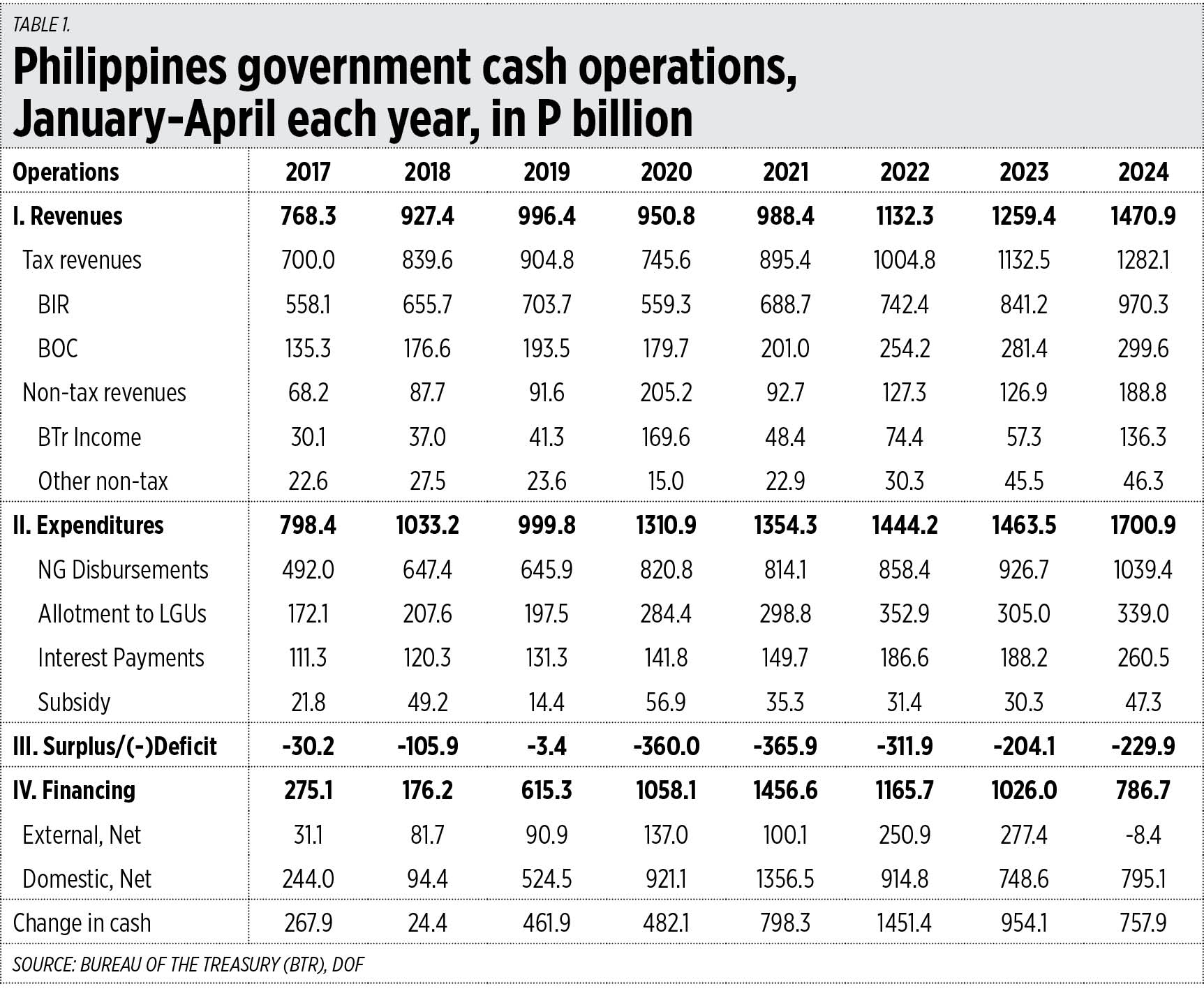
In the first four months of 2024, revenues reached P1.47 trillion, 17% higher than P1.26 trillion a year earlier. This is significant for two reasons. One, a high percentage increase despite no tax hike this year, better tax administration and higher nontax revenues. And two, the 17% revenue increase is twice as high as the 8.8% increase in GDP at current prices in the first quarter from a year ago.

But expenditures in January to April 2024 reached P1.7 trillion, 16% higher than P1.46 trillion a year earlier. So the budget deficit was P230 billion, 12.7% higher than P204 billion a year ago but 26% lower than P312 billion in 2022 and 37% lower than P366 billion in 2021.

Financing or borrowings in January to April 2024 was only P0.79 trillion, the first time it fell below P1 trillion since 2020. There was a big drop in foreign or external financing — P8 billion in 2024 vs P277 billion in 2023, which is a good development (see Table 1).

The jump in expenditure came from National Government (NG) disbursements and interest payment due to a high public debt stock and the high interest rate policy. Interest payment this year already reached P260 billion or twice the P131 billion in 2019. There is a need to significantly reduce the public debt level to save resources for social and infrastructure needs instead of diverting these to higher interest payments.

Related recent stories in BusinessWorld on the fiscal situation were “GOCC subsidies more than triple in April” (June 9), “LGUs to receive P1.034-trillion NTA in 2025” (June 16), “PHL gov’t should consider raising taxes, analysts say” (June 17).

In the last report where I was one of the quoted analysts, I argued that there is no need to raise taxes because there are short- to long-term sources of additional revenues. For instance, Finance Secretary Ralph G. Recto has raised the dividends that government-owned and -controlled corporations (GOCCs) should remit to NG to P100 billion in 2024 alone. Many of the GOCCs also raised their dividend payments to NG from a minimum 50% to 75%.

Better tax administration will also help control illicit trade and smuggling, especially of tobacco products. I elaborate on the privatization of several government land assets soon.

IMPROVING CREDIT RATINGS
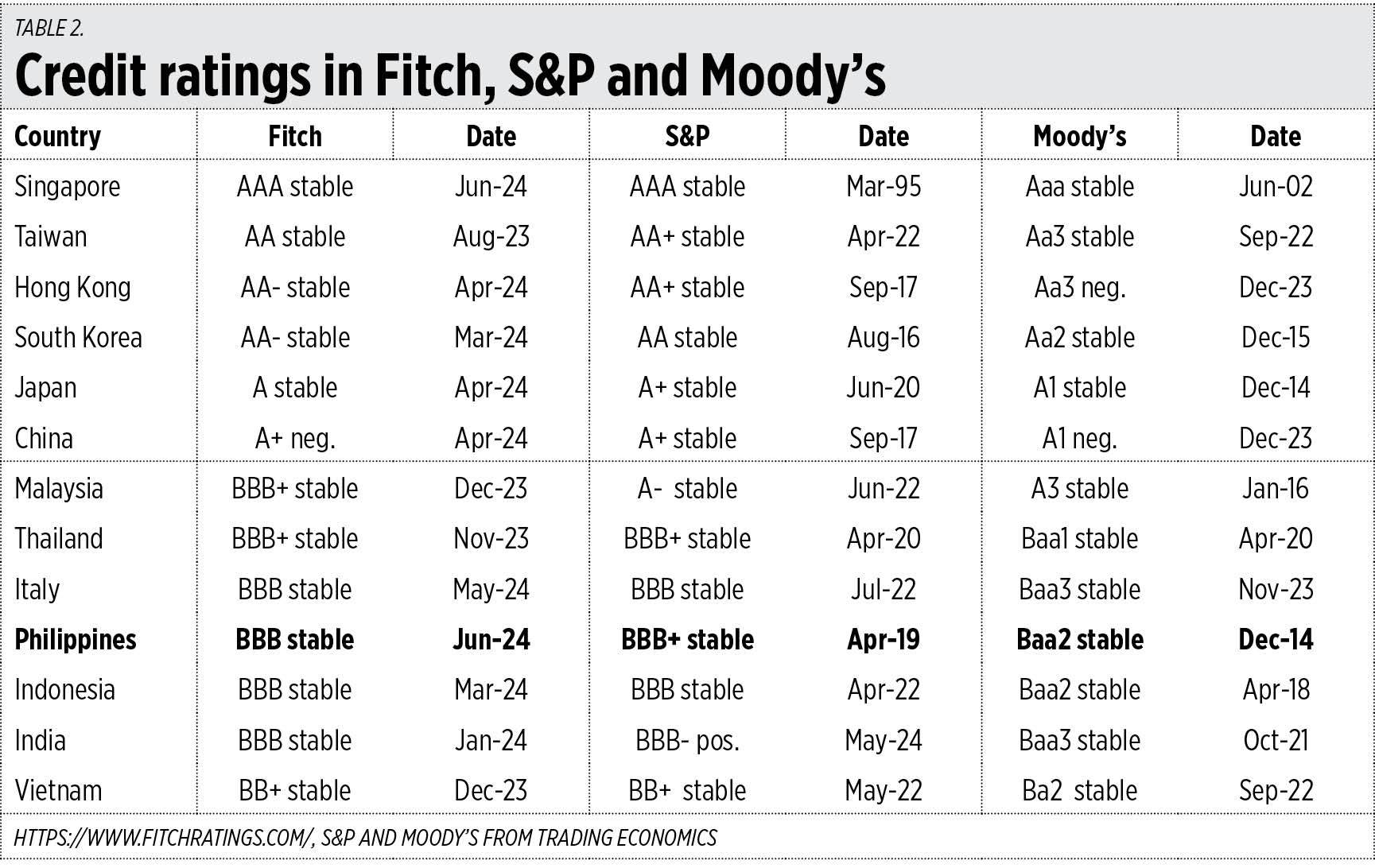
On June 7, Fitch ratings released a report where it affirmed the Philippines at ‘BBB’, with a stable outlook. This is good news. I checked other Asian economies in Fitch Ratings, and I added two other prominent rating companies — S&P and Moody’s. The Philippines is near “A” ratings and we may be able to overtake Italy and Thailand and be at par with Malaysia soon (see Table 2).

I particularly like this part in the Fitch report where they noted that “The Finance secretary has publicly indicated that no new taxes would be imposed in 2024, and possibly until the end of the Marcos Jr. administration in 2028. Nevertheless, we note that overall budget balances have tended to be close to the targets in recent history.”

There were three reports in BusinessWorld related to this — “Finance secretary wants to keep original revenue goals” (June 5), “Recto says Philippines still on track to achieve ‘A’ credit rating” (June 10) and “Banking industry outlook is ‘improving,’ says Fitch” (June 12).

Secretary Recto is correct in making an optimistic announcement that “this affirmation is highly encouraging as it shows a strong vote of confidence in our ability to grow the Philippine economy in a higher path over the medium term… We are on the road to an ‘A’ rating. A better credit rating will help us create more jobs and reduce poverty by 2028.”

Budget Secretary Amenah F. Pangandaman expressed the same optimism, saying that “It bears noting that Fitch cited the Philippines’ strong medium-term growth as one of the reasons for our rating. We hope to sustain our momentum for growth and keep our lead as one of the fastest-growing economies in Southeast Asia.”

On spot there, Mr. Recto and Madame Pangandaman. We just need to sustain high GDP growth of 6% or higher for several years while controlling borrowings so that the public debt/GDP ratio can be reduced and by extension, cut the budget deficit target of 3.7% of GDP by 2028. Productivity-enhancing budgetary spending like infrastructure should continue while wasteful spending like endless subsidies and freebies that lead to endless state dependence, war preparations and military and uniformed personnel pensions from the budget should be controlled.

In 2019, the debt-to-GDP ratio of the Philippines was only 37%, while Thailand had 41% and Malaysia had 57%. When the lockdown was imposed in 2020, their respective ratios jumped to 51.6%, 49.4% and 67.7%. By 2023, their respective ratios were 56.6%, 62.4% and 67.3%.

In average GDP growth from 2021-2023, the Philippines had 6.3%, Malaysia had 5.2% and Thailand had 2%. So in both reducing the debt-to-GDP ratio and raising overall growth, the Philippines had better performance than Thailand and Malaysia. From these two important metrics, the Philippines overtaking Thailand and being at par with Malaysia in credit ratings are a realistic and desirable trend.


Bienvenido S. Oplas, Jr. is the president of Bienvenido S. Oplas, Jr. Research Consultancy Services, and Minimal Government Thinkers. He is an international fellow of the Tholos Foundation.

minimalgovernment@gmail.com

AIA Philippines may roll out takaful, retirement products

AIA PHILIPPINES Life and General Insurance Co., Inc. is looking at offering takaful insurance in the country, an official said, although it will continue to prioritize health-related products, with the insurer also considering rolling out retirement plans.

“In the Philippines, we’re evaluating whether or not that’s (takaful) a category of business that we want to get into. There are larger value pools, larger segments, where we see more immediate opportunity to expand either distribution, proposition type, or target audience. Takaful is certainly something for us to consider. It’s sort of on the list,” AIA Group Chief Marketing Officer Stuart A. Spencer told reporters on Friday.

“But I’m not going to tell you it’s a priority here in the Philippines. It’s not. It is in places like Malaysia… where you have a majority Muslim population,” Mr. Spencer said, noting that the AIA Group has a takaful company in Malaysia.

Insurance Commissioner Reynaldo A. Regalado previously said the country’s first takaful insurance product may be sold within the year. Takaful is a type of Islamic insurance where members contribute a certain sum of money to a common pool. Takaful insurance needs to be compliant with Shari’ah law, which prohibits riba (interest), al-maisir (gambling), and al-gharar (uncertainty) principles.

For now, AIA Philippines is focusing on other product lines, specifically retirement and healthcare plans, Mr. Spencer said.

“Those are the two areas that today we see the greatest opportunity and where the group is spending most of its time to innovate,” he said.

For retirement plans, Mr. Spencer said AIA Philippines could consider tie-ups with nursing homes, nursing home planning, and emergency assistance.

“It’s about tapping people in their early 50s and late 40s who are pre-retirement that could develop a medical savings account, for example, to put money away to cover unforeseen medical events post-retirement when traditionally it’s very difficult to get insurance when you’re over the age of 65. So, we’re trying to get people to plan ahead, and everything that we’re doing has an ecosystem,” he added.

“The next is in health and healthcare — more medical products that are designed to be portable, you use them anywhere, and give you options in terms of the kind of provider that you want to see, and, with medical case management, to make sure that you get the right treatment, the right diagnosis, and you get the right return to recovery,” Mr. Spencer said.

The AIA Group is focused on “life, health, wellness, and long-term savings,” he said.

“We don’t like short-term savings. We like long-term savings in a long-term business. We are looking at new categories as well as how to best package and bundle products together to give customers more holistic solutions,” Mr. Spencer said. “We don’t just want to protect. We want to drive behavioral change that creates sustained habit formation that enables healthier long-term outcomes for our customers. So, you see, it’s much deeper than purely risk transfer.”

“We have a group-wide approach to make sure that all proposition development is designed to be customer-led, meeting target segments, understanding target segment needs, uncovering gaps, and then designing propositions to fill those needs,” he added.

AIA Philippines booked a premium income of P12.91 billion in 2023, while its net income was at P2.66 billion. — AMCS

PHL improves in 2024 Global Peace Index

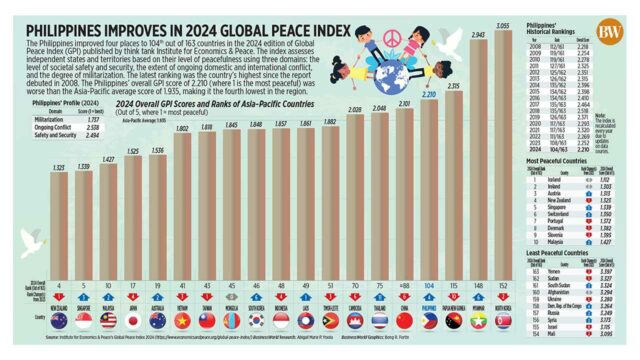
The Philippines improved four places to 104th out of 163 countries in the 2024 edition of Global Peace Index (GPI) published by think tank Institute for Economics & Peace. The index assesses independent states and territories based on their level of peacefulness using three domains: the level of societal safety and security, the extent of ongoing domestic and international conflict, and the degree of militarization. The latest ranking was the country’s highest since the report debuted in 2008. The Philippines’ overall GPI score of 2.210 (where 1 is the most peaceful) was worse than the Asia-Pacific average score of 1.935, making it the fourth lowest in the region.

PHL improves in 2024 Global Peace Index

Daniel Radcliffe, Jeremy Strong win Tony Awards

DANIEL RADCLIFFE in a scene from 2005’s Harry Potter and the Goblet of Fire.

THE TONY AWARDS for excellence in Broadway theater Sunday highlighted history with awards for a musical on the suffragette movement, a gritty remake of a book set in the 1960s and a tale of a 1970s rock band.

The ceremony took place for the first time at New York City’s Lincoln Center with Tony-nominated and Oscar-winning actress Ariana DeBose hosting the awards ceremony for the third year in a row, after presiding over last year’s writerless event with an elaborately choreographed dance number.

Shaina Taub won best score and best book of a musical for Suffs, the story of the suffragette movement, featuring an all-woman cast.

Stereophonic took the Tony Awards for best play and best direction for Daniel Aukin. David Adjmi’s play about a ‘70s-era rock band making an album, featuring original songs by Will Butler, formerly of Arcade Fire, broke the record for the most nominations for a play in Tonys history.

Succession star Jeremy Strong won best lead actor in a play for his role in the Henrik Ibsen play Enemy of the People, and Daniel Radcliffe, best known for his starring role in the Harry Potter movie franchise, won best featured actor for Merrily We Roll Along.

Will Brill beat out two other actors in his production, Stereophonic, for best featured actor in a play. Kara Young, who is the first Black actor, male or female, to be nominated for a Tony three years in a row, won the award for best featured actress in a play for her role in Purlie Victorious.

Justin Peck won the best choreography Tony for the dance musical Illinoise, which brought Sufjan Steven’s 2005 concept album Illinois to the stage.

Danya Taymor won for direction of a musical an adaptation of S.E. Hinton’s coming-of-age novel The Outsiders, upsetting favored Merrily We Roll Along actor Maria Friedman.

Dancers including DeBose, reviving her Oscar-winning role as Anita in Steven Spielberg’s film version of West Side Story, paid tribute to Broadway legend Chita Rivera, who died this in January at the age of 91.

During a pre-show event hosted by actors Julianne Hough and Utkarsh Ambudkar and streamed on the free platform Pluto TV, Tonys were awarded mostly in technical categories.

The pre-show included the award for best regional theater, which went to Philadelphia’s Wilma Theater, and the Isabelle Stevenson Award, which was awarded to Billy Porter for his work as an activist and spokesperson for the LGBTQ+ communities.

Director Jack O’Brien and writer, director and producer George C. Wolfe each received the 2024 Special Tony Award for lifetime achievement in the theater.

Special Tony Awards were also presented to Alex Edelman for his one-man show Just For Us, Abe Jacob for his work in sound design, and Nikiya Mathis for her wig design in Jaja’s African Hair Braiding. — Reuters

SEC halts Hasmadai, charges Silverlion Livestock for money laundering

THE Securities and Exchange Commission (SEC) has issued a cease-and-desist order against Hasmadai Foundation, Inc. and its officials for allegedly engaging in the sale and offer of securities without registration.

The order also covers other entities such as Humanitarian and Spiritual Mission Apostulates of Davao and Asia, Inc., and Humanitarian Institute of Technology Corp., the SEC said in an order posted on its website on June 14.

The SEC ordered its enforcement and investor protection department to serve the order to Hasmadai and other similarly named entities.

According to the SEC, Hasmadai reportedly offers securities in the form of “mission support” or “charity mission support pledge form” in which donors may pledge P5,000 to P20,000.

Hasmadai allegedly practices a scheme that involves the pooling of investments from the public.

“The funds collected by Hasmadai were ostensibly used to support its educational mission partnership, humanitarian livelihood, charity mission, and spiritual mission as proclaimed in its charity mission support pledge form. But in reality, the donations are actually utilized to pay the guaranteed returns in the form of monthly missionary allowance due to existing members, which, in turn, ensures its continued operation,” it said.

“Hasmadai’s unauthorized investment scheme promises donors guaranteed monthly spiritual medical assistance ranging from 27% to 34% of the donation,” it added.

The SEC said the entities have not registered any securities and have not filed an application for the registration or license to sell securities, which are required under Republic Act No. 8799, also known as the Securities Regulation Code.

It added that the entities are operating in various areas across the Caraga region.

“Hasmadai’s articles of incorporation shows that it is an independent religious society, a nonstock, nonprofit corporation with no sustainable income or viable source of capital that merely relies on the solicitation of donations from its members. It cannot possibly sustain the payment of returns that it guaranteed to, or is guaranteeing, to its members and the investing public,” the SEC said.

The SEC said the entities may file a verified motion to lift the order to the commission en banc within five days from receiving the order.

BusinessWorld reached out to Hasmadai through its social media pages but did not receive a response as of the deadline.

SILVERLION LIVESTOCK TRADING
In a separate statement on Monday, the SEC said it filed a second money laundering case against Silverlion Livestock Trading Corp.

The SEC and the Anti-Money Laundering Council (AMLC) filed a joint complaint against Silverlion Chief Executive Officer Ryan Cagod Ladoing on June 4 for violating Section 4(b) of Republic Act No. 9160, also known as the Anti-Money Laundering Act (AMLA).

Under Section 4(b), money laundering is committed by any person who, knowing that any monetary instrument or property represents, involves, or relates to the proceeds of any unlawful activity, converts, transfers, disposes of, moves, acquires, possesses, or uses said monetary instrument or property.

Fraudulent practices and other violations of Republic Act No. 8799, otherwise known as the Securities Regulation Code, are among the unlawful activities or predicate offenses to money laundering, under Section 3(i) of the AMLA.

“The complaint was filed after Mr. Ladoing was found to be in possession of more than P14 million in cash during the conduct of a consented search by operatives of the Philippine National Police Anti-Cybercrime Group, together with the SEC Zamboanga Extension Office in 2022,” the SEC said.

“The search was conducted following investigations by the SEC which showed that Silverlion was soliciting investments ranging from P5,000 to P100,000, with guaranteed earnings of up to 35% within 15 days. The group also offered a special promo involving the car of choice of any investor who locks in P400,000 worth of investment for 60 days,” it added.

In October 2023, the SEC and the AMLC filed a complaint against Silverlion and its other officials after it was found to be in possession of around P17.89 million of cash during the implementation of a search warrant in Silverlion’s offices in Zamboanga City.

Silverlion has not secured the license to offer investments to the public. It is registered with the SEC as a corporation.

 “Prior to the filing of the complaints, the SEC has revoked Silverlion’s corporate registration and issued a cease-and-desist order against the company and its officers, directors and agents,” the commission said. — Revin Mikhael D. Ochave

Base Bahay targets to build 400 homes in Negros Occidental this year

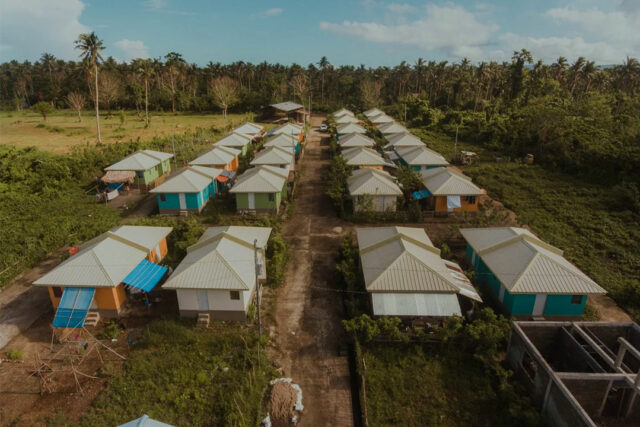
DON JOSE BERENGUER BAMBOO VILLAGE in Sorsogon. — BASE-BUILDS.COM

BASE BAHAY said it plans to construct at least 400 houses using bamboo technology by the end of 2024, primarily in Negros Occidental.

The organization has completed around 180 socialized houses, Base Bahay Head of Technology Luis Felipe Lopez said in an interview on June 7.

“The trend is showing that probably 300 to 400 is the number that we’re going to get in the Philippines,” he also said.

The organization, which has established six bamboo supply facilities nationwide, said it focuses on providing sustainable, disaster-resilient, and environmentally friendly homes to poor families and disaster victims.

These homes are built using cement bamboo frame technology (CBFT), a method where a bamboo framework is covered with a thin layer of cement cladding to prevent decay, it said.

CBFT is accredited by the National Housing Authority’s Accreditation of Innovative Technologies for Housing.

Bamboo walls are elevated by 30, 40, and 50 centimeters to prevent contact with floods, Mr. Lopez said.

“We have been doing projects even in Metro Manila; we have 50 houses in Quezon City, in Bagong Silangan,” he added.

He said that the beneficiaries of The Bagong Silangan Kawayan Housing’s 25 single-story duplex units are families who previously resided in a dump site in Payatas and include members with disabilities.

“We have a livelihood component because they have a piece of land. They are producing vegetables for the food of all the families and the talipapa we built there also is to sell the excess of those vegetables,” he added.

Base also built houses for those affected by Typhoon Yolanda in the Visayas.

“The main idea is to build these houses maintenance-less. You don’t require any special maintenance, at least for the first 10 years. And then after 10 years, it’s the minimum maintenance as any conventional house,” Mr. Lopez said. — Aubrey Rose A. Inosante

Singapore-washing has hit a wall

MIKE ENERIO-UNSPLASH

CAN private wealth management hubs stay neutral and discreet in an increasingly polarized world? Private banks in Zurich lost some of their shine after Switzerland decided to adopt the European Union’s sanctions against Russia in 2022 over the war in Ukraine. Singapore, long a haven for the super wealthy, is about to find out.

A recent S$3-billion ($2.2 billion) money-laundering scandal is putting the island-state on the back foot. It’s forcing the government to ask if the sharp influx of new money is too hot to handle.

Call it Singapore-washing. Chinese companies have been moving to the Southeast Asian nation to sidestep US-China geopolitical tensions. Some are also running away from President Xi Jinping’s “common prosperity” drive. Between 2019, when this trend started to pick up, and 2022, direct investment from China grew by more than one-third. Fast-fashion e-commerce unicorn Shein Group Ltd., aiming to go public at an above $60-billion valuation, is now headquartered in Singapore. So is Hillhouse Investment, best known for backing some of China’s biggest tech startups.

It’s been a boon for Singapore, especially the banks. In 2022 alone, the country attracted S$435 billion in new money, or about 70% of its gross domestic product. DBS Group Holdings Ltd.’s private banking franchise, for instance, is flourishing. In the first quarter, its fee income rose 23% year on year to a record S$1 billion, led by a 47% increase in wealth management fees. Its shares have risen by a third over the last year, outperforming Hong Kong-listed HSBC Holdings Plc.

After the global financial crisis, stringent capital requirements have made wealth management — till then a sleepy backwater — a bank’s crown jewel. Managing money for the rich doesn’t come with the typical credit or market risks associated with investment banking.

The one risk involved, though, is reputation. Unlike the 1MDB scandal, which got Goldman Sachs Group, Inc. into trouble, this time, the entire Singapore brand — its private banking industry as well as money-laundering regulations — is being judged. After all, a full suite of banks, not just one or two, got caught up in the recent case. A group originally from China laundered billions of dollars in proceeds from online gambling through more than a dozen banks in Singapore.

With its image at stake, Singapore is now ramping up scrutiny of family offices — a broad, opaque, unregulated subset space of private wealth. It’s also nudging banks to step up due diligence to avoid exposure to illicit flows. In April, the central bank launched a new digital information sharing system, allowing financial institutions to share client data and raise red flags.

These days, launching family offices with tax exemptions is taking a lot longer in Singapore. So is opening private banking accounts. Chinese that carry “golden” passports from countries including Turkey and Saint Kitts and Nevis in the Caribbean are seen as warning signs.

Singapore-washing is just a new iteration of an old problem — the city was once referred to as Indonesia’s money laundromat. Wealthy Southeast Asians, some with questionable connections, parked their money there. Singapore-based entities at one point were the third-largest source of weapons materials to the Myanmar military. But it has taken new Chinese money to put the issue in the international spotlight. After all, China is much bigger. The sheer scale and speed of fund flows from there force Singapore to address weaknesses in its financial system.

To be sure, as a small, open economy, Singapore is structurally exposed to money laundering, especially if it wants to develop wealth management. In 2022, it had S$4.9 trillion of assets under management, many times over its GDP. Only 24% of these funds were sourced domestically, and 88% were invested into assets outside of Singapore. The question is how much the government wants to examine the money that comes in and goes out. More scrutiny would set back the growth of its banks.

Being a glitzy global financial center has a lot of appeal. Prestige aside, a booming banking industry boosts employment, the local economy, as well as real estate values. But then compliance is also a big headache. Dubai has decided to welcome all shades of gray, making itself a playground for crypto and Russian billionaires. Singapore, it turns out, still cares about its reputation. Singapore-washing has finally hit a wall.

BLOOMBERG OPINION

Dutch lender ING targets annual income growth of 4-5% from 2024 to 2027

ING is targeting total income growth of between 4% and 5% per year in 2024 to 2027, the largest Dutch lender by assets said in a statement on Monday ahead of its capital markets day event.

The group, which has a market capitalization of €52.8 billion ($56.51 billion), said it is also aiming for fee income of €5 billion and a return on equity of 14% over the same period.

ING, whose operating arm ING Bank provides banking services in more than 40 countries, said it would continue focusing on expanding its retail business. It aims to have risk-weighted assets (RWA) in the sector of 50% to 55% by 2027. The group added it would prioritize local scale in retail banking and build wholesale banking as a separate pillar.

In the first quarter, ING saw an income increase from its retail banking unit, boosted by higher fee income for both daily banking and investment products.

The bank announced it aimed to deliver €1 billion of additional fee income by 2027, notably through growing its customer base.

ING said it expects the inflationary impact to exceed headline inflation due to delayed effects of collective labor agreements. Regulatory costs in 2025 are expected to be flat compared with 2024 and, as of 2026, to grow in line with deposit volumes. — Reuters

ADVERTISEMENT
ADVERTISEMENT