Home Blog Page 3053

Arts & Culture (06/26/24)


CAST PH presents Patintero sa Ayala Avenue

FOR the midyear, CAST PH, best known for its staged readings, is bringing the soul-searching play Patintero sa Ayala Avenue to the stage. In an intimate setting, it will tackle grief and acceptance amid an audience of at most 90 people. Shows will be on June 29 and July 6 at 7:30 p.m. and on June 30 and July 7 at 3 and 7:30 p.m., at the Mirror Theatre Studio on the 5th floor of SJG Centre, Kalayaan Ave., Poblacion, Makati City. Tickets cost P550 per seat, on a first-come first-served and free seating basis. They can be purchased through https://bit.ly/PatinteroTix.


Exhibit on anting-antings opens in San Juan

AN exhibit titled “The Enchantment of Anting-Antings in the Philippines” is the latest to provide an immersive experience of Filipino culture. The talismans on display are from the collection of Melvin Lam, put together by the Ortigas Foundation Library. The exhibit is now open at the library, which is found at the 2nd floor or the McKinley Bldg. above Unimart on Club Filipino Ave., Greenhills Shopping Center, San Juan. It runs until Aug. 26 and is accessible from the new Greenhills Mall, with free entrance to the public.


Floy Quintos’ Grace gets a rerun

JUST as the run of Floy Quintos’ final play, Grace, ends, a rerun is scheduled for September at Arete, Ateneo de Manila University, in Quezon City. Directed by Dexter M. Santos, the play is based on a religious controversy in 1948, the true story of Sr. Teresita “Teresing” Castillo who claimed that the Virgin Mother appeared to her in a convent in Lipa, Batangas. The rerun will be from Sept. 6 to 16. Details regarding tickets will be announced soon.


INKfest 2024 welcomes children at Ayala Museum

AS part of Ayala Museum’s 50th anniversary celebration, INKfest 2024 invites children to explore storytelling, art, and illustrations, in partnership with Ang INK. It will be held on June 30, which also doubles as a free admission day for children and their families. The event recreates the museum’s dioramas by members of Ang INK, with the aim of making Philippine history more accessible and engaging for children while also fostering a deeper love for country through art. INKfest will also feature a wide range of activities such as reading and drawing sessions, craftmaking, coloring, and foiling. Pre-booking of slots is required, on a first-come, first-served basis through Ayala Museum’s social media pages.


PHL College of Surgeons raises funds through art

THE Philippine College of Surgeons (PCS) is holding an exhibition titledOperart,” a showcase merging the worlds of art and medicine. It takes place at the Pintô Art Museum and Arboretum in Antipolo, Rizal. Both emerging and established artists provided an array of artworks that explore the intersection of creativity and healing, with the goal to raise awareness and support for the PCS’ surgical mission program. There will also be a silent auction highlighting the works of esteemed masters, including National Artist Benedicto “BenCab” Cabrera, Elmer Borlongan, and Ferdie Montemayor. It will be held on June 30 at the Pintô Art Museum, 1 Sierra Madre St., Grand Heights Subdivision, Antipolo City.


A comic to combat piracy

THE Intellectual Property Office of the Philippines, together with the National Book Development Board, is widening the public’s access to Pirated Inferno, a comic book by artist Manix Abrera. Five thousand copies of the comic were previously published under the interagency National Committee on Intellectual Property Rights, as part of an anti-piracy information campaign among Filipinos, especially the youth. The online version of the comic book was released in 2023 during that year’s Philippine Book Festival. Online readers can enjoy it for free through this link: https://www.ipophil.gov.ph/national-committee-on-intellectual-property-rights-ncipr/pirated-inferno-anti-piracy-comic-book/.


Lea Salonga, Dolly de Leon to return to the stage

TWO acclaimed Filipino theater actresses will return to the craft in Request sa Radyo this October. Tony and Olivier award winner Lea Salonga and Golden Globe and BAFTA nominee Dolly De Leon will take on Franz Xaver Kroetz’s landmark theatrical piece that captures the poignant solitude of a woman through her meticulous evening routine. The limited engagement will be from Oct. 10 to 20 at the Samsung Performing Arts Theater in Circuit Makati. Produced by Clint Ramos, Bobby Garcia, Christopher Mohnani for Ayala Land, and GMG Productions, Request Sa Radyo transforms the mundane into an exploration of isolation and the human condition. Ticket information can be found at requestsaradyo.com.


Beatles art exhibit, band shows open to the public

“THE Mystery Magical Trip,” a creative exhibition and set of musical performances, is coming to Manila. Inspired by The Beatles’ album and film Magical Mystery Tour, it will feature a psychedelic and whimsical journey as created by John Lennon, Paul McCartney, George Harrison, and Ringo Starr. The exhibit includes hand-made colorful costumes, scenic paintings, video projections, black light corners, and high-contrast sensory stimulators, with a concert headlined by Filipino local artists MoonDream City and Friends. “Mystery Magical Trip” is free and open to the general public on July 1 from 6 to 8 p.m., on July 2 and 4 from 11 a.m. to 5:30 p.m., and on July 5 from 11 a.m. to 2 p.m. It will be presented at the 6th Floor Blackbox Theater of the Design + Arts Campus of the College of St. Benilde, 950 Pablo Ocampo St., Malate, Manila.
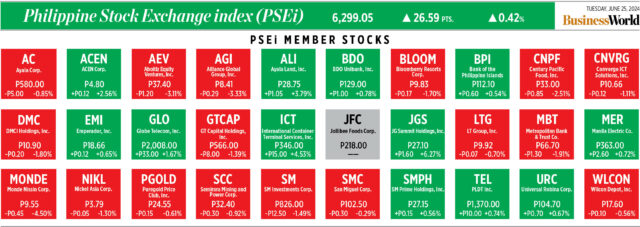
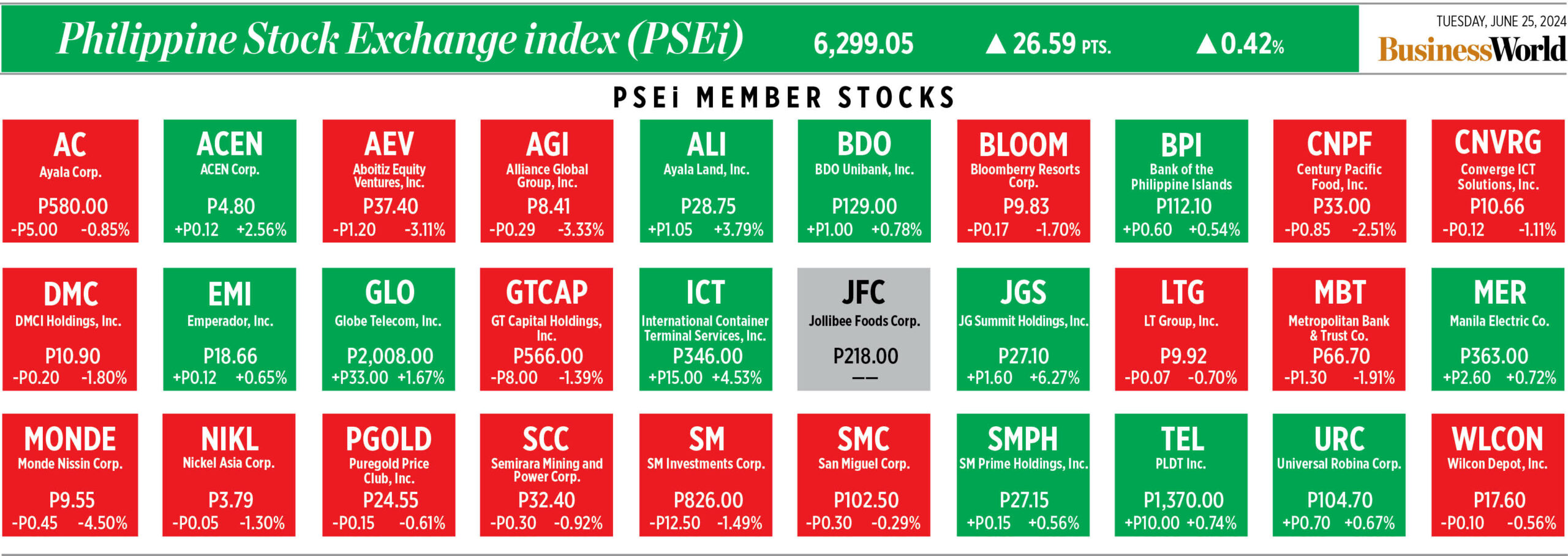
PSEi member stocks performed — June 25, 2024

Here’s a quick glance at how PSEi stocks fared on Tuesday, June 25, 2024.


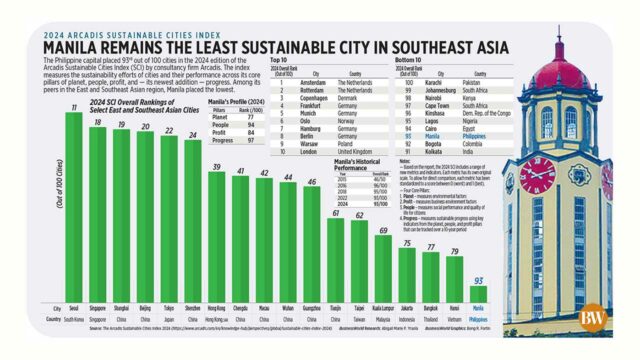
2024 Arcadis Sustainable Cities Index: Manila remains the least sustainable city in Southeast Asia

The Philippine capital placed 93rd out of 100 cities in the 2024 edition of the Arcadis Sustainable Cities Index (SCI) by consultancy firm Arcadis. The index measures the sustainability efforts of cities and their performance across its core pillars of planet, people, profit, and — its newest addition — progress. Among its peers in the East and Southeast Asian region, Manila placed the lowest.

2024 Arcadis Sustainable Cities Index: Manila remains the least sustainable city in Southeast Asia — report

DA to back tariff hike once rice prices fall to P42-45

PHILIPPINE STAR/EDD GUMBAN

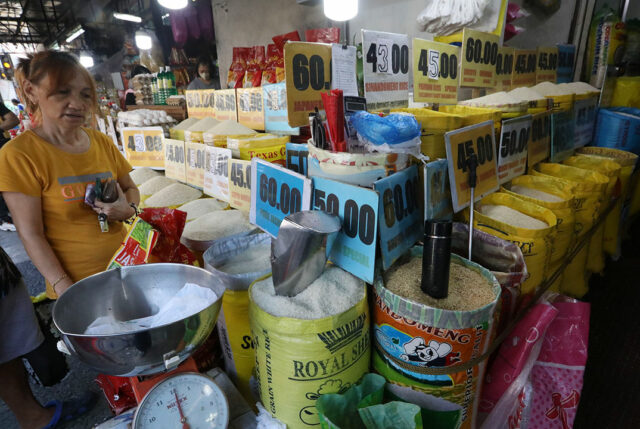
THE Department of Agriculture (DA) said it will propose to raise rice import tariffs once the price of the staple grain falls to about P42-45 per kilogram, according to the Agriculture Secretary Francisco P. Tiu Laurel, Jr. on Tuesday.

“The review will suffice to make sure that in case na bumaba na ’yan at masaya na ’yung consumers ng konti then maybe pwede na natin itaas ulit ang tariff (if prices fall to the satisfaction of consumers, then maybe we can raise tariffs again),” Mr. Laurel said at a forum organized by the Philippine Chamber of Commerce and Industry.

According to DA’s price monitors, imported well-milled rice in Metro Manila markets sold for between P42 and P55 per kilo, while regular milled rice was at P48 to P51.

Executive Order (EO) No. 62 formalized the reduction of rice tariffs to 15% from 35% until 2028. The EO is set to take effect on July 6, the 15th day after its publication.

The order calls for a review of the tariff every four months to adjust to changes in global prices and supply.

“By November, we hope, the price of rice on the world market will go down a bit. India is expected to increase its rice exports. So, there is a chance that the review will happen before the end of the year.”

The Indian government last year banned on non-basmati white rice exports, citing the need to safeguard domestic supply.

In May, the Board of the National Economic and Development Authority approved a plan to lower tariffs on industrial and farm goods, including the further reduction of rice import tariffs, as part of a broader inflation-containment plan.

“We’re not saying that we will just abandon the farmers, we have a program for providing more inputs to farmers,” he said.

Farmers’ groups have signaled their opposition to the reduced tariffs, citing the resulting pressure on farmgate prices as traders opt to deal in imports rather than domestic rice. — Adrian H. Halili

Port fees a small part of logistics costs — PPA

PHOTO COURTESY OF ICTSI

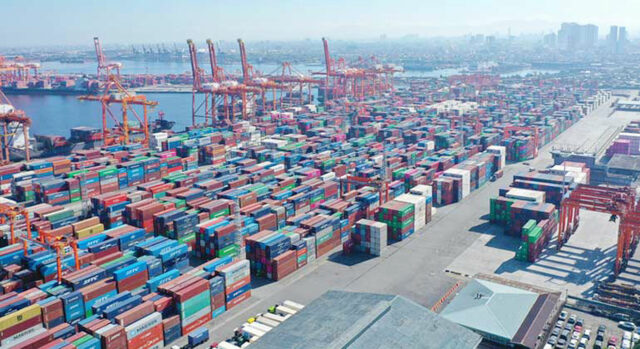
THE Philippine Ports Authority (PPA) said late Monday that port fees remain a minor component of logistics expenses, and an increase in the charges cannot be blamed for any “blow up” in logistics costs.

“Storage fees at ports remain low… with taxes and shipping costs getting most of the share for every container on the move,” the PPA told BusinessWorld via Viber.

Citing a $7,600 container shipped from China to Manila as an example, the PPA said that the total logistics cost of the container may blow up to $50,000 because of customs charges (40%), shipping costs (36%), trucking costs (16%), and terminal operator and port authority costs (8%).

“That is almost 50% of the additional charges from the small container. Maritime transportation, customs clearance, inland logistics, and port charges are among the burdens for consumers,” the PPA said.

Transportation and logistics costs are the key expenses between production and sale, the PPA said.

The PPA said that a top concern for businesses, more than the storage fees, are container deposits, which are charged by shipping lines against truckers, customs brokers, and forwarders.

“(These) have been the decade-old problems for every cargo shipment, which usually costs P10,000 up to P30,000 for dry containers and up to P180,000 for refrigerated containers,” it said.

“Port fees remain the lowest of the charges; there are many hidden logistics costs added, mostly from all of the expenses incurred by moving the product and mostly the unregulated charges by the shipping lines,” it added.

PPA was responding to the Philippine Exporters Confederation, Inc. (Philexport) call to exporters to brace for a 16% increase in cargo handling fees at Manila ports.

According to Philexport, the increase at the Manila South Harbor and the Manila International Container Terminal was confirmed through a letter sent by PPA Manager for Commercial Services Mark Jon S. Palomar in response to a petition to defer tariff hikes until the industry has recovered.

The increase, which is said to be based on the consumer price index adjustment factor from 2020 to 2023, will be executed in two tranches no earlier than Aug. 5.

The first tranche will involve a 10% increase in cargo handling fees, while the second tranche will involve a 6% increase that will be implemented six months after the initial increase takes effect.

The export group has been opposing any cargo handling rate increases at Philippine ports, including the 32% increase in storage charges for foreign containers that was implemented in January.

The proposed increase due in August was also opposed by Philippine Chamber of Commerce and Industry Chairman George T. Barcelon, as importers and exporters are already being challenged by the increase in shipping costs caused by geopolitical uncertainty in the Middle East.

“I don’t think it would be prudent for them to increase… Maybe this is not the right time because businessmen are already having challenges,” Mr. Barcelon said. — Justine Irish D. Tabile

BIR sets verification rules for low-risk VAT claims

BW FILE PHOTO

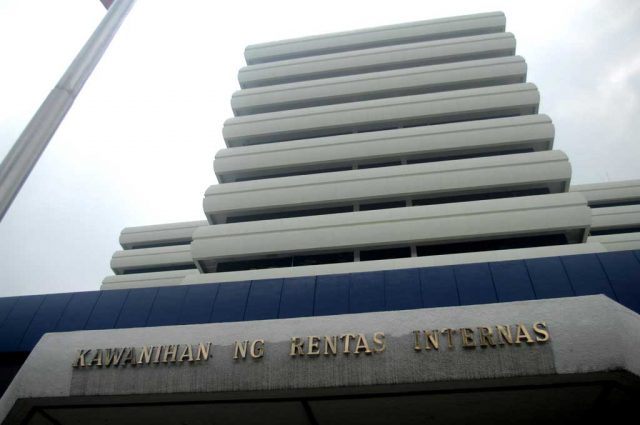
THE Bureau of Internal Revenue (BIR) said in new guidelines that it will require only minimal verification of value-added tax (VAT) refund claims classified as low risk.

In a memorandum order, the BIR said: “Processing of VAT refund claims classified as low risk shall be limited only to the checking of the authenticity and completeness of documentary requirements,” it said.

“Verification procedures for sales of goods and services as well as purchases and input tax shall no longer be performed,” the BIR added.

In the order, the BIR said revenue officers (ROs) handling VAT refund claims will be made to document their risk classification decisions.

“The assigned ROs of the VAT refund claim shall include in their respective working papers the matrix on how the risk level of the VAT refund claim was determined, providing justification and supporting documentation, if any,” it added.

The risk classification process employs a points system that considers the amount involved in the claim; the frequency of claims filed; the claimant’s tax compliance history; as well as other factors deemed to constitute risk.

The Ease of Paying Taxes Act, signed into law in January, introduced the risk-based approach to evaluating VAT refund claims, with claimants classified as low, medium, or high risk.

Medium-risk claims require the verification of at least 50% of the sales amounts and 50% of total invoices/receipts issued including inward remittances and proof of VAT zero-rating.

Claims in this category must also undergo verification of at least 50% of the total amount of purchases on which input VAT was claimed, and of 50% of suppliers with priority on “big-ticket” purchases.

Meanwhile, high-risk claims require 100% verification for both sales and purchases.

VAT refund claims that are automatically considered high risk include those claims filed between April 27, 2024 and June 30, 2024; those filed by first-time claimants, who will be treated as such for the succeeding three claims; and claims in which the claimant cannot be located, among others.

“Other cases may be considered high-risk claims as determined by the Commissioner of Internal Revenue based on reasonable criteria,” it added. — Luisa Maria Jacinta C. Jocson

Singapore firms agree to advise on operations of Clark food hub

THE Clark International Airport Corp. (CIAC) said on Tuesday that it has entered into a technical assistance agreement with Singapore companies specializing in agricultural financing, sourcing and procurement to assist in setting up the proposed National Food Hub.

In a statement, the CIAC identified the companies as a unit of Food Starter Pte. Ltd., an agricultural financing and farm incubator group, and the World Food Chain Pte. Ltd., a global food procurement company serving food and beverage businesses.

“This most recent memorandum of understanding (MoU) advances our efforts to start developing a food hub ecosystem aggregator that will ensure sustainable food security solutions,” according to Arrey A. Perez, president of CIAC.

“The partnership is the right move at the right time, as it guarantees a modernization of the national food hub, and that we’ll be able to address key challenges in its operation, maintenance, and sustainability,” he added.

The CIAC is planning to build the 62-hectare Clark National Food Hub project, which is estimated to cost P8.5 billion.

It aims to establish modern agro-logistics systems, raise food safety standards, and provide opportunities for Philippine farmers and fishermen.

According to Mr. Perez, its partners, under the MoU, will provide technical and advisory assistance on transport, trade and warehousing.

The food hub is part of the Public Investment Program for 2023–2028, having been approved by the National Economic and Development Authority.

To be located near the Clark International Airport, the hub will have easy access to cargo companies such as FedEx and UPS, major road networks, and an upcoming cargo railway. — Justine Irish D. Tabile

Biodiesel demand may buoy coconut industry

CENTURYPACIFIC.COM.PH

THE Philippine Coconut Authority (PCA) said it expects demand for coconut products to be stimulated by its use in biodiesel blends and as a possible component in aviation fuel.

“With our projections and when we also talked with market stakeholders, they’re positive there will be an increase,” PCA Administrator Dexter R. Buted told reporters on Tuesday.

“We committed to the Department of Energy (to raise the biofuel blend) from B1 to B3 this October. The contribution of the PCA is 1 billion coconuts for the increased use of Coconut Methyl Ester,” he added.

Biofuel blends are numbered by the share of the non-diesel material in the fuel, with the B3 blend indicating 3% coconut content.

The DoE has ordered oil companies to increase their coco biodiesel blend by October. The government plans to increase the biodiesel blend to B5 in the next three years.

The US Department of Agriculture (USDA) reported that El Niño could dampen coconut oil exports due to declining production.

Exports are projected to drop to 900,000 metric tons during the 2024 to 2025 market year, from 1.14 million MT the prior year.

However, Mr. Buted said that coconut production may increase 3% to 5% this year.

Last year coconut production fell to 14.89 million MT from 14.93 million MT in 2022, according to the Philippine Statistics Authority.

He added that the PCA’s replanting project could revive production as old trees give way to new ones.

He said that the country’s coconut trees are now 60 to 70 years old on average, “so we need to replace these trees.”

The Palace has tasked the agency with planting 100 million coconut trees, with a target to plant about 8 million this year.

Mr. Buted said that the PCA is also seeking P2.4 billion to increase the productivity of coconut trees. — Adrian H. Halili

South Korea to be tapped for solar rice dryer partnership

INTERNATIONAL RICE RESEARCH INSTITUTE

THE Department of Agriculture (DA) said that it is planning to develop solar-powered rice dryers in partnership with the Korea Agricultural Machinery Industry Cooperative (KAMICO).

In a statement on Tuesday, the DA said that solar dryers could fill the gaps in the National Food Authority’s capacity to process palay, or unmilled rice.

“This development is critical as the National Food Authority faces significant gaps in drying capacity, particularly during the wet season, with upgrade plans falling short of national requirements,” it said.

The DA added that the NFA’s drying capacity is expected to rise to 180,000 metric tons (MT) as a result, though this remains well short of the required 495,000 MT.

The DA also pressed KAMICO to pursue its plans to establish the Korea Agriculture Machinery Complex (KAMIC) in the Philippines.

Earlier, the DA said it will seek to establish an agri-machinery plant in Nueva Ecija or Quezon.

“Products imported under the KAMIC project will benefit from favorable tariff arrangements under CREATE Law which will further bolster the projects economic viability,” it added.

Agriculture Secretary Francisco P. Tiu Laurel, Jr. said that incentives under the CREATE Law, including exemptions from local taxes and business permits for a specified period plus incentives outlined in the Strategic Investment Priority Plan of 2022. — Adrian H. Halili

Congress think tank calls for review of rice fund use

PHILIPPINE STAR/EDD GUMBAN

LEGISLATORS need to review the use of government funds supporting the development of the rice industry in light of its weak productivity growth, a Congressional think tank said.

“The numbers suggest that the (Rice Tariffication Law) has, thus far, not shifted the growth trajectory of the Philippine rice industry upwards,” the Congressional Policy and Budget Research Department (CPBRD) said in a study.

Republic Act (RA) No. 11203 or the Rice Tariffication Law of 2019 created the Rice Competitiveness Enhancement Fund (RCEF), which takes money generated from rice import tariffs to fund modernization projects such as mechanization, the supply of superior seed, and rice cultivation know-how to farmers. 

The Department of Agriculture (DA) estimates that RCEF aid to farmers between 2020 and 2024 totaled P50 billion. Overall government support for the industry has amounted to P156.29 billion since 2019.

“The freer importation of rice, however, has kept rice prices relatively stable — to the benefit of consumers and to the detriment of producers,” CPBRD said.

The Philippines is expected to be the top importer of rice next year, the US Department of Agriculture said, with a projected 4.2 million metric tons worth of shipments.

The CPBRD also noted that the farmgate price of rice dipped shortly after the implementation of the Rice Tariffication Act but have remained elevated since 2020. 

“This suggests that the conversion and transportation costs associated with palay processing have remained largely steady in the quarters after the enactment of the RTL; and the RTL and the RCEF have not induced a long-lasting effect on rice price dynamics,” it said.

Federation of Free Farmers National Manager Raul Q. Montemayor also cited the need to review RCEF utilization alongside extending is effectivity. It had originally been intended to run for six years when the law was passed in 2019.

“One important lesson is that assistance to farmers must not be piecemeal and should instead be a coordinated package of support. Also, the array of services should be location specific to address the needs of farmers in a locality,” he said via Viber.

He said the government’s decision to lower rice tariffs to 15% from 35% could dry up the funds available for the RCEF, which by law receives P10 billion a year from tariffs.

On Monday, National Economic and Development Authority Secretary Arsenio M. Balisacan said the new 15% tariff on rice imports is the optimal rate to ensure farmers are protected.

Mr. Montemayor said tariffs should be set with farmer incomes as a major consideration.

“For the optimal rate, we should base it on a target level of income for our rice farmers. Then we compute the market price for palay, given average yields/hectare, that will result in the desired income level,” he said.

“From there, we determine the tariff level at which imported rice will land at a price equivalent to the target palay price.” — Beatriz Marie D. Cruz

South Cotabato IT park expected to start commercial operations by 2026 — PEZA

AN information technology (IT) park in South Cotabato is expected to launch commercial operations by 2026, the Philippine Economic Zone Authority (PEZA) said on Tuesday.

PEZA announced the signing of the registration agreement for the Tupi IT Park last week.

Tupi IT Park was proclaimed a special economic zone by President Ferdinand R. Marcos, Jr., through Proclamation No. 530 on May 2.

The proclamation identified the IT park site as a 15,000 square-meter lot in Barangay Poblacion, Tupi, South Cotabato.

“We are confident that with the proclamation of new ecozones outside of Luzon, such as the Tupi IT Park, we will be able to spur countryside development and achieve our goal of eco-zoning the country towards inclusive and sustainable development,” PEZA Director General Tereso O. Panga said.

According to PEZA, the land development phase of the Tupi IT Park will cost P80.5 million. Construction started in June 2017 and will be completed by January 2026.

The economic zone has received interest from potential IT locators, PEZA said, including a first locator intending to invest P15 million for an operation involving about 600 employees.

Separately, PEZA reported that at least five Japanese companies expressed interest in investing in the Philippines during a visit to Japan between June 17 and 21.

According to the investment promotion agency, its third investment mission in Japan has resulted in at least five FDI leads that are now in the due diligence stages.

“These specific activities include the manufacturing and assembly of jet bridges, smart parking structures, and submersible pumps for wastewater treatment; as well as proposals for, digital health back-office support operations, solar energy, agro-processing, and food export cargo logistics,” PEZA said.

According to Mr. Panga, its 805 Japanese registered business enterprises (RBEs) remain PEZA’s leading long-term investors, accounting for 28% of approved ecozone investments.

As of 2023, PEZA’s Japanese RBEs accounted for more than P500 billion in investments, $16 billion in exports, and 300,000 direct jobs. — Justine Irish D. Tabile

Aquaculture, livestock permits set for easing

BRUCE WARRINGTON-UNSPLASH

THE Department of Agriculture (DA) said it is seeking to streamline the permit process for aquaculture and livestock projects as a means of attracting more private-sector investment.

Agriculture Undersecretary for Policy, Planning and Regulations Asis G. Perez told reporters that one of the possible outcomes of the streamlining could be lower food prices.

“The requirement is that the government should streamline everything because that adds up to the cost,” Mr. Perez said.

The streamlining exercise, which he estimated will take eight months, will also form part of the DA’s compliance with the Ease of Doing Business Law.

He said that aquaculture farms take years to obtain approval from government agencies and local government units.

Mr. Perez added that one of the other factors hindering livestock and poultry investment is the shortage of land. “We have to develop a policy that set aside lands that will be devoted to specific areas for development,” he said. — Adrian H. Halili

ADVERTISEMENT
ADVERTISEMENT