Home Blog Page 303

Portugal floods take out major highway, force evacuation of 3,000 residents

STOCK PHOTO | Image by Hermann Traub from Pixabay

COIMBRA, Portugal — Part of Portugal’s main motorway collapsed on Wednesday night after a levee broke underneath amid heavy rain and flooding that have been battering the country for weeks, as authorities evacuated about 3,000 residents in the northern area.

One of the levees on the River Mondego near the medieval city of Coimbra burst next to one of the pillars sustaining the A1 highway that connects the cities of Lisbon and Porto, causing a gap to form in the road that had been shut by police earlier, said Coimbra Mayor Ana Abrunhosa.

“Coimbra and surrounding towns have very serious problems due to floods, some are isolated… The situation is extremely unstable,” she told national broadcaster RTP.

Prime Minister Luis Montenegro told reporters earlier authorities were “at the limit of our capacity to contain these waters”.

A succession of deadly storms has hammered mostly central and southern parts of the country since late January, blowing roofs off houses, flooding several towns and leaving hundreds of thousands without electricity for days.

At least 15 people have died as a consequence of the storms, including indirect victims.

Mr. Montenegro was in Coimbra overseeing the emergency response after Interior Minister Maria Lucia Amaral resigned following criticism from opposition parties and local communities over what they described as the authorities’ slow and failed response to devastating Storm Kristin two weeks ago.

As the storms let up this week, a weather phenomenon known as an “atmospheric river” – a wide corridor of concentrated water vapor carrying massive amounts of moisture from the tropics – brought new downpours, affecting the north to a greater extent.

RISK OF DAM OVERFLOWING
Municipal authorities in Coimbra ordered the precautionary evacuation late on Tuesday of around 3,000 people most at risk from the river bursting its banks. The operation was still under way on Wednesday, with police making door-to-door checks and bussing residents to shelters.

Regional Civil Protection official Carlos Tavares said the rain could cause the Aguieira dam, 35 kilometers northeast of Coimbra, “to overflow, sweep away levees and trigger further flooding”.

Portugal’s environment agency APA expected an “exceptional period of peak flows” on the Mondego through Saturday.

Part of Coimbra’s ancient city wall, on a hillside in one of Europe’s oldest university towns and a UNESCO World Heritage Site, collapsed, shutting the road below and forcing the closure of the municipal market, the city hall said.

In central Portugal, just across the River Tagus from Lisbon, authorities evacuated the village of Porto Brandao due to the risk of landslides. Around 30 people were removed from their homes after a landslide in the neighboring beachside area of Caparica.— Reuters

Catholic leaders push calls against corruption, dynasty

Church leaders and other civil society organizations in a press briefing for the Trillion Peso March Part 3. — ALMIRA S. MARTINEZ

Catholic leaders pushed their calls to end corruption and political dynasties on Wednesday, as they prepare for the Trillion Peso March Part 3, coinciding with the 40th anniversary of the EDSA People Power Revolution.

The call comes after President Ferdinand R. Marcos Jr. and leaders of the House and Senate identified 21 priority bills, including the Anti-Political Dynasty Act, at the 3rd Legislative Executive Development Advisory Council (LEDAC). The priority legislative measures are expected to be passed by June this year.

“What’s so special about this celebration is the two causes – against corruption and against the dynasty,” Clergy for Good Governance Robert Reyes said in a briefing.

“I challenge all dynasties that love the country, do not run in 2028. Let someone, not related to you, not a business partner, let your province decide how the province will become better,” he added.

Although the march pivots on an anti-corruption and anti-dynasty movement, Caritas Philippines Executive Director Carmelo A. Caluag noted that the church’s principle still has “respect for the rule of law and respect for the Constitution.”

“That’s why we did not include calls to resign all, or revolutionary government, or transition policy because there are other major means to hold them accountable,” he said in Filipino.

Buhay ang People Power Campaign Network (BAPP) Convenor Kiko Aquino Dee added that the rally’s advocacies remain grounded on the 1987 Philippine Constitution.

“I know there are many different interpretations for things like transition council and others that I think Bayan is advocating,” he said. “At this time, I think we’re not ready to share the stage of that when that’s not yet that clearly defined.”

Caritas Philippines, the social action arm of the Catholic Bishops’ Conference of the Philippines, along with civil society organizations such as the Trillion Peso March Movement, will lead the rally in Metro Manila on Feb. 25.

The third march has scheduled several activities from Feb. 22 to 25, including the launch of YSpeak 2.0, a youth-oriented debate show on current events.

86 catholic dioceses nationwide will also join the EDSA People Power commemoration at 4 PM.

The first two marches last year were held on Sept. 21 and Nov. 30, coinciding with the 53rd anniversary of Martial Law, and Bonifacio Day, respectively. — Almira Louise S. Martinez

BSP: Economy to rebound by 2nd half

Families spend Christmas Day at Rizal Park in Manila, Dec. 25, 2025. — PHILIPPINE STAR/RYAN BALDEMOR

By Katherine K. Chan, Reporter

THE PHILIPPINE ECONOMY is on track to bounce back this year as business confidence has begun to improve, Bangko Sentral ng Pilipinas (BSP) Governor Eli M. Remolona, Jr. said.

“It looks like it’s (confidence) beginning to come back,” the central bank chief said during a Management Association of the Philippines (MAP) event on Wednesday held in Taguig City. “Not as fast as we would like, but it’s coming back.”

“In our projections, we think that we’ll be back to normal by the second half of 2026,” he added.

Mr. Remolona noted that the loss of confidence amid the graft scandal stalled the country’s economic growth in the second half of 2025.

In the fourth quarter of 2025, the Philippine gross domestic product (GDP) grew by 3%, its slowest in 14 years (excluding the pandemic), as investments and spending slowed amid the flood control controversy.

This brought full-year economic growth to a post-pandemic low of 4.4%, undershooting the BSP’s 4.6% forecast and the government’s 5.5%-6.5% target.

However, recent indicators, such as the S&P Global Manufacturing Purchasing Managers’ Index (PMI) and the Philippine Stock Exchange index (PSEi), have signaled that business confidence is slowly returning and the economy may be on the way to recovery.

Latest data showed that the Philippines’ manufacturing PMI rose to a nine-month high of 52.9 in January from 50.2 in December.

The PSEi rose to a near seven-month high on Wednesday, even soaring above the 6,500 line during the session. The PSEi went up by 0.37% or 24.22 points to close at 6,498.82, its best finish in almost seven months or since it closed at 6,525.04 on July 14, 2025.

For 2026, the central bank projects GDP to expand by 5.4%.

However, Mr. Remolona said they are reviewing a potential revision to their growth forecast.

Speaking to reporters on the sidelines of the MAP event, Mr. Remolona said the revival of confidence, alongside inflation falling back to target, may have narrowed the central bank’s easing space.

Asked if the BSP can still afford to cut rates anew to support the economy, Mr. Remolona said: “It’s conceivable. Again, it’s based on the data. We have to review the data.”

The benchmark interest rate currently stands at 4.5%, the lowest in over three years.

The Monetary Board has so far delivered 200 basis points (bps) in cuts since it began its easing cycle in August 2024, including five straight 25-bp reductions last year.

Mr. Remolona noted that stabilizing inflation remains their priority in deciding on the monetary policy path.

“If we can maintain price stability, that will help with confidence,” he said.

In January, headline inflation came in at 2%, marking its comeback to the BSP’s 2%-4% target for the first time in nearly a year.

INFLATION
Meanwhile, BSP Deputy Governor Zeno Ronald R. Abenoja said headline inflation may approach the 3% mark in the coming months before potentially breaching it by the second half of the year.

“If you look at the inflation path in our MPR (monetary policy report), it will move gradually close to 3% and then possibly a little above 3% by (the) second half,” he told reporters on the sidelines of the same event. “But after that, it will move closer to 3% again and then stabilize around that area.”

Mr. Remolona noted that he doesn’t mind inflation undershooting their target but said that an above-3% print worries him more.

The BSP expects headline inflation to average 3.2% by yearend, before easing to 3% in 2027.

Illicit tobacco trade threatens fiscal stability, says DoF

Authorities present smuggled cigarettes along with bribe money during a press conference inside Camp Crame, Dec. 19, 2025. — PHILIPPINE STAR/MIGUEL DE GUZMAN

By Kenneth Christiane L. Basilio, Reporter

THE PHILIPPINE government’s excise tax collections on tobacco products have steadily declined in the previous years due to smuggling, Department of Finance (DoF) officials said on Wednesday, warning that unchecked illegal trade could undermine fiscal stability and jeopardize funding for public health programs.

Finance Undersecretary Karlo Fermin S. Adriano said the government collected P174.6 billion in excise taxes on tobacco products in 2021, but revenues have fallen by 24% to P132.26 billion in 2024, even as more Filipinos continued to smoke.

“Illicit tobacco trade is a direct threat to both our fiscal stability and our public health mandates,” Finance Assistant Secretary Euvimil Nina R. Asuncion told a House of Representatives hearing. “Every smuggled pack represents a direct theft from the healthcare funds.”

Excise tax collections fund a sizable share of the government’s health programs, but enforcement has long been a challenge in the archipelagic nation, where porous borders and proximity to neighboring countries make smuggling difficult to curb.

The Philippines applies an excise tax rate of P69.46 per pack of 20 cigarettes while vape products are levied with a P60.20 per milliliter (mL) tax for freebase nicotine and P69.46 per 10 mL tax for salt nicotine products, according to the excise tax rates prescribed by the Bureau of Customs for 2026.

“There’s a declining trend starting in 2022 until 2024,” Mr. Adriano said, noting that excise tax collections on tobacco products have dropped to P159.37 billion in 2022, P137.82 billion in 2023 and P132.26 billion in 2024.

Full-year data for 2025 is not yet available, but collections reached P122.15 billion from January to October.

The government may have lost as much as P172 billion in tobacco excise tax collections due to smuggling from 2020 to 2025, Philippine Tobacco Institute President Varinia Elero-Tinga said,

adding that as much as 20% of cigarettes sold are illegal.

That amount could have funded the construction of 58,000 classrooms, built 12,400 kilometers of farm-to-market roads, or provided P94 billion to support the government’s public healthcare program, her presentation to lawmakers showed.

Marikina Rep. Romero “Miro” S. Quimbo, who heads the House Ways and Means Committee, said recent government data showed more Filipinos have taken up smoking in recent years, with the rise in smokers likely driven by smuggling.

“In 2021, there were about 500,000 young people smoking. By 2023, that number had doubled to one million, with many already addicted,” he told the same congressional panel. “Among adults, the national survey showed that nearly four million new smokers were added in just two years.”

Despite the rise in the number of smokers and excise tax rates for tobacco, Mr. Quimbo noted excise tax collection from tobacco products has continued to decline. He said tax collections should have gone up alongside the increase in smokers.

Tax rates for cigarettes, heated tobacco and vape products are increased by 5% annually.

“Legal tax-paid cigarettes sell for around P125 to P200 per pack, while illicit cigarettes are selling for like P30 per pack,” Ms. Tinga said. “That’s like a 400% gap.”

Lawmakers should consider adopting a single excise tax rate for all electronic vape products. “The current structure creates a built-in incentive for misdeclaration,” she said, adding the tax gap entices manufacturers and importers to misdeclare cigarettes as vape liquids.

Authorities should also implement a minimum retail price for cigarettes to prevent tobacco companies from “artificially” declaring their products much cheaper to skirt tax obligations.

The Bureau of Internal Revenue (BIR) and Department of Trade and Industry (DTI) must coordinate by consolidating their database of registered vape producers and delisting those that failed to pay proper taxes in recent months to prevent them from selling in the country, Ms. Tinga added.

“BIR keeps a list of registered vape manufacturers and importers, while the DTI maintains a list of licensed vape importers,” she said. “The two agencies need to cross-check their lists.”

Peso seen settling at P59.70:$1 by end-2026

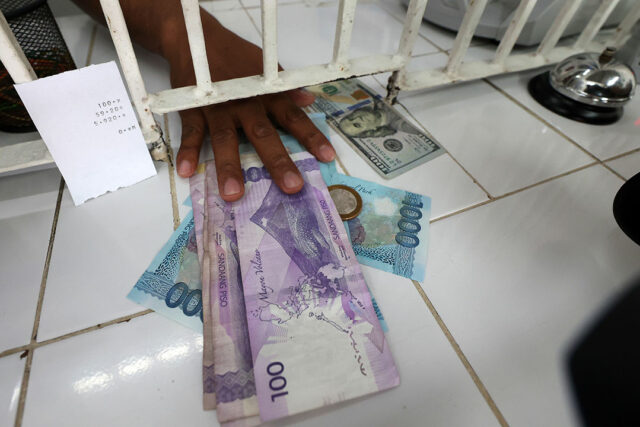
An individual exchanges US dollars for Philippine pesos at a money changer in Quezon City. — PHILIPPINE STAR/MIGUEL DE GUZMAN

THE PESO may settle at P59.70 against the dollar by end-2026 on expectations of an economic rebound driven by improved investor confidence, Metropolitan Bank & Trust Co. (Metrobank) said.

In a commentary dated Feb. 10, Metrobank trimmed its peso forecast for end-2026 to P59.70 a dollar from P60.80 previously.

It likewise projects the peso to end 2027 at P58.50 versus the greenback, from its earlier estimate of P58.90.

“(A)n anticipated economic growth rebound and improved investor confidence, thanks to better government spending, could support the peso,” it said.

If the bank’s 2026 forecast holds true, the local unit would end the year weaker than its P58.79 finish against the dollar on the last trading day of 2025.

The lingering effects of the flood control corruption scandal and uncertainties in the global market pushed the peso to test new lows at the start of the year.

On Jan. 15, it closed at P59.46 per dollar, breaking the previous all-time low of P59.44 recorded just the day prior.

However, it has recently strengthened amid a weak dollar. On Wednesday, the local unit hit a near four-month high after closing at P58.29 versus the greenback, up 24 centavos from its P58.53 finish on Tuesday, data from the Bankers Association of the Philippines showed.

Meanwhile, Metrobank noted that the peso could struggle to regain further strength as the country’s current account is projected to remain at a shortfall this year.

“Still, the projected current account deficit this year — although narrower than last year’s — would cap the peso’s strength,” it said.

Based on the latest central bank data, the current account balance stood at a $12.5-billion deficit by the end of the third quarter. This was equivalent to -3.6% of gross domestic product (GDP).

The Bangko Sentral ng Pilipinas (BSP) expects the current account gap to end at $15.5 billion in 2025 or -3.2% of GDP, before narrowing to $15.3 billion or -3% of GDP this year.

Metrobank also noted that the expected widening of the interest rate differential between the US Federal Reserve and the BSP could weigh on the local currency this year.

It sees the Fed delivering a total of 50 basis points (bps) in cuts this year, down from its initial projection of 100 bps, to bring the Federal Funds Rate to 3.25% by yearend.

In an earlier report, the bank said that the current economic backdrop gives the BSP room to lower its key policy rate further to 4% from the current 4.5%.

If both projections are realized, the difference between the two central banks’ benchmark interest rates would end at 75 bps. — Katherine K. Chan

DTI eyes more investments in aerospace manufacturing

A Comac C919 model on display at the Singapore Airshow at Changi Exhibition Centre in Singapore, Feb. 3, 2026. — REUTERS/CAROLINE CHIA

By Justine Irish D. Tabile, Senior Reporter

THE Department of Trade and Industry (DTI) is looking to attract investments in aerospace manufacturing and services as well as sustainable aviation fuel, an official said.

“The Philippines has strong capabilities in areas of parts manufacturing and MROs (maintenance, repair, overhaul),” Trade Undersecretary and Board of Investments (BoI) Managing Head Ceferino S. Rodolfo told BusinessWorld. “These include machining, plastic injection, assembly, packaging, and delivery,” he added.

Mr. Rodolfo said the Philippines can take advantage of opportunities as the industry pursues decarbonization.

“With more than 140 nations pledging for the target of Net Zero by 2050, the Philippines also recognizes the significance of sustainable aviation fuel in the global aviation industry’s decarbonization,” he added.

Mr. Rodolfo noted the Philippines has more than 15 million metric tons of biomass, which can be used for sustainable fuel. These are from rice, corn, coconut, and cassava, among others.

The country also has abundant feedstock concentrated in Central Luzon, Calabarzon (Cavite, Laguna, Batangas, Rizal, and Quezon), Western Visayas, Northern Mindanao, and Davao.

Mr. Rodolfo’s statement follows the participation of the country at the Singapore Airshow 2026 earlier this month, where the department facilitated business matching and target introductions with foreign investors, buyers, and attendees.

“DTI’s engagement at the airshow focuses on positioning the Philippines as a competitive location for aerospace manufacturing and services, including parts production, sub-assemblies, and MRO,” the Philippine Trade and Investment Center (PTIC)-Singapore said in a statement.

The DTI also advanced direct commercial discussions between Philippine firms and international aerospace companies.

“Singapore plays a central role in regional investment decision-making, with many Asia-Pacific manufacturing, MRO, and supply chain decisions taken by regional headquarters of global aerospace and aviation firms based here,” said PTIC-Singapore Commercial Counsellor Carla Regina P. Grepo.

During the event, she said that the PTIC-Singapore briefed aerospace and aviation companies on opportunities in aircraft parts manufacturing, sub-assemblies, and MRO in the Philippines.

“While some firms also referenced defense-related programs as part of their long-term outlook, the core discussions centered on commercial aerospace supply chains, procurement diversification, and expansion of MRO capabilities in Asia,” she added.

Citing data from the BoI, PTIC Singapore said that Philippine aerospace exports stood at $590.2 million in 2024, rising to $603.1 million in the first nine months of 2025. Major export markets included the US, Singapore, France, and China.

Although the country currently hosts Tier 1 and Tier 2 aerospace parts suppliers to Boeing and Airbus across industrial zones and airport-linked developments, the Philippines still face a lack of skilled workers.

To address this, Mr. Rodolfo said that the department has been working with human resource (HR) firms and relevant universities to explore potential areas of collaboration.

“The BoI is continuously engaging HR firms and workforce providers and has supported similar key players in the aerospace parts manufacturing sector, including Tier-1 companies like Collins Aerospace,” he said.

The BoI is also spearheading the Academe-Industry Matching (AIM!) Program, which aims to bridge the gap between education and industry needs.

“Through the AIM! campus roadshows, industry partners are able to increase awareness of the industries’ skills requirements and competencies, enabling high school students to have career options related to the featured industries,” Mr. Rodolfo said.

Apart from aerospace, the program also featured industries like information technology and business process management and electronics, among others.

Mr. Rodolfo also cited the role of Administrative Order No. 31 in advancing the aviation sector.

Issued in March last year, the order created the Philippine Semiconductor and Electronics Industry Roadmap as well as the Semiconductor and Electronics Advisory Council.

“Growing semiconductors and electronics through continued skills development will have a positive impact on the aviation sector,” he added.

Bases Conversion and Development Authority (BCDA), which was among the sponsors of the Philippine Pavilion at the Singapore Airshow, recently announced investment pledges from Lufthansa Technik Philippines.

BCDA President and Chief Executive Officer Joshua M. Bingcang earlier said that it received a proposal from the company for a $400-million MRO facility at the Clark Aviation Capital in Pampanga.

The company already operates an MRO facility at Ninoy Aquino International Airport.

Meralco seeks ERC nod for P272-B capex, P532-B revenue requirement

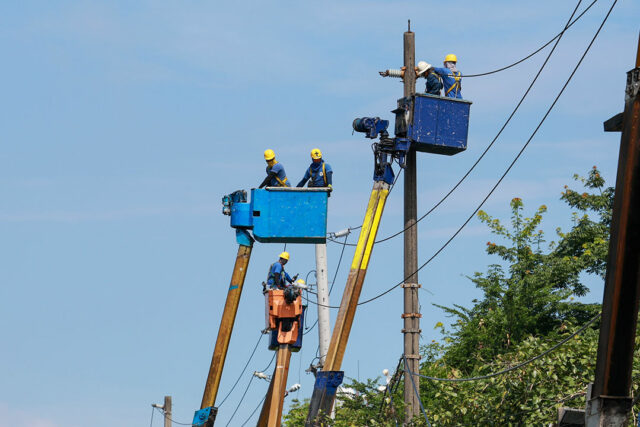
Manila Electric Co. (Meralco) workers conduct maintenance work along Magallanes Drive in Manila, June 28, 2025. — PHILIPPINE STAR/NOEL B. PABALATE

By Sheldeen Joy Talavera, Reporter

MANILA ELECTRIC CO. (Meralco) has proposed a capital expenditure (capex) program worth about P272 billion and a total revenue requirement of roughly P532.13 billion for the 2027-2030 regulatory period, as part of its rate reset application with the Energy Regulatory Commission (ERC).

In its application before the ERC, Meralco proposed an annual revenue requirement (ARR) of P116.04 billion for 2027, P126.86 billion for 2028, P138.75 billion for 2029, and P150.47 billion for 2030.

This covers operating and maintenance expenditure; taxes, levies and other duties; regulatory depreciation, and return on capital.

Meralco said the ARR — or the amount the utility seeks to recover to cover its costs and expenses — is partly based on a proposed weighted average cost of capital (WACC) of 14.6%.

Alongside the proposed revenue requirement, Meralco outlined a P272-billion capital spending plan for the four-year period covering various network and non-network programs.

Meralco has earmarked P50.80 billion for 2027, P59.87 billion for 2028, P59.67 billion for 2029, and P71.17 billion for 2030. The planned capex budget also includes more than P30 billion in carry-over projects.

The power distributor said the capex budget is allocated for programs that will support customer growth, improve system reliability and power quality, and address emerging network requirements.

For the four-year period, Meralco said a significant portion of the proposed capex will fund network expansion and related infrastructure. These include the construction of 28 substations, as well as the building and expansion of eight operating centers and 10 business centers.

The distribution utility also plans to pursue underground cabling projects in select parts of its franchise area.

Meralco has also proposed a significant investment for the rollout of smart meters to more than three million customers under its Advanced Metering Infrastructure program. Smart meters will allow both the distribution utility and customers to monitor energy consumption in real time and help detect power outages.

Meralco recently partnered with US-based Aclara Meters Philippines, Inc. for the supply of more than 72,000 smart meters to be deployed across its franchise area starting this year.

The four-year investment plan also includes programs related to distributed energy resources, such as rooftop solar solutions, which the company said could help manage demand and support the country’s clean energy transition.

The power distributor also plans to deploy electric vehicle (EV) chargers in selected facilities in line with targets under the Electric Vehicle Industry Development Act and the Comprehensive Roadmap for the Electric Vehicle Industry.

“These investments are critical to Meralco’s mandate to deliver high quality, reliable, and stable electricity service, enabling us to meet growing and evolving power requirements and support the country’s economic progress,” Meralco Senior Vice-President and Head of Regulatory Management Office Jose Ronald V. Valles said.

Aligned with the proposed revenue requirement and to help fund its capex program, Meralco is applying for an average distribution tariff of P2.34 per kilowatt-hour (kWh), higher than its current rate of P1.35 per kWh.

“Even as we continue our aggressive efforts to invest in strengthening our distribution network and implementing significant customer service improvement initiatives over the past decade, our rates have not increased in the past decade,” Mr. Valles said.

Since no rate reset was completed from 2015 to 2025 due to regulatory and legal delays in the ERC’s rate reset process, the distribution rate was adjusted to account for the lapsed regulatory period, the company said.

“This rate reset will enable Meralco to pour in massive investments for storm-hardening, upgrading, and expansion of our facilities, as well as technological advancements that are necessary for us to future-proof our distribution network. These go alongside our efforts to ensure fewer interruptions and faster service restoration, promote consumer empowerment and support government-mandated customer choice programs,” Mr. Valles said.

Meralco is among the first group of utilities to undergo the transition to the first regulatory period (1RP), marking the restart of the rate reset cycle under the ERC’s updated framework.

A rate reset process is a periodic regulatory review in which the ERC examines a utility’s costs, investments, and performance, and sets revenue limits intended to support reliable service while protecting consumers from excessive charges.

Meralco is the country’s largest private electric distribution utility, serving more than 8.1 million customers in Metro Manila and nearby provinces, including Bulacan, Cavite, Rizal, and parts of Laguna, Batangas, Pampanga, and Quezon.

Meralco’s controlling shareholder, Beacon Electric Asset Holdings, Inc., is partly owned by PLDT Inc. Hastings Holdings, Inc., a unit of PLDT Beneficial Trust Fund subsidiary MediaQuest Holdings, Inc., has an interest in BusinessWorld through the Philippine Star Group, which it controls.

Globe prices P25‑billion preferred shares at 6.12%-6.76%

BW FILE PHOTO

GLOBE TELECOM, INC. has set the price for its P25‑billion follow-on preferred share offering, with Series A and B shares yielding 6.1179% and 6.7631% per annum, respectively, as part of a plan to redeem perpetual capital securities and fund capital expenditures.

In a regulatory filing on Wednesday, Globe said the offering consists of 12.5 million non-voting preferred shares at P2,000 apiece, including 7.5 million shares and an oversubscription allotment of 5 million shares.

The shares will be issued in two tranches, with the Series “A” Non-Voting Preferred Shares carrying a dividend rate of 6.1179% per annum, and the Series “B” Non-Voting Preferred Shares having an initial dividend rate of 6.7631% per annum.

Gross proceeds from the offering will total P25 billion if the oversubscription option is fully exercised, Globe said.

The Ayala-led telecommunications company said it plans to use proceeds to redeem all or a portion of Globe’s perpetual capital securities and to fund part of its capital expenditure program, according to the company’s preliminary offer term sheet.

BPI Capital Corp., BDO Capital & Investment Corp., and China Bank Capital Corp. are the joint lead issue managers, underwriters, and bookrunners. First Metro Investment Corp. and Security Bank Capital Investment Corp. are also acting as underwriters and bookrunners.

Globe said the offer period will run from Feb. 13-20, with the issue date scheduled for March 2, 2026.

For 2026, Globe expects low- to mid-single-digit revenue growth, following a decline in 2025.

The Ayala-led telecommunications company reported a 4.12% drop in net income in 2025 to P23.3 billion from P24.3 billion in 2024, weighed down by higher depreciation and interest expenses and lower revenues for the year.

Globe said it anticipates capital expenditures to remain below $1 billion, citing a disciplined approach to capital optimization and a focus on extracting greater returns from prior network investments while continuing network expansion.

At the stock exchange on Wednesday, Globe shares closed unchanged at P1,730 apiece. — Ashley Erika O. Jose

PSALM says 2025 debt dropped P13.4 billion to P260.6 billion

ORIGINAL BACKGROUND PHOTO FROM FREEPIK/PRESSFOTO

STATE-RUN Power Sector Assets and Liabilities Management Corp. (PSALM) reported a P13.4-billion decrease in its financial obligations for 2025, citing privatization and collection initiatives.

This brings PSALM’s remaining debt to P260.6 billion as of Dec. 31, 2025, compared with P247 billion at the end of 2024, the company said in a statement on Wednesday.

The state-led firm also reported payments of P20 billion in interest and other charges, and remitted P9 billion in dividends to the National Government.

PSALM attributed the debt reduction to several transactions, including the privatization of the Caliraya-Botocan-Kalayaan hydroelectric power plants, which generated a portion of P36.3 billion.

The company added that collections from fees on the concession of transmission assets, administration of independent power producer contracts, and the privatization of select real estate assets also contributed to lowering its obligations.

PSALM reported a 92.28% collection efficiency, representing P15.88 billion in power sales collections.

“These achievements strengthen PSALM’s financial position geared towards the completion of its mandate within its extended corporate life in support of the Philippine energy sector,” said PSALM President and Chief Executive Officer Dennis Edward A. Dela Serna.

Mr. Dela Serna said the agency remains fully committed to further reducing its obligations through sustained privatization efforts and innovative asset and liability management strategies.

Created under Republic Act No. 9136, or the Electric Power Industry Reform Act of 2001, PSALM is mandated to privatize government-owned power assets and manage the proceeds to settle the financial obligations of the National Power Corp.

The agency’s corporate term, initially set to expire in June 2026, has been extended by 10 years after a measure granting the extension lapsed into law in April 2025.

Compared with its peak debt of P1.24 trillion in 2023, PSALM has reduced its obligations by 79%, or P980 billion, as of end-December 2025.

The company attributed the decline to “effective financial management and long-standing strategy of channeling privatization proceeds toward debt reduction.”

To date, PSALM has generated P959.6 billion in privatization proceeds, with P888.7 billion already collected.

Last year, Mr. Dela Serna announced a 10-year plan to liquidate remaining liabilities through several measures. — Sheldeen Joy Talavera

DoTr in talks with Arkia for direct Philippines-Israel flights

ARKIA.COM

THE Department of Transportation (DoTr) is in talks with Arkia Israeli Airlines Ltd., the operator of Arkia, to arrange direct flights between the Philippines and Israel.

“There is one airline, Arkia. It is a Tel Aviv airline. We are so interested to have direct flights between Manila and Israel,” Transportation Acting Secretary Giovanni Z. Lopez told reporters on the sidelines of a media briefing on Wednesday.

The announcement follows the agency’s plan to launch direct flights between Manila and Israel as part of its efforts to expand international connectivity and strengthen bilateral ties.

“Hopefully, we can sort out the requirements. But I think, usually, it takes like another six months,” he said, adding that both the Civil Aeronautics Board and the Civil Aviation Authority of the Philippines are coordinating with the airline.

Arkia is Israel’s second-largest airline and operates flights to Western Europe, the Mediterranean, and Asia.

The Philippines and Israel previously said they are exploring further collaboration to boost tourism and strengthen economic relations.

Israel has been involved in a nearly three-year conflict with Hamas after the group launched an attack on southern Israel on Oct. 7, 2023. The violence is part of the decades-long Israel-Palestine conflict, which has seen repeated bouts of violence, mass displacement, and stalled peace efforts.

The Philippines currently maintains Alert Level 2 over Israel amid heightened tensions. Non-essential travel is restricted, and Filipinos are advised to avoid public places and prepare for possible evacuation. — Ashley Erika O. Jose

Double your luck

CHINA BLUE SET MENU

A choice from Conrad’s Prosperity and Abundance menus

WITH TWO set menus for the Lunar New Year (which falls on Feb. 17), Conrad Manila’s China Blue by Jereme Leung might double your luck: and if you can afford it, you must already be lucky to begin with, because one menu costs P49,888 (the Prosperity Set), and the other costs P69,888 (the Abundance Set) both for a group of 10 diners.

During a tasting on Feb. 4, their executive Chinese chef, Khor Eng Yew, emphasized the lucky ingredients they are using for the set menus: there’s sea moss for wealth, prawns for happiness, a money bag stuffed with mushrooms and dried oysters for the same reason, beef for strength, and fish for a smooth transition.

The meal started with a Yee Sang set (P3,588++, which one can order separately), a lucky salad with salmon, meant to be tossed high with chopsticks until you make a mess (the higher the toss, the higher the levels of luck).

For our tasting, they combined elements from both menus, the better for us to taste more. Our soup, taken from the Prosperity set, was a Braised Dry Scallop Fish Lip and Seafood with Assorted Mushroom and Sea Moss Soup. It smelled pungent, a little bit bitter and faintly medicinal, but that’s how we like it. From the same menu came a Barbecue Roasted Duck with Mandarin Orange Sauce. Absolutely delectable, with a smoky taste on its skin, the rather succulent duck (lucky us — the seniors at our table avoided it for its glistening fat, so we had more helpings) was given some spark with the orange sauce.

Other main courses included a Wok-fried King Prawn with Butter Black Pepper Gravy Sauce (a very strong flavor), Steamed Live Sea Garoupa with Bell Pepper and Pickled Olive Sauce (from the Abundance set; light and delicate, in contrast to the prawn before), a comforting and fragrant Baked US Beef Short Rib in a Honey and Sweet Vinegar Sauce, and the money bags. These were little dumplings in bean curd skin with dried oysters and mushrooms, which burst and flowed forth in the mouth after a bite.

The dessert, symbolizing togetherness, was a chilled Mandarin Orange Jelly and Honey Pearl with Citrus Sorbet and a Coconut Brown Sugar Nian Gao, stuffed in a faux Mandarin orange.

“For me, important (to be) happy,” Mr. Yew said about the lucky nature of his dishes.

NEW YEAR, NEW SITES
Conrad Manila’s new general manager, Rupert Hallam (he started last September) told BusinessWorld about plans to build another events space in the hotel, located below its helipad. As part of his term as general manager, he says he plans to improve their spa and wellness offerings, and possibly open a new restaurant.

As for the events space, it will offer 360-degree views of the bay and the city. “It’s going to be very different because it’s going to be specifically targeted at the social side of the business,” he said, citing weddings, engagements, and other celebrations. The new events space will be named after Admiral George Dewey (the former namesake of the stretch of road now named Roxas Boulevard).

“You come to a hotel, and you’ve got a ballroom. It’s four walls, a ceiling, and a floor. It’s a box, to put it bluntly,” he said. “But this one is something completely different,” with glass walls, an outdoor space, and a garden.

The Lunar New Year menus are available at China Blue from Feb. 11 to March 3. — Joseph L. Garcia

Jollibee Group taps First Gen for renewable energy in commissaries

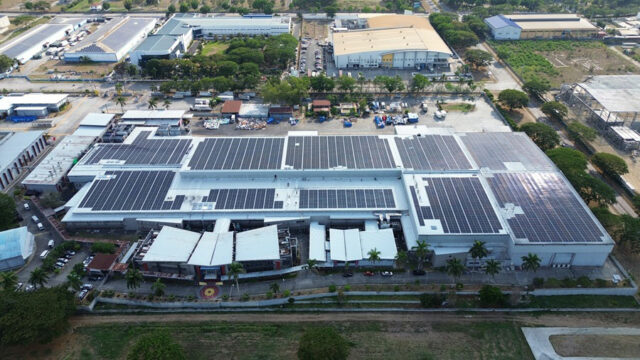
Jollibee Group’s C3 facility in Laguna — JOLLIBEEGROUP.COM

FOOD GIANT Jollibee Group has partnered with Lopez-led power producer First Gen Corp. to source renewable energy for its commissaries in the Philippines.

In a statement on Wednesday, First Gen said it is supplying 11 megawatts (MW) from its geothermal power plant in Bicol, enabling the fastfood chain’s commissaries to operate on 99% renewable energy.

By harnessing renewable energy, the Jollibee Group is expected to cut greenhouse gas emissions by 70% across the covered sites, First Gen said.

The deal builds on the two companies’ partnership in 2023, when 17,000 solar panels with more than 9 MW of capacity were installed at its commissaries and distribution sites in Parañaque and Laguna.

First Gen also provided a remote energy monitoring system to optimize electricity usage at the logistics hub.

“Behind every meal we serve is a long chain of work that begins in our commissaries. How we power these facilities matters. By shifting to renewable energy, we are ensuring our operations remain reliable and consistent as we grow,” Jollibee Group Philippines Chief Executive Officer Joseph C. Tanbuntiong said.

Jollibee Group operates over 10,000 stores and cafés in 33 countries, managing 19 brands.

Its portfolio includes nine wholly owned brands — Jollibee, Chowking, Greenwich, Red Ribbon, Mang Inasal, Yonghe King, Hong Zhuang Yuan, Smashburger, and Tim Ho Wan; five franchised brands in the Philippines — Burger King, Panda Express, Yoshinoya, Common Man Coffee Roasters, and Tiong Bahru Bakery; and stakes in other ventures such as The Coffee Bean & Tea Leaf, Compose Coffee, SuperFoods Group (Highlands Coffee), Milksha, and interests in Tortazo LLC (US) and Botrista.

First Gen Chief Customer Engagement Officer Carlos Lorenzo L. Vega said the shift to geothermal and solar power “reflects the Jollibee Group’s disciplined approach to growth” by investing in reliable energy systems.

First Gen is an independent power producer with a total installed capacity of over 3,700 MW across natural gas, geothermal, hydropower, wind, and solar technologies. — Sheldeen Joy Talavera

ADVERTISEMENT
ADVERTISEMENT