Home Blog Page 2934

Brazil halts some poultry exports after Newcastle disease case

REUTERS

SAO PAULO — The world’s top chicken exporter Brazil has voluntarily halted poultry exports to some countries after a case of Newcastle disease was detected in the state of Rio Grande do Sul, its agriculture ministry said on Friday.

The move comes as local authorities try to contain the viral disease after around 7,000 birds died on a chicken farm in Brazil’s southernmost state. The flock’s remaining 7,000 birds were culled to comply with health protocols, according to meat lobby group ABPA.

From a sample of 12 birds from the flock, government investigators found at least one positive case of Newcastle, ABPA, which represents exporters such as JBS and BRF, said.

Newcastle causes respiratory problems in birds and sometimes leads to death.

The temporary export restrictions could affect 50,000 to 60,000 metric tons of Brazilian poultry exports “in the worst-case scenario,” ABPA said. Brazil produces 1.2 million tons and exports 430,000 tons of poultry products, on average, per month.

The restrictions range, depending on the destination country, from all Brazilian poultry exports to products only from Rio Grande do Sul, the agriculture ministry said.

The restrictions affect sales to 44 nations including China, Argentina, the European Union, Japan and Saudi Arabia, the ministry said.

Rio Grande do Sul accounts for 15% of Brazilian poultry production and exports, according to ABPA.

The agriculture ministry declared an animal health emergency in Rio Grande do Sul due to the Newcastle case.

Notification by countries of Newcastle cases is mandatory under guidelines from the World Organisation for Animal Health.

The last previous confirmed cases of Newcastle in Brazil occurred in 2006 in subsistence birds in the states of Amazonas, Mato Grosso and Rio Grande do Sul, according to the ministry. Subsistence birds meet a family’s need for food and are not kept for trade. — Reuters

The P89.9 billion taken from PhilHealth are member contributions, not government subsidies

FREEPIK

Pickpockets? When the final deliberations on the 2024 General Appropriations Act (GAA) were made, no one noticed the provision that would allow Department of Finance (DoF) to take away “excess funds” from Government-Owned or -Controlled Corporations (GOCCs) to be put in a General Fund. But by including the Philippine Health Insurance Corp. (PHIC) or PhilHealth among the GOCCs with “excess funds,” the Government is taking member contributions, not government subsidies.

Congress and the DoF have conveniently mislabeled PhilHealth funds as government subsidies when these are contributions from the formal and informal sectors as well as contributions from taxes to cover premiums of indigents (the 4Ps or Pantawid Pamilyang Pilipino Program), senior citizens, and sponsored members.

In its last report in 2022, the PhilHealth President noted contributions of P216.799 billion, P80 billion of which came from taxes converted into membership contributions of the poor and senior citizens. So, when the PhilHealth Board agreed to follow the DoF Circular, they were actually giving away contributions of its 104,098,583 members, not a government subsidy.

The DoF and Congress, which approved the GAA provision, have a lot of explaining to do to the 23,721,597 indirectly contributing members and 15,322,860 dependents who will pay for their premiums this year, amounting to about P80 billion.

It is astounding that the PhilHealth Board completely misunderstood its role. As Department of Health (DoH) Secretary Ted Herbosa said in the 2022 annual report of PhilHealth: “Never forget: we at PhilHealth are stewards of the People’s money, funds that we must promptly and efficiently use to pay for health services that save lives.”

But then again, in the next sentence in the annual report, Secretary Herbosa showed that he was also unaware about the role that government has in providing premiums for the poor and senior citizens: “The premium payments of our direct contributors, as well as the subsidy provided by the National Government for our indirect contributors, are all meant to pay for benefits.”

That sentence completely negates the principle of solidarity in social health insurance that those who can pay should contribute to cover the benefits of the poor who cannot contribute, and that is done through general taxation, including taxes that Filipinos paid for under the Sin Tax laws.

To realize the grave implications of the transfer of P89.9 billion away from our healthcare system, let’s review the history of universal healthcare.

When former DoH Secretary Francisco Duque III signed the Implementing Rules and Regulations (IRR) of the Universal Health Care (UHC) Law in 2019, he stated that the UHC would require P1.5 trillion by 2025 to realize the original intent of Dr. Alberto “Quasi” del Gallego Romualdez, Jr., the father of health reform in the Philippines.

The P1.5 trillion would expand the spending of PhilHealth to about 30% of Current Health Expenditure. (In 2022, PhilHealth spending declined to 13.6% of Current Health Expenditure from a high of 19.4% in 2015.)

To date, despite the taxes used to cover the premiums of the 4Ps and others that have been provided since 2011 (thanks to the sin taxes), the goal of meeting the P1.5 trillion for UHC has not yet been fully achieved.

In 2011, PhilHealth launched the Kalusugang Pangkalahatan program. Then President Benigno “Noynoy” Aquino praised PhilHealth for an unprecedented 23% increase in its membership and 82% coverage of the population in 2011, simply by providing for the premiums of 10 million household heads covered by the 4Ps and the national household targeting system in one swoop, a record unmatched to date.

The UHC Law has the essential feature of the local and national governments providing complementary healthcare through the decentralized health system.

Quasi Romualdez launched health sector reform over a quarter century ago after taking the helm at the DoH in 1998. His vision was to cut the cost of healthcare of Filipino families so that government and health insurance would cover up to 70% of health costs (leaving 10% for private health costs). The Filipino would only pay P2 for every P10 spent on healthcare which would be widely available and of good quality.

During his 28 months in office, Quasi broke three restraints that the health sector needed to overcome to transform the traditional healthcare delivery system in the Philippines:

1. He obtained Presidential action through Executive Order (EO) 205, which directed National and Local government cooperation to set up local health systems, citing Section 33 of the Local Government Code (LGC), which allowed local government units (LGUs) to undertake cooperative undertakings among themselves for common benefit.

2. He took the first steps to achieve Universal Health Care by reducing by 10 percentage points the out-of-pocket spending of Filipinos from 50% in 1995 to 40.5% in 2000. This was an achievement that has not been repeated when health spending achieved the World Health Organization target of 5% of GDP.

3. Quasi opened the doors to a dialogue between national and local governments for health, increasing local government spending on health to 19.3% of per capita health expenditure by 2000 from 15.9% in 1995. Nationally, he increased DoH spending on health by two percentage points (19.2% in 1995 to 21.2% in 2000) and increased PhilHealth’s share in covering health costs by 2.6 percentage points, from 4.2% in 1995 to 6.8% in 2000.

Quasi got that all done without the benefit of a Sin Tax Law and the UHC Law. Let us break down what he had to overcome during his term.

Ending the myth of inviolable “Local Government Autonomy” or “Local Fiscal Autonomy.”

Whenever national agencies draft executive orders or memoranda to be issued by the President, the ultimate opinion on any executive issuance affecting local governments is usually left to the Department of Budget and Management (DBM) and the Department of the Interior and Local Government (DILG).

Once the agencies opine that any section might infringe on “local autonomy” (DILG) or “fiscal autonomy” (DBM), such recommendations are simply disapproved. The opinions of these agencies have led to unconstitutional lawmaking (Section 284 of the Local Government Code, amended by the Mandanas-Garcia ruling) and questionable Executive Orders.

In the Mandanas-Garcia ruling by the Supreme Court in 2019, the Court made the distinction between local fiscal autonomy and supervision by the National Government through the President:

“For sure, fiscal decentralization does not signify the absolute freedom of the LGUs to create their own sources of revenue and to spend their revenues unrestrictedly or upon their individual whims and caprices. Congress has subjected the LGUs’ power to tax to the guidelines set in Section 130 of the LGC and to the limitations stated in Section 133 of the LGC. The concept of local fiscal autonomy does not exclude any manner of intervention by the National Government in the form of supervision if only to ensure that the local programs, fiscal and otherwise, are consistent with the national goals.”

As long as the Chief Executive refuses to act because of fears of infringing on “local fiscal autonomy” the gridlock on the Mandanas-Garcia ruling and by extension, the UHC will remain.

The DoH continues to treat the UHC as a project, requiring pilot projects and mature LGUs to come up with policy recommendations. When former Secretary Duque signed the UHC’s (IRR) in 2019 he foresaw a five-year period of progressive implementation, requiring a budget of P1.5 trillion.

When COVID-19 hit the country four months later, the DoH leaders thought the time had come to implement the structural reform required by the UHC Law, but this remains unimplemented.

With COVID under control by 2022 and with a new administration, the gridlock has remained. Reforming the UHC is but a second priority.

It is probably time to consider reviving EO 205 of former President Joseph “Erap” Estrada to jumpstart the process of health sector reform.

Fostering a spirit of cooperation and trust between the DoH and local governments.

Many national health leaders lack the confidence and trust that then Health Secretary Romualdez had with local governments. The DoH has not given much attention to reforms to develop and strengthen local health systems as a prerequisite to improved health financing. The DoH continues to engage only a few LGUs in a “progressive” approach. And the private sector is ignored although it owns half of the health facilities registered under PhilHealth.

By re-invoking Section 33 of the LGC and the UHC itself in a revised EO 205, the DoH Secretary can make a clear appeal to the President to allow the DoH and LGUs to work cooperatively on health structure reform without amending the LGC.

In 2012, a review of the Health Sector Policy Support Project 1, which has been the foundation of health financing reform, was done. This review saw that the Inter-Local Health Zones or ILHZs (not much different from the local structure described in the UHC Law) could implement local health reform without amending the Local Government Code.

By working with mandatory ILHZs, the DoH can stop experimenting on sandbox theory and directly implement the UHC. It would only require an Executive Order and avoid amending the current law and even the Local Government Code.

The most important task of the leader of the health sector: Taking on the role of health reformer.

With four years remaining in his term, Secretary Herbosa has the opportunity to take on the mantle of health sector reform from his mentor, Quasi Romualdez. He has potentially more time than Mr. Romualdez had in his time as DoH Secretary.

Under his leadership he needs to lead the three actors in health reform to achieve UHC, namely a.) the National Government’s apex and tertiary end of the health sector, b.) the local government’s primary healthcare function and secondary level of care, and, c.) the facilitative role of PhilHealth as the single payor of a solidarity-based health insurance.

Secretary Ted, panahon na (it is time). The health sector needs to show up and stand out. The immediate step though is to stop the transfer of PhilHealth funds to the National Government. Before we all lose faith in the government’s ability to reform the health system through the UHC law.


Juan “Jeepy” A. Perez III, M.D. specializes in public health administration, primary healthcare, and has worked with nine Health Secretaries and three NEDA Secretaries since 1992. He occasionally writes for Action for Economic Reforms.


GT Capital receives 4 Alpha Southeast Asia awards

THE TY Family’s GT Capital Holdings, Inc. received four major awards at the 14th Institutional Investor Corporate Awards of Hong Kong-based magazine Alpha Southeast Asia, held on July 9 in Singapore.

The awards recognized the company’s investor relations and corporate social responsibility efforts.

GT Capital was cited for having the best annual report in the Philippines for its 2023 integrated report, according to an e-mailed statement.

The conglomerate was also recognized as one of the top Philippine companies with the most consistent dividend policy, ranking second among nominees in this category.

GT Capital’s investor relations initiatives secured the third spot in the most organized investor relations category. The conglomerate also placed third in the most strategic corporate social responsibility category.

Nominees for the Institutional Investor Corporate Awards were ranked based on the results of the 14th annual institutional investor poll. This poll sought to identify the region’s top corporates based on their financial management, corporate governance, integrated reporting, corporate social responsibility, and investor relations.

Alpha Southeast Asia is the first and only institutional investment magazine focusing on Southeast Asia.

GT Capital is a listed conglomerate with business interests in banking, automotive assembly, importation, dealership, and financing, property development, life and general insurance, and infrastructure.

Its core companies include Metropolitan Bank & Trust Co., Toyota Motor Philippines Corp., Federal Land, Inc., Philippine AXA Life Insurance Corp., and Metro Pacific Investments Corp. (MPIC).

MPIC is one of three key Philippine units of First Pacific Co. Ltd., the others being Philex Mining Corp. and PLDT Inc.

Hastings Holdings, Inc., a unit of PLDT Beneficial Trust Fund subsidiary MediaQuest Holdings, Inc., holds a majority stake in BusinessWorld through the Philippine Star Group, which it controls. — Revin Mikhael D. Ochave

Central bank approves framework for merchant payment acceptance

BW FILE PHOTO

THE BANGKO SENTRAL ng Pilipinas (BSP) has approved a regulatory framework for merchant payment acceptance activities to protect both customers and merchants from risks.

“The Bangko Sentral recognizes that enabling merchants to accept different forms of payments for the sale of goods and/or services in a safe and efficient manner is vital in facilitating the smooth flow of funds in the economy and contribution to the wide adoption of digital payments in the country,” it said in a circular.

The Monetary Board approved the framework in a resolution dated July 11. New sections will be added to the Manual of Regulations for Payment Systems.

Under the circular, merchant payment acceptance activities (MPAA) are defined as the set of services provided to a merchant to receive payment for sale of goods and/or services.

“In general, services include merchant acquisition; providing the means to accept various payment instruments and collect, secure, transmit and process payment information; and providing support services related to the payment,” it added.

Operators of payment systems (OPS) engaged in or planning to engage in MPAA are expected to comply with the requirements of the framework and must also observe governance and risk management measures commensurate to the activities they perform, according to the circular.

“For digital payments to thrive, minimum standards and good practices must be established to safeguard the funds received from customers of merchants; and protect the rights and interests of end users (i.e., merchants) that deal with operators of payment systems that engage in MPAA.”

It also seeks to mitigate risks related to settlement, operations, information technology, anti-money laundering and countering terrorism and proliferation financing, and end-user protection.

Operators of payment systems must also secure authority from the BSP prior to engaging in merchant acquisition.

However, banks and electronic money issuers-nonbank financial institutions that intend to engage in merchant acquisition as part of their normal or allowed business operations do not need to apply for a separate license from the BSP.

The rules also set the minimum required capital for operators granted a merchant acquisition license (MAL) at P5 million if the average monthly value of collected funds transferred to merchants in the applicable period is less than P100 million.

If the average monthly value is P100 million and above, the minimum required capital is at P10 million.

“The minimum required capital shall be computed as paid-in capital stock plus additional paid-in capital, deposit for stock subscription, retained earnings, and undivided profits, less intangible assets,” it added.

The framework also sets rules for the governance of merchant acquisition services, including merchant due diligence, risk assessment, monitoring, and dispute resolution, among others.

Operators must also ensure “timely and complete funds settlement” with merchants.

“The settlement period shall be agreed upon by the OPS-MAL and the merchant, but shall not be longer than two business days from the day the funds are received by the OPS-MAL for transfer to a merchant,” it said.

“In the event that the payment cycle stated in the merchant agreement is more than the agreed maximum number of days as stated above, an OPS-MAL shall submit justification, including supporting documentation, to the appropriate supervising department, subject to prior approval of the Bangko Sentral,” it added.

Pricing mechanisms must be “reasonable, transparent, market-based and proportional to the cost of services offered in order to sustain the business operations of parties involved,” the BSP said.

The framework also details the reportorial requirements for operators, including annual audited financial statements and other documents.

Operators must also create an information technology risk management system that is “risk-based, commensurate with the size, nature, types of products and services, and complexity of its information technology operations.”

“There shall be a robust and effective information technology and security risk management framework and process, including corresponding governance structures and controls, to ensure financial stability, operational resilience, and end-user protection,” it added. — Luisa Maria Jacinta C. Jocson

Armani, Dior face Italian antitrust probe on labor practices

ITALY’S Competition Authority opened an investigation into some companies controlled by luxury fashion groups Giorgio Armani SpA and LVMH’s Christian Dior over alleged unfair commercial practices.

The probe has prompted Dior to cut off orders from the targeted suppliers, the fashion house said in a statement after the investigation was made public last Wednesday.

Dior is collaborating with Italian authorities and strengthening its checks on its suppliers, the company said on Wednesday, after the Italian competition watchdog said it was probing the luxury group for allegedly misleading consumers over its social commitment and craftsmanship.

In its first comments since its Italian unit was put under court administration last month, Dior, part of French luxury group LVMH, condemned the illegal practices uncovered at some suppliers and said it had stopped working with them.

The Rome-based antitrust regulator is investigating whether the two brands used suppliers applying unfair commercial practices, including paying employees “inadequate” wages and sometimes forcing them to illegally work long hours in inadequate health and safety conditions.

The probe is only the latest move by authorities in Italy to crack down on alleged unlawful business conduct in the fashion industry.

In June, a Milan court put a unit of the French fashion house Dior under judicial control citing alleged labor violations in its supply chain. Dior, which produces luxury bags and accessories in Italy, didn’t “prevent and stem labor exploitation within its production cycle,” the Italian police said at the time.

Similarly, in April a Milan judge placed the manufacturing unit of Armani under the same control for alleged workers exploitation.

On Tuesday last week, financial police and antitrust officials searched the headquarters of Giorgio Armani SpA, G.A. Operations SpA and Christian Dior Italia, according to the statement.

The Armani Group on Wednesday said it was aware of the investigation.

“The companies involved are fully committed to co-operate with the authorities, believe that the allegations have no merit and are confident of a positive result following the investigation,” the Italian company added in a written statement. — Bloomberg with a report from Reuters

Sunlight Air founder Ryna Garcia eyes expansion as demand grows

RYNA C. BRITO-GARCIA

By Ashley Erika O. Jose, Reporter

RYNA C. BRITO-GARCIA, chief executive officer of Sunlight Air, said she founded the boutique airline with the goal of capturing the growing travel demand in underserved areas.

“We were incorporated back in 2019, but the idea to launch an airline began as early as 2017, primarily because we noticed a lack of awareness about underserved destinations,” Ms. Garcia said in an interview with BusinessWorld.

At 29 years old, Ms. Garcia is relatively new to the aviation industry but has already demonstrated her leadership by keeping the company afloat during the height of the pandemic.

“I think my lack of experience in the airline industry actually became a strength. It helped me think of innovative strategies to navigate the challenges of the pandemic,” she said.

Before offering commercial flights in 2022, Sunlight Air began operations with a travel bubble package, now offered as Sunlight Air Vacations.

Travel bubbles are arrangements for transporting travelers between two destinations. Sunlight Air Vacations include round-trip flights and hotel or resort accommodations through its sister company, Sunlight Ecotourism Island Resort.

“I had no experience in the aviation industry before starting Sunlight Air. My background was in technology and hospitality. I worked in Australia for a legal tech firm, then returned to the Philippines to manage our resort and hotels. I only began learning about the airline industry afterward,” she said.

The company launched travel bubbles during the pandemic to cater to customers seeking leisure travel while minimizing touchpoints due to government restrictions.

As a new company facing challenging conditions, Ms. Garcia had to develop innovative approaches to keep the company on track amid headwinds.

“We explored new revenue channels, such as cargo services to various provinces in the Philippines. The growth of e-commerce presented an opportunity for Sunlight Air to enter the market despite pandemic restrictions,” she said.

Currently, Sunlight Air flies to Siargao; San Vicente, Coron, and Busuanga in Palawan; and Catic-lan, Aklan; Iloilo; Cagayan de Oro; and Cebu.

“We launched many routes in 2024. Our focus is to ensure that these new routes grow effectively,” she said.

For this year, Sunlight Air has no immediate plans to add more routes or increase the frequency of its newly launched routes, Ms.Garcia said, noting the importance of stabilizing operations first.

“We plan to maintain the current frequency of our new routes and ensure they stabilize before adding new ones,” she said.

Sunlight Air may start offering new routes by 2025 once it has ensured the stability of its current domestic flights, she added.

In the meantime, Sunlight Air will launch its mobile application to allow passengers to book and manage their flights.

“We will also introduce our frequent flyer program, enabling passengers to earn points by traveling with us,” Ms. Garcia said.

The company is also targeting international flights in the future, with ongoing discussions about the plan, though nothing is finalized yet.

“I am hopeful that some of our discussions will come to fruition. There are no definitive agreements yet, so we’ll see what next year brings,” she said.

The boutique airline has announced plans to offer flights to China, Japan, Korea, and Taiwan within the next two years.

In addition to catering to leisure travelers, Sunlight Air is also targeting group travelers and companies with its private flight offerings.

“We still offer chartered flights, primarily to corporate accounts or large groups,” she said.

Sunlight Air does not regularly offer private flights, which can accommodate up to 70 passengers at around PHP 200,000 per hour.

“Companies often charter entire planes for group or company outings because it’s more cost-effective than purchasing individual tickets. We also cater to groups of friends and families traveling together, such as for weddings or debuts,” she said.

Sunlight Air currently operates with a fleet of three ATR 72-500 planes, which the company plans to replace with ATR 72-600 models in the near future.

“We will replace some of our planes with Dash 600s. Currently, our planes are ATR 72-500s. We plan to upgrade them and consider adding new planes in the last two quarters of next year,” Ms. Garcia said.

Since 2020, Sunlight Air has been growing, and the company’s plans are to sustain this growth over the next five years by capitalizing on the increasing travel demand in the country, she noted.

Ms. Garcia is also optimistic that relocating the company’s hub to Clark International Airport will spur growth, given Clark’s increasing popularity due to the decongestion in Metro Manila.

Building electric dreams in Davao

PHOTO BY DYLAN AFUANG

BYD Philippines says it corners 68% of country’s EV market, opens first dealership in Mindanao

By Dylan Afuang

BYD DAVAO has established itself in a location where clientele are seen to be “ready” for electric vehicles, which many car makers and motorists foresee as the future of mobility. Coinciding with BYD Cars Philippines’ new presence in the region is its recent “cornering of 68% of the local EV market,” according to company officials.

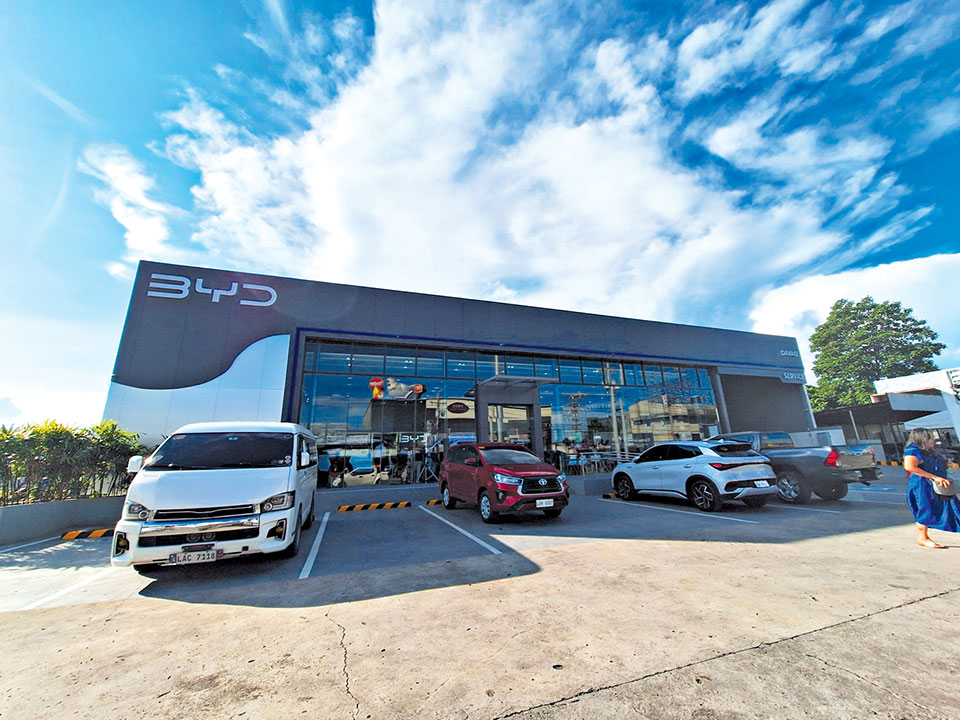
Weeks ago, local and national journalists, and content creators witnessed the introduction of the ACMobility-led company’s first dealership in Mindanao. Located on Kilometer 5, JP Laurel Avenue in Davao City — seen as the area’s “automotive row” given the many dealerships from various brands situated along this road — it has been operating quietly since June.

“We know that EVs are our future, that’s why we invested in (setting up) BYD Davao,” Image Davao Mobility Corp. President and Director Walter Alvarez told “Velocity” on the sidelines of the dealership’s grand opening. BYD Cars’ dealer partner here is Mr. Alvarez’s enterprise, which also manages dealerships of other auto brands.

“Based on the performance of BYD Davao, from what we’ve seen so far, people in Davao have warmly received the brand,” ACMobility Corporate Communications Manager Mikko David announced to the media during the event.

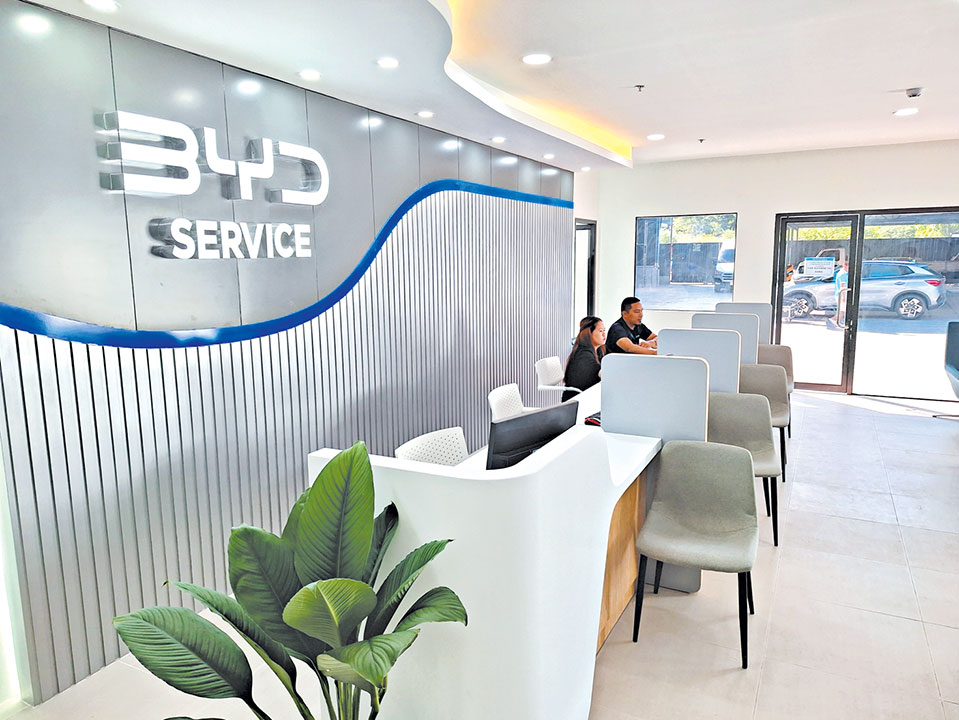
Occupying the majority of the space in BYD Davao is a six-car showroom, along with a customer lounge. Around the vehicle display, customers and agents can meet in a negotiation room, and visitors can learn about the Chinese auto brand and its technologies through an experience wall. A space in which customers can receive their BYD cars features a charger. Behind the showroom is the service area that features four vehicle bays.

The showroom is open from Monday to Wednesday with operating hours of 8 a.m. to 5 p.m., and from Thursday to Saturday from 8 a.m. to 8 p.m. The business can be contacted through phone (0927-327-0559), or through its Facebook (BYDDavao) or Instagram (byd.davao) pages.

With regard to EV sales in the Philippines, Mr. David claimed that the industry sells around 200 EVs monthly — 68% accounted for by BYD Cars Philippines. As of May 2024, he boasted that topping the sales tally were the brand’s Atto 3 compact crossover, followed by the Dolphin subcompact hatchback, and then the Tang luxury crossover.

Mr. David also revealed to the attending media from Metro Manila that the company eyes to open outlets in Cagayan de Oro and General Santos soon.

Returning to the Davao City outlet, Mr. David continued, “With support from Davao Light and Power Company, (the region) is ready to move into the EV space.”

Davao Light, a power distributor under AboitizPower that serves Davao and Panabo City, and a number of Davao del Norte towns, received two units of the BYD ETP3 electric van for its fleet last year. Davao Light Chief Operations Officer Rodger S. Velasco, who also attended the BYD Davao introduction, reiterated, “This is well-aligned also with our AboitizPower distribution massive transformative purpose and that is to empower the evolution of our cities, and one of which is the adoption of electric vehicles — one vehicle at a time.”

Outside the JP Laurel Ave. dealership, BYD drivers in Davao City can have their vehicles charged at SM Lanang Premier and Ayala Malls Abreeza.

With cocoa butter at $28,000, more companies go for ‘chocolatey’

TETIANA BYKOVETS-UNSPLASH

FOODMAKERS who’ve already shrunk packaging and raised chocolate prices to weather this year’s run-up in cocoa costs are rapidly rewriting recipes to use none of the stuff at all.

That’s according to the growing number of companies that supply cocoa-butter alternatives. They’re rapidly launching new product lines and growing volumes as demand for their cocoa-free products soars alongside the price of cocoa beans.

Cocoa butter prices are near $28,000 a ton, according to data from KnowledgeCharts — more than quadruple last year’s costs and about the same price as a budget sedan. Alternatives are roughly 40% cheaper, said Aaron Buettner, president of food solutions at Bunge Global SA, meaning deploying them could help keep sweet treats affordable during a time of prolonged food inflation.

“Chocolate quite often is an impulse purchase,” Niall Sands, president of commercial development and innovation at alternatives maker AAK AB, said in an interview. “It’s in everybody’s interest in the industry to retain that,” rather than allow chocolate to become a high-priced luxury item.

Companies generally don’t telegraph ingredient swaps that might not be unanimously popular, and suppliers are reticent to name names. In general, the swaps are easiest to pull off in treats where chocolate isn’t the snack’s star flavor, especially in secondary applications like coatings or drizzles. These reformulated treats might be branded “chocolatey” or boast a “chocolate-flavored coating.”

AAK’s chocolate and confectionery fats segment — the unit that makes ingredients designed to supplement or completely replace cocoa butter — saw volumes surge 14% in the latest quarter, the Swedish company said on Thursday. Others are expanding in the space, too. Crop trader Bunge has in the past year introduced two new cocoa-butter swaps — one shea butter-based equivalent and another that aims to match the texture and taste of 61% dark chocolate. Both were launched for the Asian and Middle Eastern markets, but may eventually be rolled out globally, Mr. Buettner said. Non-cocoa substitutes have long been more common in warmer climates, where cocoa butter’s low melting point can pose a problem.

Chicago’s Blommer Chocolate Co. last month launched a new product line of cocoa-butter equivalents that it says offers “a fabulous chocolate-like sensory experience.” It uses sunflower and palm oils, which can give customers 20% or more in savings, said Jenna Derhammer, the cocoa processor’s R&D corporate manager for innovation.

The increased interest in alternatives follows months of elevated prices for cocoa. The futures contract hit a record intraday high of $11,722 a metric ton in New York in April following shortages in top West African producers. Cocoa bean prices have eased somewhat since then but are generally seen as unlikely to return soon to levels that until last year averaged well below $3,500 a metric ton for decades. Cocoa production in West Africa is expected to rebound next season on better weather, though fears remain that structural issues like disease will continue to plague crops and keep cocoa prices higher for longer.

As cocoa stays high, so does cocoa butter, a product made by grinding beans that lends chocolate its signature texture. Foodmakers had hoped to wait out the high cocoa prices without reformulating their products — something they don’t do lightly as it can risk losing shoppers if the product ends up tasting different. With the Halloween and Christmas candy seasons fast approaching, it’s now or never for brands who need to finalize products to share with retailers preparing to stock their shelves for the holidays, said Billy Roberts, a senior economist for food and beverage at CoBank ACB.

Companies making cocoa swaps are saying “their product allows them to provide an economically viable alternative that doesn’t compromise on quality. That’s definitely the promise,” Roberts said. “But that’s also an ultimate decision that will be made by the consumer.” — Bloomberg

SONA 2024

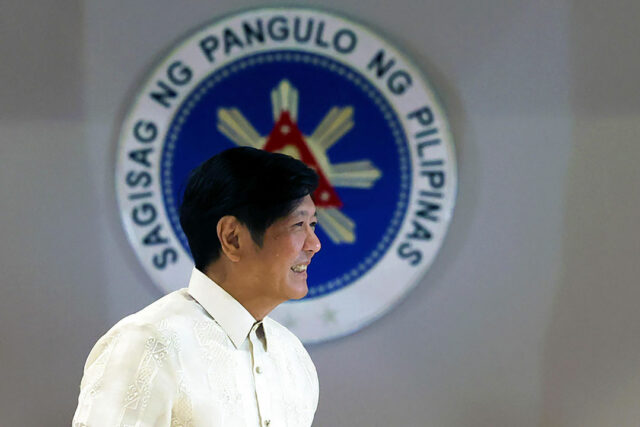
PRESIDENT FERDINAND R. MARCOS, JR. — PHILIPPINE STAR/KJ ROSALES

Eighty-five annual State of the Nation Addresses (SONA) have been delivered since 1935 by 15 presidents of the Philippines. The presidential speech had been delivered in English until the last time in 2009. Benigno Simeon Aquino III was the first president to deliver the SONA in Filipino. He used Filipino in all six of his speeches from 2010 to 2015.

Marcos Sr. had 20 SONAs in his 20-year incumbency, from 1966 to 1985 (inclusive of Martial Law) — the greatest number of SONAs by a single president in Philippine history.

The longest speech was given by Ferdinand Marcos, Sr. in 1969, which had a total of 29,335 words (it was about a 2.67-hour speech). Rodrigo Duterte’s SONA in July 2021 was two hours and 39 minutes long, about 26,242 words. In contrast, Gloria Macapagal Arroyo’s speech made in 2005 was the shortest, with only 1,551 words.

Today, July 22, 2024, President Ferdinand “Bongbong” R. Marcos, Jr. will deliver his third SONA before the Legislative body that represents the people, with the Judiciary and guests in attendance.

The State of the Nation Address as an annual practice began during the Commonwealth Era from 1935 to 1946, when the Philippines was an unincorporated territory and commonwealth of the United States, following the Tydings-McDuffie Act that replaced the Insular Government of the Philippine Islands. The Insular Government was headed by a governor general who was appointed by the president of the United States.

The Commonwealth government was designed as a transitional administration in preparation for full Philippine independence. It had a strong executive, legislative, and judicial system (except that foreign relations were still handled by the US). When the Commonwealth of the Philippines was created and the 1935 Constitution enacted, it provided for an annual report of the President of the Philippines to Congress.

Under Article VII, Section 5 of the 1935 Constitution, Manuel L. Quezon and the Presidents after him were mandated to “from time to time give Congress information on the state of the Nation, and recommend to its consideration such measures as he shall judge necessary and expedient.”

Article VII of the 1935 Philippine Constitution was copied word for word from Article II, Section 3 of the US Constitution. The yearly Philippine SONAs take after the yearly US State of the Union addresses given by all American presidents since George Washington first fulfilled this particular duty on Jan. 8, 1790 when he addressed the New Congress of the United States of America.

“The contents of the (State of the Union) speeches typically contain information and status updates of the country and federal government during the incumbent president’s administration,” the New York Times said in an op-ed article, “The State of the Union is Unreal” (Jan. 31, 2006).

“It has become customary to use the phrase ‘The State of the Union is strong,’ sometimes with slight variations, since President Ronald Reagan introduced it in his 1983 address. It has been repeated by every president in nearly every year since, with the exception of George H.W. Bush. (But) Gerald Ford’s Jan. 15, 1975 address had been the first to use the phrasing ‘The State of the Union is… not good’.” (Gerald R. Ford Presidential Library and Museum, www.fordlibrarymuseum.gov, Retrieved Feb. 6, 2019).

The first Philippine SONA by President Manuel Quezon, addressing the National Assembly started on ground-zero for the new Commonwealth. “Mr. Speaker, gentlemen of the National Assembly: As I appear before you for the first time, allow me to extend to you my cordial greetings and congratulations upon your election to this august body… It is your unique privilege to serve our country at the most critical period of its existence — at a time when the course of its destiny will be charted,” he said.

In his SONA’s 4,390 words (approximately 25 minutes delivery time), Quezon focused only on the urgent need for “a defense system to be ready for effective employment whenever the interests of the nation so demand.” The National Assembly was urged to pass enabling laws for the defense system immediately. (The full text of the first SONA is available from the National Archives.)

Quezon’s SONA did not really present the totality of the state of the nation and offer his plan of action to address issues. What seemingly annotated and expanded his evaluation and directions on the true state of the nation were fiery headline stories: “Meet challenge to Democracy, Quezon urges Assemblymen” (The Tribune, June 17, 1935); and “Nation of helpless citizens can expect nothing but slavery at home, Quezon says” (The Tribune, Nov. 26, 1935), among his other brave and feisty public declarations. The state of the nation was not good, according to President Quezon.

“I prefer a government run like hell by Filipinos to a government run like heaven by Americans,” Quezon famously or infamously said. A Time Magazine article, “The Philippines: prelude to dictatorship?” (Sept. 2, 1940) saw Quezon as “Full of energy, brilliant, brittle, as unpredictable as a hummingbird, he spent seven years reminding the US Government of its promises to set the islands free.” But Francis B. Sayre, US High Commissioner for the Commonwealth flatly declared that the Tydings-McDuffie Act meant what it said: the Philippines were to be cut loose in 1946 (Ibid.).

The invasion and occupation of the Philippines by Japan started on Dec. 8, 1941, 10 hours after the attack on Pearl Harbor in Hawaii. World War II deferred decisions on Philippine independence. Japan occupied the Philippines for over three years, organizing a new government and directing civil affairs until October 1943, when they declared the Philippines an “independent republic” administered by supervised cooperative Filipino leaders.

General Douglas MacArthur, commander of the United States Armed Forces in the Asia-Pacific region, landed on the island of Leyte on Oct. 20, 1944, accompanied by Sergio Osmeña, Sr., who had succeeded to the commonwealth presidency upon the death of Quezon on Aug. 1, 1944. Fighting for the liberation of the Philippines continued until Japan’s formal surrender on Sept. 2, 1945. After barely a year of reconstruction and rehabilitation under the rehabilitated Commonwealth led by Osmeña Sr., the United States of America finally granted Philippine independence on July 4, 1946. The first president of the Republic of the Philippines was Manuel A. Roxas, and the first Vice-President was Elpidio R. Quirino.

Perhaps the worst fallout from the experience in World War II and the Japanese occupation was the change in the socio-political culture of the Filipinos. The anxieties for independence, personified in the patriotic and ambitious Manuel L. Quezon, were heightened by the intervention of imperialist Japan, when the promise of independence by imperialist America was yet to be realized. Yet the political maneuverings of interested individual successors to foreign imperialists touched sensitivities in recalling the history of the fight for independence. Thus, Time’s scathing article asked, is this “a prelude to dictatorship?”

Rivalry between the two parties, the Nacionalistas and the Liberals dominated Philippine politics from 1946 until 1971. Both took turns to capture the presidency and control both chambers of Congress. That should have been good for the country — to maintain the political balance of power and the democratic separation of power among the judiciary, the legislative, and the executive branches.

“But do we have a two-party system? If we have none, then how can we call ourselves a democracy? But if we have a two-party system, how explain the constant political turncoatism, the interchangeability of parties? Why do Filipinos change parties as often, it sometimes seems, as they change their shirts? Is it because Filipinos are less honorable politicians than others of the breed?” Teodoro M. Locsin asked in a speech during the “Seminar on Politics in Asia,” on Nov. 29, 1963, at the University of the Philippines.

“Better a government run like Hell by Filipinos,” Manuel Quezon said, surely not meaning to be derogatory or insulting to the Filipino, but perhaps a subliminal, unintended admission of collective and even personal guilt.

So, will we ever have a SONA where our President will admit, “The state of our nation is not good”?


Amelia H. C. Ylagan is a doctor of Business Administration from the University of the Philippines.

ahcylagan@yahoo.com

Yields on gov’t securities inch up on high bond supply

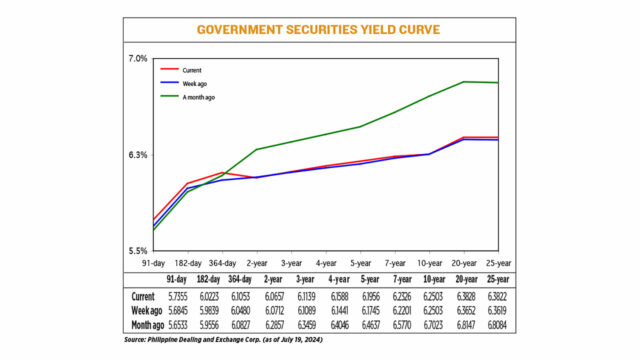
YIELDS on government securities (GS) traded in the secondary market ended mostly higher last week following the results of the Treasury’s 10-year bond auction, which partly offset the rally caused by expectations of a Bangko Sentral ng Pilipinas (BSP) rate cut as early as August.

GS yields, which move opposite to prices, went up by 2.11 basis points (bps) on average week on week, based on PHP Bloomberg Valuation Service Reference Rates data as of July 19 published on the Philippine Dealing System’s website.

Rates of the 91-, 182-, and 364-day Treasury bills (T-bills) increased by 5.10 bps, 3.84 bps, and 5.73 bps week on week to 5.7355% and 6.0223%, and 6.1053%, respectively.

At the belly, yields on the three-, four-, five- and seven-year Treasury bonds (T-bonds) went up by 0.5 bp (to 6.1139%), 1.47 bps (6.1588%), 2.11 bps (6.1956%) and 1.25 bps (6.2326%), respectively, while the two-year T-bonds inched down by 0.55 bp to fetch 6.0657%.

At the long end, the 20-, and 25-year debt papers saw their rates increase by 1.76 bps (to 6.3828%) and 2.03 bps (6.3822%), respectively, while the 10-year bond’s yield was flat at 6.2503%.

GS volume traded was at P8.06 billion on Friday, lower than the P41.7 billion recorded a week prior.

“[Last] week, bond yields remained largely range-bound as optimism surrounding the BSP’s guidance on potential interest rate cuts in August was tempered by an unexpectedly high bond market supply. The Bureau of the Treasury’s (BTr) issuance of P60 billion in 10-year bonds led to market resistance against further downward pressure on yields due to supply indigestion,” ATRAM Trust Corp. Vice-President and Head of Fixed Income Strategies Lodevico M. Ulpo, Jr. said.

“Market players initially pushed the 10-year bond yield lower early in the week, but the larger-than-expected bond award later caused yields to rise, resulting in yields remaining range-bound,” he said.

Dino Angelo C. Aquino, vice-president and head of fixed income of Security Bank Corp., likewise attributed recent GS yield movements to the dovish comments made by the central bank chief, coupled with the possibility of lower inflation in the next few months. 

“Lower inflation, [can be attributed] to the implementation of Executive Order 62, where the import on rice tariffs will be cut from 35% to 15%,” Mr. Aquino said.

“Economic growth forecasts from the IMF (International Monetary Fund) and ADB (Asian Development Bank) for the Philippines suggest a clear path towards a soft landing, indicating that monetary policy cuts could occur while growth remains well managed,” Mr. Ulpo added.

BSP Governor Eli M. Remolona, Jr. last month said the Monetary Board may deliver its first rate cut in over three years at its Aug. 15 review — the only policy meeting scheduled in the third quarter — as they expect inflation to continue easing this semester.

The Monetary Board could reduce borrowing costs by 25 bps in the third quarter and by another 25 bps in the fourth quarter, he said.

The BSP last month kept its policy rate at a 17-year high of 6.5% for a sixth straight meeting after raising interest rates by 450 bps from May 2022 to October 2023.

Meanwhile, the BTr on Tuesday made a full award of the reissued 10-year T-bonds at lower rates as the offer was met with robust demand amid expectations of monetary easing by the BSP.

The Treasury raised P30 billion as planned via the bonds as total bids reached P96.605 billion, or more than thrice the amount on the auction block. The bonds, which have a remaining life of nine years and six months, were awarded at an average rate of 6.212%. Accepted yields ranged from 6.18% to 6.223%.

The average rate of the reissued seven-year bonds dropped by 54.2 bps from the 6.754% fetched for the series’ last award on June 11 and was 3.8 bps lower than the 6.25% coupon for the issue.

To accommodate the strong demand seen for Tuesday’s bond auction, the BTr opened its tap facility window, from which it accepted another P30 billion in bids. This brought last week’s total award to P60 billion, and the total outstanding volume for the series to P201.9 billion.

For this week, GS yield movements will likely be driven by the results of the Treasury’s bond auction on Tuesday, Mr. Ulpo said. The BTr will offer P25 billion in reissued 20-year T-bonds with a remaining life of 19 years and 10 months.

“We anticipate that the upcoming 20-year auction will serve as a key indicator of the Bureau of the Treasury’s auction strategy and the market’s capacity to absorb additional bond supply. While the guided issue amount is P25 billion, a repeat of an aggressive tap award could push yields higher,” he said.

“Key driving factors will include market reactions to the auction results, investor sentiment regarding bond supply absorption, and any additional guidance from the BSP on monetary policy,” Mr. Ulpo added.

For his part, Mr. Aquino said the market may consolidate as GS yields are already around 40-60 bps lower for the month, with investors continuing to price in BSP rate cut expectations.

“As we speak, given where the levels are, the market is already pricing in two rate deductions for 2024,” he said. “We’re going to see some sticky price movements in the next few sessions, probably up until the next few weeks, as we approach the BSP meeting. So, we do expect range-bound movements.” — Abigail Marie P. Yraola

Russia names pianist Evgeny Kissin as ‘foreign agent’

KISSIN.ORG

RUSSIA has designated pianist Evgeny Kissin as a “foreign agent” because of his support for Ukraine and opposition to the war, state news agency TASS quoted the justice ministry as saying on Friday.

Moscow-born Mr. Kissin, 52, has won some of Russia’s top artistic awards and is considered one of the world’s finest concert pianists. He has lived outside the country for years and has British and Israeli citizenship.

Mr. Kissin has spoken out frequently against Russian President Vladimir Putin and the war in Ukraine. Last month he posted on Facebook: “I am convinced that in spite of all the horrors the Russian invaders are inflicting on Ukraine and its poor people, this wonderful country will survive, we shall all outlive Putin and his cronies.”

Russia has applied the “foreign agent” label, which has connotations of spying, to hundreds of individuals and organizations it accuses of conducting subversive political activity with foreign backing.

Best-selling author Boris Akunin and rock musician Boris Grebenshchikov are among other well-known artists now living outside Russia who have been added to the list.

In a landmark case earlier this month, theater director Zhenya Berkovich and playwright Svetlana Petriychuk were sentenced to six years each in prison for “justifying terrorism” in a play about Russian women who married Islamic State fighters. — Reuters

Snapshots

Members of the 2023 UAAP Cheerdance champion FEU Cheering Squad flank a Toyota Tamaraw concept which served as the pace car during the opening round of Toyota Gazoo Racing Philippine Cup’s 10th season at the Clark International Speedway. In the driver’s seat is Toyota Motor Philippines (TMP) President Masando Hashimoto. — PHOTO BY KAP MACEDA AGUILA


ADVERTISEMENT
ADVERTISEMENT