Home Blog Page 291

Red onion imports not deemed ‘overwhelming,’ Agri dep’t says

PHILSTAR FILE PHOTO

THE Department of Agriculture (DA) said imported red onion stocks currently in cold storage are not sufficient to drive down farmgate prices, contrary to farmer claims.

“The numbers show that current stocks from imports are not overwhelming the market but merely plugging a supply gap,” Agriculture Secretary Francisco P. Tiu Laurel, Jr. said in a statement on Sunday.

The DA said Mr. Laurel ordered a review of onion stocks after producers in Nueva Ecija reported that imported supplies were piling up in warehouses in Central Luzon and dragging down farmgate prices.

The Bureau of Plant Industry reported that as of Feb. 13, its survey of 82% of cold storage facilities found inventories of 4,454 metric tons (MT) of red onion and 5,271 MT of yellow onion, most of which were imported.

The DA said red onion stocks are projected to be sufficient until Feb. 19, with yellow onion adequate until March 15.

The DA said around 8,000 MT of red onions covered by valid import clearances are still expected to arrive by mid-February. However, it estimates that, even if all shipments arrive, imports are likely good until March 6, just as the harvest starts to peak.

“We are taking a closer look at why onion prices are falling at this time of the year, as claimed by farmers,” Mr. Laurel said.

The DA said it will inspect cold storage facilities, including those it funded, and urged farmers to use available storage to extend shelf life and better time the release of their harvest to avoid market oversupply. — Vonn Andrei E. Villamiel

T-bill, bond rates may be mixed before BSP review

BW FILE PHOTO

RATES of the Treasury bills (T-bills) and Treasury bonds (T-bonds) to be offered this week may end mixed as the market’s focus turns to the Bangko Sentral ng Pilipinas’ (BSP) policy meeting, where it could provide hints on its future policy direction.

The Bureau of the Treasury (BTr) will auction off P27 billion in T-bills on Monday, or P9 billion each in 91-, 182-, and 364-day papers.

On Wednesday, the government will hold the rate-setting auction for its new 10-year fixed-rate benchmark Treasury notes through which it plans to raise at least P30 billion, with the public offer scheduled to end on Friday. The offering also includes an exchange program for holders of bonds maturing over the next year.

“The size/volume of the new money will depend on the market appetite or demand, but definitely lower than what we raised last year,” National Treasurer Sharon P. Almanza said in a Viber message.

In April last year, the government raised P300 billion via new 10-year benchmark notes, above the P30-billion program. The offering was done through a new issuance format targeting institutional investors like corporates, cooperatives, trust funds, retirement funds, and provident funds.

A trader said the bonds to be offered on Wednesday could attract at least P100 billion in tenders and fetch an average rate ranging from 6% to 6.75%.

T-bill and T-bond yields could track the mixed week-on-week movements seen at the secondary market ahead of the BSP’s policy meeting, where it is expected to cut benchmark rates by 25-basis-point (bp) cut to provide support to the economy as inflation remains manageable, Rizal Commercial Banking Corp. Chief Economist Michael L. Ricafort said in a Viber message.

He added that the P232.8-billion seven-year bond maturity on Feb. 14 could boost demand for this week’s auctions as the liquidity freed up could be reinvested in the new issuances.

At the secondary market on Friday, yields on the 91-, 182-, and 364-day T-bills went down by 2.07 bps, 4.73 bps, and 5.93 bps week on week to end at 4.5498%, 4.6354%, and 4.6781%, respectively, based on PHP Bloomberg Valuation Service Reference Rates data as of Feb. 13 published on the Philippine Dealing System’s website.

Meanwhile, the 10-year bond rose by 0.78 bp week on week to fetch 5.9676%.

All 16 analysts in a BusinessWorld poll expect the Monetary Board to deliver a sixth straight 25-bp cut at its first meeting for the year on Thursday (Feb. 19) to bring the policy rate to 4.25%.

The BSP has lowered benchmark borrowing costs by a cumulative 200 bps since its easing cycle began in August 2024.

BSP Governor Eli M. Remolona, Jr. last week said that a rate cut is possible at this week’s review amid weak economic growth, but reiterated that price stability remains their primary mandate and their easing cycle is nearing its end.

Last week, the BTr raised P37.8 billion via the T-bills it auctioned off, higher than the P27-billion plan as the offer was oversubscribed, with total tenders reaching P158.173 billion. The Auction Committee doubled its acceptance of noncompetitive bids for all tenors to P7.2 billion to take advantage of the strong demand and low yields.

Broken down, the government awarded P12.6 billion in 91-day T-bills, above the P9-billion plan, as demand for the tenor reached P55.681 billion. The three-month paper fetched an average rate of 4.492%, down by 8.7 bps from the previous week. Yields accepted ranged from 4.44% to 4.525%.

The Treasury also borrowed P12.6 billion via the 182-day debt as tenders hit P56.582 billion. The average rate of the six-month T-bill was at 4.578%, easing by 9.4 bps. Tenders awarded carried yields from 4.52% to 4.609%.

Lastly, the BTr raised P12.6 billion from the 364-day securities as bids totaled P45.91 billion. The one-year paper’s average yield was at 4.615%, falling by 7.4 bps. Accepted rates were from 4.599% to 4.64%.

The government aims to raise P308 billion from the domestic market this month, or P108 billion via T-bills and up to P200 billion through T-bonds.

The government borrows from local and foreign sources to help fund its budget deficit, which is capped at P1.647 trillion or 5.3% of gross domestic product this year. — Aaron Michael C. Sy

China, the region, the Philippines

FREEPIK

Heightened verbal aggression in the current political tit-for-tat between China and the Philippines, China and Taiwan, and China and Japan are now a cultural feature of the world of 2026.

These are culture wars at the moment, and for the foreseeable future — until military options change the field of conflict. Right now, the three relatively small island countries on the aquatic flanks of the behemoth China are upping projections of sovereignty erected on amplified cultural themes and shifts.

Pro-Taiwan Japanese Prime Minister Sanae Takaichi said in November last year that a Chinese attack on Taiwan would be an “existential crisis for Japan” and “survival threatening.” Aside from raising the verbal firepower from Chinese spokespersons, the statement signaled boosted the willingness, on the part of the Japanese population, to amp up militarization.

Japan was held to non-militarized sovereignty by the Constitution imposed on it by General Douglas McArthur at Japan’s World War II defeat in 1945. From that decade until the ascension to power of Prime Minister Shinzo Abe in the 2000s, Japan built a titanic economy without building an armed force, settling into half a century of acceptance of unarmed existence.

Taiwan, on the other hand, has created an armed crisis response and defense resilience of increasing power since it was established as a quasi-state at the end of the Chinese civil war in 1949. Simultaneously, Taiwan also shaped itself as an assiduously working society of democracy advocates.

The “Taiwan miracle” of the late 20th Century economic boom was produced by a Taiwanese culture of focus on survival on all fronts. Taiwan, Singapore, South Korea, and Hong Kong were together the Four Asian Tigers (from the 1950s to the 1990s) which created extraordinary growth from rapid industrialization and export orientation.

Each of these Tigers worked with calibrated authoritarianism (dictatorship-lite, so to speak) blended to American-style neoliberal values.

Each produced a different blend. Each blend grappled with various levels of corruption that, at certain historical moments, different for each, threatened to undermine their social fabric.

The Philippines is the unusual example in the region of frayed social fabric. No such inordinate tattering shows up in today’s Tiger nations.

The Philippines produced the oldest republic in Asia — preceding by 50 years the establishment of rest of the modern Asian nations — and has a Latino streak rather than whatever “Asian” might be.

In the ongoing, veritable shouting match between the People’s Republic official representatives and members of the Philippine Senate, Filipino pro-China voices take up a big part of the debate arena.

It is in this sense that a frayed Philippines is exposed. No equivalent pro-Chinese-aggression voice has a privileged space in South Korea and Singapore. Certainly not in Taiwan, of course. And in Japan, the cultural shift to greater militarization undergirds a society ready to put their new soldiers and weapons in support of anti-China rhetoric.

Some of the pro-China voices in the Philippines are entangled in the other fronts of China assaults, notably, the enabling and exacerbation by China of corruption at the highest levels of power in the Philippines. And, moreover, these bad faith actors are darkly empowered by the cyber-assaults that China (and Russia) has become a powerhouse of.

The Latino republic, the Philippines, began in 1945 with the same givens as South Korea, Taiwan, Hong Kong, and Singapore. With postwar financial reparations funds, these vital nodes were created in the Pax Americana that is referenced with great nostalgia and despair in these days of the tattering of an international rule of law.

In East and Island Southeast Asia, democracy was shifted from being merely ideological to cultural. This shift was given huge momentum by the Cold War. On the Right (Western) half of the world, it came to pass that the best success — including viable sovereignty — was, and is, construed as financial success.

This Rightwing logic expressed itself in rabid consumerism in the Tiger economies, unmatched in many ways by the same drive in the West itself — until the buying power of the emergent Chinese middle class in the 2000s, created by Deng Xiao Ping’s turn to market forces, became phenomenal.

The Philippines careened into another direction. Its dalliance with authoritarianism was far more savage than would have been tolerable in the construction of even a flawed, democratic rule-of-law order of things, regionally and globally.

For while corruption was horrendous in Hong Kong (until fairly recently), Indonesia, Malaysia, among others, Philippine methodologies of corruption were, and are, so ingrained in the definition and exercise of power that sovereignty itself is well-nigh possible to sell. To China, to be specific.

Philippine democracy, since the postwar years and onwards, has been a mad blend of consumerism, neoliberal ideals, nationalism of a number of varieties, capitalist and Marxist impunity, techniques of subversion, dynastic self-entitlement, people powered ideas, and identity politics. At the moment, there is no center of gravity, culturally and politically.

Except that, because the Marcos Sr., Macapagal-Arroyo, and Duterte presidencies built foreign relations on the increasingly large scale of personal and oligarchic benefit, this mad blend is skewed in the direction of selling out the Philippines itself.

The current bad actors, on the Philippine side — who include themselves in the public discussion of China’s aggression — are protecting Chinese interests. That they can do so blatantly, comes from having become China’s assets in China’s bid to expand its sphere of control, now that the West and the Pax Americana are globally perceived to be imploding.

Clearly, this brazenness also comes from postwar materialism made monstrous by staggering corruption.

The Philippines can win the word war and the sovereignty stakes — just like Japan, Taiwan, and the rest of nations in the region are doing — by never for a minute decoupling issues of corruption from geopolitics.


Marian Pastor Roces is an independent curator and critic of institutions. Her body of work addresses the intersection of culture and politics.

37% of Asia-Pacific CEOs plan expansion beyond core sectors

STOCK PHOTO | Image by Pressfoto from Freepik

THIRTY-SEVEN percent of Asia-Pacific chief executive officers (CEOs) plan to enter new industries such as technology, health services, wealth management, logistics, retail, and manufacturing over the next three years, PwC’s 29th Global CEO Survey showed.

Isla Lipana & Co./PwC Philippines Chairman and Senior Partner Roderick Danao said global megatrends, including technological disruptions, climate change, fracturing geopolitics, and declining trust in institutions, are driving companies to explore new sectors for growth.

“What consumers and stakeholders need and how they want those needs met are changing. The pattern is clear around the world. Boundaries between business sectors are blurring and, as a result, new domains of growth are emerging,” Mr. Danao said in a statement over the weekend.

“Companies that actively reinvent — by crossing sector boundaries and investing ahead of the curve — are more sustainable and more confident about their future. In today’s environment, waiting for certainty is often the riskiest strategy,” he added.

Asia-Pacific CEOs face growing pressure to reinvent amid waning short-term confidence, with only 21% very or extremely confident in revenue growth for the year ahead — down from 34% in 2025 and trailing the global average of 30% — despite 59% expecting global economic improvement.

This decline stems from elevated risks. Nearly four in 10 CEOs (39%) reported feeling highly or extremely vulnerable to cyber threats, making Asia Pacific the only region in the global survey where cyber risks outrank other challenges, including inflation, macroeconomic instability, and tariffs.

In parallel, the Philippine CEO Survey 2025, released in September last year, found that 52% of Philippine-based CEOs believe their companies will not be economically viable beyond 10 years under current strategies.

The survey also showed that 84% of CEOs view cyber risks as a major threat to their businesses.

Meanwhile, PwC Philippines’ Deals and Corporate Finance Managing Partner Mary Jade Roxas-Divinagracia said local merger and acquisition (M&A) activity slowed in 2025, as CEOs prioritized short-term pressures despite recognizing the need for long-term transformation, with investors targeting sectors with clear growth paths.

PwC’s Global CEO Survey showed that 79% of Asia-Pacific CEOs focus strategic priorities on the short- to medium-term (0-5 years).

This caution is reflected in capital plans: only 28% of CEOs are considering major acquisitions in the next three years, down from 54% last year and below the global 41%, while 60% plan to forgo international investments in the next 12 months, up from 44%.

On artificial intelligence (AI), Asia-Pacific CEOs reported uneven results: 39% noted revenue growth over the past 12 months (ahead of global peers at 30%), 26% saw cost reductions, and 15% achieved both, while roughly half reported little to no financial upside.

“In PwC Philippines’ AI Readiness Survey 2025, overall AI maturity of respondent organizations generally falls within the ‘emerging stage,’ with an average readiness score of 3.2 out of 5 across six pillars: strategy and roadmap, technology and infrastructure, data assets, governance and processes, team and talent, and modelling and operations,” the survey said.

“This suggests that while many Philippine organizations have begun their AI journey, scaling and institutionalization remain the key challenges.”

PwC’s 29th Global CEO Survey drew from 4,454 CEOs worldwide, including 1,766 from Asia Pacific. — Alexandria Grace C. Magno

The woman and her dresses

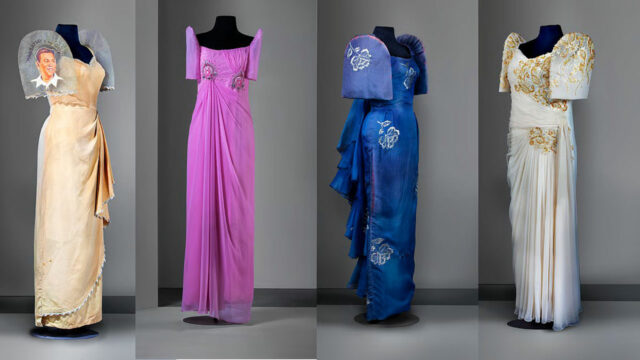
DRESSES from the Magsaysay as Muse: Luz Banzon Magsaysay and the Terno as Cultural Identity Exhibit. — FACEBOOK.COM/BENILDEMEDIARELATIONS

A NUMBER of gowns belonging to a well-loved former first lady are on display at the Magsaysay Laureate Library and Museum at the Magsaysay Center.

The exhibit, titled Magsaysay as Muse: Luz Banson Magsaysay and the Terno as Cultural Identity is presented by the Ramon Magsaysay Award Foundation (RMAF) in cooperation with the De La Salle – College of St. Benilde (DLS-CSB) through the Benilde Fashion Museum (this serves as its inaugural exhibit).

The exhibit runs from Feb. 12 to March 27.

THE MAGSAYSAYS
Mrs. Magsaysay began life as the daughter of the wealthy Banzon family (aside from land holdings, they also owned a transportation company). It was in her parents’ dealings in the transportation industry that she would meet her husband, the future seventh president of the Philippines, Ramon Magsaysay. The legend of Mr. Magsaysay’s common touch with the people started here, where he worked as a mechanic and a shop superintendent.

They married in 1933, and saw out the Second World War together, when Mr. Magsaysay found his first taste of leadership in the guerrilla forces against the Japanese. Mr. Magsaysay ran for Congress after the war, then was appointed to government posts (he was also secretary of National Defense).

Mr. Magsaysay won the presidency in 1953, and was remembered for land reform, his solution to the Hukbalahap rebellion, and encouraging closer ties with Southeast Asian neighbors — not to mention bringing the office of the president closer to the people. Sadly, few people remember this life, overshadowed by his sudden death in a plane crash in 1957.

Mrs. Magsaysay, according to her grandson, Br. Mike Valenzuela FSC, in an interview during the exhibit’s opening on Feb. 12, “wanted to vanish from the public eye after my grandfather died.” He pointed out that not many people knew she still lived, until her death was reported in 2004.

THE WOMAN IN THE DRESS
Behind the dignity of office though, her grandson Mr. Valenzuela remembers a different woman: one who talked to reformed assassins, drank a beer every night for health reasons, and had tuyo (dried fish) for breakfast.

Asked if he remembers his grandmother as particularly fashionable, he told BusinessWorld, “How do I say it? She knew what quality was. She respected it. But she was not one to run (after it)… it did not obsess her in any way.”

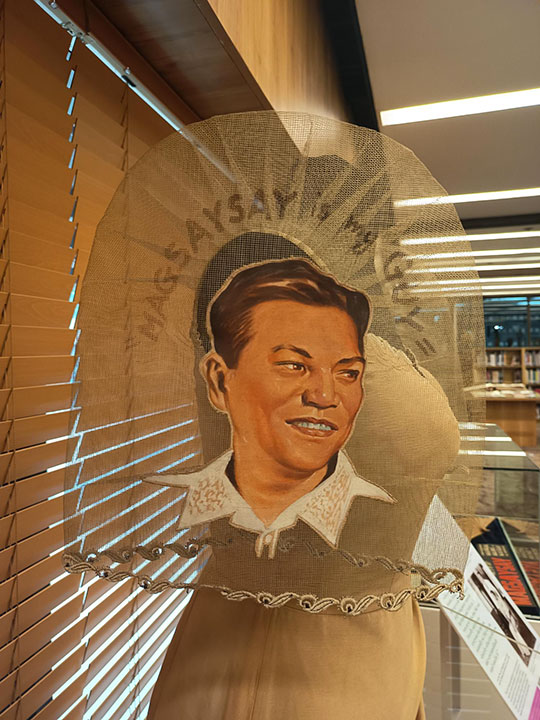
A white Ramon Valera terno in the exhibit, he pointed out, was worn by her several times at the Ramon Magsaysay Awards ceremonies. Meanwhile, a poignant terno stands out: one not made of the fine silks she wore in office. She wore it during the campaign, with her husband’s face and slogan (“Magsaysay is my Guy”) emblazoned on the sleeves. Mr. Torres says that it had a tag: “Lina’s,” possibly an off-the-rack or made-to-order item from a lesser-known designer.

“She was very simple,” Mr. Valenzuela recalled, and, vanishing from the public eye in her widowhood, “she became a recluse.”

“She wasn’t one to collect,” he said about the gowns donated by his mother. “She didn’t have that much money in the first place,” he added. “She actually lived with an insecurity about money,” he said. It is a credit to her husband’s legacy then, that several people pitched in to help after his death: a grand house she lived in after the Malacañang years, for example, was a gift from the Ortigas family. “When my grandfather died, the goodwill was so great that everyone wanted to support her.”

“One thing I remember is, whenever she goes out in public, she was always dressed,” he said. “For her, she believed that even though my grandfather died, she was carrying his legacy.”

He recounted a story that every Sunday, Mrs. Magsaysay visited her husband’s grave, and almost always saw another man there. “She was always very gracious with anyone who came, rich or poor,” he said. Befriending him, she found out that he was one of the rebels her husband had pardoned — he had been an assassin — yet they chatted like old friends, he said. “My grandmother had a gift: she could talk to anyone. She never thought of herself as a grand person.”

THE TERNOS
Gerry Torres, Benilde Fashion Museum’s director and the exhibit’s curator, took guests around the library to show Mrs. Magsaysay’s ternos. They show a distinctly postwar silhouette, closer to its final form than the traje de mestiza of the 19th century that it came from.

The traje de mestiza was a complete ensemble that included a panuelo (a fichu), a skirt, and a camison (a blouse) with pagoda sleeves. Later changes in fashion melded these elements into one by the postwar period, with the sleeves rising to become half-moons (popularly called the butterfly sleeve).

Mr. Torres, during his tour, credited this change to the popularity of the zipper. While the zipper was invented earlier, one of the first few designers to use it was Elsa Schiaparelli, and it only achieved mainstream fame after the war (perhaps after seeing it used efficiently in military gear).

Eight ternos are on exhibit: seven of them come from a bequest by her daughter, Milagros Magsaysay, while one is from the archives of the RMAF.

One of the earliest ternos in the collection was a white one by Ramon Valera, the first National Artist for Fashion Design in the Philippines. Mr. Torres pointed out the mastery in draping, almost like that seen in classical Greek marbles, and the intact beadwork.

Another dress showed the rising pan-Asian identity in a shimmering olive green, an early Thai silk, decorated with gold bands.

One blue terno had a sash running through grommets at the bustline.

One notes Mrs. Magsaysay’s age through the dresses: as a young, energetic first lady in the 1950s, her ternos are cinched at the waist. “It helped a lot that she had a slender figure, which made her ideal for most fashion designers,” said Mr. Torres in a speech, estimating that Mrs. Magsaysay might have had a 25-inch waist.

After Ramon Valera’s death in 1972, she switched her patronage to Aureo Alonzo (who died in 2014). The vicissitudes of fashion and her own age prompted Mr. Alonzo to lift the bodice up from her waist to her bustline (turning her silhouette into the then-fashionable empire waist).

According to Mr. Torres, Mrs. Magsaysay was one of the most prominent figures in the 1950s to wear the terno, as the country’s first lady. He credits this enthusiasm for native dress to postwar and post-independence nationalism, pointing out that her husband was the first Filipino president to wear the barong Tagalog at his inauguration.

“I believe that she was also trying to echo what her husband, President Ramon Magsaysay wanted to say: that we are going to rebuild our country after the war. Part of it was to establish identity as a nation, and as a people.”

CONSERVATION
One terno, in a deep blue silk organdy and embroidered with silver flowers — and unfortunately damaged — prompted Mr. Torres into a discussion of the difficulties of displaying clothing in a museum.

There’s the problem of proper dress forms, for example: the ones available commercially are much too large to accommodate the smaller ladies of the past, and they have to be padded and custom-fit to specifications of the past, according to him.

Secondly, the dress forms themselves kill the dress. “When you put a compromised garment vertically on a mannequin, it actually adds to the stress of the clothes,” he said.

He cited an exhibit at New York’s Metropolitan Museum of Art’s Costume Institute called Sleeping Beauties, where heavily damaged garments were laid to “rest” for the exhibit, laid flat to reduce stress on the clothes — a possible solution for the future museum. That’s one of the reasons for the exhibit’s short life – it only runs for about six weeks. “You cannot exhibit clothing for too long,” Mr. Torres said during the tour. “You have to keep it for twice the time that you (bring) it out.”

The Benilde Fashion Museum, currently still in construction at the former Mayflower Apartments, the old Instituto Cervantes building, on Leon Guinto St., corner Estrada in Malate, Manila, is yet to have a firm opening date, Mr. Torres told BusinessWorld. But he said it is slated to open this year, hoping to show a sampling of the museum’s collection by the last quarter of this year.

Among the collections to be included in the museum are gowns used by another first lady, Leonila Garcia (wife of President Carlos P. Garcia), and gowns from the collection of murdered socialite and TV host Elvira Manahan. The gowns are meant to be studied by the students in Benilde’s fashion design and merchandising program — and the rest of the country. “We hope to show them to our students, for them to study, and perhaps they could get inspiration from what they see,” said Mr. Torres.

“We are cultivating the next generation of fashion designers.”

The Magsaysay exhibit will be accompanied by talks: “The Lady Behind the Terno” about Mrs. Magsaysay’s life on Feb. 19, a talk about the Benilde Fashion Museum’s conservation efforts on Feb. 26, and one about Ramon Valera on March 26, all at 2 to 4 p.m. at the Magsaysay Center. The Magsaysay Center is at the corner of Roxas Blvd. and Quintos St. in Malate, Manila. — Joseph L. Garcia


Double feature

The updated Honda CR-V was recently launched at the Glorietta Palm Drive Activity Center in Ayala Center, Makati. — PHOTO BY PABLO SALAPANTAN

Honda PHL unveils updated CR-V, 30th-anniversary City

IT’S JUST the second month of 2026, and the automotive industry is already in full swing here. Among those taking the lead is Honda Cars Philippines, Inc. (HCPI), which had a relatively quiet 2025. With brands obviously trying to “box out” each other for more market share in 2026, HCPI has thrown in two new challengers in very competitive segments.

CENTER STAGE WITH 2026 CR-V
The Honda CR-V is one of the most recognizable nameplates worldwide. Since its launch in the ’90s, it has become a symbol of what makes a versatile crossover/SUV, and some say it is the definitive Honda — alongside the Civic, of course. This year, Honda is updating the CR-V and reshuffling the lineup.

Before we get to what’s new, let’s talk about the new variants. There are now two CR-V e:HEV (hybrid) models, the range-topping RS AWD and a mid-variant VX front-wheel drive. Gone is the AWD Turbo; in its place is a regular front-wheel-driven turbo variant called the 1.5 V Turbo HuNT. The engine is carried over from the previous models, but the power plant now boasts incredible fuel-efficiency numbers. The VX e:HEV posts 29.4kpl and the RS AWD e:HEV comes in with an impressive 21.3kpl. These figures are based on UNR-101 test results, shared HCPI.

The looks for the 2026 CR-V remain generally the same, with more changes taking place in its tech features. Blind Spot Information and Cross Traffic Monitor are now standard across all variants. The RS and VX models get an HUD (head-up display), allowing the driver to focus more on the road ahead. Also exclusive to the RS and VX is the Individual Driving Mode, which allows the driver to personalize the car with stored preferences. Bolstering the Honda Connect system is the Google Built-in suite, which enables hands-free voice control across the whole model range.

Here is the new CR-V’s suggested retail pricing and the introductory pricing in effect until April 30.

The new Honda CR-V is available in four colors across all grades: Platinum White Pearl (for additional P20,000), Meteoroid Gray Metallic, Crystal Black Pearl, and Canyon River Blue Metallic.

CITY TURNS 30
It’s hard to believe that the Honda City was actually first introduced here in 1996, and we’ve seen three generations (five overall, if you’re counting the two before 1996) and countless face-lifts, updates, and special-edition models.

Accompanying the launch of the revised CR-V lineup was the reveal of the special-edition, 30th-anniversary City. Both the sedan and the hatchback versions of the City will get this limited treatment even as they retain the same features and powertrain. The sedan 1.5 S CVT Honda Sensing will get a Pearl White exterior color and additional black accents — for a total package price of P1.039 million.

The Hatchback will have more aesthetic goodies apart from the Pearl White color — like a black Honda badge and City emblem, front under spoiler, front center garnish, front fog garnish, tailgate, spoiler garnish, extended rear Bumper, exhaust pipe finisher, and rear under spoiler. The City Hatchback 1.5 RS CVT is priced at P1.279 million.

New high-value crop offices to focus on export items, coffee

REUTERS

THE Department of Agriculture (DA) said it is reorganizing its high-value crops program by establishing three offices dedicated to exportable items, coffee, and commodities for domestic consumption.

Agriculture Secretary Francisco P. Tiu Laurel, Jr. told reporters that the reorganization had been planned last year, but was waiting on clarity on budget availability.

“Only in January could we act on it. We were just waiting for the DA’s budget, which was released on Jan. 10. It was only after that that we were able to decide how much would go to each office,” he said on the sidelines of the P20 rice program launch in San Juan City on Friday.

Mr. Laurel said that while the DA continues to concentrate resources on certain staple crops, programs for high-value crops had been managed under a single, broad program.

“We concentrate heavily on rice, sugar, corn, and coconut. But high-value crops were too broad and all under one roof. What we did was create more focus on individual sets of commodities,” he said.

Mr. Laurel said the reorganization will also help address consumer prices for high-value crops sold domestically, such as tomato, ginger, potato, chili pepper, and mung beans.

On Feb. 2, Mr. Laurel signed Department Order No. 2, which created the Coffee Industry Development Office (CIDO), tasked with tackling challenges in the coffee sector.

CIDO will be addressing outdated farming practices, ageing farmers, and limited infrastructure and equipment in the coffee industry.

Philip C. Young, Agriculture assistant secretary for export development, earlier told BusinessWorld that DA is finalizing the functions, structure, personnel, and budget requirements for the new office for export-oriented high-value crops, which he will head.

“It’s under organization, that new office, but we are already preparing some framework and program for the commodities,” he said. — Vonn Andrei E. Villamiel

Debt yields slip on policy easing bets

YIELDS on government securities (GS) traded in the secondary market were mixed last week as players preferred to stay on the sidelines before the Bangko Sentral ng Pilipinas’ (BSP) first policy meeting for the year, weighing shifting rate expectations.

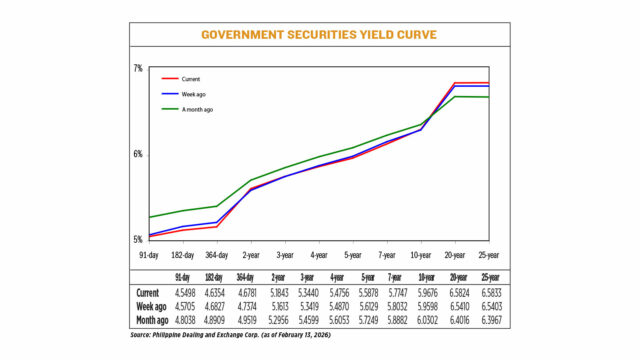
GS yields, which move opposite to prices, inched down by 0.68 basis point (bp) on average week on week, based on PHP Bloomberg Valuation Service Reference Rates data as of Feb. 13 published on the Philippine Dealing System’s website.

At the short end of the curve, yields on the 91-, 182-, and 364-day Treasury bills (T-bills) fell by 2.07 bps, 4.73 bps and 5.93 bps week on week to 4.5498%, 4.6354% and 4.6781%, respectively.

At the belly, rates were mixed. Yields on the two- and three- year Treasury bonds (T-bonds) went up by 2.3 bps (to 5.1843%) and 0.21 bp (5.344%), respectively, while those for the four-, five-, and seven-year bonds went down by 1.14 bps (to 5.4756%), 2.51 bps (5.5878%), and 2.85 bps (5.7747%), respectively.

On the other hand, at the long end, yields rose across all tenors. The rates of the 10-, 20-, and 25-year debt increased by 0.78 bp (to 5.9676%), 4.14 bps (6.5824%), and 4.3 bps (6.5833%), respectively.

GS volume traded reached P60.76 billion, higher than the P46.61 billion recorded a week earlier.

“Yields moved fairly unchanged from [the previous] week amid market uncertainty over the possible BSP decision next week,” a bond trader said in an e-mail.

The trader said players reacted to BSP Governor Eli M. Remolona, Jr.’s latest policy hints. Last week, the BSP chief said that a rate cut is possible at the Monetary Board’s Feb. 19 meeting amid stalling economic growth, but reiterated that price stability remains their primary mandate and their easing cycle is nearing its end.

The BSP is widely expected to lower benchmark interest rates at its policy meeting on Thursday to support domestic demand and prop up the economy as inflation remains benign.

All 16 analysts in a BusinessWorld poll expect the Monetary Board to deliver a sixth straight 25-bp cut this week, which would bring the policy rate to 4.25%.

The central bank has lowered interest rates by a total of 200 bps since August 2024.

Key US economic data releases last week on employment and inflation also affected GS yield movements, the trader added.

“The latest data print in the US solidified views that the Federal Reserve cuts might be delayed further as the US labor situation appeared to have stabilized from last year’s dismal picture and inflation still remains above the US central bank’s 2% target.”

Meanwhile, Alessandra P. Araullo, chief investment officer at ATRAM Trust Corp., said last week’s yield movements were primarily driven by the strong demand for the Bureau of the Treasury’s (BTr) T-bond auction last week.

“The seven-year FXTN 10-71 auction surprised on the upside, drawing over P80 billion in tenders, translating to a solid 2.6x bid-to-cover. Awards were printed within the 5.8% to 5.875% range, averaging 5.859%, reflecting healthy appetite despite the recent backup in yields,” she said in a Viber message.

“In the secondary market, we saw some afternoon selling pressure in the five- to 10-year sector as dealers lightened positions to create room for [this] week’s jumbo 10-year supply. However, this was met by opportunistic buying into the close, allowing yields to finish broadly unchanged. Overall, demand remains constructive, but positioning is turning more tactical ahead of heavy supply.”

The BTr will hold the rate-setting auction for its new 10-year benchmark bonds on Wednesday. It plans to raise at least P30 billion from the offering, which also has a bond exchange component.

For this week, the market will monitor the 10-year bond auction, Ms. Araullo said, with rates expected to be within 5.9% to 6%.

“At the same time, the Bangko Sentral ng Pilipinas is scheduled to hold its first policy meeting of the year, with consensus leaning toward a 25-bp rate cut. Beyond the cut itself, market focus will be on forward guidance specifically whether the BSP signals further easing ahead or hints at a pause to reassess inflation and currency dynamics,” she added.

“Market participants are likely to remain on the sidelines due to caution ahead of the BSP policy decision, which is still mum in its possible decision whether to hold or reduce interest rates further,” the bond trader said.

The trader added that the market will wait for the release of minutes of the US Federal Reserve’s latest meeting for potential hints on their policy path.

“External drivers remain a key swing factor. Upcoming US labor and inflation data could influence global rates and spill over into local bond movements, especially in the belly and long end of the curve. Positioning is likely to stay cautious, with players balancing domestic easing expectations against global yield volatility,” Ms. Araullo said. — Abigail Marie P. Yraola

Unprogrammed Appropriations’ danger was dormant — until it became the alibi

DSWDCASHASSISTANCE.PH

For decades, the Unprogrammed Appropriations (UA) quietly occupied a small, mostly irrelevant corner of the national budget. Its fiscal triggers — excess revenues, new revenue sources, or unprogrammed loan proceeds — rarely materialized. UA was tolerated because it was small (2-5% of the budget) and seldom used.

The constitutional objection — that the UA delegated to the Executive Congress’ power of appropriation — was acknowledged but treated as manageable. The sums were modest, and UA was practically dormant.

Then everything changed.

CONVENIENT STORY
The UA ballooned — and a convenient story emerged.

Between 2023 and 2025, UA ballooned to unprecedented levels:

• P807.2 billion in 2023

• P731.4 billion in 2024

• P363.2 billion in 2025

This expansion should have triggered alarms. Instead, it became the anchor of one of the most misleading fiscal narratives in recent memory.

Legislators and contractors repeatedly claimed that UA funded the sudden proliferation of questionable projects: ghost or substandard flood control works, barangay roads and multipurpose buildings of dubious value, and patronage-driven assistance programs like Ayuda sa Kapos ang Kita Program, Assistance to Individuals in Crisis Situation, and Medical Assistance for Indigent and Financially Incapacitated Patients, better known as AKAP, AICS, and MAIFIP respectively.

It was a clean, convenient explanation.

It was also wrong.

NO TRIGGERS
By rights, the UA could not have been released.

The General Appropriations Act or GAA requires that UA be activated only when strict fiscal triggers are met. From 2023-2025, none of these occurred:

• There were no excess revenues: the Bureau of Internal Revenue and the Bureau of Customs missed targets; the Department of Finance confirmed shortfalls.

• There were no new significant revenue sources: New taxes were either marginal or earmarked.

• There were no certifiable new loan proceeds: Pandemic loans were already programmed.

• There was no documentation: There were no Treasury certifications, no Special Allotment Release Orders or SAROs, no agency requests for UA-funded programs.

In short:

The UA was never triggered. UA was never released.

It could not have funded the projects in question.

So why insist that it did?

Because UA was the alibi — not the source.

ALIBI
Evidence from agency reports, internal communications, and legislative transcripts points to a different, clearer pattern:

1. Legitimate programmed items were cut during the Bicameral Conference Committee — including infrastructure, social services, calamity funds, and even foreign-assisted projects already approved on Third Reading.

2. These displaced items were “parked” under UA, where they appeared alive but were essentially frozen — insiders knew the triggers would never be met.

3. The funds freed from these deletions formed a large discretionary pool, no longer tied to the original programs.

4. This discretionary pool financed the controversial projects — the same ones later claimed to be “UA-funded.”

UA did not pay for the projects.

UA explained them away.

Its size and ambiguity made it the perfect smokescreen for fund movements that occurred elsewhere.

STRUCTURAL VULNERABILITY
A dormant constitutional flaw becomes a structural vulnerability.

For years, the UA’s design flaw — blurring the line between legislative appropriation and executive execution — remained harmless because the UA was small and seldom used.

But once the UA was massively expanded and politically useful as an alibi, that flaw became dangerous. It allowed:

• hidden reallocations,

• opaque fund flows,

• false public explanations, and,

• weakened legislative accountability.

A standby appropriation became a shield for diversion.

THE REAL LESSON: ABOLISH UA
Debates about the UA’s constitutionality now pale beside the threat it has already revealed. The UA is no longer benign. It has become a tool for confusion, opacity, and evasion — a ready-made alibi for irregular spending.

It must be abolished.

Not only because it fails constitutional standards, but because it has already shown how easily it can distort the budget and obscure the truth.

The UA is no longer a harmless standby authority.


Atty. Florencio “Butch” Abad served as vice-chair/chair of the House Committee on Appropriations (1995–2004) and secretary of Budget and Management (2010–2016). He is currently professor of Praxis at the Ateneo School of Government.

PDEx aims to match last year’s bond issuance value

STOCK PHOTO | Image by Jannoon028 from Freepik

THE Philippine Dealing and Exchange Corp. (PDEx) aims to match the value of bond issuances reached last year, amid delayed listings from 2024, its top official said.

“We’re hoping to reach at least P454 billion, because at the very high in 2022 we had P509 billion. So, we’re hoping to at least reach that. We wished that last year, but there were some issuers that were supposed to do it last year,” PDEx President Stephanie Marie A. Zulueta told reporters on the sidelines of an event on Friday.

Primary market listings increased by 25% to P454 billion last year from P362.23 billion in 2024, with 46% of these being environmental, social, and governance (ESG)-themed issuances.

“I think we’re hoping that we could reach at least the same levels or more,” Ms. Zulueta said. “We’re hoping that those that listed a few years ago should be refinancing, and we’re positive with the shelf registration that they will avail of it.”

ESG issuances are expected to remain a dominant theme this year, she said, following the listings of sustainability bonds by BDO Unibank, Inc. and Bank of the Philippine Islands (BPI), as well as Land Bank of the Philippines’ (LANDBANK) upcoming issuance this week.

“We’re hoping and are positive that it will be better or the same as the 46% of the issuances [last year].”

BDO on Jan. 26 raised P100 billion from its fifth issuance of three-year ASEAN Sustainability Bonds following strong investor demand, 20 times its original P5-billion offer.

BPI on Friday announced it had raised P50 billion from its latest offering of social bonds, marking its largest peso debt issuance to date. This was 10 times the initial P5-billion target size for the two-year Supporting Individuals Grow, Lead, and Achieve (SIGLA) Bonds.

Meanwhile, LANDBANK on Jan. 28 began the public offer period for its dual-tenor sustainability bonds, from which it is seeking to raise at least P30 billion through Agriculture, Sustainability, Environment, and Socioeconomic Development (ASENSO) Bonds at 5.1714% per annum for the 1.5-year Series B tranche and 5.5615% per annum for the three-year Series C papers.

Ms. Zulueta said she is also looking forward to new entrants in the bond market, regardless of the size of their issuance.

“I don’t know if it’s substantial but any new player coming in is always positive.” — Aaron Michael C. Sy

From Givenchy to Uniqlo

Trying on Uniqlo’s latest collection from Givenchy’s former artistic director

CLARE WAIGHT KELLER isn’t exactly a household name, but on an “if you know, you know” basis, she was just the artistic director of haute couture and ready-to-wear at Givenchy, and the first woman in that role.

Ms. Keller, who left Givenchy in 2020 (but not before designing the Duchess of Sussex’s wedding dress in 2018), has been collaborating with Uniqlo since 2023, through a line called Uniqlo:C. In her latest offering for Spring/Summer 2026, she shows dramatic possibilities in everyday wear.

Uniqlo Philippines held a try-on (that is, actually trying the clothes on at the store) on Feb. 10 at the Uniqlo Philippines global flagship store at Glorietta 5.

The silhouettes are certainly relaxed, and the colors more so: think drab neutrals and dusty lilacs and blues. According to a release, “Soft shades of powder lilac and sky blue introduce a sense of lightness to the season.” Crowd favorites that day were the flats: a sexless almost-clog in a brown approaching aubergine, black, and taupe (one of the colors has already sold out).

We also saw long coats without lapels, as well as a shorter coat meant for sportswear. The shorter coats, with a zipped neckline that could be closed halfway for a dramatic, face-framing effect, have concealed drawstrings that can cinch the waist for an invisible slimming effect. There’s also a tan twill suit (actually matching separates: a jacket and Uniqlo’s Easy Wide pants). We also liked a series of zip-up sweaters, with white piping. In scarlet and navy blue, they also have that dramatic face-framing effect on the collar.

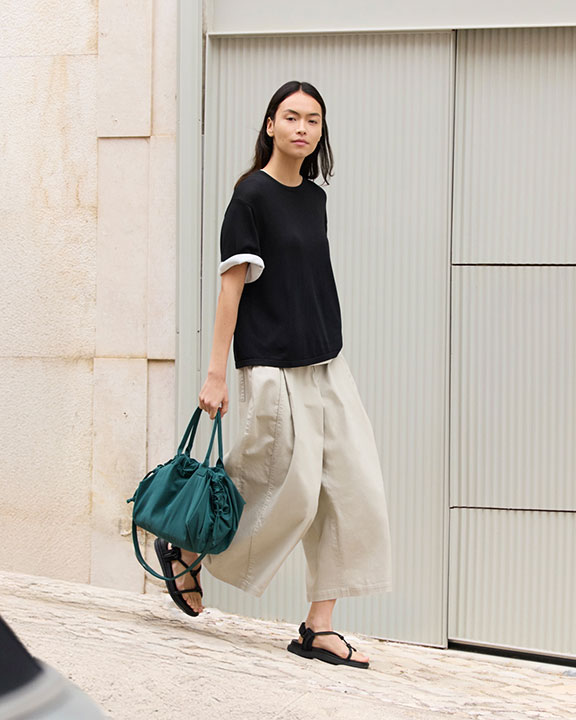
A highlight of this collection is in a series of culottes (those pants/skirt hybrids). In pleated cotton, they come in brown, white, and black; and a more relaxed version in blue denim. The collection is wrapped up with a selection of wraparound glasses (think ski goggles) and Y2K-reminiscent tiny spectacles.

Ms. Keller said, “For this collection, I wanted to focus on how clothes feel as much as how they look. Comfort comes through in the softness of the fabrics and the ease of the cuts, creating an urban wardrobe designed to move naturally through everyday life. There’s a strong unisex spirit, with styling built around fluid layering and a palette of colors that naturally complement each other.”

The Uniqlo:C collection is available in-store and online, with a special website (https://tinyurl.com/ca6nsu2c). — JL Garcia

Haval H9 aims high

The GWM Haval H9 is priced at P1.928 million. — PHOTO BY PABLO SALAPANTAN

GWM brings in new midsize SUV

By Pablo Salapantan

I’VE ALREADY gone on the record to say that the GWM Haval H9 is one of the best Chinese-made cars I’ve ridden and driven in recent memory. In a previous article on “Velocity,” I laid out just how impressive it was on one of the most challenging off-road experiences ever concocted. With that experience seared onto my memory forever, I’m happy to report that the very same car is now officially available in the Philippines.

GWM pulled out all the stops for the launch of the H9, which was done at the Lakehall in Sta. Elena. The guest list was also expansive, giving more a chance to see and experience the car.

Present during the event were representatives from GWM China headlined by GWM International Vice-President James Yang and local executives — underscoring just how important this release is. To refresh everyone’s memory, the GWM Haval H9 is a seven-seater diesel-sipping SUV that — in terms of size, capabilities, and features — directly challenges the players in the hotly contested three-row, midsize SUV segment. In other words, the H9 is going toe-to-toe with the Toyota Fortuner, Ford Everest, Mitsubishi Montero, and Nissan Terra.

Powering the H9 is a very capable and smooth 2.4-liter turbodiesel engine that makes a very decent 186hp and 480Nm of torque. The transmission is a nine-speed automatic unit, and power is sent to all four wheels. Yes, this is a true off-road and on-road SUV. In terms of looks, the H9 displays a good blend of the familiar retro boxy profile with modern sculpted panels. Most would say it looks like some contemporary SUVs, but nobody can say it’s a copy. I’d say the H9 appears to have its own identity.

Inside, the GWM Haval H9 is a modern car through and through. It comes with supple leather-covered seats and soft touch panels everywhere — not to mention the customary technological features, such as a 10.25-inch instrument cluster and 14-inch infotainment screen that also displays the feed from a 540-degree camera. You can pair your mobile device via Apple CarPlay and Android Auto.

All of this comes at an astonishingly affordable price of just P1.928 million. GWM says that no other seven-seater 4×4 SUV that’s diesel-powered comes close to offering as much value as the H9.

It’s easy to dismiss the GWM Haval H9 as just another entry in a long line of Chinese-made products, but GWM Philippines Brand Head and Marketing Director Dax Avenido begs to disagree. He told us during the launch that the H9 “offers a rare combination of true 4×4 capability, premium features, and exceptional value.” Furthermore, he said that no other SUV in the same segment offers as much value as the H9.

Mr. Avenido was also keen to point out what makes GWM stand out compared to the other Chinese automakers. “GWM differentiates itself through a strong emphasis on engineering depth, long-term quality, and global competitiveness,” he asserted.

ADVERTISEMENT
ADVERTISEMENT