Home Blog Page 2789

Filipinos worry about finances despite income rise

FREEPIK

FILIPINOS remain concerned about their household finances despite seeing increased incomes, a study by TransUnion showed.

“Although more Filipinos enjoyed increased household incomes in Q2 2024 and expect this trend to persist in the next 12 months, the adjustments they made to household budgets suggest a cautious approach to financial management,” TransUnion Principal of Research and Consulting for Asia Pacific Weihan Sun said.

“This seemingly contradicting sentiment suggests a vigilant yet hopeful outlook as Filipinos continue to acclimate to economic challenges, navigating between necessary expenditures and financial prudence,” he added.

According to the TransUnion’s second-quarter Consumer Pulse Study, which surveyed 944 Filipino adults, 44% of respondents said they are concerned about their household finances, up from 41% a year ago.

This came despite 42% saying their income grew in the second quarter, higher than the 41% seen in the same period last year.

Optimism about respondents’ outlook on household finances in the next 12 months went down to 80% from 84% last year. On the other hand, pessimistic (8%) and neutral (12%) outlooks edged up.

“The biggest concerns affecting household finances are inflation, job security, and interest rates,” TransUnion said.

In the second quarter, nearly half or 47% of households cut back on unnecessary spending such as dining out, travel, and entertainment, while 22% increased their expenses for these.

Spending on digital services was mixed, with 24% canceling or reducing services, while 26% added or expanded services. Meanwhile, 21% canceled memberships and 15% added new ones.

“These adjustments reflected a cautious approach to managing household budgets amid economic uncertainties, highlighting the delicate balance households strive to maintain between necessary expenditures and discretionary spending,” TransUnion said.

This quarter, Filipinos expect an increase in discretionary spending, with more than half or 52% of respondents saying they expect more bills and loans, while 39% said they foresee increased retail shopping.

Medical spending (43%) and large purchases (29%) are also expected to rise in the coming months, the survey showed.

“These projections indicate a cautious but hopeful outlook as households navigate the balance between necessary expenditures and financial prudence,” TransUnion said. “The data underscore a resilient consumer base adapting to economic challenges while maintaining a forward-looking financial health and spending perspective.”

CREDIT ACCESS STILL AN ISSUE
Meanwhile, Filipinos were unsatisfied with the level of credit access in the second quarter, with only 38% saying it was sufficient for their needs.

The report showed that 63% of respondents said credit access was extremely or very important, up from 56% in the second quarter last year.

Consumers’ intention to apply for new or refinance existing credit rose to 54% in the second quarter from 45% a year ago. Meanwhile, confidence in approval for credit or lending products saw a modest increase to 53% from 51%.

The frequency of credit report checks among Filipinos was stable, as 25% said they checked monthly, 27% weekly, and 15% daily, indicating consistent engagement with monitoring, TransUnion said.

However, respondents gave mixed answers on the importance of credit monitoring, with 34% saying it was extremely important, 38% saying it was very important, and 14% saying it was moderately important.

Meanwhile, 15% said they thought their credit scores would improve significantly in the future, while 38% said it would increase somewhat, and 24% expected no change.

“Consumers’ perceptions of how their credit scores would change if businesses leveraged non-standard credit information also shifted,” TransUnion said.

On the other hand, online transactions in the second quarter were stable from the previous year, with only 8% (up from 7%) saying did they not make any transactions.

Those who said they transacted around 1%-25% of the time online decreased to 34% from 36%, while those who transacted around 25%-50% online went up to 34% from 33%.

Respondents who said they transacted 51%-75% online rose to 19% from 18%. Lastly, those who transacted digitally 76%-100% were steady at 5%.

RISING FRAUD ATTEMPTS
While Filipinos who were unaware about or victimized by fraud attempts decreased, smishing attempts picked up as bad actors find new ways to attack consumers, TransUnion added.

“Although the number of respondents unaware of fraud and those victimized remains relatively stable, smishing attempts have increased, indicating that fraudsters are diversifying tactics to target unsuspecting consumers. With a slight increase in successful attempts to defraud consumers, robust consumer education efforts on fraud prevention must continue to further build consumer awareness. Consumers are also encouraged to take more protective measures in closely monitoring their credit and finances to secure against the growing threats not only in the Philippines but across the world,” Mr. Sun said.

Some 30% of respondents said they were unaware of being targeted by any fraud schemes, steady from 31% in the previous year.

Meanwhile, 60% said they were targeted but did not fall victim to fraud, while 10% admitted to being targeted and becoming victims, up slightly from 9% the previous year.

Phishing was the most common form of fraud attempts seen by respondents at 51%. Smishing, which are text messages that aim to acquire sensitive data from targets, rose to 44% in the second quarter from 40% last year. Money or gift card scams (36%) and third-party seller scams on legitimate online retail websites (31%) were steady during the period.

“These findings highlight the diverse and evolving nature of fraud schemes through various channels and methods,” TransUnion said.

Meanwhile, there was a slight increase in respondents who expressed concern about sharing their personal information at 89% from 88% previously.

“Some responses were neutral (8%, up from 9%) while fewer (3%) said they were not concerned,” TransUnion said.

In terms of reasons for concern, respondents cited identity theft as the top cause of fear at 73%, followed by unsolicited marketing communications (42%), government surveillance (23%), and personal invasion of privacy (78%).

“While the overall level of concern remained high, there was a small but notable shift in the specific reasons behind these concerns. The data underscore the importance of robust identity protection measures and consumer education on fraud prevention. As fraud schemes evolve, consumers must remain vigilant and proactive in protecting their personal information,” TransUnion added. — A.M.C. Sy


ACEN sets 2027 goal for Laguna Lake floating solar projects

AYALA-LED ACEN Corp. targets to have its five floating solar power projects in Laguna Lake, with a combined potential capacity of 1,120 megawatts peak (MWp), start supplying power to the Luzon grid by 2027.

The large-scale floating solar project in Laguna Lake is estimated to have a combined project cost of nearly P48 billion, based on its filings with the Department of Environment and Natural Resources – Environmental Management Bureau (DENR-EMB).

“The schedule may be subject to change depending on other factors that may occur during the implementation of the project,” ACEN said.

In August last year, ACEN and its subsidiaries signed a renewable energy contract area utilization agreement with the Laguna Lake Development Authority (LLDA) to lease 800 hectares of renewable energy areas in Laguna.

SolarAce4 Energy Corp., AC Laguna Solar, Inc., AC Subic Solar, Inc., GigaWind 1, Inc., and Ingrid 2 Power Corp. received notices of award from LLDA in July 2023.

“This initiative is a tangible opportunity for ACEN to adopt new technologies, contribute to the Luzon grid, and bolster the Philippines’ energy self-sufficiency while tackling the critical issue of climate change,” ACEN President and Chief Executive Officer Eric Francia said in a statement last year.

In 2023, the Board of Investments granted green lane endorsement to the five floating solar power projects, which will expedite permit and license issuance, including resolving strategic investment issues.

SolarAce4 is expected to produce 140 MWp of power, with an estimated project cost of P6.25 billion. AC Laguna will generate 280 MWp and will probably cost nearly P11 billion to construct. AC Subic, with a combined cost of P12.5 billion, is set to deliver 280 MWp of power.

ACEN is targeting to start the construction of these floating solar power projects by the third quarter of 2025.

Ingrid 2 is set to produce 140 MWp at a project cost of P6.2 billion. Construction is eyed to begin by the first quarter of 2026.

GigaWind 1 is targeted for construction by the second quarter of 2026. The project has an estimated total cost of P12 billion and is expected to produce 280 MWp of power.

ACEN said that the construction of the proposed projects will commence upon receipt of the environmental compliance certificate from the DENR-EMB and related permits from the concerned local government units and government agencies.

The GigaWind 1 and Ingrid 2 floating solar projects went through public scoping this month. It is an early stage in the environmental impact assessment process where the proponents will provide an overview of the proposed projects and gather issues and concerns.

AC Subic, SolarAce4, and AC Laguna solar projects are scheduled for public scoping next month.

ACEN currently holds about 4.8 gigawatts (GW) of attributable renewables capacity in operation and under construction, as well as signed agreements and won competitive tenders worth over 1 GW.

At the local bourse on Wednesday, shares fell by 1.27% to close at P5.46 each. — Sheldeen Joy Talavera

Questions and answers

FREEPIK

QUESTIONS and answers are part of our daily lives. What are conversations and social interactions, after all, but a series of interrogative statements followed by declarative responses? Public personalities deal with questions all the time. They don’t always provide answers.

Celebrities from the arts, business, and politics are used to being interviewed on both social and traditional media.

The questions may be submitted ahead of time to give some assurance to the subject that the interview will not be a hostile encounter. Of course, not all parties stick to the script. It’s too boring to be following unconnected questions from the host. The aim is to project a conversation where questions and answers flow naturally, sometimes in unforeseen directions.

The objective is for the host to make the subject comfortable onscreen by throwing soft lobs — so, your hobby is collecting poisonous snakes, Sir? Where do you get them and what do you do when it floods?

There are questions that do not seek information or even a sober response. These are rhetorical in nature. Legislative inquiries both here and abroad bristle with rhetorical questions — Do you think your Secret Service did a good job in protecting your subject when a 20-year-old sniper with unknown motives fired five shots in his direction, with one hitting the ear of your protectee? The dodging of questions (or accusations) can be handled by dilatory tactics — The investigation is still ongoing. Or a resignation may be submitted the following day.

In a job interview, questions are intended to elicit information for proper evaluation.

The query can be very general — tell me about yourself in five minutes. Without giving a PowerPoint presentation, the applicant may choose to just give an account of his work experience, especially if coming from a competitor company. (I was the one who ate up your market share by launching a price war that bankrupted my former company. This is why I am applying with you.)

Job interviews are intended to evaluate the qualifications of a candidate. The questions must be answered. The job applicant tries to anticipate what answers will add value to her prospects of being hired. This is especially true for a high position where the need for the job must be balanced with a token reluctance — I’m happy in my present job.

There are questions that seek simple directions. If one is lost in the lobby of a hotel in a foreign country and looking for relief, one can approach a passing bellhop — where is the CR? Instantly, the hotel staff will figure that this is a guest from the home country and reply in the vernacular — doon po.

Spokespersons are one type of respondent. They are asked questions for which the answers are either unavailable to them, or not yet for public consumption. Maybe, a narrative hasn’t been agreed on yet. This happens when the object of inquiry is unavailable as she is traveling abroad for a pop concert while a natural disaster has visited her country.

It is difficult to determine on the spot what the “official line” is going to be. The photo of the subject in a T-shirt makes avoiding the question impossible. A delaying tactic may entail not answering the buzzing phone. Or coming up with a demurral — she is using her personal artificial intelligence funds.

What about televised debates by contenders for public office?

Is a debate possible when only prepared scripts are replayed over and over, dancing away from addressing issues brought up by the moderators? One candidate may merely dismiss some controversial issue with a shrug — this question has been brought up time and time again like a nagging headache. (So, what is your answer, Sir?)

Political debates now seem to be optional. Those who feel they have everything to lose and nothing to gain simply skip the process and opt for a more friendly political rally, where even the old lines can get a rousing reception. Debates are too risky. Mistakes are played repeatedly.

In social situations, especially when meeting a person for the first time, questions are meant to establish connections and good vibes. Open-ended questions (How’s your health?) are bound to elicit either a shrug or a long-winded chronology of events and costs — providing too much information.


Tony Samson is chairman and CEO of TOUCH xda

ar.samson@yahoo.com

Bourse lifts DHI trading suspension

THE PHILIPPINE Stock Exchange (PSE) on Tuesday lifted the suspension on trading of Dominion Holdings, Inc. (DHI) shares after the company complied with regulatory requirements.

“The trading of DHI shares in the PSE was originally placed on hold since Jan. 27, 2020 due to a voluntary trading suspension and a Securities and Exchange Commission (SEC) requirement to amend the firm’s registration statement to reflect the change in its primary purpose from leasing and financing business to a holding company,” DHI said in a disclosure to the stock exchange on Wednesday.

“Subsequently, the SEC lifted its Order of Suspension on July 1, 2024, while the PSE resolved to lift the trading suspension of DHI effective Aug. 20, 2024 after DHI filed its Comprehensive Corporate Disclosure,” it added.

DHI submitted its amended registration statement on April 17 and the final updated amended registration statement on June 4. It also paid the filing and other corresponding fees for the petition to lift the order, which DHI filed on June 28.

DHI, formerly BDO Leasing and Finance, Inc., holds or owns real estate properties, securities or shares of stocks, and other assets of other companies.

It also engages in investment and business activities involving these assets.

The change in DHI’s corporate name was approved by the SEC on July 18, 2022 due to a shift in primary and secondary purposes to a holding company from a leasing and financing company.

DHI saw its net income decline by 12.45% year on year to P58.62 million in the second quarter due to lower interest earnings, it reported earlier this month.

This brought its net income for the first half to P134.48 million, up by 7.34% from a year ago as it benefited from the high interest rate environment as well as the reversal of provisions for probable losses on bond investments, which matured in the second quarter of 2024.

DHI shares went down by seven centavos or 3.63% to end at P1.86 apiece on Wednesday. — A.M.C. Sy

US firms warn against ‘unprecedented’ Hong Kong cyber rules

TRUSTPAIR.COM

US FIRMS have warned that parts of a proposed cyber law could grant the Hong Kong government unusual access to their computer systems, highlighting the latest challenge to Western tech giants in the city.

The Asia Internet Coalition, which includes Amazon.com, Inc., Alphabet, Inc.’s Google, and Meta Platforms, Inc., is among the bodies that have in recent weeks sought changes to parts of the legislation that officials say are designed to protect critical infrastructure from cyberattacks. The government, in response to the Bloomberg story, said 52 of the 53 submissions it received about the legislation, including from the coalition, “supported the legislation and made constructive suggestions.”

Critics argue the proposals give authorities overly broad powers that could threaten the integrity of service providers and rock confidence in the city’s digital economy. The local American Chamber of Commerce and Hong Kong General Chamber of Commerce have also submitted letters over the proposed legislative framework to a public consultation.

Two of the three groups flagged the rules — which some were concerned could apply to computer systems outside Hong Kong — as “unprecedented.” One of their key objections was proposed investigative powers that would let authorities connect their equipment to critical computer systems owned by private firms, and install programs on them.

“Such unprecedented power directly intervenes in, and could have a significant impact on, a CIO’s operation and could harm the users of the services,” AmCham wrote in an Aug. 1 letter, referring to critical infrastructure operators. Such a move “is likely to have a chilling effect” on tech investment in Hong Kong, it added.

The government said in a statement late on Tuesday in response to the Bloomberg News report that its proposal “in no way involves the personal data and business information.” The statement added that “relevant legislation already exists in other jurisdictions, such as the Mainland, Macau SAR, the United States, the United Kingdom, Australia, the European Union, and Singapore.”

Hong Kong will only seek out a court warrant to connect to computer systems or install programs in certain circumstances if operators won’t or can’t respond to potential cyber incidents. And the envisioned legislation won’t have “extraterritorial effect” beyond its jurisdiction, according to the statement.

A Google spokeswoman declined to comment on the concerns raised in the Asia Internet Coalition letter. Amazon and Meta didn’t respond to requests for comment.

Officials have said previously the cybersecurity bill is needed to protect the city’s economy, public safety and national security. They propose establishing a new commissioner’s office to oversee the legislation’s implementation.

Many countries have laws to safeguard strategic infrastructure and access networks — for instance, US law enforcement and counterintelligence agencies can conduct wiretaps with court authorization. But it’s rare for government agencies to try and gain access to private networks or information by directly installing software.

“This initiative is vital to ensuring the resilience and security of Hong Kong’s critical infrastructure,” the internet coalition said in a public letter. “The Government should provide assurance that information provided for investigation will be used only for specific use cases (e.g., for investigating a particular incident) and will not be used for other cases and disclosed to third parties.”

While Hong Kong’s internet remains largely free compared to mainland China’s Great Firewall, the city’s top US diplomat in March sounded the alarm over creeping online controls. President Xi Jinping’s crackdown on freedoms in the former British colony has fanned fears about the city’s reduced appeal as a finance hub.

Hong Kong recently showed its willingness to intervene directly with online content in its clash with Google over the hosting of pro-democracy protest songs on YouTube. The government — armed with a local court injunction — forced the American giant to block the videos, giving the city leaders a potent new tool to order the mass removal of content.

The relatively open flow of information in Hong Kong is a key draw for international businesses. Restrictions on Western tech firms and services could hamper efforts to revitalize the city’s image, which took a hit from years of COVID-19 curbs and a Beijing-imposed security law, also criticized as being vaguely worded and too far-reaching.

Under the proposed new cyber rules, companies would need to secure their computer systems and disclose to the government serious breaches within two hours. Fines for offenses could range as high as HK$5 million ($642,000) and would be determined by a court, according to the proposal.

The legislation is likely to be submitted to the city’s Legislative Council by the end of this year and enacted, legal observers say.

While Hong Kong has a legitimate need for new cybersecurity rules, companies will be worried about protecting user data, said George Chen, co-chair of digital practice at The Asia Group, a Washington-based business and policy consulting firm.

“International platforms, especially cloud service providers, are also naturally concerned about the enforcement,” he added. The question will be “where to draw the line between protecting user data privacy and overall cybersecurity concerns.”Bloomberg

Pilmico, Gold Coin rebrand as Aboitiz Foods

PILMICO Foods Corp. (Pilmico) and Gold Coin Management Holdings, Ltd. (Gold Coin), the agribusiness and food subsidiaries of the Aboitiz Group, announced that they have merged under the new brand, Aboitiz Foods.

“This strategic move leverages the combined strengths of these industry leaders to create an integrated agribusiness and food ecosystem dedicated to nourishing Asia’s future across the entire value chain,” Aboitiz Foods said in a media release on Wednesday.

The company added that this move would integrate the company’s value chains throughout the Asian region and optimize its processes.

“We are committed to optimizing all our processes and businesses, constantly improving as we integrate the value chain across Asia for a more sustainable and food-secure future,” Aboitiz Foods President and Chief Executive Officer Tristan S. Aboitiz said.

Pilmico is a local manufacturer of flour, animal feeds, and meat products, while Gold Coin also produces animal feeds outside of the Philippines. 

The Aboitiz Group initially purchased 75% of Gold Coin in 2018 for $334 million and acquired the remaining stake last year.

The company added that the transition would be seamless, with existing operations remaining uninterrupted and benefiting from “enhanced efficiency and product quality.”

“Combining the resources and expertise of Pilmico and Gold Coin, Aboitiz Foods ensures a consistent and dependable supply of high-quality agricultural and nutritional products tailored to each customer’s unique needs,” the company said.

The company now has 29 facilities across eight countries: the Philippines, China, Vietnam, Malaysia, Indonesia, Singapore, Thailand, and Brunei.

“With combined expertise in trading, feed, specialty nutrition, and food production, Aboitiz Foods is strategically positioned to become a dominant force in the region,” it added. — Adrian H. Halili

Taylor Swift closes European leg of Eras tour with new songs

TAYLOR SWIFT

LONDON — Taylor Swift was joined by surprise guest Florence Welch for her first live performance of “Florida!!!” during the final European date of her Eras tour on Tuesday.

The pop megastar also debuted “So Long, London,” a ballad that fans widely believe is about the end of her relationship with British actor Joe Alwyn, in the acoustic section of the show at Wembley Stadium.

Both tracks feature on Swift’s 11th studio album, The Tortured Poets Department, which was released this year.

Welch, of British indie rock band Florence + the Machine, co-wrote “Florida!!!” and sang on the recorded track.

Ms. Swift drew fans from near and far for the last opportunity to see her critically acclaimed show in Europe.

The US singer-songwriter returned to London’s Wembley Stadium last week for five performances following the cancelation of her shows in Vienna, when a planned attack was foiled by authorities.

Some of the 195,000 disappointed fans in Vienna rushed to buy tickets for the London dates on resale sites, where they were changing hands for up to 10 times face value.

Eras, the first concert tour to surpass $1 billion in revenue, showcases all 11 of Ms. Swift’s studio albums in dedicated sections. Her performances and the show’s staging have been praised by critics.

Fans arriving in Wembley, dressed in sequins, cowboy hats, and forearms covered in friendship bracelets ready to swap with other Swifties, faced tight security checks.

While British police have said there was nothing to indicate the events in Vienna would impact any of the shows at Wembley, there was highly visible security at the stadium.

Tay-gating, the practice of gathering outside a Taylor Swift show without a ticket, as thousands did in Munich last month, has been banned, as authorities try to reduce harder-to-control risks outside the venue.

Marie Wright, aged 48, from Limerick, Ireland, bought tickets on a resale site on Monday evening and flew to London on Tuesday with her daughter’s best friend Aoife McCarthy, aged 15. Her own daughter had already seen the show in Dublin.

“She’s going to leave Europe, so we had to come for the last night,” Ms. McCarthy said. “Her songs have real meaning and there’s a poetry to them,” Ms. Wright added.

The tour returns to the United States in October and ends in Vancouver, Canada, in December. — Reuters

FAO: Nearly 6 in 100 Filipinos are undernourished

There are 6.9 million undernourished Filipinos between 2021 and 2023, according to The State of Food Security and Nutrition in the World 2024 by the Food and Agriculture Organization. This translated to a prevalence of undernourishment (PoU) of 5.9% — the lowest share since 5.8% in 2019–2021. The country’s PoU during the period was the third highest in Southeast Asia. It is also lower than the 6% and 9.1% regional and global averages, respectively.

FAO: Nearly 6 in 100 Filipinos are undernourished

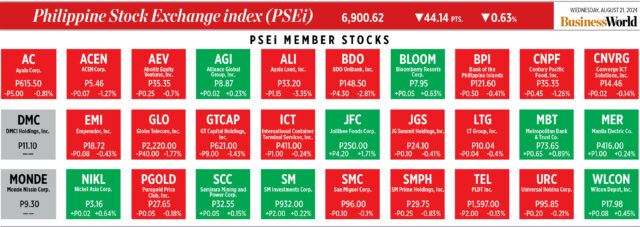
How PSEi member stocks performed — August 21, 2024

Here’s a quick glance at how PSEi stocks fared on Wednesday, August 21, 2024.


Hog farmers press for affordable ASF vaccines

REUTERS

HOG FARMERS are calling for the African Swine Fever (ASF) vaccine to be affordably priced to minimize the impact on their cost of production.

“That’s what we’re asking the Department of Agriculture (DA). In case there is an approved vaccine, we hope the price is not too high,” National Federation of Hog Farmers, Inc. Chairman Chester Warren Y. Tan told reporters on Wednesday.

The DA will conduct a limited rollout of the ASF vaccine procured from Vietnam this quarter, mainly focusing on red zones, or areas with active infections, and pink zones, or those near active areas. A commercial rollout will follow, with official pricing yet to be announced.

It had also procured 10,000 doses of the vaccine for emergency inoculation of hogs after an outbreak in Batangas.

“We hope it will be affordable because it would not only be used by commercial farms but the medium scale, small scale, and even the backyard farmers,” Mr. Tan added.

He said the vaccine should be priced between P20 and P100, which are the vaccine costs hog farmers are accustomed to paying.

“Right now, we don’t have anything yet on how much the net price of this vaccine will be,” he added.

Mr. Tan said a vaccine of P400 per dose will have a major impact on growers’ costs.

“This will not be helpful to the consumer as well. As we have said, if the vaccine is cheaper at least the cost saved by producers will go to the consumers,” he added.

Last year, the Bureau of Animal Industry (BAI) said that the ASF vaccine could be priced at P400 to P600 per dose.

The DA has allocated P350 million for the trial, sufficient to fund about 600,000 vials.

As of Aug. 8, 62 municipalities across 22 provinces had active ASF cases, according to the BAI. — Adrian H. Halili

Sugar millers see higher yields after delay to milling operations

FACEBOOK.COM/VICTORIASMILLINGCOMPANY

THE Philippine Sugar Millers Association (PSMA) said that a delay in the sugar milling season could allow the cane to mature further, possibly raising yields.

“While the association does not have the authority to change the start date (of milling), it will encourage mills to consider the delay,” the PSMA said in a statement.

The Sugar Regulatory Administration (SRA) has ordered the two-week delay to offset the impact of El Niño on the cane crop, saying it was acting at the request of planters and millers.

Last year, the SRA said that the milling season for the 2024-2025 crop year would start on Sept. 15.

“PSMA acknowledges the potential benefits of delaying milling to allow for better cane maturity and possibly higher yields, particularly in light of El Niño,” it added.

SRA Administrator Pablo Luis S. Azcona has said that the peak of the cane harvest could be delayed after El Niño damage forced farmers to replant damaged crops.

The PSMA added that the domestic allocation of sugar for the upcoming season may be justified due to the impact of El Niño.

During the second quarter, cane production dropped 42.3% year on year to 1.63 million metric tons (MT), according to the Philippine Statistics Authority, making sugar the crop most affected by El Niño during the period.

“The full impact of this weather event on the next crop season is still being evaluated by the SRA, as it reviews its pre-milling estimates for Crop Year 2024-2025,” it added.

PAGASA (Philippine Atmospheric, Geophysical and Astronomical Services Administration), the government weather service, declared the end of El Niño in early June, but dry conditions are expected to persist.

“If it is later determined that the crop yield is better than initially projected, PSMA will coordinate efforts to implement programs aimed at accessing the available US market,” it said.

The Philippines is set to export 25,300 MT of raw sugar to the US to fill its quota after three years of staying out of that market to divert more sugar to domestic use.

For the 2024-2025 season, the Office of the US Trade Representative gave the Philippines a quota of 145,235 MT in raw value equivalent. — Adrian H. Halili

PHL pork, beef imports expected to rise in 2025

REUTERS

THE US Department of Agriculture (USDA) said Philippine pork and beef imports are likely to increase in 2025 in line with population growth and its attendant impact on consumption.

In a report, the USDA said that strong economic growth, moderating inflation, and forecast population increases support the case for higher meat imports in 2025.

It reported that pork imports may increase 6% to 510,000 metric tons (MT), with domestic supply continuing to be impacted by African Swine Fever (ASF) even with vaccination efforts starting to roll out.

“While ASF remains present in the Philippines, the animal disease situation should improve in 2025,” the USDA said.

The USDA is estimating Philippine pork production next year of 1.06 million MT (MMT), up 2%.

“While ASF cases decreased from January 2024 to March 2024, cases have spread recently (August 2024) and this will limit the forecast growth in pork production in 2025,” it added.

The USDA said the cost of animal feed next year would likely decline as corn supply normalizes, raising hog growers’ profits.

Pork consumption is forecast to rise 1.9% to 1.58 MMT from 2024 levels.

Additionally, the USDA reported that beef and carabeef imports are expected to rise 3% to 226,000 MT in 2025.

“Population growth and a positive economic outlook buoyed by falling international prices, especially for the Philippines’ main beef suppliers, will push beef imports higher in 2025,” it added.

The USDA said that production would be little changed to 184,000 MT in 2025 due to limited land suitable for raising cattle and high feed prices.

It added that improved cattle genetics and live animal imports have driven the livestock sector to maintain the pace of beef and carabeef production, “but is not resulting in a meaningful increase in herd numbers or overall meat production.”

Beef and carabeef consumption is expected to grow 1.7% to 184,000 MT next year. — Adrian H. Halili

ADVERTISEMENT
ADVERTISEMENT