Home Blog Page 2760

Treasury fully awards reissued 20-year bonds

BW FILE PHOTO

THE GOVERNMENT made a full award of the 20-year Treasury bonds (T-bonds) it offered on Wednesday as rates were mostly in line with secondary market levels following dovish hints from the US Federal Reserve.

The Bureau of the Treasury (BTr) raised P25 billion as planned via the reissued 20-year bonds it auctioned off on Wednesday as total bids reached P45.114 billion, or almost double the amount on offer.

This brought the outstanding volume for the series to P102.7 billion, the Treasury said in a statement.

The bonds, which have a remaining life of 19 years and nine months, were awarded at an average rate of 6.198%. Accepted yields ranged from 6.174% to 6.22%.

The average rate of the reissued papers dropped by 66.2 basis points (bps) from the 6.86% fetched for the series’ last award on June 26. This was also 67.7 bps lower than the 6.875% coupon for the issue.

However, it was 0.6 bp above the 6.192% seen for the same bond series and 2 bps higher than the 6.178% quoted for the 20-year bond at the secondary market before Tuesday’s auction, based on PHP Bloomberg Valuation Service Reference Rates data provided by the BTr.

“The higher tendered rate for the bond auction today reflected the upward correction in bond yields following the recent declines from the dovish hints from the FOMC (Federal Open Market Committee) minutes and the Jackson Hole Symposium,” a trader said in an e-mail on Wednesday.

Demand for longer bond tenors has also declined in recent months as more global central banks embark on their monetary easing cycles, Rizal Commercial Banking Corp. Chief Economist Michael L. Ricafort said in a Viber message.

Federal Reserve Chair Jerome H. Powell on Friday endorsed an imminent start to interest rate cuts, saying further cooling in the job market would be unwelcome and expressing confidence that inflation is within reach of the US central bank’s 2% target, Reuters reported.

“The time has come for policy to adjust,” Mr. Powell said in a highly anticipated speech to the Kansas City Fed’s annual economic conference in Jackson Hole, Wyoming. “The direction of travel is clear, and the timing and pace of rate cuts will depend on incoming data, the evolving outlook, and the balance of risks.”

Analysts and financial markets had already widely expected the Fed to deliver its first rate cut at its Sept. 17-18 policy meeting, a view that was cemented after a readout of the central bank’s July meeting said a “vast majority” of policy makers agreed the policy easing likely would begin next month.

With its policy rate currently in the 5.25%-5.50% range, the Fed has “ample room” to reduce borrowing costs to cushion the economy, Mr. Powell said.

Investors are unanimous in bets that the Fed will begin cutting interest rates next month following Mr. Powell’s dovish tilt last week, with the debate now centered on whether or not it will be a super-sized 50-bp cut.

The current pricing sits at a 36% chance for the larger cut, up from 29% a week ago, according to the CME Group’s FedWatch Tool.

Markets, which are fully priced for a 25-bp cut next month, see just over 100 bps worth of easing by the end of the year.

Wednesday’s auction was the last T-bond offering for the month. The government raised the programmed P140 billion from the long-tenored papers as it fully awarded its offerings at all five auctions.

In total, the BTr raised P225.2 billion from the local market in August, higher than the P220-billion plan as it upsized its Treasury bill (T-bill) awards at two auctions.

In September, the Treasury wants to raise P195 billion from the domestic market, or P80 billion from T-bills and P115 billion from T-bonds.

The government borrows from local and foreign sources to help fund its budget deficit, which is capped at P1.48 trillion or 5.6% of gross domestic product for this year. — A.M.C. Sy with Reuters


PHL AI guardrails must be in line with regional standards, focused on data

An artificial intelligence (AI) sign is seen in this illustration taken on June 23, 2023. — REUTERS/DADO RUVIC/ILLUSTRATION

By Aubrey Rose A. Inosante, Reporter

SINGAPORE — The Philippines should draw up governance and ethics guidelines or guardrails for the use of artificial intelligence (AI) that are aligned with those in the Association of Southeast Asian Nations (ASEAN) and prioritize data privacy amid a booming digital economy, industry experts said.

“There is no point drafting your own [AI] guardrails or guidelines when not in concert with the ASEAN guidelines,” Raju Chellem, editor-in-chief of the AI Ethics and Governance Body of Knowledge, told BusinessWorld at the sidelines of the annual IBM Think Singapore 2024 conference held on Aug. 14-15.

“It’s better to work together so that we are all together to work for the common good because many countries are looking at AI in isolation and not including data as part of it,” Mr. Chellem added.

The ASEAN Guide on AI Governance and Ethics was released during the 4th ASEAN Digital Ministers’ Meeting chaired by Singapore in February. This is meant to serve as a guide for organizations in the region that wish to design, develop, and deploy traditional AI technologies.

In the Philippines, the Department of Trade and Industry this year released its National AI Strategy Roadmap 2.0, which consists of seven strategic imperatives: building a robust connected and networked environment; improving data access and data value extraction; transforming education and nurturing future AI talents; upskilling and reskilling the workforce; building an AI ecosystem “conscience”; mastering and pushing the boundaries of AI; and accelerating innovation with AI.

According to an IBM Institute for Business Value study, 60% of executives surveyed said they believe the adoption of generative AI (GenAI) comes with major ethical risks that would be difficult to manage without new or at least more mature governance structures.

Mr. Chellem said without AI guardrails, the finance and healthcare sectors, which are considered “supercritical industries,” will be at high risk as both need “high regulation for data privacy, data security, and the use of personally identifiable information.”

“Hackers can do phishing, probably destabilize governments, or ransomware as a service,” he said.

The digital sector has a “massive” contribution to the gross domestic product (GDP) of ASEAN countries, and “a huge chunk of that is because of the power of AI or the power of companies using GenAI,” Mr. Chellem said.

“The current GDP of the Philippines is about $472 billion, and the ICT (information and communications technology) sector contributed roughly about 9.4% to the GDP in 2022,” he said.

To educate people on AI, the Philippines needs to apply the same model it used to boost the nursing sector, which is integrating it in schools, Mr. Chellem added.

“The number one lesson is that the Singapore government does not work in isolation. It always includes the community, industry, and academia. All three work together to form policy and set guidelines, set governance frameworks [in AI],” he said.

Catherine Lian, general manager and technology leader for IBM ASEAN, told BusinessWorld that governance is key in the adoption of GenAI.

“The GenAI adoption that we talk about is all about governance. We have a watsonx.governance model that enables appropriate design principles across governance and building up the enterprise-wide application of multiple AI models,” she said at the sidelines of the same event.

The model ensures that the adoption of an AI-first approach does not compromise the data provided and follows the code of ethics of an organization, Ms. Lian said.

Dining In/Out (08/29/24)


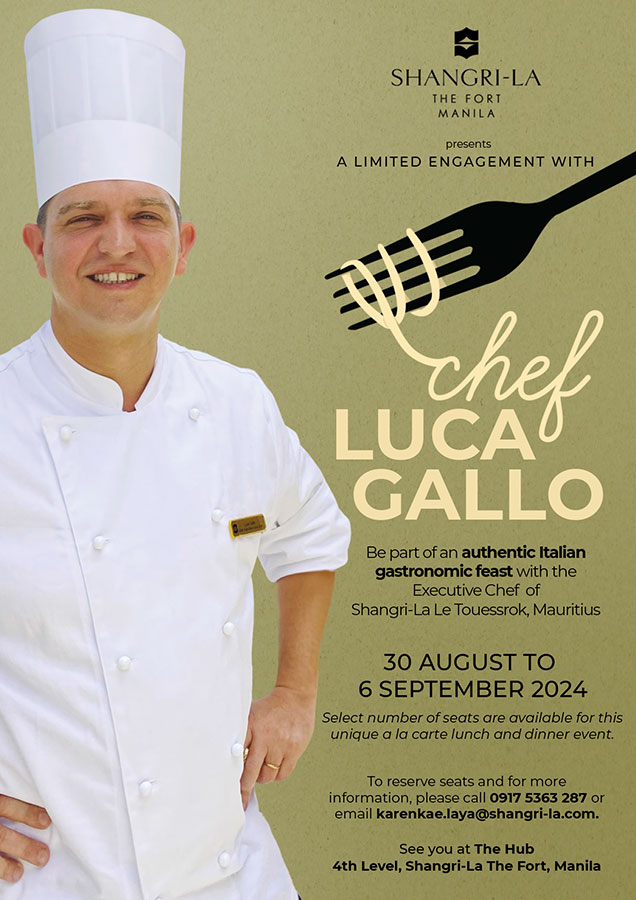
Italian gastronomy at Shangri-La The Fort

FROM Aug. 30 to Sept. 6, Shangri-La The Fort, Manila will host the Executive Chef of Shangri-La Le Touessrok, Mauritius, Luca Gallo. During this time the hotel will showcase lunch and dinner à la carte menus at The Hub crafted by Mr. Gallo, a master of Italian cuisine. Reserve seats by calling 0917-536-3287 or e-mail karenkae.laya@shangri-la.com.


Johnnie Walker Blue Luxury Artist Series out now

JOHNNIE Walker has collaborated with visual artist and art director Anna Bautista to launch the latest Johnnie Walker Blue Label Luxury Artist Series collection. This collaboration features three unique bottle designs inspired by animals of Davao, Bohol, and Cebu. The Davao bottle features the Philippine Eagle, depicted alongside the region’s natural treasures such as the waling-waling orchid, the Mickey Mouse plant, the durian, and Mount Apo. The Bohol bottle celebrates the tarsier amidst fireflies, with additional elements including the cacao plant, wildflowers, and the iconic Chocolate Hills. Finally, the Cebu bottle showcases the Philippine whale shark, or butanding, set against the vibrant marine life of the province, accompanied by the sampaguita, the Cebu Flowerpecker bird, and various aquatic elements. This collection marks Bautista’s second collaboration with Johnnie Walker, following the limited edition Blue Label Liwanag bottle in 2022, inspired by the dance, Pandanggo sa Ilaw. “I wanted to bring forth a collection that would celebrate our heritage by featuring the jewels that are distinct to the rich biodiversity of the Philippines. I am truly humbled to once again have the chance to collaborate with Johnnie Walker. More so that we are able to highlight the rarity of our country’s treasures, mirroring the attributes which have long defined Johnnie Walker Blue Label,” she said in a statement. Available now in limited quantities, these exclusive bottles can be purchased at all S&R branches nationwide.


McDonald’s PHL releases new glass collection

MCDONALD’S Philippines releases new collectible glasses that are a tribute to the 1990s and 2000s. The glasses feature toy designs from collaborations with Coca-Cola, Mattel, and Universal, and its own releases from years past. These include Shrek/Minions, Barbie/Hot Wheels, McDonald’s/Nanoblock, and McDonald’s/Coca-Cola. The McDonald’s Collector’s Meal can be availed for P79 along with a choice of a medium or large extra value meal (any meal with fries and drink). Each glass is individually packaged and sealed in a Collector’s Meal Box and comes in a limited-edition take-out paper bag beverage packaging. “These new collectible cups commemorate some of our most unforgettable designs and global collaborations over the years, allowing longtime fans to relive treasured moments and helping a new generation make their own lasting memories,” said Margot Torres, Managing Director for McDonald’s Philippines, in a statement. The new collectibles are available via the McDonald’s App from Aug. 27 to Sept. 2. They will also be available for purchase via the front counter dine-in, take-out, drive-through and McDelivery starting Sept. 3.


Milkana Creamy Lollipops now available

MILKANA, Savencia Fromage & Dairy’s international brand spotlights its Creamy Lollipops. Milkana Creamy Lollipops are formulated with milk proteins containing essential amino acids, calcium, vitamin D, and are made without preservatives. It comes in four flavors: Fruit Heart (with natural strawberry filling), Yogurt N Fruits, Mixed Berries, and Milky Ice Cream. For more information about Milkana’s Creamy Lollipops, follow https://www.facebook.com/MilkanaPhilippines and https://www.instagram.com/milkanaph/.

Indonesian airline TransNusa eyes Davao-Manado route

DREAMCATCHER-68/FLICKR

DAVAO CITY — Indonesian airline TransNusa Aviation Group has expressed interest in operating direct flights between Davao City and Manado, Indonesia, according to an official from the Mindanao Development Authority (MinDA).

Romeo M. Montenegro, MinDA assistant secretary, told BusinessWorld that he met with TransNusa executives at their Jakarta office on Aug. 21.

“The meeting with TransNusa was also a pitch for Mindanao and presented trade, investment, and tourism opportunities, particularly highlighting Davao. We also cited the passenger stats of previous Davao-Manado flights, the recently extended EAGA travel tax exemption, and other EAGA incentives for airlines,” Mr. Montenegro said.

The meeting took place during his visit to Indonesia for the Brunei Darussalam, Indonesia, Malaysia, and the Philippines-East ASEAN Growth Area (BIMP-EAGA) Special Senior Officials Meeting, which was held with the Asian Development Bank on Aug. 20.

He said TransNusa, which currently operates domestic flights within Indonesia and to several international destinations, is considering the first quarter of 2025 as a potential start date for the new route, with initial flights two-three times per week.

“Right now, Manado is serving as a hub for TransNusa’s ARJ21 aircraft flights,” Mr. Montenegro said. Manado, a major city in North Sulawesi, is known for its vibrant marine life and tourism industry.

To recall, Leading Edge Air Services Corp. (LEASCOR), an aviation services provider based in the Philippines and a subsidiary of ACDI Multi-Purpose Cooperative, was planning to begin servicing the air route between Davao and Manado this year.

LEASCOR and MinDA conducted an exploratory business mission to North Sulawesi in January to evaluate the potential resumption of air connectivity between Davao and Manado.

Mr. Montenegro noted that LEASCOR has not yet finalized its plans, as the company has deployed its ATR aircraft for domestic regional routes, including the Zamboanga-Jolo route. — Maya M. Padillo

Government corporations’ excess funds, rising interest payments, and the NGRP

Last Tuesday, Aug. 27, a magnificent document was released by seven former Finance officials, the “Statement of Former Secretaries of Finance on the Mobilization of Excess GOCC Funds.”

The signatories and their terms of office as Finance Secretary were Cesar E. A. Virata (1970-1986), Roberto de Ocampo (1994-1998), Jose T. Pardo (Jan. 2000 – Jan. 2001), Alberto G. Romulo (January – June 2001), Jose Isidro N. Camacho (2001-2003), Margarito B. Teves (2005-2010), and Cesar V. Purisima (February – July 2005; 2010-2016).

The officials declared with authority that “As former Secretaries of the Department of Finance (DoF), we fully understand and support the DoF’s exercise of its authority to effectively utilize the excess funds of government-owned or -controlled corporations (GOCCs) to finance crucial government projects in areas like health, education, social services, and infrastructure. We believe this move will bring substantial benefits to the Filipino people. Mobilizing these excess funds will enable important public projects that can strengthen our economy and ensure long-term gains through more jobs, higher incomes, and reduced poverty.”

Such a vote of confidence in the policy of current Finance Secretary Ralph G. Recto should quash any serious doubts about the efficiency and rationality of tapping the excess funds of the Philippine Health Insurance Corp. or PhilHealth (P90 billion) and the Philippine Deposit Insurance Corp. or PDIC (P110 billion), among others.

Congratulations, Messrs. Virata, De Ocampo, Pardo, Romulo, Camacho, Teves, and Purisima, for that concise and clear statement.

Disclosure: Former Secretary Gary Teves was my boss when I was working at the House of Representatives. He was a Congressman and Chairman of the Committee on Economic Affairs in the 1990s. Then when he put up a private consulting firm, Think Tank, Inc., which I worked at from late 1999 to 2004.

PROPOSED BUDGET 2025
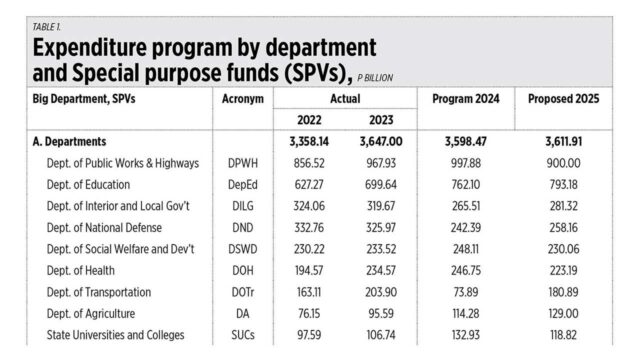
The proposed budget for 2025 is now undergoing review, agency by agency, both at the House and the Senate. The biggest expenditure areas in the budget are the departments of Public Works, Education, the Interior (including the Philippine National Police), Defense, Social Work, Health, Transportation, Agriculture, and the state universities.

For special purpose funds (SPVs), the biggest expense class, these are the allocations to local governments, the interest payment of our public debt, and subsidy to government corporations including PhilHealth (see Table 1).

Note the huge jump in interest payments, from P380 billion in 2020 to P430 billion in 2021, P503 billion in 2022, P628 billion in 2023, and a projected P670 billion this year. We spend hugely each year, beyond what domestic revenues can cover, so we have borrowed about P2 trillion/year from 2020 to 2023.

SPENDING REFORMS VIA NGPA AND NGRP
The Department of Budget and Management (DBM), as the disbursing office of the trillions of pesos in the annual budget as authorized and legislated by Congress, initiated reforms in public procurement via the newly enacted New Government Procurement Act of 2024 or NGPA (RA 12009). There is also a bill in Congress on the National Government Rightsizing Program (NGRP).

As an advocate of minimal government intervention and minimal taxes, I find these two measures worthy of support. The NGPA should lead to more transparency and reduced waste and corruption in government procurement of goods and services. Even non-participants and observers of government procurement contracts can have access to certain data via the NGPA microsite.

The NGRP is definitely needed, given the huge annual spending on government personnel services, which contributes to the high annual budget deficit and consequent large borrowings and high interest payments.

DBM Secretary Amenah F. Pangandaman said in a press statement the other week, that she wanted a reclassification of vacant positions in government agencies to ensure optimal utilization of manpower resources across the bureaucracy. She added that, “It’s not just removing and consolidating the agencies but at the same time fix[ing] the positions, do[ing] reclassifications within departments and agencies… to have a bureaucracy that is agile and responsive, not a government that is too bloated and the service is not good.”

Go for this, Madame Secretary. I hope that Congress will prioritize this bill this year.

RISING INTEREST PAYMENTS
Yesterday the Bureau of the Treasury released the cash operations report for the year until July. I have compared those numbers with those from January to July of preceding years. Among the things I discovered were the following.

There has been a significant increase in revenues, from P2.27 trillion in 2023 to P2.61 trillion in 2024, even without any major tax hikes. That high-growth Philippines is creating more jobs means more tax-paying businesses and labor.

Government expenditures are not slowing down but are keeping up with the rise in revenues, which should not be the case because we are not in any economic, or health, or political crisis.

Interest payments, in particular, are rising fast. The P457 billion released in January to July implies an average increase of P65.3 billion/month. If this trend continues, then the full-year interest payment in 2024 will be P783 billion, not the P670 billion as programmed in the 2024 budget.

The deficit is still far higher than the pre-lockdown level. In 2019 it was P118 billion, while it was P643 billion this year (see Table 2).

We need more economic growth from the private sector and less spending and borrowing in the public sector to significantly reduce the public debt stock. The call for patriotism should ring louder in the hearts of government personnel, particularly the military and uniformed personnel whose annual pension is rising consistently. This is because they do not contribute for their own personal pensions, and the irrational indexation of their pensions with the salaries of active personnel.

Together, the private and public sectors should sustain high economic growth while instilling fiscal discipline and restraint. Then attaining credit ratings of “A,” and lowering the debt/GDP ratio to below 56% and the poverty level to below 10% by 2028, should come handily.


Bienvenido S. Oplas, Jr. is the president of Bienvenido S. Oplas, Jr. Research Consultancy Services, and Minimal Government Thinkers. He is an international fellow of the Tholos Foundation.

minimalgovernment@gmail.com

Shifting towards smarter search technology on websites

TRUSTPAIR.COM

VECTOR search understands the context and meaning behind queries, allowing it to retrieve more relevant results for users’ vague searches.

This growth reflects the growing reliance on the internet for various activities and information-seeking purposes. The increasing number of internet users in the Philippines underscores the importance of adapting to the digital age and addressing potential challenges that come when searching for things.

Nearly 90% of users will not return to a site if they have a bad experience. Take a moment to appreciate that staggering statistic. Site reliability engineers are traditionally focused on the “five 9s,” ensuring a website remains up and accessible 99.999% of the time. Yet, that is only a part of the picture guaranteeing a positive user experience. What else can cause a user to click away from a site and never return?

Not being able to discover what they were looking for.

The frustration of trying to search for something and being unable to find it quickly and efficiently may be one of a user’s most disappointing experiences. You want to build a site where that rarely happens. However, users make it very hard. Oftentimes, they do not know exactly what they are looking for. They have a picture in their mind of what they want but lack the precise terms, and their search ends up being submitted with keywords such as: “the thing that tightens screws.” A human respondent to that search will return an index of screwdrivers. What will your keyword-based search return? Articles about tightening techniques, blog posts on different types of screws and tools that have nothing to do with screwdrivers.

This example happens all the time, every single day, countless times a day.

Facing this dilemma requires a new resource to improve the user experience and bring clarity even when users lack it. Vector search offers possibilities that are not feasible with traditional keyword search alone.

HOW VECTOR SEARCH WORKS
Vector search is a machine learning method that transforms textual data into high-dimensional vectors, capturing semantic relationships between words and phrases. It differs from traditional keyword-based search, which relies on exact matches, by understanding the context and meaning behind queries. This approach enhances the accuracy and relevance of search results, making it a powerful tool for modern information retrieval systems. Vector search interprets the meaning behind queries, identifying relevant documents with related terms. This makes it an invaluable tool for improving user experience by providing precise and accurate search results in response to imprecise or descriptive queries.

Here’s a simple vector search example: -0.024047505110502243.

The process of embedding involves converting textual data into numerical representations, such as vectors, to capture the meaning of words and phrases. This allows models to measure similarity between terms based on their usage and context in large datasets. This transformation leads to more nuanced and context-aware search functionalities, potentially advancing information retrieval and artificial intelligence (AI). For example, a dataset containing the string “Your text string goes here” can be converted into vectors by assigning numerical values to each word, allowing better understanding of relationships and similarities.

These vectors represent the semantic meaning of the words and allow the search functionality to understand and retrieve relevant information based on context rather than just exact keyword matches.

The search engine converts user queries into vector representations using a simple dataset, comparing them with the dataset’s vectors. The vector search identifies that the query’s context and semantics are similar to “Your text string goes here,” allowing the engine to return the most relevant result based on the similarity of the vectors. This process transforms uncertain and unclear user queries into more certainty and clarity.

HOW TO STORE AND RETRIEVE VECTOR EMBEDDINGS
Vector search is a crucial tool for websites that require quick and cost-effective storage and retrieval of vector embeddings. As a site’s data grows, so do the vector embeddings, making any solution highly scalable. A generic database solution is not suitable for vector search needs, as it must be specialized to handle high-dimensional embeddings efficiently, support rapid similarity searches, and optimize storage for large volumes of vectors. This ensures the search system remains performant and responsive, providing relevant results in real-time even as data scales. A vector search database solution should offer advanced indexing capabilities, support multiple data types, and integrate with popular AI frameworks and embedding generation tools. Additionally, it should provide a quality search experience in offline environments, known as delivering computing “on the edge.” Integrating vector search into a site can improve user experience and ensure repeat visits.


Genie Yuan is the regional vice-president for APAC Japan, Couchbase.

Asian currencies’ rally likely to slow

BW FILE PHOTO

ASIAN CURRENCIES like the Philippine peso are seen to continue rallying in the coming months but at a slower pace, Capital Economics said.

“We expect most Asian currencies to make further gains over time, even if their biggest rallies may now be behind them,” it said in a report on Tuesday.

It said that Asian currencies have seen “broad-based rallies” despite being under pressure earlier this year. “Indeed, many have now made bigger gains than the yen against the US dollar this month.”

Capital Economics said there is room for currencies to “make some ground and, indeed, fare better than most.”

“But we doubt the rally will be such a break-neck pace as it has been,” it added.

The Philippine peso closed at P56.281 per dollar on Tuesday, strengthening by 5.2 centavos from its P56.333 finish on Thursday. This was its strongest finish in nearly five months or since its P56.255-a-dollar close on April 1.

The peso was previously trading at the P57-58 per dollar level in the past months due to uncertainties over the timing of interest rate cuts here and abroad. BSP Governor Eli M. Remolona, Jr. earlier said the peso’s weakness was due to a “strong dollar” amid safe-haven demand.

The central bank intervened in “modest amounts” to keep markets orderly and control foreign exchange (FX) speculation, Mr. Remolona added.

“There are probably a couple of things going on. For a start, relatively stable interest rates in much of Asia meant that the big fall in US Treasury yields benefitted currencies there more than in many other economies,” Capital Economics said.

“What’s more, valuations – measured, for example, by the deviations of their real effective exchange rates from average – had become quite low in much of the region. The yen was probably the most extreme case of the latter, but the Thai baht and Philippine peso also looked, by this measure, to have very low valuations by past standards.”

Capital Economics said the broad-based rally was amid most Asian central banks managing their currencies “more tightly than most.”

“Those central banks have been, in general, leaning against the depreciation of their currencies for most of the year in various ways (and for much of the preceding two years as well). But they typically dislike volatility, and are probably wary of the economic consequences of a rapid appreciation as well,” it said.

“So some of them may well have leaned against the rally had it not been regionally broad based. And the rebound in the yen – which would have meant large trade-weighted depreciations for much of Asia given Japan’s particularly large share of regional trade – probably gave them implicit permission to allow their own currencies to rally.”

Capital Economics said currency valuations are still low in most countries in the region.

“That’s partly because of the broad-based nature of the rally, which means that not all Asian currencies have actually gained that much in trade-weighted terms.”

“While real effective exchange rates in Malaysia and Indonesia have swung, by this measure, from below- to above-average valuations, in addition to those of the yen and the renminbi valuation in Thailand, the Philippines and Korea still look fairly low.”

It added that if the yen can make further ground, this could “spark a bit of an Asian FX rally.” especially in places where valuations are still low. — Luisa Maria Jacinta C. Jocson

Japan’s Suntory aims for greater US canned cocktail market share, bets on spirits expertise

MINUS196.COM.AU

TOKYO — Japan’s Suntory Holdings is betting on its spirits expertise to boost its share in the US canned cocktails market, said a senior official from the drinks giant that aims to become the global leader in the sector by 2030.

While Suntory is best known among overseas consumers for its whisky, a key growth market is the canned cocktail, or the ready-to-drink (RTD), segment. It believes its annual RTD revenue could double from current levels to about $3 billion by 2030.

Suntory is No. 2 in the global RTD segment, underpinned by its dominance in Japan, Euromonitor data shows. But it is behind global leader Mark Anthony Group, maker of White Claw alcoholic seltzers, partly because of a smaller share of the US market where it is not even among the top five players.

“We believe right now in the US, spirits-based canned RTDs as well as spirits-based cocktails are an important platform for us to set the foundation for our growth,” said Kay Oh, Suntory’s Sydney-based senior general manager for RTDs.

Suntory’s Minus 196 with a 6% alcohol content, made from vodka or other spirits, proved a winner upon its debut in Australia in 2021 and has since broken into the U.S., British and German markets. This is far less potent than the company’s Strong Zero brand of fruity RTDs that have been big sellers in Japan for two decades and top out at an eye-watering 9% alcohol.

There is no immediate plan to tone down the 9% brew sold in Japan, Oh said, but the overall trend among consumers is for lower alcohol, lower sugar beverages.

“We understand and realize where consumer needs and trends are going. So the strength or that, if you will, hedonist impression is not what we stand for,” Oh said

“We are putting a lot of focus into USA.”

The global RTD market saw double-digit sales growth during the pandemic as health concerns prompted a switch from higher calorie drinks like beer, but that slowed to just 2% annual volume growth in 2023, according to industry watcher IWSR.

Suntory’s overseas expansion is an ambitious move and it will have to “navigate local tastes, intense competition, market positioning and NoLo (no and low) alcohol trends,” said Mac Salman, creator of Kanpai Planet, a YouTube channel on the Japanese drinks industry.

In the United States, taxes tend to be higher for spirits-based RTDs, versus those made with malt liquor.

Still, Ms. Oh believes Suntory has a competitive advantage.

Malt beverage seltzers have less sugar and less calories, but somewhat “lax in taste,” she said. “The better version comes in spirits, which is higher quality, better taste, while still keeping the calorie and sugar count.” — Reuters

Philippines 4th least transparent real estate market in Asia-Pacific

The Philippines went down three places to 45th out of 89 markets in the 13th edition of the Global Real Estate Transparency Index by real estate consultancy firm Jones Lang LaSalle and LaSalle Investment Management. The biennial index generates the composite score by incorporating 256 different factors spread across six subindices and then scaled from 1 to 5, where 1 means a market has total real estate transparency. With a score of 2.95 out of 5, the Philippines is the fourth-least transparent real estate market in the Asia-Pacific region.

Philippines 4<sup>th</sup> least transparent real estate market in Asia-Pacific

Buttoned up or down

FREEPIK

IS THE BUTTON as a fashion accessory still relevant? While probably declining in use, the button is still noticeable in men’s shirts, especially those sporting azaleas and waves for parties with a Hawaiian theme.

As a fastener, the button is noticed only when it doesn’t work. The awful moment when the button disconnects is called a “wardrobe malfunction.” The slipping of a top button or two, especially on a woman’s blouse can reveal more than the intended glimpse of skin. Such button mishaps can land on the internet to the embarrassment of a celebrity as the moment is posted and then shared.

Anyway, the zipper has taken up much of the task of fastening wardrobe closures. Even in colloquial speech, the plea for silence is no longer expressed as “button up” (now limited to its more literal meaning of fastening a shirt). Instead, the exhortation to keep quiet is caught better with the phrase “zip it.” Hence the zipper has acquired the primary position in the matter of keeping the upper and lower lips closed, not always in a smile. More current, is the expression that only asks for a debate event to push through: “If you have something to say, say it to my face.”

For informal attire like denim pants for men, the button is still resorted to as a fastener for the waistline. The front is just usually zipped. The buttoned-up front for men may present a distinct benefit for those with buttery fingers who are assailed by anxiety attacks after peeing when they tuck back the urinary tract and have fears of not quite fully succeeding in timing the zip-up. There is a hidden fear of zipping up too soon, catching in the teeth of the zipper some delicate skin overhang. Freeing it from this bite can be even more of a teeth clencher.

The zipped-up pants however offer speed in dressing up for both gents and ladies. The latter group wears closed fronts anyway as the pants are hoisted down for the required toilet break.

The button functions as an effective closer when paired with the right buttonhole. The button’s size and thickness must also match its buttonhole. If the latter is too tight, the button makes the process of insertion difficult if not impossible. If too loose, the garment will keep unfastening, resulting in embarrassing situations (see “wardrobe malfunction” above). The snug fit too requires an exact positioning of the button to its appropriate hole. A misalignment is sure to call attention to the exposed skin. The button is a metaphor for a good relationship. But let’s not go there.

Buttons and how they are worn can be a form of non-verbal communications.

The hunk that leaves three top buttons open showing chest hair or rib cages is meant to be a plea for attention — Sir, you need to button up. Misinterpreting intent here is likely to get one slapped, whether inside a karaoke bar or not. Still, it is a friendly gesture, though not an open invitation. This is true of both unbuttoned females as well. Such button exercises do not always appeal to the opposite sex.

Office attire has gone casual, not just for those working from home. Still, coats, if these are still the preferred attire, can be more informal when one moves beyond the traditional two buttons. The Mao suit, which is buttoned up all the way to the neck with its distinct stand-up collar, may use all of eight to 10 buttons. Not even Maoists have stayed with this buttoned-up fashion, especially when paired with crew cuts and marching exercises in the morning at some local subdivisions.

Buttons are the last barrier for civil manners. When one is asked to unbutton, it may be assumed that this is not just an invitation for the lips to loosen up. One must make sure that one heard right. (Did you say “unbutton,” Miss?) The phrase may have been misheard through the loud music as “unbutton me” may be just an innocent commentary on an Olympic event like the relay race — the baton please.

Anyway, advanced age and the onset of arthritis makes buttoning and unbuttoning a difficult chore. For the most part, fingers may be good merely for pointing — she went that way.


Tony Samson is chairman and CEO of TOUCH xda

ar.samson@yahoo.com

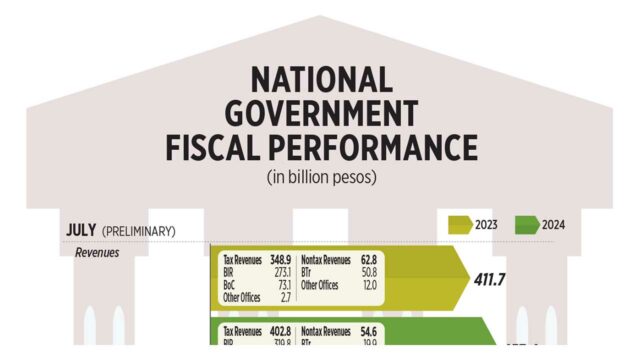
National Government fiscal performance

THE NATIONAL Government’s (NG) budget deficit sharply shrank in July as revenues posted double-digit growth, the Bureau of the Treasury (BTr) said. Read the full story.

National Government fiscal performance

EastWest Bank plans bond issue

EAST WEST Banking Corp. (EastWest Bank) is looking to raise up to P10 billion from bond issuances, although the timing will depend on market conditions, its top official said on Wednesday.

“We’re looking at a bond issue. We’re preparing at the moment for a bond issue, but we will not hit it until the price is right,” EastWest Bank Chief Executive Officer Jerry G. Ngo said on the sidelines of the launch of the lender’s new digital banking app.

He added that the bank has already tapped an advisor for the issue.

EastWest Bank could issue bonds worth up to P10 billion in tiers and in varying tenors, he added.

Mr. Ngo said he expects the Bangko Sentral ng Pilipinas (BSP) to cut rates by another 25 basis points (bps) before the end of the year as the US Federal Reserve is also expected to start its own easing cycle by next month.

The BSP’s policy-setting Monetary Board on Aug. 15 slashed its policy rate by 25 bps to 6.25%, marking its first easing move in nearly four years.

“I think the expectation (for the Fed) now is… one cut in September, and I think there’s another one coming up in November. So, I think the BSP will be very hard-pressed not to follow suit,” Mr. Ngo said.

EastWest Bank’s margins are expected to improve as benchmark interest rates go down, he added.

“We’re a consumer-focused bank. So, what happens is we’re a negatively gapped balance sheet. What that actually means is that we have long-term assets that are priced on a fixed basis, so as funding costs come down, the margins will be higher,” he said.

For every 25-bp rate cut by the BSP, Mr. Ngo said he expects a 5- to 10-bp expansion in their net interest margin.

Loan pricing will also improve as new bookings will be based on the lower benchmark rates, he added.

NEW DIGITAL BANKING APP
Meanwhile, EastWest Bank on Wednesday launched a new digital banking app as it looks to streamline its online services.

“We’re making a beginning of a new digital banking era for EastWest Bank. The launch of EastWest EasyWay represents our vision for the future of banking: one that is intuitive, seamless, and more importantly, customer-centric,” Mr. Ngo said in a speech during the app’s launch on Wednesday.

EasyWay is available on the App Store and Google Play Store.

The bank aims to onboard 40% of its total clientele of 2.6 million to the app, he said.

EasyWay currently has 500,000 users, he added, with 170,000 users still needing to be migrated to the new app as EastWest Bank is targeting to phase out its old app by November.

The new app will be part of the lender’s range of digital services that include EasyBiz, Komo, ESTA, and EWPay.

It allows users to pay bills, manage accounts, loans, and credit cards, as well as transact. It also features 24/7 customer support.

Mr. Ngo said they will roll out more features in the coming months, such as wealth management and accounts, mobile check deposit, credit card and loan application, and quick-response or QR fund transfers and payments.

The lender is also planning to introduce a business-focused app in the coming months as part of a pipeline of digital innovations, he added.

EastWest Bank saw its net income rise by 3.69% year on year to P1.79 billion in the second quarter as its retail loans continued to grow.

Its share price went down by four centavos or 0.44% to end at P9.01 apiece on Wednesday. — A.M.C. Sy

ADVERTISEMENT
ADVERTISEMENT