Home Blog Page 2661

EV tariffs will damage Germany, China, says Chinese commerce minister

ANDREW ROBERTS-UNSPLASH

 – China’s commerce minister said the European Union’s imposition of tariffs on electric vehicles (EV) will “seriously interfere” with trade and investment cooperation and hurt both China and Germany.

In talks on Tuesday with German Vice Chancellor and Economic Minister Robert Habeck, Wang Wentao said he hoped to reach a solution in line with World Trade Organization rules as soon as possible, and avoid the escalation of China-EU economic and trade frictions, according to a statement released by China’s Ministry of Commerce early on Wednesday.

The European Commission is on the verge of proposing final tariffs of up to 35.3% on EVs built in China, on top of the EU’s standard 10% car import duty.

Mr. Wang is visiting Europe for talks on the EU’s anti-subsidy case against Chinese-made EVs ahead of a vote on more tariffs.

Mr. Wang said it is hoped that Germany will proceed from its own interests and push the European Commission and China to work in the same direction.

Mr. Habeck said that Germany supports free trade, welcomes Chinese auto and parts companies to invest in Europe, and will urge the European Commission to find an appropriate solution with China and make every effort to avoid trade conflicts, according to the ministry statement.

Mr. Wang also met with Wolfgang Schmidt of the German Chancellery in Berlin, according a separate statement issued by China’s commerce ministry on Wednesday, where he told Schmidt China has insisted on properly resolving the anti-subsidy case against the country through dialogue and consultation.

China was deeply disappointed after the EU ignored China’s efforts, insisted on ruling for high countervailing duty rates, and hastily rejected the package solution proposed by the Chinese industry, Wang said in the talks.

Mr. Wang said China would not give up its efforts and will persist in holding consultations “until the last moment.”

“It is hoped that Germany, as a core member of the EU, will take the lead in playing an active role and urge the European Commission to show political will and work together with China to properly resolve the case,” Mr. Wang said, according to a second statement on the talks from the commerce ministry also released on Wednesday. – Reuters


Vehicle sales up by 6.6% in August

CAR ENTHUSIASTS attend the Manila International Auto Show in Pasay City, April 4, 2024. — PHILIPPINE STAR/RYAN BALDEMOR

By Justine Irish D. Tabile, Reporter

PHILIPPINE automotive sales grew by an annual 6.6% in August, despite a decline in passenger car sales, according to an industry report.

A joint report by the Chamber of Automotive Manufacturers of the Philippines, Inc. (CAMPI) and the Truck Manufacturers Association (TMA) showed vehicle sales rose to 39,155 units in August from 36,714 units in the same month last year.

Month on month, car sales inched down by 0.4% from the 39,331 units sold in July.

Auto Sales (August 2024)August sales were dampened by the 5.6% drop in passenger car sales to 9,529 units from 10,094 units sold a year ago.

Month on month, passenger car sales slumped by 12.76% from 10,923 units in July.

However, this was offset by the 11.3% annual jump in commercial vehicle sales to 29,626 units in August from 26,620 a year ago. Commercial vehicles accounted for 75.66% of the industry’s total sales.

Month on month, sales of commercial vehicles increased by 4.3%.

Broken down, light commercial vehicle sales went up by 3.3% year on year to 21,812 units, while sales of Asian utility vehicles (AUV) surged by 53.5% to 6,829 units.

Sales of medium trucks slid by 4.9% to 312, while sales of heavy trucks fell by 64.8% to 45. Light-duty truck and bus sales went up by 5.2% to 628 units.

For the first eight months, vehicle sales went up by 10.3% to 304,765 units from 276,215 units a year ago, CAMPI-TMA data showed.

Passenger car sales jumped by 14% to 80,327 units in the January-to-August period, while commercial vehicle sales increased by 9.1% to 224,438 units.

Rizal Commercial Banking Corp. Chief Economist Michael L. Ricafort said new vehicle launches and improving employment data are driving the growth of car sales in recent months.

“Newer models, more brands, more electric and hybrid vehicles [launches], favorable demographics, and improving employment data in recent months are still driving the demand for vehicles,” Mr. Ricafort said in a Viber message.

“[This was] reflected in the double-digit growth in consumer loans, particularly auto loans, defying relatively higher interest rates,” he added.

A preliminary report from the Bangko Sentral ng Pilipinas showed that consumer loans to residents grew by 24.3% to P1.42 trillion as of end-July, with motor vehicle loans going up by 19.9% to P424.93 billion.

“For the coming months, lower Federal Reserve and local policy rates could increase demand for auto loans and also vehicle purchases,” Mr. Ricafort said.

In August, the Bangko Sentral ng Pilipinas (BSP) cut policy rates for the first time in nearly four years. The benchmark rate was trimmed by 25 basis points to 6.25%, from the nearly 17-year high of 6.5%.

Toby Allan C. Arce, head of sales trading at Globalinks Securities and Stocks, Inc., said the auto industry’s sales were driven by commercial vehicles.

“These vehicles cater more to businesses, logistics, and transport needs, reflecting a shift towards utility and functionality, possibly in response to increased demand for delivery services, logistics support, or business expansions in the post-pandemic era,” said Mr. Arce via Viber.

“The passenger car segment saw a notable drop in August. However, the continued strong performance in the commercial sector more than offset this decline, suggesting that businesses, rather than individuals, are leading the market’s recovery,” he added.

In the first eight months, Toyota Motor Philippines Corp. remained the market leader with sales of 140,654 units, up by 10.9% from 126,795 units a year ago. Toyota sales accounted for 46.15% of the industry’s total.

Mitsubishi Motors Philippines Corp. ranked second with a market share of 19.2%. Mitsubishi sales jumped by 16% to 58,513 units in the first eight months.

In third spot was Ford Motor Co. Phils., Inc. which saw sales drop by 3.8% to 18,961 units. This accounted for 6.22% of the industry.

Rounding out the top five were Nissan Philippines, Inc., whose sales went up by 2.2% to 18,270, while Suzuki Phils., Inc. posted an 11.7% rise in sales to 13,206 units.

Last month, CAMPI raised its sales target to 500,000, from 468,300 initially. If realized, this will be the industry’s highest annual sales to date and will represent a 16.3% increase from last year’s 429,807 units sold.

Philippine credit rating upgrade possible if GDP grows faster than expected

Consumer spending is expected to accelerate ahead of the holiday season. Christmas decorations are now up at a shopping mall in Antipolo, Rizal, Sept. 16, 2024. — PHILIPPINE STAR/MIGUEL DE GUZMAN

By Luisa Maria Jacinta C. Jocson, Reporter

THE PHILIPPINES’ credit rating may be upgraded if the economy grows faster than expected, S&P Global Ratings said.

“On the upside for us, the Philippines’ ratings could be raised if the economic recovery is even faster than what we currently project and if the government achieves even faster fiscal consolidation,” YeeFarn Phua, director at S&P Global Ratings, said in a webinar on Tuesday.

The Philippines currently holds a “BBB+” rating with a “stable” outlook from the debt watcher.

“The outlook on the sovereign ratings remains stable. Basically, this stable outlook reflects our expectation that the economy will continue to grow healthily,” Mr. Phua said.

The credit rater expects Philippine gross domestic product (GDP) growth to average 5.8% this year and 6.1% in 2025. These are both below the government’s 6-7% and 6.5-7.5% growth targets for this year and next, respectively.

In the second quarter of the year, Philippine GDP grew by 6.3%, the fastest since 6.4% in the first quarter of 2023. This brought the first semester growth to 6%.

Mr. Phua said the outlook is also “balanced by the fact that we believe fiscal performance will also improve over the next 24 months.”

The National Government’s (NG) budget deficit widened by 7.2% to P642.8 billion in the January-to-July period, latest data from the Treasury showed.

Mr. Phua also flagged potential risks, such as an economic slowdown, that could hinder a credit upgrade for the Philippines.

“On the downside, however, we believe that if economic recovery were to weaken, leading to the long-term growth rates below its peers, this will also lead to an associated weakening of the government’s fiscal and debt positions,” he said.

He also noted risks to external settings, such as the current account deficit.

“If we see that the (current account deficit) starts to get persistently large, this will actually lead to a structural weakening of the Philippines’ external balance sheet. And we believe this could exert downward pressure on the ratings.”

In the second quarter, the current account deficit reached $5.1 billion, which accounts for 4.6% of GDP. The BSP projects a $4.7-billion current account deficit for 2024, equivalent to 1% of GDP.

Meanwhile, Mr. Phua noted that S&P Global’s lower-than-expected growth forecasts for the Philippines are due to still-elevated interest rates.

“So far, the BSP has only cut once. Therefore, our expectation is that we expect the cutting phase to be done gradually over the next year or so. And therefore, monetary policy will still remain tighter than normal for a while more,” he said.

Last month, the Monetary Board delivered a 25-basis-point (bp) rate cut and brought the key rate to 6.25% from the over 17-year high of 6.5%. This was the first time the central bank cut rates since November 2020.

Prior to this, the central bank raised borrowing costs by a cumulative 450 bps from May 2022 to October 2023 to tame inflation.

“At the same time, we are also seeing the consumption and investments are also showing slowing momentum than usual,” Mr. Phua said.

“We believe this could last for some more time, given as the central bank moves tend to be a bit more long and variable lags before they can start to impact the real economy.”

BSP may cut RRR this year — Metrobank

BW FILE PHOTO

THE BANGKO SENTRAL ng Pilipinas (BSP) could reduce local banks’ reserve requirement ratio (RRR) to as low as 7% this year, Metropolitan Bank & Trust Co. (Metrobank) said.

“While we expect the central bank to continue cutting rates in the coming months, we believe BSP Governor Eli M. Remolona, Jr. is also planning to reduce banks’ reserve requirements, as he previously hinted,” Metrobank Chief Economist Nicholas Antonio T. Mapa said in a commentary.

“We think (Mr.) Remolona might lower (RRR) by 250 basis points (bps) or 2.5 percentage points before the end of the year, with the first reduction likely to happen soon.”

The RRR is the percentage of bank deposits and deposit substitute liabilities that banks cannot lend out and must set aside in deposits with the BSP.

In June last year, the BSP reduced the ratio for big banks and nonbank financial institutions with quasi-banking functions by 250 bps to 9.5%.

The central bank has brought down the RRR for universal and commercial banks to a single-digit level from a high of 20% in 2018.

“Since RR changes are not considered policy moves, we believe the upcoming RR reduction could happen on any Thursday (when the Monetary Board meets weekly),” Mr. Mapa said.

The BSP chief earlier said they are seeking to bring down the banks’ RRR to as low as 5%, but added the timing is yet to be decided.

“Adjustments to the RR were once considered a policy adjustment. However, with the advent of the BSP’s interest rate corridor system and its accompanying liquidity management facilities, any RR reduction has been relegated to a simple operational adjustment,” Mr. Mapa said.

The start of RRR cuts “may not necessarily be announced during the regular policy cycle,” he added.

“With the BSP in easing mode, we expect RR reductions to be announced shortly after the Fed policy meeting or perhaps after the Philippines’ September inflation data is released, which could show inflation drop to around 2.3%.”

The Federal Open Market Committee (FOMC) is having its meeting from Sept. 17-18.

Philippine headline inflation eased to 3.3% in August from a nine-month high of 4.4% in July, latest data from the local statistics authority showed.

The BSP earlier said it expects inflation to ease further from August onwards. It expects full-year inflation to settle at 3.4%.

“Now that the BSP is looking to bring down its borrowing costs from elevated levels to more normal and supportive levels, the time appears ripe for another round of RR reductions,” Mr. Mapa added.

Mr. Remolona earlier signaled the possibility of another 25-bp cut before the year ends.

The Monetary Board cut benchmark interest rates by 25 bps to 6.25% at its Aug. 15 meeting, the first rate reduction in nearly four years.

However, Mr. Mapa said that it is still uncertain if slashing the RRR while interest rates are still elevated would lead to higher bank lending.

“Banks that have more funds available for lending might choose to deposit this money back with the central bank, where they can earn attractive interest rates of about 6.25%.”

Metrobank expects the central bank to reduce the RRR by 150 bps first, followed by another 100-bp cut within the year.

“As such, should the BSP carry out a 150-bp RR reduction in the near term, banks may become attractive again in the near term. However, caution about its impact on bank lending and overall growth momentum is warranted.”

Data from the central bank showed that outstanding loans of universal and commercial banks rose by 10.4% year on year to P12.14 trillion. This was the fastest growth since 13.7% in December 2022. — Luisa Maria Jacinta C. Jocson

Filipino youth worry about climate change, education — survey

Students wade through floods along Taft Avenue in Manila, Aug. 31, 2023. — PHILIPPINE STAR/MIGUEL DE GUZMAN

AROUND 44% of young Filipinos expect future generations to be “worse off than today,” amid rising concern over climate change, education and lack of jobs, according to a survey by the United Nations Children’s Fund (UNICEF).

Results of the U-Report survey also showed 37% of Filipino youth think the next generations will be “better off than today” while 19% believe conditions will be the same.

“While youth are split on whether the future generation is “worse off” or “better off” (44% vs 37%) they do see the value that rapid technological innovations and democratic access to information can bring,” UNICEF said in a statement.

According to the survey, 26% of young Filipinos see climate change, including natural disasters, as the biggest problem they will face in the future.

Also, 23% of respondents are concerned they will not be able to finish their education, while 22% are worried about finding a job and about their health (both physical and mental).

The results of the survey were released ahead of the Summit of the Future 2024 in New York on Sept. 22-23.

“The U-Report findings reveal the sobering, yet hopeful outlook young people have about their prospects for the future,” UNICEF Representative to the Philippines Oyunsaikhan Dendevnorov was quoted in a statement.

“We should listen to what they have to say and work together to address these issues so that every child is cared for, protected, and given a fair chance in life,” she added.

The U-Report poll was conducted online from June 13 to July 14, 2024. Of the 3,109 respondents, 44% were aged 15-19 and 37% were aged 20-24.

Asked what the biggest obstacle will be to getting their dream job or starting a business in the future, 33% of respondents were worried about the lack of jobs for people without experience.

Another 26% were concerned about the economic situation, while 20% said access to a good education is hampering their prospects.

Asked what they will do if given a chance to be the Philippine president, respondents said they will prioritize education, health and the economy to build a better future. They also want to address corruption as well as issues related to agriculture, poverty, and the environment.

“New generations are bringing a reinvigorated sense of solidarity and a compelling call for collective action. Both are essential to build the future we want,” UN Philippines Resident Coordinator Gustavo González was quoted as saying.

The survey also showed the majority, or 69%, of respondents said the United Nations (UN) is “very important’ in creating a better future for them as well as for future generations.

“Every young person’s concern has always been to finish their studies and find a job good enough to support their families. This is a fundamental aspiration, as quality education has a real corresponding impact on the quality of jobs offered to the youth in the future,” Terry L. Ridon, a lawyer and former party-list lawmaker, said in a Viber message.

The Philippine government should address climate-related challenges, Mr. Ridon said. It must also bolster measures to boost job generation and expand access to quality education. — Beatriz Marie D. Cruz

Developers confident in PHL tourism with P250-B investment — report

JBDODANE-FLICKR

DEVELOPERS have committed about P250 billion to construct 158 accommodation projects, totaling 40,084 room keys, signifying strong confidence in the tourism sector, according to the 2024 Philippine Accommodation Pipeline Report.

“That 40,000 room keys equate to approximately P250-billion commitment over the following years,” Alfred Lay, director for hotels, tourism, and leisure at Leechiu Property Consultants, said during the launch of the 2024 Philippine Accommodation Pipeline Report on Tuesday. The study was conducted in partnership with the Philippine Hotel Owners Association, Inc. (PHOA).

The developers include Megaworld Corp., Double Dragon Properties Corp., SM Prime Holdings, Inc., the Hann Group in Clark, Ayala Corp., Cebu Landmasters, Inc., Filinvest Development Corp., AppleOne Properties, Inc., and Robinsons Land Corp.

“We released surveys to various brand operators, to developers, to design consultants, to the Department of Tourism (DoT), and local government units… to gather knowledge about upcoming hotels,” Mr. Lay said.

He said that once these keys are completed and operational, they will generate 57,000 direct jobs in the hotel industry.

“Luzon, as we would expect, maintains the largest pipeline that’s sitting at about 50% today, and that’s heavily driven by the economic hub being Manila,” he said, adding that this leads to 85 new accommodations and 20,116 room keys.

Visayas followed with 57 accommodations and 16, 830 room keys, accounting for 42% of the pipeline.

Meanwhile, Mindanao is expected to have 16 new accommodations and 3,138 room keys, or 8% of the total pipeline.

In terms of pipeline keys in the top 10 areas by opening years, Lapu-Lapu City led with 4, 786 keys in the pipeline across 10 projects, averaging 435 keys per accommodation.

Mr. Lay said Panglao Island, a top accommodation investment destination, came in second with 4,401 keys planned across 16 projects. This was followed by Boracay with 3, 625 keys in the pipeline.

“But it’s interesting to see that there are still quite a lot of keys coming into Boracay. Despite various infrastructure issues they may have, it still sits very much at the forefront of our development pipeline,” Mr. Lay said.

Cebu City (1,929 keys), New Clark City (1,550 keys), and Clark (2,098 keys) are also significant, with Clark’s growth attributed to its international airport and the increasing influx of Korean arrivals.

“In Clark, we’ll be driven by a lot of gaming-related keys. There are quite a lot of casino announcements lately and all of those have to be supported by a good number of room keys,” Mr. Lay said.

He also said that outside of Metro Manila, the real growth story sits in Panglao and Mactan Island due to being coastal destinations and served by international connectivity.

“This information becomes especially crucial as our hotel rules inventory is invariably compared to our competitors in the region and is often used as a gauge of our competitiveness,” PHOA President Arthur M. Lopez said.

From January to August 2024, the Philippines welcomed more than four million international visitors and generated visitor receipts amounting to approximately P362.58 billion, the Tourism department reported. — Aubrey Rose A. Inosante

Design appreciation: Hangeul reinterpreted in the modern era

BRONTË H. LACSAMANA

AT THE HEART of Taguig stands a curious exhibit that presents modern-day interpretations of a very old language system.

The Korean Cultural Center of the Philippines (KCC) has welcomed the National Hangeul Museum’s timeless tribute to Hangeul, the Korean language alphabet. By showcasing its design in various art forms, Hangeul’s adaptability in conveying ideas in modern times is highlighted, despite being created way back in 1443.

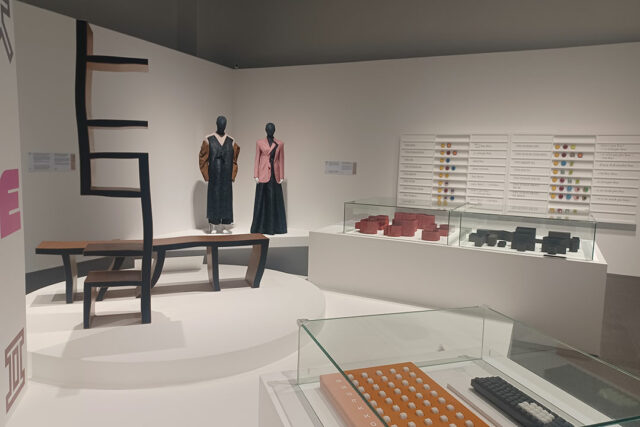
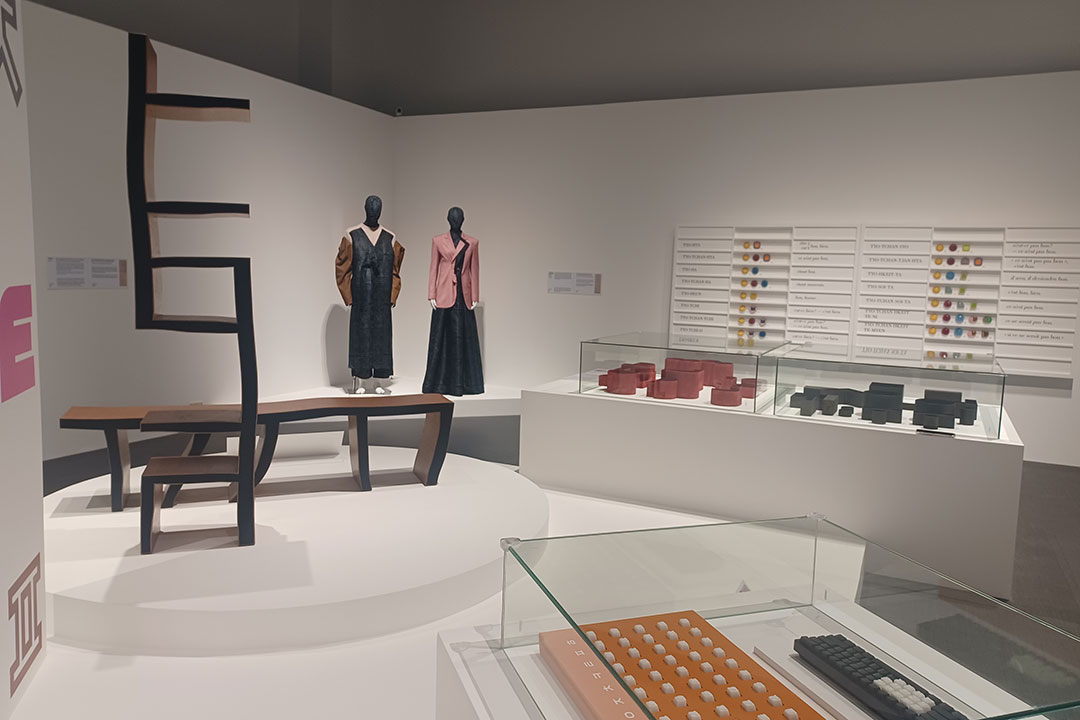
The items in the exhibit, Hangeul Design Project: Reinterpreting Hangeul in the Modern Era, are of different mediums, from traditional calligraphy displays to contemporary art, fashion, and furniture mimicking the alphabet’s style.

“Language is constantly changing, sometimes becoming something new, sometimes disappearing. It can be called an intangible cultural heritage,” National Hangeul Museum of Korea curator Kim Eun-jae said at the exhibit’s launch on Sept. 5.

Inside the hall on the 5th level of KCC, visitors are able to see how the language system can be integrated into other objects and art forms. The exhibit offers “an engaging and accessible perspective on the Korean alphabet,” according to Ms. Kim.

Designed by King Sejong of Joseon in the 15th century, Hangeul utilizes a simple form to convey the sound of each letter within the parameters of a square. Each letter differs in sound depending on their change in location.

Some of the objects in the exhibit are 3D-printed works, furniture, and hanbok (traditional clothing) following the figurative characteristics of Hangeul.

“Its main visual feature is its use within a square frame. Various combinations can be created within, which is why it is highly efficient when used in visual and digital media,” Ms. Kim said.

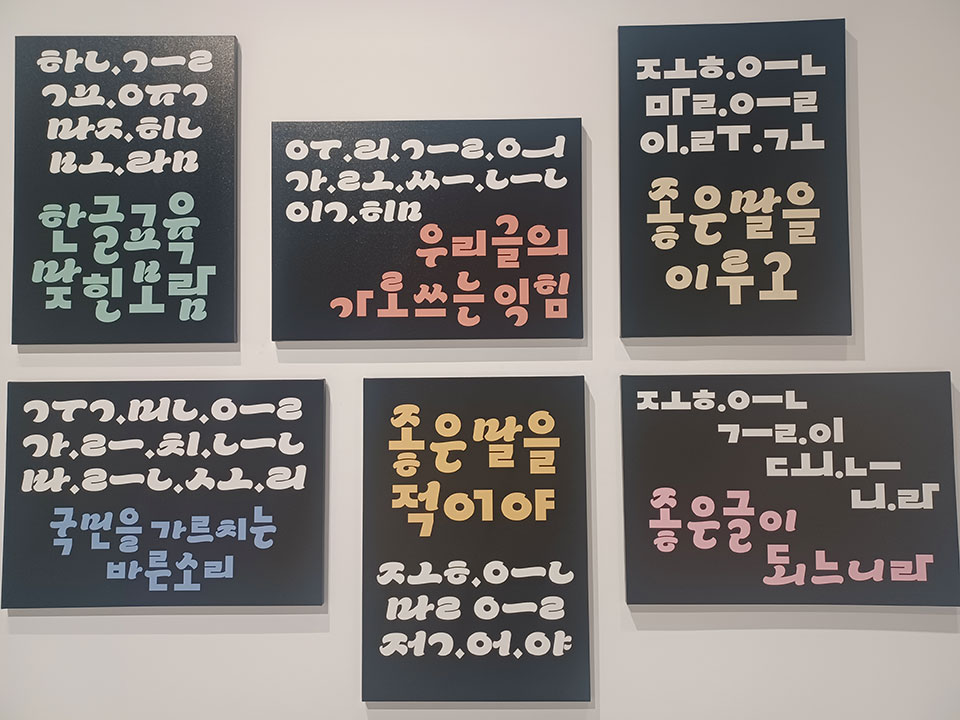
On the walls are Hangeul typography, some stylized and some placed in contrast with other languages. A notable display is the video projection of words from an old novel, animated to move as if being written onscreen.

Ms. Kim noted that, from eight basic letters, Hangeul is able to expand to 28 letters based on form and location within the square frame format. Further nuances can transform these consonant and vowel sounds to include hundreds more letters.

“King Sejong may have been a king, but I also want to express his mastery of design,” she said.

In addition to the exhibit, KCC will be organizing a series of performances and workshops to enhance the experience, including a calligraphy workshop series to begin in October. More details will be posted on KCC’s social media.

Hangeul Design Project: Reinterpreting Hangeul in the Modern Era runs until Feb. 28, 2025 at the Korean Cultural Center of the Philippines in Bayani Road, Taguig City. The exhibit is free and open to the public. — Brontë H. Lacsamana

Analysts see mixed outlook for PHL ICT, telco firms

BW FILE PHOTO

By Ashley Erika O. Jose, Reporter

PHILIPPINE telecommunications and information and communications technology (ICT) companies are expected to face challenges in the second half of the year due to increased competition and ongoing technological investments, but sustained demand for data services, lower borrowing costs, and the growth of adjacent services could help mitigate these challenges, according to analysts.

The growing digital landscape will continue to drive the demand for data and telco services, favoring companies in the telco and ICT industry, Globalinks Securities and Stocks, Inc. Head of Sales Trading Toby Allan C. Arce said in a Viber message to BusinessWorld on Tuesday.

“We expect the sector to generally do well and post better earnings for the second half on sustained demand for data, lower borrowing costs, and the growth of adjacent services like data centers and fintech services,” Chinabank Capital Corp. Managing Director Juan Paolo E. Colet said in a Viber message.

However, the growing competition in the sector, followed by ongoing technological investments amid a challenging economic environment can limit companies’ earnings growth, Mr. Arce said.

“An expected pickup in business activity and consumption on the back of lower inflation, dovish monetary policy are broad tailwinds for the major telco and ICT companies,” Mr. Colet said.

Inflation rate slowed in August due to a moderate rise in food and a dropped in transport costs, the Philippine Statistics Authority (PSA) said.

Philippine inflation cooled to 3.3% in August from 4.4% in July, data from the PSA showed.

Most of the listed telco and ICT companies posted flat profits for the second quarter and the first half.

For instance, telco giant PLDT Inc. saw a 9% decrease in its attributable net income for the second quarter, dropping to P8.59 billion from last year’s P9.44 billion due to higher expenses for the period.

For the first half, PLDT registered an attributable net income of P18.41 billion, lower by 0.21% from P18.45 billion previously despite posting higher revenues for the first six months of the year.

Globe Telecom, Inc., on the other hand, managed to post an attributable net income of P7.74 billion for the second quarter, representing a 9.5% increase from the same period last year.

The Ayala-led telco company reported earnings of P14.55 billion for the first half, a slight increase of 1.6% from last year’s P14.32 billion.

Meanwhile, Converge ICT Solutions, Inc. registered an attributable net income of P2.74 billion, up 29.8% from P2.11 billion in the same period last year, its financial statement showed.

Despite posting increased gross expenses for the April-to-June period at P6.18 billion, 15.1% higher than P5.37 billion previously, the company managed to register higher earnings on elevated revenues.

For the first semester, Converge’s attributable net income climbed to P5.29 billion, marking an increase of 23.6% from P4.28 billion in the same period last year.

DITO CME Holdings, Inc. (DITO), the operator of  DITO Telecommunity Corp., widened its attributable net loss for the second quarter to P7.94 billion from last year’s P1.1 billion on higher expenses for the period.

“Overall, while there could be steady growth, earnings may not rise as dramatically as expected given the balancing act between operational costs and market demands,” Globalinks Securities’ Mr. Arce said.

He said the ongoing digital expansion of listed telco and ICT companies will offer revenue opportunities through broadband, mobile services, and ICT infrastructure development.

For its part, Converge has revised its revenue growth forecast for 2024 to between 12% and 14%, up from the earlier estimate of 7-8%, driven by market optimism after delivering stronger earnings in the second quarter.

Further, market watchers said previously that the plan of PLDT to sell at least 49% of its data center business is expected to improve the company’s data center operations and its financial position.

Hastings Holdings, Inc., a unit of PLDT Beneficial Trust Fund subsidiary MediaQuest Holdings, Inc., has a majority stake in BusinessWorld through the Philippine Star Group, which it controls.

Paintings of tropical warmth and beauty find a place in Paris

MIDNIGHT FAIRIES by Rachel Ngan Dueñas

THE healing power of art helped many people cope during the stressful peaks of the pandemic.

For tea sommelier-turned-painter Rachel Ngan Dueñas, assisting others maintain their peace through tea meditation left her in need of a calming pastime of her own.

This led her to painting impressionist works inspired by the glimpses of beauty around her — some of which will be exhibited at the Carrousel du Louvre in Paris, France, this October.

“A lot of people think that I’m a genius in my craft or that I always wanted to be an artist. But no, hamak na ordinaryong tao lang ako (I am simply just an ordinary person),” she told BusinessWorld.

“When the pandemic happened, I was doing tea meditation for people. It got overwhelming and I started painting. They were ugly paintings, but I didn’t mind because it was for me.”

HEALING HOPES
From creating works for herself, Ms. Dueñas eventually started gaining recognition for her developing style, which blends abstraction and impressionism to depict the colors and textures of nature.

Three solo shows since she first picked up the paintbrush in 2021, it was her work as a tea sommelier that brought her to the doorstep of an unlikely opportunity. The setting: Paris Fashion Week 2023, where she conducted tea meditations for stressed designers backstage amid the chaos of the fashion industry’s biggest event. The kind benefactor: Junever Mahilum-West, Philippine Ambassador to France, who was in awe of her paintings.

“The ambassador said she found my artworks beautiful and told me that they can help me out. I said that, as an up-and-coming artist, it would be an honor to exhibit in Paris in the future. I didn’t know back then that the opportunity would be the (Carrousel du) Louvre,” said Ms. Dueñas.

The Carrousel du Louvre — an underground art shopping mall near the actual Louvre Museum and the adjacent Place du Carrousel public square — is known for its vibrant blend of gallerists and collectors allowing emerging artists to showcase their work. With the help of the Philippine Embassy in France, it has become a fine place for a Filipino artist to make an international debut.

Of the 5,000 works displayed there, three will be Ms. Dueñas’ paintings.

“My artworks are healing. They are my prayers; they are my hopes. I want them to go home to those who can resonate with that,” she said.

A TROPICAL HOMAGE
Art critic Cid Reyes has described Ms. Dueñas’ work as “seeming naive in execution, but quietly expressive,” which the artist considers high praise.

She said that her creative introspection often stems from negative self-talk. “You don’t wake up saying beautiful things or thinking beautiful thoughts. Even if I’m going through something, even if I don’t have anything positive to say, art translates the unpleasant into something beautiful.”

One interesting point to reflect on for her is the fact that she has been called an “old artist” for starting at the age of 36. “I never realized that that’s how people would see me,” she said.

Through brushstrokes that achieve a balance between abstract and impressionist styles, Ms. Dueñas hopes that her homage to Philippine tropical warmth and beauty will convey a sense of joy.

From the torture of facing a blank canvas to the release of finally putting color upon color to paint a calming picture, the goal is to create something relaxing — much like that of tea meditation.

“I want the Parisian audience to see the beauty of art inspired by the tropical flora and fauna of the Philippines,” she added.

Ms. Dueñas’ artworks can be seen at her ongoing fourth solo exhibit at Chef Jessie Rockwell Club in Makati until Sept. 30. She will then fly to France for the Carrousel du Louvre where her works will be seen from Oct. 18 to 20, with select works also on view at the Kwadro Pintura Gallery on Oct. 19 to 20, also in Paris. — Brontë H. Lacsamana

PLDT names Menardo Jimenez, Jr. as COO

BW FILE PHOTO

PANGILINAN-LED PLDT Inc. has named Menardo G. Jimenez, Jr. as executive vice-president and chief operating officer (COO).

In a regulatory filing on Tuesday, PLDT said its board of directors has approved the appointment of Mr. Jimenez as the company’s executive vice-president and COO, effective Sept. 17.

Mr. Jimenez has served as PLDT’s senior vice-president and network head. He has also served as the consumer business home advisor from 2022 to 2023, head of consumer business home from 2019 to 2022, and deputy business transformation office head from 2017 to 2019, the telecommunications company said.

Further, PLDT said the search for the replacement of Alfredo S. Panlilio as the company’s president and chief executive officer is still ongoing, after his retirement in January 2024 due to health reasons.

PLDT Chairman Manuel V. Pangilinan currently holds Mr. Panlilio’s vacated posts.

Mr. Pangilinan said earlier that there are two to three potential candidates for the role.

At the stock exchange on Tuesday, shares in the company closed P7, or 0.48% lower, at P1,453 each.

Hastings Holdings, Inc., a unit of PLDT Beneficial Trust Fund subsidiary MediaQuest Holdings, Inc., has a majority stake in BusinessWorld through the Philippine Star Group, which it controls. — Ashley Erika O. Jose

Arts & Culture (09/18/24)


Avellana Art Gallery presents Eugene Jarque show

THE long-awaited solo exhibition of Thirteen Artists awardee Eugene Jarque is now open at Avellana Art Gallery. Returning to the spotlight after 10 years, his abstract works and prints will be on display in the exhibit Arboreal Patterns. His first solo show in a full decade, this is a showcase of his deepened expertise, renewed inspiration, and evolving art practice. Ongoing at the same time is the group exhibit Unidentical Spaces, featuring the works of Beng Espiritu, Bud Omeng, Demosthenes Campos, Edmond Yanga, Horhe Jacinto, Joseph Tecson, Lendl Arvin, Lourd De Veyra, Lynrd Paras, Max Balatbat, Michael Villagante, Neil Arvin Javier, Olan Ventura, and Romeo Lee. Avellana Art Gallery is located on F.B. Harrison Street, Pasay City.


Big Bad Wolf Books offers P99 sale

BIG BAD Wolf Books is going for the first time to Robinsons Malls from Sept. 18 to 23. Under the mall’s 40-ft Golden Winter Playland Christmas Tree, Robinsons Manila hosts the popular Malaysian book fair, Big Bad Wolf Books, with the lowest book offer so far for pre-holiday shopping. The P99 price applies to all books — children’s board books, fiction hard covers, national bestselling novels, and brand-new books. The sale takes place at Robinsons Manila’s Midtown Atrium, from 10 a.m. to 10 p.m. Admission is free upon registration via scanning of QR Code.


Concert marks Ayala Museum’s Zóbel exhibit

ON SEPT. 26, at 7:30 p.m., the Ayala Museum will be holding a Rush Hour concert with the Manila Symphony Orchestra (MSO), giving insight to a new side to the artist Fernando Zóbel — his love for music. In honor of the Asian premiere of the international exhibition Zóbel: The Future of the Past at the Ayala Museum, the MSO will be taking on music from the artist’s cassette tape collection. The concert repertoire includes compositions from Mozart, Bach, and Chopin, music that Zóbel himself listened to while painting. Tickets to the show are available via https://ayalamuseum.org/events/rush-hour-zobel-playlist.


Samar artist Aris Ventures at ARTablado Antipolo

PAINTINGS by Samar artist Aris Ventures, all showcasing a childlike quality filled with warm smiles, are on display at ARTablado in Robinsons Antipolo. With motifs of young leaves, vibrant flowers, and an ever-present sun complemented by swirls and stripes, Mr. Ventures’ “Environmentrick Art” combines Cubism and diaphanous techniques. While he has participated in dozens of group shows, this will be his first solo exhibition outside of Samar. Abode, the name of the exhibit, reflects his dedication to this home in Calbayog, Samar, despite now being based in Manila. The exhibit is on view at ARTablado at Robinsons Antipolo until Sept. 30.


Gateway Art Fair expands for third edition

BOTH TITANS of Philippine art and up-and-coming artists will be coming together for the Gateway Art Fair, set for Sept. 26 to 29 at the Quantum Skyview of Gateway Mall 2 in Araneta City, Quezon City. The third edition of the fair will feature 30 exhibitors and over 1,000 artworks, highlighting the rich artistry of Filipinos from all over the country. Organized by the Gateway Gallery under the J. Amado Araneta Foundation (JAAF), this year’s fair has the theme “Live Your Art.” There will be daily side events at the Ibis Styles Manila Araneta City from Sept. 27 to 29, from 1 to 5 p.m. The final schedule of events will be posted on Gateway Gallery’s social media pages.


Sorsogon participates in worldwide Photo Walk

SCOTT KELBY has announced the official date of his Annual Worldwide Photo Walk, the world’s largest Photo Walk, on Oct. 5. In Sorsogon City, the Kurit-Lagting Art Collective will lead the local walk, in partnership with the Concerned Artists of the Philippines Bicol Chapter (CAP Bicol), the Sorsogon Initiatives for Culture and Arts Development, Rhymes of Peg, and Delta Beta Omega. The starting location for the event is the Sorsogon East Central School, with 100 participants already registered online, with more welcome to join for free. Sorsogon City first participated in the Scott Kelby Worldwide Photowalk in 2012. Now, it encourages participants to support The Springs of Hope Kenya Orphanage, which provides food, housing, education, and empowerment for young orphans.

Leviste-led Provincia investing P15B in Batangas, Tarlac, Nueva Ecija

PIXABAY

LEANDRO Antonio L. Leviste, founder of Solar Philippines Power Project Holdings, Inc., is investing over P15 billion in land development projects in Batangas, Tarlac, and Nueva Ecija.

The investment will be made through Mr. Leviste’s Provincia Investments Corp., Solar Philippines said in a statement posted on its Facebook page on Tuesday. Provincia is an affiliate of Solar Philippines.

Provincia, which is engaged in making investments in real estate and equities for industrial, commercial, energy- and infrastructure-related developments, will collaborate with Solar Philippines to develop its landbank in the three provinces.

The P15 billion is on top of the P5-billion investment previously made by Mr. Leviste’s Countryside Investments Holdings Corporation in Batangas.

Recently, Provincia acquired JJPNM Agro Industrial Corp., the owner of the largest poultry farm in Nueva Ecija spanning approximately 60 hectares.

The value of the transaction was not disclosed, but Provincia said the land was valued at an “attractive price net of the value of the poultry structures.”

Provincia’s investment will be funded by the sale of secondary shares of listed SP New Energy Corp. (SPNEC), which was also founded by Mr. Leviste.

Pangilinan-led Meralco PowerGen Corp. recently paid P6.7 billion for 5.8 billion shares of SPNEC that were held by Solar Philippines.

To date, Solar Philippines has raised about P15 billion from the sold SPNEC shares. It continues to own about 29% of SPNEC after the share sale.

SPNEC has solar projects in Batangas, Tarlac, and Nueva Ecija, which are also the locations of Provincia’s initial investments.

“We are grateful to our partners who have helped our business grow. Now that we have this capital, it is our responsibility to invest it to benefit as many of our countrymen as we can,” Mr. Leviste said.

In 2021, Provincia forged a P1-billion loan agreement with Ayala-led AC Energy Corp. to acquire land in Tarlac for solar projects. The loan has since been fully repaid.

Meralco’s majority owner, Beacon Electric Asset Holdings, Inc., is partly owned by PLDT Inc.

Hastings Holdings, Inc., a unit of PLDT Beneficial Trust Fund subsidiary MediaQuest Holdings, Inc., has an interest in BusinessWorld through the Philippine Star Group, which it controls. — Revin Mikhael Ochave

ADVERTISEMENT
ADVERTISEMENT