Home Blog Page 254

Dairy agency eyes program expansion in Romblon to increase local milk supply

THE National Dairy Authority (NDA) said it is exploring the expansion of its dairy programs in Romblon in an effort to increase local milk production and support government feeding initiatives.

In a statement on Thursday, the NDA said it recently held an exploratory meeting with Romblon officials, including 14 of the province’s 17 mayors, and Rep. Eleandro Jesus F. Madrona to discuss plans for local dairy development.

NDA Administrator Marcus Antonius T. Andaya said developing the local dairy industry would help secure a more reliable milk supply, create livelihood opportunities for farmers, and improve the nutrition of women and children in Romblon.

“Three groups will benefit from this program — the children, mothers, and our farmers,” he was quoted as saying in the statement in Filipino.

The NDA said local officials expressed interest in using idle lands for dairy and corn silage production to ensure a year-round feed supply for cattle.

The agency said it will work closely with participating municipalities to identify suitable sites, provide technical assistance, distribute planting starter kits, and train prospective dairy farmers.

According to the NDA, expanding dairy production is crucial as demand for locally produced milk increases, particularly from the Department of Education’s (DepEd) milk feeding program, which now serves 4.6 million learners.

“Government partners such as the DepEd and other institutions are now looking to source local milk, while local chief executives also want milk for their own feeding programs,” Mr. Andaya said.

The NDA said it is adopting a “proactive model” of dairy expansion by directly engaging local government units to encourage investments in dairy development.

In 2025, local milk production reached 43.4 million liters, marking the highest output on record and raising national milk sufficiency to 2.22%. — Vonn Andrei E. Villamiel

BARMM residents, other Muslim communities begin Ramadan fasting season

COTABATO CITY — Residents of the Bangsamoro Autonomous Region in Muslim Mindanao (BARMM) and other southern cities and provinces started their month-long Ramadan fasting season at dawn on Thursday.

Muslims fast from dawn to dusk during the Ramadan, which is a holy month in Islam, and focus on reparations for wrongdoings and reconciliation with adversaries as a religious obligation.

Fasting during the Ramadan is one of the five fundamentals of the Islamic faith, which include absolute belief in Allah, praying five times a day facing west, giving of alms to the poor and, for those who can afford the cost of travel, a pilgrimage to Makkah in Saudi Arabia, seat of the Islamic faith, even just once in a lifetime.

Two non-Muslim local executives, Governor Emmylou T. Mendoza of Cotabato and her counterpart in South Cotabato, Reynaldo S. Tamayo, Jr. separately told reporters on Thursday that they will expand their humanitarian programs for their Muslim constituents during the Ramadan as interfaith peacebuilding thrusts in support of the national government’s peace overture with southern Moro communities.

Mr. Tamayo, now in his third term as South Cotabato governor and is presiding chairperson of the multi-sector Regional Peace and Order Council 12, said he has requested the Police Regional Office 12 and the Army’s 6th Infantry Division to secure worship sites, where Muslims perform extensive worship rites during the Ramadan, which lasts between 28 to 30 days based on the lunar Hijrah calendar.

Three Muslim members of BARMM’s 80-seat parliament, John Anthony “Jet” L. Lim, Naguib G. Sinarimbo and Kadil M. Sinolinding, Jr. started their separate Ramadan humanitarian activities for Muslim constituents last Monday, all supported by their chief minister, Abdulraof A. Macacua.

Mr. Macacua issued on Wednesday a memorandum for all ministries and support agencies under the BARMM government directing fasting employees and their officials to work straight from 7:30 a.m. until 3:30 p.m. from Monday to Friday so that they can leave their offices early and have enough time to prepare for their iftar, or first meal after a day-long fast.

Mr. Sinolinding, who is overseeing the Ministry of Health-BARMM, said all of their emergency response operations will continue as usual during the Ramadan season.

“We have organized teams of mixed Muslim and non-Muslim emergency responders to work together during the Ramadan,” Mr. Sinolinding said.

Bangsamoro Labor and Employment Minister Muslimin G. Sema, who is chairman of the Moro National Liberation Front (MNLF), said members of the MNLF in all provinces and cities in BARMM will support the Ramadan security missions of the police and the military.

“Ramadan is a holy month in Islam. The Moro National Liberation Front shall help the police and military and local government units make it peaceful,” Mr. Sema said.

Lt. Gen. Donald M. Gumiran, commander of the Western Mindanao Command, said they appreciate the commitments of the MNLF, the Moro Islamic Liberation Front, the provincial officials in Cotabato and South Cotabato provinces, and BARMM’s top official, Mr. Macacua, to cooperate in maintaining law and order in predominantly Muslim communities for the whole duration of the Ramadan.

“Our units in the Bangsamoro region, in Region 9 and in Region 12 shall also embark on community projects for Muslim communities during the month-long fasting season,” Mr. Gumiran said. — John Felix M. Unson

DepEd to prioritize health interventions for learners, teachers

PHILIPPINE STAR/ EDD GUMBAN

The Department of Education (DepEd) said on Thursday that it aims to address students’ vision problems and teachers’ high blood pressure, which hinder quality learning outcomes.

“Overall health is important but the common illness for kids is their eyes because it affects their reading,” Education Secretary Edgardo “Sonny” M. Angara told reporters in an interview.

“For teachers, some of them get high blood pressure,” he added.

Yaman ng Kalusugan Program (YAKAP), under the Philippine Health Insurance Corporation (PhilHealth), supports DepEd’s health initiative by providing free health services, such as consultations and laboratory tests.

YAKAP supports Clinics for Learners’ Access to School-Health Services Plus (CLASS+), linking school clinics to local health systems.

“This is really a big help because some students struggle learning because they can’t read,” Mr. Angara said in Filipino. “Some of our teachers also have headaches and body aches.”

“They don’t have enough time for check-ups, so the YAKAP program is really a big help,” he added.

In Minuyan Elementary School in Bulacan, about 3,000 students are expected to benefit from the YAKAP program.

Mr. Angara also noted that there are no plans for higher health maintenance organization (HMO) coverage among teachers. “P7,000 is already generous; it’s only now that DepEd teachers are receiving HMO of P7,000.”

CENTRAL LUZON TEACHERS PROMOTED
Beyond physical well-being, Mr. Angara underscored his support for teachers’ career development.

On Thursday, he led the oath-taking ceremony of 1,991 teachers and school personnel from Bulacan and Pampanga.

“By streamlining and expanding promotion, we are strengthening our teachers who are key to the quality education of each Filipino child,” he said in a statement.

“This is a clear indication of the President’s priority to strengthen our education system by supporting our teachers,” he added.

The promoted personnel, including Teacher II to Teacher VII, Master Teachers I to III, and Principals I to IV, are part of the nationwide implementation of Republic Act No. 12288, or Career Progression for Public School Teachers and School Leaders.

The expanded career progression system has promoted over 16,000 teachers nationwide, and 40,000 applications are currently under review. — Almira Louise S. Martinez

UK police arrest King Charles’ brother Andrew, BBC reports

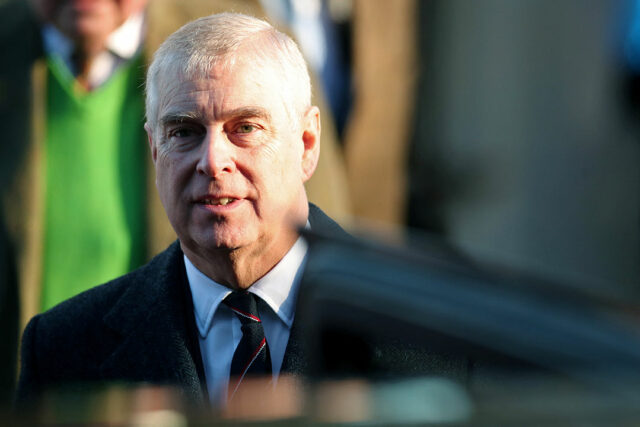
Britain’s Andrew Mountbatten-Windsor eaves St. Mary the Virgin church in Hillington, near royal Sandringham estate, in Norfolk, Britain Jan. 19, 2020. — REUTERS

LONDON — King Charles’ younger brother Andrew Mountbatten-Windsor was on Thursday arrested on suspicion of misconduct in public office over allegations he sent confidential government documents to Jeffrey Epstein, the BBC reported.

Thames Valley Police said earlier this month officers were considering allegations that Mountbatten-Windsor had passed documents to the late convicted sex offender, according to files released by the US government.

“Thames Valley Police have opened an investigation into an offence of misconduct in public office,” the force said in a statement on X.

“A man in his sixties from Norfolk has been arrested and remains in police custody. As per national guidance we will not name the arrested man.”

Earlier newspapers had reported that six unmarked police cars and around eight plain clothed officers had arrived at Wood Farm on the Sandringham estate in eastern England where Mountbatten-Windsor, whose 66th birthday falls on Thursday, now lives.

The former prince, the second son of the late Queen Elizabeth, has always denied any wrongdoing in relation to Epstein, and said he regrets their friendship. But he has not responded to requests for comment since the latest release of documents.

There was no immediate comment from Buckingham Palace.

Mountbatten-Windsor had been reported to police by the anti-monarchy campaign group Republic following the release of more than 3 million pages of documents relating to Epstein, who was convicted of soliciting prostitution from a minor in 2008.

Those files suggested Mountbatten-Windsor had in 2010 forwarded to Epstein reports about Vietnam, Singapore and other places he had visited on official trips.

Thames Valley Police and the Crown Prosecution Service have previously said that they were in discussions about the case. Police said allegations of misconduct in public office, which is a ‘Common Law’ offence and so is not covered by written statute legislation, involved “particular complexities”. — Reuters

S. Korea’s former president Yoon sentenced to life over martial law

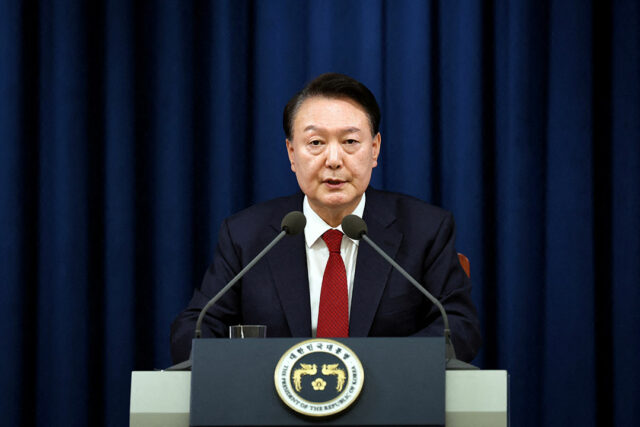
SOUTH KOREAN President Yoon Suk Yeol delivers a speech to declare martial law in Seoul, South Korea, Dec. 3, 2024. — THE PRESIDENTIAL OFFICE/HANDOUT VIA REUTERS

SEOUL (UPDATE) – A South Korean court sentenced former President Yoon Suk Yeol to life in prison on Thursday, after finding him guilty of masterminding an insurrection linked to his December 2024 attempt to impose martial law.

Prosecutors had sought the death penalty in the case, closely watched in a deeply divided country. It is the most consequential of a series of trials for the ousted leader, whose bid triggered a national political crisis and tested democratic resilience.

Yoon conspired with his then-defence minister, Kim Yong-hyun, to subvert the constitutional order by deploying troops to parliament, intending to paralyse its functions, Judge Jee Kui-youn told a packed courtroom.

“It is the court’s judgment that sending armed troops to parliament … and using equipment to try to make arrests all constitute acts of insurrection,” he said, speaking for the panel of three judges.

Yoon led a number of officials and troops in criminal activities on December 3, 2024, and “because of the martial law declaration, an enormous social cost was incurred,” Jee said as he handed down the life term for the former leader.

Wearing a dark navy suit without a tie, Yoon, 65, stood ashen-faced as the sentences were read out for him and seven other defendants, including Kim, the former defence minister, who received 30 years, and former top police officials.

Yoon’s defence team will discuss with him whether to appeal the ruling, with one of his lawyers, Yoon Kab-keun, saying it completely ignored the key legal principle of basing findings on evidence.

A lawyer for Kim said the former defence minister would “of course appeal”.

A prosecutor said the team had some “regret” over the sentencing but declined to say whether they planned to appeal.

RISK OF DEATH PENALTY
Before delivering the verdict, Judge Jee reviewed the long history of treason and insurrection, from the Roman Empire and medieval era to the trial and execution of England’s Charles I for waging war against parliament.

Masterminding an insurrection carries a maximum sentence of the death penalty or life imprisonment under South Korean law. The country last handed down a death sentence in 2016, but has not executed anyone since 1997.

Yoon denied the charges. The conservative former career prosecutor said he had presidential authority to declare martial law and his action was aimed at sounding the alarm over opposition parties’ obstruction of government.

The ousted former leader is likely to remain held at the Seoul Detention Center. He can appeal the ruling and again challenge any appellate court decision at the Supreme Court.

Judicial guidelines say the first trial should conclude within six months and the entire process, including appeals, in two years, but trials often exceed that.

Yoon, who has faced eight trial proceedings, is appealing a five-year jail term handed him in January in a separate trial on charges including obstructing attempts by authorities to arrest him after his martial law declaration.

SHOCKWAVES IN SOUTH KOREA
While Yoon’s bid to impose martial law lasted only about six hours before it was met by large street protests and voted down by parliament, it sent shockwaves through Asia’s fourth-largest economy, a key US security ally, and long considered one of the world’s most resilient democracies.

Ko Jeong-suk, 65, who watched the court decision at Seoul Station, said the martial law bid deepened social divisions. “I really think it should have been the death sentence so that this doesn’t become an example to repeat.”

But hundreds of Yoon supporters rallied outside the court complex calling for him to be freed.

In a post on X, President Lee Jae Myung, a liberal who won the presidency in a snap election in June after Yoon’s removal, commended the actions of the Korean people to thwart the martial law.

“It was possible because it was the Republic of Korea,” Lee said, using the official name of the country, whose people would set an example for history, he added.

His post ahead of Thursday’s ruling was attached to a newspaper report that some academics had recommended a Nobel Peace Prize nomination for the Korean public, which faced down troops and police to oppose martial law without violence. — Reuters

How China plans to dominate global trade

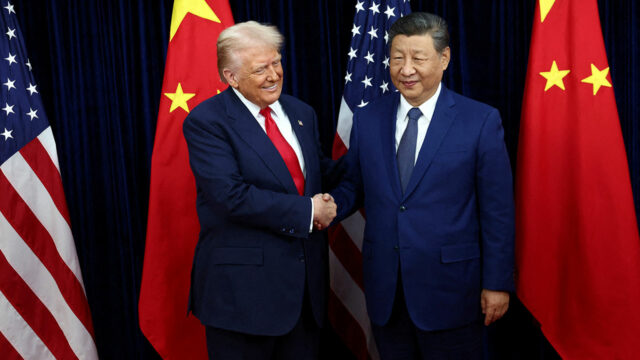
US PRESIDENT Donald J. Trump shakes hands with Chinese President Xi Jinping as they hold a bilateral meeting at Gimhae International Airport on the sidelines of the Asia-Pacific Economic Cooperation (APEC) summit in Busan, South Korea, Oct. 30, 2025. — REUTERS/EVELYN HOCKSTEIN

BEIJING — China sees an opening to turn President Donald J. Trump’s tariffs to its advantage by reshaping global trade in ways that would insulate its $19-trillion economy from US pressure far into the future.

Beijing is exploiting the uncertainty created by Mr. Trump to try to stitch China’s vast manufacturing base into the world’s biggest economic blocs, including the European Union (EU), Gulf States and a trans-Pacific trade pact, a Reuters examination found. The push involves accelerating efforts to clinch some 20 trade deals in total, many years in the making, despite widespread concerns about China’s overproduction, uneven market access and soft domestic demand.

A Reuters review of 100 Chinese-language articles by state-backed trade scholars written since 2017 reveals a systematic push by China’s policy advisers to reverse-engineer US trade policy and neutralize Washington’s containment strategy.

China is now putting that blueprint into action. The deal reached with Canada during Prime Minister Mark Carney’s January visit to Beijing — which slashes tariffs on Chinese electric vehicles — was the first of many aimed at breaking US leverage, according to interviews with 10 people, including Chinese officials and trade diplomats.

“Don’t interrupt your opponent when he is making a mistake,” said one Chinese official of Mr. Trump’s disruptive trade agenda.

The review, drawn from over 2,000 trade-strategy papers endorsed by the Chinese Academy of Social Sciences (CASS) and Peking University, which advise top leaders, shows policy insiders broadly accept that painful structural change is a price worth paying for China’s long-term dominance of global commerce. The papers’ contents are reported here for the first time.

If successful, Beijing could upend more than a decade of US trade policy by placing itself at the heart of a new, China-shaped multilateral order, two Western diplomats said.

“The Chinese have a golden opportunity now,” said Alicia Garcia Herrero, senior fellow at the Bruegel think tank.

China’s commerce ministry didn’t respond to a request for comment about Beijing’s strategy.

Asked about China’s approach, a US official told Reuters it was no surprise that countries with large trade surpluses sought to maintain globalization.

“President Trump is fixing the problems globalization caused for the United States while other countries are trying to double down on globalization as free market access to the United States goes away,” the official said.

BUILDING BLOCS
The shift in China’s tone reflects its calculations. A year ago, Beijing was invoking Mao Zedong and its ability to fend off the West in the Korean War with martial propaganda.

Now, as China prepares to welcome Mr. Trump in April, its diplomats are touring the world urging trading partners to join it in defending multilateralism and open trade.

In January, China dispatched its top diplomat to tiny Lesotho — which Mr. Trump initially hit with a 50% tariff — to pledge development cooperation. On Saturday, state media said China would implement zero tariffs on imports from 53 African countries. Meanwhile, China is pitching artificial intelligence (AI)-powered customs systems to neighbors and working to retool digital infrastructure that underpin commerce.

The moves underline a goal identified in the policy papers: to embed China so deeply in global trade that partners can’t afford to decouple under US pressure.

“In countering US strategic competition with China, ‘anti-decoupling’ should become China’s primary focus,” wrote Ni Feng, fellow at CASS’ Institute of American Studies, in 2024.

Chinese officials are now working to fast-track stalled trade talks. Since 2017, China has been negotiating with countries including Honduras, Panama, Peru, South Korea and Switzerland.

“We are willing to negotiate bilateral and regional trade and investment agreements with interested countries and regions,” commerce ministry spokesperson He Yongqian told Reuters during Mr. Carney’s visit, without elaborating.

China’s Foreign Minister Wang Yi surprised European negotiators in November by raising the prospect of a free-trade agreement with Brussels during talks with his Estonian counterpart.

A month later, Mr. Wang pressed the Gulf Cooperation Council to conclude long-running talks on a free-trade agreement. In January, British Prime Minister Keir Starmer agreed with Chinese leader Xi Jinping to launch a feasibility study into a trade-in-services agreement that could reduce barriers for British firms. German Chancellor Friedrich Merz has said he will seek “strategic partnerships” with China during a trip next week.

China’s Commerce Minister Wang Wentao has made joining the Comprehensive and Progressive Agreement for Trans-Pacific Partnership (CPTPP) a priority. The pact has its roots in the US-backed Trans-Pacific Partnership, developed in part to counter China before Washington withdrew in 2017.

But China’s huge trade surplus complicates the pitch. Some member countries worry Chinese manufacturers may use improved market access to funnel excess low-cost goods abroad, while China’s domestic demand remains sluggish.

Wendy Cutler, chief negotiator during the Obama administration for the Trans-Pacific Partnership, acknowledged the window for Beijing to champion trade and multilateralism but said China needed to go beyond talk.

“And with its huge trade imbalances, as well as some of the coercive measures it’s now taking against countries like Japan, it’s hard to see how they’re walking the walk,” Ms. Cutler told Reuters.

A senior European trade diplomat dismissed Beijing’s overtures as “pure Chinese propaganda,” saying Brussels had no plans for a trade deal.

Chinese advisers are undeterred. Speaking to Reuters, one noted the EU and China had negotiated a landmark 2020 investment deal during Mr. Trump’s first term. The deal, however, was frozen in 2021 before it could take effect amid a dispute over human rights sanctions.

LESSONS LEARNED
Some Chinese advisers contend in the papers that Beijing should study how Washington has “weaponized” global institutions to contain China, and exploit openings created by Mr. Trump’s willingness to abandon or sideline multilateral bodies such as the World Trade Organization.

Others argue Beijing should focus on influencing global standards in fields such as intellectual property through initiatives like Mr. Xi’s Belt and Road program and China’s membership of the Regional Comprehensive Economic Partnership, which covers about 30% of global gross domestic product (GDP).

China is now applying those insights.

Its recently upgraded deal with Southeast Asian states, for example, focuses on AI-driven and digital trade, where China hopes to secure a first-mover advantage.

Indeed, China’s vision for customs processing is evident at its “Friendship Port” on the Vietnamese border, where state media says home-grown AI solutions have slashed waiting times by 20%, enabling faster deliveries. Reuters couldn’t independently verify the claim.

The risks that China’s $1.2-trillion trade surplus poses to trading partners’ manufacturing sectors are hard to overlook, however.

Pascal Lamy, former World Trade Organization director-general and EU trade commissioner, said Chinese firms are sending more goods to Europe than the bloc can absorb.

“It’s a mystery how, given the nature of the regime, given the sort of collective cleverness, how is it that they have not succeeded in rebalancing their economic model?” he said.

Not everyone sees closer ties with China as the easiest way to curb reliance on the US.

Stephen Nagy, China project lead at the Macdonald-Laurier Institute in Ottawa, said Mr. Carney’s tariff-cutting agreement with Mr. Xi appears designed to build leverage before talks over the US-Mexico-Canada (USMCA) trade deal.

“I think his bet is wrong,” he added, predicting that Mr. Trump wouldn’t be swayed.

Mr. Carney has said Canada respects its USMCA commitment not to pursue free-trade deals with non-market economies. His office didn’t respond to a request for comment.

Mexico, for its part, is wary of endangering US market access by moving too close to China.

“We see no need for a free-trade agreement with China right now,” said a Mexican trade official. “We are already in the CPTPP and have 60% of world GDP covered.”

Beijing’s trade partners really need China to revive its consumption, said Fred Neumann, chief economist for Asia-Pacific at HSBC.

Mr. Wang, China’s commerce minister, has said growing imports is a priority as Beijing prepares to launch its next five-year plan in March, in line with a commitment to raise consumption’s share of GDP.

But rebalancing is a long-term project. Mr. Trump has three years left in office, and the next administration could revert to building coalitions to contain China.

China must “study in depth the logic of US actions within international institutions and the possible next steps it may take to better respond to increasingly fierce strategic offensives in the future,” Zhao Pu, then at Renmin University and now a researcher at CASS’ Institute of American Studies, wrote in 2023. — Reuters


Germany seeking more F-35 jets as European fighter program falters, sources say

A German national flag flies atop the illuminated Reichstag building in Berlin, Germany. — REUTERS

BERLIN/WASHINGTON — Germany is considering ordering more US-made F-35 fighter jets, two sources told Reuters, a move that would deepen Berlin’s reliance on American military technology as its joint next-generation fighter program with France falters.

One source said Berlin was in negotiations that could lead to the purchase of over 35 additional jets. Germany purchased 35 of the aircraft in 2022 which are due to begin delivery later this year.

The potential acquisition of more Lockheed Martin stealth fighters, at a cost of more than $80 million per plane, would follow pressure from Washington on European allies to increase defense spending.

If all the potential F-35 purchases and existing orders come to fruition, Germany would have around 85 F-35s. But the sources cautioned the outcome was still uncertain.

Germany’s defense ministry did not immediately comment while a Pentagon spokesperson referred questions to Germany. A spokesperson for defence contractor Lockheed Martin said the company was focused on building F-35s already ordered by Germany.

In October, a German parliamentary source said the defense minister intended to order 15 more F-35s. Germany was expected to announce that purchase in the near-term, the second source said.

Expansion of Germany’s F-35 fleet would mark a significant strategic shift toward deeper military integration with the United States and away from European defense autonomy, a priority for fellow European Union member France.

Germany and France are deadlocked on their Future Combat Air System (FCAS) program, a problem-plagued, €100-billion effort launched in 2017 to build a next-generation aircraft to replace French, German and Spanish jets starting in 2040. Under the emerging scenario, Germany and France would abandon the FCAS project.

A commitment by Germany to add F-35s to its arsenal would also have implications for the North Atlantic Treaty Organization (NATO) as the jet plays a key role in the alliance’s nuclear strategy.

Buying more F-35 jets would give Germany time to figure out developing and finding a partner for a jet project.

German Chancellor Friedrich Merz on Wednesday questioned whether developing a manned sixth-generation fighter jet, as FCAS has sought to do, still made sense for his country’s air force.

“Will we still need a manned fighter jet in 20 years’ time? Do we still need it, given that we will have to develop it at great expense?” Mr. Merz said on the Machtwechsel podcast published on Wednesday.

Berlin’s 2022 decision to buy the US-made F-35 was driven by its NATO obligation to deliver US nuclear bombs stored in Germany if called upon. The F-35 is the only Western fighter jet certified to carry the most modern B61 nuclear bombs and is central to replacing Germany’s aging Tornado jets, which play that role now.

While insiders expect Germany and France to abandon a joint fighter jet, they anticipate the allies will continue to cooperate on drones and digital warfare infrastructure.

German Defense Minister Boris Pistorius said last week the fate of FCAS would become clear within days. — Reuters

In Russia, many restaurants and cafés close as consumption stalls amid major slowdown

A RUSSIAN FLAG flies with the Spasskaya Tower of the Kremlin in the background in Moscow, Russia, Feb. 27, 2019. — REUTERS

MOSCOW — Restaurants and cafés are closing down in Russia at the fastest pace since the start of the war in Ukraine four years ago as consumption stalls even in affluent Moscow.

The closures, visible on streets from the capital to Vladivostok 6,500 kilometers (4,000 miles) east on the Pacific Ocean, point to a significant slowdown in Russia’s $2.8-trillion economy, which has so far proved surprisingly resilient in the face of stringent Western sanctions.

At the BonCafé bakery in southwestern Moscow, the shelves are empty of cakes and pastries, the espresso machine is silent and owner Yekaterina Oreshkina, 39, sits amid the dust and regret of a failed business.

“When we opened, we didn’t expect such a downturn,” Ms. Oreshkina, who owns a chain of such cafés, told Reuters over the mosaic-topped tables her children helped to decorate.

For Ms. Oreshkina, the traditionally slow January proved the final straw after costs ballooned due to the combination of a 50% rise in ingredient prices, high rent and higher taxes. She closed the bakery but has kept her other cafés open.

Their signature “Napoleon” cake, said to be named after the French emperor who invaded Russia in 1812, is a decadent mille-feuille dessert of multiple puff-pastry and cream layers that costs 2,850 rubles ($37) per kg, or 300 rubles ($4) a slice.

Many Russians, though, are cutting back on discretionary spending — particularly on expensive eating out — at the fastest rate since the shock of the February 2022 invasion.

RUSSIANS TIGHTEN BELTS
Guided by President Vladimir Putin’s crack team of economic officials, Russia has reported better average growth than the euro zone over the past four years despite being hit by some 24,000 Western sanctions.

But high interest rates, higher taxes, rising prices and a $20-per-barrel discount for Russian oil are taking their toll — even in Moscow, a vast urban area of 22 million people that has been largely insulated from the worst impact of Europe’s deadliest war since World War II.

“To let” signs are prominent in retail spaces across the capital. Sales of new light commercial vehicles and trucks, a good indicator for the health of the retail and construction industry, fell by 38% to 147,000 units in 2025 and have continued to fall in the first weeks of 2026, Autostat said.

Data from Sberbank, which as Russia’s biggest bank sees the ripples of expenditure across the economy, showed that the fall in the number of catering outlets in January was the biggest since 2021 and that restaurant spending hit the lowest in three years in November-early December 2025.

The change is especially striking as major Russian cities saw a restaurant boom before the pandemic, and some politicians bridled at what they saw as Moscow’s “decadent frivolity” while soldiers were being killed or injured at the front.

Overall, real consumer spending growth fell to zero in February for the first time in two years, Sberbank data showed. Russia forecasts economic growth of 1.3% this year after 1% in 2025, 4.9% in 2024 and 4.1% in 2023. The International Monetary Fund forecasts 0.8% growth for 2026.

Across Russia’s 11 time zones, central bank research showed, people are seeking cheaper options: fast food or supermarket meals instead of restaurants, discounted food in supermarkets, repairs of cars rather than new purchases, and a cooling housing market.

“Café and restaurant closures increased in the capital in 2025 compared to 2024, while the number of takeaway coffee outlets continues to grow,” the central bank said.

WAR ECONOMY
Russian sources say that while there are certainly problems in the economy, it is still performing remarkably well, and they dismiss suggestions of its demise as premature. Besides, Mr. Putin is unlikely to change course on Ukraine due to restaurants shutting their doors, they said.

Nevertheless, Mr. Putin earlier this month told top economic officials to restore the growth rate and urged them not to simply monitor prices. Just 10 days later, the central bank cut rates by 50 basis points to 15.5%.

Olga Belenkaya, head of the department of macroeconomic analysis at FG Finam, a leading Moscow financial services company, said state statistics showed Russians were saving more and paying off mortgage debt, especially as money became so expensive after the central bank hiked rates to 21% in 2024.

Borrowing costs — advertised by major banks at about 18-19% for unsecured loans to business — have hit small businesses and consumers hard, especially after some lenders imposed stricter limits on consumer credit.

“Because we are a goods-based business, we have to borrow constantly, taking on new loans and refinancing old ones,” said Yelena Bannikova, the founder and owner of the “VeroVika” Korean beauty store.

“High interest rates have had a very strong impact on us. The refinancing rate is high, and refinancing has become extremely difficult, almost impossible.” — Reuters

Alex Eala advances to last eight of Dubai Tennis Championships

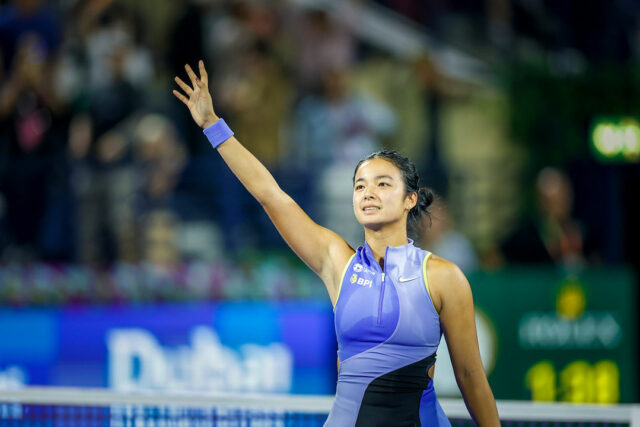
ALEX EALA — DUBAIDUTYFREETENNISCHAMPIONSHIPS.COM

ANOTHER higher-ranked opponent, another sweep.

Relentless Alexandra “Alex” Eala rolled into the last 8 of the WTA 1000 Dubai Duty Free Tennis Championships, hacking out a gutsy 7-5, 6-4 win over world No. 32 Sorana Cirstea of Romania before another full capacity crowd on Thursday at the Aviation Club Tennis Centre Stadium in the United Arab Emirates.

On the heels of a mammoth triumph over world No. 8 Jasmine Paolini of Italy, the WTA No. 47 Ms. Eala rode on the momentum against the 35-year-old Romanian after overturning a 4-5 deficit in extended opener and breaking away in the second for the win in 98 minutes.

The 20-year-old Filipina Ms. Eala, who also defeated No. 39 Hailey Baptiste in Round 1 (6-4, 0-1) after the latter’s retirement due to abdominal pain, faces her good friend, former doubles partner and world No. 4 Coco Gauff of the United States next at press time for a seat in the final four.

The 15-year, 46-day age gap between Mses. Eala and Cirstea was the biggest between two opponents from the Round of 16 onward in Dubai since its foundation in 2001, becoming the first Filipina quarterfinalist in the event’s history. It’s her second last 8 appearance in the 1000-level tours, next only to the four majors which she had already played in as the first Filipina as well.

Moreover, Ms. Eala — who became the youngest Asian woman to post multiple Top-10 wins surpassing Naomi Osaka — rose as only the third Asian player to reach multiple WTA 1000 quarterfinals before turning 21, joining Ms. Osaka and Olympic champion Zheng Qinwen.

“It’s super special. Every round is such a battle and so filled with tension so I’m really happy with how I performed,” said Ms. Eala, who snapped Ms. Cirstea’s seven-game winning run since ruling the Cluj-Napoca Open at home over world No. 25 Emma Raducanu of Great Britain.

“I think the key to today was staying calm and trusting my shots. I think I was very solid in particular moments where I needed to be. So yeah, that reflected in my performance and in the score.”

Ms. Eala’s win has now catapulted her to No. 32 in the live WTA rankings with 205 additional points albeit it’s still subject to change upon the official update next week.

Out for vengeance after her playoff streak this season was snapped with a first-round exit in the WTA 1000 Qatar Open, Ms. Eala did it behind another roaring Filipino support, proving her stature as one of the world’s hottest tickets today at only 20 years of age with packed stadiums one after another regardless of the country she’s in.

“The waves of support have really just made every single match all the more special. And it’s so difficult to describe the emotions and the actual experience of playing in front of this crowd. So I’m really grateful to be here,” beamed Ms. Eala, who had to weather Ms. Cirstea’s storm in the second set.

Ms. Eala zoomed to a 4-0 lead by holding serve but yielded to Ms. Cirstea’s torrid 4-1 answer to strike within 4-5 for a potential decider bid. But Ms. Eala was calm, cool and collected, holding serve in the 10th where she completed a love game capped by a forehand winner that kissed the baseline out of Ms. Cirstea’s reach.

It’s the same winner for Ms. Eala against the 2024 Dubai champion and this year’s No. 6 seed Ms. Paolini, whom she beat with a 6-1, 7-6(7-5) triumph for her third career win against Top 10 players.

And now, a familiar foe stands in her way as she shoots for a fourth Top-10 slay.

“You know, Coco (Gauff) is such an amazing person, and we tend to forget that she’s just a year older than me. But she’s a great role model for so many, so I’m really excited for that match,” said Ms. Eala, who teamed up with two-time Grand Slam champion Ms. Gauff for a quarterfinal finish in the 2025 Italian Open.

A win by Ms. Eala would replicate her best WTA 1000 outing so far in the 2025 Miami Open, where she reached the semifinals all the way from the qualifiers that shattered the gates wide open to her Top 100 and later on Top-50 entry.

But that would not be walk in the park against the 21-year-old Ms. Gauff, who looks forward to experiencing the ever-supportive Filipino crowd once again.

“I know you guys are probably here for Alex so I’m sorry to make you wait,” smiled the No. 3 seed Ms. Gauff, who pulled off a 2-6, 7-6(11-9), 6-3 comeback win against world doubles No. 1 and singles No. 22 Elise Mertens of Belgium in the Round of 16. “If I’m not mistaken, I think some of you guys are cheering for me so I appreciate it a lot and I hope you guys enjoy the next match.” — John Bryan Ulanday

Defending titlist TNT Tropang 5G enlist 7-foot-3 import Bol Bol

7-FOOT-3 TNT import Bol Bol — FACEBOOK.COM/TNTTROPANG5G

TNT gets the ball rolling for its PBA Commissioner’s Cup title defense by enlisting high-profile import Bol Bol.

The 7-foot-3 Mr. Bol, who saw action for Denver, Orlando and Phoenix in the NBA, arrived on Thursday, eager to take on the role for the Tropang 5G in the mid-season conference that kicks off March 11.

Mr. Bol brings elite rim protection and perimeter shooting skillset to the PLDT franchise as it gears up for its repeat bid against determined challengers.

“TNT adds a legit NBA-caliber player in Bol Bol but Bol Bol alone can’t carry the team,” PBA Chairman and TNT Governor Ricky Vargas told The STAR.

“We need consistent production from the locals, plus strong contributions from the bench, good health and consistency from our starters. A plan from our coaches for better bench rotation and players reciprocating with performance matters a lot,” he added.

Mr. Bol, who has a 7-foot-7 wingspan, is stepping in while TNT’s resident import Rondae Hollis-Jefferson is still recovering from the Achilles injury he suffered in his stint with Meralco in the East Asia Super League.

“We are hoping that Mr. Bol would be more than enough to cover for Rondae’s loss. It’s encouraging, too, that Jayson (Castro) will be back,” said team manager Jojo Lastimosa.

“It will still depend on how the locals can complement the presence of a player with no position just like Rondae, only taller,” he added.

Mr. Bol will headline a promising cast in the import-flavored tourney with no height restrictions. Ginebra’s Justin Brownlee, Meralco’s Ismael Romero, Terrafirma’s 7-foot import Mubasha Ali, Magnolia’s Terrell Brown-Soares, Blackwater’s Daniel Ochefu and Rain or Shine’s Jaylen Johnson were the others in tow.

“Our championship chances are as good as any team but I personally think we are no way close to being favorites and the path is tough. But we will try,” said Mr. Vargas.

“Bol Bol raises the ceiling (and) he will be good for the PBA. I’m sure the fans will come to watch him play,” he added. — Olmin Leyba

Quentin Millora-Brown joins Gilas ahead of FIBA World Cup Asian Qualifiers second window campaign

QUENTIN MILLORA-BROWN — FIBA

GILAS PILIPINAS will have big man Quentin Millora-Brown (QMB) in its arsenal for its showdown with powerhouses New Zealand and Australia, after all.

This as talks between the camp of the 6-foot-10 bruiser and the Samahang Basketbol ng Pilipinas (SBP) yielded a positive result, allowing him to join the Nationals for the crucial FIBA World Cup Asian Qualifiers second window campaign next week.

“After direct conversations with Quentin Milllora-Brown and his family, the Samahang Basketbol ng Pilipinas announces that he is en route to Manila from Japan,” the federation reported on Thursday.

“The SBP appreciates his continued commitment to the program. He’s ready to suit up for Gilas and is going to be an integral part of the current and future of the national team,” it added.

QMB’s participation was initially in doubt due to the absence of a contract, adding to the frontcourt woes of a Gilas crew that’s already missing Kai Sotto. The 7-foot-3 Mr. Sotto is still not 100% recovered after a year of recovery from ACL and should be in harness by the third window yet.

Mr. Millora-Brown is expected to enter the Gilas camp by Friday.

This is a welcome development for coach Tim Cone and Co. who will have their hands full against the Tall Blacks on Feb. 26 and the Boomers on March 1, in a pair of Group A home gigs.

The Filipino cagers will gun for their third straight victory after sweeping Guam in Window 1 while New Zealand will seek to enter the win column after dropping its first two matches versus the Aussies last time. — Olmin Leyba

Tanking to Cuban

Conventional wisdom’s instinctive reaction to tanking has always been moral outrage. Lose on purpose? Undermine competition? Betray the paying public? The arguments are familiar, the tone indignant. And yet, when Mark Cuban recently urged the league to not just tolerate tanking but to embrace it, he did not sound like a provocateur. He came off as a realist. In the wake of renewed crackdowns and escalating fines, he framed the practice as strategy, as an inevitable feature of a system that rewards long-term asset building over short-term optics. His point was simple, if uncomfortable: Teams do not tank because they want to fail. Teams tank because there is reason to give the structure of the National Basketball Association (NBA).

This perspective runs counter to the urgency coming from the league office. Commissioner Adam Silver has warned that tanking has worsened “in recent memory,” with penalties already imposed on franchises manipulating lineups and stronger sanctions under consideration. His concern is institutional: competitive integrity, public trust, nightly credibility. In contrast, Cuban’s counterargument cuts deeper into the business logic of modern sports. Fans, he suggests, do not merely buy wins. They buy possibility. In closed competition sans promotion or relegation, protagonists ultimately sell either contention or hope. And taken in this context, rebuilding, however unappealing in the moment, is invariably the most rational path to both.

The tension, then, is not between virtue and vice; it is between two competing definitions of fairness. The NBA wants honest effort every night. Front offices want the flexibility to maximize long-term competitiveness. Cuban’s willingness to admit he has embraced tanking himself strips away the pretense. The practice is not aberrational; it is systemic. If poor records yield premium draft position, and if elite young talent remains the most reliable pathway to contention, then losing strategically becomes an investment. Punish the behavior without changing the incentive, and teams will simply grow more discreet, not more competitive.

Cuban has floated what might be his most intriguing idea yet: redesign the draft to resemble free agency, allowing prospects to choose destinations rather than be assigned by reverse standings. Such a shift figures to fundamentally alter the calculus. Losing games would no longer guarantee access to top talent; organizational appeal, development infrastructure, and market strength would matter more. In theory, it would redirect competition away from the bottom of the standings and toward institutional excellence. In practice, of course, it would also risk concentrating power in already attractive franchises, a dilemma the league has historically tried to avoid.

Which leaves the NBA confronting an old truth expressed in a novel way. Tanking persists not because teams lack competitive spirit, but because the architecture of competitive balance makes it rational. Reforming deportment without changing inducements rarely works, in sports or elsewhere. The league can fine, warn, and threaten. Owners can defend, rationalize, and strategize. But until the reward structure itself changes, the gravitational pull toward calculated losing will remain. Cuban’s argument may sound disruptive. In reality, it is diagnostic. And diagnosis, however inconvenient, is often the first step toward a cure. Or, at the very least, toward accepting that the condition is chronic.


Anthony L. Cuaycong has been writing Courtside since BusinessWorld introduced a Sports section in 1994. He is a consultant on strategic planning, operations and human resources management, corporate communications, and business development.