Home Blog Page 250

A brief overview of extrajudicial settlement

When a person passes on, those left behind are often faced not only with emotional loss but also with the task of settling the person’s affairs. The process of estate settlement affects families from all walks of life, regardless of the size or value of the estate involved. It is therefore not surprising that estate settlement continues to receive public attention, including through proposals in Congress relating to estate tax, such as bills seeking to extend estate tax amnesty programs or to revisit the existing estate tax system itself. While these proposals remain under discussion, they reflect a shared recognition that estate settlement is a common and often challenging experience for many Filipinos and foreigners who have properties in the Philippines.

Estate settlement is the process by which a decedent’s properties, rights, and obligations are identified, settled, and transferred to his or her heirs. There are different ways to complete this in the Philippines, depending on the circumstances. One of the most commonly used methods is extrajudicial settlement (EJS) which allows heirs to settle the estate among themselves without going to court. This is allowed if the decedent did not leave any will, there are no unpaid debts (or the heirs agree to take responsibility for them), and all heirs sign and publish the agreement to divide the estate.

For many families, EJS offers a way to move forward without the added cost, time, and formality associated with judicial processes. However, while EJS simplifies the procedure, it does not remove the legal and tax requirements that accompany the transfer of property from one party to another.

The EJS process actually starts with the determination of who are the heirs and what are the properties left by the deceased. The heirs will then have to decide how the properties will be divided among themselves. This agreement must be formalized in a notarized deed of extrajudicial settlement, which must be published once a week for three consecutive weeks in a newspaper of general circulation. These procedural steps, while straightforward in principle, also form the basis for subsequent steps involving taxes and property transfers.

Tax law imposes a 6% estate tax on the transfer of a decedent’s net estate upon death to the heirs, regardless of whether the estate is settled through court proceedings or through EJS. The law allows certain deductions to arrive at the net estate subject to tax, such as the value of the family home or certain properties received prior to death, subject to limitations.

Beyond estate tax, the way the heirs apportion the estate can also have separate tax consequences. A 6% donor’s tax may apply if an heir gives up part of his or her rightful share so that another heir receives more than his or her legal share. Donor’s tax can likewise be imposed when there is a specific renunciation in favor of a particular co‑heir, as opposed to a general renunciation. In a recent Court of Tax Appeals (CTA) case, the court held that although certain paragraphs of the EJS appeared to indicate a general renunciation (i.e., without designating a specific recipient), these were effectively negated by later provisions that clearly directed the repudiated shares in favor of a specific heir. Consequently, the CTA considered renunciation in the EJS as a gratuitous transfer or donation. Careful drafting and aligning allocations with legal shares help avoid unintended donor’s tax exposure.

Where land or other real property forms part of the estate, local taxes likewise come into play. Under the Local Government Code, local government units are authorized to impose a tax on the transfer of ownership of real property, including transfers by donation and inheritance. The specific rates and procedures may vary depending on the city or municipality, adding another step to the settlement process.

Notably, settling an estate also involves the submission of required documents (e.g., death certificate of the decedent, the deed of extrajudicial settlement, proof of publication of EJS, tax declarations, certificates of title), filing the estate tax return, and paying the tax due to the Bureau of Internal Revenue (BIR). Heirs or their representative must also secure a Certificate Authorizing Registration (CAR) from the BIR for each property before any transfer can be recorded by other institutions such as the Register of Deeds (RD) and the Land Transportation Office (LTO).

Ultimately, beyond these required documents and processes, it’s important to recognize the human context in which estate settlement takes place. Families often begin the settlement process while still grieving the loss of a loved one. During this period, attention is understandably focused on personal and family matters, and the completion of legal and tax requirements may not be an immediate priority. In reality, this may contribute to delays in filing estate tax returns or settling tax obligations within the periods prescribed by law, resulting in the imposition of penalties and interest. This experience is not uncommon and reflects the practical challenges faced by families navigating estate settlement during a difficult time.

From the perspective of families, these layered requirements combined with emotional and personal circumstances can make EJS feel more tedious than initially expected. While the absence of court proceedings remains a clear advantage, the overall timeline of the settlement may still be affected by the need to gather the required documents, complete tax filings, and secure clearances. The delays at any stage may affect the next steps, making timing and coordination an important part of the process.

The government passed several estate tax amnesty measures, with the most recent ending on June 14, 2025. These helped to ease the burden of long-standing unpaid estate taxes for families of decedents, especially those from earlier years. Today, legislators are once again discussing potential amnesty and other reforms, reflecting their continued recognition of the practical realities faced by families in settling estates. While these are still under deliberation, families must manage estate settlement based on existing rules and procedures.

In sum, extrajudicial settlement remains a valuable and legally recognized option for settling estates in the Philippines. At the same time, its effectiveness in practice largely depends on how well heirs or their representatives understand and manage the surrounding tax and legal requirements while coping with personal loss. A clearer appreciation of these realities may help set more realistic expectations and encourage informed decision-making during what is frequently a sensitive and challenging period.  

The views or opinions expressed in this article are solely those of the author and do not necessarily represent those of Isla Lipana & Co. The content is for general information purposes only, and should not be used as a substitute for specific advice.


Julrey Florence Garcia is a senior legal advisor at Cabrera & Co., a Philippine member firm of the PwC network.

+63 (2) 8845-2728

julrey.florence.garcia@pwc.com

Cambodian PM says Thailand occupying territory after Trump-brokered ceasefire

A girl eats a meal at Chong Kal refugee camp on Dec. 11, 2025 after evacuation amid deadly clashes between Thailand and Cambodia along a disputed border area in Chong Kal, Oddar Meanchey Province, Cambodia. — REUTERS

WASHINGTON — Cambodian Prime Minister Hun Manet told Reuters on Tuesday that Thai forces were occupying Cambodian territory after fighting last year despite a peace accord brokered by US President Donald Trump. Hun Manet called on Thailand to allow a joint boundary commission to begin working on their disputed border.

Hun Manet traveled to Washington to attend a meeting of Mr. Trump’s Board of Peace this week, and said he hoped the new body could play a role in de-escalating the situation on the border, which he described as “fragile” despite a December ceasefire that ended renewed fighting. The board was created to oversee a Gaza peace plan, but Mr. Trump has said it could take on a broader role.

Thailand has said it is maintaining troop positions as part of de-escalation measures and denied it is occupying territory.

The comments from Cambodia’s leader underscore the risk that the conflict could reignite once again despite Mr. Trump continuing to promote the success of the peace deal.

The worst fighting in more than a decade, which broke out in July, has displaced hundreds of thousands of people and disrupted trade across the 817-kilometer (508-mile) border. An October peace accord signed with Mr. Trump and Malaysia’s prime minister broke down within a matter of weeks before a new ceasefire was reached on December 27.

“We still have Thai forces occupy(ing) deep into Cambodian territory in many areas. This is further beyond even Thailand’s own unilateral claim… border line,” Hun Manet told Reuters in his first interview with international media, adding that Thai troops had laid shipping containers and barbed wire inside what Thailand had long recognized as Cambodian territory and residents were unable to return home. “This is not an accusation but it’s a statement of the facts on the ground.”

Cambodia could not accept what he called a “violation of our sovereignty or territorial integrity,” he said.

“The only way to verify that is using the technical mechanism that we have, based on treaties, based on all the agreements we have. So we hope that Thailand will agree and start to allow the JBC (joint boundary commission) to work as early as possible,” Hun Manet said, adding that Thailand had cited its February 8 election as a reason not to begin demarcation work. Thai Prime Minister Anutin Charnvirakul rode a wave of nationalism in the election in the wake of the border conflict.

“Now the election is done, we hope that Thailand can start, at least on a technical level, to start measuring, start demarcating in the hot zone, so that we can go back to life,” Hun Manet said.

Cambodia’s long-ruling leader Hun Sen announced that he would hand over power to his son, Hun Manet, after elections held in 2023 in which his ruling Cambodian People’s Party ran virtually unopposed.

The ascension of Mr. Manet, 48, a graduate of the US Military Academy at West Point, followed by Mr. Trump’s involvement in the border dispute, has ushered in warmer ties between Washington and Phnom Penh, which had for years been moving closer to China.

Mr. Manet said relationships with China and the US were “not mutually exclusive” and said Cambodia had “nothing to hide” on the Ream naval base that was upgraded by China. — Reuters

Trump admin says Japan to invest in energy, industrial projects in Ohio, Texas and Georgia

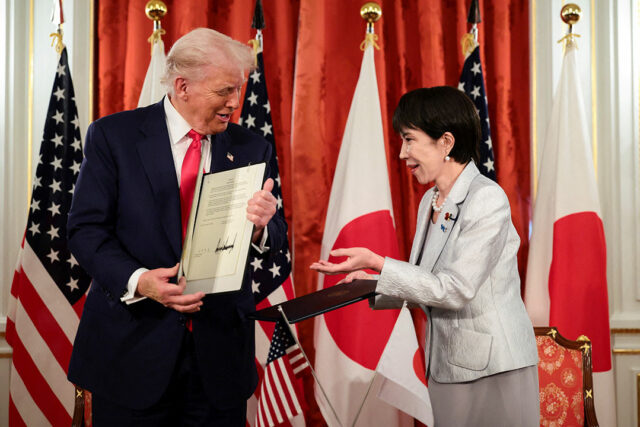
US PRESIDENT Donald J. Trump and Japanese Prime Minister Sanae Takaichi hold signed documents following a bilateral meeting at Akasaka Palace in Tokyo, Japan, Oct. 28, 2025. — REUTERS/EVELYN HOCKSTEIN

WASHINGTON — President Donald J. Trump’s administration on Tuesday announced three projects valued at $36 billion to be financed by Japan, including an oil export facility in Texas, an industrial diamonds plant in Georgia and a natural gas power plant in Ohio.

The projects are the first investments under Japan’s $550-billion US investment pledge as part of a trade deal that cut Mr. Trump’s tariffs on Japanese imports to 15%, Mr. Trump said on Truth Social. He gave few details about the projects.

Commerce Secretary Howard Lutnick said in a statement that the Portsmouth, Ohio power plant, valued at $33 billion, would be the largest natural gas-fired generating facility in history with a capacity of 9.2 gigawatts.

The facility, to be operated by SB Energy, a subsidiary of Japanese tech investor SoftBank Group, would increase baseload power at a time of fast-growing electricity demand from data centers built to power artificial intelligence applications.

The White House said Japan would invest in the $2.1-billion Texas GulfLink deepwater crude oil export facility off the Texas coast.

“This project is expected to generate $20-30 billion annually in US crude exports, secure export capacity for our refineries, and reinforce America’s position as the world’s leading energy supplier,” Mr. Lutnick said.

Texas GulfLink, which is being developed by Sentinel Midstream, confirmed that it was part of the initiative and was “honored to be a trusted partner with the US Department of Commerce and the government of Japan.”

Mr. Trump said the Texas investments would include a liquefied natural gas (LNG) project, but Mr. Lutnick’s statement and a White House fact sheet did not mention LNG.

Mr. Lutnick said the third major project in Georgia was a synthetic industrial diamond manufacturing plant that would satisfy 100% of US demand for synthetic diamond grit, a critical input for advanced manufacturing and semiconductor production. The US currently relies largely on China for such supplies.

The high-pressure synthetic diamond plant, valued at about $600 million, will be operated by Element Six, the White House said in a fact sheet. The industrial diamond company is a unit of De Beers Group, the world’s largest diamond producer.

It was unclear how much of the projects’ costs would be funded by Japanese entities and under what conditions. Under an earlier US-Japan agreement, profits from the projects were due to be shared 50-50 between the US and Japan until Japan’s initial investment costs were recouped, after which profits would be split 90-10 in favor of the US.

The administration’s announcements followed meetings last week between Mr. Lutnick and Japan’s Economic and Trade Minister Ryosei Akazawa, where they worked out remaining issues before deals could be announced.

“The scale of these projects are so large, and could not be done without one very special word, TARIFFS,” Mr. Trump wrote on Truth Social.

MORE DEALS COMING
“All of these projects involve Japan and the United States working together to build supply chains in strategically important fields,” Mr. Akazawa told reporters in Tokyo on Wednesday.

He also said that Japan would continue to work with the US for more investment deals, adding that Tokyo has pledged investments of up to $550 billion before the end of Mr. Trump’s current term in office.

While declining to comment on the estimated timing for forthcoming deals, Mr. Akazawa said he, as a negotiator, “would keep in mind that Prime Minister Sanae Takaichi’s planned US visit (in March) would be fruitful.”

Multiple Japanese firms expressed interest in the three initial projects, according to the Japanese government, including Noritake as an off-taker for the diamond project, Mitsui O.S.K. Lines and Nippon Steel as suppliers for the crude oil export facility project, and Hitachi and Toshiba for the power project.

Japan’s investment package would consist of equity, loans and loan guarantees from state-owned agencies Japan Bank for International Cooperation and Nippon Export and Investment Insurance.

Mr. Akazawa has said the investment would have no foreign exchange impact in light of sizable foreign currency reserves that the government could use for loans. — Reuters

Europe loses hold on American tourists, woos Chinese, Indian travelers, survey shows

A VIEW of the Eiffel Tower in Paris, France, Nov. 28, 2015. — REUTERS

CHINESE and Indian tourists are set to make up for a potential slowdown in growth from US travelers to Europe this year, according to a survey published on Wednesday by the European Travel Commission, with international arrivals to the continent set to rise by 6.2%.

This is the first sign of a slowdown in the post-pandemic boom in American travel to Europe, driven by a strong US dollar and economic resilience in North America.

An earlier study from industry group the European Travel Commission showed that Americans were less intent on traveling to Europe in 2026 than in 2025, a trend driven by worsening economic concerns and geopolitical instability.

While Chinese arrivals to Europe are set to rise by 28% compared to 2025 and Indian arrivals to climb by 9%, traveler numbers from the Americas were seen growing by just 4.2%.

According to data from aviation intelligence platform Cirium, bookings from Europe to the US between Oct. 7 and end-January fell 14.2% year on year, while bookings from the US to Europe slid 7.3%.

Despite a tempering of interest from core American travelers, Europe is still seeing a steady rise in both long-haul travelers and in spending, showing that tourists who still want to come are more focused on high-value experiences that can keep the European travel market steady.

“Europe continues to stand out as a reliable destination, well-positioned to respond to evolving demand for more flexible travel and experience-led journeys,” said Miguel Sanz, head of the European Travel Commission, in a statement.

Travel spending in Europe is set to have risen by 9.7% in 2025, according to the survey.

That is in line with reports from Europe’s major carriers, including Lufthansa and Air France-KLM, of a steady rise in bookings for their premium offerings, while economy cabin bookings for transatlantic travel have fallen.

Air France-KLM reports its full-year results for 2025 on Thursday. — Reuters

US envoys juggle two crisis talks, raising questions about prospects for success

A US flag is draped at Union Station with the US Capitol dome in the background on Capitol Hill in Washington, DC, June 28, 2025. — REUTERS/KEN CEDENO

WASHINGTON/GENEVA/DUBAI — Even for a US president long fixated on dealmaking, Donald J. Trump’s assignment of his favorite envoys to juggle two sets of negotiations — the Iranian nuclear standoff and Russia’s war in Ukraine — in a single day in Geneva has left many in the foreign policy world scratching their heads.

The shuttle diplomacy on Tuesday by US special envoy Steve Witkoff and Mr. Trump’s son-in-law Jared Kushner has raised questions not only about whether they are overstretched and outmatched, but about their serious prospects for resolving either of the twin crises, experts say.

Mr. Trump, who has frequently boasted about having ended multiple wars and conflicts in the first year of his second four-year term, has made clear he is looking to add more international deals that he can tout in his quest for the Nobel Peace Prize.

But the high-stakes negotiations over the two long-running issues were arranged quickly, and the choice of Geneva as the setting for both was never clearly explained, except for the city’s long history of hosting international diplomacy.

“Trump seems more focused on quantity over quality instead of the difficult detailed work of diplomacy,” said Brett Bruen, who was a foreign policy adviser in the Obama administration and now heads the Global Situation Room strategic consultancy. “Tackling both issues at the same time in the same place doesn’t make a lot of sense.”

Iran was the opening act in a carefully choreographed diplomatic dance in Geneva, where talks took place under high security in two locations on different sides of the Swiss, French-speaking city.

After 3-1/2 hours of indirect discussions between the US team and Iranian Foreign Minister Abbas Araqchi mediated by Oman, both sides indicated that some progress was made, but there was no suggestion that an agreement was imminent in the longstanding dispute over Iran’s nuclear program.

As long as the diplomatic process continues, Mr. Trump can keep expanding his massive military buildup near Iran, making clear that use of force remains on the table. That is likely to keep the Middle East on edge, with many fearing that US strikes could escalate into a wider regional war.

‘OVERSTRETCH’?
With barely a pause on Tuesday, the US delegates went straight from the Iran talks at Oman’s diplomatic mission to the five-star InterContinental hotel for the first of two days of Russia-Ukraine negotiations over a war that Mr. Trump, during the 2024 presidential campaign, had promised to end in a day.

Expectations were low for a breakthrough in the latest round of talks to end Europe’s biggest war since World War II ended in 1945.

A regional official close to Iran’s leadership said the US team’s double agenda in Geneva reinforced doubts about whether Washington was sincere about either of the diplomatic efforts.

“The approach risks overstretch,” the official, who spoke on condition of anonymity, told Reuters. “It resembles an emergency room with two critically ill patients and a single doctor unable to give either case sustained attention, increasing the likelihood of failure.”

Mohanad Hage Ali of the Carnegie Middle East Center in Beirut said there was too much at stake in the Iran crisis for the US to handle diplomacy this way.

“Having a team of Witkoff and Kushner tasked with resolving all the world’s problems is, frankly, a shocking reality,” he said.

Some experts said the two, both from Mr. Trump’s world of New York real estate development, lack the depth of knowledge and experience to go up against veteran negotiators like Mr. Araqchi and their Russian interlocutors and that they were in over their heads in such complicated conflicts.

Absent from the Geneva meetings was US Secretary of State Marco Rubio, Mr. Trump’s top diplomat, who is known as a foreign policy wonk.

Asked for comment, White House spokesperson Anna Kelly said Mr. Trump and his team “have done more than anyone to bring both sides together to stop the killing and deliver a peace deal” in Ukraine. She denounced anonymous “critics” of the president’s approach but did not provide answers to Reuters’ specific questions for this story.

‘ENVOY FOR EVERYTHING’
Administration officials have long defended Mr. Witkoff and Mr. Kushner’s roles, citing their skills as dealmakers, the trust Mr. Trump puts in them, and the failings over the years of more traditional diplomatic approaches.

Mr. Witkoff, a longtime Mr. Trump friend often called the “envoy for everything” due to his broad remit, played a key role in securing a ceasefire agreement last year between Israel and Hamas in the Gaza war, though progress has stalled toward a more permanent resolution. His diplomatic efforts with Iran and Russia have had little success so far.

In Mr. Trump’s first term, Mr. Kushner spearheaded the Abraham Accords, under which several Arab states forged landmark diplomatic relations with Israel. But the pact has not advanced much since Mr. Trump returned to office nearly 13 months ago.

Mr. Kushner and Mr. Witkoff’s ability to handle their latest diplomatic tasks has been undercut by Mr. Trump’s stripping down of the government’s foreign policy apparatus, both at the State Department and the National Security Council, where many veteran staffers were sent packing, some analysts say.

“We’ve seen a hollowing-out of our diplomatic bench,” said former Obama foreign policy adviser Mr. Bruen. “So there’s a question of whether we still have the right people to work on these big issues.” — Reuters

Eala stuns world No. 8 Paolini in WTA 1000 Dubai Championships

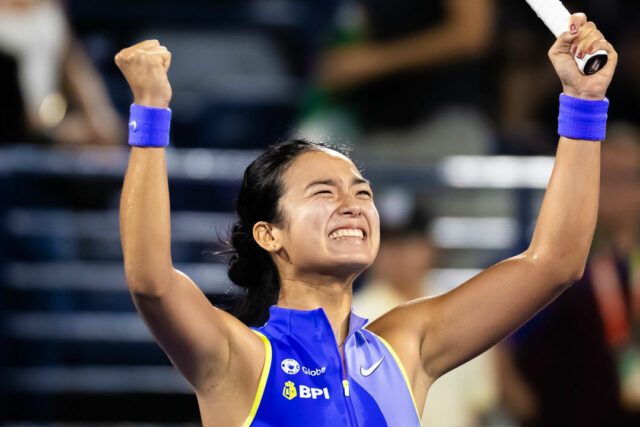
ALEX EALA — FACEBOOK.COM/WTA

ALEXANDRA “ALEX” EALA adds another star to her giant-killing spree, slaying world No. 8 Jasmine Paolini of Italy in the WTA 1000 Dubai Duty Free Tennis Championships with a 6-1, 7-6(7-5) on Wednesday morning at the Aviation Club Tennis Center Stadium in the United Arab Emirates.

Ms. Eala, teary-eyed and in disbelief after a baseline winner that prompted an eruption from the predominant Filipino crowd, handed the sixth-seeded Italian a near bagel in the first set and recovered from wasting two match points in the second to complete the stunning upset via sweep in 100 minutes.

The 20-year-old Filipina pride, WTA No. 47, will try to go deeper in the 1000-level tourney with massive ranking points at stake against the Romanian veteran Sorana Cirstea in the Round of 16.

Ms. Cirstea, WTA No. 32, also scored a 6-1, 6-4 upset over world No. 14 and Dubai’s No. 10 seed Linda Noskova of Czechia in their own Round of 32 duel.

“A star is soaring,” said the WTA as Ms. Eala pulled the rug from under Ms. Paolini who ruled the same Dubai tilt in 2024.

Ms. Eala, a young gun seen as the next big thing in world tennis with a legion of fans wherever she goes like she has a homecourt advantage, did by setting a bevy of milestones once again from the monumental triumph.

It’s the third career Top-10 win for Ms. Eala after taking down world No. 2 Iga Swiatek of Poland and then world No. 5 Madison Keys of the United States in a magical final four run as a wildcard last year at the Miami Open, where she’s slated for a grand return next month.

Ms. Eala, 20 years and 268 days old, thus became the youngest Asian woman to post multiple Top 10 wins in two or more 1000-level tours, surpassing the 28-year-old Japanese Naomi Osaka, who achieved the feat at 20 years and 350 days old.

Her win also propelled her to a new career-high placing of No. 38 in the live WTA rankings with 110 additional points albeit it’s still subjected to change depending on player movements upon the official update next week.

“In the tiebreak, I was trying everything to keep myself in check. I was thinking, this stadium is full of Filipinos kaya sabi ko, ‘Ilan kaya sa inyo ang nagdadasal para sa akin?’ so I really have to give everything I got,” Ms. Eala, showered by cheers and chants from the pro-Pinoy crowd once again like what she had in Abu Dhabi and Doha, beamed.

Ms. Eala earned a shot at the 30-year-old Ms. Paolini, 2024 Olympic doubles gold medalist with Sara Errani, after the injury of American foe Hailey Baptiste, who had to retire leading 1-0 in the second set of Round 1 due to abdominal pain. The lefty ace took a 6-4 win in the first set behind a 3-1 blast from a close 3-all score.

And she did not shy away from the big stage against the multititled Italian who reached a career-best ranking of No. 3, making Ms. Paolini bleed for just a lone game in the first set before wearing her down in the extended second frame.

Ms. Eala, thirsty for a good showing after a first-round exit in the Qatar Open last week, relinquished a 5-3 lead marked by back-to-back service breaks to allow a tiebreaker, where she staged a telling 5-2 finishing kick to erase a 2-3 deficit after Ms. Paolini held serve in the fifth game.

At match point with a 6-5 cushion, Ms. Eala sent a strong serve that triggered a long rally before icing it with a forehand winner straight into the baseline as Ms. Paolini failed to recover.

“All the emotions are coming because the tension was so high, especially during that second set. I’m really happy to have gotten through. She’s a great opponent, obviously being Top 10 and a former champion here,” said Ms. Eala.

“So, to be able to compete with her at this level is a great achievement for me.” — John Bryan Ulanday

Unbeaten Nxled, PLDT brace for tough game in Galeries Tower, Akari in PVL All-Filipino tourney

NXLED CHAMELEONS — FACEBOOK.COM/PREMIERVOLLEYBALLLEAGUE

Games on Thursday
(FilOil Arena)
4 p.m. – Akari vs PLDT
6:30 p.m. – Nxled vs Galeries Tower

NXLED and PLDT look to keep their records immaculate as they face dangerous foes in Galeries Tower and Akari, respectively, in the PVL All-Filipino Conference at the FilOil Arena.

The Nxled Chameleons have lived up to the hype and racked up three straight victories including one against the Cignal Super Spikers, 25-19, 25-22, 27-25, on Saturday at the Ynares Center Antipolo that propelled it straight to the top.

A win over the Galeries Tower Highrisers (1-2) in their 6:30 p.m. duel would keep the lighting company at the helm.

The PLDT High Speed Hitters have also started strong and won their first two outings including one over the Capital1 Solar Spikers, 25-20, 25-16, 22-25, 25-17, last week at the same San Juan venue.

They too have no plans of slowing down when they tackle the Akari Chargers, who are winless in two starts.

Nxled coach Ettore Guidetti said they needed to be always prepared because everyone would want a piece of them.

“We just know every single game we have a big target on our back,” said the Italian bench strategist.

The Chameleons have drawn strength from their vaunted three-headed dragon in Brooke Van Sickle, Myla Pablo and MJ Phillips while the Manny V. Pangilinan franchise should go to Savi Davison and its deep bench. — Joey Villar

NU Lady Bulldogs sweep Adamson for UAAP Season 88 women’s volleyball tournament solo lead

NATIONAL UNIVERSITY LADY BULLDOGS — FACEBOOK.COM/UAAPVARSITYCHANNEL

Games on Saturday
(SM Mall of Asia Arena)
9 a.m. – UE vs AdU (Men’s)
11 a.m. – NU vs FEU (Men’s)
1 p.m. – UE vs AdU (Women’s)
3 p.m. – NU vs FEU (Women’s)

SUPER rookie Sam Cantada drew first blood against her former high school teammates, towing reigning champion National University (NU) to a 25-23, 25-19, 28-26 sweep to gain a solo lead early in the UAAP Season 88 women’s volleyball tournament on Wednesday at the UST Quadricentennial Pavilion.

The former UAAP juniors MVP from Adamson high school sizzled with 16 points on 13 hits, two aces and a block as the NU Lady Bulldogs jumped to a 2-0 start after a tough four-set debut against rival University of Santo Tomas last weekend, 25-23, 25-19, 23-25, 26-24.

It was a solid follow-up performance for Ms. Cantada, who fired 21 points in that win, to announce a roaring statement as the next big thing in women’s collegiate volleyball for NU in what’s supposed to be a rebuilding stage after the graduation of Bella Belen and company.

Even if that meant beating her former high school teammates like ex-UAAP juniors MVP and last season’s Rookie of the Year Shaina Nitura, Abby Segui and Fhei Sagaysay in their first encounter.

Ms. Cantada committed to NU for collegiate play after keeping the juniors MVP crown in San Marcelino in Season 87 on the heels of Ms. Nitura’s MVP campaign and championship sweep the season prior.

Ms. Cantada, a pride of Dasmariñas, Cavite, wasn’t alone in delivering the big win for the Lady Bulldogs though, getting 12 points from another high school sensation Arah Panique from Naga.

Team captain Vange Alinsug and Chams Maaya added six points each while Abegail Pono dished out 14 sets and Shaira Mae Jardio provided 11 receptions plus eight digs.

New coach Regine Diego, who took over from Sherwin Meneses in the offseason, is liking the team’s showing so far in a tough transition after losing the championship core and four of the team’s Super Six in Ms. Belen, Alyssa Solomon, Sheena Toring and Erin Pangilinan.

NU, albeit against a strong Adamson University resistance in each set, raced to a 2-0 lead but was nearly denied a sweep after losing a 15-12 lead in the third frame.

Ms. Nitura along with Frances Mordi willed the squad to set point, 24-23, but Ms. Cantada forced a deuce before errors cost them in the extension as Alexa Mata iced the deal with an ace.

Mses. Nitura and Mordi led with 18 and 17 points, respectively, for the wards of coach JP Yude, who failed to mirror their 25-19, 25-18, 25-10 debut win against the Ateneo Blue Eagles.

In the men’s division, six-peat title-seeking NU also zoomed to 2-0 start after a 25-13, 25-18, 25-15 win over Adamson (1-1), behind the troika of Leo Ordiales, Buds Buddin and Jade Disquitado with 16, 15 and 11 points, respectively. — John Bryan Ulanday

Chip-enabled identity cards with enhanced security key to fighting identity fraud

PHILIPPINE STAR/ MICHAEL VARCAS

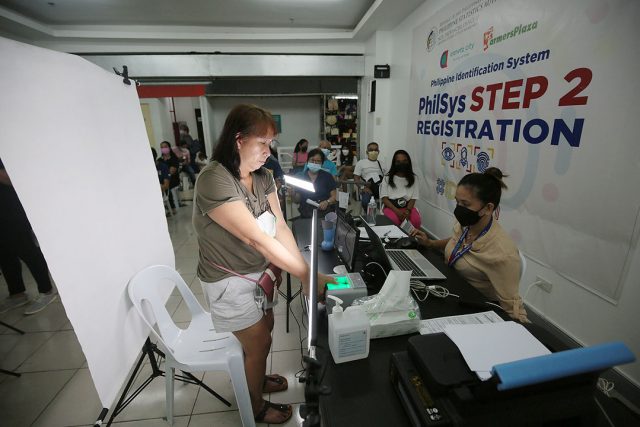
The Philippines must transition to chip-enabled identity cards to effectively fight identity fraud amid the advent of generative artificial intelligence (AI), which has allowed perpetrators to scale attacks to an unprecedented degree, according to UK-based biometric specialist iProov.

“If you’re introducing a new type of identity card, ensure it has a chip-enabled card that can be verified electronically. That, combined with e-verify.gov.ph, gives you a really, really high level of assurance it’s the right person,” said Milko Radotic, vice president for Asia Pacific at iProov, in an interview.

Mr. Radotic noted that document-related fraud is one of the most prevalent forms of identity fraud in the country, partly due to the lack of embedded chips in common IDs—unlike the secure electronic chips, usually found in passports.

IProov said that at least US $23 billion is the projected loss in 2030 due to synthetic identity fraud in United States alone, citing the report of Delight Insights Report in 2023.

The Bangko Sentral ng Pilipinas (BSP), for instance, currently accepts around 30 different valid identity documents for opening a bank account, but very few of them have secure electronic chips.

“If you want to open up a bank account remotely from your couch, you can do that,” Mr. Radotic said. “You can use any one of these 31 documents. Some of them are more secure than others. So therefore, the level of trust that you can put into the document is a challenge.”

According to the Secure Technology Alliance, smart ID cards with embedded chips or RFID technology strengthen identity security by securely storing and protecting personal data, supporting trusted authentication, and helping prevent alteration, cloning, or unauthorized access to identity records.

It added that chip-based IDs also enable stronger verification processes, allowing institutions to confirm identities electronically and detect fraudulent or altered credentials more efficiently.

Various agencies have started to adopt more secure digital identity systems recently in the Philippines, such as the Digital National ID and its authentication platforms National ID eVerify and National ID Check launched in June 2024.

The unified Person with Disability (PWD) ID system with RFID technology also had a pilot rollout last year to curb fake cards and improve verification.

Mr. Radotic expressed appreciation for the government’s initiatives to combat identity fraud, noting that with over 92 million Filipinos already enrolled in the Philippine Identification System (Philsys) platforms like e-verify.gov.ph and eGov.ph now allow organizations to verify the “source” of a document directly against a trusted official database. — Edg Adrian A. Eva

Salt research and development center inaugurated in Pangasinan to boost PHL salt industry

The Accelerating Salt Research and Innovation (ASIN) Center is located at Pangasinan State University. — EDG ADRIAN A. EVA

The Department of Science and Technology (DOST) on Tuesday inaugurated the country’s first salt research and development center, aiming to revive the declining salt industry and achieve the country’s salt self-sufficiency.

The facility, called the Accelerating Salt Research and Innovation (ASIN) Center, was built at Pangasinan State University (PSU) with support funding of ₱43 million from DOST and is monitored by the attached agency Philippine Council for Industry, Energy and Emerging Technology Research and Development (DOST-PCIEERD) under the Niche Centers in the Regions for Research and Development (NICER) program. PSU also allocated a ₱20 million counterpart to set up the building.

DOST Secretary Renato U. Solidum Jr. said the center aims to address the country’s overreliance on imported salt, which currently accounts for 93% of total demand, while only 7% is produced locally. He noted that limited salt farms, aging farmers, and outdated technologies have contributed to the decline of the country’s salt industry.

“The establishment of the ASIN R&D Center is our response to decades of underinvestment in salt science and a decisive step toward achieving true salt self-sufficiency,” Mr. Solidum said during his speech at the launch event.

The ASIN Center was enabled by Republic Act No. 11985, or the Philippine Salt Industry Act, signed in early 2024. The law promotes the use of machines and cost-effective technologies to improve salt production in the country.

The ASIN Center is set to be a hub for exploring new and efficient ways to process salt. It is equipped with advanced laboratory testing equipment, training and workshop areas, and a salt production technology demonstration site.

PSU President Elbert M. Galas said the system being developed at the center is poised to improve both the quality and quantity of salt produced. Once patented and ready for commercialization, it will be available for potential local adopters.

“Ibig sabihin, papalakihin pa nila yung machine para mas marami pang ma-produce” [This means they will scale up the machine to produce more], Mr. Galas told reporters.

Once operational, the system can produce 300–350 liters of brine in just 3.5 hours and yield up to 55 kilograms of salt in 2–2.5 hours, compared with traditional methods that take up to 7 hours, while using only 30 kilowatts of electricity, said Rex B. Basuel, program leader of the ASIN Center.

Mr. Solidum noted that the system is also exploring ways to make salt production more cost-effective for potential adopters, such as using solar energy and traditional salt-cooking methods to improve energy efficiency.

Local farmers and smaller stakeholders are also expected to benefit from the technologies developed at the ASIN Center, as communities and local government units can access the technology, Mr. Basuel told BusinessWorld.

“Kung assisted sila ng government through equipment, ang expectation noon pwede na silang magtaas ng farmgate price” [If the government provides equipment, they are expected to raise farmgate prices], he said, noting that the technology can help farmers produce processed salt of higher value.

The new system developed at the center is expected to be piloted at Bulinao Salt Farm in Pangasinan in partnership with the provincial government, allowing the technology to be adopted and upscaled, Mr. Galas said.

Regarding the ASIN Center’s sustainability, which is organized into three divisions — Membrane Science and Separation Technology, Salt Science and Applications, and Process Design and Engineering — Mr. Galas said they are currently processing plantilla items with the Department of Budget and Management (DBM). — Edg Adrian A. Eva

Vatican says it will not participate in Trump’s ‘Board of Peace’

AERIAL VIEW of St. Peter’s Basilica, Vatican City — ALAN LIU-UNSPLASH

WASHINGTON — The Vatican will not participate in US President Donald Trump’s so-called “Board of Peace” initiative, Cardinal Pietro Parolin, the Vatican’s top diplomatic official, said on Tuesday while adding that efforts to handle crisis situations should be managed by the United Nations.

Pope Leo, the first US pope and a critic of some of Mr. Trump’s policies, was invited to join the board in January.

Under Mr. Trump’s Gaza plan that led to a fragile ceasefire in October, the board was meant to supervise Gaza’s temporary governance. Mr. Trump thereafter said the board, with him as chair, would be expanded to tackle global conflicts. The board will hold its first meeting in Washington on Thursday to discuss Gaza’s reconstruction.

Italy and the European Union have said their representatives plan to attend as observers as they have not joined the board.

The Holy See “will not participate in the Board of Peace because of its particular nature, which is evidently not that of other States,” Mr. Parolin said.

“One concern,” he said, “is that at the international level it should above all be the UN that manages these crisis situations. This is one of the points on which we have insisted.”

Many rights experts say that Mr. Trump overseeing a board to supervise a foreign territory’s affairs resembled a colonial structure. The board launched last month has also faced criticism for not including a Palestinian.

Countries have reacted cautiously to Mr. Trump’s invitation, with experts concerned that the board could undermine the UN. Some of Washington’s Middle Eastern allies have joined but its Western allies have stayed away so far.

The Gaza truce has been repeatedly violated with hundreds of Palestinians and four Israeli soldiers reported killed since it began in October.

Israel’s assault on Gaza has killed over 72,000, caused a hunger crisis and internally displaced Gaza’s entire population.

Multiple rights experts, scholars and a UN inquiry say it amounts to genocide. Israel calls its actions self-defense after Hamas-led militants killed 1,200 people and took over 250 hostages in a late 2023 attack.

Pope Leo has repeatedly decried conditions in Gaza. The pope, leader of the world’s 1.4 billion Catholics, rarely joins international boards. The Vatican has an extensive diplomatic service and is a permanent observer at the United Nations. — Reuters

Nordic region seeks deeper ties with Greenland after Trump threats

GREENLAND’s flag flutters on a tourist boat as it sails past icebergs near Ilulissat, Greenland, Sept. 13, 2017. — REUTERS

COPENHAGEN — Nordic government ministers will meet in Denmark on Wednesday to discuss elevating Greenland and two other autonomous territories to equal status in a regional forum, boosting cooperation after US President Donald Trump’s push to control the Arctic island.

Denmark and its European allies have rejected Mr. Trump’s insistence that the Nordic country must hand Greenland to the United States, launching talks last month between Copenhagen, Nuuk and Washington to resolve the diplomatic standoff.

Wednesday’s meeting will focus on upgrading the Helsinki Treaty, adopted in 1962 by Finland, Sweden, Denmark, Iceland and Norway, to give full rights to the Danish-ruled territories of Greenland and the Faroe Islands as well as Finland’s Aland.

The autonomous regions have for decades sought equal status in the Nordic forum, but were kept out of meetings focusing on security and related matters such as the war in Ukraine, leading Greenland’s government in 2024 to boycott the format.

“An update of the Helsinki Treaty will be a historic step and a future-proofing of Nordic co-operation,” Denmark’s minister for Nordic cooperation, Morten Dahlin, said in a statement.

Greenland will actively participate in creating a commission to update the agreement, the island’s Foreign Minister Vivian Motzfeldt said in the statement.

“The process surrounding the Helsinki Treaty will be decisive in determining whether Greenland can be recognized as an equal partner in Nordic cooperation,” Ms. Motzfeldt said.

While opinion polls have indicated that a majority of the island’s 57,000 people hope to one day gain independence from Denmark, many warn against rushing it due to economic reliance on Copenhagen and becoming overly exposed to the United States.

Greenland’s Prime Minister Jens-Frederik Nielsen earlier this month said that if Greenlanders were forced to choose between the US and Denmark, they would choose Denmark. — Reuters