Home Blog Page 2495

Green travel essentials now found at SM

INCORPORATING sustainable practices when traveling is easy with SM Green Finds, products that are eco-friendly and which are marked with the Green Finds badge for easy identification in the store.

For a comfortable flight, there are Travel Blue pillows which are made of eco-friendly materials. For travelers who prefer to bring their own towels, SM Home offers quick-drying Hosh bamboo travel towels which are not only eco-friendly but are also lightweight and compact for easy packing.

Over at Kultura, there eco-friendly, lightweight shopping totes in different prints and sizes for lugging around souvenirs. There is also a line of katsa (cheesecloth) bags and sustainable bags made of upcycled denim. A raffia belt bag makes wandering around on holiday easy while being fashionable at the same time.

The Supplies Station inside SM Store also has its own sustainable bags like a katsa tote bag and Eco Jute Bags that come in different sizes. These are not only sustainable but are easy on the budget as well.

For those who prefer to bring their own reuseable tumblers and utensils, check out Kultura’s line of bamboo products. Bamboo is durable, biodegradable and stylish. Kultura also has a line of bamboo eye wear.

Don’t forget to pack clean beauty essentials on a trip. SM Beauty carries Luxe Organix Cica Soothing Gel — for easing sunburn — that comes with easy to carry refill packs. For ease when cleaning up there is Garnier Micellar Cleansing Water (for makeup removal) and Watsons Antibacterial Biodegradable Cleansing Wipes that is free from alcohol, parabens, silicon and mineral oil. These are 100% plant-based wipes which are eco-friendly, convenient, and disposable.

For travelling with a baby or toddler, the Baby Company also has green travel essentials like bibs, a milk pump, and organic juices under the Only Organic brand. Meanwhile, Toy Kingdom carries the SES brand of toys that are 100% carbon neutral, and Melissa and Doug branded toys, which are sustainably packaged and also 100% carbon neutral.

Keep older kids busy on the plane, train, or automobile with a box of Crayola. As a company, Crayola invests in 100% renewable energy, enough to make over three billion crayons, 700 million markers, and 120 million jars of paint a year.

SM Green Finds is one of the key programs under the SM Green Movement, a group-wide Sustainability initiative aimed to encourage multi-stakeholder collaboration to create a shift in mindset and behavior toward a better and improved quality of life for every Filipino, anchored on three pillars: Green Planet, Green Culture, and Green Living.

A matter of luck

FREEPIK

THERE are just some people who believe in good fortune and avoiding its negative version. Even in house construction there are rules on the location of the doors and the windows and how to deflect bad vibes. Does the flow of the wind really bring good chi?

In personal grooming, these beliefs in supernatural forces, not necessarily religious, prevail. How else can one explain a cultivated goatee allowed to grow uncut and comprising of not more than five strands of hair? It has nothing to do with good grooming. (Yes, these eccentrics have fortunes to hang on too.)

Trying to get a lucky strike or avoid misfortune is a lifelong goal. Some prefer training and attending seminars, or “upskilling” — the more I practice, the luckier I get. Others prefer to consult fortune tellers who even advertise on billboards at bus stops.

From ancient times, priests and conjurers tried to predict the outcome of battles and looked for signs on the best time to embark on a major invasion or coup. The Romans routinely checked the entrails of birds on the best time for a triumph, the parade of a victor returning from battle. Still, a charioteer accompanying the victorious general was obliged to whisper to the victor’s ear that “this too shall pass” — sic transit gloria.

Do people really postpone construction when beset by stern warnings of “impediments in initiating a new project”? When does the “ghost month” start and end? When the warnings are defied and ill fortune befalls the project like the collapse of a wall, the unfortunate builder may well regret not heeding his astrological consultant.

Reading one’s good fortune in the coming year creates its own problems. The false sense of security can lead to smug arrogance that challenges the gods (or the writers of the horoscope) to back up their promise.

The idea that a certain group of people sharing an accident of birth dates will undergo a common fate is hard to swallow. Still, horoscope readers tend to be personalized and see the prediction as intended only for them. “Someone above you who has consistently derailed your career progress will be summarily dismissed for fraud. He will be screaming your name as the whistleblower as he is dragged out by his glued toupee.” Interpretations can point to a difficult boss being pirated by the competition and no longer able to inflict pain on you. It can be a romantic rival who decides to migrate to Canada… or a neighbor who always blocks your driveway with his SUV finally constructing his own garage rather than parking on the street.

Phrasings for fortune telling are intentionally vague to allow for multiple interpretations. Few readings are specific enough to allow only a single meaning — the SOB who had been hounding you all of last year will be stricken by bird flu and live in excruciating pain for 12 days in July before swooning in a narcoleptic fit and being cremated by mistake while still alive. Only the telltale tear among the ashes will indicate the dreadful mistake.

Fortune hunting is not always about gold-diggers. It can mean searching for the best reading of the future. Anyway, most astrological pieces tend to be optimistic. You can go through different glossy magazines in the beauty parlor for metrosexuals and glance through the various entries for a fire dog in the year of the fire pig next year. The worst reading (all your dreams will come true in the first semester, and then you will wake up) can be discarded.

Is it best to rely on a volatile fate which bodes neither good nor bad fortune? Life presents its own strokes of fate (like having an umbrella when it rains). It seems best to be surprised by unexpected events without benefit of anticipation. Still, life’s little speed bumps can be unusually bone-rattling.

Anticipation of bad luck can be a self-fulfilling prophecy. Indecision and wavering before taking the plunge may result in unfortunate results. Explaining away any development as a matter of luck can distort analysis of what really happened, or what needs to be done about it.

As the stoic Epictetus puts it, “You can’t control what happens to you, only how you react to it.” So maybe we should pray for equanimity… when good fortune strikes — how long will it last?


Tony Samson is chairman and CEO of TOUCH xda

ar.samson@yahoo.com

How the Philippines can protect itself from a rising tide of ransomware attacks

MARKUS SPISK-UNSPLASH

By Scott Hesford

RECENTLY, the Department of Information and Communications Technology announced that the Philippine Health Insurance Corp. (PhilHealth) and the Department of Science and Technology suffered cyberattacks, which were confirmed as ransomware attacks. Faced with an increasing number of sophisticated cyberattacks, government agencies in the Philippines are racing to strengthen their security measures to protect their core systems and data.

Many of the cybercriminals behind these attacks are using leaked ransomware builders. Their goal appears to be to cause disruption of core government services and, in turn, problems for citizens.

There are a range of ransomware builders in use, including Vice Society, Clop, AlphV, and LockBit. Interestingly, the notes received by victims of many of the ransomware attacks appear to have been copied from the original LockBit template and do not include contact details.

This indicates that cybercriminals have little interest in actually extracting ransom payments, but are instead focused purely on causing disruption and losses. In many cases, attackers are also posting details of their successes on discussion boards and social media sites in an effort to gain notoriety.

Outside the Philippines, LockBit is also proving to be a popular option for cybercriminals. During the past 12 months alone, notable victims have included The Royal Mail (UK), Hospital for Sick Children (Canada), Managed Care of North America (US), and Center Hospital Sud Francilien (France).

THE ORIGINS OF LOCKBIT
Since first being discovered in 2019, LockBit has grown to become one of the most successful cybercrime operations in the world. In 2022, it was estimated to account for 44% of all ransomware campaigns.

LockBit operates as a ransomware-as-a-service operator. This means it focuses on delivering ransomware attack capabilities for a fee to criminals who lack the technical knowledge to undertake attacks alone.

LockBit attacks also regularly use a “double extortion” technique, where data is stolen before it is encrypted on a victim’s systems. This allows the attacker to threaten to publish the data on the Internet if the ransom is not paid.

TACTICS AND TECHNIQUES
Ransomware attacks make use of a range of different tactics to successfully penetrate a victim’s IT infrastructure. These include:

• Privilege escalation: This approach often makes use of local administrator privileges to abuse elevation control mechanisms. LockBit is regularly observed performing user account control bypass techniques.

• Defensive evasion: To evade detection, LockBit regularly disables security tools and clears Windows Event logs. These actions require the attacker to have at least local administrator privileges on the endpoint and the ability to execute code.

• Credential access: LockBit attackers sometimes use OS Credential Dumping tools, such as ExtPassword and LostMyPassword, to access the credentials of other users accessing an endpoint device. This allows them to capture the credentials of potentially privileged domain users and escalate their access.

• Lateral movement: LockBit attackers sometimes use administrator accounts and SMB (Server Message Block) to achieve lateral movement within an IT infrastructure.

DEFENDING AGAINST LOCKBIT ATTACKS
To avoid falling victim to a LockBit-powered ransomware attack, organizations need to focus on a number of security fundamentals. Together, they can significantly enhance existing protective measures. They include:

• Keep software patched: Keeping operating systems and application software up to date is vital, particularly for public-facing systems. Known software vulnerabilities often provide attackers a way to execute code on a victim’s systems.

• Enforce a policy of least privilege: Ransomware attackers rely on gaining access to accounts with admin access rights. By using an endpoint privilege management tool, local admin rights can be removed without affecting user experience.

• Apply controlled access: It’s important to move towards zero trust architectures and away from VPN and RDP solutions that provide attackers with broad access to an organization’s network. Focus on giving users only the access they need in a way that is controlled and auditable. Multifactor authentication is also highly recommended.

• Control execution: Application control is a well-established defense against a significant number of threats. While it may appear to be a daunting task when combined with privilege management, it can be very achievable.

AN ONGOING THREAT
Ransomware attacks based on LockBit present an alarming threat to many other organizations in the Philippines. The criminal group’s innovative approach to ransomware combined with a small army of technically skilled affiliates makes it dangerous.

For this reason, it is vital to ensure that the security measures organizations have in place can withstand such attacks. Threats need to be quickly identified and prevented from progressing through an IT infrastructure.

LockBit is going to remain a feature of the cybersecurity landscape in the Philippines for an extended period. Taking the necessary protection steps now will reduce the chances of falling victim to these kinds of cyberattacks in the future.


Scott Hesford is the director of Solutions Engineering for Asia-Pacific and Japan at BeyondTrust.


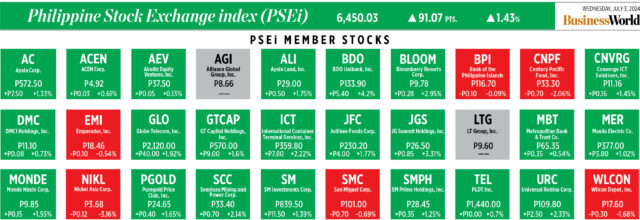
PSEi member stocks performed — July 3, 2024

Here’s a quick glance at how PSEi stocks fared on Wednesday, July 3, 2024.


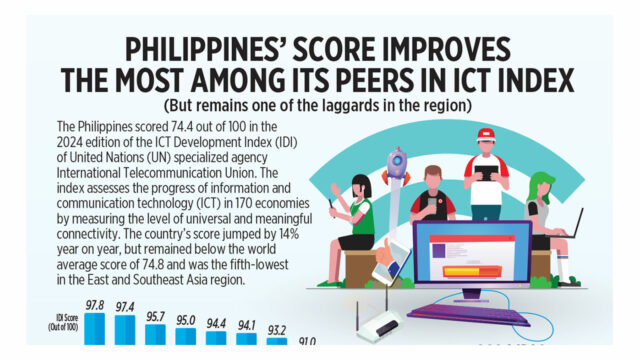
Philippines’ score improves the most among its peers in ICT Index

(But remains one of the laggards in the region)

The Philippines scored 74.4 out of 100 in the 2024 edition of the ICT Development Index (IDI) of United Nations (UN) specialized agency International Telecommunication Union. The index assesses the progress of information and communication technology (ICT) in 170 economies by measuring the level of universal and meaningful connectivity. The country’s score jumped by 14% year on year, but remained below the world average score of 74.8 and was the fifth-lowest in the East and Southeast Asia region.

Philippines’ score improves the most among its peers in ICT Index

Peso climbs on dovish remarks from Fed chief

BW FILE PHOTO

THE PESO rebounded against the dollar on Wednesday following dovish comments from US Federal Reserve Chair Jerome H. Powell.

The local unit closed at P58.725 per dollar on Wednesday, strengthening by seven centavos from its P58.795 finish on Tuesday, Bankers Association of the Philippines data showed.

The peso opened Wednesday’s session slightly stronger at P58.77 per dollar. Its weakest showing was at P58.83, while its intraday best was its close of P58.725 versus the greenback.

Dollars exchanged decreased to $779.72 million on Wednesday from $915.14 million on Tuesday.

The peso went up against the dollar following dovish comments from Mr. Powell, a trader said in a phone interview.

The local unit rose as the Fed chief’s remarks renewed bets of more than one rate cut within the year, Rizal Commercial Banking Corp. Chief Economist Michael L. Ricafort said in a Viber message.

The US is back on a “disinflationary path,” Mr. Powell said on Tuesday, but policy makers need more data before cutting interest rates to verify that recent weaker inflation readings provide an accurate picture of the economy, Reuters reported.

Data for May showed the Fed’s preferred measure of inflation did not increase at all that month, while the 12-month rate of price increases has ebbed to 2.6%, still above the US central bank’s 2% target but on the way down after a scare in the first months of the year.

“We just want to understand that the levels that we’re seeing are a true reading on what is actually happening with underlying inflation,” Mr. Powell said at a monetary policy conference in Portugal sponsored by the European Central Bank.

“I think the last reading… and the one before it to a lesser suggest that we are getting back on the disinflationary path,” Mr. Powell said. “We want to be more confident that inflation is moving sustainably down toward 2%… before we start… loosening policy.”

US short-term interest rate futures were little changed on Tuesday, with prices continuing to imply that the Fed would deliver its first rate cut in September and a second one in December.

The Fed has kept its benchmark policy interest rate steady in the 5.25%-5.5% range since last July, and still described inflation as “elevated” in its June 12 policy statement.

Whether the Fed ends up cutting in September or winds up on a more delayed timetable will hinge on the coming employment and inflation reports, including the monthly jobs report on Friday and the July 11 release of the consumer price index for June.

The Fed will hold its next policy meeting on July 30-31.

While the timing of an initial rate cut may matter little to the larger economic outcomes the Fed is seeking, policy makers are sensitive to the signal they will send by cutting rates.

They want to be sure, in particular, that the first reduction in borrowing costs becomes the start of a full monetary easing cycle that brings rates steadily down to a level where the Fed feels it is neither encouraging nor discouraging businesses and households to invest and spend.

For many officials, that has been an argument in favor of being patient and waiting longer to make the first rate cut.

For the rest of the week, the market will look at economic reports out of the US, including latest jobs data, for leads, the trader said.

For Thursday, the trader expects the peso to move between P58.50 and P58.90 per dollar, while Mr. Ricafort sees it ranging from P58.60 to P58.80. — AMCS with Reuters

Shares up as Powell comments boost sentiment

BW FILE PHOTO

PHILIPPINE SHARES surged on Wednesday as dovish comments from the US Federal Reserve chief boosted sentiment.

The Philippine Stock Exchange index (PSEi) rose by 1.43% or 91.07 points to end at 6,450.03 on Wednesday, while the broader all shares index climbed by 0.93% or 32.46 points to close at 3,495.13.

“Philippine shares closed in positive territory yesterday after the Federal Reserve announced some progress in reducing inflation but indicated that it is not yet ready to lower interest rates,” Regina Capital Development Corp. Head of Sales Luis A. Limlingan said in a Viber message.

“The local market rose as investors hunted for bargains after a two-day decline. Positive cues from Wall Street also fueled Wednesday’s climb, with the bourse joining its neighboring peers in the green territory at the session’s close,” Philstocks Financial, Inc. Research and Engagement Officer Mikhail Philippe Q. Plopenio said in a Viber message.

The Dow Jones Industrial Average rose 162.33 points or 0.41% to close at 39,331.85; the S&P 500 gained 33.92 points or 0.62% to 5,509.01; and the Nasdaq Composite gained 149.46 points or 0.84% to 18,028.76, Reuters reported.

Asian stocks rose on Wednesday as comments from Federal Reserve Chair Jerome H. Powell reinforced expectations that US rate cuts were not far off.

MSCI’s broadest index of Asia-Pacific shares outside Japan was 0.64% higher, boosted by tech stocks, while Japan’s Nikkei jumped 1.4%, stalking the record high touched in March.

The US is back on a “disinflationary path,” Mr. Powell said on Tuesday, although he cautioned that policy makers need more data before they can consider cutting interest rates.

Traders are currently pricing in a 69% chance of the Fed cutting rates in September and as many as two rate cuts this year, a far cry from the more than 150 basis points of easing expected at the start of the year.

Almost all sectoral indices closed higher on Wednesday. Financials rose by 1.55% or 29.54 points to 1,929; services went up by 1.41% or 28.15 points to 2,021.71; holding firms climbed by 1.21% or 66.38 points to 5,527.89; industrials added 1.09% or 98.68 points to end at 9,081.88; and property gained by 1.06% or 26.75 points to end the session at 2,531.68.

Mining and oil was the lone decliner, dropping by 0.97% or 83.47 points to 8,507.08.

“Among the index members, BDO Unibank, Inc. was at the top, rising 4.2% to P133.90. Nickel Asia Corp. lost the most, dropping 3.16% to P3.68,” Mr. Plopenio said.

Value turnover slipped to P3.93 billion on Wednesday with 263.93 million shares changing hands from the P3.94 billion with 422.91 million issues traded on Tuesday.

Advancers outnumbered decliners, 95 versus 83, while 58 names ended unchanged.

Net foreign buying stood at P22.09 million on Wednesday versus the P310.09 million in net selling recorded on Tuesday. — RMDO with Reuters

Hog output gains seen cutting pork import demand by 10%

REUTERS

THE Department of Agriculture (DA) said it expects a swine repopulation program to raise output by about 60,000 metric tons (MT) this year, potentially reducing demand for pork imports by about 10%.

In Memorandum Circular No. 28, the DA said it will push for the recovery of the hog industry via the establishment of multiplier and production farms employing artificial insemination under the Integrated National Swine Production Initiatives for Recovery and Expansion (INSPIRE) program.

“There is a need to enhance and refocus the implementing strategies of the repopulation program, to achieve the targets of the project,” it added.

During the first quarter, hog production declined 4.3% to 419.37 thousand MT, according to the Philippine Statistics Authority. This was a reversal from the 5.1% growth posted a year earlier.

Imports of pork, on the other hand, rose 11.9% to 128.51 million kilos in the first quarter, according to the Bureau of Animal Industry (BAI).

The DA said the INSPIRE program will focus on areas that are free of African Swine Fever (ASF).

“This will ensure the sustainable supply of breeders, feed, semen, access to markets, and overall logistical and technical support,” it said.

The DA added that beneficiaries will be adopting modern climate-controlled building systems or conventional facilities compliant with Biosecurity Level 1.

It said piglets produced by multiplier farms would be distributed to participating hog raisers engaged in contract growing or finishing.

“It is expected that this approach will reduce the possibility of ASF infection, facilitate sustained production of piglets, provide of technical support to beneficiaries, and enable efficient monitoring organized by the farmer cooperatives and associations (FCA),” the DA said.

It added that beneficiaries may opt to avail of a production farm package worth P5.5 million to P16.2 million.

As of June 21, 10 provinces had active cases of ASF across 21 municipalities, according to the BAI. — Adrian H. Halili

DTI planning to cut down items on SRP list 

PHOTO BY BERNARD HERMANT

THE Department of Trade and Industry (DTI) said on Wednesday that it will reduce the number of items on the suggested retail price (SRP) bulletin.

In a statement, the DTI said that the proposal was presented to a special meeting of the National Price Coordinating Council last week.

“Our goal with this proposal is to improve the usability and relevance of the SRP Bulletin, making it a more effective tool for consumers to make informed purchasing decisions,” Trade Secretary Alfredo E. Pascual said in the statement.

“By aligning the SRP with essential daily and emergency items, we are taking a significant step towards better price stability and consumer protection,” he added.

The DTI is proposing to reduce the number of stock keeping units (SKUs) being monitored from the current 217 SKUs.

It proposed to delist condensed milk, evaporated milk, coffee refills, candles, salt, bottled water, condiments, and batteries, among others.

The proposed streamlined SRP will focus on sardines, powdered milk, bread, laundry soap, instant noodles, processed and canned pork, beef, poultry meat, and toilet soap.

The proposal follows consultations with the Department of Social Welfare and Development and the Philippine Statistics Authority.

Also consulted were the Philippine Amalgamated Supermarkets Association, Inc., the Philippine Association of Stores and Carinderia Owners, and various retailers.

“Additionally, the DTI considered data from the Family Income and Expenditure Survey, consumer price index basket commodities, and top-selling items in sari-sari stores,” the DTI said.

The DTI is organizing a technical working group to finalize the list of SKUs within each category.

The DTI, under the Price Act, is empowered to issue SRPs for any or all Basic Necessities and Prime Commodities, to guide producers, manufacturers, traders, retailers, and consumers.

Undersecretary Jose Edgardo G. Sunico said that the streamlined SRP list is targeted for release within the month. — Justine Irish D. Tabile

Prices of back-to-school items largely steady, Trade dep’t says

PHILIPPINE STAR/EDD GUMBAN

THE Department of Trade and Industry (DTI) said on Wednesday that 68% of the school supplies covered by its buyers’ guide were unchanged in price.

The DTI is set to release the “Gabay sa Pamimili ng School Supplies” (guidance on purchasing school supplies), which covers specific brands of notebook, pad paper, pencil, ballpoint pen, crayon, eraser, sharpener, and ruler.

According to the DTI’s Consumer Affairs and Legal Services group, the list will indicate the price changes and will be presented at the Plan Balik Eskwela (back to school) event of the Department of Education.

This year, 173 stock keeping units (SKUs) of school supplies were submitted, representing a 53 SKU increase from the previous year.

“Compared to last year’s set of SKUs, 68%, or 80 SKUs, of the 117 SKUs recorded no price movement, while 8%, or 9 SKUs, had decreased prices. In addition, only 24%, or 28 SKUs, showed an increase in prices,” the DTI said.

For this year, notebook prices range from P11.80 to P52, Grade 1-4 pad paper sold for P9.50 to P61, and intermediate pad paper prices fetched between P13.80 and P48.75.

Prices of pencils and ballpoint pens ranged from P11 to P33 and P3 to P33, respectively.

Sharpeners and rulers were priced at P15 to P69 and P16 to P29, respectively. Meanwhile, erasers fetched P4.50 to P20.

With classes resuming on July 29, the DTI urged consumers to check the labels of school supplies for the name and address of the manufacturer or importer and the number of leaves in notebooks and papers, among others.

“I urge consumers to buy school supplies from companies that comply with labeling requirements and use the price guide when shopping,” Trade Secretary Alfredo E. Pascual said.

The DTI will also be posting the “Gabay sa Pamimili ng School Supplies” on its website, it said. — Justine Irish D. Tabile

Spot power prices decline in June

BW FILE PHOTO

ELECTRICITY spot prices declined in June due to the decreased demand, the Independent Electricity Market Operator of the Philippines (IEMOP) said.

The IEMOP reported that the average power price at the Wholesale Electricity Spot Market (WESM) system-wide fell 25.2% to P6.15 per kilowatt-hour (kWh) in June from P8.22 per kWh a month earlier.

Supply fell 0.1% to 19,638 megawatts (MW). Demand dropped 6.2% to 14,710 MW.

For Luzon, the spot price fell 27.9% to P5.97 per kWh.

Supply on the main island fell 1% to 13,860 MW, while demand dropped 6.2% to 10,664 MW.

Last month, the average spot price in the Visayas fell 2.9% to P8.56 per kWh.

Supply was 2,322 MW, down 3.6%, while demand hit 2,002 MW, down 7.6%.

For Mindanao, the average WESM price fell 36.6% to P4.61 per kWh.

Supply increased 6.8% to 3,457 MW. Demand fell 5% to 2,044 MW.

IEMOP operates the WESM, where energy companies can buy power when their long-term contracted power supply is insufficient for customer needs. — Sheldeen Joy Talavera

New Clark City to get EV-capable service station

Image via Ivan Radic/CC BY 2.0

THE Bases Conversion and Development Authority (BCDA) said it signed a deal with Double 11 Properties Corp. to establish a service station capable of recharging electric vehicles (EVs) on a one-hectare site in New Clark City.

“This partnership signals another milestone in the development of New Clark City as a smart and green metropolis, one that is ready for a future filled with electric vehicles and eco-friendly cars,” BCDA President and Chief Executive Officer Joshua M. Bingcang said in a statement on Wednesday.

“This is also a step towards our ‘15-minute city’ vision for New Clark City, where basic amenities and facilities are easily accessible within walking or cycling distance,” he added.

Under the contract, Double 11 will be investing at least P100 million for the development of the facility, which will include charging terminals for EVs, a mixed-use commercial complex, and retailers.

“With this engagement, we expect economic benefits, such as additional revenue for the government, employment opportunities for local residents and communities, and most importantly, increased foot traffic in New Clark City,” BCDA Vice-President for Business Development Mark P. Torres said.

Double 11 also expressed interest in an additional P100-million investment for a phase 2 expansion on an additional hectare.

The service station is expected to house over 20 retailers and office tenants and is estimated to service 200,000 motorists annually. It is projected to create 500 direct jobs and generate P100 million in revenue for the government.

“With BCDA, we are bringing our international brand partners here to provide excellent service to motorists,” Ren Siccion, a Double 11 business development manager, said.

“Using our experience and expertise, we will not only be developing a super station but also a lifestyle development where people can park, dine, shop, and work,” he added.

Double 11’s other businesses are zoos and theme parks, and industrial parks.

Its projects include Northwalk Clark along M.A. Roxas Highway, Shell of Asia and Caltex Stations along the North Luzon Expressway, Northwalk 1 and 2 in San Fernando, Pampanga, and the PTT Station along the Subic-Clark-Tarlac Expressway. — Justine Irish D. Tabile