Home Blog Page 2483

Arts & Culture (07/10/24)


Jethro Jocson solo exhibition at Alliance Française

WITH a palette of vibrant colors, playful textures, and nostalgic motifs, the exhibit “Resurrect” by Jethro R. Jocson acts as a portal to the past and a bridge to the present self and beyond. By utilizing whimsical and childlike elements that evoke memories of childhood, he invites the audience to re-examine what possible new meanings or feelings they can derive from their unique and personal experiences. “Resurrect” is open for public viewing until July 24 at the Alliance Française de Manille Gallery, 209 Nicanor Garcia St., Makati City.


Pop art group exhibit at Imahica Art

IMAHICA Art is opening a group show titled “Neon Dreams: Through the Prism” on July 13 at 4 p.m. It will explore pop art in traditional and digital media with cultural reflections in vibrant and striking colors. The contemporary Filipino artists in the exhibit are Alver de Ocampo, Astrid Anabo, Obags, Genzel San Jose, J.Iimayo, J Simo Bello, JOLY BEART!, Joyce Igancio, KRING, Miclcee, Mr. E, Mustache Boii, and Nantz Matienzo. “Neon Dreams: Through the Prism” will run until July 31 at Imahica Art Gallery, 2A Lee Gardens, Shaw Blvd., Mandaluyong.


Filipino children’s book talents celebrated

THE CULTURAL Center of the Philippines (CCP), in collaboration with the Philippine Board on Books for Young People (PBBY), celebrates National Children’s Book Day this July. This year, the PBBY-Salanga Prize recognizes the literary brilliance of Eric R. Roxas for his book entitled Monina’s Many Moles that transcends boundaries and inspires young minds. Meanwhile, illustrator Marcus Vito Z. Nada receives the PBBY-Alcala Prize for his artistic prowess in enriching the world of children’s literature with captivating visuals. The celebration and awarding ceremony are scheduled for July 16, starting at 9:30 a.m., at the Tanghalang Ignacio Gimenez (CCP’s Blackbox Theater), featuring a musical performance by Ginger Karganilla and Billy Joel del Rosario, composed by Greg Zuniega; storytelling by the Philippine Information Agency (PIA) puppeteer; and the unveiling of new children’s books. The Payapa book fair will be held at the basement level of the venue. To join the festivities, a children’s book must be donated to the registration desk on the day of the event.


Theater play shop for kids at AFM

THE ALLIANCE Française de Manille (AFM) and Kalipayan Education will be holding ThéÂRTelier, a theater play shop for children ages six to 11 starting on July 23 at AFM. The workshop aims to develop the children’s communication and collaboration skills through modern, experimental, and improvisational theater techniques. The nine-day workshop concludes with a recital at the AFM Multipurpose Hall on Aug. 3. It costs P16,500 for the entire workshop and recital. For an early bird rate, participants can register until July 14.


Dancers spotlight feminism, gender oppression

A SERIES of performances titled Cycles: From Conversations to Choreography are meant to shed light on feminism and misogynistic issues. The 75-minute mixed bill repertoire will unveil original and innovative dance styles inspired by the narratives of systemic oppression experienced by female adolescents in the Philippines. It will showcase the contemporary and open-style choreographies of the Dance Program students from the De La Salle-College of Saint Benilde (DLS-CSB). Cycles: From Conversations to Choreography will be held on July 19 at 6 p.m. and July 20 at 1 and 6 p.m. at the 5th Floor Theater of the Design + Arts Campus, 950 Pablo Ocampo St., Malate, Manila. Tickets are available for P500 at rb.gy/0q7wzw.


Virgin Labfest announces plays for 20th edition

AFTER the successful three-week run of its 19th edition, the Virgin Labfest has announced the 12 new plays culled from over 200 submissions that it will be presenting next year. Co-presented by the Cultural Center of the Philippines (CCP), Tanghalang Pilipino Foundation Inc. (TP) and the Writer’s Bloc, Inc., the playwrights festival of untried, untested, and unstaged plays announces the new “virgin” plays, namely: Minating ni Mariah ang Manto ng Mommy ni Mama Mary by Eljay Castro Deldoc, Unang Araw by Ivan Villacorta Gentolizo, Anniversary by Nelsito Gomez, Ang Problema sa Trolley by Imuthis (Harvey Rebaya Sallador), Mga Magindara sa Siyudad by Chris Joseph Junio, Mommy G by Jobert Grey Landeza, Don’t Meow for Me, Catriona by Ryan Machado, Presidential Suite 2 by Siege Malvar, The Late Mr. Palma by Rolin Migyuel Cadallo Obina, The Orphan and the Rat by Liane Carlo R. Suelan, Polar Coordinates by Ade Valenzona, and TBT: Takbo, Batang Tondo by Mikaella Yoj.


Double win for Manila Symphony Jr. Orchestra

THE MANILA Symphony Junior Orchestra (MSJO) has topped two international competitions in Europe. First it won the Gold Prize and Grand Prix at the 6th Bratislava International Music Festival in Slovakia on July 4, then on July 7 it won First Place, with Outstanding Success for String Orchestra Category at the 16th Summa Cum Laude International Music Festival in Vienna, Austria. Asian orchestras did well at the Austrian festival, with first place also awarded to the Hsing Lung String Orchestra from Taiwan while 2nd place went to the Hong Kong Youth Strings and the Taipei Municipal Zhongzheng Junior High School, and 3rd Place going to the Singapore National Youth String Orchestra. The MSJO is currently on tour in Europe and will return to the Philippines on July 13. The 2024 European Tour of the MSJO was sponsored by Standard Insurance.


Converge affiliate Reliance Broadcasting secures direct-to-home license 

GLENN CARSTENS PETERS-UNSPLASH

RELIANCE Broadcasting Unlimited, Inc. (RBU), an affiliate of Converge ICT Solutions, Inc., has secured a direct-to-home (DTH) license from the National Telecommunications Commission (NTC), allowing it to broadcast free-to-air channels nationwide, the Pampanga-based company said on Tuesday.

“It has been a challenge to provide information to our people because the Philippines is an archipelago with over 7,000 islands. With RBU pivoting into a DTH operator, we’ll be able to do our share in giving access to crucial public information to more Filipinos as we try to reach every island in the country,” Reliance Broadcasting President Frank Martin S. Abalos said in a media release.

Reliance Broadcasting said its direct-to-home service will be powered by Korea-based company KT Sat Co. Ltd., a provider of satellite services and solutions.

According to its website, KT Sat satellite covers around 60% of the global population. Aside from Korea, it also provides satellite communication services to the Philippines, Indonesia, Malaysia, India, and Pakistan.

“The NTC granted provisional authority to RBU late last year to provide DTH services throughout the Philippines,” the company said.

With its license, Reliance Broadcasting is now allowed to broadcast free-to-air channels like PTV, GMA, RPTV, GTV, All TV, and 14 more “must carry” channels nationwide, including remote areas in the Philippines. 

Reliance Broadcasting’s direct-to-home service will complement the internet services of its affiliate Converge, Mr. Abalos said, noting that the broadcasting company can provide broadcasting services  to underserved areas through satellite technology.

Reliance Broadcasting is also in collaboration with various organizations to air public service announcements and education materials, it said. 

Further, Reliance Broadcasting is also eyeing to offer set-top boxes.

Converge is the largest operator of fiber-to-home fixed broadband in the Philippines with over 700,000 kilometers of fiber footprint in the Philippines. — Ashley Erika O. Jose

Private initiatives fostering marriage inviolability

ANNA VI-UNSPLASH

(Part 1)

Some of those Catholics who are in favor of absolute divorce in the Philippines wrongly maintain that there is not enough being done by the Catholic clergy and laity to foster the sanctity of marriage and that of the family. They could not be more misinformed. In this series of articles, I will feature the numerous groups organized by Catholic lay people on their own or under the mandate of their respective bishops that have been working tirelessly on living and teaching the doctrines of the Catholic Church on human sexuality, the institution of marriage, and the sanctity of the family. It is unfair for those supporting the Absolute Divorce bill passed by the Lower House and now pending in the Senate to claim that the Church (which includes both clergy and laity) has been remiss in inculcating, especially among the lower-income households, the truths about the natural institution of marriage, the Sacrament of Matrimony, the role of parents in the upbringing of their children, and the legitimate use of human sexuality.

Actually, it is the State that can be faulted for not doing enough to respond to the very clear mandate found in the Philippine Constitution of 1987 to “protect and strengthen the family as a basic autonomous social institution. It shall equally protect the life of the mother and the life of the unborn from conception. The natural and primary right and duty of parents in the rearing of the young for civic efficiency and the development of moral character shall receive the support of the Government.” In fact, the Constitution is even more explicit in Article XV on The Family when it mandates that “the State recognizes the Filipino family as the foundation of the nation. Accordingly, it shall strengthen its solidarity and actively promote its total development.” There is also the very explicit constitutional mandate that “marriage, as an inviolable social institution, is the foundation of the family and shall be protected by the State.” It is understandable that the State is hard put to implement these very clear mandates when it cannot even guarantee high-quality basic education as shown by the very performances of Filipino youth in international achievement tests in reading, mathematics, science, and creative thinking.

That is why it is the private sector that has devised countless means of fostering the inviolability of marriage and sanctity of the family. It is ironic that the State, in the face of its failure to comply with these constitutional mandates to strengthen the Filipino family, is now trying to weaken the institution of marriage through the attempt of the House of Representatives to introduce an Absolute Divorce law. It is hoped that the Senate will reject the bill or, as a final resort, that the President veto the bill if it reaches Malacañang. Meanwhile, as in many cases of the default or negligence of the State in performing its duty to the common good, it is the private sector that is very active in strengthening the institution of marriage and the family.

As reported in a document published by the Asian Development Bank (ADB), entitled “Overview of NGOs and Civil Society in the Philippines,” our society is well known in the world as a leader in the establishment of Non-Government Organizations (NGOs) and People’s Organizations (POs) that render public services which in countries with more competent and efficient governments are usually provided by the State. Because it is obvious that over the years, the Philippines has not generally been endowed with government leaders who were as competent as those of countries like Japan, Singapore, South Korea, Taiwan, and territories like Hong Kong, the private sector often had to take over these public services by organizing NGOs and POs, the Filipino equivalent of what in other countries are commonly called community-based organizations as commented in the ADB report.

On a lighter vein, in a road show in which I participated recently in Tokyo in cooperation with some top executives of Mitsui, I tried to explain the difference between the cultures of Japan and the Philippines in this regard. I wanted the potential investors from Japan to be ready to understand the complex dynamics between the State and the private sector that prevails in the Philippines. The quickest way I found to deliver the message of the primordial importance of civil society in the face of a generally ineffective State (unlike what prevails in Japan) is to refer to the recent blockbuster film entitled Godzilla Minus One. As anyone who has seen this film would remember, the plot involved a traumatized former Japanese fighter pilot who joins a civilian effort to fight off a massive nuclear-enhanced monster (Godzilla) attacking the shores of Japan. Because at that juncture of Japanese history, exceptionally the Japanese Government was incapacitated from being at the forefront of preventing Godzilla from destroying their shores, a group of private citizens joined forces to do the fighting. This, I told the Japanese audience, was what happens very often in the Philippines.

To expose the misinformation that was being spread by the pro-divorce Catholics, let me enumerate just a few of the outstanding initiatives of both the Catholic clergy and laity in educating their fellow Catholics and others who may care to listen about the inviolable institution of marriage and the sanctity of the family. This information was shared with me by one of the leading Filipino educators who have specialized in values education and character formation among parents, teachers, and students, especially in the public schools. He is Dr. Antonio Torralba. He has first-hand knowledge about the organizations which I describe here because of his work of more than 50 years in the field of values education, especially related to the strengthening of the Filipino family.

First, there is the Marriage Encounter Foundation of the Philippines. Before the pandemic, the Foundation conducted nationwide research on the status of family life and teenage lifestyle in the Philippines, which dealt with the perceived major issues facing families and the youth of the country today. The findings, conclusions, and recommendations were submitted in person and in writing to the Catholic Bishop Conference of the Philippines (CBCP), which mobilized the Commission on Family and Life, then under Archbishop Gilbert Garcera of Lipa, to carry out the recommended development programs in all dioceses. Lay leaders in major archdioceses in the country were encouraged to attend courses on marriage and family life which combined Catholic doctrine on these topics, enriched by empirical data that were the results of the research sponsored by the Marriage Encounter Foundation.

Then there is the Focolare Movement, an Italian-origin movement of lay people and clergy whose aim is to build a more united world in which people value respect and diversity. The elements upon which the movement bases its programs are the art of loving, community, and dialogue — which invariably apply to family, community, and society, especially among the married members. A branch of Focolare is called New Families Movement catering to engaged and young married couples through talks, shared experiences, congresses, regular meetings, family fests, and “schools,” some held in Italy, whose purpose is to develop the minds especially of young people towards the basic principles and nuances, as well as the reality, of life-long marriage, very much in keeping with the constitutional principle of the “inviolability of marriage.”

(To be continued.)


Bernardo M. Villegas has a Ph.D. in Economics from Harvard, is professor emeritus at the University of Asia and the Pacific, and a visiting professor at the IESE Business School in Barcelona, Spain. He was a member of the 1986 Constitutional Commission.

bernardo.villegas@uap.asia

Migrant Pinoys urged to invest in PHL startups

By Patricia B. Mirasol, Multimedia Producer

DOLLAR-RICH Filipino migrant workers should start investing in local startups not only because of the potential returns but also because it is the right thing to do, according to nonprofit Endeavor Philippines.

“There’s the heart side of it,” Judge R. Calimbahin III, manager for entrepreneur experience at Endeavor, said of one of the reasons why overseas Filipino workers  would want to put their money in a startup.

“They want to give back to the Philippines,” he said in an e-mail. “There’s also the economic opportunity — we are one of the fastest growing economies in Southeast Asia.”

Pickup Coffee, Kumu and NextPay are examples of local companies that have benefited from the support of the Filipino diaspora this year, Mr. Calimbahin said.

Venture capital and private equity funds in Philippine startups have grown more than 25 times since 2010, according to a report this year by Foxmont Capital Partners and Boston Consulting Group. The growth was driven by foreign investors entering the local market.

StartupBlink, a global startup map and research center, in a separate report said the Philippines has been making progress in becoming a formidable startup ecosystem in the Asia-Pacific region.

“Now’s the time to support [Philippine startups] because over the next few years, [economic] growth will skyrocket,” Mr. Calimbahin said.

The Philippine diaspora is one of the largest in the world, with more than 10 million Filipinos living and working overseas.

About 2 million of them were living in the United States as of 2021, according to data from the US Census Bureau’s American Community Service.

In June, Endeavor Philippines hosted Balik*Bayan LA 2024, which connected Filipino founders, investors and creatives.

Among the attendees were representatives from the Filipino Young Leaders Program, a nonprofit that taps Filipino-Americans to promote Philippine development, and Apl.de.Ap Foundation International (APLFI), a nongovernmental group that supports poor Filipino youth.

APLFI’s projects have evolved since they started more than a decade ago, according to Executive Director Audie T. Vergara.

“We’re finding ourselves playing a role in economic development, helping to build the middle class here through projects like electric vehicles (EV) and semiconductor activity,” he said in a Zoom interview.

The foundation, he said, has signed a deal with the Asian Development Bank, and plans to train Filipino mechanics in EV maintenance.

“Cities are saying to themselves, ‘We want to electrify our city, but how?’” Mr. Vergara said. “Effectively, that’s what we’re making. We’re putting together the Philippines’ first center for excellence for EV technology.” 

The rising number of Filipino-Americans who want to give back to the Philippines is “partially rooted in identity,” he told BusinessWorld

“A lot of the Filipino Americans I happen to come across today have been schooled in the United States, but they really have this interest to come back here to take whatever they do — say, in Silicon Valley — to the Philippines,” he added.

There is a call to reverse brain drain, Mr. Calimbahin said. “Bring back everyone who has learned new things from abroad, and bring that knowledge in — and keep that knowledge — in the Philippines.”

Russia sentences director, playwright to 6 years for ‘justifying terrorism’

MOSCOW — A Russian court sentenced a playwright and a theater director each to six years in prison on Monday for “justifying terrorism,” concluding a trial that rights campaigners had said demonstrated Russia’s intolerance of artistic freedom.

Director Zhenya Berkovich, 39, and playwright Svetlana Petriychuk, 44, were arrested in May last year over their production of a play called Finist, the Brave Falcon, about Russian women who marry Islamic State fighters.

The case was the most prominent prosecution of Russian cultural figures over the content of their artwork since Moscow sent troops into Ukraine in 2022. Both denied guilt.

The seven-week trial was condemned by free speech campaigners and Russia’s artistic community as politically motivated.

Partway through the trial, judge Yuri Massin approved a request from prosecutors to close the proceedings to the public over alleged threats to some participants.

Defense lawyer Kseniya Karpinskaya vowed to appeal the verdict and sentence.

“We will, of course, appeal this ruling, although we have little hope,” she told supporters outside the court in a video clip posted on social media.

“But I want you to know that they are absolutely innocent. Nothing new was produced in the closed sitting.”

At the start of their trial in late May, Ms. Berkovich and Ms. Petriychuk said they had staged the play because they oppose terrorism rather than support it.

“I staged the performance to prevent terrorism,” Ms. Berkovich, told the court. Towards terrorists, she said, “I have nothing but condemnation and disgust.” — Reuters

Philex Mining eyes extension of Padcal mine operations until 2027

PHILEX Mining Corp. said it may extend operations at its Padcal mine site in Tuba, Benguet until 2027 if gold prices remain elevated.

“At current metal prices, we (can extend) until 2027,” Philex Mining President and Chief Executive Officer Eulalio B. Austin, Jr. said during the company’s annual stockholders’ meeting on Tuesday.

Gold averaged $2,300 per troy ounce in June, while copper averaged $4.37 per pound, according to World Bank data.

Originally slated to cease operations by the end of this year, the Padcal mine has been operational since 1958.

Mr. Austin said that extending the mine’s lifespan also depends on the company’s profitability.

He added that the company’s production cost for gold was $1,800 per troy ounce and  $3.4 per pound for copper.

If costs rise but are offset by high metal prices, operations will continue, Mr. Austin said.

At the same time, he expressed contentment with metal prices above $2,000 per troy ounce for gold and $3.5 per pound for copper, which he described as the company’s break-even points.

In the first quarter, Philex Mining’s attributable net income dropped by 71% to P114.72 million from P389.57 million, primarily due to lower metal production.

On Tuesday, Philex shares fell by 2.55% or seven centavos to close at P2.68 apiece.

Hastings Holdings, Inc., a unit of PLDT Beneficial Trust Fund subsidiary MediaQuest Holdings, Inc., has interest in BusinessWorld through the Philippine Star Group, which it controls. — Adrian H. Halili

Yields on reissued bonds drop on strong demand

THE GOVERNMENT made a full award of the reissued Treasury bonds (T-bonds) on Tuesday at an average rate lower than secondary market levels as the offer fetched robust demand, with investors looking to lock in high yields amid expectations of a Bangko Sentral ng Pilipinas (BSP) cut as early as next month.

The Bureau of the Treasury (BTr) raised P30 billion as planned via the reissued 20-year bonds it auctioned off on Tuesday as total bids reached P114.896 billion, or almost four times the amount on the auction block.

The bonds, which have a remaining life of seven years and nine days, were awarded at an average rate of 6.286%. Accepted yields ranged from 6.28% to 6.29%.

The average rate of the reissued seven-year bonds rose by 33.8 basis points (bps) from the 6.624% fetched for the series’ last award on June 4, but was 171.4 bps lower than the 8% coupon for the issue.

This was also 9.2 bps lower than 6.378% quoted for the seven-year bond — the tenor closest to the remaining life of the papers on offer — and 4.9 bps below the 6.335% seen for the same bond series at the secondary market before Tuesday’s auction, based on PHP Bloomberg Valuation Service Reference Rates data provided by the BTr.

To accommodate the strong demand seen for Tuesday’s offer, the BTr opened its tap facility window to raise P5 billion more via the bonds at the same average rate.

The BTr fully awarded the bonds as the offer was oversubscribed and as the issue fetched yields below prevailing secondary market rates, it said in a statement after the auction.

Tuesday’s award brought the total outstanding volume for the series to P343.3 billion, it added.

The government fully awarded its offer amid “strong demand as investors with excess liquidity are now looking to extend duration in anticipation of rate cuts from BSP,” a trader said in a text message.

The bonds fetched lower rates following the “unusually huge” amount of bids seen for the offer “after local monetary officials reiterated a possible local policy rate cut as early as August 2024 that could even come ahead of a possible US Federal Reserve rate cut,” Rizal Commercial Banking Corp. Chief Economist Michael L. Ricafort likewise said in a Viber message.

BSP Governor Eli M. Remolona, Jr. last month said the Monetary Board may deliver its first rate cut in over three years at its Aug. 15 review — the only policy meeting scheduled in the third quarter — as they expect inflation to continue easing this semester.

The Monetary Board could reduce borrowing costs by 25 bps in the third quarter and by another 25 bps in the fourth quarter, he said.

The BSP last month kept its policy rate at a 17-year high of 6.5% for a sixth straight meeting after raising interest rates by a cumulative 450 bps from May 2022 to October 2023.

On Monday, Mr. Remolona said the better-than-expected June inflation print gives them “a bit more scope for easing” by next month.

Headline inflation eased to 3.7% in June from 3.9% in May. This was below the 3.9% median estimate in a BusinessWorld poll of 14 analysts. The June consumer price index (CPI) was within the BSP’s 3.4-4.2% forecast for the month, and also marked the seventh straight month that inflation settled within the central bank’s 2-4% annual target.

For the first six months, the CPI averaged 3.5%, slightly faster than the BSP’s 3.3% full-year forecast.

The central bank chief also reiterated that the BSP does not need to wait for the Fed before it begins cutting rates.

T-bond yields also dropped following “signals on additional national government foreign bond sales for the rest of this year that could somewhat hedge and help reduce the need for more local borrowings,” Mr. Ricafort added.

The government is looking to issue Japanese yen-denominated and US dollar-denominated bonds within the year, Finance Secretary Ralph G. Recto said on Monday.

It plans to borrow $5 billion this year, of which $2 billion was raised from the issuance of global bonds last May. This leaves $3 billion that has yet to be raised.

Meanwhile, the Philippines last issued Samurai bonds in April 2022, raising ¥70.1 billion.

The BTr wants to raise P215 billion from the domestic market this month, or P100 billion from Treasury bills and P115 billion via T-bonds.

The government borrows from local and foreign sources to help fund its budget deficit, which is capped at P1.48 trillion or 5.6% of gross domestic product for this year. — AMCS

Our arbitral victory is a victory for the international order

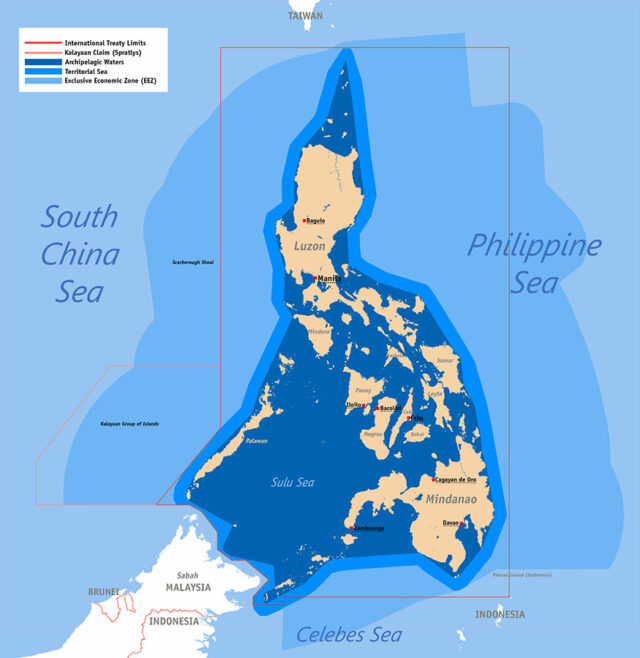
TERRITORIAL MAP claimed by the Philippines, showing internal waters, territorial sea, international treaty limits and exclusive economic zone. — ROEL BALINGIT/COMMONS.WIKIMEDIA.ORG

Two days from now, on July 12, we will commemorate the 8th anniversary of the historic ruling of the Permanent Court of Arbitration (PCA), declaring the West Philippine Sea as belonging to us. Numerous countries have hailed the decision as a victory not only for the Philippines but for international law.

But given what is happening right now in the West Philippine Sea, some are asking, is it even right to feel victorious?

China persists on rejecting the arbitral ruling. It refuses to recognize the jurisdiction of the PCA and has even modified its nine-dash line claim to a 10-dash line claim. In recent weeks, it has intensified its aggressive acts in the West Philippine Sea in open defiance, contrary to the norms of decency and fairness, and in violation of the established rules-based international order.

Consider this: The Chinese have been making many audacious attempts to block reprovision missions. They cause collisions, use water cannons, and intimidate our soldiers and our fisherfolk. Most recently, not content with their already reprehensible behavior, the Chinese Coast Guard actually had the gall to go on board our vessels. They rammed our boats, seized firearms and other equipment, and used knives on our inflatable boats. Brandishing axes and knives, they told our soldiers that they were “trespassing,” and one was injured.

We do not see any letup in these brazen acts soon. Indeed, we can only expect them to increase in intensity and frequency, despite the Philippines having already filed multiple diplomatic protests with China.

It is under these circumstances that we find ourselves commemorating the 2016 ruling of the PCA.

When we see China’s unrelenting acts in the West Philippine Sea, it is easy to feel disheartened and to doubt whether the PCA ruling is indeed a victory. We cannot even rest easy because we know that China knows no bounds when it comes to using its disinformation networks to twist and confuse the narrative.

What victory, we might ask, when we have to keep watch every minute so that what has already been established as ours will not be taken over by another, and our people will not be harmed by a bold trespasser?

Fortunately, many like-minded countries are lending their support in terms of public pronouncements and, most especially, tangible help in terms of boosting our defense and security capabilities. While we beef up our own ability to protect what is ours, our military is adopting a Comprehensive Archipelagic Defense Concept, shifting from a focus on internal to external security, and while numerous sectors in Philippine society are coming together to assert that we are not yielding to China’s bullying tactics, we are also supported by countries that equally value the rule of law and uphold the international order.

Indeed, the anniversary of the ruling is significant not only for the Philippines but also for the peace and stability of the global community. The PCA award is a precedent for resolving disputes peacefully based on international law. It reinforces the principle that all nations, regardless of size or power, are equal under international law — a sentiment eloquently articulated by the late Secretary of Foreign Affairs Albert del Rosario, who stated that “International law is the great equalizer among states.”

We at the Stratbase ADR Institute are staunch advocates of cooperation among sectors and nations in upholding what is right and good in the international sphere. To mark the anniversary’s ruling, we, in partnership with the Australian Embassy in the Philippines and the United States Embassy in the Philippines, will hold a conference themed “The 8th Year of the Arbitral Victory: A Collective Pursuit of Maritime Security in the West Philippine Sea.”

The event will bring together government officials, members of the diplomatic community, scholars, and policy experts in an in-person discussion to exchange views and re-affirm the strategic value of the arbitral tribunal ruling towards sustaining the rules-based international order in the Indo-Pacific region.

There will be four panels throughout the day, each with its own set of speakers and open forum sessions. The first panel on “A Shared Commitment to Advance the Rules-Based International Order” will underscore the importance of a collective approach in addressing asymmetric security challenges, particularly in the maritime domain. Panel 2, “The Fundamental Tenets of the Laws of the Sea as an Instrument to Peace, Security, and Stability,” will illustrate that international law serves as a great equalizer across the international community.

Panel 3, “Reinforcing the Philippines’ External Defense Capabilities,” will highlight the strategies employed and challenges faced by the Philippine military in effectively safeguarding the Philippines’ rights in the West Philippine Sea. Finally, “Assertion of Rights and Responsible Conduct in the West Philippine Sea” will illustrate how the Philippines has effectively and responsibly responded to aggression in the West Philippine Sea.

The Philippines is not alone in this struggle, working with like-minded partners such as the United States, Australia, Canada, Japan, France, and the European Union among others as part of the collective effort to ensure security, stability, and prosperity in the Indo-Pacific region. And, within our borders, the Filipino spirit is awakening and will be ready to uphold our rights with our legendary resilience and resolve.

Thus, the PCA ruling is a victory in its truest sense. It highlights that when something is lawful and right, it deserves to be fought for — no questions or second thoughts about it.


Victor Andres “Dindo” C. Manhit is the president of the Stratbase ADR Institute.

UK’s Motor City hopes Labour can jumpstart EV dream

ANDREW ROBERTS-UNSPLASH

MORE THAN three years have passed since Coventry unveiled plans for a giant electric-car battery factory at its small airport in England’s West Midlands, offering hope that the UK could catch up with rival countries already years ahead in cell production.

But with no major customer or investor, the project has yet to get off the ground, making hollow its target to produce batteries by 2025. Its struggles are emblematic of why the UK’s car industry is foundering.

The upcoming general election could provide a boost. The Labour Party, which is leading in polls, plans to restore a 2030 ban on new petrol and diesel car sales — a move that may finally help the site attract investors put off by mixed messages from the government and the broader electric vehicle (EV) slowdown.

“That will change the dynamic,” Richard Moore, a former auto executive who’s spearheading the project, said in an interview at the UK Battery Industrialization Centre next to the airport. The current Conservative government has no clear strategy, leaving potential investors wondering how they would access any state support, Mr. Moore said.

The auto industry has been crying out for change since the Conservatives came to power in 2010, presaging a steady decline in car manufacturing. Executives’ biggest complaint is mixed signals from government, noting that Brexit sowed confusion about trade. The decision to push back the ban on new petrol and diesel car sales by five years created more uncertainty about the country’s commitment to EVs.

“They’ve probably done more damage to the UK car industry than any other administration, on both sides, in the past 50 years,” said Andy Palmer, the former chief executive officer of Aston Martin Lagonda Global Holdings Plc and current chairman of EV charging company Pod Point Group Holdings Plc. “The world’s car companies are confused in terms of what to expect from the UK. That’s broken one of the major merits of investments in the UK, which is it’s understandable and predictable.”

LAGGING INVESTMENT
Once the world’s second-largest car manufacturing hub in the 1950s, the UK has dropped to 18th as of last year, according to the International Organization of Motor Vehicle Manufacturers. The country’s efforts to become an early adopter of electric vehicles has stalled, with only one in six new cars registered last year being battery-electric — in line with the year before.

The UK isn’t alone with regard to battery disappointment. Production plans have sputtered across Europe, where countries are struggling to compete with lucrative financial incentives in the US and the stranglehold China has on cell manufacturing.

“The very first question any government coming in has got to ask is: Do we want to stay in the car business?” Mr. Palmer said. “Because ultimately, if you want to stay in the car business, you’ve got to make a lot of investment.”

Last year, the Conservative government committed £2 billion ($2.5 billion) to the EV transition, though it also has vowed to reverse an expansion of London’s Ultra-Low Emission Zone that penalizes older, more polluting vehicles.

Labour has pledged £1.5 billion toward new cell factories and committed to a battery-health standard that it says will support the second-hand market for EVs.

EMISSIONS POLITICS
Both main parties have promised to fix potholes and roll out EV charging infrastructure, but neither has committed to financial incentives to encourage consumers to buy EVs.

Labour also plans to stick with the zero-emission vehicle mandate introduced by the Conservative government earlier this year. This requires at least 22% of cars sold to be fully electric this year, rising to 80% by 2030. Carmakers face fines of up to £15,000 per vehicle for missing the targets.

Stellantis NV’s UK boss Maria Grazia Davino last week threatened to close van factories in northwest England’s Ellesmere Port and Luton, near London, if the government doesn’t ease targets or introduce consumer incentives. The maker of Peugeot and Vauxhall vehicles employs 2,500 people across the two facilities.

Government investment will be key to enticing the sort of foreign investors that Mr. Moore wants in Coventry. The area formerly known as the UK’s Motor City is still home to Jaguar Land Rover Automotive Plc, Britain’s biggest carmaker.

In a blow to the Coventry project, JLR’s owner, India’s Tata Motors Ltd., decided last year to build a £4-billion battery factory in Somerset, with the help of taxpayer support. The government also offered aid to get Nissan Motor Co. to make electric successors to its Qashqai and Juke models in Sunderland.

The UK is still lagging rival countries when it comes to battery manufacturing capacity, with only one operational factory run by Envision’s AESC in Sunderland for Nissan, producing less than 2 gigawatt hours of battery capacity a year. For the automotive industry alone, the UK will require at least 100 GWh a year by the end of the decade, according to a 2022 report from the Faraday Institution. The collapse last year of battery startup Britishvolt Ltd. cast a shadow over the sector.

“No one’s going to take us seriously” until the UK can produce at least 20 GWh a year, said Mr. Moore, whose site has planning permission for up to 60 GWh, enough to power 600,000 EVs.

Jim O’Boyle, a Labour councilor for Coventry who used to work at a car factory, blames the government for the lack of progress on the project.

“The frustration has been clear here because they just don’t seem to see it as that important,” Mr. O’Boyle said. “I don’t think they’ve understood what the potential benefits are here, never mind what the potential risk is here.” — Bloomberg News

Bulgarian archaeologists find marble god in ancient Roman sewer

RUPITE, Bulgaria — Bulgarian archaeologists stumbled upon unexpected treasure this week during a dig in an ancient Roman sewer — a well-preserved, marble statue depicting the Greek god Hermes.

The discovery of the 6.8-foot (2-meter) tall statue was made during excavation work at the site of the ancient city of Heraclea Sintica in southwestern Bulgaria, which lies close to the Greek border.

Archaeologists leading the work said that after an earthquake devastated the sprawling city in about A.D. 388, the statue had been carefully placed in the sewers and covered with soil, explaining its good condition.

“Its head is preserved. (It’s in a) very good condition. There are a few fractures on the hands,” said Lyudmil Vagalinski, who led the team of archaeologists, adding that the statue was a Roman copy of an ancient Greek original.

Heraclea Sintica was a sprawling city founded by the ancient Macedonian king Philip II of Macedon, between 356 B.C. and 339 B.C. in what is now the Bulgarian region of Pirin Macedonia.

Archaeologists say that the people of the Heraclea Sintica likely attempted to preserve the statue, even after Christianity was adopted as the official religion in the Roman Empire.

“Everything pagan was forbidden, and they have joined the new ideology, but apparently they took care of their old deities,” he said.

After the earthquake, the Heraclea Sintica fell into a rapid decline and was abandoned by around A.D. 500. — Reuters

URC board OKs JV with Greencycle for plastic recycling

UNIVERSAL Robina Corp. (URC) said its board of directors has approved a proposal to form a joint venture (JV) company with Greencycle Innovative Solutions, Inc. for plastic waste management and collection.

In a regulatory filing on Tuesday, URC said its board greenlit the plan on Monday, pending approval from the  Securities and Exchange Commission. 

“The establishment of the JVCo (joint venture company) is subject to the parties being able to secure the requisite regulatory approvals and corporate approvals,” URC said.

The joint venture company is targeted to start commercial operations by September, it added. 

Once approvals are obtained, the joint venture plans to implement an integrated operation to manage plastic waste by processing materials into reusable and recyclable products.

The initial paid-in capital for the joint venture is set at P27 million, with URC holding a majority stake of 75% and Greencycle holding 25%.

“Such ownership ratio shall be maintained for all types of financial capital undertakings,” URC said. 

URC is a Gokongewei-led  food and beverage manufacturer company; while Greencycle is an industrial aggregator, focusing on waste management, recycling, processing, and converting of waste materials into viable energy sources or materials.

On Thursday, shares in URC went up by P3.60 or 3.22% to end at P115.50 apiece at the stock exchange. — Ashley Erika O. Jose

Philippines falls in Global Presence Index

The Philippines dropped two places to 44th out of 150 countries in 2023, based on the latest edition of the Elcano Global Presence Index by Madrid-based think tank Elcano Royal Institute. The index assesses and ranks a country’s international relations, foreign policy, and global affairs under three dimensions: economy, defense, and soft presence. With an index value of 55.15, the country is the sixth-lowest among its peers in the region.

Philippines falls in Global Presence Index