Home Blog Page 2480

Philippine shares rally, tracking Wall Street’s rise 
REUTERS

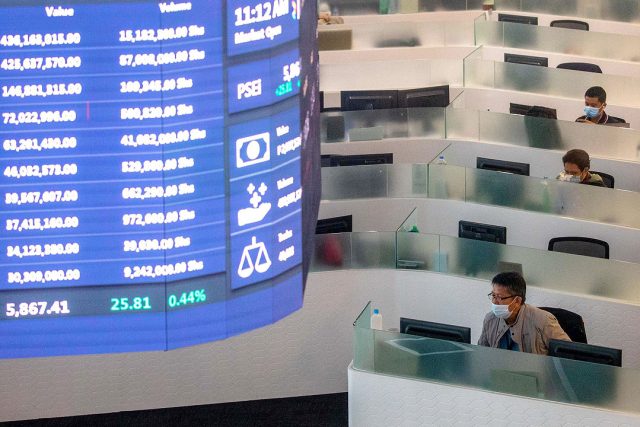
PHILIPPINE SHARES climbed for a fourth straight day on Thursday, tracking Wall Street’s overnight rise, as bargain hunting continued ahead of the central bank’s policy announcement.

The Philippine Stock Exchange index (PSEi) rose by 1.22% or 77.47 points to end at 6,390.58 on Thursday, while the broader all shares index climbed by 0.78% or 27.12 points to close at 3,477.70.

“The PSEi sustained its gains for the fourth consecutive day, driven by bargain hunters. It was just announced at market close that the Bangko Sentral ng Pilipinas (BSP) would maintain its key policy rate at 6.5% in the meantime, which was in line with the consensus expectations,” Regina Capital Development Corp. Head of Sales Luis A. Limlingan said in a Viber message.

The BSP on Thursday kept its policy rate at a 17-year high of 6.5% for a sixth straight meeting, as expected by all 15 analysts in a BusinessWorld poll.

“Philippine shares edged higher as investors made bets ahead of the latest inflation data, which is set to be released on Friday with May’s PCE (personal consumption expenditures) price index. Investors hope the report will show easing pricing pressures, which could increase the likelihood that the Fed will lower interest rates later this year,” Mr. Limlingan added.

“The local market rose as investors took positive cues from Wall Street overnight amid optimistic anticipation over the US May PCE inflation report, which will be released by the end of the week,” Philstocks Financial, Inc. Research and Engagement Officer Mikhail Philippe Q. Plopenio likewise said in a Viber message.

On Wall Street, the Dow Jones Industrial Average rose 15.64 points or 0.04% to 39,127.80; the S&P 500 gained 8.60 points or 0.16% to 5,477.90; and the Nasdaq Composite gained 87.50 points or 0.49% to 17,805.16, Reuters reported.

Investors await Friday’s release of the US PCE price index, the US Federal Reserve’s preferred inflation measure. Economists polled by Reuters expect PCE annual growth to ease to 2.6% in May.

All sectoral indices closed higher on Thursday. Financials jumped by 2.49% or 47.17 points to 1,934.55; industrials went up by 1.06% or 94.63 points to 8,977.11; property increased by 0.92% or 22.97 points to 2,504.98; holding firms climbed by 0.55% or 30.08 points to 5,501.71; services rose by 0.42% or 8.42 points to 1,986.56; and mining and oil inched up by 0.23% or 20.03 points to 8,554.89.

“Among the index members, Converge ICT Solutions, Inc. was at the top, rising 3.83% to P11.40. JG Summit Holdings, Inc. lost the most, dropping 2.59% to P26.30,” Mr. Plopenio said.

Value turnover dropped to P4.52 billion on Thursday with 508.74 million shares changing hands from the P4.96 billion with 323.63 million issues traded on Wednesday.

Decliners beat advancers, 99 versus 91, while 43 names were unchanged.

Net foreign selling stood at P96.3 million on Thursday, a reversal of the P84.58 million in net buying recorded on Wednesday. — R.M.D. Ochave with Reuters

Peso rises on profit taking after BSP meeting

BW FILE PHOTO

THE PESO ended higher against the dollar on Thursday despite testing a new 20-month low intraday, propped up by profit taking after the Philippine central bank maintained its policy stance for a sixth straight meeting.

The local unit closed at P58.75 per dollar on Thursday, strengthening by 11 centavos from its P58.86 finish on Wednesday, Bankers Association of the Philippines data showed.

The peso opened Thursday’s session slightly weaker at P58.88 per dollar. Its weakest showing was at P58.92, a level not seen since October 2022 and just eight centavos away from the peso’s record low of P59 per dollar, while its intraday best was its close of P58.75 versus the greenback.

Dollars traded jumped to $1.21 billion on Thursday from $720.25 million on Wednesday.

The peso rose on profit taking after the central bank held benchmark rates steady at its meeting on Thursday, a trader said via phone call.

The Bangko Sentral ng Pilipinas (BSP) kept its target reverse repurchase rate unchanged at 6.5% for a sixth straight time on Thursday, as expected by all 15 analysts in a BusinessWorld poll last week.

Interest rates on the overnight deposit and lending facilities were also maintained at 6% and 7%, respectively.

The central bank’s lower inflation forecasts also supported the peso, Rizal Commercial Banking Corp. Chief Economist Michael L. Ricafort said in a Viber message.

“The peso appreciated from local optimism after the BSP substantially lowered its medium-term inflation outlook, changing its assessment of risks from the upside to the downside,” a second trader said in text message.

The BSP on Thursday lowered its average baseline inflation forecasts for 2024 and 2025 to 3.3% and 3.1%, respectively, from 3.5% and 3.3% previously.

It also slashed its risk-adjusted inflation forecasts for this year and next to 3.1% from 3.8% and 3.7%, respectively.

Headline inflation accelerated to 3.9% year on year in May from 3.8% in April, but marked the sixth straight month that inflation settled within the central bank’s 2-4% annual target.

For the first five months, the consumer price index averaged 3.5%.

For Friday, the second trader said the peso could strengthen further ahead of the release of the May US personal consumption expenditures (PCE) report.

The second trader sees the peso moving between P58.60 and P58.85 per dollar on Friday, while Mr. Ricafort expects it to range from P58.65 to P58.85.

Meanwhile, the yen languished near a 38-year low on Thursday and struggled on the weaker side of 160 per dollar, keeping markets on alert for any signs of intervention from Japanese authorities to prop up the currency, Reuters reported.

In the broader market, the dollar pared some of its gains from the previous session as US Treasury yields eased a touch, though it held near an eight-week high against a basket of currencies.

The yen rose 0.2% to 160.47 per dollar, having fallen to a low of 160.88 on Wednesday, its weakest since 1986.

The Japanese currency has fallen some 2% for the month and 12% for the year against a resilient dollar, as it continues to be hammered by stark interest rate differentials between the US and Japan, which has maintained the appeal of using the yen as a funding currency for carry trades.

The dollar index dipped 0.13% to 105.91, not far from a nearly two-month high of 106.13 hit on Wednesday.

Currency moves outside of the yen have been largely subdued for the most part of the week, as traders await Friday’s US core PCE data — the Federal Reserve’s preferred measure of inflation, for further clues on the US rate outlook. — AMCS with Reuters

Travel, tourism seen exceeding 2019 GDP contribution this year

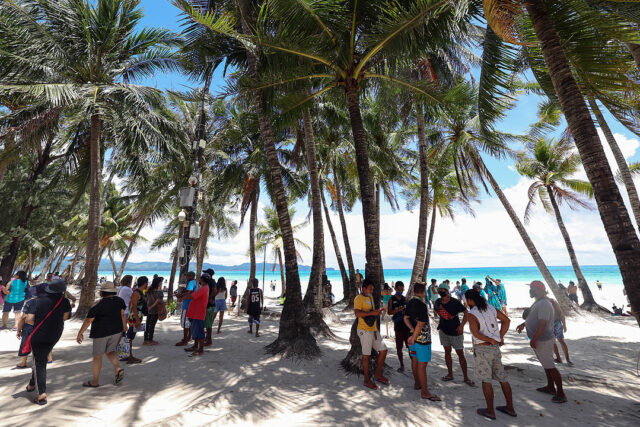
Tourists are seen at the beach of Boracay island, Aklan province. — PHILIPPINE STAR/KRIZ JOHN ROSALES

THE Philippine travel and tourism industry is expected to surpass its pre-pandemic performance with an over P5.4 trillion contribution to the economy in 2024, the World Travel and Tourism Council (WTTC) said.

Citing its 2024 Economic Impact Research, WTTC said that 2024 will be a record-breaking year for the industry’s economic contribution, job generation, and visitor spending.

“According to the latest data, the sector’s contribution to the national economy is set to surpass P5.4 trillion this year, marking almost 25% year-on-year growth and soaring 7.1% above the previous 2019 peak,” the WTTC said.

It said travel and tourism currently represent 21.3% of gross domestic product (GDP).

“This data also signals a remarkable year for employment, growing beyond the 2019 peak to surpass 9.5 million jobs, or 20% of the national workforce,” it added.

The WTTC said international and domestic visitor spending is expected to beat records in 2024, exceeding 2019 levels by 5.7% and 1.8%, respectively.

“The remarkable progress of the Philippines’ travel and tourism sector highlights the government’s dedication, putting it at the forefront of its national agenda and continuing to improve infrastructure,” WTTC President and Chief Executive Officer Julia Simpson said.

“This unwavering commitment has not only driven economic growth but also enhanced the global standing of the Philippines as a top travel destination,” she added.

In the next decade, the WTTC forecasts Philippine travel and tourism to increase its annual GDP contribution to P9.5 trillion, or nearly 22% of the economy.

Meanwhile, employment in the industry is projected to exceed 11.9 million by 2034.

Travel and tourism accounted for P4.34 trillion in economic output last year, 14% below 2019 levels.

In 2023, the industry created more than 608,000 jobs, bringing the total to 9 million, also still below 2019 level.

“Domestic demand… was sluggish, while the late reopening of borders resulted in a slower than expected recovery last year,” the WTTC said.

Last year, international and domestic spending grew 104.2% and 83.4% to P630 billion and P2.9 trillion, respectively.

As a region, WTTC expects travel and tourism in Southeast Asia to grow by 20.6% to P21 trillion this year, accounting for 9.7% of the region’s economy, while jobs are expected to reach over 42.4 million.

Although domestic visitor spending is expected to surpass 2019 levels and grow 15.8% to P10.3 trillion in the region, international spending is seen to grow 33.2% to P8.6 trillion, still below 2019 levels.

“WTTC is forecasting that travel and tourism across the region will continue to grow over the next decade, with the GDP contribution set to reach almost P36 trillion,” WTTC said.

“Jobs are forecast to exceed 56.5 million, creating more than 14 million new jobs,” it added. — Justine Irish D. Tabile

MWSS wants Angat water share retained at 52 cms

PHILSTAR FILE PHOTO

THE Metropolitan Waterworks and Sewerage System (MWSS) said it is seeking to retain its water allocation at 52 cubic meters per second (cms) for July.

“Our request was 52 cms during our meeting last Monday with the Angat TWG (Technical Working Group),” Patrick James B. Dizon, manager of the MWSS water and sewerage management department, said on Thursday via Viber.

The request will be presented during the board meeting with the National Water Resources Board next week for its approval, he said.

For June 1-15, the MWSS was given a water allocation of 51 cms, rising to 52 cms for June 16 to 30.

Angat Dam is the primary water source for Metro Manila, providing approximately 90% of the capital’s potable water.

As of early Thursday, the water level at Angat Dam was 175.90 meters, against 175.55 meters the previous day.

Mr. Dizon said the average daily decrease in the water level was around 14 centimeters since June 1.

“Looking at the historical elevation of Angat Reservoir for the second half of the year, the reservoir will start to refill. We need this refill in preparation for next year,” he said. — Sheldeen Joy Talavera

Pre-shipment inspection regime ordered for agricultural imports

COURTESY OF BUREAU OF CUSTOMS

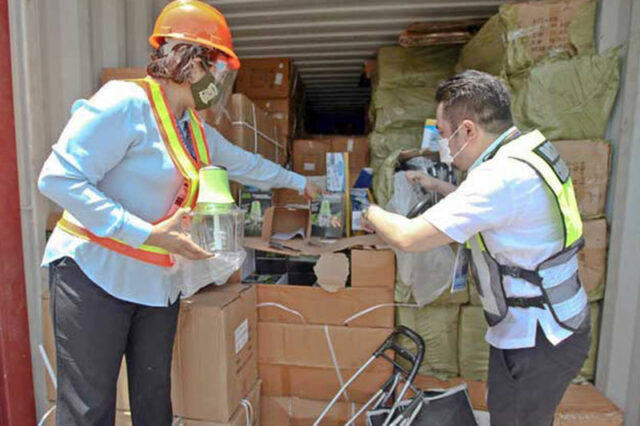
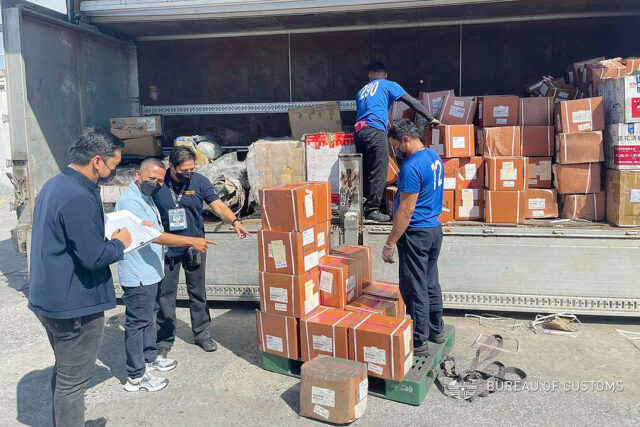
THE Department of Agriculture (DA) said it will require pre-shipment inspections for selected countries’ farm products that are due to be shipped to the Philippines.

“What we will do is release an administrative order (AO), requiring pre-shipment inspection. But we will choose countries,” Agriculture Secretary Francisco P. Tiu Laurel, Jr. told reporters late Wednesday.

He added that the administrative order will be implemented in the next three months.

Mr. Laurel said pre-shipment inspections are necessary as the Philippines still lacks the means to inspect imported farm goods at the border.

The DA’s cold examination facilities in agriculture (CEFA) are intended to ensure imported agricultural goods are disease-free and to minimize the risks from smuggling.

Imported agri-fishery products need to undergo examination by food regulators overseeing the animal, plant, meat, and fisheries industries.

He added that the DA has four planned facilities in Bulacan, Manila, Subic, and General Santos.

The Angat, Bulacan facility is set to start operations during the first two months of next year.

“The one in Angat was done by a private company… maybe by January or February next year, it will be running,” Mr. Laurel said.

The DA signed a memorandum of agreement with Pacific Roadlink Logistics, Inc. to construct the facility in Bulacan.

He added that the three other facilities will start construction by September, taking about a year to complete. — Adrian H. Halili

New cybersecurity tech needs to drive policy evolution, experts say

FREEPIK

CYBERSECURITY POLICY must evolve with the emergence of new technology, experts said, noting also the importance of automatic reporting from organizations experiencing data breaches.

“The policy should evolve with the emergence of new cybersecurity technology because it affects the landscape as well,” ePLDT Enterprise Field CISO and Head of Enterprise Consulting Practice Alex Bernardino said during a panel discussion at a BusinessWorld Insights event on June 25.

He noted the PLDT network threats have evolved from denial-of-service attacks to ransomware during the pandemic.

National Privacy Commission Director of Data Security and Compliance Office Aubin Arn R. Nieva cited the progress made in legislation, such as the Cybercrime Prevention Act, the Data Privacy Act, the Consumer Protection Act, and the Internet Transactions Act.

“As you remember, back in 2012, our congressmen in Batasan Hills rushed to pass the Data Privacy Act because overseas investors did not want to invest in the Philippines because we had no data privacy regime here,” he said.

Mr. Bernardino expressed support for more “ironclad legislation” like the Cybercrime Prevention Act and the Data Privacy Law.

“We have to implement it strictly… I think that’s the missing piece now,” he said, noting that violators must be made an example of.

On June 21, the National Bureau of Investigation arrested a Manila Bulletin data security officer who admitted to hacking about 93 websites of government agencies, private companies, and overseas organizations.

The hacks involved the website of the Armed Forces of the Philippines, the mail server of the National Security Council, and an Army recruitment website.

Other government websites that were recently compromised include those of the Maritime Industry Authority, while the list of private-company victims included Jollibee Foods Corp., Maxicare Corp., and Toyota Motor Philippines Corp.

“It should not be only The National Privacy Commission that discloses the breach to the public. It was the duty of Maxicare in the first place to disclose that and inform their members that were affected,” Information and Communications Technology Assistant Secretary for Legal Affairs Renato A. Paraiso said.

Mr. Nieva said organizations that were breached should not be stigmatized and instead held up as case studies for future learning.

“The learnings should become part of our best practices,” he said.

Asked about making cybersecurity less daunting for small business owners, Mr. Nieva said the solution involves a solid privacy management program.

Mr. Nieva said negligent employees not observing the correct procedures in using company infrastructure could expose the company to threats and risks.

He also cited the need for data protection measures.

“Are we going to use artificial intelligence, machine learning, blockchain technology, neural networks in the pursuit of the company’s purpose?” he added, citing the risk posed by the technologies to client data.

“Artificial intelligence tunnels into the data you collect. The golden rule is, do not collect if you cannot protect,” he said. — Aubrey Rose A. Inosante

Philippine content creation industry urged to address gaps in technology, training

By Justine Irish D. Tabile, Reporter

THE content creation industry is being hampered by shortcomings in technology adoption and professional training, technology-focused media company Hepmil Philippines said.

Hepmil Philippines General Manager Erwin Razon told BusinessWorld via e-mail that such shortcomings are limiting the quality and competitiveness of the industry.

“There is a notable gap in access to advanced technology and professional training, which limits the quality and competitiveness of content produced by local creators,” he said.

“Additionally, many creators struggle with securing sustainable income and protecting their work from piracy and unauthorized use,” he added.

He said that the Philippines will need a conducive policy environment that will encourage investment in the creative industries and protect intellectual property rights.

Mr. Razon said nevertheless, the outlook for the content creation and influencer industry remains positive, amid rising demand for localized and culturally relevant content.

“Furthermore, the expansion of digital infrastructure and increased internet penetration are critical, enabling content creators to reach wider audiences,” he said.

“Our recent investments in a new production hub and content programs illustrate our commitment to capitalizing on these opportunities, aiming to foster a vibrant ecosystem for content creators,” he added.

Hepmil Philippines recently opened a 400-square-meter production hub in Makati that features studios, workstations, lounges, and a wardrobe department, with plans to integrate livestreaming capabilities.

“This new production hub responds to the growing demand for virtual production services. As highlighted by the 2024 Global Digital Report, 64.5% of consumers do online brand research and are becoming more selective about online content,” it said.

“With its expanded capabilities, Hepmil Philippines aims to lead in innovative content creation, ensuring that brands can effectively engage their audiences with captivating and relevant content,” it added.

Aside from the hub, Hepmil Philippines also launched a new show, “We The Future,” a comedic documentary series featuring stories and voices from various Filipino communities.

Hepmil Philippines runs the digital platform PGAG and currently has 500 content creators in its network.

Potential RE adopters urged to weigh benefits of incentives

ZBYNEK BURIVAL—UNSPLASH

THE Department of Trade and Industry said manufacturers considering renewable energy (RE) investments stand to benefit from incentives apart from realizing power savings.

“We are encouraging these companies that are setting up their factories in the Philippines (to invest in RE),” Trade Secretary Alfredo E. Pascual told reporters in a recent briefing.

Mr. Pascual touted an incentive that allows RE investors to recover 50% of the cost of their investment.

He said the cost argument is also compelling for companies setting up their own power-generating facilities.

“Some companies have already done that; some Japanese companies have set up solar farms, and they are able to get their own supply of power,” Mr. Pascual said.

“With the incentive, they are able to recover the cost of the investment over the years,” he added.

Mr. Pascual said the government will also support such companies with manpower development to ensure a workforce that can function with new technology.

“Since we are inviting so many technology companies, we need to keep up with the training, education, and development of our workforce,” he said.

“We have to strengthen our education system so that we are able to encourage our students to go into STEM (science, technology, engineering, and mathematics) and information technology courses,” he added.

According to Trade Undersecretary and Board of Investments (BoI) Managing Head Ceferino S. Rodolfo, at least two project proponents are interested in the RE incentive.

“There is one in telco and another one in manufacturing — specifically pharmaceuticals,” Mr. Rodolfo said.

Currently, only one project has applied with the BoI for the incentives attached to installing RE facilities. This involves a 10-megawatt solar energy facility in which P500 million will be invested. — Justine Irish D. Tabile

Building permit approvals decline in 2023

PHILIPPINE STAR/ MICHAEL VARCAS

APPROVED building permits fell 3.4% in 2023, reversing the 4.2% growth recorded in 2022, though the value of overall projects rose, the Philippine Statistics Authority (PSA) reported on Wednesday.

Building permits totaled 163,663, covering 39.54 million square meters of floor area.

Projects covered by the approved permits were valued at P457.36 billion, up 6%.

“Although permits fell in 2023, the increase in construction cost boosted the value of building construction. Also, there were more big-ticket building construction projects that boosted value,” Cid L. Terosa, senior economist at the University of Asia and the Pacific, said in an e-mail.

Permits for residential projects, which accounted for 67.5% of the totals, fell 8.7%. These permits were valued at P200.85 billion.

Of the residential permits, single homes accounted for 86% (valued at P146.08 billion), followed by apartment homes (12.6%, P32.25 billion), and duplex or quadruplex homes (1.2%, P2.44 billion).

Meanwhile, nonresidential permits increased 18.6% year on year to 35,162. Nonresidential permits accounted for 21.5% of approved building permits and were valued at P219.56 billion.

Approved commercial construction applications accounted for 70.7% of all nonresidential permits, totaling 24,851 permits, up 20.9% year on year. These permits were valued at P108.08 billion.

Institutional and industrial permits rose 10.2% and 23% to 5,325 and 2,835, respectively.

Permits for additions to an existing building rose 16.8% to 5,872 and were valued at P5.44 billion while alteration and repair permits totaled 12,097, down 11.4%. They were valued at P31.51 billion.

Calabarzon (Cavite, Laguna, Batangas, Rizal, and Quezon) had the most approved building projects, making up 24.6% of the total with 40,332 permits, followed by the Central Visayas (18,631), and Central Luzon (18,583).

Mr. Terosa expects the number of permits to continue to decrease this year while the value of building projects rises.

“I think that this trend will persist, but there could be an increase in permits and value once interest rates are cut,” he said.

The PSA said that construction statistics are compiled from the copies of original application forms of approved building permits as well as from the demolition and fencing permits collected every month by the agency’s field personnel from the offices of local building officials. — Karis Kasarinlan Paolo D. Mendoza

PHL, Indonesia adopt e-Phyto certificate system, BoC says

BUREAU OF CUSTOMS

THE Bureau of Customs (BoC) said that the Philippines and Indonesia have adopted an electronic Phytosanitary (e-Phyto) certificate system to ensure the security of the trade in agricultural goods within the region.

“This initiative not only enhances trade efficiency but also strengthens economic ties among member states, paving the way for a more unified and prosperous ASEAN region,” Customs Commissioner Bienvenido Y. Rubio said in a statement.

The e-Phyto certificate is the electronic version of a phytosanitary import certificate, which certifies that agricultural goods are pest and disease-free.

The exchange was done through the Association of Southeast Asian Nations (ASEAN) Single Window (ASW). The Philippines joined the regional platform in 2019, which connects each country’s National Single Window (NSW) to transact and exchange customs documents.

“The BoC e-Phyto Portal also has access to the e-Phyto certificates issued by the Department of Agriculture – Bureau of Plant Industry, the National Plant Protection Organization (NPPO), as well as to e-Phyto certificates issued by the respective NPPOs of exporting countries,” the BoC added.

The Philippines and Thailand hope to begin their exchange by the end of the month.

The BoC said that it will continue to “collaborate with ASEAN counterparts to support its priority program on conducting the study of the new generation of the ASW.”

It also said it will continue to pursue exchanges with other trade partners and work on the implementation of new customs documents and forms. — Luisa Maria Jacinta C. Jocson

Marcos: Philippines must do more than just file protests versus China

PRESIDENT FERDINAND R. MARCOS, JR. — PHILIPPINE STAR/RYAN BALDEMOR

By John Victor D. Ordoñez, Reporter

PRESIDENT Ferdinand R. Marcos, Jr. on Thursday said the Philippines must do more beyond filing diplomatic protests against China, which he accused of deliberately and illegally blocking a resupply mission in the South China Sea that led to a standoff on June 17.

“We have filed over a hundred protests, we have already made a similar number of demarches,” he told reporters. “We have to do more than just that.”

The Philippine leader said actions by China’s coast guard men were not an armed attack. “No one fired a shot. They did not point guns at us, but it was a deliberate action to stop our people.”

“Although there were no arms involved, nonetheless, it is still a deliberate action, and it is essentially an illegal action that was taken by the Chinese forces,” Mr. Marcos said.

The Chinese Embassy in Manila did not immediately reply to a Viber message seeking comment.

The President said the government has been in constant communication with Chinese Ambassador to the Philippines Huang Xillian over recent incidents in the South China Sea that have worsened tensions between the two neighbors.

“Our objection, we have made it very clear not only to the ambassador but also to Beijing,” Mr. Marcos said. “So it will really depend on how formal we want to make this complaint.”

Chinese Coast Guard men with bladed weapons on June 17 boarded Philippine rubber boats and looted several rifles, actions that Philippine military chief Romeo S. Brawner, Jr. said only “pirates” do. 

A Filipino Navy officer on a rubber boat lost his right thumb when the Chinese Coast Guard rammed the army’s boat, the military said.

China has disputed the Philippine account, saying the measures it had taken were lawful, professional and beyond reproach.

Philippine Foreign Affairs Secretary Enrique A. Manalo on Wednesday said Manila has filed a note verbale to China, expressing concern over the June 17 standoff.

The Philippines does not plan to engage in defense talks with China, Defense Secretary Gilberto Eduardo C. Teodoro, Jr. told a Senate hearing on Tuesday that is looking into the latest incident.

On Monday, he said the Philippines would not announce the schedule of its resupply missions to the shoal, where a handful of Filipino troops live on a World War II-era ship that Manila grounded in 1999 to bolster its sea claim.

Executive Secretary Lucas P. Bersamin earlier said the encounter was not an armed attack and was probably a “misunderstanding or accident.”

Mr. Marcos said his Cabinet secretary made the statement because they were still studying whether the standoff could have been caused by miscommunication.

He said Armed Forces of the Philippines Western Command chief Rear Admiral Alfonso F. Torres, Jr. had briefed him on the incident, which the President said was “clearly not a misunderstanding.”

The Philippines under Mr. Marcos has filed 164 diplomatic protests against China, 31 of which were filed this year, Foreign Affairs spokesperson Ma. Teresita C. Daza said in a WhatsApp message.

Manila is trying to hold talks with China to discuss the sea, Mr. Manalo told senators on Tuesday.

NOT SEEKING US HELP
Meanwhile, US Defense Secretary Lloyd Austin on Wednesday spoke with Mr. Teodoro on the phone to discuss last week’s standoff, according to the US State Department.

“Secretary Austin underscored continued US support for the Philippines in defending its sovereign rights, and the two officials discussed the importance of preserving the rights of all nations to fly, sail and operate — safely and responsibly — wherever international law allows,” State Department spokesman Matthew Miller said in a statement posted on the agency’s website.

Meanwhile, Philippine Ambassador to the US Jose Manuel G. Romualdez said the Philippines had not asked the United States for support in resupplying its troops at Second Thomas Shoal.

The US was providing only “visuals” to help view the situation around the ship, he told reporters in Washington.

Manila, which has a long-standing defense treaty with the US, has complained that the Chinese Coast Guard had used “aggressive and illegal force” during last week’s standoff.

Manila’s patience was being stretched by China’s actions, but it was hoping for talks to deescalate tensions with Beijing as soon as July, and did not want to invoke the US treaty, the Philippine envoy said.

“We would like to be able to supply our soldiers on our own without really bringing in any third party because, as I said, this is our territory, which we’ve made very clear from the very beginning,” he said. “And so, we have not asked the United States for any assistance whatsoever.”

Mr. Romualdez said the Philippines had sought a meeting with Chinese officials to ease tensions, not resolve territorial claims, and hoped it would occur “maybe early next month.”

He noted that Philippine failure to deliver food and other supplies to its troops would amount to “killing our soldiers” through starvation and thirst.

“I don’t think China wants to have a major conflict. And definitely, we do not want to have one. And so, that’s a good starting point,” he added. — with Reuters

Marcos: De Lima’s acquittal shows Philippine justice system is working

PHILIPPINE STAR/MIGUEL DE GUZMAN

PHILIPPINE President Ferdinand R. Marcos, Jr. on Thursday said he won’t change his mind about not cooperating with the International Criminal Court (ICC) in its investigation of his predecessor’s deadly drug war.

Former Senator Leila M. de Lima’s acquittal in her last drug trafficking case showed that the country’s justice system is working, he told reporters on Thursday.

“Maybe this is something we should show the ICC,” he said. “The Judiciary is working properly. Our investigative services are working properly, and former Senator de Lima has been acquitted.”

“We still stay with our position that the ICC has no jurisdiction in the Philippines because we have a working police force, we have a working Judiciary and do not require any assistance in that regard,” he added.

Mr. Marcos earlier ruled out working with the ICC, saying its probe violates Philippine sovereignty given the country’s fully functional justice system.

The Philippines under ex-President Rodrigo R. Duterte withdrew from the ICC in 2019 amid criticisms that his government systemically murdered drug suspects in police raids. It took effect a year later.

A Muntinlupa court on Monday acquitted the former lawmaker, who had been in jail for nearly seven years, in her third and last drug trafficking case that she said was fabricated to muzzle her investigation of then-President Rodrigo R. Duterte’s war on drugs.

The US State Department has called on the Marcos government to step up its efforts to resolve politically motivated lawsuits against civic leaders after Ms. De Lima’s acquittal.

Muntinlupa Presiding Judge Gener M. Gito said prosecutors had failed to prove that Ms. De Lima was involved in the illegal drug trade. The same court granted her bail plea in November.

She was accused of promoting the illegal drug trade inside the national penitentiary in Muntinlupa during her time as Justice secretary.

Convicts allegedly bribed her with P70 million, which she allegedly used to fund her senatorial campaign.

Ms. De Lima incurred Mr. Duterte’s ire when, as chairwoman of the Commission on Human Rights, she started a probe in 2009 into extrajudicial killings by the so-called Davao Death Squad in the tough-talking leader’s hometown, where he was the long-time mayor. Mr. Duterte later vowed to “destroy” her.

Amnesty International has said the government had deprived the ex-senator of her right to a fair trial through her arbitrary detention.

Political experts have said her detention showed how the government had abused the justice system.

At a media forum on Thursday, Senator Ronald M. Dela Rosa, who enforced the anti-illegal drug drive as Mr. Duterte’s police chief, said there is no need to bring drug war complaints before the ICC.

He noted that if the country’s justice system was flawed, cops who committed wrongdoing shouldn’t have been charged, convicted or jailed. “So there were rights violations. That’s why we need to investigate each case individually,” he said in Filipino.

The government estimates that at least 6,117 suspected drug dealers were killed in police operations. Human rights groups say as many as 30,000 suspects died. — John Victor D. Ordoñez