Home Blog Page 2432

PELCO II powers up mobile substation

PAMPANGA 2 Electric Cooperative (PELCO II), an electric cooperative co-managed by Manila Electric Co. (Meralco), has begun operations of its first mobile substation to meet the power demand in Mabalacat City.

The 10-megavolt ampere (MVA) mobile substation provides capacity flexibility for PELCO II’s distribution network — augmenting the existing power capacity in the city and other areas it served, Meralco said in a statement on Thursday.

“This first of its kind project is intended to ensure availability of stable electricity service to meet the growing power requirements of homes and businesses in Mabalacat City,” PELCO II Chief Management Advisor Joe-Mel S. Zaporteza said.

“We are working closely with the local government and other relevant stakeholders to continuously implement innovative solutions and projects that will benefit our consumers in the long term,” he added.

PELCO II is also developing a new 20-MVA substation which is expected to be energized early next year.

Meralco’s controlling stakeholder, Beacon Electric Asset Holdings, Inc., is partly owned by PLDT Inc.

Hastings Holdings, Inc., a unit of PLDT Beneficial Trust Fund subsidiary MediaQuest Holdings, Inc., has an interest in BusinessWorld through the Philippine Star Group, which it controls. — Sheldeen Joy Talavera

Truck plunges into Benguet ravine, killing 1

BAGUIO CITY — A truck driver died on the spot, while his two passengers were hurt after the truck dived in a 20 meter-ravine in Upper Cotcot, Bangao, Buguias town in Benguet on Tuesday.

Buguias town police named the fatality — Denver Adcapen, 33, from Barangay Guinzadan Bauko, Mountain Province. His two passengers are recovering now.

The two passengers were immediately taken out of the wreckage and to the Lutheran Hospital in Abatan, also in Buguias. Rescuers had difficulties in removing the driver pinned down at the front seat of the truck.

Probers added that the vehicle’s front landed first before it slid further down the ravine.

The truck reportedly suffered a mechanical defect. — Artemio A. Dumlao

BARMM officials destroy P55-M confiscated drug

LOREN BISER-UNSPLASH

COTABATO CITY — Officials of law-enforcement agencies destroyed P55 million worth of confiscated crystal meth (shabu) in a power-generation incinerator of a private cornstarch factory in Sultan Kudarat, Maguindanao del Norte on Wednesday.

The symbolic destruction of some nine kilos of shabu at the power plant of the Lamsan Incorporated in Crossing Simuay in Sultan Kudarat was led by Gil Cesario P. Castro, director of the Philippine Drug Enforcement Agency-Bangsamoro Autonomous Region in Muslim Mindanao (PDEA-BARMM), local officials and Cotabato City’s prosecutor, Mariam April V. Mastura.

Mr. Castro told reporters that the drugs destroyed were seized during PDEA-BARMM and police operations in the past 24 months.

PDEA agents told reporters at the sideline of Wednesday’s activity that local executives in BARMM have supported extensively their entrapment operations, many of which were laid based on their tips about drug trafficking activities of their own constituents. — John Felix M. Unson

Baguio turns parks into museums, galleries

BAGUIO CITY — The Baguio City government is putting up artworks by local artists in various parks and open spaces turning these into outdoor museums and galleries as it seeks to further bolster the Summer Capital’s reputation as a haven for artists and art lovers.

This is similar to the ‘Igobots,’ which are four sculptures using recycled materials situated at the Post Office Park and lower Session Road, City Environment and Parks Management Office (CEPMO) head Atty. Rhenan G. Diwas explained.

“The project is part of the city’s creative crawl where its parks are transformed from being not only open spaces and green areas but also serve as outdoor museums and galleries for local artists,” Mr. Diwas said.

The parks management chief also said that sculptures, mostly made of stone, can also be seen at the Baguio City Hall Park, Rizal Park, and the Botanical Garden.

Mr. Diwas also invited artists to submit proposals for outdoor art installations at Sunshine Park, Wright Park, Mines View, Arboretum and other similar places in the city.

“Developments in these areas will include the art installations,” he added. — Artemio A. Dumlao

PSEi drops to 7,000 level on Trump win, GDP miss

BW FILE PHOTO

THE BENCHMARK INDEX plunged to the 7,000 level and hit a near two-month low on Thursday following slower-than-expected Philippine economic growth in the third quarter and as Republican Donald J. Trump won the US presidential election.

The Philippine Stock Exchange index (PSEi) dropped by 2.1% or 150.98 points to end at 7,014.44 on Thursday, while the broader all shares index went down by 1.97% or 78.33 points to 3,891.64.

This was the PSEi’s worst finish in nearly two months or since it ended at 6,944.88 on Sept. 11. The benchmark index also dropped below 7,000 intraday, hitting a low of 6,923.99.

“The local market plunged this Thursday. Investors priced in the negative implications of US protectionist policies on the global economic outlook as Mr. Trump wins the US presidential race,” Philstocks Financial, Inc. Senior Research Analyst Japhet Louis O. Tantiangco said in a Viber message.

“Also weighing on investor sentiment was the slowdown in the Philippines’ third quarter gross domestic product (GDP) growth to 5.2%,” he added.

The Philippine economy expanded by 5.2% in the third quarter, slower than the revised 6.4% expansion in the second quarter and the 6% print in the same period last year. This was below the 5.7% median GDP growth forecast in a BusinessWorld poll of 12 analysts.

“Philippine shares slid anew as the third-quarter GDP figures came in much lower than expected at just 5.2%. Though private consumption continued to pick up, fixed investment and government consumption weakened as exports further declined,” Regina Capital Development Corp. Head of Sales Luis A. Limlingan said in a Viber message.

“Meanwhile, US stocks rallied sharply on Wednesday, with major benchmarks hitting record highs following Donald Trump’s victory in the 2024 presidential election. Mr. Trump is perceived as favoring lower corporate tax rates, deregulation, and pro-domestic industrial policies, all of which could stimulate the US economy and benefit risk assets.”

Almost all sectoral indices closed lower. Property went down by 3.93% or 108.90 points to 2,656.43; mining and oil declined by 2.59% or 219.83 points to 8,262.81; industrials retreated by 2.25% or 224.45 points to 9,712.17; financials dropped by 2.1% or 49.09 points to 2,282.48; and holding firms decreased by 1.9% or 116.86 points to 6,015.38.

Meanwhile, services inched up by 0.04% or 1.07 points to 2,163.43.

Value turnover increased to P9.72 billion on Thursday with 1.11 billion shares traded from P4.66 billion with 1.34 billion issues changing hands on Wednesday.

Decliners overwhelmed advancers, 167 versus 46, while 40 names were unchanged.

Net foreign selling ballooned to P3.9 billion on Thursday from P1.12 billion on Wednesday. — Revin Mikhael D. Ochave

Peso weakens further as Philippine economic growth slows in Q3

BW FILE PHOTO

THE PESO depreciated further against the dollar on Thursday due to slower-than-expected Philippine gross domestic product (GDP) growth last quarter.

The local unit closed at P58.73 per dollar on Thursday, declining by 6.9 centavos from its P58.661 finish on Wednesday, Bankers Association of the Philippines data showed.

This was the peso’s weakest close in over four months or since its P58.795-a-dollar finish on July 2.

The peso opened Thursday’s session weaker at P58.80 against the dollar. Its intraday best was at P58.68, while its worst showing was at P58.805 versus the greenback.

Dollars exchanged went down to $1.57 billion on Thursday from $1.91 billion on Wednesday.

“The dollar-peso consolidated with an upward bias, triggered by lower-than-expected third-quarter GDP data,” a trader said by phone.

The Philippine economy grew by 5.2% in the third quarter, slower than the revised 6.4% expansion in the second quarter and the 6% print in the same period last year. This was below the 5.7% median GDP growth forecast in a BusinessWorld poll of 12 analysts.

In the first nine months, GDP growth averaged 5.8%, below the government’s 6-7% annual target. The economy now needs to expand by 6.5% in the fourth quarter to meet this goal.

The peso declined as the dollar was generally stronger after Republican Donald J. Trump won the US presidential election, Rizal Commercial Banking Corp. Chief Economist Michael L. Ricafort likewise said in a Viber message.

For Friday, the trader said the peso could move between P58.50 and P58.80 per dollar, while Mr. Ricafort sees it ranging from P58.60 to P58.80.

The dollar edged lower on Thursday after hitting a four-month high following Mr. Trump’s win in the US presidential election, while investors awaited policy decisions from the Federal Reserve and other central banks, Reuters reported.

The Fed was expected to cut interest rates by 25 basis points later in the day, and the market’s focus will be on any clues suggesting the US central bank could skip a cut in December.

Mr. Trump’s victory was also fueling speculation that the Fed might reduce rates at a slower and shallower pace, as his policies on restricting illegal immigration and enacting new tariffs could boost inflation.

Markets now see about a 67% chance the Fed will also cut rates next month, down from 77% on Tuesday, according to the CME Group’s Fed Watch Tool.

The dollar index, which measures the greenback against six major peers, dropped 0.16% to 104.94 after surging to its highest since July 3 at 105.44 and locking in its biggest single-day gains since September 2022 in the previous session.

The yen fell against the greenback to a three-month low of 154.715 — a decline that had Japan’s top currency diplomat Atsushi Mimura flagging readiness to act, marking the government’s strongest warning to speculators in recent months.

The Japanese currency was last 0.36% higher at 154.09 per dollar. — A.M.C. Sy with Reuters

Backup sources readied as calamity funding runs low

PHILIPPINE STAR/CESAR RAMIREZ

THE Department of Budget and Management (DBM) said Thursday that the contingent fund and local government support fund have been placed on standby to support the government’s dwindling disaster funds.

Concerns have been raised about the depletion of the Quick Response Fund (QRF), which can be disbursed rapidly in response to calamities. It can finance preparatory activities, relief, and rehabilitation.

Budget Secretary Amenah F. Pangandaman said as of Oct. 2024 it had P30 billion.

Nakita po natin na ‘yung mga ahensya tulad ng DSWD at DPWH, naubos na po nila ‘yung sa kanila. So humihingi na po sila ng replenishment (We have seen that the Department of Social Welfare and Development and the Department of Public Works and Highways have run out of funding, and are asking for replenishment),”she said in a statement.

The Departments of Agriculture, Education, Interior and Local Government, and Health, as well as the Philippine National Police, Bureau of Fire Protection, Office of Civil Defense, and Philippine Coast Guard also have access to the QRF.

According to the 2024 General Appropriations Act, the balance of the National Disaster Risk Reduction and Management Fund (NDRRMF) can be tapped to replenish the individual agencies’ QRFs.

Replenishment may be requested from the DBM once QRF utilization hits 50%, the DBM said.

Ms. Pangandaman standby funds are available in the form of Unprogrammed Appropriations should the Contingent Fund would run out.

She added that agencies can request the DBM directly to tap the Local Government Support Fund – Financial Assistance to Local Government Units (LGSF-FA to LGUs).

Under Local Budget Circular No. 155, LGSF-FA to LGUs may be tapped for financial assistance to LGUs for “implementation of programs, projects, and activities for disaster response, rehabilitation, and recovery, including procurement or acquisition of disaster equipment and vehicles for disaster response and rescue activities.”

Finance Secretary Ralph G. Recto has said that the NDRRMF is nearly depleted, adding that the frozen P30-billion transfer of Philippine Health Insurance Corp. (PhilHealth)reserve funds could have been used to fund it.

“It’s almost gone. The Supreme Court TRO (temporary restraining order) of P30 billion could have been used for calamities,” Mr. Recto told BusinessWorld on the sidelines of the DBM budget deliberations.

The SC recently issued a TRO on the further transfer of excess funds of PhilHealth to the National Treasury.

When asked how to the government can fund future disasters, he said the Philippines will have a “positive cash balance by the end of the year.”

“We have agreements with the World Bank; if needed, we can use loan proceeds for calamity victims,” Mr. Recto said. — Aubrey Rose A. Inosante

Recto expects BSP to continue easing cycle

FINANCE SECRETARY RALPH G. RECTO — DEPARTMENT OF FINANCE FACEBOOK PAGE

THE BANGKO SENTRAL ng Pilipinas (BSP) is expected to continue cutting rates in the next few months, Finance Secretary and Monetary Board Member Ralph G. Recto said Thursday.

“We have cut our interest rates by a total of 50 basis points (bps), creating an even more conducive environment for growth and investment. And more rate cuts are expected in the coming months,” Mr. Recto said in a speech.

The Monetary Board began its easing cycle in August, bringing the central bank’s key rate to 6%.

BSP Governor Eli M. Remolona, Jr. has signaled a possible 25-bp rate cut in December, which would bring the benchmark rate to 5.75% by the end of 2024.

Mr. Recto told reporters on the sidelines of a conference that the BSP will review its easing cycle outlook following the slowdown in third-quarter gross domestic product (GDP) growth, but he noted “there’s a possibility” for a rate cut in December.

The economy expanded 5.2% in the third quarter, the weakest reading since the 4.3% posted in the second quarter of 2023.

Third-quarter growth marked a slowdown from the revised 6.4% posted in the second quarter, and the year-earlier 6%.

The median forecast had been 5.7% in a BusinessWorld poll of 12 economists and analysts ahead of the data release.

On a quarter-on-quarter basis, GDP expanded by 1.7%.

Mr. Recto said rate cuts could put the economy on a strong growth track until 2030 and possibly bringing the Philippines to upper middle-income status by next year.

“The Philippine economy has already doubled in size since 2013 in terms of nominal GDP. And by 2030, our projections show that we can grow by another twofold, and this has not gone unnoticed by the rest of the world,” he said in his speech.

Economic growth will also be supported by strong job numbers and slowing inflation, which will support consumer spending.

“Today, about 50 million Filipinos are employed, and 63.9% of them hold formal, stable jobs. Unemployment has steadily decreased. This is proof of an expanding middle class ready to drive consumer demand,” he said.

The labor force participation rate increased to 65.7% in September from 64.1% a year earlier. The labor force is estimated to number 51.77 million, up 1.84 million.

“Additionally, our whole-of-government efforts to mitigate food and nonfood inflation are expected to keep the inflation rate within our target band for the next two years. Low and stable prices will speed up the growth of our already robust domestic demand, with household consumption accounting for more than 70% of our economy,” Mr. Recto added.

Headline inflation picked up to 2.3% in October from 1.9% in September, but remained below the 4.9% from a year earlier. It was also within the central bank’s 2-4% target.

“With these favorable forces at play, we are on course to reach upper middle income status next year. And by 2030, the Philippines will become the 30th largest consumer market globally,” Mr. Recto said.

The Philippines was classified as a lower middle-income country with a gross national income per capita of $4,230 in 2023, according to World Bank’s income classification standards. It has been a lower middle-income economy since 1987. — Aaron Michael C. Sy


Improved quality norms seen boosting PHL pharma exports

HAL GATEWOOD-UNSPLASH

PHILIPPINE pharmaceutical exports are expected to grow further, boosted by supportive regulation that will enhance quality, Fitch Solutions unit BMI said.

“Improved regulatory standards will boost prospects for Philippine’ medicine exports, enabling expansion beyond neighboring Southeast Asian markets,” it said in a report.

BMI expects pharmaceutical exports to grow to P3.7 billion in 2028 from P2.7 billion in 2023.

The Food and Drug Administration (FDA) reformed the regulatory process for pharmaceutical and active pharmaceutical ingredient exports, in a bid to improve compliance and “rigorously assess the quality, safety and efficacy of products intended for both local and international markets.”

“The FDA decision to tighten drug exporting standards is indicative of a wider movement towards reinforcing drug safety and quality control. This elevation in standards will stimulate export growth in the medium- to long-term,” BMI said.

The report noted that the Philippines exports primarily to other Southeast Asian countries such as Indonesia, Thailand, Malaysia and Singapore.

“The outlook for export growth over the coming years is robust given its low base. Posing upside to the country’s pharmaceutical export potential is the adoption of improved regulatory standards in the coming years which will boost the potential for its pharmaceuticals in global markets,” it added.

Meanwhile, BMI expects pharmaceutical imports to grow at a slightly slower pace. Imports are expected to grow to P161 billion in 2028 from P124 billion in 2023.

“The relatively lower growth rate of imports indicates a gradual reduction in the market’s dependency on foreign pharmaceutical products as domestic production ramps up,” it added.

The government is in the process of reviving domestic manufacturing overall, BMI said.

It noted initiatives such as the FDA working with Philippines Economic Zone Authority (PEZA) to expand pharmaceutical development zones and the government’s target for the domestic pharmaceutical industry to produce 60% of registered medicines.

“We expect these initiatives to attract pharmaceutical companies into the Philippines, contributing to the growth of medicine manufacturing and R&D activity,” it said.

The Philippine pharmaceutical market is expected to grow to P414 billion by 2028 from P335 billion in 2023. — Luisa Maria Jacinta C. Jocson

IEMOP eyes full commercial operations for renewable power market by December

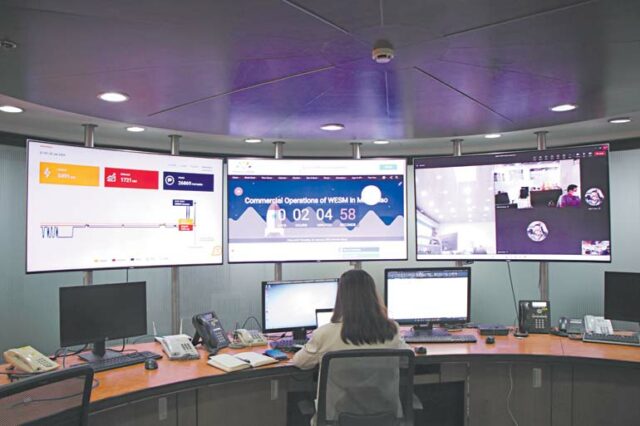
Commencement of the commercial operations of WESM in Mindanao at the IEMOP control room

THE Independent Electricity Operator of the Philippines (IEMOP) said it hopes to launch full commercial operations by December for the renewable energy (RE) market serving on-grid participants.

“We are preparing for the renewable energy market full commercial operations, targeted for December,” Arjon B. Valencia, manager for corporate planning and communication at IEMOP, told reporters at a briefing recently.

The RE market is the venue for trading RE certificates (RECs) equivalent to an amount of power generated from RE resources, and is intended as a facility for mandated participants to comply with their Renewable Portfolio Standards (RPS) obligations.

RPS requires distribution utilities (DUs), electric cooperatives (ECs) and retail electricity suppliers to source a certain portion of their energy supply from eligible RE resources.

RECs, which are issued to mandated participants, is equivalent to a one-megawatt-hour of RE generation at a price capped at P241 each. Renewables should account for at least 11% of the participants’ energy sales.

The RE market launched interim commercial operations in 2022 with the Philippine Electricity Market Corp. (PEMC) as the RE registrar.

“We’re expecting to have the functions transferred to IEMOP together with the declaration of commercial operations,” Mr. Valencia said.

The Department of Energy (DoE) will issue a department circular declaring the full commercial operations of the RE market, he said.

“When it comes to the scale of this market, I think the sales will focus more on the off-takers, the ECs, DUs to source or to buy from the market as they are the mandated participants,” Mr. Valencia said.

“As to our target of 35% by 2030, this market will facilitate that,” he added, referring to the goal of increasing RE share in the power generation mix, which is currently at 22%. — Sheldeen Joy Talavera

Green energy auction expected by year’s end

PHILSTAR FILE PHOTO

THE green energy auction (GEA)  will likely proceed within the year even though the pricing mechanisms have yet to be issued.

“Towards the end of this year, we should finalize the GEA for hydro pump storage and geothermal, as well run-of-river and impounding hydro,” Energy Secretary Raphael P.M. Lotilla said during the Pilipinas Conference Thursday.

Mr. Lotilla said the GEA for integrated renewable energy storage systems (IRESS) “will also be coming soon as well.”

GEA is designed to increase renewable energy capacity to help the government meet its goal of 35% renewable energy in the power mix by 2035 and 50% by 2040.

In the last two years, the Department of Energy (DoE) has conducted two GEA rounds, which generated 5,306 megawatts (MW) of renewable energy commitments for delivery in 2024 to 2026.

For 2024, the DoE plans to auction renewable energy projects with a combined capacity of 4,399 MW.

The GEA third round will cover non-feed-in-tariff (FIT) eligible renewable energy technologies such as geothermal, impounding hydro, and pumped storage hydro.

The auction will also cover run-of-river hydro, a FIT-eligible renewable energy technology.

For GEA-4, the DoE is looking to offer IRESS and liquefied natural gas.

Earlier this month, the Energy Regulatory Commission (ERC) posted the draft price determination methodology (PDM) guidelines for renewable energy technologies for public  comment.

The ERC is responsible for establishing the PDM for GEA bidders. — Sheldeen Joy Talavera

Marcos signs priority measure on apprenticeship incentives

NOEL B. PABALATE / PPA POOL

PRESIDENT Ferdinand R. Marcos, Jr. signed into law Thursday a priority bill seeking to boost  apprenticeship programs and better align them with industry needs.

The proposed Enterprise-Based Education and Training (EBET) Framework Act provides incentives for employers offering apprenticeship programs to prospective members of the workforce.

It also covers workers who want to engage in upskilling to support career progression.

“By establishing a framework on career advancement and industry-relevant skills, this law directly addresses the issues (like) the lack of formal training and skills mismatches,” Mr. Marcos said in a speech at the signing ceremony.

He said many livelihood programs at the national and local levels have been inadequate in terms of landing jobs for participants.

“That is why it is very important to synchronize our skills training with the actual requirements of industry and the labor market.”

Workers eligible for the EBET program are those who are either newly employed or established workers who want to acquire new skills.

Under the law, enterprises should give their trainees allowances not lower than 75% of the applicable minimum wage.

In programs exceeding one year, the apprentice is entitled to a yearly increase in line with labor market wage rates in the sector, and subject to evaluation of performance.

Training hours are not to exceed eight hours per day.

A trainee required to work overtime not exceeding two hours a day is to be paid an additional 25% of the hourly allowance for every hour of extra work.

Workers undergoing upskilling training are entitled overtime pay and a night shift differential, if applicable.

“We are hopeful that the law can effectively address these issues so we can prepare our workers for the demands of the local and foreign market, and assist them in finding new or additional employment so they can help their families,” Speaker Martin G. Romualdez, who witnessed the signing, said in a statement.

EBET program graduates will enjoy hiring preference in the company implementing the program and will not need to undergo probation.

EBET trainees are eligible to tap the Tulong Trabaho Fund, a component of Republic Act No. 11230 or the Tulong Trabaho Law.

The Philippine Statistics Authority reported that the unemployment rate fell to 3.7% in September from 4% in August and 4.5% a year earlier. — Kyle Aristophere T. Atienza

ADVERTISEMENT
ADVERTISEMENT