Home Blog Page 2423

Farmers want more say on coco trust fund use

By Adrian H. Halili, Reporter

COCONUT farmers say they are underrepresented on the body that determines the use of an industry trust fund sourced from assets acquired using the coconut levy.

“Farmers are nowhere on the Coconut Trust Fund Committee. So that has to be amended,” Charles R. Avila, executive director for the Confederation of Coconut Farmers’ Organizations of the Philippines, told BusinessWorld.

Republic Act No. 11521, or the Coconut Farmers and Industry Trust Fund Act, puts coconut levy assets into a trust fund that will finance the rehabilitation and modernization of the coconut industry.

The law tasks the Bureau of the Treasury with transferring P10 billion immediately to the trust fund, P10 billion in the second year; P15 billion in the third year; P15 billion in the fourth year; and P25 billion in the fifth year.

The use of the fund is guided by the Coconut Farmers and Industry Development Plan.

The coconut levy from the first Marcos Presidency was improperly used to acquire assets for private gain. The assets were seized and later transferred to the trust fund after lengthy legal proceedings.

Mr. Avila added that the government needs to amend the law.

“The law has infirmities. The coconut trust fund committee right now is consists of officials led by the Department of Finance (DoF),” he said.

The trust fund committee is headed by representatives from the DoF as well as the departments of Budget and Management and Justice.

He added that pending any changes to the law, the trust fund committee should have an advisory committee which includes the Department of Agriculture, the Philippine Coconut Authority, and coconut farmers.

On the other hand, Mr. Avila said that production continues to be hindered by the age of the Philippines’ coconut trees.

“We may be one of the top three producers in the world, we are supplying about 80% of global demand… but we may not be able to do that (further) if we do not plant more trees,” he added.

He said that the government should also involve coconut farmer organizations in the replanting effort.

President Ferdinand R. Marcos, Jr. ordered the PCA to draft a plan to rehabilitate the coconut industry, including the planting of 100 million coconut trees by 2028.

The rehabilitation plan aims to address the advanced age of the nut-bearing trees. The PCA is seeking to replant about 8.5 million trees this year.

Yellow alert raised over Luzon grid

BW FILE PHOTO

A YELLOW ALERT was raised over the Luzon grid for a second consecutive day after a forced outage at a gas-fired power plant and the derating of a coal-fired power plant, according to the National Grid Corp. of the Philippines (NGCP).

In an advisory early Wednesday, the NGCP said that the Luzon grid will be under yellow alert between 1 p.m. and 10 p.m., though the alert was called off shortly after 1 p.m.

The grid’s available capacity was 12,376 megawatts (MW) against peak demand of 11,794 MW.

The NGCP said that factors that contributed to the raising of yellow alert were the unplanned outage of 417.4-MW San Gabriel Power Plant in Batangas and the inabillity of four units of SMC Limay Coal Power Plant with capacity of 150 MW each.

The yellow was lifted at 1:10 p.m. after demand proved to be less than forecast and the shutdown of SMC Limay 1-4 was delayed.

A yellow alert is issued when the operating margin is insufficient to meet the transmission grid’s contingency requirement.

A total of 1,893.5 MW was unavailable to the grid as 17 power plants have been on forced outage while 10 are derated.

Since April, the Luzon grid has been under red and yellow alerts for 11 and 33 days, respectively.

The Visayas and Mindanao grids are operating normally, according to the NGCP. — Sheldeen Joy Talavera

JBIC expresses interest in PHL Samurai bond issues and infra tie-ups

REUTERS

THE Japan Bank for International Cooperation (JBIC) has expressed interest in Philippine Samurai bond issues and green infrastructure, the Department of Finance (DoF) said.

The interest was conveyed in a meeting between Finance Secretary Ralph G. Recto and JBIC officials, the DoF said.

“JBIC Governor Nobumitsu Hayashi expressed strong interest in Samurai bond issuances, particularly green bonds, and explored potential cooperation in renewable energy projects, such as hydropower and power grids,” the DoF said in a social media post.

The Philippines last issued Samurai bonds in April 2022, raising 70.1 billion yen.

Mr. Recto has said the DoF is looking to issue yen-denominated and dollar-denominated bonds within the year. However, the timing would be determined by the Federal Reserve’s policy easing decisions.

The government plans to borrow $5 billion this year, of which $2 billion was raised from the issue of global bonds in May, leaving $3 billion yet to be raised.

Mr. Recto told the JBIC that the passage of proposed amendments to the Corporate Recovery and Tax Incentives for Enterprises (CREATE) law will exempt export-oriented firms from value-added tax.

The CREATE MORE (Maximize Opportunities for Reinvigorating the Economy) bill is still at the Senate committee level. It is one of the priority measures of the Legislative-Executive Development Advisory Council (LEDAC).

It is expected to offer incentives to attract investments in key sectors, especially mining.

The Philippines, with the world’s fourth-largest copper reserves, fifth-biggest nickel deposits, and substantial cobalt deposits, is positioning for a major role supplying materials for clean-energy technologies. — Beatriz Marie D. Cruz

La Niña not expected to fully replenish Angat

PHILSTAR FILE PHOTO

ANGAT DAM water levels are not expected to be fully replenished by the end of La Niña, according to the Department of Environment and Natural Resources (DENR).

“We just came from El Niño and our dam is not full at all. In fact, the danger even with La Niña is that we won’t be able to fill it up enough,” Environment Undersecretary Carlos Primo C. David told BusinessWorld on the sidelines of a water forum organized by the European Chamber of Commerce of the Philippines.

Mr. David, who also heads the DENR’s Water Resources Management Office, said that the water level in Angat may be insufficient to meet Metro Manila’s needs during the next dry season.

“In the next dry season next year, we (may not) have enough water,” he added.

As of early Thursday, Angat water levels were at 173.2 meters, against the normal high-water level of 210 meters.

Angat Dam is the primary water source for Metro Manila, providing approximately 90% of the capital’s potable water.

Last week, the government weather service, known as PAGASA (Philippine Atmospheric, Geophysical and Astronomical Services Administration), said that there was a 70% chance La Niña will set in between August and October.

Separately, Ana Liz S. Solis, assistant weather services chief at PAGASA said La Niña will increase the likelihood of tropical cyclone activity in the coming months.

“During La Niña, more tropical cyclones track within the Philippine area of responsibility,” Ms. Solis added. — Adrian H. Halili

6 of 10 Filipinos satisfied with gov’t handling of sea dispute with China

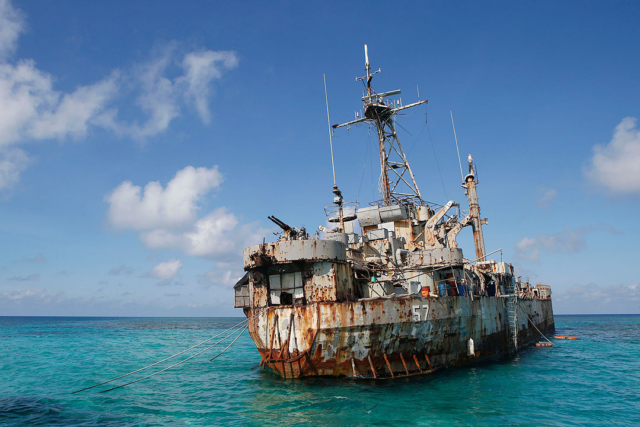
BRP SIERRA MADRE, a marooned transport ship which Philippine Marines live in as a military outpost, sits on the disputed Second Thomas Shoal, part of the Spratly Islands in the South China Sea. — REUTERS

SIX of 10 Filipinos are satisfied with actions taken by the government of Philippine President Ferdinand R. Marcos, Jr. on the sea dispute with China, according to a Social Weather Stations (SWS) poll conducted days after a June 17 standoff at Second Thomas Shoal in the South China Sea.

Sixty percent of Filipinos said measures including joint patrols and military exercises with “allies, friends and partners” were “sufficient,” based on the June 23-July 1 poll commissioned by think tank Stratbase ADR.

Stratbase said 36% of the 1,500 respondents said these measures are not enough.

The poll showed that 72% of Filipinos wanted the Philippine government to boost security ties with other countries.

The Philippines conducted joint patrols within its exclusive economic zone (EEZ) in the South China Sea with the United States, Australia, Japan and France since last year, amid confrontations between its vessels and larger Chinese Coast Guard ships.

On June 17, Chinese forces with bladed weapons boarded Philippine rubber boats on a resupply mission to BRP Sierra Madre at Second Thomas Shoal and looted rifles, according to the Philippine military.

Philippine Navy forces fought with bare hands and one of them lost a thumb after the rubber boat he was in was rammed by Chinese forces, according to the Philippine military.

The Philippines grounded the BRP Sierra Madre, a World War II-era ships, at the shoal in 1999 to bolster its sea claim. The shoal is 240 kilometers off the coast of Palawan province and is about 900 kilometers from Hainan, the nearest major Chinese landmass.

The incident sparked discussions on the limits of the US-Philippines Mutual Defense Treaty, which compels both sides to defend each other in case of an armed attack, and prompted calls for joint resupply missions.

Stratbase ADR President Victor Andres C. Manhit said the Philippine government should “reinforce cooperation and elevate partnerships” with allies by conducting more joint patrols and military exercises within the Philippine EEZ.

“By conducting joint patrols with like-minded partners and allies, we are sending a strong message that the Philippines is not alone,” he said in a statement.

“Those who attempt to circumvent their obligations and behave aggressively will not be tolerated by the international community,” he added.

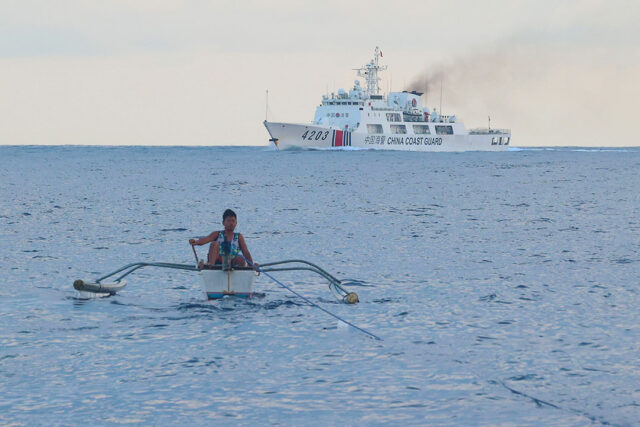
Days after the June 17 standoff, the Philippines and China met in Manila under their so-called bilateral consultation mechanism, but security experts doubted Beijing’s sincerity as a China Coast Guard ship (CCG) was deployed off the coast of Palawan and another Chinese ship known as the “The Monster” to Second Thomas Shoal.

The Philippine Navy on Tuesday said it was considering holding resupply missions to BRP Sierra Madre with several nations including the US, Japan, the United Kingdom and Australia.

China’s Monster ship, the largest coast guard vessel in the world, was spotted at Sabina Shoal on July 4, and Philippine Coast Guard (PCG) spokesman Jay Tristan Tarriela on Wednesday said the ship was still in the area.

He said the PCG had spotted another China Coast Guard ship near Lubang Island, which is just 40 kilometers west of Calatagan, Batangas province south of Manila.  The ship was moving toward Palawan.

The Navy on Tuesday said they had detected four China Coast Guard vessels at Second Thomas Shoal, which is about 67 kilometers west of Sabina.

The Philippines last week marked the anniversary of a 2016 arbitral ruling that voided China’s expansive claims in the South China Sea, with statements of support from Philippine allies.

Mr. Marcos has pursued closer ties with Western nations amid China’s increasing assertiveness at sea.

Mr. Tarriela earlier this month said Manila had used Canada’s “dark vessel” technology in detecting China’s 12,000-ton Monster ship.

The SWS poll showed that 56% of Filipinos thought the government was doing enough to protect Filipino fishermen in the disputed waterway and in boosting the military.

Most Filipinos also said the government was doing enough to protect marine resources within its exclusive economic zone, and in referring the issue to international organizations like the United Nations and Association of Southeast Asian Nations.

Stratbase said 49% of Filipinos thought it was not enough for the government to demand for China to leave the artificial islands it had built and occupied within the Philippine EEZ. — Kyle Aristophere T. Atienza

US, Philippines agree to develop Manila’s 5G, cable systems

FLATART-FREEPIK

THE PHILIPPINES and the United States have agreed to boost cooperation in building more fifth-generation (5G) and undersea cable networks to boost Manila’s technology ecosystem and defenses against cyberthreats, according to the US Embassy.

Manila and Washington on July 15 and 16 held their first Cyber-Digital Policy Dialogue where diplomats and information technology officials from both countries shared best practices in protecting critical digital infrastructure, the embassy in Manila said in a statement on Thursday.

It added that both sides had committed to work on cloud computing and satellite-based solutions to improve digital connectivity in the Philippines.

“Our collaboration sets a powerful precedent, inspiring nations to join forces in confronting cybersecurity challenges head-on, ensuring a safer and more resilient global cyberspace for generations to come,” Philippine Information and Communications Technology Secretary Ivan John E. Uy said during the dialogue, based on the statement.

A US business delegation that visited Manila in March committed to invest over a billion dollars in the Philippines.

Private equity firm KKR & Co. has also pledged to continue investing about $400 million to develop about 2,000 telecommunications towers in the Philippines.

“The United States believes that a secure and trustworthy ICT ecosystem is vital to supporting the growth of the digital economy and providing improved digital services for our citizens,” US Ambassador at Large for Cyberspace and Digital Policy Nathaniel C. Fick said during the talks.

“The first Cyber-Digital Policy Dialogue was an opportunity to discuss our important bilateral efforts to strengthen cybersecurity and our digital economy and to protect government information systems that are a critical backbone of our alliance,” he added.

A 2023 Palo Alto Networks report showed the Philippines was hit by the highest number of cyberattacks in Southeast Asia.

It said 29% of Filipino organizations reported higher threats, with 51% feeling that they were at high risk from cyberthreats. — John Victor D. Ordoñez

Philippines to work with Vietnam on maritime issues, says DFA

PHILIPPINE STAR/ MIGUEL DE GUZMAN

THE PHILIPPINES on Thursday said it is ready to work with Vietnam on maritime issues in the South China Sea after Hanoi filed a claim to an extended continental shelf before the United Nations (UN).

“We acknowledge Vietnam’s right as a coastal state like the Philippines to submit information to establish the outer limits of their continental shelf beyond 200 nautical miles from the relevant and lawful baselines from which its territorial sea is measured, as provided for under the United Nations Convention on the Law of the Sea,” the Philippines’ Department of Foreign Affairs (DFA) said in a statement.

Manila is ready to find a “mutually beneficial solution to South China Sea issues” with Vietnam in accordance with international law, it added.

Vietnam Foreign Ministry in a separate statement said it was asserting its claim over the Paracel and Spratly Islands. Vietnam filed the claim a month after the Philippines filed a similar claim before the UN.

China claims more than 80% of the South China Sea, overlapping with the exclusive economic zones of Vietnam, Malaysia, Brunei, Indonesia and the Philippines.

It seized the Scarborough Shoal in 2012 and forced Filipino fishermen to travel further for smaller catches.

A United Nations-backed tribunal in 2016 voided China’s claim over the waterway for being illegal. Beijing has largely ignored the ruling and continued its island-building activities.

About $3 trillion worth of trade passes through the South China Sea annually, and it is believed to be rich in oil and natural gas deposits, apart from fish stocks.

Last month, the Philippines filed an extended continental shelf claim with the UN covering up to 350 nautical miles off the western island of Palawan.

The Philippines and China have agreed to set up new lines of communication to improve their handling of sea disputes after both countries resumed talks on easing tensions in the South China Sea. — John Victor D. Ordoñez

P41-B drugs, fake goods seized

BW FILE PHOTO

THE BUREAU of Customs (BoC) said it seized illegal drugs and counterfeit goods including general merchandise, cigarettes and tobacco worth P41.58 billion in the first half.

The agency recorded 204 apprehensions during the period, it said in a statement on Thursday. It destroyed illegal cigarettes worth P595.2 million and seized agricultural products worth P100 million.

The bureau collected P455.8 billion in the first half, surpassing its P442.621-billion target by 2.98%.

Earlier this week, Customs said it is confident of collecting P20-30 billion more than its P939.69-billion target this year.

Citing its digitalization efforts, the bureau said it had started its electronic phytosanitary certificate exchanges with Indonesia and Thailand as well as the enhanced e-Travel system, integrating Customs declarations and overseas employment certificates.

In April, the BoC said its operations were 96.99% digitalized. — Beatriz Marie D. Cruz

Balabac runway almost done

PRESIDENT Ferdinand R. Marcos, Jr. on Thursday said a military runway project on Balabac Island, one of the four new sites under the Philippine-US Enhanced Defense Cooperation Agreement (EDCA) is almost complete.

The project is 89% finished, he said in a speech in Palawan province, where he distributed aid.

The President said the project would boost Philippine security and tourism in Palawan, which is facing the South China Sea.

Construction of the three-kilometer Balabac Military Runway started as early as 2019, based on state media reports. It became a state priority after Balabac, Palawan’s southernmost municipality, was listed last year as among the four new sites under the 2014 EDCA.

Three other sites are in the northern provinces of Isabela and Cagayan, which is about 600 kilometers away from Taiwan.

The project, which is funded by a partnership between the Department of Public Works and Highways and Department of National Defense, will serve both military and civilian aircraft. — Kyle Aristophere T. Atienza

Angara resigns as senator

PHILSTAR FILE PHOTO

SENATOR Juan Edgardo “Sonny” M. Angara has resigned from the Senate before he takes his oath as the country’s Education secretary on Friday.

His resignation took effect on July 18.

In a letter to Senate President Francis “Chiz” G. Escudero dated July 16 and sent to reporters by his office via Viber on Thursday, the lawmaker said his experience in passing educated-related bills would help him take on the challenges of his job.

President Ferdinand R. Marcos, Jr. appointed Mr. Angara Education chief on July 2 after Vice-President Sara Duterte-Caprio quit.

“The portfolio that I will be taking on as Education Secretary is riddled with very serious challenges,” Mr. Angara told Mr. Escudero.

“But I am confident that with your support and of the rest of my colleagues at the Senate, these challenges are surmountable.” — John Victor D. Ordoñez

Public attorney posts created

THE DEPARTMENT of Budget and Management (DBM) has approved the creation of 178 public attorney positions.

“These additional public attorney positions will enhance the efficiency and effectiveness of the Public Attorney’s Office in delivering legal services to the public, ensuring that every Filipino, regardless of their economic status, has access to justice and representation they deserve,” Budget Secretary Amenah F. Pangandaman said in a statement.

Public attorneys represent poor clients in different legal cases, conduct research, prepare legal documents and appear in trials and hearings. They also engage in inquests, jail visitation and village-level programs. — Beatriz Marie D. Cruz

Bill allows dual citizens to teach

TWO senators have filed a bill that seeks to allow Filipinos with dual citizenship to teach in state universities without having to give up their foreign passports.

Senate Bill No. 2733, which Senators Sherwin T. Gatchalian and Emmanuel Joel J. Villanueva filed on Wednesday, will amend the Citizenship Retention and Re-acquisition Act of 2003.

“To provide transformative education and increase the global competitiveness of our public higher education institutions, the immediate passage of this bill is earnestly sought,” they said in the bill’s explanatory note.

Covered jobs include teaching, research and administrative positions. — John Victor D. Ordoñez