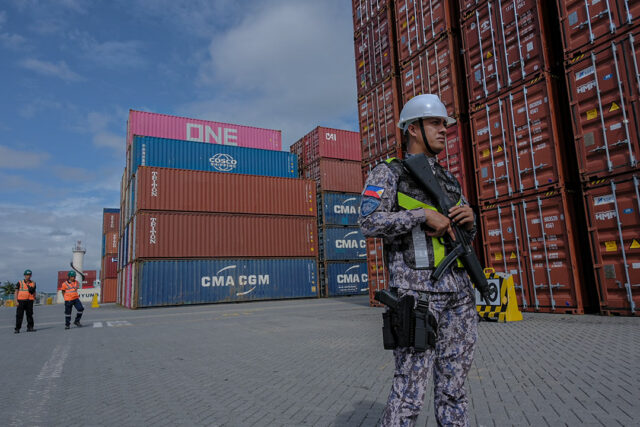
Container vans are seen in the port area in Manila. — PHILIPPINE STAR/RYAN BALDEMOR
By Aubrey Rose A. Inosante, Reporter
THE PHILIPPINES’ trade-in-goods deficit ballooned to $5.09 billion in September, the biggest trade gap in 20 months, the Philippine Statistics Authority (PSA) said on Wednesday.
Preliminary data from the PSA showed the trade-in-goods balance — the difference between exports and imports — stood at a $5.09-billion deficit in September, up by 43.4% from $3.55-billion gap a year ago.
Month on month, the trade gap rose by 15.81% from $4.39 billion in August.
The country’s balance of trade in goods has been in the red for 112 straight months (over nine years) since the $64.95-million surplus recorded in May 2015.
In September, exports declined 7.6% to $6.26 billion from $6.77 billion a year ago. This was the biggest drop since June.
For the first nine months, exports rose by 1.1% to $55.67 billion.
The Development Budget Coordination Committee (DBCC) expects 5% growth in exports this year.
On the other hand, the value of imports went up by an annual 9.9% to $11.34 billion in September from $10.32 billion in the same period last year.
In the nine-month period, imports inched up by 0.6% to $95.07 billion. This is below the DBCC’s target of 2% growth in imports for the year.
ELECTRONICS EXPORTS Among the major types of goods, exports of manufactured goods fell by 11.1% year on year to $4.95 billion in September, followed by mineral products ($645.24 million) and agro-based products ($492.62 million). Manufactured goods accounted for 79.2% of the total exports in September.
By commodity group, electronic products was still the country’s top exports in September with $3.15 billion, down 23.1% from $4.09 billion a year ago.
Semiconductor exports, which accounted for the majority of electronic goods, dropped by 30.6% to $2.31 billion in September.
Exports of other manufactured goods increased by 73.7% to $506.69 million, while other mineral products rose by 16.2% to $330.23 million in September.
The United States remained the top destination of Philippine-made goods, with exports valued at $1.08 billion. This accounted for 17.3% of total exports in September.
Hong Kong was the second-biggest market with an export value of $867.42 million (13.9% share), followed by Japan with $847.47 million (13.5%), China with $830.36 million (13.3%), and South Korea with $318.50 million (5.1%).
Other top export destinations include Thailand, the Netherlands, Germany, Singapore, and Taiwan.
IMPORTS By type of goods, imports of raw materials and intermediate goods increased by 19.5% to $4.33 billion in September, while capital goods inched up by 1.4% to $3.03 billion and consumer goods rose by 20.6% to $2.56 billion.
In terms of value, electronic products had the highest import value at $2.4 billion in September, up by 8.9% from last year. It made up 21.2% of the total imports in September.
Imports of mineral fuels, lubricants, and related materials slipped 11.4% year on year to $1.36 billion in September, while transport equipment also fell by an annual 3.1% to $1.12 billion.
In September, China was the biggest source of imports valued at $2.84 billion, which made up 25% of the total import bill.
This was followed by Indonesia with $1.09 billion (9.6%), Japan with $837.75 million (7.4%), South Korea with $784.65 million (6.9%), Thailand with $735.58 million (6.5%) and the United States with $6.298 million (6.7%).
GlobalSource Country Analysts Diwa C. Guinigundo said that the widening trade deficit was due to sluggish exports.
“We are strong in imports, but our exports are not doing very well precisely because the global economy was also not doing very well,” he said in a phone call interview.
“Exports declined because the global economy is not exactly robust, while our imports were driven by the demand for imports of capital goods, raw materials and intermediate products, as well as consumer imports like oil, cars,” he added.
Rizal Commercial Banking Corp. Chief Economist Michael L. Ricafort said the increase in imports was also due to a stronger peso.
The peso closed at P56.03 per dollar at end-September, strengthening from the P56.111 finish at end-August.
For the coming months, Mr. Ricafort said that the weakening peso would “make imports more expensive from the point of view of local buyers, but would make exports more price competitive from the point of view of foreign buyers.”
“Increased demand other economic activities during the Christmas holiday season would help spur more imports/production activities and export sales,” Mr. Ricafort said.
People submit their applications at a job fair in Manila. The jobless rate fell to 3.7% in September, the statistics agency said. — PHILIPPINE STAR/EDD GUMBAN
By Chloe Mari A. Hufana, Reporter
THE PHILIPPINES’ unemployment rate fell to 3.7% in September, driven in part by a growing number of female workers joining the labor force ahead of the holiday season, the statistics agency said on Wednesday.
Preliminary data from the Philippine Statistics Authority’s (PSA) Labor Force Survey showed the jobless rate dropped to 3.7% in September from 4% in August and 4.5% in September last year.
This translated to 1.89 million unemployed Filipinos in September, down by 177,000 from August and by 370,000 from a year earlier.
Despite the lower jobless rate, underemployment rose to 11.9% in September from 11.2% in August and 10.7% in September last year.
The number of underemployed Filipinos — those who want longer work hours or an additional job — increased by 831,000 to 5.94 million in September from 5.11 million a year ago.
In the first nine months of the year, the unemployment rate averaged 4%, lower than the 4.6% average a year ago.
PSA data showed the employment rate went up to 96.3% in September from 95.5% a year ago. This is equivalent to 49.87 million employed Filipinos, up by 2.2 million from 47.67 million in September 2023.
In September, the labor force participation rate (LFPR) increased to 65.7% in September, from 64.1% a year ago. This translates to a labor force of 51.77 million in September, up 1.84 million from 49.93 million a year ago.
Undersecretary and National Statistician Claire Dennis S. Mapa said 1.34 million of these new workers were women.
“In [the number of] employed persons year on year, the majority here are actually female workers,” he told a news briefing in mixed English and Filipino.
He noted there has been a steady increase in female workers for the past three months.
The LFPR among female Filipino workers rose to 55.7% in September from 53.4% a year ago. For male workers, the rate also rose to 75.6% from 74.7% a year ago.
“By and large, more and more women and youth are entering the labor force. This bodes well for our economic outlook as more Filipinos see increasing job opportunities. As the holiday season approaches, we expect more employment available in retail trade as well as accommodation and food services,” Finance Secretary Ralph G. Recto said in a statement.
Of the 883,000 new employees seen in September, the bulk or 802,000 were youth, bringing the youth employment rate to 90%.
National Economic and Development Authority (NEDA) Secretary Arsenio M. Balisacan said the government will continue to implement supply-side and demand-side interventions to ensure the government will hit quality employment targets.
“The government is urgently addressing the constraints to high-quality job creation and collaborating with the private sector to capacitate our workers with the right skills and competencies simultaneously,” he added.
Mr. Balisacan said the NEDA is also working to finalize the Trabaho Para sa Bayan Plan, a 10-year roadmap to encourage investments in priority sectors, improve the employability of the current and future workforce, and enhance labor market governance for the next decade.
DECLINING JOBS By industry, the services sector continued to employ the largest number of Filipinos with 31.31 million workers in September.
This was followed by the agriculture sector, which employed 9.48 million, and the industry sector with 8.56 million workers.
Meanwhile, the administrative and support service activities industry gained the biggest number of new employees year on year with 735,000.
Service activities added 559,000 workers year on year, followed by wholesale and retail trade; repair of motor vehicles and motorcycles with 486,000 and public administration and defense with 333,000.
The manufacturing sector added 200,000 jobs year on year in the third quarter.
On the other hand, accommodation and food service activities had the biggest annual decrease in jobs with 242,000, followed by agriculture and forestry (210,000), fishing and aquaculture (136,000) and construction (87,000).
On average, employed Filipinos worked 40.3 hours a week, slightly lower than the 40.7 hours in August and 40.8 hours in September 2023.
University of the Philippines School of Labor and Industrial Relations Assistant Professor Benjamin B. Velasco said the September unemployment and underemployment data implies that “more people entered the labor force but found part-time or temporary jobs only.”
“This is revealed in the rise in LFPR but lower average hours of work per week along with an increase in people wanting more hours of work,” he said in a Facebook Messenger chat.
“This can mean a greater number of young people employed in freelance work like virtual assistants, internet-based tasks, or delivery riders as shown in the comparative increases in sub-sectors like admin and support services and other service activities,” he added.
University of the Philippines Baguio economics instructor Edgar Antonio C. Suguitan said the underemployment trend reflects the precarious nature of employment in the country.
“It is a sign of a weakness of the economy because the economy does not have the capacity to accommodate a growing labor force,” he told BusinessWorld in a Facebook Messenger chat.
“Rampant in the labor market is this employment ‘flexibility’ as many workers are given temporary contracts,” he added.
Federation of Free Workers (FFW) President Jose Sonny G. Matula sounded the alarm over the rise in underemployment, which he said suggested workers’ incomes are insufficient to meet basic needs, driving them to seek more jobs to survive.
“This financial strain has potential health consequences for workers who are compelled to work longer hours or multiple jobs simply to make ends meet,” he told BusinessWorld in a Viber chat.
He said the decline of employment in the wholesale and retail, construction, human health, and social work activities sectors was concerning.
“While the rise in overall employment indicates resilience in certain areas of the economy, the downturn in these key sectors highlights underlying vulnerabilities,” he said.
PSA data showed wholesale and retail trade lost 597,000 workers month on month. Followed by 284,000 in construction and 177,000 in human health and social work activities.
The labor group leader said wholesale and retail are “traditionally a cornerstone for job creation.” Its decline in workers could potentially impact small businesses and consumer activity, he added.
HEADLINE INFLATION is seen to remain within the Bangko Sentral ng Pilipinas (BSP) 2-4% target in the coming months despite the uptick in October, analysts said.
“Yes, headline inflation did accelerate year on year, but we don’t think there is any reason to worry,” HSBC economist for ASEAN Aris D. Dacanay said in a report.
“In fact, price pressures were relatively (and fortunately) benign, considering how supply conditions weren’t favorable due to the typhoons in late September,” he added.
Headline inflation picked up to 2.3% in October from 1.9% in September but slowed from 4.9% a year ago.
This brought average inflation in the 10-month period to 3.3%, still within the BSP’s 2-4% target but above the 3.1% full-year forecast.
Mr. Dacanay said he expects inflation to average below 3% well into 2025.
“Despite a slight uptick this month, inflation is still expected to remain within manageable levels or between the 2% to 4% target range for the rest of the year,” former Finance Secretary Margarito B. Teves said in a Viber message.
Mr. Dacanay said the outlook for improving inflation was due to the continued downtrend in rice prices.
“Despite the supply shocks, the lower tariff rates on rice and the drop in global rice prices are finally in the works, keeping overall inflation at bay,” he added.
Rice inflation, which contributed 30.8% to overall inflation, quickened to 9.6% in October from 5.7% a month ago.
However, retail prices of rice have been on the decline since the executive order cutting tariffs on rice imports to 15% took effect in July.
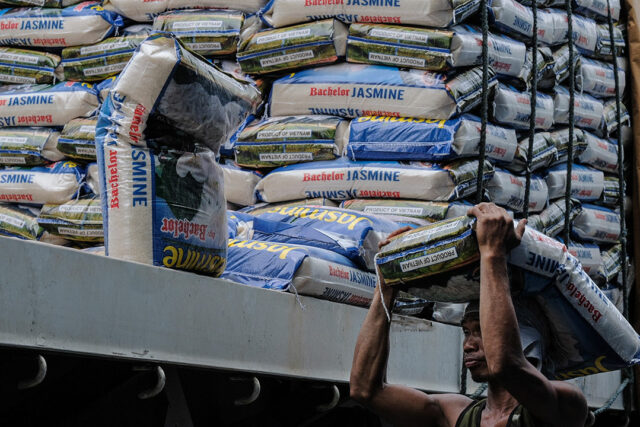
Latest data from the Philippine Statistics Authority showed the average price of regular milled rice dropped to P50.22 per kilo in October from P50.47 in September. Well-milled rice prices likewise decreased to P55.28 per kilo from P55.51.
The PSA also said that rice inflation and retail prices are likely to continue to go down moving forward.
“Note that rice represents roughly 9% of the Philippine CPI (consumer price index) basket, so what happens to rice prices affects the overall outlook for Philippine CPI. And so far, risks to rice prices are tilted to the downside,” Mr. Dacanay said.
“Global rice prices are currently falling, and we likely have yet to see it through with India resuming its non-basmati rice exports. The full effect of the tariff rate cut of rice have also yet to fully filter through retail rice prices.”
Pantheon Chief Emerging Asia Economist Miguel Chanco said the uptick in October was due to food inflation and will likely continue into November but “less pronouncedly, before food price base effects turn more neutral.”
“Fundamentally, the outlook for food inflation continues to improve, with upstream pressures still subsiding,” he added.
This inflation outlook will help support the central bank’s plans to further cut interest rates.
“This would allow the BSP to continue with its monetary easing cycle which started in August with a 25-basis-point (bp) cut,” Mr. Teves said.
“This likely gives the BSP room to continue its easing cycle in December, when we expect the central bank to cut rates by 25 bps to 5.75%,” Mr. Dacanay added.
The Monetary Board is set to meet on Dec. 19 for its last policy review for the year. BSP Governor Eli M. Remolona, Jr. has signaled the possibility of a 25-bp cut for the meeting.
Since August, the BSP has cut borrowing costs by a total of 50 bps, bringing the benchmark to 6%.
On the other hand, Mr. Dacanay flagged risks to the rate-cutting cycle, such as currency volatility.
“We continue to expect the BSP to continue its easing cycle in December but flag the risk of a rate pause if FX (foreign exchange) volatility were to persist due to global events,” he said.
“If the (peso) weakens against the US dollar due to global events, such as the US election, the BSP may opt to briefly pause its easing in December to give itself some flexibility if financial markets were to remain volatile,” he said.
“Nonetheless, the BSP should eventually continue its easing cycle once the volatility subsides, bringing the policy rate down to settle at 5% by 2025. In other words, if there are delays to the easing cycle, those delays will likely be only brief.” — Luisa Maria Jacinta C. Jocson
Spotlight is BusinessWorld’s sponsored section that allows advertisers to amplify their brand and connect with BusinessWorld’s audience by publishing their stories on the BusinessWorld Web site. For more information, send an email to online@bworldonline.com.
Join us on Viber at https://bit.ly/3hv6bLA to get more updates and subscribe to BusinessWorld’s titles and get exclusive content through www.bworld-x.com.
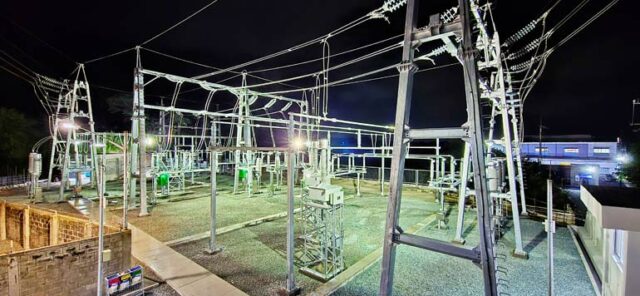
Meralco recently commissioned the Milagrosa 115-kilovolt (kV) Switching Station in Carmelray Industrial Park II in Calamba City, Laguna to support the power requirements of Solar Tanauan Corp.
As the year draws to a close, the Manila Electric Company (Meralco) continues to exhibit exceptional service, bolstering its commitment to innovation to enhance value for its customers and stakeholders.
The Manuel V. Pangilinan-led distribution utility closed the first nine months of 2024 with an impressive operational and financial performance, further solidifying its role as a leader in the energy industry and as an economic growth enabler.
Continuing initiatives to support customers’ needs
To ensure delivery of sufficient, reliable, and stable service at the least possible cost, Meralco continuously implements distribution network upgrades and strategic sourcing activities.
Among the major distribution network projects completed by Meralco in the third quarter of the year are the new gas-insulated switchgear (GIS) in a first full indoor substation at Elisco Road in San Joaquin, Pasig City; the Milagrosa Switching Station in Carmelray Industrial Park II in Calamba City, Laguna; and a third 300-MVA power transformer at the Duhat Delivery Point Substation in Bocaue, Bulacan.
Through its pole relocation program, a total of 924 poles were relocated for road widening projects of the Department of Public Works and Highways and various local government units (LGUs) while a total of 571 poles were relocated for the government’s Build Better More infrastructure program.
“Despite the challenges we have encountered so far this year, Meralco has been relentless in anticipating the needs of our customers and investing in projects that would be beneficial for them in the long run,” Meralco Executive Vice-President and Chief Operating Officer Ronnie L. Aperocho said.
Consistent with its Power Supply Procurement Plan approved by the Department of Energy (DoE), Meralco conducted the competitive selection process (CSP) for 600-MW baseload and 400-MW mid-merit supply requirements.
Meralco secured the best bids for the 600-MW baseload requirement from two (2) generation companies, which offered a levelized cost of electricity (LCOE) inclusive of line rental and Value-Added Tax (VAT) of P5.6015 per kWh and P5.7392 per kWh.
Meanwhile, the sole winning bidder of the CSP for the 400-MW mid-merit requirement offered an LCOE of P7.6816 per kWh, including line rental and VAT. These 15-year PSAs from the two (2) CSPs shall be submitted to the Energy Regulatory Commission for review and approval to be implemented beginning Aug. 26, 2025.
Aperocho added that Meralco is also working to ensure that the company is prepared to meet the supply needs of customers without unnecessarily exposing them to volatile energy prices.
“To this end, our efforts are centered on competitive biddings, which historically yielded lowest rates that translate into savings for our millions of customers. While there are still a lot of things to be done, our customers can be assured that Meralco will remain proactive in working with the energy industry players, and the regulator, in promoting consumer welfare,” he said.
Power generation business forges ahead
Meralco PowerGen Corp. (MGEN) the power generation investment arm of Meralco, was also a significant contributor to the distribution utility’s continued growth.
As of end-September, MGEN had a combined power generation capacity of 2,417 MW (net) in its diversified power generation portfolio in the Philippines and Singapore. During the period, MGEN delivered 11,556 GWh of energy, 3% more compared with the same period last year.
Terra Solar Philippines, Inc., MGEN’s cornerstone renewable energy project through SP New Energy Corp. (SPNEC), has secured green lane certification from the Board of Investments that entitles the project to streamlined processing alongside expedited approval of permits. This came on the heels of Terra Solar’s certification as an Energy Project of National Significance from the Department of Energy in July 2024.
Terra Solar is developing a 3,500-MWdc utility scale solar with 4,500-MWhr Battery Energy Storage System in Nueva Ecija and Bulacan spanning five (5) municipalities and 11 barangays.
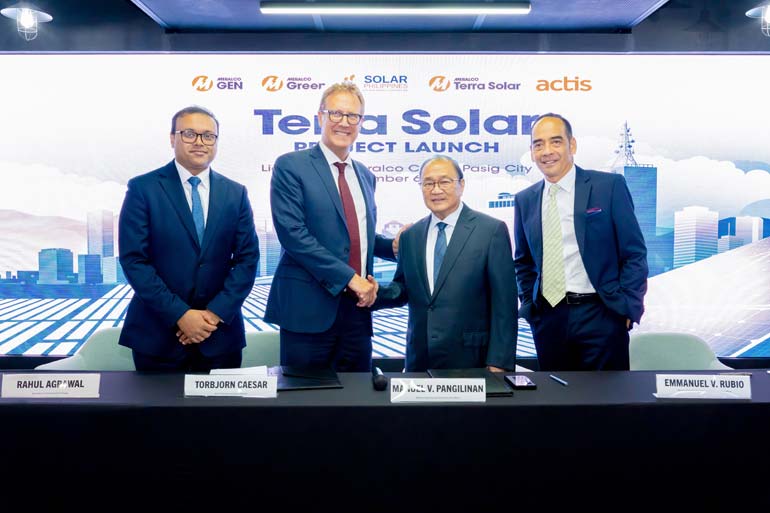
UK-based Actis has acquired a 40% equity stake in Terra Solar for the largest foreign direct investment for a greenfield infrastructure project in the Philippines. Seen in the photo are (from L-R) Actis Head of Southeast Asia Energy Rahul Agrawal, Actis Chairman and Senior Partner Torbjorn Caesar, Meralco Chairman and CEO Manuel V. Pangilinan, and MGEN President and CEO Emmanuel V. Rubio during the signing ceremony.
In September 2024, SPNEC announced the strategic entry of UK-based Actis through Actis Rubyred (Singapore) Pte. Ltd., which is set to acquire a 40% equity stake in Terra Solar for a total consideration of approximately US$600 million — by far, the largest foreign direct investment for a greenfield infrastructure project in the Philippines.
With the development activities of the project in full swing, Terra Solar entered an engineering, procurement, and construction contract with Meralco Industrial Engineering Services Corp. (MIESCOR) covering the connection assets that will link the power plant to the national grid.
These milestones are expected to positively impact the timely construction of the project, with the first phase involving 2,500 MW to be delivered on-track by the first quarter of 2026 — and Phase 2, a year later.
Aside from Terra Solar, power plants of MGEN Renewable Energy, Inc. (MGreen) operated efficiently and collectively maintained an impressive 97% average plant availability. The renewable energy arm of MGEN delivered a total of 483 GWh of clean energy, its highest generation of solar power to date — a 90% increase from 254 GWh the previous year, which is expected to grow further as new solar plants start operating.
“As we work on progressing all our projects in the pipeline, we also strive to maximize the efficiency of our current power generation assets. We expect to sustain this momentum as we realize gains from our energy portfolio,” MGEN President and Chief Executive Officer Emmanuel V. Rubio said.
Still in line with Meralco’s commitment to pursuing energy security, Meralco recently entered into partnerships with South Korean firms to study the adoption of nuclear energy in the Philippines.
Meralco signed a memorandum of understanding (MoU) with Doosan Enerbility Co. Ltd. to study the use of small modular reactors (SMRs) to help meet the country’s growing energy demand. Meralco also signed a separate MoU with Samsung C&T Corp. Engineering & Construction Group (Samsung C&T), for the sharing and discussion of technical design and capabilities of nuclear technology.
“Our recent partnerships with reputable South Korean firms to explore nuclear energy projects in the Philippines also reflect our commitment to the Government’s emphasis on sustainability,” Meralco Chairman and Chief Executive Officer Manuel V. Pangilinan said.
Social development initiatives that benefit Filipinos across the country
Alongside its efforts to grow its business, Meralco remains keen in advancing sustainability and implementing social development initiatives.
PRESERVING THE PLANET. Meralco Chairman and CEO Manuel V. Pangilinan (second from right) leads the acceptance of tree seedlings from Communications Electrical Equipment & Supply Co., Inc. (Celeasco) President Natalie G. Siy. The donated seedlings will form part of Meralco’s greening initiative under the One For Trees and PowerPlants environmental programs. Seen in the photo as well are One Meralco Foundation President Jeffrey O. Tarayao (left) and Meralco First Vice-President and Chief Sustainability Officer Raymond B. Ravelo (right).
Under the flagship One for Trees environmental program of One Meralco Foundation (OMF), Meralco in September launched the “Greening the Meralco Operating Center” initiative that aims to transform its Pasig City headquarters into “the lungs of the Ortigas business district.” In partnership with the Communications Electrical Equipment & Supply Co., Inc. (Celeasco), Meralco planted over a thousand seedlings to enhance urban green spaces in its compound.
As of end-September, the One for Trees program now covers a total of 2,400,803 trees in different parts of the Philippines.
As a testament to its steadfast commitment to support underserved communities, OMF’ssocial development programs benefitted7,059 families in the third quarter of 2024 alone. This includes energization of low-income households in parts of Metro Manila, Bulacan, Laguna, Batangas, and Quezon, and provision of solar lamps to indigenous families from a mountain community in Puerto Princesa City, Palawan.
To support the government’s national security efforts, the OMFalso provided solar lamps to soldiers from the Philippine Marine Corps — Marine Battalion Landing Team-9, which is assigned to secure the Kalayaan Island Group near the West Philippine Sea. On the disaster response front, the OMF continued its immediate distribution of relief packs to families affected by weather disturbances and fire victims in different parts of the country.
IN SUPPORT OF NATIONAL SECURITY. One Meralco Foundation turns over solar lamps to the Philippine Marine Corps — Marine Battalion Landing Team-9, which is assigned to secure the Kalayaan Island Group near the West Philippine Sea.
In helping promote quality education, the OMF along with Meralco Employees Fund for Charity, Inc., MGEN, MPower, and Vantage Energy, continued with the employee-led “Balik Eskwela” program which benefitted more than 1,200 kindergarten students.
The OMF has also undertaken a host of initiatives in partnership with MGEN, which has been expanding its footprint and actively supporting communities across the country. This includes the distribution of 150 home solar kits to residents of Sitio Tamale in Bongabon, Nueva Ecija which is an area outside of Meralco’s service area that has no access to electricity. To promote public health, the OMF supported MGEN’s Adopt-a-Health Center Program that benefitted 35 health centers and clinics in its adopted villages in Iloilo City, Nabas and New Washington, Aklan, and Toledo City, Cebu.
Sustainability wins and demonstration of excellence
Aligned with its long-term sustainability strategy, Meralco continues to heighten its environmental, social, and governance (ESG) performance.
The distribution utility recently improved its ESG rating with corporate governance research and analytics firm Sustainalytics — landing in the top 39% of the global electric utilities industry with its strong management of material ESG risk areas such as carbon emissions, community relations, and business ethics and governance.
For the fourth consecutive year, Meralco was likewise recognized in the FTSE4Good Index Series, which tracks global sustainability performance across key ESG areas, including risk management, labor standards, corporate governance, and anti-corruption. Meralco is the only Philippine electric utility company that is part of the index.
As Meralco continues to advance programs that benefit its stakeholders, the company has garnered numerous accolades from prestigious organizations for reflecting sustained excellence in business performance, sustainability, social development, human resource management, digital transformation, customer centricity, and corporate governance.
BEACON OF EXCELLENCE. Meralco took home eight (8) Stevies at the 2024 International Business Awards. Seen in the photo are (from L-R) Meralco FVP and Head of Customer Retail Services Charina P. Padua, OMF President Jeffrey O. Tarayao, Meralco EVP and Chief Operating Officer Ronnie L. Aperocho, Meralco FVP and Chief Sustainability Officer Raymond B. Ravelo, and Meralco SVP and Chief HR Officer Edgardo V. Carasig.
Among the recent feted honors are eight (8) Stevies at the 2024 International Business Awards. For the second consecutive year, Meralco First Vice-President and Chief Sustainability Officer Raymond B. Ravelo took home the Gold Stevie Award for Sustainability Hero of the Year in Asia, Australia, and New Zealand.
OMF President Jeffrey O. Tarayao was, meanwhile, recognized with a Silver Stevie under the Thought Leader of the Year for Non-Profit or Government Category.
Meralco also garnered two (2) more Silver Stevie Awards for its sustainability and corporate social responsibility efforts — the company’s sustainability campaign “Powering the Good Life,” and OMF’s “Leading Energy for Productivity in Underprivileged Communities in the Philippines” which championed inclusive development in geographically isolated and disadvantaged communities.
Meralco’s human resource and stakeholder management strategies, along with its digital transformation efforts, earned four Bronze Stevie Awards. These include the company’s employee engagement strategy “Nurturing a Vibrant Workforce: Meralco’s Approach to Engagement and Retention,” the diversity and inclusion program #Mbrace, the external stakeholder recognition program “The 9th Meralco Luminaries: Brighter New World,” and “Lighting the Way: Meralco’s Customer Experience Dashboard for Sales Analysis,” which was recognized for its innovative use of competitive intelligence to address evolving customer needs.
“We remain optimistic about the continued expansion of the country’s economy under the leadership and tutelage of President Ferdinand Marcos, Jr., with full-year economic growth forecasts hovering around 6%, and the potential to outpace other Southeast Asian nations. Easing inflation pressures and sustained spending on major infrastructure projects which Meralco actively supports and would help,” Pangilinan said.
Spotlight is BusinessWorld’s sponsored section that allows advertisers to amplify their brand and connect with BusinessWorld’s audience by publishing their stories on the BusinessWorld Web site. For more information, send an email to online@bworldonline.com.
Join us on Viber at https://bit.ly/3hv6bLA to get more updates and subscribe to BusinessWorld’s titles and get exclusive content through www.bworld-x.com.
CONGRESSMEN APPROVED Meralco’s franchise to operate four years ahead of its initial concession’s expiry. — PHILIPPINE STAR/JESSE BUSTOS
By Kenneth Christiane L. Basilio, Reporter
THE HOUSE of Representatives on Wednesday approved on third and final reading a bill granting Manila Electric Co. (Meralco) a 25-year franchise extension.
In a 186-7-4 vote, congressmen agreed to extend Meralco’s franchise to construct, operate, and maintain its electric distribution systems in the greater Metro Manila area, including Bulacan, Cavite, Rizal, and parts of Batangas, Quezon, Laguna, and Pampanga.
House Bill No. 10926 outlines that Meralco must offer at least 30% of its outstanding capital stock to Filipinos. Failing to do so would result in its franchise revocation.
The power distributor is also mandated to provide an annual report of its operations, including the rollout, development, and expansion of its operations to Congress. Meralco would incur a P1 million fine per working day of noncompliance to this requirement.
Congressmen approved Meralco’s franchise to operate four years ahead of its initial concession’s expiry.
Its counterpart measure, Senate Bill No. 2824, filed by Senator Emmanuel Joel J. Villanueva on Sept. 12, is currently pending at the Senate rules committee.
In a statement, Albay Rep. Jose Ma. Clemente S. Salceda said he expects the franchise bill to breeze through the Senate, even floating the possibility of Congress no longer needing to convene in a bicameral conference committee to discuss the measure.
Bills seeking to provide a legislative franchise to companies first originate at the House, undergoing the same legislative process as regular bills, according to the Energy department.
Meralco is the main power distributor for the National Capital Region and nearby areas, covering 39 cities and 72 municipalities, delivering electricity to at least 7.6 million Filipinos. It provides power to a region responsible for half of the country’s gross domestic product output.
“A stable and affordable power sector is necessary for economic growth, and Meralco has the burden of providing electricity to the nation’s most important economic hub,” Terry L. Ridon, a public investment analyst and convenor of think-tank InfraWatch PH, said in a Viber message before the bill’s approval.
“Extending Meralco’s franchise would erase uncertainty of Meralco in investing for expansion and improvement of its infrastructure and facilities,” Calixto V. Chikiamco, Foundation for Economic Freedom president, said in a Viber message also before the bill’s approval.
Earlier this year, Meralco announced that it committed to course P100 billion in investments to “critical projects” seen improving its power distribution infrastructure as part of its long-term sustainability strategy.
Meralco and its unit SP New Energy Corp. entered into a strategic partnership with global investment firm Actis for the Terra Solar Project, a P200-billion solar power plant in Central Luzon that is expected to generate more than five billion kilowatt-hours of electricity yearly.
The granting of an extended franchise to Meralco could lead to cheaper electricity for consumers, said Antonio A. Ligon, a law and business professor at De La Salle University in Manila. “One advantage, of course, is that Meralco’s adjustment on electric bills will lean toward providing ease to consumers,” he said before Meralco’s legislative franchise approval.
The approval of Meralco’s franchise could also drive down the generation prices of its power supply agreements with electricity generation firms, said Mr. Ridon, citing their need to “offer the lowest price” to secure deals with the power distributor.
In October, Meralco sought the Energy Regulatory Commission’s approval for 600-megawatt power supply deals, seen to result in P11.75 billion in consumer savings.
The bill needed more time for thorough review, said Gerry C. Arances, convenor of the Power for People Coalition, in a Facebook Messenger chat before the bill’s approval.
Meralco’s majority owner, Beacon Electric Asset Holdings, Inc., is partly owned by PLDT Inc.
Hastings Holdings, Inc., a unit of PLDT Beneficial Trust Fund subsidiary MediaQuest Holdings, Inc., has an interest in BusinessWorld through the Philippine Star Group, which it controls.
AYALA LAND, Inc. (ALI) expects P80 billion in project launches by yearend, the company’s president said on Wednesday.
“The ALI business line continued with its strong performance… We expect to end the year with a total of P80 billion in launches,” Ayala Land President and Chief Executive Officer Anna Ma. Margarita B. Dy said during the company’s nine-month financial and analysts’ briefing.
Of the company’s planned launches for the remainder of the year, approximately 90% are awaiting licenses to sell, she noted, adding that half of these projects are in the company’s core segments.
“Given the unique position of our inventory, almost half of the projects for launch in the coming months are in our core segment, bringing fresh products to the market,” she said.
More than 70% of the company’s planned launches will be horizontal projects.
Only one of the projected project launches is located in Metro Manila, while the rest will be in Laguna and Cavite, Ms. Dy noted.
For the first nine months of the year, Ayala Land reported an attributable net income of P21.16 billion, up by 15.1% from the P18.39 billion recorded in the same period last year.
The company has yet to release its financial statement for the third quarter.
For the first semester, the company logged an attributable net income of P13.13 billion, marking an increase of 15.3% from the P11.39 billion in the same period in 2023.
For January to September of 2024, Ayala Land recorded total revenues of P125.21 billion, surging by 26.6% from the P98.92 billion in the comparable period a year ago.
Revenues from real estate accounted for the bulk of its top line for the period after generating revenue of P122.69 billion, or 97.9% of its gross revenues.
Property development generated P76.6 billion in revenue, driven by strong residential bookings and commercial lot sales. The leasing and hospitality segment earned P33.23 billion, while construction, property management, and ancillary services brought in P12.77 billion.
“We realize that in certain parts of the market, there is an oversupply. Fortunately, we are not geographically in those areas. We believe that the products that we will be launching in the core will actually be very strong, and we will restart our launches in the core in the fourth quarter of the year,” said Ms. Dy.
Ayala Land said that its full-year capital expenditure spending is projected to be P85 billion, down from the previous forecast of P100 billion.
“This is lower as we reduced our launches and staggered the start of mall and hotel reinvention to minimize disruption in our operations,” she said.
She said that the company’s mall renovations in Glorietta, Trinoma, Greenbelt, and Ayala Center Cebu are ongoing, with an average completion rate of 40% expected by the end of the year. The entire renovation project is set to be fully completed by 2026.
“We are also bullish on the mid- to long-term prospects of our estates as we look to benefit from the road and rail infrastructure programs of the government and private sector,” she said.
To recall, the company, along with San Miguel Corp. and the Transportation department, broke ground for the Ayala Greenfield Interchange, which is expected to commence construction in November.
“We have also divested AirSWIFT to Cebu Pacific. They expect to increase the number of round-trip flights by 30%, and in turn, we will focus on Lio Airport, which we will expand to accommodate all its current passenger capacity,” Ms. Dy said.
Last month, Cebu Pacific acquired AirSWIFT from ALI Capital Corp., a unit of Ayala Land, for P1.75 billion.
“Lio Estate, where we will develop new hospitality formats and expand Seda Lio, as well as our commercial district in the next five years,” she said.
ALI Capital is the owner and operator of the Lio Airport in El Nido, Palawan, while Lio Tourism Estate is Ayala Land’s tourism estate in El Nido, Palawan.
At the stock exchange, shares in Ayala Land fell by P1.50, or 4.35%, to end at P33 apiece. — Ashley Erika O. Jose
There is a need to expedite the development of the Silangan Copper and Gold Project in Surigao del Norte to take advantage of current market conditions, according to Philex Mining President and Chief Executive Officer Eulalio B. Austin, Jr. — REUTERS
PHILEX Mining Corp. saw its third-quarter attributable net income more than double to P306.6 million from P139.84 million a year earlier, driven by higher gold and copper prices.
In a disclosure on Wednesday, the company reported a 22.6% increase in its core net income to P199.79 million in the three months ended September from P163 million last year.
“Average realized gold prices in the third quarter were higher at $2,336 per ounce compared with the $1,927 per ounce in the third quarter of 2023,” the company said.
“Realized copper prices for the third quarter stood at $4.59 per pound, higher than the $3.73 in the third quarter of 2023,” it added.
This brought the company’s top line to P2.12 billion in the July-to-September period, up 17.9% from P1.8 billion.
However, the company incurred higher costs in the third quarter, totaling P1.89 billion. This represents a 15.67% increase from P1.63 billion in the same period last year, which may be attributed to the company’s higher tonnage milled this year.
For the July-to-September period, the company milled 1.77 million tons, up 4.5% from 1.693 million tons last year. Gold output was at 7,801 ounces, while copper output was at 4.951 million pounds.
Meanwhile, the company saw a decline in attributable net income to P636.03 million in the first nine months. This was 24.6% lower than the P843.98 million seen in the same period last year.
This was also reflected in the 29.4% decrease in its core net income to P610.13 million from P864.34 million a year prior.
The company’s nine-month revenues were higher at P6.1 billion, representing a 2.4% increase from P5.96 billion a year ago. This was dampened by a 7.8% increase in costs to P5.36 billion from P4.97 billion in 2023.
SILANGAN PROJECT There is a need to expedite the development of the Silangan Copper and Gold Project in Surigao del Norte to take advantage of current market conditions, according to Philex Mining President and Chief Executive Officer Eulalio B. Austin, Jr.
“We have a responsive metals market brought about by the demand for critical metals necessary for the green energy transition and a favorable regulatory environment due to the support from the current administration,” said Mr. Austin.
“We are still on track to see our first metal output during the process plant’s debugging stage starting Feb. 2026, with the target of starting commercial operation within the first quarter of 2026,” he added.
Philex Mining said that the Silangan project is already in its final stages as “the main access decline to the Boyongan Ore Body is less than 50 meters.”
Once finished, Philex Mining subsidiary Silangan Mindanao Mining Co., Inc. is said to commence production on the first mining level, while works at the ventilation exhaust shaft and other ancillary services are continuing as planned, according to the company.
Civil works for the construction of the process plant have already commenced, while works on the Tailings Storage Facility are on track to finish by June 2025, it added.
Mr. Austin also said the company is evaluating the possible extension of Padcal’s mine life beyond 2027.
On Wednesday, shares in Philex Mining fell by 2.17% or seven centavos to close at P3.15 each.
Philex Mining is one of three Philippine units of Hong Kong-based First Pacific Co. Ltd., the others being Metro Pacific Investments Corp. and PLDT Inc.
Hastings Holdings, Inc., a unit of PLDT Beneficial Trust Fund subsidiary MediaQuest Holdings, Inc., has an interest in BusinessWorld through the Philippine Star Group, which it controls. — Justine Irish D. Tabile
BUSINESSES could see security vulnerabilities and operational inefficiencies due to unverified code generated by autonomous artificial intelligence (AI) agents, according to clean code provider Sonar.
“The quality of code generated by autonomous AI agents can vary,” Marcus Low, general manager and vice-president for Asia-Pacific and Japan at Sonar, told BusinessWorld. “While these tools aim for consistency, AI-generated code inherently lacks the meticulousness of humans, leading to potentially harboring hidden issues that might lead to bugs or security vulnerabilities.”
Autonomous AI agents may not fully understand the context in which the code operates, which risks exposing firms’ systems to exploits or breaches, he said.
While AI can enhance efficiency and innovation, robust verification processes are critical to ensuring code security, Mr. Low said. This verification is done through testing, human oversight, and continuous monitoring to ensure that the code meets safety, security, and performance standards.
“This means businesses can reduce costly risks associated with bad code, a problem estimated to cost companies more than a trillion dollars per year,” he said, adding that for business leaders, this means greater confidence in the reliability and security of software being rolled out into the production phase.
For its part, Sonar’s latest capabilities for SonarQube Server and SonarQube Cloud, AI Code Assurance, and AI CodeFix are designed to improve the quality and security of code produced by generative AI, he said.
“Ultimately, the key to mitigating these risks is to leverage AI code generation tools responsibly. This also means that AI-based software development should be seen as augmenting human skills, not replacing them,” Mr. Low said.
The importance of human oversight cannot be overstated in the process of AI code generation, as AI “lacks the nuance, understanding of context, and critical thinking” that developers bring to the table, he said.
Aside from creating guidelines that both AI and human developers can follow to ensure quality without compromising speed, the companies should also maintain a “human-in-the-loop system,” the official added.
“The widespread use of AI agents in software development tools can give developers enormous productivity benefits, but it raises some concerns about accountability, transparency, and security that must be addressed in order to foster responsible adoption,” Mr. Low said.
Amid the increased use of AI-generated code, organizations must ensure that these outputs comply with industry standards, ethical guidelines, and regulatory requirements, he added, noting that without a robust AI governance framework, businesses expose themselves to risks stemming from inferior or even harmful code.
“THE ADDITIONAL CAPITAL infusion will be used for the development of the Pantingan Gold project, Bolco Gold project, solar project, agribusiness project, and other priority projects of the company,” Benguet Corp. said. — BENGUETCORP.COM
LISTED mining company Benguet Corp. has received P300 million from Red Earth Mineral Resources Corp., a company engaged in surface mining and diversified investments, as partial payment for two private placement agreements.
In a disclosure to the stock exchange on Wednesday, the listed firm said that it signed two separate private placements with Red Earth on Nov. 5, covering 110 million common shares.
The first transaction covers Red Earth’s subscription to Benguet Corp.’s 90 million shares priced at P4 apiece. Broken down, these comprise 53 million Class A common shares and 37 million Class B common shares.
Meanwhile, the second transaction covers Red Earth’s subscription to 20 million common shares — 13 million Class A and 7 million Class B — in Benguet Corp. priced at P4 per share.
“At the signing of the private placement agreements, the company (Benguet Corp.) received from Red Earth the amount of P280 million as partial payment for the first transaction,” the company said.
“The balance of P80 million will be paid after stockholders’ approval of the private placement in the upcoming annual stockholders’ meeting on Dec. 20,” it added.
Red Earth also paid the listed firm P20 million as a deposit for its subscription in the second transaction and is expected to pay the balance of P60 million after the transaction receives approval from the Securities and Exchange Commission.
In a previous disclosure, Benguet Corp. said that the conclusion of the private placement will result in public ownership accounting for 39% of the outstanding capital.
“The additional capital infusion will be used for the development of the Pantingan Gold project, Bolco Gold project, solar project, agribusiness project, and other priority projects of the company,” Benguet Corp. said last week. — Justine Irish D. Tabile
HONOR Philippines on Wednesday launched its latest entry-level smartphone, the all-angle water-resistant HONOR X7c.
The HONOR X7c has an IP64-rated design for dust and water resistance, the brand said in a statement.
This latest smartphone is “another innovative yet affordable device to uplift the lifestyle needs of the Filipino consumers,” HONOR Philippines Vice-President Stephen Cheng said.
The phone has a 6000mAh battery that HONOR said can power up to 28.5 hours of streaming or 21.5 hours of playback on YouTube and supports up to 35 watts wired fast charging.
It has 256 gigabytes (GB) of internal storage and features RAM Turbo Technology for a 16GB RAM experience (8GB physical and 8GB virtual RAM).
Based on HONOR Philippines website, the X7c comes in three colors, namely Forest Green, Midnight Black, and Moonlight White.
It has a 6.77-inch TFTLCD display with a 1610×720 resolution and a 120Hz refresh rate and 850-nit peak brightness.
The HONOR X7c is powered by a Qualcomm Snapdragon 685 octa-core processor and runs on MagicOS 8.0 based on Android 14.
It has a dual rear camera setup comprised of a 108-megapixel (MP) main camera and a 2-MP depth lens. It also features an 8-MP front camera.
The phone also has dual stereo speakers.
The HONOR X7c features the HONOR Magic Capsule interface for multitasking.
It is now available at HONOR Experience and Partner stores nationwide, as well as via HONOR’s official stores on e-commerce platforms like Lazada, Shopee, and TikTok Shop. — BVR
TERM DEPOSIT yields fell on Wednesday ahead of the US Federal Reserve’s policy decision this week and following the release of latest Philippine inflation data.
The Bangko Sentral ng Pilipinas’ (BSP) term deposit facility (TDF) attracted bids worth P291.099 billion on Wednesday, above the P230 billion on the auction block and the P250.427 billion in bids a week ago for a P210-billion offer.
Tenders for the seven-day papers reached P155.328 billion, higher than the P130 billion auctioned off by the central bank. It was also above the P133.311 billion in bids for the P120-billion worth of deposits offered last week.
Banks asked for yields ranging from 5.955% to 6.1%, narrower than the 5.95% to 6.13% margin a week earlier. This caused the average rate of the one-week deposits to slip by 0.68 basis point (bp) to 6.0824% from 6.0892%.
Meanwhile, bids for the 14-day term deposits stood at P135.771 billion, above the P100-billion offer as well as the P117.116 billion in tenders for the P90 billion auctioned off a week ago.
Accepted rates were from 6% to 6.13%, also narrower than the 6% to 6.1685% range a week ago. As a result, the average rate for the two-week deposits fell by 1.14 bp to 6.1167% from 6.1281% last week.
The BSP has not auctioned off 28-day term deposits for more than four years to give way to its weekly offerings of securities with the same tenor.
The central bank uses the term deposits and BSP bills to help mop up excess liquidity in the financial system and to better guide market rates.
“The TDF average auction yields were again slightly lower for the seventh straight week, ahead of the widely expected Fed rate cut on the next Fed rate-setting meeting on Nov. 7,” Michael L. Ricafort, chief economist at Rizal Commercial Banking Corp., said in a Viber message.
The Federal Reserve on Thursday is expected to cut interest rates again, this time by a quarter of a percentage point to the 4.50%-4.75% range, Reuters reported.
The US central bank launched its policy easing cycle with an unusually large half-percentage-point rate cut in September, the first reduction in borrowing costs since 2020. The Fed hiked rates by 525 bps in 2022 and 2023.
Traders on Tuesday trimmed bets on Fed interest rate cuts next year as early tallies for the US presidential election rolled in through the evening.
Traders of futures contracts tied to the Fed’s policy rate now see the Fed likely stopping its rate cuts after just two more such cuts in the first half of 2025, bringing the rate to the 3.75%-4% range.
Mr. Ricafort added that TDF yields went down as Philippine inflation remained within the central bank’s target in October despite picking up from the month prior.
Headline inflation picked up to 2.3% in October from 1.9% in September, the Philippine Statistics Authority reported on Tuesday.
Still, this was slower than the 4.9% print in the same month last year. This was also within the BSP’s 2%-2.8% forecast for the month and a tad below the 2.4% median estimate in a BusinessWorld poll of 11 analysts.
For the first 10 months, the consumer price index averaged 3.3%, well within the BSP’s 2-4% target for the year but above its 3.1% baseline forecast. — L.M.J.C. Jocson with Reuters