Home Blog Page 2265

Low brow and vulgar? Micro dramas shake up China’s film industry, aim for Hollywood

REUTERS

ZHENGZHOU, China — On a film set that resembles the medieval castle of a Chinese lord, Zhu Jian is busy disrupting the world’s second-largest movie industry.

The 69-year-old actor is playing the patriarch of a wealthy family celebrating his birthday with a lavish banquet. But unbeknownst to either of them, the servant in the scene is his biological granddaughter.

A second twist: Zhu is not filming for cinema screens.

Grandma’s Moon is a micro drama, composed of vertically shot, minute-long episodes featuring frequent plot turns designed to keep millions of viewers hooked to their cellphone screens — and paying for more.

“They don’t go to the cinema anymore,” said Zhu of his audience, which he described as largely composed of middle-aged workers and pensioners. “It’s so convenient to hold a mobile phone and watch something anytime you want.”

China’s $5 billion a year micro drama industry is booming, according to Reuters’ interviews with 10 people in the sector and four scholars and media analysts.

The short-format videos are an increasingly potent competitor to China’s film industry, some experts say, which is second in size only to Hollywood and dominated by state-owned China Film Group. And the trend is already spreading to the United States, in a rare instance of Chinese cultural exports finding traction in the West.

Three major China-backed micro-drama apps were downloaded 30 million times across both Apple’s App Store and Google Play in the first quarter of 2024, grossing $71 million internationally, according to analytics company Appfigures.

“The audience only has that much attention. So obviously, the more time they spend in short videos, the less time they have for TV or other longer format shows,” said Ashley Dudarenok, founder of a Hong Kong-based marketing consultancy.

The leader in the space is Kuaishou, an app that accounted for 60% of the top 50 Chinese micro dramas last year, according to media analytics consultancy Endata.

Kuaishou vice-president Chen Yiyi said at a media conference in January that the app featured 68 titles that notched more than 300 million views last year, with four of them watched over a billion times.

Some 94 million people — more than the population of Germany — watched more than 10 episodes a day on Kuaishou, she said. Reuters was not able to independently verify the data.

Initial episodes on such apps are often free, but to complete a micro drama like Grandma’s Moon, which has 64 clips, audiences may pay tens of yuan.

Douyin, the Chinese version of TikTok which is owned by internet technology firm Bytedance, is also popular with micro drama fans.

Alongside other major Chinese social media apps like Instagram-like Xiaohongshu and YouTube competitor Bilibili, it has announced plans to make more.

In the United States, micro drama platform ReelShort, whose parent company is backed by Chinese tech giants Tencent and Baidu, has recently outranked Netflix in terms of downloads on Apple’s US app store, according to market researcher Sensor Tower.

“China discovered this audience first,” said Layla Cao, a Chinese producer based in Los Angeles. “Hollywood hasn’t realized that yet, but all the China-based companies are already feeding the content.”

‘LOW-BROW AND VULGAR’
Many popular micro dramas, including Grandma’s Moon, have narratives that revolve around revenge or Cinderella-like rags-to-riches journeys.

Tales of how circumstances at birth are deterministic and can only be changed by near-miracles have struck a chord with viewers at a time when upward mobility in China is low and youth unemployment high.

The micro dramas often “show people who one day are lower class and the next day become upper class — you get so rich that you get to humiliate those who used to humiliate you,” said a 26-year-old screenwriter known by her pen name of Camille Rao.

Rao recently left her poorly paid job as a junior producer in the traditional film industry for what she described as the more dynamic and less hierarchical world of micro dramas. She now writes and adapts scripts for the US market.

“Social mobility is actually very difficult now. Many people perceive this as a social reality,” said Xu Ting, associate professor of Chinese language and literature at Jiangnan University.

This has fueled interest in stories about billionaires and wealthy families, she added: “Everyone desires power and wealth, so it is normal for these type of stories to be popular.”

In the US market, by contrast, fantasy stories about werewolves and vampires are particularly popular, several creators told Reuters.

The boom in micro dramas in China has brought scrutiny from the Communist Party.

Between late 2022 and early 2023, the National Radio and Television Administration (NRTA) regulator said it organized a “special rectification campaign” during which it removed 25,300 micro dramas, totaling close to 1.4 million episodes, due to their “pornographic, bloody, violent, low-brow and vulgar content.”

As Chinese leader Xi Jinping promotes values such as loyalty to the Communist Party and heteronormative marriages, the state-owned China Women’s News outlet in April complained that some micro dramas “portray unequal and twisted marriage and family relationships as a common phenomenon” and “deviate from mainstream social values.”

In June, the government began requiring some creators to register micro dramas with the NRTA. The regulator didn’t respond to Reuters’ questions for this story.

Key to the commercial success of these films are plot twists that keep people paying as they scroll while commuting or stand in line at a grocery store. Episodes often end with a hook — such as a boyfriend walking in on his partner with another man — and viewers have to pay for the next episode to find out what happened.

“The plot of these micro dramas is exaggerated,” said Zhu, the actor. “It has plot reversals, it’s nonsensical, so it catches people’s attention and a large audience wants to see them.”

Zhu is a lover of cinema and an avid fan of Ingrid Bergman in Casablanca. Like many of his colleagues in micro dramas, he thinks the genre has limited artistic value. “I see it as fast food: a longer drama is a kind of sumptuous meal, and a micro drama is fast food.”

But its dedicated viewers disagree. Huang Siyi, a 28-year-old customer service agent, said she enjoyed watching romantic micro dramas because “the acting is good and the male and female leads are good-looking.”

“It’s easy to be obsessed with micro dramas,” she said.

EXPLOSIVE GROWTH
Vertical filming and distribution through social media apps mean micro dramas can be made with small overhead costs. Budgets for such films range from between $28,000 (200,000 yuan) and $280,000 (2 million yuan), according to market researcher iResearch.

In the central Chinese city of Zhengzhou, Grandma’s Moon is being made with a compressed budget and timeline. When Reuters visited the set in July, the filming day stretched until 2 a.m. The crew then moved to a new location and began shooting again at 7 a.m.

The show was shot in just six days, and Zhu, a muscular man with a wide smile and boundless energy, says he plays table tennis after hours to keep up with the young crew on set.

“We’d need to take two to three years to distribute one traditional TV series of film, but we only need three months to distribute a micro drama, saving us a lot of time,” said Zhou Yi, a showrunner at Chinese gaming giant NetEase, which also makes micro dramas.

As micro dramas gain in popularity, actors’ salaries have also grown. Leading roles used to pay $280 a day, said Zhu, adding that main actors in big productions can now make more than double the rate, though extras earn as little as $17 daily.

A retired railway employee who started acting in the 1970s in a theater troupe attached to the unit where he worked, Zhu now lives off his pension and occasional acting gigs.

Many Chinese micro drama producers have their eye on Western markets, where cultural exports from China have often struggled. NetEase last year started making productions for the US that it distributes via an app called LoveShots; the made-for-export films aren’t typically available in China.

Micro dramas designed for the West are often made by production and acting crews in Los Angeles and shot on location. The scripts, which are in English, may also revolve around themes of wealth, cheating partners, and miracles.

One of the latest micro dramas on LoveShots is about a woman who, after years of being paralyzed, miraculously regains her ability to move — and walks in on her husband cheating on her. — Reuters


Building permit approvals fell 2.4% in July — PSA

A worker arranges steel bars at a construction site in Manila, April 17, 2015. — REUTERS/ROMEO RANOCO

APPROVED building permit applications dropped 2.4% in July to 14,343 from 14,689 a year ago, according to the Philippine Statistics Authority (PSA).

Building projects covered by the permits were equivalent to 3.06 million square meters (sq.m.) in floor area valued at P41.21 billion.

Floor area and value totals were down 41.7% and 14.1%, respectively, from a year earlier.

Permits for residential projects accounted for 67.3% of the total fell 2.9% at 9,652 approvals. These projects were valued at P15.97 billion with a floor area of 1.45 million sq.m.

Single homes accounted for 79.5% of all residential projects, down 6.6% year on year at 7,672 approvals from 8,210 a year ago.

Permits for apartment buildings rose by 15.6% to 1,832, while permits for duplex or quadruplex homes also increased by 13.1% to 138.

In July, nonresidential projects tallied 2,907 approvals, slightly up by 0.1%.

Commercial construction saw 2,011 approvals, a decrease of 3.3%. Agricultural projects had 86 approvals, down 9.5%, while other nonresidential works recorded 58 approvals, a decline of 6.5%.

Meanwhile, institutional building permits rose 33% to 548, while industrial project approvals were down 20% at 204.

On the other hand, permits for additions — construction that increases the height or area of an existing building — fell 7.6% to 500 in July, while alteration and repair permits were up 2.5% at 993.

The Calabarzon region — composed of the provinces of Cavite, Laguna, Batangas, Rizal, and Quezon — accounted for 27.8% of all approved building permits in July with 3,984, followed by the Central Visayas with 13.2% or 1,899 and Central Luzon with 11.8% or 1,686.

By value, construction projects in Calabarzon amounted to P15.3 billion. This was followed by Central Luzon with P4.82 billion, and National Capital Region with P4.21 billion. 

The PSA said construction statistics are compiled from the copies of original application forms of approved building permits as well as from demolition and fencing permits collected monthly by the agency’s field personnel from the offices of local building officials nationwide. — Lourdes O. Pilar

RCBC boosts salary loan product

RIZAL COMMERCIAL Banking Corp. (RCBC) has reduced the processing time for its traditional salary loan product to allow for the faster release of funds, it said on Monday.

“In response to a growing demand for swift and efficient financial services, RCBC has reduced loan processing for its traditional salary loans product from eight days to next-day funds release, allowing employees of its accredited companies to receive their loan proceeds within one day after applying for a loan,” it said in a statement.

“We remain committed to enhancing customer experience. We understand that speed is a critical factor for employees who are borrowing money, especially in times of need,” RCBC Head of Credit Cards and Personal Loans Arniel Vincent B. Ong said. “The bank’s focus on speed and efficiency is part of a bigger strategy to enhance its competitiveness in personal lending. With the updated feature of our Salary Loans facility, we have seen growth in loan availments, with many new companies starting to avail of our program.”

RCBC offers traditional salary loans to accredited companies whose payroll services are provided by another bank.

It said it expects sustained growth in its salary loan business as it continues to streamline its product offerings.

The bank’s net income declined by 12.97% year on year to P2.25 billion in the second quarter due to increased tax expenses.

RCBC shares rose by P1.80 or 7.09% to end at P27.20 apiece on Monday. — AMCS

Ascott boosts PHL presence amid regional expansion

HOSPITALITY CHAIN The Ascott Limited, wholly owned by CapitaLand Investment Ltd. (CLI), is expanding its presence in the country with Citadines Mactan Cebu, as part of its 28 new signings in Southeast Asia (SEA).

These signings will add over 3,400 units across the company’s various brands in key destinations, Ascott said in a media release on Monday.

“Among the 28 signings in SEA this year, one is in the Philippines, Citadines Mactan Cebu. The property is expected to add 200 units to the portfolio and is expected to open in early 2028,” Ascott said.

The company said it has a portfolio of more than 30 properties in the Philippines, spanning both operational and pipeline properties.

“This year alone, we opened three properties, lyf Cebu City, Citadines Roces Quezon City, and Citadines Bacolod City. We also expect to open two more properties later this year, Somerset Valero Makati and Somerset Gorordo Cebu,” Ascott added.

Ascott also said it “secured 28 new signings year to date in Southeast Asia, with plans to open 28 properties across the region this year.”

Wong Kar Ling, chief strategy officer and managing director of Southeast Asia at Ascott, said leveraging the firm’s experienced local teams and deep market insights, along with a robust conversion framework that enhances their speed-to-market, the company is on track to open 28 new properties in the region this year, with 12 already completed.

“Our diverse new offerings, which include beach resorts, boutique heritage hotels, full-service city hotels, and premium serviced residences, will cater to a wide range of guest preferences,” she said.

She said Southeast Asia as a region remains central to Ascott’s global expansion strategy, contributing over 30% of its total revenue.

“Across key markets within the region, the Philippines included, we continue to evaluate new opportunities to expand our brands, and to optimize returns,” Ascott said. — Aubrey Rose A. Inosante

Interest rate cuts and credit ratings upgrade

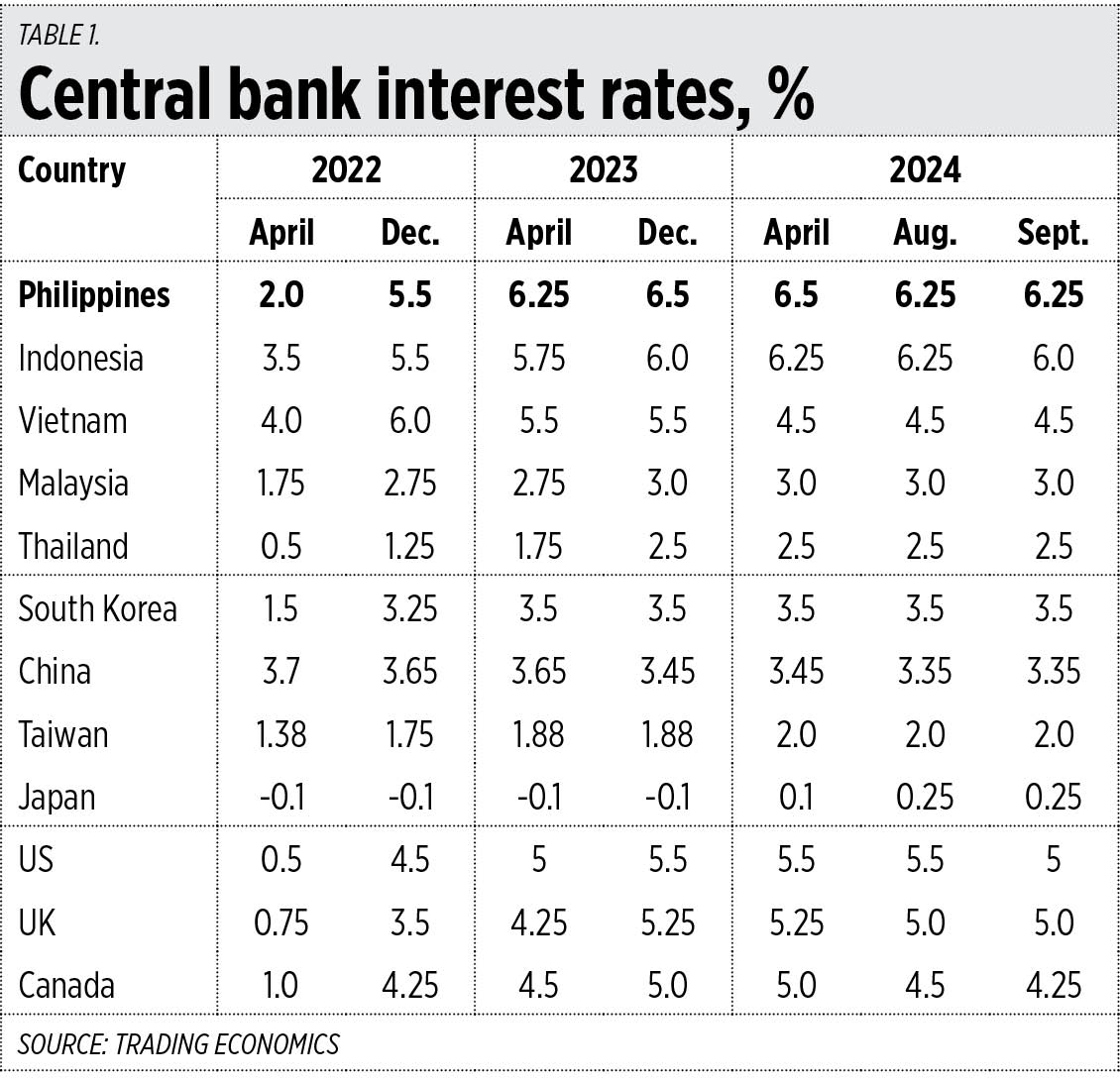
Among the important events that happened over the last few weeks was the big interest rate cuts in the US and Canada, with the Philippines, Indonesia and few other countries following with smaller interest rate cuts.

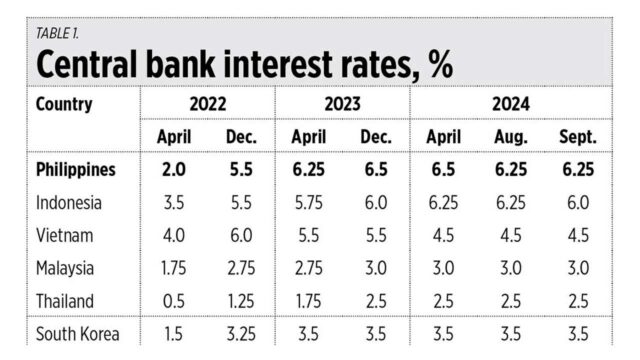
In Asia, the Philippines had, until the second quarter this year, the highest interest rate set by monetary authorities or central banks at 6.5%. Despite this policy, which was supposedly to control high inflation, the Philippines endured the highest inflation rate in the ASEAN-6 in 2023 at 6%, and the second highest in the region from January to July 2024 at 3.7%, next to Vietnam’s 4.1%.

So it was good that the Bangko Sentral ng Pilipinas (BSP) finally realized that its high interest rate policy should be reversed even if at a piecemeal rate.

Meanwhile, Japan raised its interest rate from -0.1% to 0.25% (see Table 1).

I bumped into the president of Meralco PowerGen Corp. (MGen), also the former president of Aboitiz Power Corp., Manny Rubio. He has a bright finance mind because two big conglomerates have trusted him. I asked Manny about the huge recent US Fed rate cut and its microeconomic impact to households, he replied that “Broadly it signals that the government is less worried now about controlling inflation and is now prepared to shift to an expansionary policy. For companies with substantial funding requirements to support their capex plans and new projects, this would mean a substantial reduction in their funding costs. Such savings would allow energy companies to complete new generation capacities and distribution facilities more cheaply which would eventually reduce the cost of electricity for the consumers.”

In a Viber message, Budget Secretary Amenah F. Pangandaman welcomed the interest rate cuts of the US Fed and BSP, saying, “this will have significant reduction in our interest payment which is now a significant share of our total annual budget. And this will eventually lead to efficient budget allocation to sectors that need more funding and help expand our economy.”

Secretary Pangandaman’s concern is correct because the amount of our interest payments has been rising fast, from P361 billion in 2019 to P429 billion in 2021, P503 billion in 2022, P628 billion in 2023, and P457 billion already in January-July 2024 alone. If this trend continues, then the full year 2024 interest payment will rise to P783 billion. Or a doubling of our interest payment in just five years from 2019 to 2024.

ROADMAP TO CREDIT RATINGS
There were a number of recent pieces in BusinessWorld on the subject of credit ratings:  “Recto says Philippines still on track to achieve ‘A’ credit rating” (June 10), “Philippines needs 6-7% growth to achieve ‘A’ credit rating — Recto” (Aug. 14), “R&I upgrades PHL credit rating to ‘A-’” (Aug. 15), “Public-finance roadmap to help elevate PHL to ‘A’ credit rating — Budget dep’t” (Sept. 17), “Philippine credit rating upgrade possible if GDP grows faster than expected” (Sept. 18). There was also yesterday’s column, Introspective, entitled “Philippine sovereign credit rating: An ‘A’ rating, how soon?” (Sept. 23) by Alex Escucha.

My column has also discussed this subject previously: “Declining borrowings and improving credit ratings” (June 18), “Fast growth towards better credit ratings” (Aug. 13), “MUP pension reform and ‘A’ credit ratings” (Aug. 20).

Finance Secretary Ralph G. Recto and Budget Secretary Pangandaman’s desire for the Philippines to attain a credit rating of “A” is understandable. An “A” means our capacity to service our loan obligations is high, so the cost of borrowing, both public and corporate, will be lower. And financing important projects like infrastructure will entail lower costs.

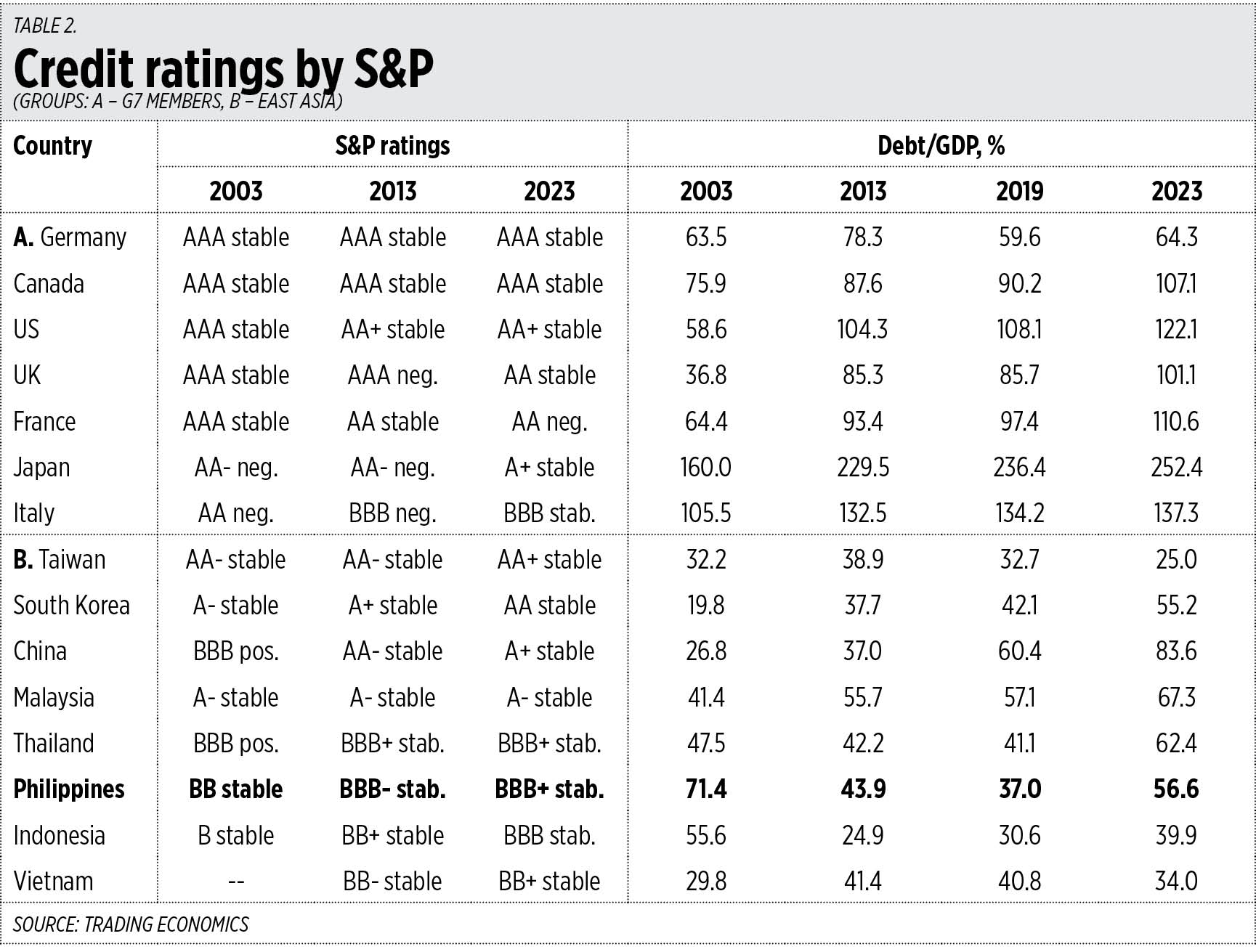
Currently, the Philippines has credit rating of BBB+ “stable” under S&P, Baa2 “stable” under Moody’s, and BBB “stable” under Fitch. Then there are the ratings of BBB+ “positive” from R&I, and A- “stable” from the Japan Credit Rating Agency (JCR). An A- from the JCR is good but it is the Big Three — S&P, Moody’s, and Fitch — that matter most.

One thing I notice though is that high credit ratings can also lead to the problem of a “moral hazard” in economics. Since the cost of borrowing is low due to high ratings, there is a tendency by governments to over-spend and over-borrow. So, the high ratings do not lead to less public debt and lower Debt/GDP ratios, the reverse can happen. This is happening in the G7 industrial countries and other countries around the world.

For example, there is Canada which has had a high AAA “stable” rating for decades and its Debt/GDP ratio kept rising, from 76% in 2003 to 107% in 2023. The US, the UK, France, Japan, and Italy all suffered declines in ratings over the past two decades but still at high A levels, except Italy (see Table 2).

An upgrade in ratings to “A” is important. But more important is how we can control our spending, deficit, and borrowings in years where there are no economic or finance crises, like 2022 to the present. We should have a budget surplus, not a deficit; we should reduce, not increase, our public debt stock; and we should reduce, not maintain, our Debt/GDP ratio.


Bienvenido S. Oplas, Jr. is the president of Bienvenido S. Oplas, Jr. Research Consultancy Services, and Minimal Government Thinkers. He is an international fellow of the Tholos Foundation.

minimalgovernment@gmail.com

Man smashes Ai Weiwei sculpture at Italy art show opening

PORCELAINE CUBE by artist Ai Weiwei is pictured after being destroyed by a man during the opening exhibition, in Bologna, Italy, Sept. 20, 2024. — GENUS BONONIAE PRESS OFFICE/REUTERS

ROME — A man shattered a sculpture by Chinese artist and activist Ai Weiwei on Friday during the opening of his exhibition at Palazzo Fava in the Italian city of Bologna, a spokesperson for the show said.

Footage from CCTV cameras — posted on Ai Weiwei’s Instagram account — showed a man vigorously pushing the sculpture over, breaking it and then holding a piece of it over his head.

The sculpture targeted was the artist’s large blue and white Porcelain Cube, the spokesperson said.

The exhibit’s curator, Arturo Galansino, said the perpetrator was well-known in the art world.

“Unfortunately, I know the author of this inconsiderate gesture from a series of disturbing and damaging episodes over the years involving various exhibitions and institutions in Florence,” said Mr. Galansino.

The police in Bologna told local media a 57-year-old Czech man had been arrested after being stopped by the museum’s security. The police could not immediately be reached for comment.

The spokesperson said the art show, entitled Who am I? had opened on Saturday as normal and that the oeuvre will be replaced by a life-size print of the cube. The exhibition is due to run until May 4.

“Ai Weiwei worried that no one was hurt and then asked that the remains of the work be covered and taken away,” he said.

It was not clear how the man had entered the building during the invitation-only event on Friday. — Reuters

Pueblo de Oro allots P450M for ‘Japandi’ homes in Pampanga

REAL ESTATE developer Pueblo de Oro Development Corp. (PDO) has allotted P450 million for the construction of its Japan and Scandinavian-inspired units called “Unihomes” in San Fernando, Pampanga.

“The Unihomes are part of La Aldea Fernandina II’s expansion,” PDO said in an e-mailed statement on Sept. 19.

La Aldea Fernandina II is a 12-hectare community within the 30-hectare Pueblo de Oro masterplanned community in Barangay Del Carmen, San Fernando, Pampanga.

The 332 units are designed with the “Japandi” aesthetic, a blend of Japanese minimalism and Scandinavian functionality, the company said.

Unihomes units offer bigger floor areas of 52 square meters (sq.m.), set on a minimum lot sizes of 70 sq.m. for single-attached and 85 sq.m. for single-detached models.

This was meant to answer the growing demand for “more innovative and spacious homes,” according to PDO.

Residents will have access to amenities such as the clubhouse, basketball court, children’s playground, and outdoor fitness stations picnic areas.

“The Department of Human Settlements and Urban Development states that the project was completed on May 10, 2024, and the company expects it to sell out in three years,” it said.

In a media release on Sept. 17, PDO said each home is designed to provide ample living space, with dedicated carports and expansion areas for future growth.

“Buyers can choose between classic (semi-finished) or premium (finished) trims, allowing for customization to suit individual preferences and needs,” the company said.

La Aldea Fernandina II is near SM City Pampanga, Robinsons Starmills, S&R Membership Shopping – San Fernando, WalterMart Pampanga, and Vista Mall Pampanga.

“It is also near schools, hospitals, and places of worship offering exceptional convenience for homeowners,” the company said.

Residents also have access to San Fernando and Mexico/Sindalan North Luzon Expressway exits, offering a way to neighboring provinces and Metro Manila, which is less than a two-hour drive away. The development can also be reached via Jose Abad Santos Avenue, also known as the Olongapo–Gapan Road, or through the MacArthur Highway. — Aubrey Rose A. Inosante

Thai businesses urge central bank to take measures to stabilize baht

PERESLAVL FROM PIXABAY

BANGKOK — Thai businesses are pressing the central bank to take measures to stabilize the baht currency, which has rapidly gained strength and could impact fourth-quarter growth, a senior chamber of commerce official said on Monday.

The baht has strengthened faster than anticipated and was affecting exports and tourism, deputy chairman Phot Aramwattananon told a press conference.

Both sectors are key drivers of the Thai economy, Southeast Asia’s second-largest, which has been struggling since the pandemic and lagging regional peers.

The impact of its strengthening has been immediate, already hitting competitiveness of exports, especially in agriculture and food product sectors, the chamber said in a statement.

The central bank should oversee the baht stability so that it was in line with global and domestic economic conditions, it added.

On Monday morning, the baht hovered around 32.8 to the US dollar, trading at its strongest level in more than 19 months. It has gained 13% against the dollar since a low in April of 37.17.

Bank of Thailand (BoT) Governor Sethaput Suthiwartnarueput said on Friday the central bank was monitoring the baht, which he said has become stronger and more volatile, driven by a weaker dollar.

However, he said the baht’s strength had not impacted exports much, but the BoT wanted to ensure it was not overly volatile.

The chamber of commerce also adjusted its 2024 growth forecast upwards from 2.5% seen previously to a range of 2.6% to 2.8% due to policies of the new government to revive the economy.

Stimulus measures are expected to add 0.2 to 0.3 percentage points of growth, said Thanavath Phonvichai, president of the Thai Chamber of Commerce University. — Reuters

Dolmar Land eyeing Pampanga expansion with planned horizontal project

REAL ESTATE developer Dolmar Real Estate Development Corp. (Dolmar Land) is eyeing to expand into Mexico, Pampanga with a planned horizontal project to bolster the company’s presence in the affordable to mid-end segment.

“We’re also foraying into our first Pampanga location. The direction that we’re doing is to keep landbanking and to unlock the landbank that we already have to sustain not only the growth of the company but to serve more Filipinos. It is going to be horizontal community,” Dolmar Land Director of Operations Francis C. Tan said during a media briefing in Makati City last week.

According to Mr. Tan, Dolmar Land is eyeing to begin pre-selling for the 20-hectare Pampanga development within the year.

“We’re very excited to launch in the next weeks or months. What we’re trying to do is (to begin) pre-selling within the year. Between four to five years after land development, we’ll start turning over (the units),” he said. “Before, it is more focused in Bulacan. But now we feel like we are ready to introduce ourselves to many provinces that need housing in the Philippines. We try to be ahead of the curve,” he added.

Mr. Tan added that Dolmar Land strives to “always stay tuned to the evolving and changing needs of the Filipino property market.”

“Our challenge is to make sure that each new community that we develop is better than the one that came before it. We will always remain committed to build and serve for the future of our fellow Filipinos by developing more Dolmar Land communities and working together with our partners and clients,” he said.

Angelo D. Elispe, Dolmar Land vice-president for business development, said at the same briefing that the planned Pampanga development will have at least 1,500 units.

“Our (price) range will be around P2.5 million to P4 million for the Pampanga development,” he said.

Meanwhile, Dolmar Land Chairman and President Mariano John L. Tan, Jr. said during his opening remarks that the property developer has two residential subdivisions under development in Bulacan that would provide an additional 1,966 units for about 7,900 residents.

“The pipeline for future projects is already being prepared by scouting and investing in additional hectares of land in Metro Manila, Bulacan, and Pampanga,” he said.

Dolmar Land has delivered over 7,000 homes since its establishment in 1972. Its residential portfolio consists of Bella Vista, Northgrove Hills, Legacia, Golden Hills Panorama Bulacan, Golden Heights Cartagena, Barcelona, and Andalucia.

The company also has commercial properties such as the Dolmar Building in Mandaluyong, UN Avenue Manila, and Gold Tower Makati. — Revin Mikhael D. Ochave

UN’s pact to protect future generations will be undermined by Security Council’s veto and its use in cases of mass atrocity

World leaders will gather at the United Nations (UN) on Sept. 22-23, 2024, where they are set to adopt the Pact for the Future — an ambitious plan for how to best reform the UN, and other institutions, to address the current problems of the world and protect future generations.

It couldn’t come at a more pressing time. As presidents, prime ministers and top diplomats prepare to meet in New York, mass atrocities — genocide, war crimes, crimes against humanity and ethnic cleansing — are taking place or alleged in several countries around the world.

The pact and an accompanying Summit of the Future serve as an opportunity for the UN to make structural changes that will better empower the international body to prevent and respond to such crimes and protect populations under threat. As UN Secretary-General António Guterres noted, the summit is a “once-in-a-generation opportunity to reinvigorate global action, recommit to fundamental principles, and further develop the frameworks of multilateralism so they are fit for the future.”

As a scholar-practitioner of mass atrocities prevention and human rights, I share Guterres’ hope that the summit and pact can lead to a change. The existing frameworks have failed time and time again to prevent or end mass atrocities.

But to have a real chance of success, I believe the summit will have to look at reforming the UN’s principal body on peace and security: the Security Council. The council is not only unrepresentative, but its five permanent members —France, the United Kingdom, the United States, Russia, and China — all stand accused of being directly or indirectly complicit in some of the worst mass atrocities currently taking place.

A FORGOTTEN RESPONSIBILITY
The Summit for the Future comes nearly 20 years after the last major push for UN reform at the 2005 World Summit. Staged in the aftermath of genocides in Rwanda and Srebrenica, the summit saw 170 governments adopt the Responsibility to Protect, or R2P, pledging to take on individual responsibility to protect their own populations from mass atrocities.

States also accepted collective responsibility to protect people in other countries. In cases when a nation fails to prevent mass atrocities, or commits them directly, world leaders agreed to “take collective action, in a timely and decisive manner, through the Security Council.” Such actions could include everything from sanctions and arms embargoes to coercive military action.

Two decades on, it is clear that UN member states and the Security Council have failed to live up to their commitment to R2P. In the intervening years, the world has seen mass atrocities in Sudan, South Sudan, China, Ethiopia, Yemen, Myanmar, and Syria — with limited effective interventions by the UN.

PERPETRATORS OR PROTECTORS?
Part of the problem, I believe, is with the Security Council itself. Not only has this crucial body not ensured populations were protected, but that task is undermined by the fact that all five permanent members of the Security Council are either accused of directly committing or assisting mass atrocities.

China has been accused of committing genocide and crimes against humanity against its Uyghur ethnic minority. Russia has been accused of committing war crimes, crimes against humanity and genocide in Ukraine.

Both China and Russia supply arms to regimes in Syria and Myanmar — both accused of committing mass atrocities.

The United States, the United Kingdom, and France — the three permanent Western members on the council — have armed, and continue to arm, Israel, which has been accused of committing genocide, war crimes, and crimes against humanity in Gaza and the West Bank.

Such complicity undermines the authority of the Security Council as the UN body charged with taking action to prevent and respond to mass atrocities. Additionally, the five permanent members have veto power, unlike the 10 rotating nonpermanent members of the council. This means whenever one of the permanent members votes “no” on a Security Council resolution, it does not pass.

Since the Responsibility to Protect was adopted, the veto has been used to block action on mass atrocities several times. Russia and China have used their veto to block action in cases related to the crisis in Syria. Meanwhile, the US has repeatedly vetoed action over Israel’s treatment of Palestinians in the occupied territories.

The power to veto also acts as a deterrent, preventing issues from being brought before the Security Council. If member states believe a permanent member will block a resolution, they may decide not to bring the issue before the council for a vote.

VETOING THE VETO
The idea of reforming the council so that the five permanent members do not have veto powers on resolutions related to mass atrocities is not new.

It gained traction in 2013 after France’s then-President François Hollande addressed the UN General Assembly and stated that “whenever [the United Nations] proves to be powerless, it’s peace that pays the price.” Hollande called for a “code of good conduct” whereby the permanent members could decide to “collectively renounce their veto powers” regarding mass atrocities.

In 2015, Mexico joined France in formally calling for the suspension of veto powers in such cases. As of 2023, 106 states have expressed support for this effort.

Separately in 2015, the Accountability, Coherence and Transparency Group — 27 states that work to enhance the Security Council’s effectiveness — proposed a “Code of Conduct on Genocide, Crimes against Humanity and War Crimes.” It called on states to “voluntarily commit themselves not to vote against a draft resolution of the Security Council in which the Council takes measures to end these crimes.” The key difference between the two proposals is that the ACT Group’s code of conduct would apply to both permanent and nonpermanent members of the Security Council. As of 2023, 129 UN members and observers have signed.

The issue of the Security Council veto has come up during the drafting of the Pact for the Future.

An earlier version of the draft pact held that member states “encourage a collective and voluntary agreement among the permanent members of the Security Council to refrain from the use of the veto when the Security Council intends to take action to prevent or halt genocide, crimes against humanity or war crimes.”

But this paragraph was removed in a subsequent revision.

The latest version due to be discussed at the summit references the need to address veto reform and “intensify efforts to reach an agreement on the future of the veto, including discussions on limiting its scope and use.”

But achieving true veto reform has proven difficult in the past, as permanent members have been reluctant to relinquish this extraordinary power.

LESS REPRESENTATIVE, BUT NO LESS POWER
The veto debate forms part of a larger discussion that many states, especially in the Global South, want to have over the shape of the UN’s highest body.

Next year will mark the 80th anniversary of the founding of the United Nations. In the conferences that preceded the creation of the UN, the allied victors of World War II negotiated to give themselves permanent membership on the Security Council and veto power.

But the world looks very different today than it did in 1945. The five permanent members are no longer all allies, and membership of the UN has grown significantly from 51 original members to 193 members today.

As the UN has grown, it has added more members to the Security Council, expanding from 11 to 15 members in 1963.

But the number of permanent members has not changed. And while in 1945 they represented close to half the world’s population and 10% of member states, that has dwindled to about a quarter and 2.5%, respectively.

Despite becoming less representative, this five-member club still has the power — should it find the willingness to use it — to exert pressure to end many mass atrocities that are causing incredible suffering and death and driving the highest level of global displacement in history, with more than 120 million people forcibly displaced in 2024.

But it has failed to do so. And while there are several challenges that need to be addressed in the Pact for the Future, any efforts to safeguard the safety of peoples now and in the future will be undermined without reform of the Security Council and its veto powers.

THE CONVERSATION VIA REUTERS CONNECT


Mike Brand is an adjunct professor of Genocide Studies and Human Rights at the University of Connecticut.

For a show about witches, Agatha All Along has very little magic

By Esther Zuckerman, Bloomberg

TV Review
Agatha All Along
Disney+

ONDISNEYPLUS.DISNEY.COM

AGATHA HARKNESS, the Marvel witch played with fabulous flair by Kathryn Hahn, became a sensation largely thanks to the jaunty earworm “Agatha All Along,” which she performed in the seventh episode of Disney’s 2021 hit series WandaVision. A chorus asks: “Who’s been messing up everything?” To which Hahn winningly sings, in her best Broadway belt: “It’s been Agatha all along!”

Given that WandaVision was the first Marvel franchise to drop on streaming service Disney+, and that critics largely agreed the series felt like a creative leap forward (and away from the already tired Marvel Cinematic Universe), Hahn’s star turn all but guaranteed her a spinoff.

Three years later, Walt Disney Co. has made good with Agatha All Along, a nine-episode series stacked with a dream-team cast of divas and character actresses that also features another original, surprisingly good tune from songwriters Robert Lopez and Kristen Anderson-Lopez. To get to the good stuff, though, you’ll have to make it through an uneven story setup that makes you wonder whether the series will stick its landing.

The last time we saw Agatha in WandaVision, Wanda Maximoff (Elizabeth Olsen, absent from Agatha All Along thus far) trapped her in the town of Westview, leaving her powerless and hallucinating. The first episode of Agatha picks up where WandaVision left off, opening with a parody of an HBO drama: Still under Wanda’s spell, Agatha believes herself to be Agnes, a small-town detective hunting down the killer of a Jane Doe. It’s a not-so-subtle spin on Mare of Easttown, with Hahn doing her best bad impression of Kate Winslet (and a Saturday Night Live sketch).

Although it’s very funny, it also feels like filler leading up to the real action, which kicks off with a mysterious goth teenage boy (Heartstopper’s Joe Locke). He arrives in town and awakens Agatha from her stupor. Meanwhile she has another visitor: a vengeful witch from her past, Rio Vidal, portrayed with a sexy villainy by Aubrey Plaza. Rio warns that a menacing cohort known as the Salem Seven is on the way to kill Agatha, angry at a past offense.

It’s not until the second episode, which was released alongside the first on Wednesday, (after that it’s on a one a week schedule) that we get to the real meat of the plot. To fully regain her powers, Agatha has to assemble a coven and walk a dangerous magical byway that will end in either death or enhanced power. The path is known as the Witches’ Road, the route to which is summoned via a ballad on which the cast expertly harmonizes. (This isn’t the last time you’ll hear “The Ballad of the Witches’ Road,” which I found myself involuntarily humming the day after I watched the screeners.)

The coven is one I’d happily join. Theater legend Patti LuPone is magisterially kooky as Lilia Calderu, a brassy soothsayer who’s working as a cheap psychic when Agatha approaches. Former SNL cast member Sasheer Zamata’s Jennifer Kale is a potions master who’s taken to selling wellness items such as probiotic candles. And Ali Ahn is Alice Wu-Gulliver, a ne’er-do-well nepo daughter of a formerly powerful witch rock star who’s been reduced to working security at a Hot Topic-type store.

The other sorceresses are skeptical of Agatha’s intentions — as they should be, because she has only her own interests at heart. But despite their reservations, they team up with Agatha on her quest, all in need of their own type of fulfillment. They’re also joined by the nonwitch, suburban gardener Mrs. Hart (Debra Jo Rupp, a holdover from WandaVision), who thinks Agatha is inviting her to a party; in reality, Agatha needs someone with a green thumb to complete the coven. Eventually, Plaza’s Rio is also integrated back into the fold, bringing with her the brand of wide-eyed, alluring chaos in which the actress specializes.

In its initial episodes, Agatha All Along, created by Jac Schaeffer, offers up a lot of mysteries. The biggest one: Who is this goth boy whom Agatha simply calls “Teen,” since whenever he tries to say his own name a spell prevents him from doing so? Locke brings an adorable earnestness to the part, which one has to assume will somehow be complicated as the narrative progresses. Two other questions: Just who is Rio Vidal? And what is her history with Agatha? Plaza and Hahn’s scenes together bristle with a palpable chemistry that’s not entirely chaste, and therefore quite radical for a Marvel product (though we’ll see how far they actually take it).

The fun really begins when the ladies hit the literal road and are greeted with a series of magical trials that test their supernatural abilities. Without spoiling too much: Each trial comes with a variety of absurd costumes. The first includes a setup that plays like a Nancy Meyers movie gone horribly wrong. That’s followed by one with the cast in groovy 1970s wigs, forced to rock out to stop a curse.

If the rest of the series’ nine episodes follow this path, with each installment providing another goofy trial, Agatha All Along should be a swell, silly time. That said, the emotional stakes so far feel remarkably thin. It’s unclear why we should care whether Agatha regains her power, other than that it’s amusing to watch Hahn and her co-stars ham it up.

When Marvel premiered WandaVision, it was the start of a new era for the studio. It was less about introducing new superheroes and more about expanding the boundaries of what was possible within the medium, inflecting existing characters with real pathos. It was a Marvel product that transcended the Marvel baggage. Three years later, Agatha All Along arrives as a bit of an afterthought. It’s got its charms, but it feels haphazardly thrown together, and the magic isn’t fully there.

Aeon Luxe tops off 2 towers of Aeon Bleu Residences in Davao

DAVAO CITY — Aeon Luxe Properties, Inc. (ALPI) recently conducted a ceremonial topping off for the two towers of its condominium development, Aeon Bleu Residences.

The topping off ceremony, held on Friday last week, signified the completion of the structural frameworks for the two 26-storey towers, 20 months following the groundbreaking in December 2022.

The increase in inquiries and reservations reflects strong support from brokers, sellers, future residents, and investors, said Ian Y. Cruz, president and chief executive officer of Aeon Luxe Properties.

Situated on a 1.6-hectare property along Bacaca Road, Aeon Bleu Residences aims to set a new standard in upscale living in Davao City with its six medley-themed pools and exclusive Club Aeon amenities, according to the company.

“All designed to provide not just comfort but a true sense of community for our residents,” Mr. Cruz said.

The project is a six-tower mixed-use development, comprising two residential towers, one condotel, one corporate tower, Club Aeon, and one future development. The tallest buildings will be up to 26 storeys.

Towers 1 and 2 will house the residential flats of Aeon Bleu, while Tower 3 is a hotel-operated condotel equipped with revolutionary technology like a digital concierge, fiber optic backbone, and smart home features.

Mr. Cruz told Businessworld that Tower 3 will also reach its topping this year and is expected to bring more upscale hotel rooms for future guests.

The company is eyeing the turnover of the three towers in December 2025, he added.

The master plan includes Tower 4, a corporate tower with shared workspaces and private offices. 

Club Aeon at Tower 5, the crown jewel of the Aeon projects, features a luxury lobby, basketball court, fitness facility, children’s playroom, entertainment area, and a unique six-themed pool.

Tower 6, a premium residence, will offer the most luxurious units, an infinity pool, and large office spaces on its top floor. — Maya M. Padillo