Home Blog Page 220

Leadership in a geopolitical storm
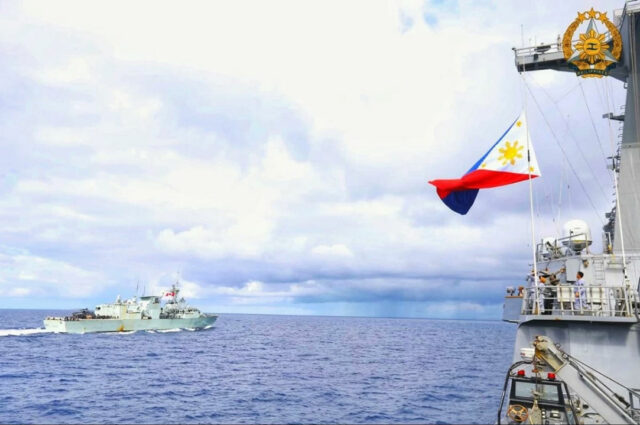
PHOTO COURTESY OF ARMED FORCES OF THE PHILIPPINES

What happens when rising tensions in the West Philippine Sea, an increasingly polarized digital public square, and a restless citizenry weary of economic strain converge at the same historical moment? The rare combination produces something close to a geopolitical storm.

We feel its winds in many ways. News alerts about maritime confrontations. Commentaries demanding either hardline condemnation or cautious accommodation. Social media feeds that amplify outrage faster than reflection. In such times, leadership is tested — not only in Malacañang, but in Congress, in boardrooms, in classrooms, and even in our homes.

But let me step back a bit.

Years ago, I wrote that the Philippines does not merely need charismatic leaders. It needs nation-builders — men and women who understand that institutions, not personalities, secure our long-term freedom. In times of geopolitical tension, this insight becomes urgent. We may be tempted to look for tough talkers who can cut through complexity with bravado. Yet history teaches us that democratic resilience is built not by spectacle, but by constitutional fidelity.

The 1987 Constitution declares that the Philippines is a democratic and republican State. Sovereignty resides in the people, and all government authority emanates from them. Lofty words. Abstract, even. But they take on concrete meaning precisely when pressures to define our nationhood mount.

If we as a nation continuously advance our constitutional core values of truth, justice, equity, peace, freedom, and equality, we enhance our credibility abroad. Diplomacy is strengthened when domestic governance is sound. International partnerships are more durable when anchored in shared democratic values.

If sovereignty resides in the people, then leadership during geopolitical tension must strengthen — not weaken — democratic practice. It must expand reasoned discourse rather than shrink it. It must call citizens to higher civic responsibility rather than manipulate emotions for short-term unity.

We have seen how easily public conversation can deteriorate into slogans and suspicion. When maritime incidents involving Chinese ships occur, narratives quickly harden. One side accuses the other of weakness. The other warns against recklessness. What we need is patient dialogue on international law, strategic constraints, economic trade-offs, and long-term national interest.

Yet truth requires patience.

Truth is not achieved by the loudest voice. It emerges from disciplined inquiry, respect for evidence, and openness to correction. A democratic nation under pressure must guard its epistemic foundations. Leaders must resist the temptation to simplify complex realities into applause lines. They must instead teach — even at the risk of being misunderstood.

Justice, too, comes into sharper relief during times of tension.

External threats often expose internal weaknesses. Economic inequality, uneven rule of law, corruption, and bureaucratic inefficiency all reduce national resilience. A divided society cannot present a united front. A citizenry that distrusts institutions will not easily rally behind them.

Thus, constitutional nation-building is not a distraction from geopolitics. It is its precondition.

When the Constitution speaks of public office as a public trust, it sets the moral tone for governance. Citizens are more likely to endure sacrifice — higher defense spending, strategic restraint, diplomatic compromise — if they believe their leaders are acting with integrity. Moral ascendancy cannot be manufactured. It is earned through consistency between word and deed.

Consider how small gestures communicate large principles. When officials explain policy transparently, they affirm the people’s right to information. When critics are allowed to speak without fear, freedom is strengthened. When decisions are justified in terms of law rather than personality, equality before the law is reinforced.

Some commentators argue that in times of geopolitical tension, we must close ranks and suspend criticism. But such advice misunderstands democracy. Unity imposed by silencing dissent is brittle. Unity forged through reasoned deliberation is durable.

Peace, moreover, must not be confused with passivity.

The Constitution commits the State to the pursuit of peace. This includes adherence to international law and peaceful settlement of disputes — hence, our government’s commitment to the Arbitral Tribunal ruling in our favor, declaring China’s “nine-dash line” claim to have no legal basis under the United Nations Convention on the Law of the Sea (UNCLOS).

But peace also requires internal social harmony. Leaders who inflame domestic divisions in the name of external firmness undermine the very stability they claim to protect.

Freedom and equality complete the constitutional compass. Under the shadow of external threat, there is always pressure to curtail civil liberties — especially freedom of speech. Prudence is necessary; security matters. Yet any temptation to limit others’ opportunities to express divergent perspectives denies equality before the law. This would make the cure more dangerous than the disease.

The ultimate test of leadership in geopolitical tension is not rhetorical defiance, but institutional strengthening. Are we investing in education and public information that cultivate critical thinking? Are we supporting channels that can adjudicate disputes fairly? Are we building economic systems that expand opportunity rather than entrench privilege?

I do not know how the present geopolitical currents with China will settle. Storms, by definition, are unpredictable. But one thing is clear: our response cannot be driven by fear nor by anger. It must be guided by constitutional conviction.

Instead of asking only what government should do in the face of the current tensions, perhaps we should also ask: How can we, as citizens, elevate our discourse? How can we insist on facts over rumor, principle over passion, dialogue over personal attacks, institutions over impulse?

In the end, leadership during times of geopolitical tension is not merely about defending territory. It is about defending the democratic soul of the nation.

And that work begins — and must continue — with us.


Dr. Benito L. Teehankee is a full professor at the Department of Management and Organization of De La Salle University. He chairs the Shared Prosperity Committee of the Management Association of the Philippines.

benito.teehankee@dlsu.edu.ph

Arthaland launches 37-story Sondris Tower in Makati

SONDRIS FACADE — ARTHALAND CORP.

LISTED Arthaland Corp., through its subsidiary Zileya Land Development Corp., has started construction of the 37-story Sondris residential tower along Arnaiz Avenue in Makati.

The project is a partnership with Mitsui Fudosan (Asia) Pte. Ltd., a subsidiary of Japan’s Mitsui Fudosan Co., Ltd.

“We are highly selective about the developments we choose to invest in, and our participation reflects our firm belief in the strengths, vision, and high standards of this project,” Mitsui Fudosan (Asia) Deputy General Manager Tan Yan Fen said in a statement on Monday.

“It also underscores our confidence in the Philippine market and our long-term commitment to contributing meaningfully and responsibly to the country’s growth.”

Mitsui Fudosan Co., Ltd., a major Japanese real estate firm with $62 billion in assets as of December 2024, develops mixed-use neighborhoods integrating offices, retail, logistics, hotels, resorts, and residences across Japan. The company also operates in key cities in North America, Europe, China, Taiwan, Southeast Asia, Australia, and India.

Under the partnership, Arthaland will oversee development and operations, drawing on Mitsui’s global expertise in design and property management.

The tower will feature 252 units, including one-bedroom units of 46-61 square meters (sq.m.), two-bedroom units of 91-114 sq.m., three-bedroom units of 135-137 sq.m., and Garden units of 180-230 sq.m. Larger units include balcony Sun Rooms with three interior packages: Timeless and Transitional; Modern and Industrial; and Formal and Serene.

The site offers views of San Lorenzo Village and the Makati skyline and is near EDSA, Skyway, business districts, museums, shops, and hospitals.

“Sondris, which is a coined name rooted in empathy, authenticity, and the presence of living fully in a space, embodies our commitment to creating a home that puts people, wellness, and sustainability at the center,” Arthaland Executive Vice-President and Chief Sustainability Officer Oliver L. Chan said.

Like other Arthaland developments, Sondris aims to meet stringent sustainability and wellness standards for multi-certification from LEED, WELL, EDGE, and BERDE.

Project turnover is scheduled for April 2030.

Arthaland Corp. shares rose 1.12% to P0.45 apiece on Monday. — Alexandria Grace C. Magno

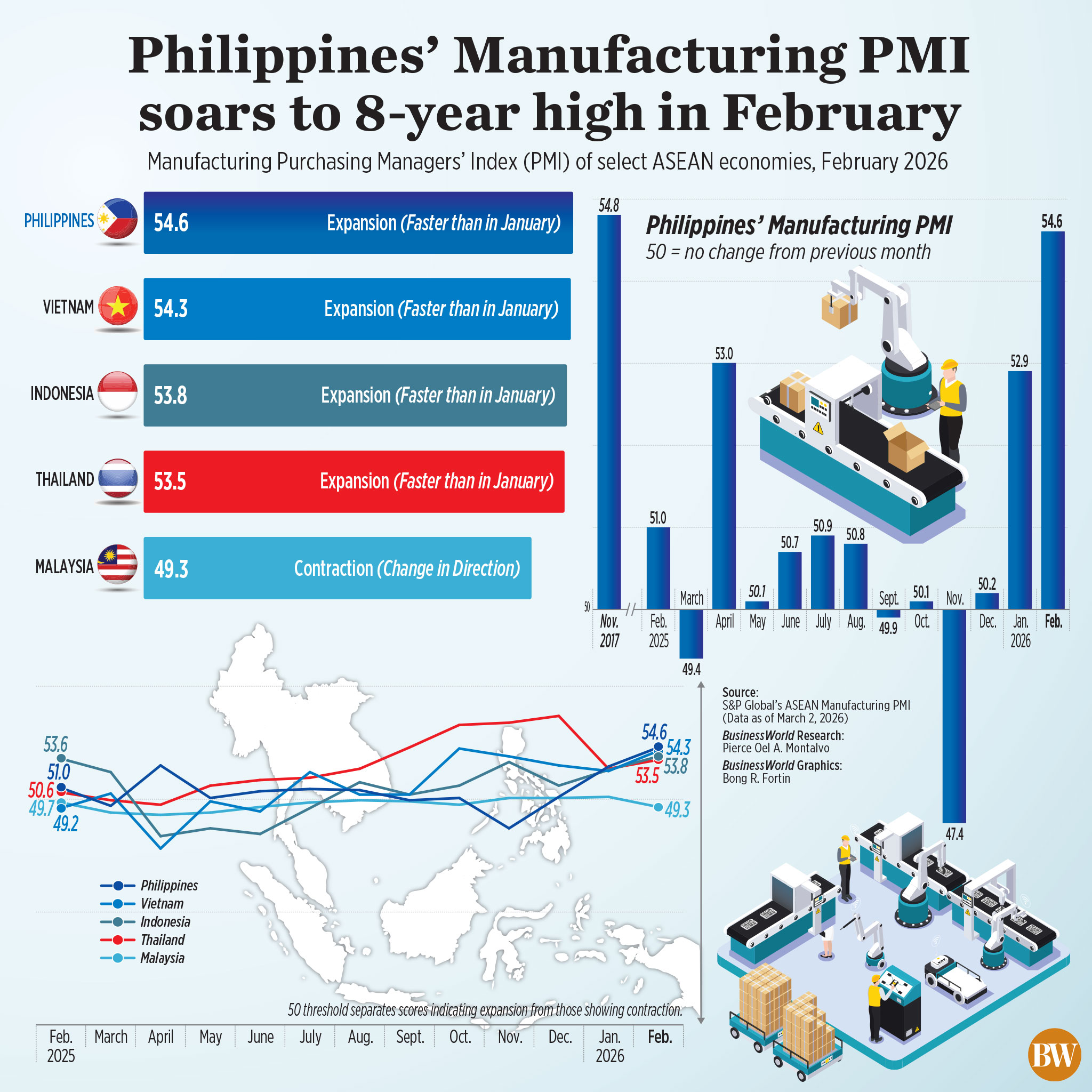
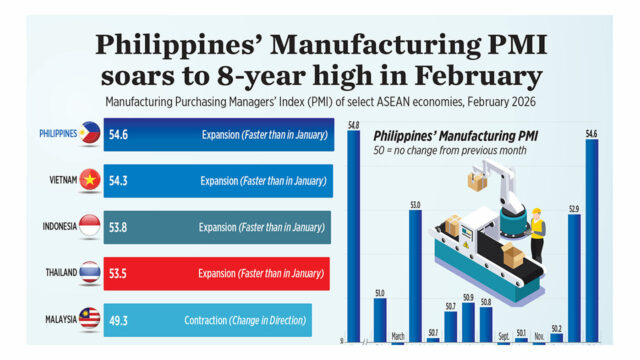
Philippines’ Manufacturing PMI soars to 8-year high in February

PHILIPPINE FACTORY activity in February expanded at its fastest pace in eight years amid an increase in production and new orders as well as a “surge in business confidence,” S&P Global said on Monday. Read the full story.

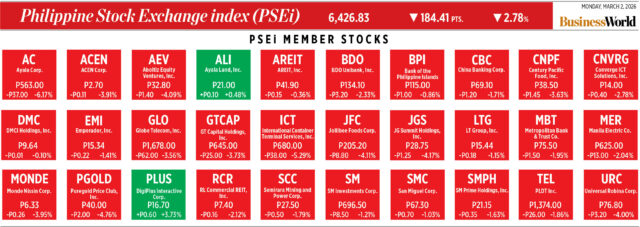
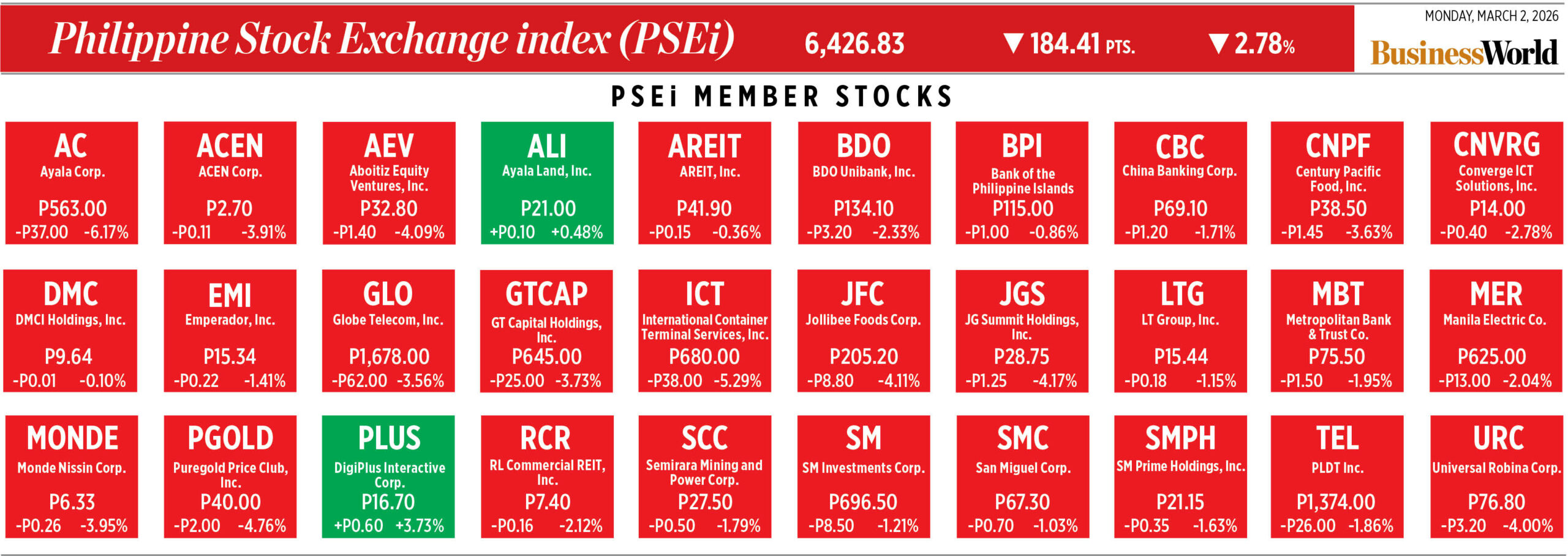
How PSEi member stocks performed — March 2, 2026

Here’s a quick glance at how PSEi stocks fared on Monday, March 2, 2026.


Philippine government prepares OFW repatriation amid war in Middle East

Smoke rises after reported Iranian missile attacks, following strikes by the United States and Israel against Iran, in Manama, Bahrain, February 28, 2026. — REUTERS/STRINGER TPX IMAGES OF THE DAY

MORE than 80 overseas Filipino workers (OFWs) in the United Arab Emirates (UAE) have requested repatriation amid escalating war in the Middle East, the Department of Migrant Workers said on Monday.

Fifty-two Filipinos in Israel have also sought voluntary return.

Migrant Workers Secretary Hans Leo J. Cacdac said mass repatriation is not yet required because Alert Level 4 has not been raised outside Syria and Yemen.

“Although the airspace in Dubai and the airports are closed, we are prepared to provide the 80 who need repatriation assistance with temporary basic needs and shelters,” he told a news briefing in Filipino. “At the appropriate time, they will be evacuated to the country.”

The Middle East is home to more than 2.4 million OFWs working in hospitals, homes, construction and other sectors. Remittances from these workers remain a key component of the Philippine economy, providing critical foreign exchange inflows.

Air transport remains a major challenge. “We are finding ways to ensure their safe return, but at this stage, air options are not yet viable, particularly in the UAE,” Mr. Cacdac said. He added that the government is coordinating with embassies, consulates and private companies to prepare land, sea and air options for repatriation if the situation worsens.

The UAE hosts the biggest concentration of Filipino labor in the region, with roughly 400,000 in Dubai alone, and about one million nationwide. Mr. Cacdac said the Philippine government is coordinating closely with the Department of National Defense and other agencies to ensure military assets, including C-130 transport aircraft, are available for evacuation if needed.

For returning OFWs, the government is preparing livelihood and reintegration support. The Department of Trade and Industry will facilitate livelihood initiatives, while recruitment agencies may help with redeployment opportunities, including transfers to other countries.

The Department of Labor and Employment will provide local employment placements via Public Employment Service Offices, and the Technical Education and Skills Development Authority will offer reskilling and retooling programs.

Meanwhile, one OFW in Israel was killed after being struck by shrapnel from falling explosives. The victim, Mary Ann Velasquez De Vera, 32, a domestic worker from Pangasinan, could not yet be repatriated due to airspace restrictions, but her family will receive government assistance, Mr. Cacdac said.

The crisis follows coordinated US and Israeli airstrikes on Tehran’s military assets over the weekend, targeting Iran’s alleged nuclear weapon program.

Iran retaliated with missile strikes against countries hosting US bases, including Iraq, the UAE, Kuwait, Bahrain, Qatar and Saudi Arabia.

Senator Rafael T. Tulfo, chairman of the Senate Migrant Workers Committee, called on the government to extend aid to undocumented OFWs in the region.

“Whether they are undocumented or not, they should be given the necessary help from the government,” he told a news briefing. He also cited the need to help stranded tourists.

The Armed Forces of the Philippines remain on standby with C-130 transport aircraft for evacuation, Mr. Tulfo said.

The senator on Monday filed a resolution urging the Senate to investigate the potential economic and security impacts of the US-Iran war.

Senator Ana Theresia Hontiveros-Baraquel urged continuous support for repatriated OFWs, highlighting assistance for reintegration into the workforce or enterprise.

She also called on the Department of Energy to strengthen measures to secure the country’s energy supply amid projected spikes in global oil prices.

“They should also prepare a comprehensive and longer-term plan for energy security because we don’t know how long this will last,” she told a separate press conference.

The situation underscores the Philippine government’s dual challenge: protecting millions of OFWs abroad while mitigating domestic economic risks tied to energy and remittances.

Officials are also closely monitoring global developments, including potential supply chain disruptions and price fluctuations, that could affect both labor mobility and domestic economic stability. — Chloe Mari A. Hufana and Adrian H. Halili

PHL told to seek Korean investment beyond tariffs

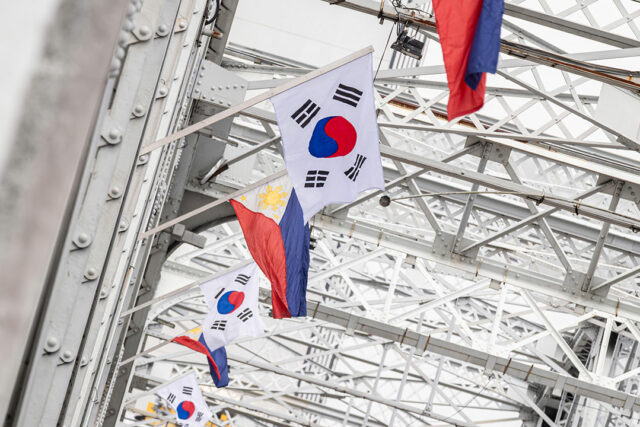
Philippine and Korean flags line the Ayala Bridge in Manila ahead of the state visit of South Korean President Lee Jae Myung.

By Chloe Mari A. Hufana, Reporter

THE PHILIPPINES should look beyond tariff reductions under the Korea-Philippines free trade agreement (FTA) and instead position itself as a regional base for South Korean investments targeting Southeast Asian supply chains, analysts said ahead of South Korean President Lee Jae Myung’s March 3-4 visit to Manila.

John Paolo R. Rivera, a senior research fellow at the Philippine Institute for Development Studies, said the visit should focus less on boosting bilateral trade volumes and more on attracting capital and technology.

“The goal should be to attract capital, technology transfer and deeper value-chain integration, not just expand bilateral trade volumes,” he said via Viber.

Mr. Lee’s trip marks his first visit to the Philippines as president and the first state visit since the FTA took effect on Dec. 31, 2024. The agreement reduced tariffs on key industrial and agricultural goods.

The visit also comes as both economies navigate global supply chain shifts and ahead of the 77th anniversary of diplomatic ties on March 3.

Rather than treating the FTA primarily as a trade liberalization tool, Manila should use it to position itself as Seoul’s gateway to the 680-million strong Association of Southeast Asian Nations (ASEAN) market, Mr. Rivera said.

Priority sectors include electronics, green technology, infrastructure and digital services.

Jonathan L. Ravelas, a senior adviser at Reyes Tacandong & Co., said the timing is significant, particularly with the Philippines chairing ASEAN. While the FTA can support growth, it is not transformative on its own.

“The FTA adds fuel, but smart ASEAN-level economic diplomacy is what can scale the gains,” he said. Manila should link Korean investments to regional supply chains in electric vehicles, manufacturing, energy and technology, he added.

Mr. Rivera said the agreement might lift exports and investment in manufacturing and services over the next three years, but its impact on gross domestic product would likely be modest compared with domestic drivers such as household consumption and infrastructure spending.

“The bigger contribution will be structural, by improving competitiveness and investment flows rather than sharply lifting short-term growth,” he said.

Trade between the two countries has long been anchored in electronics, automotive components and agricultural products. South Korea is a major source of foreign direct investment and tourists, while Philippine exports such as bananas and manufactured goods benefit from improved market access.

Bilateral trade is projected to reach $24 billion (P1.4 trillion) by 2030, according to ASEAN Secretariat estimates cited in December 2025. ASEAN-South Korea trade is targeted to hit $300 billion by the same year.

Analysts said deeper integration could also help cushion both countries from volatility tied to US-China tensions.

The trade war between Washington and Beijing, marked by tariffs and export controls, has prompted governments to diversify supply chains and reduce strategic dependencies.

Josue Raphael J. Cortez, an ASEAN Studies lecturer at De La Salle-College of St. Benilde, said stronger Manila-Seoul ties could support more cohesive regional supply chains in electronics components, rare earth minerals and other critical inputs.

Closer cooperation under the ASEAN-South Korea Comprehensive Strategic Partnership may reduce reliance on balancing between major powers, he said, and facilitate integration of production and services.

Francis M. Esteban, a faculty member at the Far Eastern University Department of International Studies, said the visit underscores the Philippines’ alignment with like-minded middle powers seeking to strengthen institutions amid global fragmentation.

While defense and people-to-people exchanges would likely be discussed, economic cooperation, particularly in trade and investment, would anchor the talks, he added.

Tourism and mobility are also expected to feature in discussions. South Korea remains one of the Philippines’ biggest tourism markets. Simplifying visa processes, potentially through digital systems backed by stronger cybersecurity safeguards, could boost travel, education and investment flows, Mr. Cortez said.

House committee keeps two impeachment complaints versus VP Duterte

VICE-PRESIDENT SARA DUTERTE-CARPIO — PHILIPINE STAR/ RYAN BALDEMOR

By Kenneth Christiane L. Basilio, Reporter

A HOUSE committee on Monday found two of four impeachment complaints against Vice-President (VP) Sara Duterte-Carpio sufficient in form, dismissing the others due to a procedural defect in one and withdrawal by complainants in the other.

The Justice committee reviewed the complaints to determine if they were properly signed and endorsed by lawmakers, a necessary first step before a full inquiry. “There are only two remaining impeachment complaints,” Batangas Rep. Gerville R. Luistro, committee chairman, said after Monday’s 39-member committee hearing.

Civil society groups, activists and religious organizations filed the four complaints since early February, alleging that Ms. Duterte misused hundreds of millions of pesos in confidential and intelligence funds allocated to the Office of the Vice-President and Department of Education, which she used to head.

The first complaint, filed on Feb. 2 by left-leaning groups, was set aside because the Constitution bars multiple impeachment attempts against an official within a year. Twenty-two congressmen voted to dismiss the complaint, while 10 opposed.

The filing accused the Vice-President of misusing confidential funds, directing subordinates to falsify reports and skipping congressional budget hearings.

The second complaint was withdrawn by its 17 complainants, who shifted support to a similar complaint to streamline the process. “The complainants… have decided to formally withdraw their complaint in the interest of procedural expediency and to obviate any needless delay,” according to a letter from the group.

Ms. Luistro said dismissing the two complaints would allow the committee to assess the remaining cases more efficiently. “We can move faster this time,” she said, noting that deliberations could still take longer than previous proceedings due to the volume of documents and breadth of allegations.

Speaker Faustino “Bojie” G. Dy III said he would not interfere in the committee’s work. “My role is not to pre-judge the outcome, or to influence the committee’s deliberations,” he said in a statement, adding that the House must function professionally, lawfully and transparently.

Analysts said the handling of the process would be closely watched. Political Science Professor Ederson DT. Tapia said scrutiny would focus on whether House leaders manage dissent fairly, including among Duterte allies.

“Observers should watch how the committee handles dissent and whether procedures appear impartial or driven by political expediency,” he said.

Arjan P. Aguirre, an assistant professor of political science at the Ateneo de Manila University, said the institutional credibility of the House is at stake. “If the process appears rushed, dismissive or overtly partisan, it could reinforce perceptions that impeachment is a political weapon rather than a constitutional safeguard,” he said in a Facebook Messenger chat.

The Makabayan bloc, which endorsed the first complaint, disagreed with the committee’s dismissal, saying the House has the authority to craft its own rules on impeachment. “It must not retreat, and it must not be intimidated by legal uncertainties that were not the people’s making,” Party-list Reps. Antonio L. Tinio, Sarah Jane Elago and Renee Louise M. Co said in a statement.

Former Party-list Rep. France L. Castro, one of the complainants in the dismissed case, said the committee might be erring on the side of caution to prevent Ms. Duterte from challenging proceedings at the Supreme Court. “The committee and House leadership are just being cautious,” she told BusinessWorld in Filipino.

The Justice committee will now focus on the two remaining complaints, marking the first stage in a process that could lead to a full-blown inquiry against the Vice-President.

India offers local defense production to Philippines

BrahMos fired from INS Chennai during TROPEX 2017. - COMMONS.WIKIMEDIA.ORG

INDIA’S defense industry is pitching production lines in the Philippines as Manila boosts its military modernization.

Ashish Kansal, co-chairman of the Federation of Indian Chambers of Commerce and Industry’s defense committee, said Indian manufacturers are ready to sell systems used by India’s armed forces and set up local production to meet Philippine demand.

“We are more than willing to set up actual production bases within the Philippines, so it has the right surge capacity to produce products for its own demand,” he told a defense expo in Makati City on Monday. “We are… giving not just the second best, but the best we give our armed forces.”

The move comes as the Philippines earmarks roughly $35 billion (P2 trillion) over the next decade for warships, missiles and other platforms, mainly sourced from South Korea, Israel and the US, to bolster deterrence amid tensions with China in the South China Sea.

“Modernization, however, cannot stop at acquisition,” Philippine Major General Ivan DR. Papera, chief of the military’s modernization office, told the event organized by the Indian Embassy in Manila. “Modernization must be sustained, and sustainment requires industrial partnership.”

Reading a statement from military chief General Romeo S. Brawner, Jr., he added: “Modernization without industrial capacity creates dependency.”

The remarks underline Manila’s push to strengthen its domestic defense industry under a 2024 law that encourages foreign suppliers to partner with local companies, building self-reliant capabilities with the help of trusted strategic partners.

Mr. Papera called India a “natural and strategic partner” in this effort, citing its experience in missile development, shipbuilding, aerospace, cyber systems and defense electronics.

Indian Ambassador to the Philippines Harsh Kumar Jain said India is ready to help Manila develop, produce and explore joint military projects to strengthen the country’s deterrence capabilities. He described the Philippines as a key pillar for a stable Indo-Pacific region.

“India stands ready as a reliable and steadfast strategic partner to work closely with the Philippines in building capacities, enhancing resilience and contributing to a secure and stable democracy,” he told the expo. He added that Indian defense manufacturers are increasingly seeking partnerships focused on co-development, co-production and technology transfer with trusted allies like the Philippines. 

The Philippines has already bought BrahMos supersonic cruise missiles from India. Three orders placed in 2022, worth $375 million, aiming to boost anti-ship capabilities in response to repeated confrontations with Chinese vessels in contested waters.

Despite a 2016 United Nations-backed ruling voiding Beijing’s claims, China asserts sovereignty over the energy-rich South China Sea.

Manila has accused Chinese ships of using water cannons and aggressive maneuvers to intimidate Philippine vessels.

China insists its operations in the South China Sea comply with international law. — Kenneth Christiane L. Basilio

Panel report on flood mess sought

SENATE PRIB

LEGAL practitioners have filed a petition with the Supreme Court (SC) seeking to compel the Senate Blue Ribbon Committee to officially release a draft partial report on its investigation into alleged anomalies in national flood control projects.

Petitioners Eldrige Marvin B. Aceron, Sikini C. Labastilla, and Purificacion Bartolome-Bernabe argued that the Senate’s refusal to disclose the document violates the constitutional right to information and that its invocation of deliberative process privilege is no longer valid.

The lawyers asserted that Committee Chairman Senator Panfilo “Ping” M. Lacson effectively waived this privilege through three weeks of detailed public disclosures regarding the report’s evidentiary basis and specific recommendations between Feb. 4 and 23.

“The Senate cannot use Chairman Lacson’s public statements to build public confidence in the investigation — as it clearly has —while simultaneously invoking privilege to deny citizens the document those statements describe,” part of the petition read.

“The right to information is not a gift from the state to the citizen. It is a guarantee the citizen holds against the state. It is time this Honorable Court enforced it,” the petitioners added.

In response, Mr. Lacson maintained that the draft remains a work in progress and is not subject to court intervention.

“What I know, and this is in consultation with a recently retired SC justice and an incumbent Court of Appeals justice is that matters that are ministerial in nature are not subject to mandamus and/or certiorari,” he said in a statement.

“This, aside from the fact that the draft partial committee report, unless adopted in plenary with all the amendments and finally approved by the body, is just a draft,” Mr. Lacson added.

According to the petitioners, the draft report names Senators Francis Joseph “Chiz” G. Escudero, Joel J. Villanueva, and Jose “Jinggoy” P. Ejercito Estrada, Jr. as subjects of recommended criminal and administrative charges.

Mr. Lacson previously assured the public and the Office of the Ombudsman that the recommendations were evidence-driven, based on testimonial and documentary materials gathered during hearings into systemic corruption, kickbacks, and ghost projects.

The filing also flagged the withdrawal of signatures by Senators Juan Miguel F. Zubiri, Joseph Victor G. Ejercito, and Sherwin T. Gatchalian. The petitioners also noted a “severe” conflict of interest involving Mr. Ejercito, who chairs the Ethics committee handling a complaint against Mr. Escudero while simultaneously withdrawing his signature from the Blue Ribbon report.

The petitioners are seeking an urgent temporary restraining order to prevent the Senate from altering or destroying versions of the draft that contain original signatures. They are also asking the High Court to order the three senators to provide written explanations for their signature withdrawals and to compel the release of the “full, complete, and unredacted” document as it existed in early February. — Erika Mae P. Sinaking

Removal of party-list limit backed

PHILIPPINE STAR/KJ ROSALES

THE Commission on Elections (Comelec) backed proposals to scrap the limit on party-list seats in the House of Representatives, noting that the cap undermines representation of marginalized groups.

“It is really unfair that we are putting a cap, when the votes of the people matter and should be based on proportional representation,” Comelec Chairman George Erwin M. Garcia told a Senate hearing on Monday, in mixed English and Filipino.

The Election chief added that Comelec sees no risks in the removal of the seat limit for party-lists, “to a certain extent it will give more weight to the votes of the electorate.”

Party-lists are limited to three seats in the House of Representatives, with parties receiving at least 2% of the total votes entitled to one seat and an additional seat for every 2% vote cast.

Mr. Garcia said that Comelec is also backing a proposal to implicate party-lists in the disqualification of their nominees.

“If the nominee is disqualified, the party-list should also be implicated, because that means… they allowed someone who is not qualified to run,” he added.

He said that this would allow parties to screen out their potential nominees for potential conflicts of interest.

The Senate Electoral Reforms panel conducted a public hearing on proposed measures to amend the country’s party-list system including the removal of the three-seat limit for party-lists, amid alleged failure to represent marginalized sectors.

The Philippine party-list system was created by the 1987 Constitution, with its framers seeing the system as allowing underrepresented sectors to participate in the lawmaking process. — Adrian H. Halili

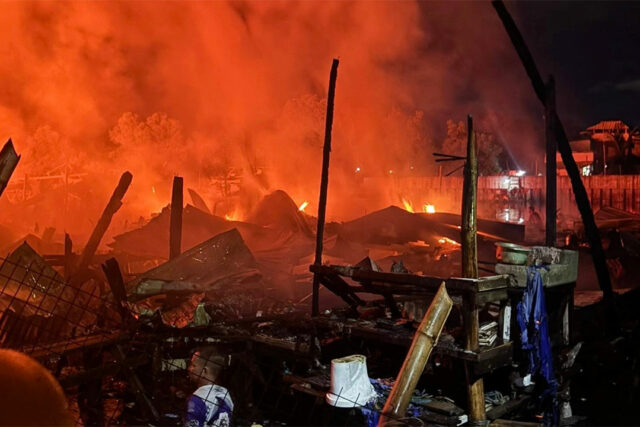
March-May most fire-prone months

The Bureau of Fire Protection said March, April, and May are the most fire-prone months — BFP-NCR

THE Bureau of Fire Protection (BFP) on Monday urged the public to be vigilant as March, April, and May remain the most fire-prone months in the country.

In a statement, the BFP said fire incidents in Metro Manila peak in March and April, with the highest number of fire incidents consistently being recorded in April.
In the past five years, 2024 recorded the highest number of fire incidents at 22,301, higher than 16,228 logged in 2025. The lowest was seen in 2021 at 12,812.
The BFP also identified the following villages as the most fire-prone areas: Payatas in Quezon City, Baseco Compound in Manila, Bagong Silang in Caloocan, the Maricaban area in Pasay, Barangay Western Bicutan in Taguig, and Barangay Tejeros in Makati.

“Fires don’t start big,” the BFP said. “They grow exponentially, doubling in size every 30 seconds. The first minutes of a fire are crucial, and the proper relay of complete and accurate information can make all the difference in emergency response.”

The BFP has improved the average nationwide fire emergency response time to 3-4.5 minutes through the Unified 911 system, which has centralized dispatch, GPS-based caller location, and stronger inter-agency coordination.
While a faster response can make a difference in saving lives, the BFP urged the public to closely monitor heat sources and avoid unattended stoves and open flames, noting that prevention remains the strongest defense.

The BFP also advised the public to check electrical systems for overloaded outlets, exposed wiring practice safe smoking habits, address malfunctioning appliances, and prepare a clear fire escape plan. — CAT

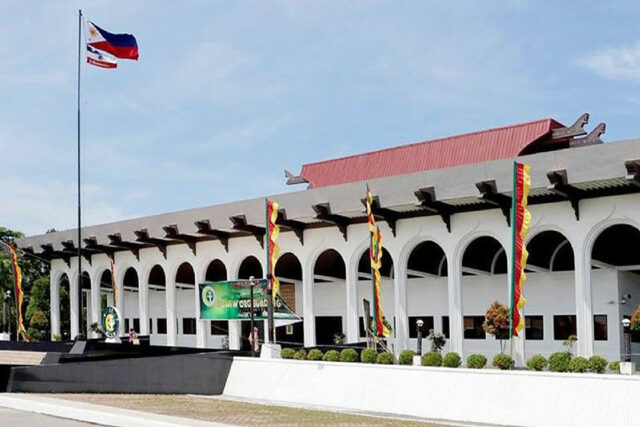
Senate OKs BARMM polls in Sept.

PHILSTAR FILE PHOTO

A MEASURE resetting the first parliamentary election for the Bangsamoro Autonomous Region in Muslim Mindanao (BARMM) in early September hurdled the Senate on Monday.

Through a unanimous vote, 21 senators approved on third and final reading Senate Bill No. 1823, which sets the first BARMM elections to Sept. 2026 from March 2026.

“Hopefully, this measure is passed on third reading in the House, so that the people of BARMM can also be confident that elections will be held and that there would no longer be postponements,” Senator Juan Miguel F. Zubiri, who sponsored the measure, told senators.

The BARMM polls were initially set for Oct. 2025 but were deferred to March 2026 after the Supreme Court declared two Bangsamoro parliamentary redistricting laws unconstitutional.

In January, the Commission on Elections (Comelec) deferred the elections anew due to operational hurdles and the belated approval of Parliament Bill No. 415 on Jan. 13, which establishes parliamentary districts in BARMM.

Under the Senate bill, the term of office for elected BARMM officials will start on Oct. 30, 2026, at noon and will end on June 11, 2031.

Subsequent elections will be held on the second Monday of May every three years starting in 2031, simultaneous with national and local elections. Elected officials will assume office on the 30th day following their elections.

The Comelec is ordered to draft implementing rules and regulations for the conduct of the polls, as well as enforce and administer national and local laws.

Republic Act No. 11054, the Bangsamoro Organic Law, which was signed in 2019, mandates parliamentary elections every three years. Since then, elections have faced multiple delays due to legal, operational, and political hurdles.

The September poll is seen as a critical step in consolidating the region’s autonomy, enabling residents to elect representatives to a fully functioning regional Parliament for the first time. — Adrian H. Halili