Home Blog Page 221

Senate concurs with PHL-UK treaty on transfer of sentenced persons

BW FILE PHOTO

THE Senate on Monday concurred with the ratification of a treaty between Manila and London, which would allow imprisoned Filipinos in the United Kingdom to serve their sentences in the Philippines.

During a Plenary session, 20 senators voted in favor of Senate Resolution No. 315, which concurs with the ratification of the treaty on the transfer of sentenced persons.

“This treaty will allow Filipinos convicted of crimes in the UK to serve their remaining sentence in the Philippines and facilitate their effective rehabilitation as they will be close to their families and friends, and be with other inmates with whom they share the same language and culture,” Senator Erwin T. Tulfo, who sponsored the resolution, said.

Under the agreement, a prisoner can be transferred back to their home country upon the consent of both governments, and the consent of the prisoner before a transfer can take place.

The treaty states that a sentencing country must authorize the transfer, while the receiving country must agree to enforce the judgment. The prisoner, on the other hand, must provide informed, voluntary consent after being made aware of the transfer conditions.

“The human rights and dignity of each person remain, whether they are inside or outside the prison. Under our Constitution, the government’s protection of a Filipino does not end just because he or she has committed a mistake in another country,” the senator added. — Adrian H. Halili

Comelec says voter registration in Middle East continues

PHILSTAR FILE PHOTO

THE Commission on Elections (Comelec) said on Monday that overseas voter registration activities in the Middle East are still ongoing amid heightened alert following direct military engagements involving Iran and coalition forces led by the United States and Israel.

“As of today, 2 March 2026 (Monday), overseas voter registration activities in Philippine Embassies and Consulates in the Middle East affected by the ongoing tensions and escalations in the region continue as Philippine Foreign Posts remain operational and open for consular services, including overseas voter registration,” the poll body said in a statement.

Comelec also urged the Filipino community in the region to remain vigilant against misinformation and disinformation, which tend to surge during periods of geopolitical instability.

“The Commission on Elections highly encourages our fellow Filipinos in the Middle East to stay alert and keep updated of the current situation in their respective areas, be vigilant against misinformation/disinformation and trust only reliable sources of information,” the Comelec added. “Take heed of the notice and advise from the Department of Foreign Affairs as well as the Philippine Embassy or Consulate, and contact help lines if in distress.”

The ongoing registration drive, which began on Dec. 1, 2025, is part of preparations for the 2028 Philippine national and local elections and runs until Sept. 30, 2027. — Erika Mae P. Sinaking

BoC seizes P112-M illegal drugs in NAIA operations

PHILIPPINE STAR/MIGUEL DE GUZMAN

THE Bureau of Customs (BoC) on Monday said it seized more than P112 million worth of illegal drugs upon the arrest of a Malaysian national at the Ninoy Aquino International Airport (NAIA) Terminal 1.

“The baggage of the arrested individual was flagged by Customs personnel for inspection, which led to the discovery of the illegal drugs concealed inside his checked-in luggage,” the BoC said in a statement on Monday.

“Authorities recovered approximately 16.526 kilograms of white crystalline substance suspected to be methamphetamine hydrochloride, commonly known as shabu,” it added.

The suspect was subjected to inquest proceedings for violation of the Comprehensive Dangerous Drugs Act of 2002.

The operation was led by the BoC through its Customs Anti-Illegal Drugs Task Force, in close coordination with the NAIA-Inter-Agency Drug Interdiction Task Group.

Customs Commissioner Ariel F. Nepomuceno said that the operation aligns with the directive of President Ferdinand R. Marcos, Jr. to intensify the campaign against illegal drugs and strengthen border protection measures. — Justine Irish D. Tabile

PSEi plummets to 6,400 level amid Iran conflict

PHILIPPINE STAR/KRIZ JOHN ROSALES

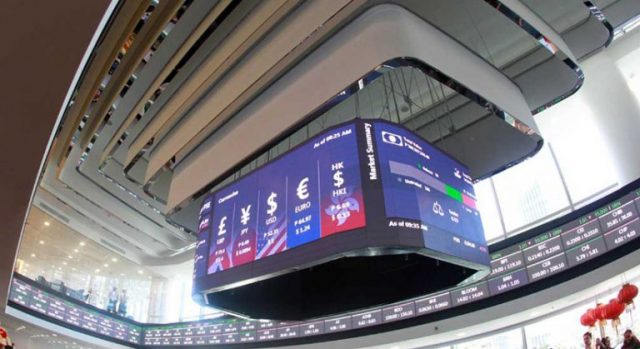
PHILIPPINE STOCKS closed lower on Monday, with the main index sliding back to the 6,400 range as worries over the escalating conflict in the Middle East triggered a sell-off.

The Philippine Stock Exchange index (PSEi) decreased by 2.78% or 184.41 points to close at 6,426.83, while the broader all shares index went down by 2.01% or 73.38 points to end at 3,567.86.

This was the biggest single-day drop posted by the PSEi since it plunged by 4.3% or 261.34 points on April 7, 2025.

It was also the benchmark’s lowest close since Feb. 19’s 6,407.15.

“The local market plunged by the week’s open as investors digested the ongoing conflict between the US and Iran, which is expected to negatively affect the local economy mainly through higher oil prices,” Philstocks Financial, Inc. Research Manager Japhet Louis O. Tantiangco said in a Viber message.

“The local index closed sharply lower as escalating global conflict triggered a broad-based sell-off across sectors, dampening overall market sentiment,” Regina Capital Development Corp. Head of Sales Luis A. Limlingan said in a Viber message.

Oil prices surged 9% on Monday after shipping in the crucial Strait of Hormuz was disrupted by retaliatory Iranian attacks following initial bombing by Israel and the United States that killed Iranian Supreme Leader Ali Khamenei, Reuters reported.

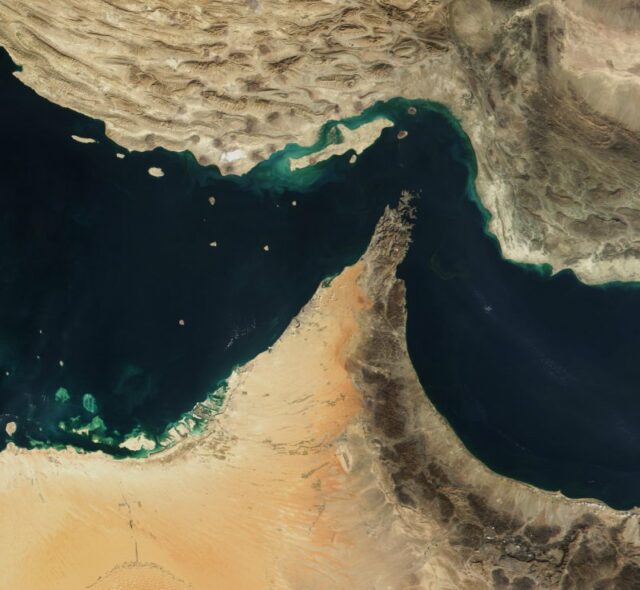
A sustained exchange of counterattacks damaged tankers and sharply disrupted shipments in the Strait of Hormuz, a waterway between Iran and Oman that connects the Gulf to the Arabian Sea.

Most sectoral indices ended lower on Monday. Services slid by 4.11% or 117.20 points to 2,732.86; holding firms plunged by 2.74% or 143.04 points to 5,076.53; industrials retreated by 2.33% or 220.50 points to 9,228.59; financials dropped by 1.77% or 38.56 points to 2,129.64; and property decreased by 0.82% or 18.16 points to 2,176.56.

Mining and oil was the lone gainer, rising by 0.1% or 20.14 points to 19,943.29.

“Only the miners posted gains as investors went for precious metal related stocks amid geopolitical tensions offshore,” Mr. Tantiangco said.

“Risk-off sentiment prevailed throughout the session, with investors trimming exposure amid heightened geopolitical uncertainty, while some rotated into commodity-backed assets, such as gold and oil, which are traditionally viewed as defensive hedges during market stress,” Mr. Limlingan added.

Decliners overwhelmed advancers, 159 to 53, while 52 names closed unchanged.

Value turnover dropped to P9.12 billion with 1.19 billion shares traded from the P19.62 billion with 1.23 billion issues that changed hands on Friday.

Net foreign selling was at P784.64 million, a reversal of the P915.72 million in net buying recorded in the previous session. — Alexandria Grace C. Magno with Reuters

First offshore wind auction set for August

WORLDBANK.ORG

THE FIRST green energy auction (GEA) round dedicated to offshore wind power projects is set to take place on Aug. 27, according to the Department of Energy (DoE).

The auction was scheduled after the Energy Regulatory Commission issued the green energy auction reserve (GEAR) price to guide bidders. It was set at P11 per kilowatt-hour.

Interested parties have 14 days to register starting March 2, with the list of qualified bidders scheduled to be published on July 3, the DoE said in a statement on Monday.

A pre-bid conference will be held on July 16 to outline the bidding rules and technical, and financial requirements for prospective developers.

After the auction proper, the bids will undergo evaluation by the Bids Evaluation and Awards Committee, followed by validation by the technical working group.

The list of winning bidders will be announced starting Sept. 23.

The fifth GEA (GEA-5) round focuses on fixed-bottom offshore wind technology, with an installation target of 3,300 megawatts and a delivery commencement period of 2028 to 2030.

“GEA-5 marks a major stride towards a more sustainable energy future for the Philippines,” the DoE said. “The initiative aims to expand the share of renewable energy in the national energy mix, strengthen grid reliability, and enhance long-term energy security through large-scale offshore wind development.”

The Philippines is hoping to start generating offshore wind power by 2028 in the course of diversifying its energy sources and reducing dependence on fossil fuels.

It expects offshore wind to play a key role in achieving the target of increasing renewable energy’s share in the power mix to 35% by 2030 and 50% by 2040. — Sheldeen Joy Talavera

Iran crisis seen driving up agri production costs

THE STRAIT OF HORMUZ — WIKIPEDIA

By Vonn Andrei E. Villamiel, Reporter

RISING OIL PRICES triggered by the recent US-Israeli attacks on Iran are expected to increase production costs for Philippine farmers and fisherfolk, adding pressure on producer incomes and consumer food prices, analysts said.

Former Agriculture Secretary William D. Dar said the main risk comes from the closure of the Strait of Hormuz, a key shipping lane through which 20% of the world’s oil passes.

“If the closure is long, this will increase oil prices, impacting countries including the Philippines. Higher cost of food production will happen with increased oil prices,” he told BusinessWorld via Viber.

Roehlano M. Briones, senior research fellow at state think tank Philippine Institute for Development Studies, told BusinessWorld via Viber that the impact on agriculture will depend on the extent of fuel price increases, with fisheries likely to be the hardest hit.

Even before the attacks on Iran, fisherfolk group Pambansang Lakas ng Kilusang Mamamalakaya ng Pilipinas (PAMALAKAYA) pointed to the successive diesel price hikes, which it said are limiting the time fisherfolk can spend at sea, cutting into their income.

“From the usual six to eight hours at sea, fisherfolk now spend only about four hours fishing, as this is all they can afford,” the group said in an earlier statement.

PAMALAKAYA estimates that fuel expenses account for about 80% of total production costs for small-scale fishers.

Rosendo O. So, chairman of the Samahang Industriya ng Agrikultura, said increased oil prices will also affect the farming sector, as diesel powers mechanized farm equipment, irrigation pumps, and transportation.

“Farmers use fuel at every stage, for irrigation pumps and tractors during planting, for harvesters, and for transporting produce to the market. Any increase significantly raises production costs,” he told BusinessWorld by phone.

Danilo V. Fausto, president of the Philippine Chamber of Agriculture and Food, Inc. said the Middle East crisis will likely raise costs for fertilizer users.

“The war on Iran is expected to increase prices of fuel (and) will likely increase the cost of agricultural inputs, especially inorganic fertilizers that are by-products of oil,” he told BusinessWorld via Viber.

Agriculture Secretary Francisco P. Tiu Laurel, Jr. told BusinessWorld that the Department of Agriculture is currently assessing possible interventions for farmers and fisherfolk.

“We are studying now what we can assist them with. I hope this conflict in the Middle East does not last long,” he said via WhatsApp.

Fish landed at regional ports up 2.7% in Jan.

PHILIPPINE STAR/ MICHAEL VARCAS

THE Philippine Fisheries Development Authority (PFDA) said fish landed at regional fish ports totaled 40,460 metric tons (MT) in January, up 2.7% from a year earlier.

In a statement, the PFDA said the General Santos Fish Port Complex posted the highest volume for the month, with 24,908 MT of fish landed.

The Navotas Fish Port complex recorded the second-highest volume of fish landed in January at 14,843 MT.

The PFDA said the Davao Fish Port Complex posted the largest year-on-year increase, with volume rising almost fourfold to 1,719 MT.

Fish unloaded at the Iloilo Fish Port Complex rose 9.91% in January to 1,750 MT.

The volume of fish landed at the Lucena Fish Port Complex in Quezon inched up to 1,602 MT, while fish landed at the Zamboanga Fish Port Complex rose 22.8% to 425 MT.

The Bulan Fish Port Complex in Sorsogon posted landed volume of 1,041 MT.

“A further increase in unloading is also expected in February with the opening of the annual fishing season in the waters of the Zamboanga Peninsula, Northern Palawan, and the Visayan Sea,” the PFDA said. — Vonn Andrei E. Villamiel

Gypsum board imports subject to anti-dumping duties

NATURLOOP.COM

THE PHILIPPINES started imposing an anti-dumping measure against gypsum board imports on Feb. 27 that will run for five years, the Bureau of Customs (BoC) said.

In a memo issued last week, the BoC said the measure was implemented in the Electronic-to-Mobile System on Friday.

The measure covers imports of standard gypsum board, those faced or reinforced with paper, or paperboard only.

According to the Department of Trade and Industry’s (DTI) Bureau of Import Services (BIS), the measure will be in place for five years from Feb. 27, 2026.

The DTI had recommended a dumping margin of 8.52%, calculated based on the export price, on products from Thailand’s Gypman Tech Co. Ltd.

Meanwhile, a dumping margin of 9.18% was imposed on products from Thai Gypsum Products PCL and other Thai exporters.

Anti-dumping investigators found that the volume of imports of standard gypsum board at dumped prices accounted for 71% of total Philippine imports of standard gypsum board between 2019 and September 2024.

The dumped imports, the DTI said, accounted for almost 40% of consumption during the period.

As of March 2, the BIS said the BoC has released the memorandum circulars required to impose anti-safeguard and dumping measures.

From 2018 to 2025, the government investigated 18 trade remedy cases, which include safeguard or anti-dumping measures for cement, ceramic tiles, float glass, liquefied petroleum gas, and corrugating medium.

Collections from trade remedy measures are part of BoC collections.

In the first two months, the BoC collected P154.75 billion, up 2.5% from P151.02 billion a year earlier.

Last month, the BoC collected P73.8 billion, up 1.7% from a year earlier.

“The entire bureau delivered more than the expected financial target for February. This is contrary to the expectation that, during the month of the Chinese New Year, bababa ’yung collection natin (collections will fall),” Customs Commissioner Ariel F. Nepomuceno said in a statement on Monday.

“We were able to prove, with the efforts of everyone, especially our port collectors, that it can be done — with the proper assessment, with the stricter implementation of enforcement rules, and with the due diligence of our deputy commissioners,” he added. — Justine Irish D. Tabile

ADB guarantee to cover North-South Commuter Railway operator payments

DOTR PHOTO

THE PHILIPPINES is seeking to borrow up to $800 million from the Asian Development Bank (ADB) to serve as a partial credit guarantee (PCG) that will ensure payments to the operator of the North-South Commuter Railway (NSCR) project, the bank said.

According to a project data sheet, the ADB said that the government requested the ADB to provide a PCG to ensure the winning operator is paid, while also addressing market concerns on the possibility of delayed or non-payment.

The availability of the PCG will ensure efficient and sustainable operations of the NSCR project, the ADB said, adding that this mechanism will encourage bidder participation, improve competition and strengthen the financial viability of the transaction.

“The PCG will backstop a standby letter of credit issued by a reputable commercial bank, mitigating liquidity risk and enhancing bankability,” the ADB said.

The proposed PCG of up to $800 million is the equivalent of 24 months of availability payment obligation, it said, adding that it is de-risking the Department of Transportation’s (DoTr) NSCR O&M public-private partnership (PPP).

“This PCG-backed letter of credit will support private sector participation in the operations and maintenance (O&M) of the NSCR under a long-term PPP arrangement,” it said.

Last year, the DoTr conducted  roadshows in Japan, Singapore and France to promote the P229.32-billion O&M contract for the NSCR project.

According to the instructions to prospective bidders, the final O&M concession agreement will be released on April 30. Bids will be accepted by May 29 at 11 a.m., according to the PPP Center.

To qualify for the project, the bidder must have a minimum net worth of P114.65 billion or its equivalent in foreign currency as of the 2024 financial year. For consortia, the lead member of the group must have an equity interest of at least 34% of both voting and non-voting shares of the O&M concessionaire, the DoTr said.

Bidders including consortium members or affiliates must include at least one entity with 10 years of experience in rail operations, specifically in managing a rail line that handles at least 45,000 passengers per hour in each direction.

At least one entity must have eight years of experience in maintaining railway infrastructure and systems, including the use of a computerized maintenance management system, and another must have eight years of experience in track and civil infrastructure maintenance.

The NSCR O&M deal will cover 15 years from the signing date of the contract, the DoTr said.

The 147-kilometer NSCR will connect Malolos, Bulacan with Clark International Airport, and Tutuban, Manila with Calamba, Laguna. The P873-billion project is co-financed by the Japan International Cooperation Agency and the ADB. It will have 35 stations and three depots.

Full operations are expected by January 2032; partial operations on the Malolos to Valenzuela segment by December 2027; and operations on the Clark to West Valenzuela segment by October 2028. — Ashley Erika O. Jose

PCC raises M&A notification thresholds

THE Philippine Competition Commission (PCC) has said it raised the thresholds for notifying the regulator about mergers, acquisitions, and joint venture transactions, with the new thresholds in effect starting March 1.

In a statement, the PCC said it increased the Size of Party  threshold for mergers and acquisitions (M&A) to P9.1 billion from P8.5 billion previously.

It also raised the Size of Transaction threshold for mergers and acquisitions to P3.8 billion from the previous P3.5 billion.

Both thresholds must be met for a transaction to be considered notifiable under Section 17 of Republic Act No. 10667, or the Philippine Competition Act (PCA), and Rule 4, Section 3 of its Implementing Rules and Regulations (IRR).

The revised thresholds also apply to joint venture transactions under Rule 4, Section 3(d) of the law’s IRR.

The PCC reviews the notification thresholds for mergers, acquisitions, and joint ventures to ensure they are up to date, ensuring that businesses are afforded regulatory certainty and protecting the welfare of consumers.

The PCC is also authorized to review transactions that fall below the notification thresholds. It may initiate a motu proprio (on its own initiative) review if it suspects a deal could significantly harm competition.

The commission is authorized to determine and adjust the thresholds for compulsory merger notification, following Sections 12(b) and 19 of the PCA, in relation to Rule 4, Section 8 of the IRR.

“The adjustment ensures that the notification thresholds reflect inflation, economic growth, and prevailing market conditions, while enabling the commission to effectively allocate its resources toward transactions that are more likely to have a substantial impact on competition in Philippine markets,” PCC said.

The thresholds were indexed against nominal gross domestic product growth of the previous calendar year. — Beatriz Marie D. Cruz

Cable landing station in Baler to take in $31M worth of investment from Japan-controlled telco

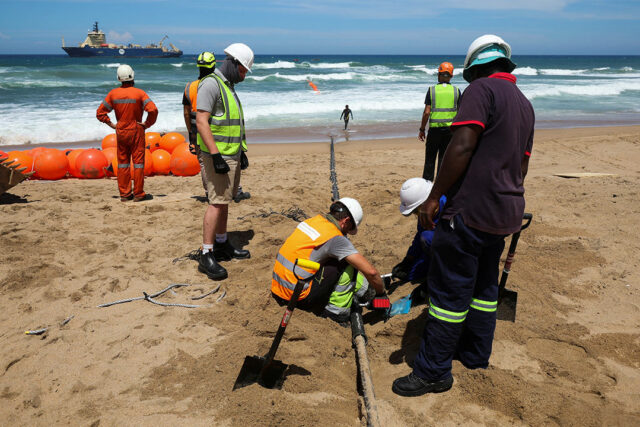
Workers install the 2Africa undersea cable on the beach in Amanzimtoti, South Africa, February 7, 2023. — REUTERS/ROGAN WARD

INFINIVAN, Inc., the Philippine telecommunications unit of Japan’s IPS, Inc., is investing $31 million to build a cable landing station (CLS) in Aurora province, in a bid to boost internet connectivity in Southeast Asia.

“The station itself will cost around $16 million, but because of the request for an expansion, we’re going to have another $15 million,” InfiniVAN, Inc. Chief Technology Officer Alberto C. Espedido told reporters on the sidelines of an event on Monday.

The company began the construction of its CLS in January, which will be operational by early 2028.

The Baler CLS forms part of the 8,000-kilometer Candle submarine cable system that will connect the Philippines, Indonesia, Malaysia, Singapore, Japan, and Taiwan.

Candle is being developed by a consortium that involves IPS, Meta Platforms, Inc., TM Technology Sdn. Bhd., PT XLSmart Telecom Sejahtera Tbk and several Asian carriers.

Mr. Espedido noted that the upcoming CLS will help support growing demand for artificial intelligence (AI), 5G, and data centers.

InfiniVAN is also in talks with a government-owned and -controlled corporation to acquire a CLS in San Fernando, La Union, he said.

The company is expected to announce its La Union acquisition by the second quarter, he said.

Also on Monday, InfiniVAN, IPS, IPO Pro, and Indian agentic AI platform Gnani.ai signed a strategic partnership to leverage AI and digital infrastructure for enterprises in the Association of Southeast Asian Nations.

The partnership seeks to exchange cross-border technologies to help businesses adopt AI-driven communication and customer experience technologies in the region.

It is also expected to strengthen trilateral economic and digital cooperation among the Philippines, Japan, and India.

The collaboration is also expected to boost industry confidence in AI and telecom-enabled digital solutions. It will also serve as a foundation for upcoming public-private cooperation on AI, telecommunications, and digital infrastructure, the companies said. — Beatriz Marie D. Cruz

All five provincial airport upgrade projects attract potential bidders

CAAP NAGA AIRPORT FB PAGE

THE Department of Transportation (DoTr) said the pre-bidding conference for the contracts to upgrade five provincial airports attracted potential interest for all five projects.

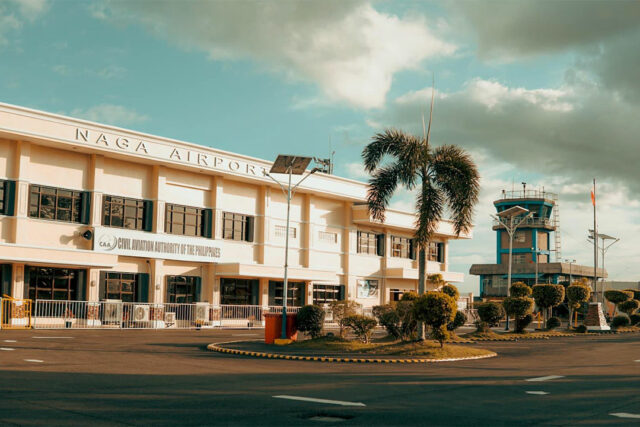
The DoTr said interested parties inquired about projects to develop or upgrade Antique Airport (indicative cost P96.44 million), Kalibo International Airport (P189.64 million), New Naga Airport (P431.33 million), Ormoc Airport (P419.92 million), and Tacloban Airport (P611.10 million).

IPM Construction and Development Corp. submitted the sole proposal for Antique Airport. The company also filed a proposal for Kalibo International Airport, the DoTr said.

Kalibo airport attracted two other interested parties, BM Marketing and Golden Rich A Concrete and Construction Corp.

The New Naga Airport development project attracted four bidders, the DoTr said — BM Marketing; Octagon Concrete Solutions, Inc.; BSP and Co., Inc.; and Red Diamond Construction.

BM Marketing also submitted a proposal for Ormoc and Tacloban airports. Other Ormoc bidders were Aqualine Construction Corp. and Red Diamond Construction.

Aqualine was the other interested party for Tacloban airport.

The DoTr’s airport upgrade program is focused on improving many provincial airports to accommodate at least narrowbody jets to handle growing passenger demand. The capacity to handle Boeing 737 or Airbus A320 aircraft — the most prevalent single-aisle jet models — also suggests upgrades to attract direct international flights. — Ashley Erika O. Jose