Home Blog Page 22

’80s nostalgia seen with fresh eyes

Bagets the Musical gets ready for its audience

By Brontë H. Lacsamana, Reporter

STAGING a beloved Filipino coming-of-age tale four decades after the original film came out could be considered a no-brainer in 2026, given how nostalgia is the big thing in different forms of storytelling today. Using the versatility of Philippine theater as a platform, the challenge now is presenting 1980s nostalgia with a refreshed perspective.

As Bagets the Musical opens this year, it’s important to note the interesting blend of creative groups that brought the show to life. It’s adapted by PETA Plus (the creative agency of the Philippine Educational Theater Association), produced by Viva Communications, Inc. (which produced the Bagets film in 1984), and helmed by Philstar Next (the Philstar Media Group’s entertainment arm*).

Put all of that together, and you have a musical that aims to recapture the spirit of Filipino youth — with the help of songs from the movie as well as other iconic 1980s hits — while giving audiences some nuggets of reflection to carry home from the show.

“We hope you’ll enjoy this because the kids worked hard during rehearsals. It’s a fun show and I hope you all enjoy it!” said director Maribel Legarda at the start of the open rehearsals on Jan. 21.

(As with all technical dress rehearsals, the show BusinessWorld saw was not yet fully polished, so there were a few mishaps with lighting. Otherwise, it was already mostly how it should be on opening night.)

“It’s not perfectly clean yet, but generally it’s complete and you’ll get a sense of what Bagets has become from its transition from the 1984 movie to the musical you’re going to see,” Ms. Legarda said.

A cute touch while the audience waits for the curtains to rise is the voiceover announcing the minutes left before the show starts — each one is recorded by a cast member announcing the time in character.

The musical opens by traveling back in time, as a large box television set projected on the screen in front takes us from 2026 newsbites to all the way back to the vibrant colors and sounds of 1984.

After that, the energy kicks off, as five young men — Topee, Tonton, Gilbert, Arnel, and Adie — cap off their third year in high school causing trouble as usual. Hilarious antics follow as they get kicked out of their school and launch into a series of adventures and misadventures both at home and in their new school, revealing complex family issues at the same time.

Tall, rolling set pieces were utilized cleverly, allowing us to glimpse each boy’s house in multiple scenes, while the mini car they used onstage was fun to see as it glided around.

While the timing of the lights with the music and dialogue was, indeed, a work-in-progress, the use of set pieces, props, and LED screens is exciting. It’s fun to watch a dynamic PETA Plus production on a stage as vast as the Newport Performing Arts Theater.

The five leads were played by Sam Shoaf, Milo Cruz, Noel Comia, Jr., Ethan David, and Andres Muhlach during the open rehearsals, and it was good to see that a shared chemistry was there.

Admittedly, there were some glaring pain points in terms of singing and dancing skills. Some of the performers take to the songs and choreography better than others, but the chemistry of the five as friends is undeniable.

Each brings something different to the table. Sam Shoaf has a magnetic presence as martial arts ace and athletic heartthrob Topee. Milo Cruz is a solid performer who can sing and bust out moves as he takes on daredevil Tonton. Noel Comia, Jr., stands out as an actor, able to bring out both the comic relief and endearing geek within Gilbert. Ethan David lends his beautiful voice to the role of well-mannered rich kid Arnel.

Andres Muhlach probably has the most pressure on him out of the bunch, having the least performing experience in the group and being in the shadow of his father who originated the role of the baby-faced romantic Adie in the movie. Still, he perseveres through the songs and choreography, offering a singular charm to the role.

Altogether, the five make it work, amid understandable first-show jitters and timing issues. The other batch of leads — Jeff Moses, Migo Valid, Tomas Rodriguez, KD Estrada, and Mico Hendrix Chua — would be interesting to see, for a different take on the main barkada.

Finally, it would be remiss to talk about Bagets the Musical without giving kudos to the actors playing the moms. Thanks to director Ms. Legarda and writer J-mee Katanyag, a noticeable focus of the show is how mothers take care of their sons, expanding the glimpses we see in the original film.

The ermats are played splendidly by Neomi Gonzales, Natasha Cabrera, Mayen Cadd, Ring Antonio, and Carla Guevara Laforteza, each delivering the quirks and flaws that flesh out dimensions of the boys’ lives. They have their own journey growing up alongside their sons, in the context of working women becoming a norm in the 1980s.

Another cool element is seeing the machismo and youth culture that only make sense in that time period. While deemed inappropriate and politically incorrect in today’s milieu, it’s intriguing to witness these outdated aspects in a Bagets updated in 2026.

Most of all, Bagets the Musical leans heavily into the nostalgia, offering a fun time in the theater with hits like “Telefone (Long Distance Love Affair)” and “Wake Me Up Before You Go-Go” alongside iconic Bagets tunes “Growing Up” and “Just Got Lucky.” The entire ensemble really fills out the stage and brings their A-game each time.

The experience is a good one that both young and old can appreciate. There are even interactive portions that allow the audience to revel in the music and the youthful energy. While there are still things to fine-tune here and there, it’s a show worth checking out.

Bagets the Musical opens on Jan. 23 and runs until March at the Newport Performing Arts Theater, Pasay City. Tickets, ranging in price from P1,000 to P4,000, are now available at the Newport World Resorts Box Office and via TicketWorld.

*The Philstar Media Group is part of MediaQuest Holdings, Inc., as is BusinessWorld.

Globe, Nokia widen tie-up to offer new digital tools to businesses

STOCK PHOTO | Image by M. Rennim from Unsplash

GLOBE TELECOM, INC. said it has expanded its collaboration with Nokia Corp. to make network application programming interfaces (APIs) available to more users and businesses.

The Ayala-led telecommunications company said broader access to network data through APIs could create opportunities for enterprises to use advanced network capabilities across sectors such as banking, healthcare, automotive, and entertainment.

Under the agreement, Globe will gain access to Nokia’s full portfolio of APIs through the Network Exposure Program (NEP), a cloud-native and programmable platform designed to streamline API services and enable interoperability within network environments.

“With cyberattacks on digital services accelerating, it is crucial that we make available the latest network-powered technologies to our enterprise customers and help safeguard against fraud. We are now at the stage of testing how Nokia’s NEP can support our customers in the banking and enterprise sectors,” Globe Vice-President and Head of Globe Business Stella Christine D. Dizon said in a media release on Thursday.

Globe previously partnered with Nokia last year to test the NEP for the development of security-focused applications aimed at addressing mobile banking fraud.

“Nokia’s open API solutions will empower Globe to rapidly develop and deploy new services, fostering innovation and creating new revenue streams by securely exposing network capabilities to developers and partners,” Nokia Head of Network Monetization Platform Shkumbin Hamiti said.

Shares in Globe rose P28, or 1.75%, to close at P1,630 apiece on Thursday. — Ashley Erika O. Jose

Taylor Swift named to Songwriters Hall of Fame, second-youngest ever

BW FILE PHOTO

LOS ANGELES — Taylor Swift, 36, will become the second-youngest songwriter ever inducted into the Songwriters Hall of Fame, joining the ranks of Stevie Wonder, who was 33 when he was inducted in 1983, the organization announced on Wednesday.

The honor places the pop superstar, winner of 14 Grammys, among the most celebrated songwriters across generations.

Ms. Swift will be inducted alongside Alanis Morissette, Kenny Loggins, and Kiss bandmates Paul Stanley and Gene Simmons, with the ceremony set for June 11 at the Marriott Marquis Hotel in New York City, the organization announced on CBS Mornings.

“They’ve literally written the soundtrack to our lives. The songs we dance to, cry to and rock out to,” culture correspondent Anthony Mason said on CBS Mornings before announcing the inductees.

Established in 1969, the Songwriters Hall of Fame requires that inducted songwriters have a notable catalog of songs to qualify for induction 20 years after the first commercial release of a song.

The “Bad Blood” singer has won four Grammy album of the year awards. Her latest release, The Life of a Showgirl, sold more copies than any other album in the modern era during its first week of release, according to Billboard, which cited data from Luminate, a firm that tracks music sales.

In May 2025, Ms. Swift announced that she bought her music rights, officially reclaiming ownership of all her master recordings, including her first six albums.

Later that year, Ms. Swift’s record-breaking Eras tour spawned a concert film and a six-part documentary series that chronicles the success of the tour on Disney+.

Her 2024 The Tortured Poets Department album, which debuted at No. 1 on the Billboard 200 album chart, sold the equivalent of 8 million albums in the United States, according to Luminate. — Reuters

Ayala Land unit signs five-year office lease with LANDBANK

LAND BANK OF THE PHILIPPINES

THE OFFICE leasing unit of Ayala Land, Inc. (ALI) has signed a five-year lease agreement with Land Bank of the Philippines (LANDBANK) for 3,866.75 square meters of office and parking space at the Ayala Malls Manila Bay Corporate Center.

In a statement on Thursday, Ayala Land Offices, Inc. (ALO) said the space will be used by selected LANDBANK head office units, departments, and a subsidiary. The lease is scheduled to begin on June 1.

Under the agreement, LANDBANK is the lessee, Bay City Commercial Ventures Corp. is the lessor, and ALO will serve as the leasing manager.

ALO said the lease reflects its continuing efforts to meet evolving office requirements as organizations adjust their space needs.

Ayala Land reported combined revenues from office and commercial and industrial lot sales of P12.8 billion in the first nine months of 2025, up from P10.4 billion in the same period a year earlier.

The company attributed the increase to lot sales in the first half and sustained bookings in key locations, including the Makati central business district, Vertis North, and Arca South.

Shares in ALI were unchanged at P22.50 apiece on Thursday. — Alexandria Grace C. Magno

Stuff to Do (01/23/26)


Go to Asia’s biggest dog show

THE Philippine Circuit Dog Show 2026 is ongoing at the Smart Araneta Coliseum until Jan. 26. Now in its 12th year, it is headlined by the 2026 Fédération Cynologique Internationale (FCI) World Grooming Competition, which highlights the skills and artistry in dog grooming. Dogs and their handlers from around the world showcase creative styling, breed-specific cuts, and technical expertise. Alongside this contest, there will be 12 All-Breed Championship Dog Shows, mediated by renowned international judges to ensure fair and healthy competition. There are 7,440 entries representing 91 breeds.


Listen to some jazz

THE year 2026 marks the 70th anniversary of the establishment of diplomatic relations between Japan and the Philippines. To formally launch this landmark year, The Japan Foundation, Manila will present Harmony of Friendship: A Jazz Prelude to 70 Years of Japan-Philippine Ties. The concert series is headlined by the Tokyo-Manila Jazz & Arts Festival Group led by Filipino jazz vocalist Charito. They will be joined by the Philippines’ AMP Big Band, an organization of professional session musicians. On Jan. 22 at the Carlos P. Romulo Auditorium, RCBC Plaza, Makati City, the concert tour continues, free and open to the public, while a jazz workshop at De La Salle University-Dasmariñas will be organized by Lasallian Pop Band, with registration required through the organization. A third by-invitation-only concert will be held in Cebu.


Watch CAST’s staged readings

CAST PH’s (The Company of Actors in Streamlined Theatre) is once again presenting its annual staged readings. The theme of this year’s season (its 6th) is “RE-ORIENT — Narratives from Asian Voices.” As has been done every year during the CAST PH Staged Reading Series, the titles of the plays are not revealed beforehand. The season takes place over the course of four weeks (every Sunday), and Play #3 on Jan. 25, will be directed by Guelan Varela-Luarca. It will star Jenny Jamora, Zoë De Ocampo, Jam Binay, Frances Makil-Ignacio, Dolly de Leon, and Roselyn Perez, with stage directions to be read by Monty Uy. The season ends on Feb. 1 with Play #4 which will be directed by Caisa Borromeo. It will feature Jillian Ita-as, Kakki Teodoro, George Schulze, Yanah Laurel, Alfredo Reyes, and Miren Alvarez-Fabregas. There are only 100 seats per performance, priced at P500 each. For tickets, visit https://tinyurl.com/vrdfrfwm. All performances will be held at The Mirror Theatre Studios, 5th floor, SJG Center, Kalayaan Ave., Makati City. Performances are at 3 and 8 p.m.


Try out new fitness experiences at GH Mall

GH MALL at San Juan’s Greenhills Shopping Center, balances the overindulgence of the Christmas season by going healthy in January and offering a lineup of sports and wellness activities. There is the Table Tennis Academy, running until Jan. 31 at the 4F Tech Hub. Mallgoers can also play pickleball at the 5th floor until Jan. 31. The “Motion in Glow” Zumba sessions at the 6F roof deck run every Monday from 5 to 7 p.m. “Step & Groove” dance sessions occur in the same location and at the same time on Wednesdays, while yoga is available on Fridays.


Do not sing along with Les Miz

THAT is the plea of GMG Productions which has brought Les Misérables: World Tour Spectacular, a reimagined staged concert production of the iconic musical, to the Philippines. “Let the cast tell the story,” it exhorts. That cast includes Filipinos: Lea Salonga and Red Concepcion as the Thenardiers, Rachelle Ann Go as Fantine, and Emily Bautista as Eponine. The expanded concert-like format features a new design and production enhanced with new set and lighting designs, bringing Cameron Mackintosh’s critically acclaimed production to life on a scale never seen before in Manila, with a company and crew of over 110, including an international all-star cast and a large ensemble of musicians. Les Misérables runs at the Theater at Solaire, Solaire Resort & Casino, Entertainment City, Aseana Ave., Parañaque from Jan. 20 to March 1, with no extensions possible. As of now, all 48 shows are sold out. But keep checking as you never know.


Enjoy a bit of timely satire

THE Corner Studio presents People v. Dela Cruz, a one-act satirical play that looks at online behavior by using the Philippines’ first-ever jury case as its frame. According to Theater Fans Manila, People v. Dela Cruz takes a country testing its new jury system and turns legal deliberation into a circus of ego, politics, prayer, hunger, and possibly Wi-Fi withdrawal. Written and directed by Eldrin Veloso, it stars Mark Aranal, Emlyn Olfindo-Santos, JP Basco, Althea Aruta, Pauline Arejola, Rain de Jesus, and Aaron Dioquino. The show has performances on Jan. 23, 7 p.m., and Jan. 24 at 3 and 7 p.m., The Corner Studio, J&T Building, 3894 Magsaysay Blvd., Santa Mesa, Manila. Tickets are priced at P800 and are available for purchase via Helixpay.


Get nostalgic with Bagets the Musical

BAGETS THE MUSICAL, a stage adaptation of the 1984 coming-of-age film Bagets, follows a group of high school friends navigating adolescence, family, friendship, and young love. This production by Newport World Resorts, The Philippine Star, and VIVA Communications, is directed by Maribel Legarda, with a book by J-mee Katanyag and music by Vince Lim. The five leads are played by Sam Shoaf, Milo Cruz, Noel Comia, Jr., Ethan David, and Andres Muhlach. They alternate with Jeff Moses, Migo Valid, Tomas Rodriguez, KD Estrada, and Mico Hendrix Chua. Also in the cast are Neomi Gonzales, Natasha Cabrera, Mayen Cadd, Ring Antonio, and Carla Guevara Laforteza. Bagets the Musical opens on Jan. 23 and runs until March at the Newport Performing Arts Theater, Pasay City. Tickets, ranging in price from P1,000 to P4,000, are now available at the Newport World Resorts Box Office and via TicketWorld.


Glimpse artifacts of Philippine devotion at NCCA

THE National Commission for Culture and the Arts (NCCA) has opened the Balaang Bata exhibit, which explores the enduring Filipino devotion to the Santo Niño. On view at the NCCA Gallery in Intramuros, Manila, it features a diverse selection of Santo Niño images and sculptures from across the country, bringing together treasured works from private collections that reflect centuries of personal faith, artistry, and cultural tradition surrounding the Holy Child. Many of the pieces on display are more than a century old, carved from various types of wood and shaped by everyday devotion passed down through generations. The exhibit is open to the public.


Watch chimpanzee thriller Primate in cinemas

PRACTICAL EFFECTS in the new movie Primate, helmed by filmmaker Johannes Roberts, bring the character of Ben the chimpanzee to life. Billed as a shocking, bone-chilling tale, it follows a group of teens who are terrorized when their pet chimp suddenly turns on them. It combines visceral terror with old-school, in-camera special effects. Primate is now showing in cinemas nationwide.


Listen to Charlie Puth’s new single

AWARD-WINNING artist, producer, musician and songwriter Charlie Puth has released his latest single, “Beat Yourself Up,” from his forthcoming studio album Whatever’s Clever!, which will be out in March. Co-produced by Mr. Puth and BLOODPOP, the track is personal and explorative, accompanied by an official music video directed by Hunter Moreno. It is out now on all digital music streaming platforms.


Watch Abbott Elementary, 9-1-1: Nashville on Disney+

THIS JANUARY, several acclaimed and long-running titles are streaming new episodes on Disney+. One of these is crime-dramedy series High Potential, starring Kaitlin Olson as extraordinary and eccentric Morgan Gillory, a cleaning lady for the Los Angeles Police Department recruited as an investigative consultant. Another is the returning 9-1-1 and its newest spinoff, 9-1-1: Nashville, updating the drama franchise that follows different first responders in their day jobs. There’s also the critically acclaimed mockumentary Abbott Elementary, created by and starring Quinta Brunson, centered on a group of dedicated, underfunded teachers in a fictional public school in Philadelphia.


Listen to Cavetown’s new album

CAVETOWN, the moniker of UK-born artist Robin Skinner, has released his new album, Running With Scissors, via Futures Music Group. The record is emotionally expansive and aims to capture the disorienting threshold between youth and adulthood, braided together sonically through hyper-pop, heavy guitars, and dream-pop sounds. Alongside the album is the lead single and music video for “Cryptid,” which explores Skinner’s experience as a transgender person. The album is out now on digital music streaming platforms.

PLDT, Smart deploy technology to improve connectivity in remote areas

BW FILE PHOTO

PLDT INC. and its wireless unit Smart Communications, Inc. have deployed new technologies to enhance internet connectivity in remote and geographically isolated and disadvantaged areas (GIDAs).

“By working hand-in-hand with our partners in government, we believe we can roll out a stronger, more resilient network faster and more efficiently,” PLDT Chief Operating Officer Menardo G. Jimenez, Jr. said in a media release on Thursday.

The Pangilinan-led telecommunications company said connecting underserved communities requires multiple solutions to ensure faster and more reliable internet services.

To reach GIDAs, PLDT said it will continue investing in network infrastructure and innovative technologies, while also strengthening partnerships with government agencies and industry stakeholders.

“PLDT’s investments in innovating to enhance its network are aligned with the Group’s broader thrust to deliver improved services to customers nationwide. It also supports PLDT and Smart’s commitment to national development through strategic partnerships that expand digital access and enhance the delivery of essential services,” the company added.

On Thursday, PLDT shares rose P26, or 1.95%, to close at P1,360 apiece.

Hastings Holdings, Inc., a unit of PLDT Beneficial Trust Fund subsidiary MediaQuest Holdings, Inc., has a majority stake in BusinessWorld through the Philippine Star Group, which it controls. — Ashley Erika O. Jose

An ongoing journey towards modernized transport

The leadership of the DoTr was turned over to Acting Secretary Giovanni Lopez (left) from Vivencio “Vince” Dizon (right) last year. — Photo from facebook.com/DOTrPH

Transportation may very well be the very engine that keeps any economy running. The sector, after all, is responsible for connecting producers to resources and consumers, creating jobs in the making of roads and in the driving of vehicles, boosting productivity by lowering costs, and fostering overall growth by moving goods, services, and people efficiently.

Dealing with the difficult task of making lives easier for millions of Filipino motorists and commuters, the Department of Transportation (DoTr) is the government entity in charge of promoting, developing, and regulating a dependable and coordinated network of transportation systems, as well as providing fast, safe, efficient, and reliable transportation services.

Established under the Malolos Constitution on Jan. 21, 1899, the agency, then called the Communicaciones y Obras Publicas, was given the role of accelerating the country’s economic development through the creation of effective and efficient transportation infrastructure systems.

After 80 years of regulating transportation activities in the country, the Ministry of Transportation and Communication (MoTC) was created pursuant to Executive Order No. 546 with the task of regulating a dependable and coordinated network of transportation and communication systems in the country. Eight years later, the MoTC converted to the Department of Transportation and Communications (DoTC) through Executive Order No. 125.

With the signing of Republic Act No. 10844 in 2016, the communications portfolio from the DoTC was removed following the creation of the Department of Information and Communications Technology (DICT). Hence, the department’s current name.

Expanded capacity

Artist’s render of Siargao Airport, one of the Philippine airports currently undergoing improvements — Photo from facebook.com/DOTrPH

This year, the agency is marking its 127th year in service of Filipinos, remaining committed to providing comfortable, accessible, safe, sustainable, and affordable transportation for Filipinos.

As the department reflects on more than a century of service and modernizing Philippine transport, it is equally important to highlight the agency’s recent achievements that show its lasting impact on the lives of Filipinos.

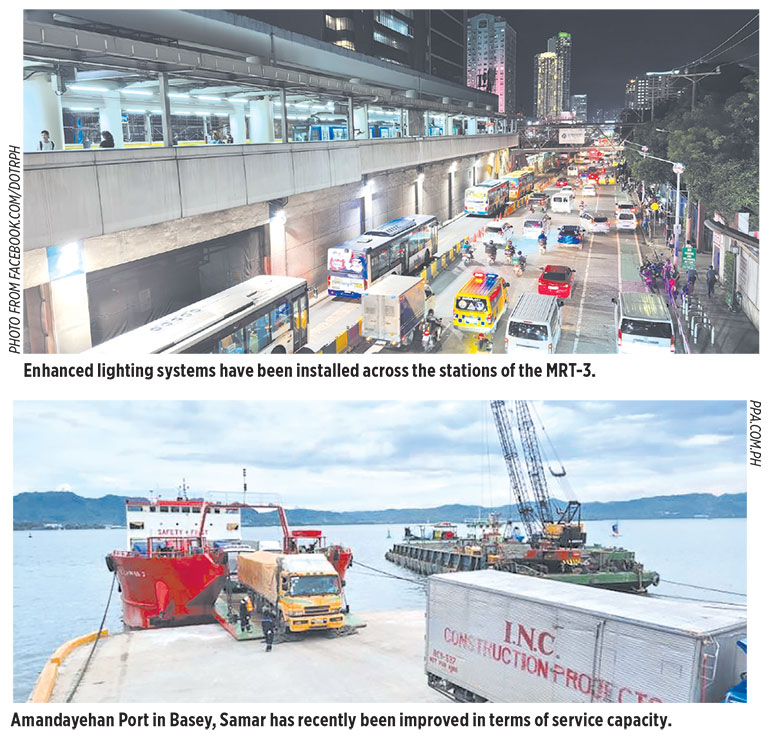
For rail transport, the DoTr has consistently maintained its standard in what may be the country’s busiest transport systems: the Metro Rail Transit Line 3 (MRT-3), the Light Rail Transit Line 1 (LRT-1), and Light Rail Transit Line 2 (LRT-2). Last year, both the MRT-3 and LRT-2 lines observed an increase in ridership, with the former recording a total of 141,626,536 passengers in 2025, higher than the 135,885,336 commuters served in 2024, and the latter tallying a total of 58,754,981 passengers served in last year compared to around 50.7 million total passengers the year before.

Over the past few years, the country’s rail system has seen improvements led by the DoTr. The most important of which is the completion of Phase 1 of the LRT-1 Cavite extension project, which opened up five new stations spanning from Pasay City to Sucat, Parañaque City. Additionally, the agency partnered up with the finance superapp GCash last year to enable commuters to pay for their fares in the MRT-3 railway line through cashless methods.

The department has also carried out road decongestion works to remedy the capital region’s notorious traffic problem. One of the most visible successes in this area is the EDSA Busway, which has drastically reduced travel times along the capital’s busiest road by dedicating a lane exclusively for buses. This system has not only made commuting more predictable for thousands but has also served as a model for “people-centric” infrastructure that prioritizes high-capacity public transport over private vehicles.

Simultaneously, the Public Transport Modernization Program (PTMP) continues its phased implementation across the country. The project aims to replace aging, high-emission jeepneys and buses with safer, Euro-4-compliant modern public utility vehicles. In recent budget hearings, the increase in subsidy for cooperatives by the said program has been discussed to rise from P260,000 in 2025 to P400,000 in 2026.

In aviation, the agency has worked tirelessly to shed what is globally perceived as a legacy of congestion and inefficiency. The most significant move in this direction is the landmark privatization and rehabilitation of the Ninoy Aquino International Airport (NAIA) via a public-private partnership. Since the turnover to the San Miguel-led New NAIA Infra Corp. (NNIC), the gateway has seen improvement in terminal efficiency, upgraded baggage handling systems, and improved facilities, all aimed at restoring the airport’s reputation and elevating the passenger experience.

Similar to the rehabilitation efforts at NAIA, modernization efforts of the Tuguegarao, Bacon, Loakan, Daet, Cauayan, Vigan, and Candon airports are taking place, according to the DoTr. Catbalogan, Dumaguete, Kabankalan, Calbayog, Zamboanga, Mati, M’lang, Jolo, Siargao, and Tandag airports in Visayas and Mindanao will also undergo improvements.

Maritime travel improvements have also been made in various ports in the country. An example of this is the Amandayehan Port in Basey, Samar. Improvements made on the port include increasing its service capacity, with six landing craft tank (LCT) vessels, as well as addressing the alleged “palakasan” (patronage) system and illegal collection of fees raised by port users.

Last year, the Philippine Ports Authority, under the DoTr, said that it allocated as much as P1.42 billion for the expansion and improvement of three ports in the country, including the third phase of the Malalag Port expansion project in Davao del Sur; Lipata Port improvement project in Surigao del Norte; and Buenavista Port expansion project in Guimaras.

Sustainable transport

Aside from these achievements in different areas of transportation, the DoTr has also begun on projects that seek to make Philippine transport more convenient, inclusive, and sustainable.

Part of this is the transportation department’s recently launched Active Transport Project, aimed at promoting healthier and more sustainable modes of transport. Under the program, pedestrians and non-motorized vehicles are prioritized in the hierarchy of road users, with the DoTr mandated to focus on the development of active transport infrastructure. The project is pegged to establish 2,400 kilometers of protected and dedicated lanes for cyclists by 2028.

Topping off the agency’s lengthy list of accomplishments, the Transportation department, together with the DICT, launched the DICT Free WiFi for All program along EDSA Busway Stations, which will provide internet connection to over 183,000 passengers daily. Based on data from the department, the EDSA busway ridership jumped by 6% from 63.02 million in 2024 to 66.67 million last year.

Projects in the pipeline for the agency include the highly anticipated Metro Manila Subway Project (MMSP), often referred to as the “Project of the Century.” Complementing this is the North-South Commuter Railway (NSCR) system, a massive 147-kilometer rail network that will link Clark in Pampanga to Calamba in Laguna. The agency is also making significant strides in regional rail development through the PNR South Long Haul project, popularly known as the “Bicol Express.”

The department is also looking into the development of more Intermodal Terminal Exchanges (ITX) to provide commuters with seamless transfers between different modes of transport, similar to the operations of the Parañaque Integrated Terminal Exchange (PITX).

As the DoTr enters its 127th year, these ambitious projects signify its vision of a Philippines that is fully connected and economically vibrant. By blending the preservation of its historical mandate with the adoption of world-class technology and sustainable practices, the DoTr continues to drive the nation forward and ensure that the “engine” of the Philippine economy remains fueled for the generations of commuters yet to come. — Jomarc Angelo M. Corpuz

Sun Life Philippines looking to boost digitalization initiatives

BW FILE PHOTO

SUN LIFE of Canada (Philippines), Inc. (Sun Life Philippines) will ramp up its technology investments to further expand its reach via online distribution platforms and create specialized products to cater to Filipinos’ varying insurance needs.

“Tech is going to be one of my focus areas… I would like to leverage the digital savviness of Filipinos. The use of technology to make higher value transactions, it’s still not yet there, especially as insurance would be a higher value transaction. But I want to already be in that space where they think of Sun Life once they are ready to make a high-value transaction,” Sun Life Philippines President and incoming Chief Executive Officer (CEO) and Country Manager Jonathan Juan “JJ” D. Moreno told BusinessWorld on the sidelines of an event this month.

“I want to be able to catch that wave because it’s going to be very difficult if that’s the only time I will build a platform once the market is ready for those kinds of things.”

He said younger Filipinos who are digital natives are becoming increasingly aware of the importance of financial protection.

“We’re seeing a trend. We’re seeing that more and more, there are younger cohorts, young professionals actually buying insurance, realizing that it’s an essential expense,” Mr. Moreno said.

While these individuals usually do their research on insurance via digital platforms, they still prefer to consult with human financial advisors and transact in person when they want to avail of policies, he said.

“Some do not want to be approached by an agent immediately. They’ll do their own research, they’ll do everything, they’ll use AI (artificial intelligence) to compare the products, and then when they’re ready, they call an agent.”

They’ve seen the same trend among high-net-worth individuals, he said.

Recognizing this consumer behavior, Mr. Moreno said insurers can boost their digital distribution by first offering simple, straightforward, and lower value products that are tailored for specific needs that clients would be confident to buy via online channels.

For their part, Sun Life Philippines plans to launch products targeting employees and professionals, the high-net-worth segment, and business owners this year.

“So, it would be correct to say that we will launch low-value products… The products we will be launching will be specifically tailored to address a particular segment.”

He said there has been strong demand for traditional life insurance and variable unit-linked products among Filipinos.

“After the previous year, there was a shift towards more traditional products in terms of product creation. That’s due to global headwinds, but it’s still just going down,” Mr. Moreno added.

At end-September, Sun Life Philippines topped the life insurance sector with a premium income of P44.73 billion. — A.M.C. Sy

Snow White and War of the Worlds lead Razzie nominations

War of the Worlds-(2025)

LOS ANGELES — With Oscar nominations a day away, Hollywood’s annual reckoning with its film failures took shape on Wednesday as Disney’s live‑action Snow White and the remake War of the Worlds tied for six nods for the Golden Raspberry Awards.

Popularly known as the Razzies, the awards are an annual Oscar spoof that spotlights what voters deem Hollywood’s worst performances. The 46th Golden Raspberry Awards are set for March 14, the day before the Oscar awards.

Disney’s Snow White, a 2025 remake of the 1937 animated classic, scored a worst picture nod along with nominations for worst remake, director, and screenplay. The fantasy film stars Rachel Zegler as Snow White and Gal Gadot as the Evil Queen, and its seven computer-generated dwarf characters were also cited for both worst supporting actors and screen combo.

Tying with Snow White, the 2025 science fiction film War of the Worlds, starring rapper Ice Cube and actor Eva Longoria, based on H.G. Wells’ 1898 novel, also scored six nominations, including worst picture, actors, remake, director, screenplay, and screen combo.

Other nominees include the psychological thriller Hurry Up Tomorrow, science fiction film Star Trek: Section 31, and the action-adventure Netflix film The Electric State, starring Stranger Things lead Millie Bobby Brown.

More than 1,100 Razzie members from across the United States and about two dozen other countries vote on the awards, according to the Razzie website. Voters are members of the Golden Raspberry Foundation that consists of film critics and movie experts. — Reuters

DENZA to launch first EV model in Philippines next month

BYD GROUP DENZA

PREMIUM ELECTRIC VEHICLE (EV) brand DENZA, under the BYD Group, is set to launch its first model, the multi-purpose vehicle D9, in the Philippines on Feb. 27.

“Many people have been asking me why we (BYD) have grown so fast here in the Philippines. Indeed, it is very fast,” BYD Asia Pacific Auto Sales Division General Manager Xueliang Liu said in Chinese at an event on Thursday.

Asked about the brand’s local market presence, he said: “[If] you are asking about the Philippine figures, it would be over 26,000.”

BYD Singapore, Philippines, and Brunei Managing Director James Ng said the company’s earlier success in introducing BYD vehicles locally helped motivate the DENZA launch.

“In collaboration with ACMobility, we have successfully introduced BYD into the Philippine market and got reception from the public,” Mr. Ng said.

“So, with that, this gives us a very strong motivation to introduce DENZA … it gives us very good strength to further push our DENZA brand.”

Mr. Liu added that the company plans to introduce the other two models, the sports utility vehicles B8 and B5, later in 2026.

On Thursday, DENZA also awarded its initial dealer partners, which will form the foundation of its retail network in the country.

The brand partnered with ACMobility Premium Dealership, Inc. for DENZA Alabang and DENZA Cebu; with Harmony New Energy Auto Service (Philippines) Ltd. Corp. for DENZA Makati; and with E-Vantage Motors, Inc. for DENZA Greenhills.

At the event, DENZA showcased all three models, though only the D9 will be available for launch next month. — Justine Irish D. Tabile

Missing the point — and falling further behind

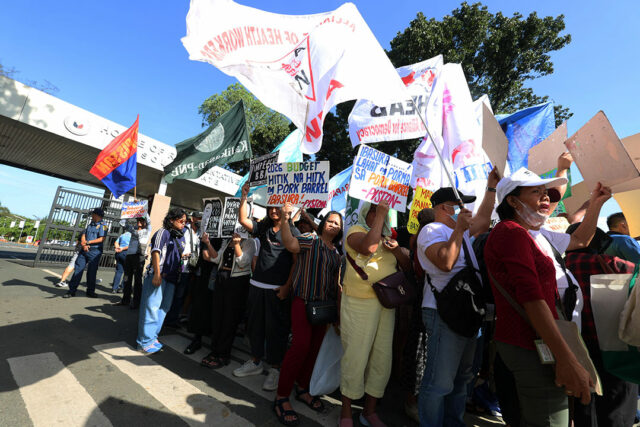
VARIOUS organizations led by the Bagong Alyansang Makabayan troop to the House of Representatives in Quezon City on Jan. 22. — PHILIPPINE STAR/MIGUEL DE GUZMAN

In our “In Brief” for New York-based GlobalSource Partners last Monday, and in my interview with Cathy Yang on Money Talks that same day, we addressed a simple but consequential question: Are the Marcos Jr. administration’s responses to deteriorating business sentiment truly game-changing, or do they merely move the needle?

The decline in sentiment among business and civil society is not cyclical noise. It reflects a hard judgment: the state has failed to curb corruption and enforce good governance. Without restoring integrity in public institutions, public resources will continue to be siphoned away from infrastructure, innovation, sound economic planning, public health, and education. Without good governance, there can be no durable growth.

Against this backdrop, government officials announced a slate of “big, bold reforms.” The issue is not whether these reforms are well intentioned. The issue is whether they represent a break from the past — or simply another iteration of familiar promises.

Several agencies outlined commitments. Tourism, Agriculture, and Agrarian Reform pledged modernization initiatives. The Department of Trade and Industry, Board of Investments, and Department of Information and Communications Technology committed to attracting high-impact investments and accelerating digital transformation. Regulatory agencies — the Securities and Exchange Commission, Food and Drug Administration, the Philippine Competition Commission, and the Department of Environment and Natural Resources — promised to streamline procedures and reduce bottlenecks.

We readily acknowledge that engagement with the private sector is necessary. Signaling reform intent and addressing the high cost of doing business, much of it driven by regulatory inefficiency, are overdue. Streamlining processes and cutting red tape are welcome steps. They should, however, have been done on day one of every administration over the past two decades. We are now into the last two and a half years of President Ferdinand Marcos, Jr.’s term.

Yet these initiatives are not sufficient. They miss the core of the problem.

As one broadsheet captured succinctly: “Corruption puts investors on edge.” The deeper issue can be summarized as TEA: weak transparency, selective enforcement and execution, and uncertain accountability. These deficits corrode trust far more severely than administrative delays. When corruption is systemic, public funds are diverted away from research and development, innovation, and productivity-enhancing infrastructure. The consequence is slower growth, weaker efficiency, and fading regional relevance.

Specific examples underscore the point. How does restoring P4.32 billion to the CARS (Comprehensive Automotive Resurgence Strategy) Program reverse decades of manufacturing hollowing? How does visa-free entry for Chinese nationals boost tourism and investment when signage is inadequate, connectivity is weak, and destinations are poorly maintained? How does IMF-compliant debt reporting restrain a growing bias toward borrowing rather than fiscal consolidation? How does digitizing Bureau of Internal Revenue audits prevent abuse of Letters of Authority when discretion remains entrenched in enforcement? In each case, the reform is procedural; the problem is institutional.

A wry comparison in social media illustrates the gap between reform as rhetoric and reform as rupture:

• Vietnam: “We will reduce provinces from 63 to 34 and cut 30% of party commissions and ministries — making the state leaner and easier to coordinate.”

• Philippines: “We will eliminate visas for Chinese tourists and create a National Single Window for Imports.”

Both are reforms. Only one fundamentally alters how power, accountability, and coordination operate.

This distinction helps explain why, despite respectable GDP growth, often ranking second only to Vietnam for 2025 and perhaps for 2026 as well, many Filipinos feel no corresponding improvement in their lives. Inflation may be contained, but absolute prices remain beyond household capacity. Jobs exist, but many are insecure and poorly paid. The economy appears stable, but it lacks the resilience to absorb future shocks.

The proposed reforms will not overturn a consumption-led growth model fueled by remittances and Business Process Outsourcing receipts. The Philippines has a weak industrial base, a fragmented, if not absent, industrial policy, limited processing of raw materials, feeble exports, Asia’s highest power costs, chronic port congestion, and unpredictable investment rules — problems flagged repeatedly by multilateral institutions, with little sustained follow-through.

Indonesia and Vietnam stand in sharp contrast. Private consumption accounts for less than 60% of GDP in both countries, compared with over 70% in the Philippines. Gross investment consistently exceeds 30% of GDP in Indonesia and Vietnam, versus roughly 23% in the Philippines. Indonesia anchors growth on resource-based manufacturing; Vietnam on export manufacturing. Investor trust reflects this reality: Tesla suppliers and Hyundai invest in Indonesia; Samsung, Apple, Intel, and Lego operate at scale in Vietnam. Their industrial zones, logistics, and incentives are coherent, predictable, and credible.

In short, the Philippines grows by spending more; Indonesia and Vietnam grow by making more.

This brings us to what game-changing reform actually looks like. For that, Canadian Prime Minister Mark Carney’s Davos speech is instructive.

Carney offered an unvarnished diagnosis: we are witnessing “the rupture of the world order” — the end of comforting narratives and the emergence of a brutal reality in which great-power geopolitics is no longer constrained. Territorial pressure over Greenland, regime-change intervention in Venezuela without a clear multilateral mandate, and the weaponization of tariffs against allies, including Canada, all signal that the old rules no longer hold.

The appropriate response, Carney argued, cannot be superficial. Middle powers must decide whether to retreat behind walls or act with ambition. His prescription was both principled and pragmatic: anchored on sovereignty, territorial integrity, the prohibition of force, and respect for human rights — while recognizing that interests diverge and progress is often incremental.

Crucially, Canada acted. It dismantled federal barriers to interprovincial trade. It fast-tracked nearly a trillion dollars in investment in energy, AI, critical minerals, and new trade corridors. It committed to doubling defense spending with domestic industrial linkages. It rapidly diversified trade partnerships and asserted sovereignty in Ukraine, the Arctic, and NATO — marking a decisive departure from automatic reliance on the United States. These were not slogans; they were structural breaks.

By contrast, the Philippine response remains tangential. The crisis is a collapse of public trust in the state’s capacity to enforce rules and punish wrongdoing. Yet the policy response centers on process streamlining and visa facilitation. What about the rule of law, or justice, or overhauling the election law, or banning political dynasties?

President Marcos’ “Mahiya naman kayo!”* moment in last year’s State of the Nation Address nearly crossed into game-changing territory. It named corruption at an unprecedented scale. But without sustained enforcement, institutional backing, and visible consequences, it remained rhetorical.

Which brings us back to “big, bold reforms.” Too many echo recommendations repeated for more than a decade by international financial institutions: better planning, improved budgeting, technical assistance, revenue mobilization. Necessary, yes — but not transformative.

Carney’s invocation of Václav Havel’s greengrocer is apt. Everyone displays the slogan — “Workers of the world, unite!” — even though no one believes it. The system endures not through coercion, but through participation in rituals known to be untrue. Havel called this living within a lie.

For policymakers, the implication is stark. Game-changing reform is not about announcing familiar fixes with louder adjectives. It is about visibly breaking with practices that hollow out the state: enforcing accountability without exception, dismantling rent-seeking structures, committing to an industrial strategy that survives political cycles, and building institutions that work even when personalities change.

Until reform shifts from ritual to rupture, from intent to enforcement, the Philippines will continue to grow on paper while falling behind in reality. And if we continue to post slogans we no longer believe, we should not be surprised when Indonesia and Vietnam pull decisively — and permanently — ahead.

*“For shame.”


Diwa C. Guinigundo is the former deputy governor for the Monetary and Economics Sector, the Bangko Sentral ng Pilipinas (BSP). He served the BSP for 41 years. In 2001-2003, he was alternate executive director at the International Monetary Fund in Washington, DC. He is the senior pastor of the Fullness of Christ International Ministries in Mandaluyong.