Home Blog Page 23

A fresh start with bathroom revamp essentials

And just like that — it’s the second month of the brand new year. But the act of gift-giving does is a yearlong passion for many especially with so many festivities. A new beginning is also an opportunity to treat yourself. And treating yourself doesn’t have to be momentary; it can be a long-term investment — something that brings comfort, value and peace into your everyday life.

Keep in mind spaces like The Bathroom. As a place you visit early each morning and the last spot you visit at night, it’s the perfect space to embrace a fresh start — quite literally, with a bathroom shower that sets the tone for the year ahead.
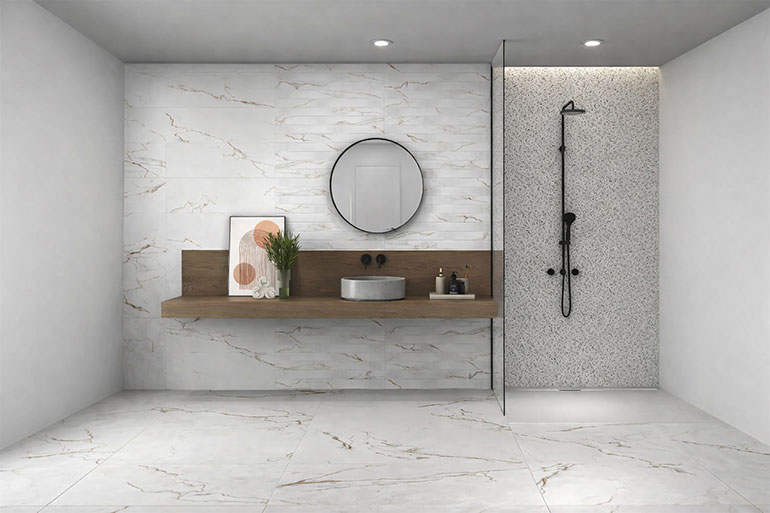
Designing a bathroom that feels new begins with the surfaces that frame the experience. Walls and Floors can influence the overall mood of the space. Clean and glossy finishes such as the white Basel Chex Arkos Wall Tile brightens up the room, allowing it to feel breathable. Grounding the area is the Saigres Porcelain Floor Tile, a matte-finished tile that’s available in four colors (gris, white, anthracite, and graphite) and whose subdued texture gives personality and a modern look. For those who wish to add depth without visual noise, the Emigres Alba Decor Wall Tile works as a thoughtful accent — with its matte-relief texture, it brings character while still being gentle on the eyes. Together, these elements create a space that feels refreshed yet calm, even within limited square footage.
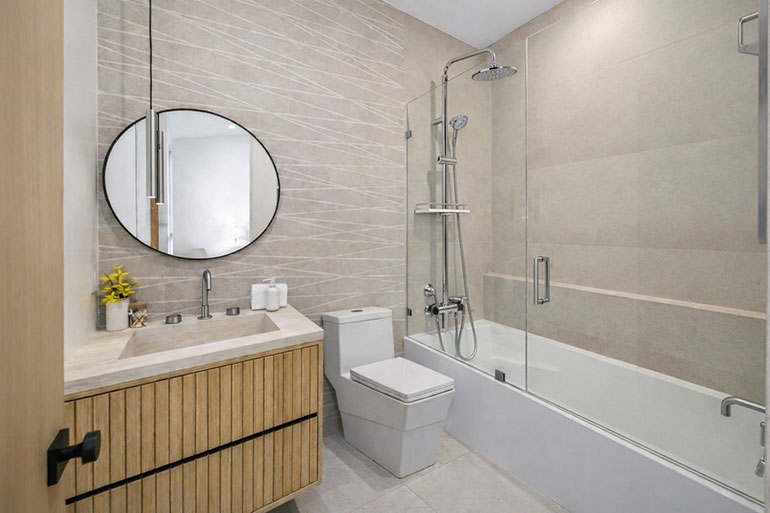
Attention naturally turns to the fixtures that define everyday comfort. Thoughtfully chosen sanitaryware brings quiet efficiency into the routine. The Pozzi Clove Watercloset with tank fittings and seat cover offers dependable functionality wrapped in a clean, modern form. Paired with it, the Pozzi Coldline Lavatory Faucet and the Sefa Exposed Shower Set, both visually pleasing with its classic design and glossy finish that feels sleek. Completing the setup is the Birke Leeds Recess Wall Shower and Bath Mixer, designed to blend shower and bath functions into one unit featuring a clean, minimalistic look that encourages a more pleasing bathing experience.

Tranquility is sustained through order, and storage plays a crucial role in maintaining that balance. The Pozzi Bathroom Cabinet keeps essentials tucked away, allowing space to remain uncluttered. Enhancing daily hygiene is the Sefa Hand Bidet Set, with its brass material and satin finish, it offers clean aesthetics beyond function. For those ready to fully embrace renewal this year, the Pozzi Cuboid Whirlpool Massage Tub transforms the bathroom into a personal haven where relaxation, restoration, and quiet moments take priority.
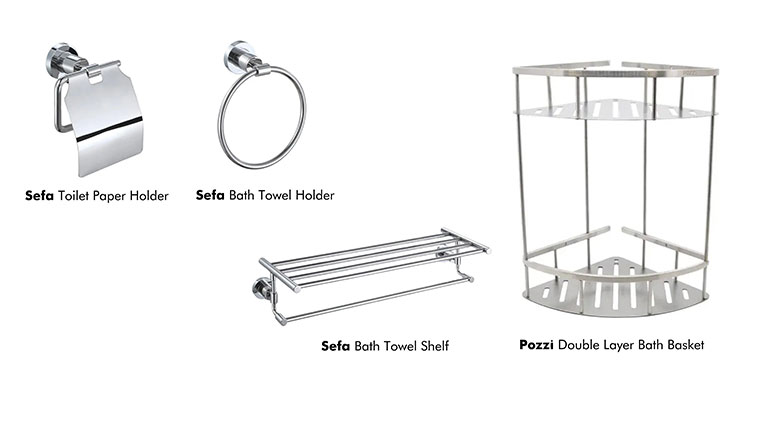
The space is completed through subtle yet intentional details. Accessories such as the Sefa Toilet Paper Holder, Sefa Bath Towel Holder, and Sefa Bath Towel Shelf contribute to functionality while maintaining visual harmony. The Pozzi Double Layer Bath Basket offers practical storage, ensuring everyday items remain accessible without disrupting the room’s clean lines. These complementary pieces work together quietly, reinforcing the sense of balance and ease within the space.

Renewal goes beyond resolutions — it’s about creating spaces that support how we live, rest, and recharge. Just as the holidays reminded us of the joy of gift-giving, the new year invites us to invest in ourselves and our homes.

At Wilcon Depot, bathroom revamp is more than just a design upgrade, it’s a fresh start — one that greets you every morning and welcomes you home every night. With modern, innovative, and carefully chosen essentials, your bathroom can reflect the new beginnings you want to embrace this year!

For more information about Wilcon, visit www.wilcon.com.ph or follow their social media accounts on Facebook, Instagram, and TikTok, or subscribe and connect with them on Viber Community, LinkedIn, and YouTube. Or you may contact the Wilcon Depot Hotline at 88-WILCON (88-945266) for inquiries.


Spotlight is BusinessWorld’s sponsored section that allows advertisers to amplify their brand and connect with BusinessWorld’s audience by publishing their stories on the BusinessWorld Web site. For more information, send an email to online@bworldonline.com.

Join us on Viber at https://bit.ly/3hv6bLA to get more updates and subscribe to BusinessWorld’s titles and get exclusive content through www.bworld-x.com.

Philippines revises Q3 GDP down to 3.9% from 4.0%

People flock to Divisoria ahead of the holiday season, Dec. 21, 2023. — PHILIPPINE STAR/WALTER BOLLOZOS

MANILA – The Philippines statistics agency has revised third quarter economic growth downwards to 3.9% from 4.0%, reflecting changes in the contributions made by sectors like real estate, electricity and food service activities, it said Wednesday.

Official fourth quarter gross domestic product (GDP) and full0tear numbers will be released on Thursday. — Reuters

Manila Water secures up to P27-B BDO loan facility for Wawa project

PRIMEINFRA.PH

Razon-led Manila Water Co., Inc. has secured a loan facility of up to P27 billion from BDO Unibank, Inc. to partially finance its acquisition of the Wawa bulk water supply project.

In a regulatory filing on Wednesday, Manila Water said the 15-year term loan facility will be used to fund the purchase of a 92.97% stake in WawaJVCo, Inc., the project’s operator.

Last year, Manila Water acquired the Wawa Bulk Water Supply Project from its parent firm Prime Infrastructure Capital, Inc. (Prime Infra) for P37.8 billion, giving the listed water concessionaire full ownership of the project.

WawaJVCo, a joint venture between Prime Infra and San Lorenzo Ruiz Builders & Developers Group, was formed to develop, operate, and maintain the Wawa Bulk Water Supply Project in Rizal province.

The project is a major raw water source infrastructure facility intended to help augment Metro Manila’s water supply, which remains largely dependent on Angat Dam. — Sheldeen Joy Talavera

Saudi won’t allow airspace to be used for military action against Iran, crown prince says

A Saudi flag flutters atop Saudi Arabia’s consulate in Istanbul, Turkey, Oct. 20, 2018. — REUTERS

SAUDI Crown Prince Mohammed bin Salman told Iranian President Masoud Pezeshkian that Riyadh will not allow its airspace or territory to be used for military actions against Tehran, state news agency SPA reported on Tuesday.

In a phone call with Mr. Pezeshkian, the crown prince affirmed his country’s support for any “efforts that would resolve differences through dialogue” to bolster security and stability in the region.

Earlier, Iranian media reported that Mr. Pezeshkian told the crown prince that Tehran welcomes any process, within the framework of international law, that prevents war.

The statement by the Saudi de facto ruler follows a similar statement by the United Arab Emirates that it would not allow any military action against Iran using its airspace or territorial waters.

Uncertainty over the possibility of military action in Iran has lingered after US President Donald Trump said last week that an “armada” was heading toward the country but that he hoped he would not have to use it.

Mr. Trump’s warnings to Tehran were against killing protesters or restarting its nuclear program, but the countrywide demonstrations have since abated.

A US aircraft carrier and supporting warships have arrived in the Middle East, two US officials told Reuters on Monday, expanding Mr. Trump’s capabilities to defend US forces, or potentially take military action against Iran.

Iran has been embroiled in protests during which rights groups say security forces killed thousands of people, including bystanders. The rights groups describe the unrest as the biggest crackdown since Shi’ite Muslim clerics took power in the 1979 revolution. Iranian authorities have blamed the unrest and deaths on “terrorists and rioters” backed by exiled opponents. — Reuters

Nicaraguan court finds long-time Ortega adviser guilty of money laundering

WIKIMEDIA COMMONS

A NICARAGUAN court declared Bayardo Arce, a long-time ally and economic adviser to President Daniel Ortega, guilty of money laundering, the Nicaraguan Attorney General’s Office said in a statement on Tuesday.

Mr. Arce, who was also one of the nine Sandinista commanders that governed the Central American nation in the 1980s, was found guilty alongside his personal assistant, Ricardo Bonilla. Mr. Arce’s wife and her brother, who are both in exile, were named as co-conspirators in the scheme.

Mr. Arce has been imprisoned for six months, after he was detained in July. The ruling against him comes three days after his family from exile told newspaper El Pais that he had been arrested without a warrant, held incommunicado and subjected to mistreatment, and now fear for his life due to his age and serious health conditions.

According to the family, Mr. Arce was not formally charged or brought before a judge. Nicaragua’s government has not said when or if Mr. Arce faced a trial, and on Tuesday did not provide a sentence.

Judges said the defendants ran a long-running $2.71 billion money-laundering scheme that involved tax fraud and used shell companies, bank accounts, and financial transactions to hide the origin and destination of funds.

Mr. Arce had been the last of the Sandinista commanders to back Mr. Ortega, who has increasingly been cracking down on dissidents and isolating the country from global diplomacy.

Relatives told El Pais that Mr. Arce is a political prisoner caught in an internal purge led by Mr. Ortega’s wife Rosario Murillo against figures seen as obstacles to a family succession of power.  Ms. Murillo now holds the role of co-president alongside Mr. Ortega.

Ms. Murillo, who also serves as the government’s spokesperson, did not immediately respond to a request for comment. — Reuters

Trump says Alex Pretti should not have carried gun that was allowed under Minnesota law

Masked law enforcement officers, including Immigration and Customs Enforcement agents, walk into an immigration court in Phoenix, Arizona, US, May 21, 2025. — REUTERS/CAITLIN O’HARA

US PRESIDENT DONALD TRUMP on Tuesday said Alex Pretti, the man fatally shot by a federal agent during a confrontation in Minneapolis, should not have been carrying a gun or fully loaded magazines, comments that put him at odds with gun rights groups and some Republicans.

Asked whether he agreed with administration officials who described Mr. Pretti as a domestic terrorist, Mr. Trump said: “I haven’t heard that, but certainly shouldn’t have been carrying a gun.”

Mr. Trump, speaking to reporters at an Iowa restaurant, later added: “He had a gun. I don’t like that. He had two fully loaded magazines. That’s a lot of bad stuff. And despite that, I’d say that’s…very unfortunate.”

Mr. Pretti, a licensed concealed-weapons holder, was killed on Saturday by federal agents during an immigration enforcement operation in Minneapolis. The shooting drew broad criticism and prompted a White House-ordered leadership shakeup.

Gun rights groups, including the influential National Rifle Association and Gun Owners of America, said Mr. Pretti was legally carrying a concealed gun. Bystander video of Mr. Pretti’s killing was widely shared, showing he never touched his gun before being shot and contradicting some Trump officials’ initial claims that he posed a threat to law enforcement.

“You absolutely can walk around with a gun, and you absolutely can peacefully protest while armed,” said Luis Valdes, a spokesman for the Gun Owners of America, a gun rights lobbying group. “It’s an American historical tradition that dates all the way back to the Boston Tea Party.”

“We are not happy,” Mr. Valdes said of Mr. Trump’s latest comments.

Gun rights groups are one of the Republican Party’s most loyal voting blocs. Such statements by Mr. Trump and other administration officials have opened a rift ahead of midterm elections in November.

Mr. Trump made his comments while greeting supporters at an Iowa restaurant before a scheduled speech on the economy. He said his border czar, Tom Homan, had met Minnesota Governor Tim Walz and was expected to meet Minneapolis Mayor Jacob Frey later on Tuesday.— Reuters

Visa outsourcing firm projects foreign visa applications increase by up to 7% in 2026

VFS Global Regional Head for North Asia Atul Lall. — ALMIRA S. MARTINEZ

VFS Global, a visa outsourcing and technology firm, said on Tuesday that visa applications from the Philippines are expected to grow by 5% to 7% year-on-year in 2026, as travelers’ confidence continues to improve.

“Given the current geopolitical situation… we still see application numbers in line with what we had forecasted, which is still slightly marginally higher than 2025,” VFS Global Regional Head for North Asia Atul Lall told reporters in an interview.

“We are optimistic to see at least a 5% to 7% growth going forward,” he added.

Data from the firm showed that the volume of visa applications from Filipino travelers increased by 8% in 2025 compared to the previous year.

The firm also noted the rising demand for personalized services in visa applications in the country as its Visa At Your Doorstep (VAYD) service showed a year-on-year improvement of 62%.

Through the doorstep visa service, applicants can complete their application process from the comfort of their homes or in their preferred locations.

The countries offered in the said service are Australia, Austria, Belgium, Croatia, the Czech Republic, Denmark, Finland, Germany, Greece, Hungary, Japan, Malta, the Kingdom of Saudi Arabia, Slovenia, Switzerland, Türkiye, the United Kingdom, and the Netherlands.

According to the UN Tourism, if the Asia-Pacific region recovers its 2019 tourist levels, global economic conditions remain favorable, and geopolitical conflicts do not escalate, international tourism could climb by 3% to 4% in 2026.

The Asia-Pacific region grew 6% last year but remains 9% below its 2019 level.

“When the world started to open up, I think there was a lot of revenge travel, so there was a significant increase between 2021 and 2023, but still, 2019 numbers were higher than 2023,” Mr. Lall said. “2024 was pretty much a slight increase, but not phenomenal.”

PHL travel trends

While popular destinations among Filipino travelers are Australia, Canada, Germany, Greece, Japan, the Kingdom of Saudi Arabia, Switzerland, the Netherlands, and the United Kingdom, the firm sees higher demand in short-distance travel.

“It’s more short-distance travel that we’re seeing the numbers increase, where there’s a lot of travel happening,” Mr. Lall said.

Like other travelers around the globe, Filipinos are exploring overseas destinations for leisure and quality time with loved ones.

“I think reasons for travel normally are either a vacation, family, or new destinations. So I think those will never change, those will continue to be the same,” the firm’s regional head said.

“The willingness to travel has been and always has been and will be there, and that’s why our business needs that kind of momentum that we are talking about,” he added.

VFS Global caters to 33 sovereign governments, including Australia, Canada, Germany, Italy, Japan, and New Zealand, among others, through 61 visa application centers in eight cities nationwide. — Almira Louise S. Martinez

Trade deficit narrows to 4-year low in 2025

A truck is loaded with a container at the Manila International Container Terminal at the Port of Manila in Manila, Philippines, Aug. 11, 2025. REUTERS/Eloisa Lopez

By Abigail Marie P. Yraola, Deputy Research Head 

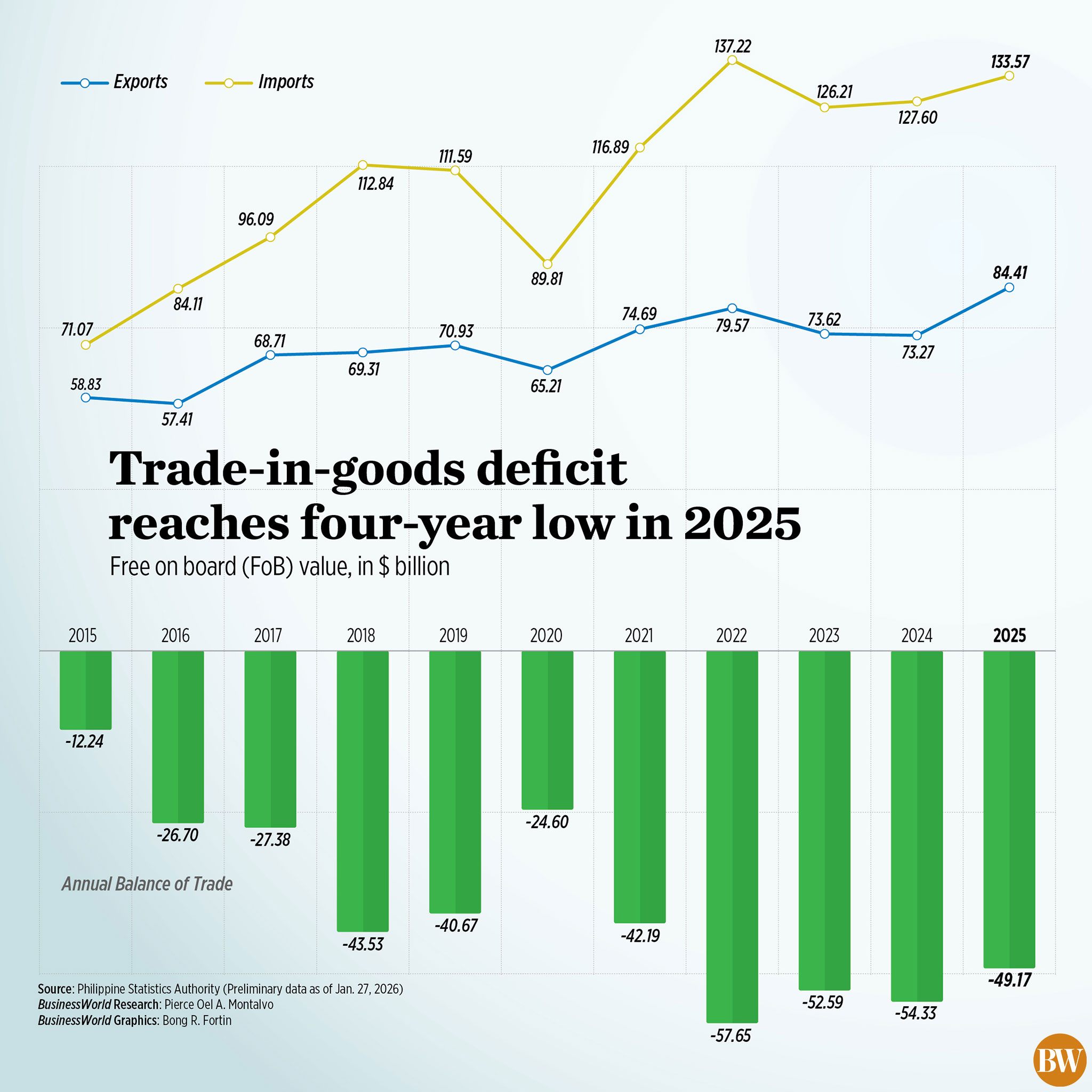
THE Philippines’ trade-in-goods deficit narrowed to a four-year low in 2025, as exports rose by double-digits and import growth remained muted, the Philippine Statistics Authority (PSA) reported on Tuesday.

Analysts said that the narrower trade deficit may have helped provide a modest lift to gross domestic product (GDP) growth in 2025.

Preliminary data from the PSA showed the country’s trade deficit fell by 9.5% year on year to $49.17-billion deficit in 2025, smaller than the $54.33-billion gap a year earlier.

This was the smallest trade gap in four years or since the $42.19-billion deficit in 2021.

Merchandise exports climbed by 15.2% to $84.41 billion last year, better than the government’s projection of a 2% decline. The rise in exports was a turnaround from the 0.5% contraction in exports in 2024.

Meanwhile, imports grew by 4.7% year on year to $133.57 billion in 2025, faster than the 3.5% growth expected by the government for the year. This was also faster than the 1.1% gain in 2024.

The trade deficit in 2025 shrank year on year due to better-than-expected exports performance and subdued appetite for imports, Marco Antonio C. Agonia, an economist at the University of Asia and the Pacific, said in an e-mail.

“On the exports side, trade uncertainties encouraged export frontloading to duck erratic tariff announcements, [and were] also helped by a weakened peso making exports more cost-competitive,” he said.

Weak domestic demand, following the corruption scandal and consecutive natural disasters, coupled with a depreciated peso, dampened imports, he added.

Miguel Chanco, chief emerging Asia economist at Pantheon Macroeconomics, said the narrowing trade deficit is due to a genuine recovery in exports, which grew by 15% overall compared to the previous year.

“In the second half of 2025, though, this consolidation was helped more by imports underperforming quite considerably, which is great for the trade balance but bad for what it says about the Philippine economy, given that it’s mainly domestic demand driven.”

George T. Barcelon, chairman of the Philippine Chamber of Commerce and Industry (PCCI), said that as the US introduced reciprocal tariffs, orders were held up as businesses were uncertain about how to proceed and what tariff rates would apply.

“At least 19% (tariffs) were considered one of the medium lows on tariffs. So, business continues,” he said in a phone interview.

The United States imposed a 19% reciprocal tariff on Philippine goods beginning Aug. 7.

DEFICIT IN DECEMBER
In December, the trade-in-goods deficit narrowed to $3.52 billion from the $4.15-billion gap in the same month in 2024, declining by 15%.

It was the smallest trade balance in 10 months or since the $2.97 billion logged in February 2025.

Total outbound sales of Philippine-made goods jumped by 23.3% year on year in December to $6.99 billion, faster than the 21.6% growth in November and a turnaround from the 1.9% drop in the same month in 2024.

It was the quickest pace for exports in six months or since the 26.9% increase in June last year.

By value, December export haul was the highest in two months or since the $7.45 billion posted in October 2025.

On the other hand, merchandise imports rose by 7.1% year on year to $10.52 billion in December, faster than the 2.3% gain in November and a turnaround from the 1.4% contraction in the same month in 2024.

The import bill was the smallest in 10 months or since the $9.76 billion in February.

For Mr. Agonia, the smaller trade deficit may provide a slight boost to the fourth-quarter and full-year GDP figures, but unlikely to overturn the effect of lower government spending and weak investor and consumer confidence following the corruption scandal.

The PSA will be reporting the fourth-quarter and full-year GDP data on Jan. 29, Thursday.

EXPORTS REBOUND
By major type of goods, manufactured goods, which made up 80.1% of the total exports, climbed by 15.8% to $67.62 billion in 2025.

By commodity, electronic products, which accounted for more than half of total exports (54.4%) jumped by 17.6% to $45.96 billion last year.

Semiconductors, a subset of electronic products and accounted for the bulk of electronic product sales, rose by 18.7% to $34.62 billion.

“Exports staged a strong rebound in 2025, far outpacing the growth in imports on the back of robust demand for semiconductors,” Chinabank Research said in a research note.

It said exports saw a recovery in 2025 after two years of decline, despite initial concerns that exports would face challenges amid an uncertain global trade environment.

Chinabank Research said overseas demand for semiconductors remained the key driver of exports’ robust year-end performance.

“Global requirements tied to AI (artificial intelligence), electric vehicles, and data centers are expected to continue supporting demand this year,” it added.

Meanwhile, other manufactured goods surged by 31.1% last year to $6.13 billion, followed by machinery and transport equipment which rose by 34.3% to $3.55 billion.

In 2025, the United States was the top export destination for locally made products with a 15.9% share worth $13.44 billion.

It was followed by Hong Kong, which accounted for a 14.6% share ($12.32 billion), Japan with 13.7% share ($11.57 billion), China with 11% share ($9.3 billion) and the Netherlands with 4.3% share ($3.6 billion).

MUTED IMPORT GROWTH
Raw materials and intermediate goods, which made up the bulk of the country’s total imports (36.1% share) rose by 3.7% to $48.21 billion in 2025.

Imports of capital goods grew by 13.2% to $40.45 billion in 2025, while consumer goods jumped by 7.3% to $27.71 billion.

By import commodities, electronic products which made up 23.9% of the country’s total imports made up most of the manufactured goods. It rose by 16.7% to $31.94 billion in 2025.

Imports of semiconductors increased by 20.1% to $22.22 billion in 2025.

On the other hand, imports of mineral fuels, lubricants and related materials contracted by 12.5% to $16.69 billion. This accounted for 12.5% share in the country’s total imports.

Imports of transport equipment went up by 10.5% to $12.55 billion last year from $11.36 billion in 2024.

In 2025, China was the country’s biggest source of imports with a 28.6% share worth $38.22 billion. South Korea followed with a 7.9% share ($10.58 billion), Japan with a 7.9% share ($10.52 billion), Indonesia with a 7.6% share ($10.16 billion) and the United States with 6.1% share ($8.11 billion).

“Trade statistics will likely normalize heading into 2026,” Mr. Agonia said as ongoing geopolitical and trade uncertainties continue to weigh on global growth prospects, while base effects from the previous year’s outcomes may impact this year’s trade performance.

Chinabank Research said the country’s export performance this year will likely to be supported by sustained demand for chips related to advanced technologies.

“However, the volatile global landscape — amid renewed US tariff threats and geopolitical tensions — poses a risk to external demand,” it said.

Mr. Chanco said that it will be difficult for the Philippines to replicate the strong growth in exports this year, “with global growth set to slow further and with the imposition of higher US tariffs in the middle of last year likely to be felt more fully.”

“High base effects from the front-loading of shipments to the US, pre-tariff, will act against headline export growth this year,” he added.

BIR resumes tax audits

Finance Secretary Frederick D. Go and Bureau of Internal Revenue (BIR) Commissioner Charlito Martin R. Mendoza on Tuesday announced the resumption of tax audits. — AUBREY ROSE A. INOSANTE

THE BUREAU of Internal Revenue (BIR) is resuming the issuance of letters of authority (LoA) and mission orders after a two-month suspension triggered by complaints these were being misused and weaponized.

“We are lifting the suspension of issuing letters of authority, mission order and field audits with reforms in place,” Finance Secretary Frederick D. Go said at a briefing on Tuesday.

BIR Commissioner Charlito Martin R. Mendoza said the suspension of all field audits and related operations since Nov. 24 had allowed the agency to review audit procedures, consult stakeholders, and implement reforms.

“That review has now been completed. We are lifting the suspension because key reforms are in place,” Mr. Mendoza said at the same briefing.

The LoA is a document from the BIR that allows an examiner to inspect taxpayer accounts. It is required before any tax audit can proceed.

The Marcos administration had issued 82,228 LoAs from January until Nov. 3 in 2025, BIR data showed. This was nearly double the volume in 2022.

Mr. Go said the comprehensive review led to concrete reforms to make tax audits fairer, more predictable, and more accountable.

“These changes align with the administration’s big, bold reforms to improve the ease of doing business and strengthen trust in government,” he said. “As audits resume, we urge taxpayers and the public to actively participate in implementing these reforms.”

The BIR is set to issue a memorandum circular formalizing the end of the suspension, backed by the Technical Working Group on Assessment Integrity and Audit Reform’s tweaked rules and process.

As tax audits resume, Mr. Mendoza said businesses should no longer fear these documents will be weaponized, as additional safeguards are in place to protect taxpayers.

“With all the new reforms that will be in place now with the lifting of the audit suspension, we are confident that the conduct of audits will now be more transparent and controlled and with clearer oversight,” he said.

These reforms include adopting a single-instance audit framework. This generally limits each taxpayer to one LoA per taxable year and the consolidation of multiple audit authorities into a single LoA.

In addition, the BIR chief said the agency will shut down operations of the value-added tax audit service and VAT audit units, as well as disband existing audit task forces.

“Audit authority will now be limited to the regional offices and the large taxpayers’ service,” Mr. Mendoza said.

He also said taxpayers will be able to verify the authenticity of their LoAs through the BIR website using the REVIE chatbot.

Mr. Mendoza said taxpayers will now have reasonable options regarding the manner and venue of record examinations, particularly when documents are voluminous and transporting them would be impractical, burdensome, or disruptive.

“We have strengthened documentation, verification, and oversight, and are launching an Audit Auditor Program to ensure revenue officer accountability,” he said.

At the same time, Mr. Mendoza said that the actual collection from the LoA accounts for 2-3% of the agency’s overall intake, while the rest comes from voluntary compliance.

Mr. Go earlier noted that the BIR could not indefinitely suspend the use of LoAs, making it crucial to meet its revised P3.431-trillion revenue target for 2026.

The BIR collected P3.11 trillion in 2025, falling short of its full-year target of P3.22 trillion. — Aubrey Rose A. Inosante

SEC imposes strict 9-year limit for independent directors

BW FILE PHOTO

By Alexandria Grace C. Magno

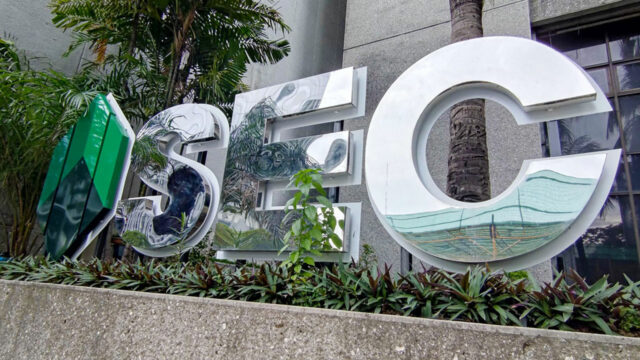
THE SECURITIES and Exchange Commission (SEC) is imposing a maximum cumulative nine-year term limit for independent directors of publicly listed companies starting in February, a move that will boost board independence, analysts said.

SEC Memorandum Circular No. 7, which was signed by SEC Chairperson Francisco Ed. Lim on Jan. 26, stated that an independent director is elected for a one-year term and can only serve for a maximum cumulative term of nine years in the same listed company.

The circular will take effect on Feb. 1 after publication in two newspapers of general circulation.

Independent directors who were elected before the effectivity of the circular will also be covered by the nine-year limit, starting from calendar year 2012.

For continuous or consecutive service, the nine-year term limit will end on the date of the annual stockholders’ meeting or on another date approved by the SEC.

In cases of intermittent service, the independent director’s total tenure must still not exceed nine years.

Under the circular, if an independent director becomes a non‑independent director or an officer of the company within the nine‑year limit, that person may only be reappointed as an independent director after a two‑year cooling‑off period starting from the date they stop serving in the non‑independent role.

If an independent director serves more than six months, the term will be considered one full year.

All independent directors that have reached the nine-year limit will be “barred perpetually” from re-election as an independent director of the same company. However, the person can still serve as a non-independent director or officer of the same company without a cooling off period.

Incumbent independent directors that have served the maximum nine-year limit at the time of the circular issuance may continue to serve until the company’s 2026 annual stockholders’ meeting.

Under the previous rules, persons can serve as independent directors for up to nine years, but companies may apply for exemptive relief to extend their term.

The new SEC circular removes the flexibility of companies to seek exemptive relief.

Companies that exceed the maximum cumulative term limit for an independent director may face a basic penalty of P1 million per violation, plus P30,000 for each month that the director remains in office beyond the allowed term, in addition to other sanctions under existing laws.

A third or succeeding offense for the same violation may lead to the suspension or revocation of the company’s primary or secondary license.

STRONGER GOVERNANCE
Meanwhile, analysts said the tighter rules on independent directors’ term limits will enhance board independence and strengthen governance over time. In the near term, however, they noted this could spark changes in boards of listed firms ahead of the annual stockholders’ meetings this year.

“The term limit for independent directors is a major step to strengthen corporate governance. It will prevent director entrenchment that could affect perceived independence. The limit will likewise open corporate boards to new members with fresh ideas and perspectives,” China Bank Capital Corp. Managing Director Juan Paolo E. Colet said in a Viber message.

Toby Allan C. Arce, head of sales trading at Globalinks Securities and Stocks, Inc., said the cap will ensure directors are really independent and avoid issues like too much familiarity, management capture, and passive oversight.

“It also accelerates board refreshment, which can enhance diversity in skills, age, gender, and professional background,” he said in a Viber message.

Mr. Arce noted that the policy forces companies, especially large conglomerates and banks, to balance director independence with preserving institutional memory, as losing experienced independent directors risks weakening boards if succession isn’t planned ahead.

“Companies that treat this as an opportunity to redesign board composition — rather than merely comply — are likely to emerge with stronger oversight frameworks and clearer role definitions between executive, non-executive, and independent directors,” he said.

BDO Securities President John Tristan D. Reyes said the new rules will help bring in new perspectives and skills as new independent directors are appointed to boards of listed firms.

“In the short term, however, it may create challenges for companies that depend on long‑serving directors with deep knowledge of their business, especially in more complex or regulated sectors,” he said. “As companies prepare for the 2026 annual stockholders’ meetings, many will speed up succession planning, adjust board composition, and provide more detailed disclosures on their refresh plans. Some may face continuity issues if several long‑tenured directors need to step down at the same time,” he added.

Mr. Colet, however, called on the commission to go further, emphasizing that much more can be done to enhance public companies’ governance.

“For example, public shareholders should have a greater say in electing independent directors. This can be done through a requirement that an independent director must also receive a majority of the votes cast by public shareholders, or through a rule that at least one independent director should be elected solely by public shareholders,” he said.

Mr. Arce said investors will also likely scrutinize not just rule compliance but also whether replacement directors bring relevant expertise, genuine independence, and real board influence.

“Poorly executed transitions could raise red flags, while thoughtful board renewal could strengthen investor confidence,” he said.

Car sales may reach 503,000 in 2026, says CAMPI

Former Chamber of Automotive Manufacturers of the Philippines, Inc. (CAMPI) President Rommel R. Gutierrez (left) shakes hands with the new CAMPI President Jose Maria M. Atienza on Tuesday. — JUSTINE IRISH D. TABILE

By Justine Irish D. Tabile, Reporter

CAR SALES are expected to breach 500,000 this year, driven by rising demand for electrified vehicles (EVs) and multi-purpose vans, according to the Chamber of Automotive Manufacturers of the Philippines, Inc. (CAMPI).

“We see that there’s a big chance that the market can reach 500,000 this year. That’s around a 2% to 2.5% increase,” said Jose Maria M. Atienza on the sidelines of the CAMPI president turnover ceremony on Tuesday.

“We’re pegging it at around 503,000,” he added. “But again, it would depend on how the market grows coming from the trend.”

Auto industry data showed that 491,395 vehicles were sold in 2025, up 3.7% from 473,842 in 2024. This includes sales of CAMPI and Truck Manufacturers Association, Inc. (TMA) members which reached 463,646 in 2025, down 0.8% from 467,252 units sold in 2024.
“For CAMPI and TMA, same as our projection for industry, around 2%,” Mr. Atienza said.

Mr. Atienza said that the outlook reflects the conservative optimism of the industry after seeing a sales decline in the second half of 2025.

“Right now, we are just accepting the reality of what happened during the second half but are still positive that at least we will bottom out and then see some growth,” he said. “But we are very hopeful that the market will reach 500,000 units.”

In particular, he said that the imposition of excise tax on pickup trucks has resulted in a decline in the segment’s sales, especially in the second semester.

“There was a big reduction in our pickup sales because of the change in excise tax structure. So, there’s a big, actually, there’s a 20% drop in pickup sales in the second half compared to maybe the same period in the previous year,” he added.

Mr. Atienza said industry sales growth this year will be driven by demand for EVs as well as multi-purpose vehicles.

“EVs have improved and increased in terms of sales. We also saw some good segments, such as multi-purpose vehicles like L300s and Tamaraws. I think there was a 70% increase,” he said.

“So, there are growth areas in the market. And again, it would just depend on when it will grow. It is a very sound market, and it would depend on when the customers would again have the confidence to purchase more vehicles,” he added.

Data from CAMPI and TMA showed that 32,489 EVs were sold in 2025, accounting for 7.01% market share. Including other available industry data, CAMPI said that EV sales hit 58,905 units last year, which reflect 12% market share.

“We see this growth [continuing]. But of course, it is just a matter of customer preference and how ready we are. But I think we already saw the increase in hybrid and EV sales in 2023, and it continued into last year,” he said.

“And we are quite positive that with the introduction of additional models, this trend would still continue for EVs,” he added.

He also said that the group is expecting some improvement in the passenger car segment after CAMPI members saw a 23.1% drop in passenger car sales to 92,924 in 2025 from 120,770 in 2024.

“It would depend on how much individual brands can introduce new models. There are cycles of demand, again depending on the model introduction,” he said.

Meanwhile, Mr. Atienza said that the group is hoping the government will implement the Revitalizing the Automotive Industry for Competitiveness Enhancement program.

“We all know how important it is for automotive manufacturing. And we are always here to work with the government and concerned agencies on how to make sure that this is finally implemented,” he said.

“I am sure there are many stakeholders also, not only CAMPI, but individual members and even the parts makers and suppliers who really want to see this program through and finally implemented,” he added.

To further attract car manufacturing, he said that the government must pursue initiatives that will make the country more competitive in terms of cost.

“We have a good cost structure, but there are some areas in cost that are not as favorable. So, that is where collaboration with the agencies should come in on how to make the Philippines a good environment for investments,” he added.

On Tuesday, CAMPI held a ceremonial turnover for its new president, Mr. Atienza, who is also the executive vice-president of Toyota Motor Philippines Corp.’s marketing division. He took over from Rommel R. Gutierrez.

Gov’t eyes emerging tech board at PSE as 15 firms signal interest

PHILIPPINE STAR/EDD GUMBAN

By Justine Irish D. Tabile, Reporter

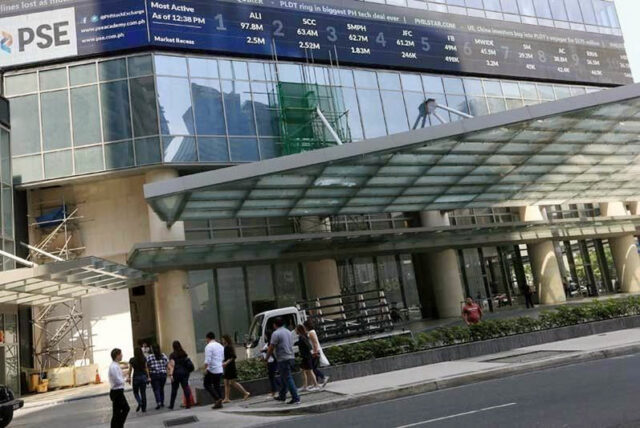
THE government is exploring the creation of an emerging technology board at the Philippine Stock Exchange (PSE) to allow high-growth technology firms to access public capital, the Department of Information and Communications Technology (DICT) said.

DICT Secretary Henry R. Aguda said he is working with the PSE, the Securities and Exchange Commission (SEC), and the Department of Trade and Industry (DTI) to establish the board.

“So, we’re still conceptualizing,” he told reporters on Monday, noting that the board’s design will be inspired by the Nasdaq-style technology board, a US-based exchange known for listing high-growth technology companies and innovation-driven firms.

“We started talking about it last year… Right now, we are still doing the technical evaluation,” he added.

Mr. Aguda said the board aims to advance President Ferdinand R. Marcos, Jr.’s vision of making the capital market more accessible.

“Second, we should have an honest-to-goodness technology stock market because, in other countries, it is the technology that’s driving the [market],” he said. “So, we should do the same.”

He added that the government plans to finalize policy for the emerging technology board this year.

“Realistically, we can complete it this year. Hopefully by the first half,” he said.

The proposal has received support from PSE President and Chief Executive Officer Ramon S. Monzon and SEC Chairperson Francisco Ed. Lim.

“The two of them combined are very progressive. So, I think it is going to move fast,” Mr. Aguda said.

On the board’s regulatory framework, Mr. Aguda noted that the agencies have yet to define specific rules on public float, minimum market capitalization, and other listing requirements.

He said several Philippine technology companies are already preparing for potential listings.

“So, there are 15 companies that have signified interest… but of course, we do not expect all of them to list; interest is different from actually listing. So, 15 companies and counting,” he said.

China Bank Capital Corp. Managing Director Juan Paolo E. Colet described the board as a “promising concept.”

“Depending on how it is designed, the new board could potentially encourage local emerging technology companies to list on the PSE for fundraising,” he said in a Viber message.

He noted that the targeted companies would benefit from more flexible listing, disclosure, and corporate governance requirements.

“Moreover, it would help if the government would create or sponsor a public-private fund that will invest in PSE-listed technology companies to spur the growth of the sector,” he added.

Toby Allan C. Arce, head of sales trading at Globalinks Securities and Stocks, Inc., said the board could address “structural weaknesses that have long weighed on the Philippine stock market.”

“At its core, such a board could lower the barriers for high-growth, innovation-driven companies to access public capital by offering more flexible listing requirements, valuation frameworks, and disclosure rules that better reflect the realities of tech and digital businesses,” he said in a Viber message.

He added that conservative listing standards have discouraged fast-growing firms from going public locally.

“By broadening the type of companies that can list, the local course could become more representative of the modern economy rather than being dominated by mature conglomerates and traditional sectors,” Mr. Arce said.

He said the board could also attract younger investors, foreign funds, and domestic capital currently on the sidelines.

“Even a small number of credible tech listings could help re-rate market sentiment by shifting perceptions of the PSE from a low-growth, dividend-focused exchange to one with longer-term capital appreciation potential,” he said.

However, he cautioned that the board’s success will depend on execution and credibility, with investors expecting strong governance, clear risk disclosures, and robust regulatory oversight.

“If the board is perceived as a dumping ground for weak or speculative issuers, it could damage confidence rather than enhance it,” he said.

“Coordination among regulators will therefore be crucial to ensure consistent rules on disclosure, investor sustainability, and post-listing compliance, while allowing enough regulatory innovation to support new business models,” he added.

Meanwhile, the DICT on Monday signed a memorandum of understanding with the Intellectual Property Office of the Philippines to strengthen support for digital infrastructure innovations through a responsive and robust intellectual property system.

Under the partnership, the two agencies will work together to enhance the technical capacity of examiners who assess and manage innovations in artificial intelligence, blockchain, the Internet of Things, big data, and other emerging ICT fields.