Home Blog Page 24

ARTA says data centers critical to improving government services

STOCK PHOTO | Image by Wirestock from Freepik

THE Anti-Red Tape Authority (ARTA) said data centers will play a crucial role in supporting improvements to government services as well as the growth of the digital economy.

“We recognize that our digital economy is expanding and that the demand for data centers in the Philippines is growing rapidly,” ARTA Director General Ernesto V. Perez said at a forum on Monday.

He said however that the permit process is proving to be a challenge in setting up such centers.

“The development of data centers continues to face not just technical but systemic challenges in the permitting process that slows progress and increases costs,” Mr. Perez noted.

The Philippine digital economy is projected at between $70 billion and $140 billion in gross merchandise by 2030, according to a November report by Google, Temasek Holdings, and Bain & Co.

Mr. Perez cited the importance of data centers, communication towers, and fiber optic cables as the government seeks to digitalize public services.

He said Executive Order (EO) No. 32 will help address delays in expanding internet and mobile services.

The EO seeks to “institutionalize a set of streamlined guidelines for the issuance of permits, licenses, and certificates for the construction of telecommunications and Internet infrastructures to ensure the continuous development of the country’s digital infrastructure.”

The EO resulted in the reduction of the time to energize a telecommunications tower to 29 days, down 80.13%, Mr. Perez said.

The Philippine data center market was projected at $2.37 billion by 2031 from a base of about $850 million in 2026, according to Modor Intelligence, an Indian market research firm. — Beatriz Marie D. Cruz

Domestic trade hits P3.34 trillion in 2025

PNA PHOTO BY JOEY O.RAZON

THE domestic trade in goods surged to P3.34 trillion in 2025, after the Philippine Statistics Authority (PSA) started incorporating new data on goods transported by land.

In 2024, the revised total had been P1.31 trillion, which included only goods transported by water and air.

By volume, domestic trade was 60.19 million tons, more than double the 30 million tons reported in the previous year, the PSA said, citing preliminary data.

The PSA noted that the addition of road transport data to the Commodity Flow Survey during the first quarter of 2025 makes the year’s reading of limited value in making year-on-year comparisons.

Commodities traded during the year that were transported via road accounted for P1.8 trillion.

Domestic trade by value is the outflow value of commodities transported from the place of origin to destination.

Calabarzon posted the largest outflow value of traded goods in 2025 with P714.85 or a 21.4% share of all trade. Inflows totaled P437.45 billion.

The National Capital Region booked P556.21 billion in outflows or 16.7% of the total, and P655.89 billion in inflows.

Northern Mindanao accounted for 16.4% of total domestic value with P547.21 billion.

The top three regions with positive domestic trade balances were Calabarzon with P277.40 billion, followed by Northern Mindanao with P262.77 billion, and Central Luzon with P219.48 billion. — Pierce Oel A. Montalvo

DTI urges exporters to comply with new EU food testing rule

REUTERS

THE Department of Trade and Industry (DTI) said exporters need to begin testing food shipments for mineral oil aromatic hydrocarbon (MOAH) content to prepare for European Union (EU) rules coming into force in the new year

In a statement on Monday, the DTI said an EU regulation capping MOAH levels in various food products takes effect on Jan. 1, with coconut products from the Philippines likely to be the commodity most affected.

“Exporters are advised to begin MOAH testing, review processing and packaging practices, and coordinate closely with EU buyers on compliance requirements,” the DTI said.

The rule amended Regulation (EU) 2023/915, in the wake of health concerns raised about MOAH, which could be introduced into food products by processing equipment, lubricants, packaging materials, or transport.

“Noncompliant products may face EU border rejection or market withdrawal,” the DTI said.

Likely to be affected are coconut oil, desiccated coconut, coconut milk and cream, and processed foods containing coconut ingredients.

Coconut oil is the Philippines’ top agricultural export generating $2.87 billion in revenue last year, according to the DTI.

Other Philippine exports that could be affected are cereals and grains; milk and dairy products; cocoa beans and cocoa products; confectionery items; food additives; food supplements; and other processed and compound foods containing the above ingredients.

The European Commission (EC) has designated MOAH as a genotoxic carcinogen.

“Maximum levels for MOAH in food should therefore be set to ensure a high level of human health protection,” the EC said.

“Those maximum levels should apply regardless of the source of the contamination, which means that they should apply to contaminations that were originally present in raw materials or ingredients or that occurred during the production process, transport, and packaging,” it noted. — Beatriz Marie D. Cruz

When oil prices explode, is your Transfer Pricing still arm’s length?

Global oil prices have once again surged, driven by escalating conflict in the Middle East, attacks on critical energy infrastructure, and disruptions to key shipping routes such as the Strait of Hormuz. Rising fuel and power costs quickly translate into higher manufacturing expenses, increased logistics and freight charges, and mounting operational costs across supply chains. For Philippine entities that are part of multinational groups, this commercial reality inevitably raises a critical tax question: when external shocks fundamentally change the cost structures and profitability, can existing intercompany pricing arrangements still be considered arm’s length?

This question is not unfamiliar to businesses. Only a few years ago, the COVID-19 pandemic forced businesses and tax authorities alike to confront similar issues. Pricing models designed for stable economic conditions suddenly failed to reflect reality. Lockdowns disrupted supply chains, demand patterns shifted overnight, and many entities, particularly those characterized as “routine” or “limited risk” experienced losses or severe margin erosion. The pandemic served as a stress test for transfer pricing frameworks, revealing how vulnerable static policies can be when markets become anything but normal.

During the pandemic, Philippine taxpayers learned that contractual labels alone offered little protection. Entities described as limited risk were nonetheless questioned when they incurred losses, while benchmarking analyses based on pre-pandemic data were challenged for lacking relevance. Tax authorities focused less on how transactions were described on paper and more on how businesses actually operated during the crisis. Perhaps the most important lesson from that period was the growing importance of narrative. Taxpayers who could clearly explain why their results deviated from historical norms, grounded in commercial reality, were far better positioned to defend their outcomes than those who relied solely on numbers.

Today’s oil price shock revives many of the same issues, although under a different set of circumstances. Unlike the pandemic, which constrained economic activity, rising oil prices exert upward pressure on costs across almost every industry. Manufacturing entities must pay more for energy, distributors contend with fuel surcharges and transport volatility, and shared service centers must absorb increased power consumption expenses. These cost increases often occur suddenly, while intercompany pricing arrangements are typically set on an annual basis, creating a timing mismatch that strains existing transfer pricing models.

A key question, therefore, is whether the current environment can be considered an extraordinary market condition. While transfer pricing guidelines do not define such circumstances precisely, they do recognize that economic conditions affecting comparability must be taken into account. War-driven energy price spikes share many characteristics with the COVID-19 crisis: they are external, systemic, unpredictable, and largely beyond the control of individual operating entities. Treating these conditions as if they were part of normal market fluctuations risks applying the arm’s length principle in a purely mechanical manner, separated from commercial reality.

One of the most immediate transfer pricing issues arising from oil price volatility is whether existing intercompany prices remain arm’s length. Many Philippine subsidiaries operate under cost-plus or fixed markup arrangements that assume relatively stable cost bases. When fuel, power, and logistics costs surge, maintaining the same markup may result in sharply reduced margins or even losses. While the arm’s length principle does not guarantee profitability, persistent deviations from expected returns inevitably draw scrutiny, particularly when comparable companies appear to remain profitable.

This leads to a second issue: can routine or limited risk entities absorb oil-related cost increases without adjusting prices? From a tax authority’s perspective, there is an inherent tension. On one hand, absorbing significant cost increases may suggest that the entity is bearing risks inconsistent with its characterization. On the other hand, passing through costs without contractual support or functional justification may appear artificial. The issue is not whether costs have increased but rather who, under arm’s length conditions, should bear the economic burden of those increases.

Benchmarking analyses further complicate matters. Oil price volatility tends to widen profit dispersion among comparable companies, resulting in broader interquartile ranges and a higher incidence of loss-making comparables. Businesses are once again faced with difficult judgement calls: whether to include loss-making companies, whether multiyear averages remain meaningful, and whether current-year data better reflect economic reality. These are precisely the debates that emerged during COVID-19 audits, underscoring the cyclical nature of transfer pricing challenges during periods of crisis.

At the heart of many disputes lies the issue of risk allocation. Modern transfer pricing principles emphasize that risks should be allocated to entities that exercise control over those risks and have the financial capacity to bear them. In practice, oil price risk is often influenced by strategic decisions relating to sourcing, logistics, hedging, and pricing, decisions typically made at the group or regional level rather than by a Philippine subsidiary. When a local entity absorbs losses arising from oil price shocks despite lacking control over these decisions, questions inevitably arise as to whether the pricing outcome aligns with economic reality.

From the perspective of the Bureau of Internal Revenue, these developments are likely to translate into familiar audit questions. Why did profitability decline despite a routine characterization? Why were markups not adjusted in response to rising costs? Why do comparable companies remain profitable while the taxpayer does not? Experience from COVID-19 audits suggests that weak documentation often aggravates these issues. Generic references to “higher costs,” unsupported assertions of extraordinary circumstances, and benchmarking studies carried over unchanged from prior years all undermine a taxpayer’s position.

Practical defense strategies, therefore, must go beyond numerical adjustments. Pricing outcomes must be aligned with actual conduct, and transfer pricing documentation must clearly explain how oil price volatility affected operations, costs, and margins. Taxpayers should document not only the existence of higher costs but also their inability to control or mitigate those costs and the commercial rationale for any temporary deviation from target returns. The experience gained during the pandemic can serve as a useful template, but it must be adapted to reflect the distinct nature of energy-driven shocks rather than health-related disruptions.

Ultimately, the current oil price explosion does not suspend the arm’s length principle. Instead, it tests how faithfully that principle is applied under pressure. The lesson from COVID-19 remains relevant: arm’s length outcomes are not defined by stable margins or rigid adherence to historical benchmarks but by economically rational behavior supported by credible, well-articulated documentation. For Philippine taxpayers, oil price volatility is not merely an operational challenge. It is a transfer pricing risk that demands proactive management, thoughtful analysis, and a narrative firmly grounded in commercial reality.

Let’s Talk TP is a weekly newspaper column of P&A Grant Thornton that aims to keep the public informed of various developments in taxation. This article is not intended to be a substitute for competent professional advice.


Nikkolai F. Canceran is a partner from the Tax Advisory & Compliance division of P&A Grant Thornton, the Philippine member firm of Grant Thornton International Ltd.

pagrantthornton@ph.gt.com

Marcos launches Cavitex-C5 Link as House minority calls for clear action

An attendant updates the fuel prices at a gas station in Cubao, Quezon City, March 10, 2026. — PHILIPPINE STAR/MIGUEL DE GUZMAN

By Chloe Mari A. Hufana and Erika Mae P. Sinaking, Reporters

PRESIDENT Ferdinand R. Marcos, Jr. on Monday inaugurated a road link connecting key corridors in Metro Manila, framing the project as a way to curb fuel consumption by easing congestion as higher global oil prices strain households and businesses.

The two‑kilometer Manila-Cavite Toll Expressway (Cavitex)-C5 Link Segment 3B is expected to cut travel time between Parañaque City and Taguig City to about 15 minutes from as long as 90 minutes, reducing stop‑and‑go traffic that increases fuel burn and vehicle operating costs.

“This will result in significant savings on gasoline and fuel,” Mr. Marcos told reporters in Filipino, according to a transcript released by the Presidential Palace.

The Philippines, a net oil importer, remains vulnerable to supply disruptions stemming from the Middle East war. Local fuel prices have been climbing since the war involving Iran erupted, with energy officials warning that elevated prices could persist.

The toll segment is expected to serve about 36,000 vehicles daily and divert traffic from secondary roads linking southern Metro Manila. To ease immediate cost pressures on motorists, the President said the entire CAVITEX network would remain toll‑free until the end of April, citing increased travel during Holy Week.

“There will be no toll here for the time being,” he said. “This is to give consideration to our fellow citizens using the road, especially with Holy Week underway and many people traveling.”

Mr. Marcos linked the project to his administration’s broader response to surging fuel costs under the Unified Package for Livelihoods, Industry, Food and Transport, or UPLIFT, which supports infrastructure and transport interventions aimed at softening external shocks.

Last week, the President placed the Philippines under a one‑year state of national energy emergency, issuing Executive Order No. 110 to address what his administration described as an “imminent danger” to fuel supply and economic stability. The order created an inter‑agency UPLIFT committee to coordinate energy, agriculture and transport responses.

Malacañang said the country is expecting the arrival of 1.04 million barrels of diesel this week to strengthen fuel buffers. The delivery follows efforts to diversify supply, including commitments from Indonesia on coal shipments and recent inflows of Russian crude.

Surging fuel prices have fed through to food and transport prices, intensifying inflationary pressures and weighing on economic growth. The peso has also weakened sharply, breaching the P60‑per‑dollar level after the conflict began.

To cushion vulnerable sectors, the government has rolled out fuel and cash subsidies for transport workers and low‑income households. Mr. Marcos also signed into law Republic Act No. 12316, granting him authority to cut or suspend fuel excise taxes, though Malacañang has said implementation remains under review.

‘NOT ENOUGH’
Meanwhile, members of the minority bloc in the House of Representatives have floated proposals to help fund fuel subsidies as the Philippines entered its second week under a state of national energy emergency, arguing that more decisive action is needed to shield motorists and consumers from surging oil prices.

House Senior Deputy Minority Leader Leila M. de Lima and Caloocan Rep. Edgar R. Erice said the Marcos administration should move beyond announcements and clarify how emergency powers will translate into concrete relief measures, even as Mr. Marcos last week signaled openness to cutting or suspending fuel excise taxes.

“The President really has to do that — it’s either to defer, suspend or cut the fuel excise tax,” she told BusinessWorld on the sidelines of a Liberal Party event in Makati City last week. She added that the rising cost of fuel has become an added burden for households already struggling with higher food and transport expenses.

“With the looming energy crisis, more measures have to be adopted by the House, by Congress to help out the Executive,” she added.

Mr. Erice said the government has yet to clearly define the scope of the declared energy emergency, including what powers it unlocks and how it would be used to stabilize prices or supply.

“It’s not explained what that means,” he said in Filipino. “What are the benefits? It feels like it was declared because there was clamor, but it’s not clear what the government will actually do.”

Aside from UPLIFT, other measures include the possible use of Malampaya energy funds for fuel procurement, targeted subsidies, conservation policies and tighter market monitoring.

Ms. de Lima said subsidies for transport operators, fishermen and farmers should be expanded, arguing that support remains insufficient given persistent fuel inflation. “It’s not enough,” she said, adding that fare adjustments in the transport sector should strike a balance between cushioning drivers and protecting commuters.

She also renewed calls to revisit the Oil Deregulation law, which removed government control over fuel pricing and distribution. Ms. de Lima said re-examining the law could give the state more tools to manage price shocks driven by global markets.

“Many sectors are now calling for its re-examination,” she said. “Is it time to repeal, modify or amend the Oil Deregulation Law to address the current crisis?”

To offset potential revenue losses from fuel tax cuts, some economists have proposed imposing a wealth tax. Malacañang has said “nothing is off the table” but cautioned that such a measure would be difficult to implement.

Ms. de Lima said she supports taxing high net-income earners to help fund crisis responses, provided the framework is properly designed.

“We cannot be taxing those who are barely surviving,” she said. “If one will be filed, I will be supporting that.”

Mr. Erice was more skeptical, saying a wealth tax might yield limited revenue given the small number of billionaires in the country. “The tax base is too small for our country’s needs,” he said, questioning how much could realistically be raised.

As an alternative, Mr. Erice proposed a one-time “legalization fee” for undocumented foreign nationals, claiming tens of thousands of migrants may be willing to pay to regularize their status. He estimated such a scheme could generate trillions of pesos, though he offered no official data to support the numbers.

He also urged the administration to look beyond excise taxes and examine the 12% value-added tax on fuel, saying the government is getting higher-than-expected revenues as oil prices exceed initial assumptions.

With fuel costs continuing to ripple through inflation and transport fares, minority lawmakers said policy choices over the coming weeks would determine whether emergency powers result in tangible relief or remain largely symbolic.


Philippines urged to tie US ammunition plant to transfer of technology

PHILIPPINE STAR/KRIZ JOHN ROSALES

By Kenneth Christiane L. Basilio, Reporter

THE Philippine government should secure binding technology‑transfer provisions if it allows a US‑backed ammunition facility to be built in the country, political analysts said, arguing the project must advance Manila’s self‑reliant defense posture rather than function mainly as a supply‑chain node for Washington.

The US Department of Defense said a defense industry partnership in the Indo‑Pacific region is evaluating the Philippines as a possible host for an ammunition production site intended to support munitions widely used by military aircraft and ground forces. The plan is part of a broader effort to disperse manufacturing capacity among allied states in the region.

“This must be treated as a self-reliant defense posture initiative,” Michael Henry Ll. Yusingco, a senior research fellow at the Ateneo Policy Center, said in a Facebook Messenger chat. “This cannot be presented as a mere foreign direct investment or an accommodation of US interests.”

President Ferdinand R. Marcos, Jr. in 2024 signed a law directing the government to pursue a defense posture reliant on domestic manufacturing, as the Philippines seeks to strengthen its production base amid tensions with China in the South China Sea.

The Self‑Reliant Defense Posture Revitalization Act allows foreign companies to operate through joint ventures with local companies, provided Filipinos retain at least 60% ownership.

It also offers incentives, including exemptions from value‑added tax and import duties on raw materials and equipment used for defense manufacturing, reducing startup costs while promoting local participation.

Sherwin E. Ona, an international fellow at Taiwan’s Institute for National Defense and Security Research, said the proposal provides an opening to jump‑start the Philippines’ self‑reliance program, which has faced constraints from limited capital and industrial depth.

To ensure lasting benefits, the government must insist on comprehensive technology transfer, analysts said. “Establishing the manufacturing facility must be part of a broader effort to build a defense industry in the country,” Mr. Yusingco said. “There must be full transfer of production know‑how to Filipino partners.”

That requirement should include practical training across the production chain, he said, so local workers gain expertise in loading, assembly and packaging rather than being confined to auxiliary roles.

Workforce development is essential if the facility is to contribute to industrial capability rather than operate as an enclave.

Producing ammunition domestically would improve supply stability for the Philippine military, particularly for calibers used extensively by its air and ground units, Mr. Ona said.

He added that Manila should negotiate assured purchase agreements so a portion of the output is reserved for the armed forces at predictable prices.

The government could also study the feasibility of producing howitzer rounds at the site, broadening its market and aligning capacity with the military’s modernization plans. Over time, related industries could emerge, including unmanned system manufacturing, as skills and supplier networks expand, Mr. Ona said.

The Pentagon said the 16‑nation Partnership for Indo‑Pacific Industrial Resilience, which includes the Philippines, is also examining co‑production arrangements for aerial drones, signaling that ammunition manufacturing could be one element of a wider industrial footprint in the region.

China has criticized the proposal. Its foreign ministry last week warned that ammunition production in the Philippines could destabilize the region and invite “conflict and the chaos of war,” Agence France Presse reported.

Beijing claims sovereignty over much of the South China Sea based on a so‑called nine‑dash line map dating to the 1940s. The claim overlaps with the Philippines’ exclusive economic zone, where Chinese coast guard and maritime militia vessels have operated despite a 2016 ruling by a United Nations‑backed arbitral tribunal that voided those claims. China has rejected the decision.

Opposition has also emerged within the Philippines. Left‑wing organizations and a bloc of minority lawmakers in the House of Representatives said the facility could expose the country to retaliation from adversaries of the US.

“The Philippines has a Mutual Defense Treaty with the US, so there is always a risk of retaliation from Washington’s adversaries regardless if ammunition facilities are established in the Philippines or not,” Francis Rico C. Domingo, an associate professor at the University of the Philippines’ Political Science Department, said in an e-mailed reply to questions.

Manila could not quickly achieve defense self‑reliance, he said, adding that the government should ensure that the military is operationally and strategically aligned.

Marcos orders power, fuel cuts as war threatens supply

PHILSTAR FILE PHOTO

PRESIDENT Ferdinand R. Marcos, Jr. has ordered government agencies to sharply cut power and fuel consumption as the Middle East war threatens global energy supplies and raises the risk of shortages in the Philippines.

In a statement, Executive Secretary Ralph G. Recto said compliance with the directive is mandatory across the bureaucracy, including state‑owned and ‑controlled companies. The measures are aimed at curbing demand as supply chains remain vulnerable amid the Iran war.

Energy monitors have inspected more than 1,000 government offices in the first week of enforcement, Mr. Recto said. Checks covered air‑conditioning use, lighting systems and office equipment, as the administration pushed for immediate and measurable reductions in consumption.

Under the order, agencies must limit electricity use, while fuel consumption is being curbed by restricting the use of government vehicles. Only vehicles assigned to public safety, emergency response and health services are exempt.

Mr. Marcos also ordered energy‑saving measures tied to the Philippines’ hosting of the Association of Southeast Asian Nations (ASEAN) this year. Spending has been cut, meetings scaled down and nonessential events canceled.

The President said ASEAN activities would be “bare‑bones,” with discussions focused on oil prices, food costs and migrant workers. The ASEAN Summit scheduled for May will proceed.

Earlier this month, the Executive branch shifted to a four‑day workweek as part of conservation efforts. The Senate adopted a five‑day work from home setup, while the House of Representatives implemented a hybrid arrangement with three days onsite and one day remote. Malacañang said private firms may adopt similar measures, echoing policies used during the COVID‑19 pandemic.

The Philippines is under a one‑year state of national energy emergency — the first such declaration globally — as the country faces the risk of fuel supply disruptions. As a net oil importer, the Philippines remains highly exposed to global price swings.

Fuel prices have surged, feeding through to food and transport costs. Economic Planning Secretary Arsenio M. Balisacan has warned that sustained oil price increases could push inflation beyond the government’s 4% target and weigh on economic growth.

Congress has granted Mr. Marcos emergency powers to cut or suspend excise taxes on fuel, though analysts have said the impact on pump prices could be limited.

In the meantime, the government has rolled out fuel and cash subsidies to cushion the impact on vulnerable sectors, including transport workers and low‑income households.

Meanwhile, Senator Paolo Benigno A. Aquino IV has filed a bill that seeks to classify petroleum products as basic necessities, a move that would allow the government to intervene in fuel pricing amid surging costs.

Mr. Aquino in the explanatory note of Senate Bill No. 2011, which will amend Republic Act No. 7581 or the Price Act, said the law fails to address gasoline and diesel as major drivers of inflation because these remain deregulated.

“The Philippines is in the midst of a fuel price crisis, and Filipino families are feeling the strain,” he said in a statement. “Rising diesel and gasoline prices have pushed up transportation costs, food prices and the cost of basic goods.”

The proposal would expand the list of basic necessities to include petroleum products, giving the government authority to impose price ceilings during emergencies. It also seeks to extend the period of government price control to 30 days from 15 days.

Mr. Aquino said workers, small business owners, farmers and ordinary households are bearing the brunt of high fuel costs, which ripple across the economy.

Under the Price Act, only liquefied petroleum gas and kerosene are classified as basic necessities. Mr. Aquino said the law no longer reflects the structure of household and business expenses.

He also urged economic agencies to revisit the 12% value-added tax (VAT) on fuel. Mr. Aquino said suspending the VAT could lower pump prices by roughly P20 per liter.

This is one of the fastest tools the government could use to ease the burden on consumers, he pointed out.

Several fuel-related bills have been filed following the escalation of war involving the US, Israel and Iran, including proposals for a national petroleum reserve, amendments to the Biofuels Act and the repeal of the Oil Deregulation Law.

Fuel prices have climbed sharply, with diesel at P144.20 per liter, gasoline at P102.50 and kerosene at P166.

The Department of Energy said fuel inventories remain sufficient until late April, while Executive Secretary Ralph G. Recto said 1.04 million barrels of diesel are set to arrive this week. — Chloe Mari A. Hufana and Kaela Patricia B. Gabriel

CAAP heightens alert for Holy Week

REUTERS

THE Civil Aviation Authority of the Philippines (CAAP) is on heightened alert as it expects more than half a million passengers across all its airports this Holy Week.

“We want to assure the public that all CAAP-operated airports are fully prepared to handle the surge in passenger volume, with measures in place to ensure safe, smooth, and convenient travel for all,” CAAP Director General Raul L. Del Rosario said in a statement on Monday. 

CAAP said that it anticipates an estimated 550,000 passengers across 42 airports under its management. This is higher by 8.80% from the 505,511 passengers recorded in the same period a year ago.

It said it has ordered all area and airport managers to intensify operations by deploying additional personnel, enforcing stricter security protocols, and continuously monitoring passenger movement to ensure safety and seamless travel.

Further, the New NAIA Infra Corp. (NNIC) said it expects passenger traffic to rise to 1.35 million passengers during the Easter travel season, from 1.33 million passengers recorded in 2024.

The Philippine Ports Authority said on Sunday that passengers at ports are set to increase 2.46 million between Palm Sunday and Easter Sunday, up 2.07% from a year earlier.

However, Transportation Acting Secretary Giovanni Z. Lopez said on Monday that the agency is seeing a 10% reduction in shipping lines voyage due to the rising fuel costs. 

“Based on our study, on reports from last week. [We have seen] about 10% reduction. Some shipping lines, for cost efficiency and savings, have stopped certain voyages,” Mr. Lopez told reporters on Monday.

The Maritime Industry Authority (MARINA) earlier authorized ship operators to collect a fuel surcharge of up to 20% of base fares, among other measures to promote the efficient use of fuel.

The regulator said it is also allowing shipping companies to adjust their operations by consolidating or reducing trips to optimize vessel use in the interest of cutting fuel consumption, subject to MARINA approval.

“So, at MARINA, we issued a relaxation order. In terms of scheduling, we’re easing requirements a bit so they can fill up the ships,” Mr. Lopez said. — Ashley Erika O. Jose

389 Filipinos in Kuwait to return

DMW.GOV.PH

THE Philippine government said that it is targeting to repatriate 389 overseas Filipino workers (OFWs) from Kuwait this week, as more nationals seek to return home amid the escalating Iran war.

In a statement on Monday, the Overseas Workers Welfare Administration (OWWA) said that 99 OFWs and their dependents are set to return by March 30, another 99 Filipinos will arrive by Tuesday, while 191 are set to arrive by April 2.

“Amid limited flights and closed airspace, they are being ferried from Kuwait to Saudi Arabia to ensure they can board their flights back to the Philippines,” the agency said in Filipino.

This will bring the total repatriated Filipinos from Kuwait to 530 by the end of the week, OWWA added. There are an estimated 211,000 Filipinos in Kuwait, data from the Foreign Affairs department showed.

“Once they arrive in the country, they will not be abandoned. The government is on standby to ensure their safe and orderly return,” it said.

It added that affected nationals will receive financial and livelihood assistance, free transportation to their respective provinces, temporary lodging, along with medical support. — Adrian H. Halili

NCR jeepney drivers to get aid

PHILIPPINE STAR/EDD GUMBAN

JEEPNEY DRIVERS in the National Capital Region (NCR) will be prioritized for an emergency employment program set to be rolled out next month, the Department of Labor and Employment (DoLE) said on Monday, marking the initial phase of a P1.2-billion support fund for vulnerable workers amid a national energy emergency.

Leilani M. Reynoso, director of the DoLE-Bureau of Workers with Special Concerns (BWSC), said the agency is finalizing implementation details this week, with full deployment expected after the Lenten break.

“Our priority and focus for now is jeepney drivers, to provide them with immediate income relief and alternative livelihood,” Ms. Reynoso told BusinessWorld via teleconference, in a mix of English and Filipino. “The emphasis is really on immediate income relief, as jeepney drivers report struggling with rising fuel prices while fares have not increased, which affects their take-home pay.”

She added that the program also aims to prevent drivers from stopping operations, ensuring commuters and large sectors of workers can continue to reach their workplaces.

Of the P1.2-billion allocation, P1 billion has been earmarked for the Tulong Panghanapbuhay sa Ating Disadvantaged/Displaced Workers (TUPAD) program, while P200 million is set aside for the DoLE Integrated Livelihood Program.

Ms. Reynoso noted that existing guidelines for the programs will be supplemented with provisions specific to transport workers.

Under the proposed guidelines, beneficiaries are expected to earn the prevailing minimum wage for 15 to 20 days. She added that the initiative could work alongside the Department of Social Welfare and Development’s P5,000 fuel subsidy, with TUPAD providing subsequent income support.

The initial phase targets jeepney drivers along key NCR routes, including Commonwealth Avenue, Marcos Highway, España Boulevard, and the Caloocan-Zapote corridor.

Expansion to Metro Cebu and Metro Davao is also in the pipeline to address similar transport sector vulnerabilities. Tricycle and water transport drivers may be included in later phases.

“We are also considering the water transport sector, such as small-motorized boats, which our regional offices have reported are heavily affected as well,” Ms. Reynoso said.

For the private sector, the department continues to promote flexible work arrangements and telecommuting to mitigate the impact of high energy costs on workers. Ms. Reynoso said that such measures, which were refined during the pandemic, could help reduce commuting expenses and promote work-life balance during the current energy emergency.

While the P1.2 billion represents an initial funding cap, Ms. Reynoso indicated that the department is prepared to manage the implementation through batches to ensure a continuous supply of public transportation for workers. — Erika Mae P. Sinaking

Crisis response package pushed

BW FILE PHOTO

HOUSE SPEAKER Faustino “Bojie” G. Dy III on Monday ordered several congressional panels to hold joint hearings to craft a package of bills aimed at mitigating the effects of rising pump prices caused by the US and Israel’s war on Iran.

He said top government officials will attend the congressional hearings to brief congressmen on the socioeconomic effects of the Iran war, providing lawmakers with information to help them craft legislation responsive to the conflict. 

“We cannot control what happens outside the country, but we can control how we respond to these challenges,” Mr. Dy said in a statement in Filipino.

Efforts to rein in surging fuel prices have prompted lawmakers to push for sweeping reforms, including proposals to suspend fuel taxes and a review of a 1998 law that deregulated the oil industry.

The House Ways and Means, Economic Affairs, Energy, Agriculture, Foreign Affairs, Labor and Employment, and Transportation committees, among others, will lead the joint congressional hearing, according to the statement. 

“We want to hear directly from our economic managers and frontline agencies so we have the information we need to come up with measures that can help our people cope with the impact of the Middle East conflict,” Mr. Dy said. — Kenneth Christiane L. Basilio

Fertility rate in PHL steadily declines to record low of 1.7 — PSA

FREEPIK

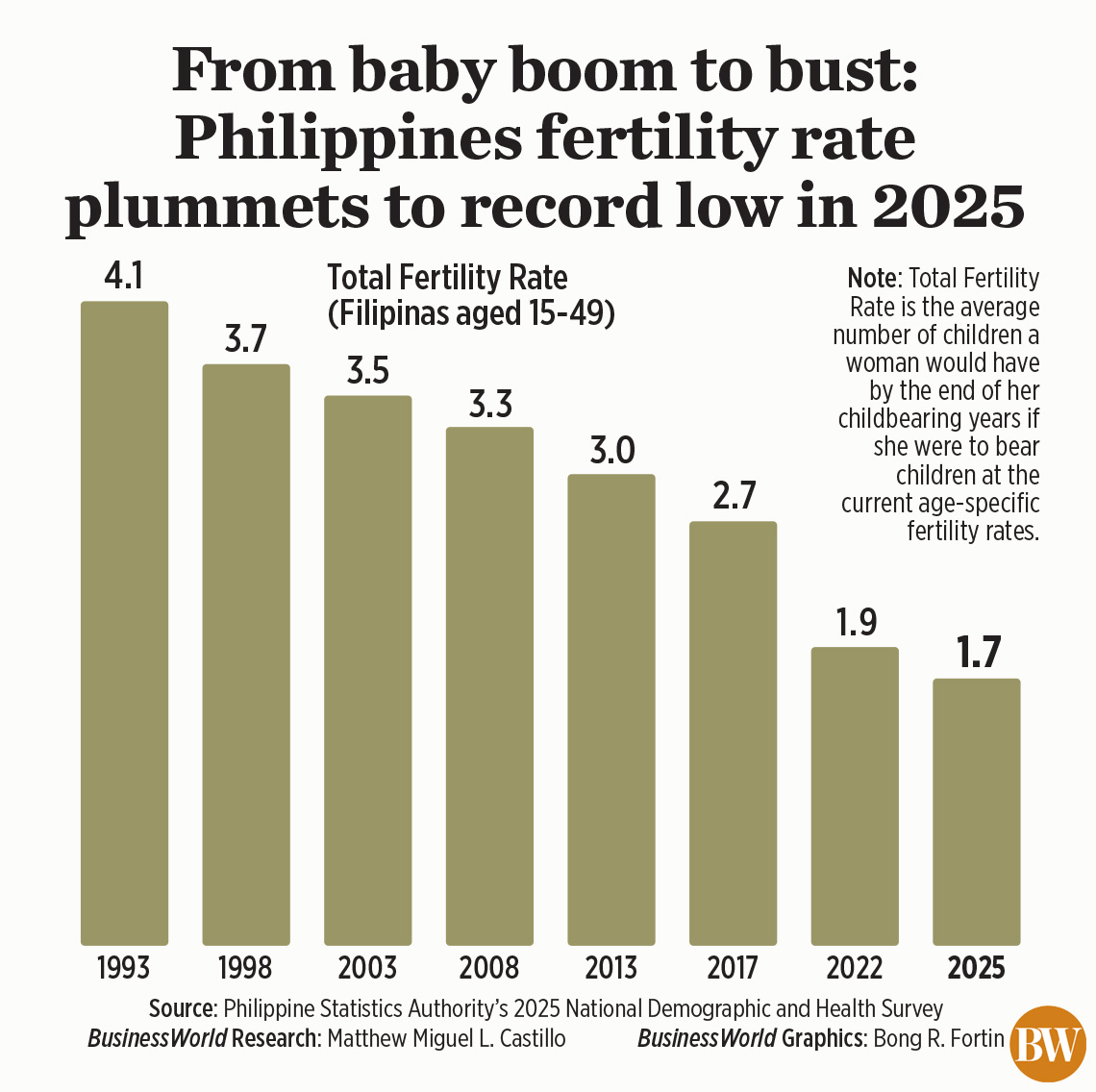
THE Philippines’ total fertility rate (TFR) reached a record low of 1.7 children per woman in the 2023-2025 period, the Philippine Statistics Authority (PSA) reported on Monday.

Preliminary data from the National Demographic and Health Survey (NDHS) by the PSA showed that the TFR in the three years leading up to the 2025 survey dipped from the 1.9 TFR recorded in 2022.

This was the lowest recorded TFR since tracking began in 1993, and a continuation of a downward trend in the rates throughout all releases of the NDHS.

The PSA defines the TFR as the number of a woman’s children by the end of her childbearing years.

By region, the Bangsamoro Autonomous Region of Muslim Mindanao logged the highest fertility rate at 2.4, followed by the Zamboanga Peninsula at 2.3, and Caraga at 2.2.

Meanwhile, the lowest TFR was recorded in Calabarzon at 1.3, followed by Metro Manila and the Negros Island Region at 1.4.

By educational attainment, women who have an elementary-level educational attainment had the highest TFR with 3.1 childbirths inching up from 3 in 2022.

This was followed by those with junior high school-level attainments and no attainments with 2.3 (from 2.5 in 2022), and then by those with senior high school-level attainments with 1.8 (from 2.7 in 2022).

Categorized by wealth quintile, those at the lowest wealth quintile had the highest TFR with 2.8 births from 3.1 in 2022.

This was followed by the second wealth quintile with 2.1 (from 2.2 in 2022), and the middle wealth quintile with 1.7 (from 1.9).

Age-specific fertility rates, which pertain to births per 1000 women over the three-year period covered, were highest in the 25 to 29-year-old age group with 94 births.

This was followed by those aged 30-34 years old with 84 births, and the 20 to 24-year-olds with 67 births.

The percentage of women who said they no longer want children rose to 49.4% from 48.8% in 2022.

By region, the largest share of women with this sentiment was highest in Bicol with 57%, followed by Mimaropa with 56.9%, and the Negros Island Region at 56.7%.

The NDHS is conducted every three years and provides data to guide policies and programs to improve the health and development of Filipinos.

It is also aligned with indicators on the Sustainable Development Goals and the Philippine Development Plan 2023-2028, covering fertility, family planning, maternal and child health, and domestic violence. — Matthew Miguel L. Castillo