Home Blog Page 2173

PHL property market ripe with opportunities in 2025 — Colliers
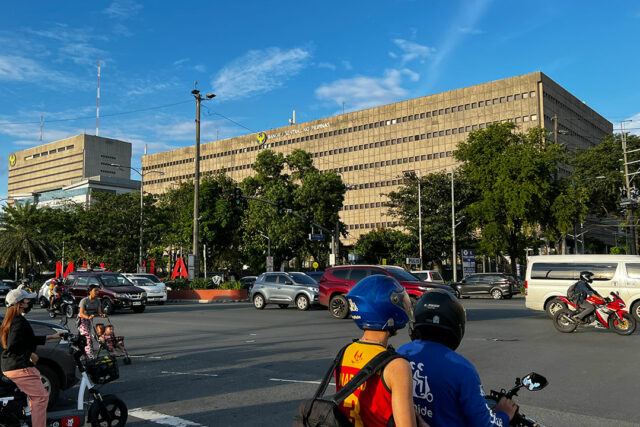
PHILIPPINE STAR/MIGUEL DE GUZMAN

Conclusion

THIS is the conclusion of the piece on what to expect in the Philippine property scene in 2025. The Philippine economy continues to enjoy stellar growth, and we see this providing opportunities for the real estate sector, especially in the retail, residential, and industrial segments.

In our view, these are the property sub-segments likely to benefit from interest rate cuts recently implemented by the central bank. The Philippines’ young and skilled workforce with constantly rising disposable incomes also support these sub-segments’ growth beyond 2025.

RETAIL: MORE EXPERIENTIAL, LESS TRANSACTIONAL
The retail sector has exhibited resilience over the past 12 months with Philippine malls attracting greater interest from foreign retailers. Some mall developers have even reported that consumer traffic is even greater than pre-pandemic level and this presents tremendous opportunities for retailers and consumers alike.

There will be a focus on experiential retail and special products and services. Even luxury is facing ‘fatigue’ at the moment, and we project that brands that will do well are those that offer unique curation and offering.

We are now seeing the impact of Retail Trade Liberalization Law on physical mall space absorption. With rising interest on the Philippine retail landscape, Colliers expects the entry of more anchor tenants particularly in major regional and super-regional malls across the capital region. The Philippine economy is primarily consumption-driven, and this entices foreign retailers to invest in the country. Foreign players are now more aggressive in taking up physical mall space.

Mall operators are also implementing shifts to suburbia even in the retail sector, resulting in more retail centers outside of the capital region. Among the malls undergoing redevelopment and are scheduled to open outside Metro Manila include the Filinvest Mimosa Mall in Pampanga, Power Plant Malls in Bacolod and Pampanga by Rockwell Land, Megaworld’s The Upper East Mall in Bacolod, Ayala Malls Abreeza expansion, and the redevelopment of Ayala Center Cebu and Robinsons Bacolod.

Colliers sees the expansion of foreign retailers including those from the home furnishing segment. We believe that the eventual take-up of the sizable number of ready-for-occupancy (RFO) units in Metro Manila will likely support the demand for furniture and home accessories.

RESIDENTIAL: KNOW YOUR DEMAND, BEFORE YOU EXPAND
Tempered new launches in the capital region would mean tempered take-up particularly for condominiums in Metro Manila given the sizeable number of unsold pre-selling and completed/RFO units right now that could take more than five years to absorb given the current take-up rates.

Colliers believes that the substantial number of unsold RFO units is constricting developers to launch new condominium projects in the capital region. As of Q3 2024, Colliers data showed that unsold inventory in Metro Manila (covering pre-selling and RFO) reached 75,300 units. It will take about 5.8 years to fully sell out all these unsold condominium units, about five times longer compared to the pre-pandemic period (2017 to 2019) where remaining inventory life (RIL) ranged between 0.9 and 1.1 years. Of the 75,300 remaining inventory, 27,200 are RFO valued at P154.4 billion ($2.8 billion).  This is a sizable amount yet to be taken up.

The lower to upper mid-income segments (P3.6 million to P12 million) accounted for 57% of remaining RFO inventory in Metro Manila as of Q3 2024. Meanwhile, among the submarkets with high level of unsold RFO units include Pasig City, QC-South, Parañaque, Manila North, Makati Fringe, and QC-North.

Developers are likely to continue the shift to suburbia with lots-only and house-and-lot (H&L) projects outside of Metro Manila and in key areas outside NCR (AONCR).

Horizontal projects remain attractive. We encourage developers to consider the viable locations for H&L and lot-only projects including provinces in Calabarzon, Central Luzon, Central Visayas, Western Visayas, and Davao region. H&L projects in these property hotspots recorded an average annual price increase of 4% to 7% from 2016 to 2023. Lot-only developments, meanwhile, recorded stronger price appreciation during the period, ranging between 7% and 15% annually from 2016 to 2023.

Colliers sees greater focus on leisure developments but unlike the property cycle in the mid 1990’s, the development is more holistic, and masterplanned with various land uses.

Colliers data showed that these projects were already popular pre-Covid but the pandemic only highlighted the strong take-up for these leisure-centric residential enclaves. Some of these leisure-oriented projects are dispersed across Batangas, Cavite and Cebu. Other locations likely to attract similar investments include Palawan, Boracay, Bohol, and Davao. The demand for these projects should also get a boost from the recovery of the country’s travel and tourism sector. Colliers also sees the revival of demand for golf communities within and outside Metro Manila.

INDUSTRIAL: HOT ON COLD STORAGE
The industrial sector stands to benefit from the government’s push to promote the country as a manufacturing hub in the ASEAN region. Colliers sees semiconductors, food and beverage (F&B) manufacturers as well as sunshine industries including electric vehicles (EVs) likely propelling industrial space absorption across the country. We encourage industrial players to incorporate technological innovation into their warehouses and work with the government and other stakeholders in upskilling manufacturing workforce and ease the process of registering businesses to send a signal to foreign industrial locators that the Philippines is open for business.

Colliers also projects the cold chain sector likely sustaining demand for industrial and warehouse assets. We see this subsegment thriving even post-pandemic. The Cold Chain Association of the Philippines (CCAP) expects the sustained expansion of country’s cold storage capacity. This should entice more foreign locators to invest in the country’s cold chain segment.

The opportunities for Philippine property are boundless. We should aim to thrive in 2025.


Joey Roi Bondoc is the director and head of Research of Colliers Philippines.

joey.bondoc@colliers.com

Healthcare benefit costs likely to post double-digit growth

PHILIPPINE STAR/EDD GUMBAN

PHILIPPINE healthcare benefit costs may post double-digit growth for a third straight year in 2025 due to increased use of health services amid the higher frequency of diseases and rising prices and fees related to medical services, global advisory company Willis Towers Watson plc (WTW) said.

The WTW Global Medical Trends Survey for 2024 showed that Philippine gross medical insurance costs are expected to increase by 18.3% this year, slightly slower than 19.3% in 2024.

Still, this is the second fastest growth projected among Asia Pacific markets following Indonesia’s 19.4% and would mark the third consecutive year of double-digit increases, coming from 17.9% in 2023.

“While the trend may be slightly cooling from 2024, it is projected to remain elevated over the longer term,” WTW said in a statement. “Medical inflation in the country has been hovering between 15% and 18% over the last three years.”

The 2025 forecast for the Philippines is also higher than the global average of 10.4% and the Asia Pacific average of 12.3% for 2025.

“Although reports indicate that HMOs (health maintenance organizations) are recovering in the first half of 2024, ongoing negotiations between two HMO associations and various doctor groups regarding a potential 80% to 150% increase in professional fees are still driving the projected double-digit medical inflation projected for 2025,” WTW Philippines Health & Benefits Head Maria Nelissa Abrera-Badal was quoted as saying.

The HMO industry posted a net income of P800.86 million at end-September 2024, rebounding from the P2.15-billion net loss in the prior year, latest data from the Insurance Commission showed.

This was driven by a 22.5% increase in revenues to P59.65 billion. Meanwhile, the sector’s total expenses increased by 15.75% year on year in the period due to a 14.05% rise in healthcare benefits and claims paid to P46.67 billion.

WTW said the “substantial” increase in claims and benefits paid out by HMOs has caused the sector to adjust its pricing assumptions annually amid rising utilization.

Claims frequency has rebounded in the Philippines, it added, with the cost per claim also rising mainly due to higher prices of medical services and procedures.

It said the increase in healthcare costs in the Philippines have been driven by both internal and external factors.

“Internal drivers of medical costs are perpetuated by behaviors of healthcare providers and insured members. The top factor reported is medical practitioners recommending too many services (79%), including overprescription of both medications and diagnostics, which results in unnecessary and excessive costs,” WTW said.

Meanwhile, among the external factors cited by insurers as the main healthcare cost drivers are “higher cost of new medical technologies (73%); the continued pressure being placed on private healthcare providers as public healthcare systems are overwhelmed (40%) which leaves many employees to turn to and rely on private medical providers; as well as the lack of cost sharing in plan design (39%).”

“Continued pressure is being placed on private healthcare providers in the Philippines. Although the rise in availability of telehealth and other virtual care offerings is expanding access to healthcare in the Philippines, it also contributes to increasing costs. Coupled with the shortage of manpower in the healthcare sector in the country, the double-digit trend of medical cost increases remains and is expected to rise in the near future,” Ms. Badal said.

“Sustainable solutions and joint efforts from individuals, healthcare providers and government are needed to build a more resilient and cost-effective healthcare system to ensure that quality care remains accessible to all at an affordable price. Cost sharing aimed at apportioning medical costs between insurers and members can also help to manage costs. This will help to minimize overuse and overprescription of care,” she added. — A.M.C. Sy

Demand for physical experiences spurs innovation in malls — experts

People walk around a mall in Quezon City, June 22, 2022. — PHILIPPINE STAR/MIGUEL DE GUZMAN

By Beatriz Marie D. Cruz, Reporter

DESPITE consumers cutting down on expenses, the demand for physical experiences remains strong, driving mall operators and retailers to innovate and expand their offerings, according to industry players.

Amid the e-commerce boom, Fisher Mall has been catering to the demand for “experiential” dining and entertainment in its malls, Fisher Mall Group of Companies President Robert Raymond B. del Rosario said in an interview with BusinessWorld.

“We’ve noticed that people are cutting down on expenses, but they’re still after that physical experience,” he said.

Mallers Investments Corp. operates Fisher Mall, which has two branches in Metro Manila — one in Quezon City and another in Malabon City.

The malls are “community-driven” given their proximity to schools and residential areas, according to Mr. Del Rosario.

When the company first opened its Quezon City branch in 2014, 70% of its tenants were from retail, while 30% were in food.

“But then, over the next couple of years, we saw this shift towards 60-40,” Mr. Del Rosario said.

Philippine malls are expected to be “more experiential and less transactional” this year, according to property consultancy firm Colliers Philippines.

Retail trends that are expected to take over include more immersive experiences, family entertainment centers, expanded food halls, and upgraded cinemas, according to its 2025 outlook report.

To stay competitive amid the growth of e-commerce, Fisher Mall has expanded its dining options and has been creative in its mall activities, Mr. Del Rosario noted.

“E-commerce is strong globally, but here, even though we do have that, it’s still different because people want to see each other and hang out, and so that’s what we’re leveraging here,” he said.

As an example, Fisher Mall Quezon City held a lookalike contest in December to promote the premiere of Renaissance: A Film by Beyoncé.

In November, Fisher Mall also held its spinoff of the Black Friday sale, called the Black Out Sale, offering up to 80% in discounts.

“We’re finding ways to address rising costs by introducing more sales and looking at how we engage the customer,” Mr. Del Rosario said.

METRO RETAIL STORES
“We’re actually revisiting our expansion plans and looking at how we can make the spaces more productive, especially if the store has already been built, so what more can we do about it,” Metro Retail Stores Group, Inc. Chairperson Sherisa P. Nuesa told BusinessWorld.

“There are challenges, but there are also a lot of opportunities with consumers’ willingness to spend.”

Metro Retail, which operates around 70 stores across Luzon and Visayas, has used data analytics to provide more curated offerings and changes in the use of its retail spaces, according to Ms. Nuesa.

“There’s a lot that can still be done to make the spaces productive, notwithstanding that it has been very, very competitive.”

Ms. Nuesa also cited expansion opportunities in the Visayas, driven by faster economic growth and its increasing acceptance of modern retail.

For its part, Fisher Mall plans to build up to three new malls in the next two to three years, Mr. Del Rosario said, noting that it has been considering areas both within and outside Metro Manila.

It also expects up to five new tenants in its Quezon City mall early this year. For the Malabon branch, it is eyeing a 5-10% increase in tenants in 2025.

Likewise, Metro Retail plans to open 12 new stores this year, it said in December.

“The competition from online platforms is quite tough. But I think what’s unique about the retail market is there’s a lot of resilience and ability to adjust,” Ms. Nuesa said.

Entertainment News (01/07/25)


Wicked sing-along experience out in theaters

STARTING Jan. 8, there will be special sing-along screenings of the hit movie musical Wicked. Filipino fans will be able to sing along to iconic songs like “Popular” and “Defying Gravity.” Directed by Jon M. Chu, the film is based on the acclaimed musical of the same name and tells the story of the witches of Oz, starring Cynthia Erivo as Elphaba and Ariana Grande as Glinda.


Genshin Impact pop-ups, motorcycles raffled

FANS of of the video game Genshin Impact across Southeast Asia and Australia have a chance to win a Mavuika-themed motorcycle by visiting pop-up events this January. Genshin Impact will be celebrating a newly released playable character — the new Pyro Archon, Mavuika — in Version 5.3, through pop-ups in Indonesia, Malaysia, Philippines, Thailand, Vietnam, and Australia. Visitors to the pop-ups will have the chance to get exclusive goodies by taking part in the onsite activities and purchasing Genshin Impact merchandise. This month also marks the first time that Genshin Impact is holding an event in Cebu, with the first pop-up opening at SM Seaside City Cebu’s City Wing Atrium from Jan. 9 to 12. The pop-up will then move to One Ayala’s Concourse Level from Jan. 16 to 19. There will be one winner of the Mavuika-themed motorcycle per country.


Three movies opening on Jan. 15

THE midpoint of January will see three movies out in Philippine theaters. Paramount Pictures’ Sonic the Hedgehog 3, starring Jim Carrey, Ben Schwartz, James Marsden, Tika Sumpter, Idris Elba, and many others, will see the beloved Team Sonic take on a new enemy. Universal Pictures’ Wolf Man, directed by Leigh Whannell and starring Christopher Abbott and Julia Garner, offers an Oregon-set horror drama where a young family moves to the countryside and confronts a dangerous creature. Finally, the Ayala Malls Cinemas-exclusive 4DX concert experience, Tomorrow x Together: Hyperfocus, gives a glimpse of the K-pop boy group Tomorrow x Together’s latest performance with immersive visuals.


Korean thriller Unmasked to premiere on Disney+

ACCLAIMED actress Kim Hyesoo stars in a series that follows investigative journalists working to uncover the identity of an insider who’s been leaking personal stories about the team. In the process, they hope to solve a 20-year-old cold case involving a famous actor who disappeared without a trace. The show also stars Jung Sungil and Joo Jonghyuk, with direction by You Sundong. The Korean thriller premieres on Jan. 15, exclusively on Disney+.


Multisensory dinosaur adventure premieres this month

AYALA Malls Cinemas will be premiering Multisaurs, a fully immersive adventure film for the entire family, on Jan. 17. It is set to run until April. Its goal is to deliver “a prehistoric experience involving dinosaurs,” with children and dinosaur enthusiasts as the target audience. Viewers will be able to move the story and adventure forward using their lighted bracelets, thanks to the film’s immersive technology. Multisaurs has been shown in 200 cities over six countries in Europe and Asia. Tickets to the Ayala Malls screenings will cost P990 in Metro Manila, and P750 in the provinces. Events such as school field trips get a discounted rate of P840 per ticket in Metro Manila and P635 per ticket in the provinces.


GMA Public Affairs reveals movie, TV lineup for 2025

GMA’s films and TV shows for 2025 have been unveiled to the public. These include Season 2 of Lolong starring Ruru Madrid. Titled Lolong: Bayani ng Bayan, the show makes its comeback on Jan. 20. Meanwhile, GMA Pictures will be premiering KMJS’ Gabi ng Lagim, based on real-life horror stories tackled in the Kapuso Mo, Jessica Soho series. Another horror offering by the studio is P77, starring Barbie Forteza and Euwenn Mikaell, set in a luxurious yet otherworldly penthouse that is a play on the reality of urban housing. GMA Pictures is also releasing the animated feature 58th, which examines the Maguindanao Massacre 15 years on and sheds light on the story of Reynaldo Momay, the 58th victim whose body was never found.


Ayala Malls Cinemas brings in award-winning films

TWO films with awards season buzz are coming to the Philippines through Ayala Malls Cinemas. First to open on Jan. 22 is Sean Baker’s Anora, which stars Mikey Madison as a sex worker from Brooklyn whose whirlwind fairytale romance with a rich son of a Russian oligarch quickly falls apart. Also coming to the country is Jesse Eisenberg’s dramedy-adventure A Real Pain, set for Jan. 29, which stars Mr. Eisenberg alongside Kieran Culkin as two cousins who reunite for a wild and revelatory tour of their family’s ancestral country, Poland. Both films are Ayala Malls Cinema exclusives.


Eraserheads film to open in March

THIS March, Eraserheads: Combo On The Run will hit theaters nationwide for one weekend only, from March 21 to 23. The highly anticipated film delves into the heart and soul of the Eraserheads, the Filipino band that defined a generation. It tackles the untold story of their painful breakup and the difficult but necessary challenges they had to face to get back on stage for their historic reunion in 2022, at a time when the country was grappling with political division and uncertainties.


BBC, Disney announce Bluey animated film

DISNEY has acquired the global theatrical film rights for BBC Studios’ Emmy and BAFTA-winning series Bluey. The resulting film will be premiered worldwide in 2027. Written and directed by Bluey creator Joe Brumm, the film aims to deliver “the same charm and humor that made the television series a global phenomenon.” It will continue the adventures of Bluey, a loveable, inexhaustible, blue heeler dog, who lives with her Mum, Dad and her little sister, Bingo.

2GO sets sights on 2025 growth with route enhancements, service expansion

LOGISTICS and sea travel solutions provider 2GO Group, Inc. aims to sustain its growth in 2025 by enhancing routes and expanding key services.

“We are building on the solid foundation we established in 2024 to achieve even greater success in 2025,” 2GO President and Chief Executive Officer Frederic C. DyBuncio said in a media release on Monday.

For the year, the company has expressed its optimism about its operations, driven by the enhancement of shipping routes and the expansion of cold chain and ISO tank services to new destinations.

“These initiatives aim to reinforce 2GO’s position as a leading driver of economic progress in the Philippines, enabling seamless movement of goods and passengers across the archipelago,” the company said.

2GO is an end-to-end transportation, logistics, and distribution provider in the country under Sy-led conglomerate SM Investments Corp.

The company expects growth in its passenger volume in 2025 as it intends to further grow its services in its current operations.

In 2024, 2GO launched its ship re-fleeting program, which improved its operational efficiency and increased its cargo capacity by 35%, while also allowing route expansions to Davao and General Santos City.

2GO also leveraged its retail network in the Visayas region, which allowed improved trade in the region.

“With solutions tailored to diverse customer needs, from less-than-container-load (LCL) temperature-controlled shipments to reliable package and parcel services, 2GO’s offerings continue to cater to a wide range of logistical requirements,” it said.

2GO offers multimodal transportation, warehousing and inventory management, distribution, special containers, project logistics, and e-commerce logistics. It also provides sea travel, freight forwarding, import and export processing, and customs brokerage services. — Ashley Erika O. Jose

To change, or to change for the better?

FREEPIK

At the start of every year, many people make a list of resolutions — things to start, do, or change. However, many of these resolutions become harder to sustain as the months go by (just look at gym attendance numbers in January vs. the rest of the year!).

New Year’s resolutions are like many planned change initiatives in today’s workforces: it’s easier to start them than it is to sustain them in the long term. And since the COVID-19 pandemic, change has been happening in our lives at an exponential pace. Hybrid work, the rise of generative AI, and increasing incidents that stoke geopolitical tensions around the world have all compelled organizations to pivot and adapt rapidly to keep up.

But an often-cited — and sobering — statistic in change management is that on average, only 34% of implemented change initiatives succeed. So, for business owners or leaders of transformation, the challenge really isn’t just being open to change, but also how they give themselves the best chance of success. There are quite a few best practices out there, but they boil down to the following:

ACTIVE SPONSORSHIP AND A STRUCTURED PLAN
Leaders need to model the behaviors they want to see in their teams and employees. The same principle applies to change projects. A systematic literature review covering several decades worth of change research reveals that one of the consistent significant factors why employees resist change is distrust in the leadership or their organization.

Having an active executive or management sponsor provides change management teams with not just a champion at the executive levels, but also a clear path to decision approvals when needed. Once you have this, dive into the project management aspect. Map a timeline of events for the proposed change because once people find out what you are proposing to do, the inevitable question is when do you plan to do it. Don’t fall into the trap of haphazardly rolling something out borne by overeagerness to implement a change. Failing to plan is planning to fail.

TRANSPARENT COMMUNICATION AND EARLY ENGAGEMENT
Clearly inform people about what’s changing, why it’s happening, how it will affect them, and when it is proposed to happen. Use multiple channels as needed — e-mail, team meetings, and one-on-one discussions — to ensure everyone is on the same page, but be conscious of which channel to use for the kind of conversation you are having. Obviously, when a change initiative could cause someone to lose his or her job, you don’t want to e-mail that person about it.

Sometimes, people resist change because they feel excluded and powerless. To address this, bring people in early. When possible, consult them so that you can get a range of inputs on the change proposal/s, which in turn can provide you with valuable insights, increase buy-in, and help you identify potential challenges. But genuine consultation requires psychological safety within teams. If team members are worried about retaliation, or how the feedback will be received, they will just more likely silently resist.

SUPPORT FOR LEADERS TO BE CHANGE AGENTS
Leadership plays a pivotal role in driving change. Ensure that leaders are engaged with the proposed change and that anyone doing team briefings feels enabled and supported in having those conversations. Prepare talking points and internal FAQs to better equip leaders who may be feeling some anxiety. The last thing you want is to roll out a change proposal where the senior leadership team is convinced of the plan, but your mid- to frontline leaders are not.

Interestingly, the department I teach with at De La Salle University has a mission of developing “reflective change agents for the common good.” This mission resonates with me because it’s a good challenge not just for management educators, but also for organizational transformation leaders, who, when planning change initiatives, can easily get caught up in the benefits the initiative will bring, but lose sight of the genuine human impact it will have.

As we start 2025, let’s remember that to change, and to change for the better, are two different goals. It’s entirely up to us which one to strive for.


Dr. Armando Ricardo J. Aguado is a professional lecturer at De La Salle University and the senior HR manager with Australia’s leading telecommunications company. Over nearly two decades, he has held corporate roles in strategic HR management, business partnering, and organizational transformation, while educating young minds and taking the opportunity to also learn from the next generation of working professionals.

armando.aguado@dlsu.edu.ph

Philippines, Japan renew currency swap arrangement

BW FILE PHOTO

THE PHILIPPINES and Japan have renewed a bilateral currency swap arrangement, which will boost financial stability and cooperation between the two countries, the Bangko Sentral ng Pilipinas (BSP) said.

The BSP and the Bank of Japan (BoJ) have renewed their bilateral swap arrangement effective Jan. 1, the Philippine central bank said in a statement on Monday.

“The Bank of Japan, acting as agent for the Minister of Finance of Japan, and the Bangko Sentral ng Pilipinas signed the fourth Amendment and Restatement Agreement of the Third BSA,” it said.

“Japan and the Philippines believe that the BSA, which aims to strengthen and complement other financial safety nets, will further deepen financial cooperation between the two countries and contribute to regional and global financial stability,” the BSP said.

The BSA allows both central banks to swap their local currencies in exchange for the US dollar.

“The arrangement also enables the Philippines to swap the Philippine Peso against the Japanese Yen,” the BSP added.

The limit for the swap agreement remained unchanged at $12 billion or its equivalent amount in yen for the Philippines. Japan can swap up to as much as $500 million. — A.M.C. Sy

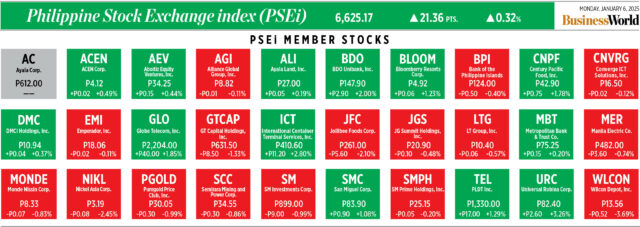
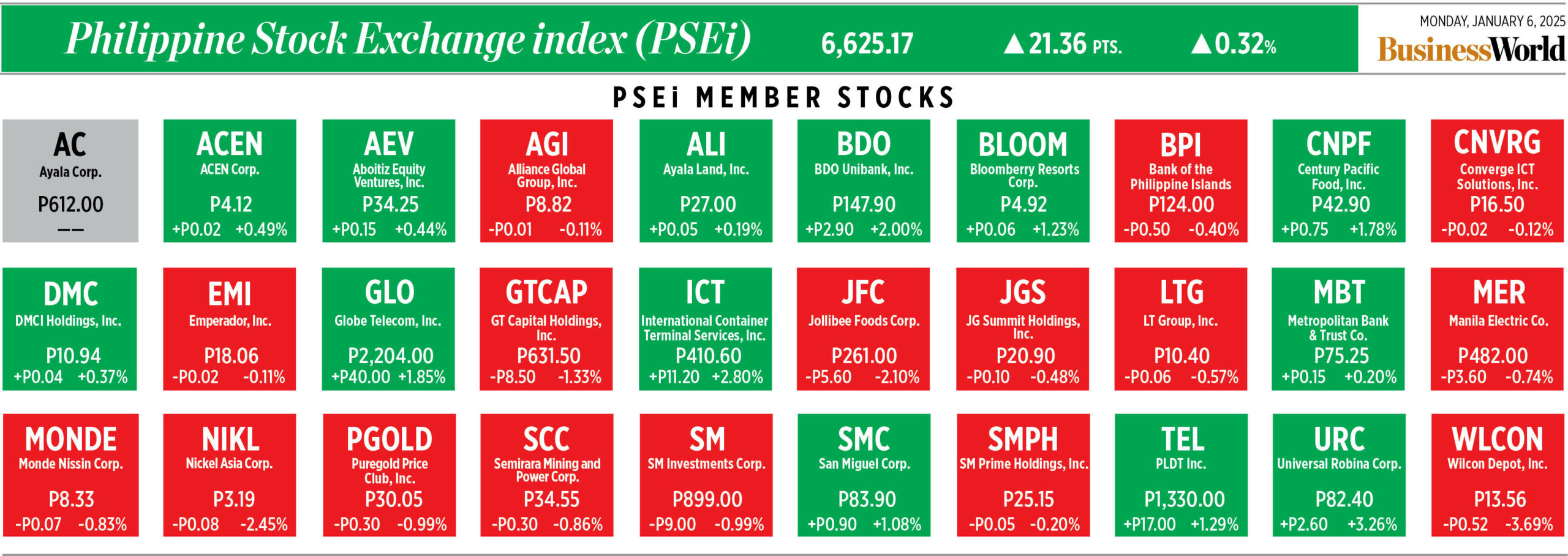
How PSEi member stocks performed — January 6, 2025

Here’s a quick glance at how PSEi stocks fared on Monday, January 6, 2025.


Report: Philippines ranks 68th in Globalization Index 

The Philippines ranked 68th out of 196 countries in the latest edition of the KOF Globalization Index published by KOF Swiss Economic Institute which used 2022 data. The index measures the economic, social, and political dimensions of globalization, distinguishing between de facto globalization and de jure globalization in the overall index as well as in its economic, social, and political components. On a scale of 1 to 100, where 100 indicates a country is most globalized, the Philippines achieved a score of 66.61, above the world average of 60.80.

Report: Philippines Ranks 68<sup>th</sup> in Globalization Index

Customs order implementing PHL-South Korea FTA released

ANFLOCOR.COM/TADECO

THE Bureau of Customs (BoC) said it issued a memorandum order implementing the preferential tariffs the Philippines will enjoy as a result of its free trade agreement (FTA) with South Korea.

In a statement on Monday, Commissioner Bienvenido Y. Rubio said issuing clear guidelines aims to foster a “smooth transition and effective implementation” of the FTA between two countries.

The Customs Memorandum Order (CMO), signed by Mr. Rubio, took effect on Dec. 31 and outlines “pertinent provisions such as pre-exportation examination or product evaluation, procedures for the issuance of Certificates of Origin.”

In addition, the CMO provides sets guidelines governing the application process for obtaining Approved Exporter status, obligations of an Approved Exporter, procedures for completing Origin Declarations, and verification protocols.

On Dec. 23, President Ferdinand R. Marcos, Jr. released Executive Order (EO) 80, which called for the updating of import duty rates for products covered by the FTA.

Under EO 80, goods from South Korea listed in the Philippine Schedule of Tariff Commitments will be subject to reduced or zero tariff rates as long as these goods align with the specified rules of origin, including proof of origin.

“The issuance of this Customs Memorandum Order underscores the BoC’s commitment to facilitating trade and fostering economic partnerships with our global partners,” Mr. Rubio added.

“These comprehensive guidelines are designed to ensure seamless compliance with the agreement and maximize the benefits of preferential trade terms,” the BoC said.

In a separate statement on Monday, Customs also announced its five-Point Priority Program, which are digitalizing customs processes, surpassing revenue targets, simplifying procedures and facilitating secure trade, curbing smuggling, and enhancing employee welfare and development.

Mr. Rubio also said he is confident the BoC will reach its P1.06-trillion revenue target for 2024. — Aubrey Rose A. Inosante

Universal Healthcare milestones face delays after reduction in budget allocations — BMI

REUTERS

LIMITED GROWTH in public health pending in the 2025 national budget could delay progress towards Universal Health Care (UHC), Fitch Solutions unit BMI said.

The UHC Act or Republic Act 11223 aims to ensure quality and affordable access to healthcare, minimizing financial hardship.

“The reduction in total health expenditure allowance will slow progress for the Universal Health Care (UHC) Act, limiting market opportunities in the public health system,” BMI said in a report on Monday.

In the General Appropriations Act (GAA) 2025, the Department of Health was allocated P247.56 billion, up 2.69% from a year earlier. The broader picture, however, taking into consideration the allocation for the Philippine Health Insurance Corp. (PhilHealth), shows a spending plan for health amounting to P297.6 billion.

“Despite a 10.1% year-on-year growth in the total government budget in 2025, public health expenditure saw a 3.5% decrease from 2024 levels,” it said.

BMI projects health spending to grow by 5.7% between 2023 and 2028.

“Significant cuts to the Health Facilities Enhancement Program (HFEP) and government-owned and -controlled corporation (GOCC) hospitals will reduce investment sustainability in the health system,” it added.

The HFEP budget goes towards the construction, upgrading or expansion of government healthcare facilities and the purchase of medical equipment and medical vehicles.

In 2025, this was trimmed to P22.9 billion from P28.5 billion a year earlier.

This year P14.5 billion was earmarked for infrastructure and P7.6 billion for medical equipment.

“We expect these reductions will limit the DoH’s operational ability to ensure that the 700 rural health units it manages, the 300 local government unit-run and other clinics are constructed and equipped with the necessary medical supplies and facilities,” BMI said.

Some regions are set to receive more funding. South Cotabato, Cotabato, Sultan Kudarat, Sarangani, and General Santos City (Soccsksargen) received a bump in allocation of 245% to P37 million, while Caraga got a 443% increase to P80.7 million.

“While these appear like large rises, given that most regions are not experiencing budget allocation changes in 2025, we believe they are only single investments which will not provide sustained market opportunities,” it said.

Similarly, the GOCC hospitals, which operate both commercial and noncommercial activities, had their funding cut.

BMI, citing the Department of Budget and Management, noted that the Philippine Children’s Medical Center’s budget fell 28.55% in 2025.

The Lung Center of the Philippines followed with a 10.08% decrease to P711.34 million, while the National Kidney & Transplant Institute’s funding fell 8.56% to P1.49 billion. The Philippine Heart Center’s budget fell 8.21% to P2.41 billion.

“We expect this will impact their ability to provide healthcare services in the regions they operate in,” it said. “Combined with the HFEP reductions, we anticipate that medical device sales will be constrained in these markets.”

Additionally, BMI noted that budget increases in other sectors such as defense “highlight a divergence from health system prioritization.”

This could lead to private health expenditure to grow 7.2% with greater resort to the private healthcare system.

PhilHealth, meanwhile, found itself stripped of subsidies. The bicameral conference committee report on the budget bill reviewed by President Ferdinand R. Marcos, Jr. originally contained a P74.4-billion subsidy for PhilHealth, which was stripped from the version ultimately signed by the President.

BMI also noted that the Philippines lacks 190,000 healthcare workers as professionals choose to migrate.

“Without a long-term plan, the public health system will lack the human capital necessary to maintain and expand its services, resulting in a decline in the quality of care,” it said. This could also be exacerbated by lower HFEP and GOCC budgets.

This could lead to a “more fragmented health system,” preventing “future market opportunities as the health system’s growth rate begins to slow.”

“I think all the healthcare cuts are significant since the budget for health should be increasing alongside education budget. It does not help that we prioritize education but consider health as a minor concern,” Leonardo A. Lanzona,an economics professor at the Ateneo De Manila said via Messenger chat.

In compliance to the constitution, education had the highest allocation in the 2025 GAA with P1.056 trillion.

He said that investments in these areas are “complementary” in the as the market returns from education are higher if healthcare is assured.

“Without health, education is not going to yield many market opportunities, making investments in schooling unproductive,” Mr. Lanzona said. added.

“It is crucial that we develop both human capital investments simultaneously.” — Aubrey Rose A. Inosante

Accessing remote areas seen as top obstacle to distributing cheap drugs

Illustration photo shows various medicine pills in their original packaging in Brussels, Belgium, Aug. 9, 2019. — REUTERS/YVES HERMAN/ILLUSTRATION

By Justine Irish D. Tabile, Reporter

AFFORDABLE medicine remains out of reach for much of the population despite their availability, with the main obstacle being inadequate distribution to remote areas, the Philippine Pharma Procurement, Inc. (PPPI) said.

“While there are affordable and cheaper medicines, the lack of access to these is the biggest problem,” PPPI President and Chief Executive Officer Maria Blanca Kim B. Lokin told BusinessWorld in an e-mailed statement.

“The lack of logistics and infrastructure, and the geographical makeup of the Philippines are some of the main challenges,” she added.

PPPI is a government-owned and -controlled corporation organized during the Estrada administration to reduce drug prices and engage in parallel imports. Its parent is the Philippine International Trading Corp., an arm of the Department of Trade and Industry.

She proposed that PPPI take the lead in linking procurement and distribution.

“The recommendation is that the government use PPPI as the lead agency to implement access to affordable medicines nationwide,” she added.

“It can serve as the bridge to harness government health programs for cheaper medicines and bring them to where the communities are,” she added.

She said a revival of the Botika ng Bayan program through franchising will not only accelerate access to affordable medicines but also empower micro, small and medium-sized enterprises.

In response to President Ferdinand R. Marcos, Jr.’s eight-Point Socioeconomic Agenda, the PPPI established the Botika at Bakuna Para sa Mamamayan (BBM Pharmacy) program.

It resurrects a program originating in the 1970s whose most recent iteration was the Botika ng Bayan from the early 2000s.

The BBM Pharmacy is a joint program with the Food and Drug Administration and the Department of Health.

“Although there are affordable medicines in the market, access to these medicines remains limited, especially in the rural areas,” Ms. Lokin said.

“Even with the proliferation of pharmacies nationwide, the reality is that there are still a lot of underserved areas. The main reason for this is profitability,” she added.

To address this, she said that she hopes the Philippine Health Insurance Corp. (PhilHealth) can help build PPPI flagship stores and commissaries in the regions to service the soon-to-be-launched BBM Pharmacies.

“This will greatly accelerate nationwide access to affordable medicines. It can also be a tangible program that Filipinos can relate to and serve as a good complement to the Konsulta & Gamot Programs of PhilHealth,” she added.

ADVERTISEMENT
ADVERTISEMENT