THE University of Connecticut (UConn) thrashed South Carolina 82-59 to claim a record-extending 12th national championship in NCAA women’s basketball on Sunday, the first title for the team since 2016.
A dream showdown between two of the sport’s marquee teams quickly turned sour for defending champions South Carolina against a suffocating UConn defense, as the Huskies ended their longest title drought since their first title in 1995.
The Gamecocks were unable to slow down freshman Sarah Strong, who put up a double-double with 24 points and 15 rebounds, and guard Azzi Fudd, who added another 24 points and was later named the most outstanding player of the Final Four.
“You just never know if you’ll be back in this situation again,” said UConn coach Geno Auriemma, the winningest coach in collegiate basketball who became emotional in his post-game remarks. “We kept hanging in there and hanging in there.”
The Huskies had a 10-point lead through two quarters after a clutch three-point jumper from guard Ashlynn Shade to close out the first half, in which UConn sharpshooter Fudd led the way with 13 points.
They heaped on more pressure in the second half and South Carolina’s hope of a third title in four years evaporated as the Huskies were up by 32 points with four minutes left in the game.
The win gave famed guard Paige Bueckers, the presumed first pick in the upcoming WNBA Draft, the accolade she craved most in her final collegiate game and she wept as she stepped off the court and embraced Auriemma.
“Unreal. Just so much gratitude for everything this program has meant to me,” said Bueckers, who put up 17 points on Sunday after overcoming injuries to become one of the collegiate game’s biggest names.
“I can’t even put into words what’s happening right now.” — Reuters
VEHICLES travel along the Federal Highway in Petaling Jaya, Selangor, Malaysia, on Sunday, Feb. 9, 2025. — BLOOMBERG
MALAYSIA is bracing for the possibility that US President Donald Trump’s tariffs will leave a lasting impact on its economy for years to come, given that nearly all of its trading and investment partners will be affected by the new regime.
The government is taking measures to address the tariffs’ impact, said Minister of Investment, Trade and Industry Zafrul Aziz. These include setting up a task force to gather feedback from stakeholders, assessing the impact on industries and continuing its engagement with Washington, he said. Mr. Zafrul is seeking meetings with US officials by month-end.
“We are one of the US’s largest trading partners in Asean, and also one of the major recipients of US-based foreign investment,” the minister said at a briefing on Monday in Kuala Lumpur. “We must therefore acknowledge that there will be mid-to-long-term impact.”
The direct hit will include reduced demand and revenue, as well as conservative investment spending, Mr. Zafrul said. “In the long run, it may lead to decrease in Malaysia’s GDP and slowdown in global growth,” he added. The government is also vigilant of potential dumping of imported goods, he said.
Still, Malaysia’s “moderate” tariff rate could see some of its exports becoming more competitive in the global market, Mr. Zafrul said. The nation will also see some gains over palm oil exports as consumers opt for cheaper substitutes, he added.
After starting off the year on an optimistic note, Malaysia is now reviewing its gross domestic product growth target for 2025 should the tariffs come into effect on April 9. The Malaysian ringgit was one of the biggest losers in Asia on Monday, weakening 0.6% against the US dollar. The Kuala Lumpur benchmark stock index slumped as much as 5.7%, its biggest intraday drop since the start of the Covid pandemic.
The nation is also seeking to lead efforts to coordinate a regional response to the tariffs. Countries in the Association of Southeast Asian Nations are among those hardest hit: Vietnam and Cambodia were slapped with rates of 46% and 49%, respectively, by the Trump administration, while Malaysia is subject to a 24% levy.
Like its regional peers, Malaysia has opted not to retaliate against the punishing trade overhaul and is seeking engagement, though it’s refuted the Trump administration’s claim that it imposes a 47% levy on US goods. — Bloomberg
BARRIERS are seen in front of the Bank of Japan building in Tokyo, Japan, March 15, 2016. — REUTERS
TOKYO — The Bank of Japan (BoJ) said uncertainty over Japan’s economy was growing as some firms worried about the hit to profits from higher US duties, a sign President Donald Trump’s sweeping tariffs risked upending a moderate economic recovery.
In a quarterly meeting of its regional branch managers on Monday, the BoJ maintained its assessment for all nine areas to say they were either recovering or picking up moderately.
But it said in a statement that “uncertainty over Japan’s economy was heightening,” underscoring the BoJ’s concern Mr. Trump’s tariffs may threaten to derail a cycle of rising wages and prices — a key prerequisite for further interest rate hikes.
While the statement did not make direct mention of higher US tariffs, it warned that “some firms voiced concern over the impact on output and profits” from US trade uncertainty.
The BoJ’s assessment of regional economies, which is based on surveys conducted by its nationwide branches on firms, did not fully incorporate the impact of Mr. Trump’s reciprocal tariffs announced last week, a central bank official told a briefing.
The BoJ painted an optimistic view on the economy, saying that brisk spending by overseas tourists and strong demand for luxury items have underpinned consumption. It also said firms maintained their robust capital expenditure plans.
Pay hikes were broadening for a wide range of sectors in regional areas, though some regions saw smaller firms voicing caution over further pay increases, the statement said.
“Companies continue to pass on rising import costs at a moderate pace,” with some also considering or implementing price hikes to raise funds to pay for rising labor costs, it said.
Asian share market tanked on Monday as investors feared that Mr. Trump’s tariffs could lead to higher prices, weaker demand and tip the global economy into recession.
Mr. Trump’s decision to slap a 25% levy on auto imports, and a reciprocal 24% tariff on other Japanese goods, will likely deal a huge blow to the export-heavy economy with analysts predicting the higher duties could knock up to 0.8 percentage point off economic growth.
The BoJ’s assessment of regional economies will be among factors that will be scrutinized at its next policy meeting on April 30-May 1, when the board is seen keeping interest rates steady at 0.5% and issuing fresh quarterly economic forecasts. — Reuters
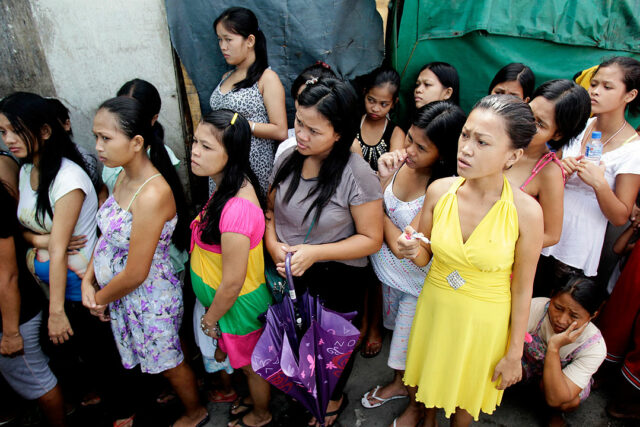
Pregnant teenagers wait in line for a free pre-natal checkup at a clinic in Tondo, Manila, Aug. 31, 2012. — REUTERS
LONDON — Cuts to aid budgets are threatening to undermine years of progress in reducing the number of women dying during pregnancy and childbirth, and could lead to a rise in deaths, the United Nations (UN) has warned.
Globally, there was a 40% decline in maternal deaths between 2000 and 2023, a report by UN agencies including the World Health Organization (WHO) showed on Monday, largely due to better access to essential health services.
That could now go into reverse, the WHO said in a statement accompanying the report which did not mention specific cuts but came in the wake of a foreign aid freeze by the U.S. government and the ending of funding through the United States Agency for International Development (USAID) for many programs.
Other donor countries including Britain have also announced plans to cut aid budgets.
“One of the headline messages is that the funding cuts risk not only that progress, but we could have a shift backward,” said Dr. Bruce Aylward, Assistant Director-General, Universal Health Coverage at the WHO.
The cuts have had “pandemic-like effects” on health systems globally and could have a “more structural, deep-seated effect,” Mr. Aylward added.
The WHO said the cuts were already rolling back vital services for maternal, newborn and child health in many countries, reducing staff numbers, closing facilities and disrupting supply chains for supplies including treatments for hemorrhage and pre-eclampsia.
Cuts to other areas, such as malaria and HIV treatment, would also impact maternal survival, the UN said.
Even before the aid cuts led by the United States, things were backsliding in some countries, and progress has slowed globally since 2016, the report said.
In 2023, despite recent progress, a woman still died roughly every two minutes — around 260,000 in total that year – from complications that were mainly preventable and treatable, it added.
The situation was particularly bad in countries affected by conflict or natural disaster, although the US itself is one of only four countries to have seen its maternal mortality rate increase significantly since 2000, alongside Venezuela, the Dominican Republic and Jamaica.
The COVID-19 pandemic also had an impact, the report said: 40,000 more women died due to pregnancy or childbirth in 2021, bringing the total number of deaths that year to 322,000.
“While this report shows glimmers of hope, the data also highlights how dangerous pregnancy still is in much of the world today — despite the fact that solutions exist,” WHO Director-General Tedros Adhanom Ghebreyesus said.
The report itself was part-fundedby USAID. — Reuters
PARIS — European Commissioner for Industrial Strategy Stephane Sejourne said the European Union’s (EU) response to US tariffs should be “proportionate” and hoped bourbon will be dropped from a list of US imports that could be slapped with additional tariffs.
The European Commission, which coordinates EU trade policy, will propose to members late on Monday a list of US products to hit with extra duties in response to US President Donald Trump’s steel and aluminum tariffs rather than the broader reciprocal levies.
The 27-nation EU bloc faces 25% import tariffs on steel and aluminum and cars and “reciprocal” tariffs of 20% from Wednesday for almost all other goods.
One product that has received more attention and exposed discord in the bloc is bourbon. The Commission has earmarked a 50% tariff, prompting Mr. Trump to threaten a 200% counter-tariff on EU alcoholic drinks if the bloc goes ahead.
Wine exporters France and Italy have both expressed concern.
“For bourbon, I have hopes that this element is taken out of the list. We will see in the coming hours,” Mr. Sejourne told France Inter radio on Monday.
Mr. Sejourne also said the EU had several cards up its sleeve to put pressure on America apart from tariffs, including “withdrawing US companies from our European public markets.”
“We need to look at exactly which sectors and why we can do it, but it’s one of the subjects on the table,” he added. — Reuters
BEIJING — China’s state-run media has taken to the internet with AI-generated videos, featuring dancing robots and fraught consumers, to chide US President Donald Trump and tariffs they say threaten high inflation and economic distress for Americans.
“’Liberation Day’, you promised us the stars. But tariffs killed our cheap Chinese cars,” an automated female voice sings in a video on the website of China’s CGTN, a state-run English-language broadcaster, over a shot of a woman at a kitchen table staring at an empty fork.
The two-minute, 42-second clip, referring to Mr. Trump’s use of “Liberation Day” for the day of his tariff announcement, was captioned with a warning: “Track is AI-generated. The debt crisis? 100 percent human-made.”
Another video posted on the X.com page of state-run news agency Xinhua, also generated by artificial intelligence (AI), shows a robot named TARIFF that chooses to self-destruct rather than follow its creator’s orders for high tariffs that bring “trade wars and unrest.”
China has sharply criticized the US tariffs, which have triggered the biggest stock market rout since the pandemic, and retaliated on Friday with import duties and export curbs of its own.
Economists say consumers are likely to see higher prices due to the trade war and that the US economy could enter a downturn, while some US trade partners are putting their own levies on American products — effects that Mr. Trump has called a “disturbance.”
The CGTN video, which displays lyrics in English and Chinese over images of car factories and humanoid robots dancing in burned-out streets, makes a more dire assessment.
“You taxed each truck, you taxed each tire. Midwest burnin’ in your dumpster fire,” the automated voice sings. — Reuters
WELLINGTON — New Zealand said on Monday it would boost defense spending by NZ$9 billion ($5 billion) over the next four years, and aim to nearly double spending to 2% as a share of gross domestic product (GDP) in the next eight years, at a time of rapidly growing tension worldwide.
The details came in remarks by Prime Minister Christopher Luxon, who called for more spending on defense to ensure prosperity.
“New Zealand and our allies and partners across the world are no longer in a benign environment,” he told a press conference at the release of the Defense Capability Plan.
“My primary focus is the economic importance of this country. However, there can be no prosperity without security, and defense is one vital component of that picture.”
The Defense Capability Plan maps out new funding of NZ$9 billion over the next four years to boost defense capability. It comes on top of baseline spending set to be announced in May.
The new spending is a significant boost to Defense Force spending of just under NZ$5 billion in 2024/25.
New Zealand’s first national security review in 2023 called for more military spending and stronger ties with Indo-Pacific nations to tackle issues of climate change and strategic competition between the West, and China and Russia.
New Zealand’s Defense Force has struggled with systemic underspending over the past several decades, which amounts to just over 1% of GDP now.
High attrition in recent years has seen the force idle three of its ships and put on ice plans for a new vessel designed for patrol of the Southern Ocean, though attrition has fallen in the last year.
Over the next four years, the plan envisages the defense force will invest in projects such as boosting strike capability, buying an uncrewed aerial system, replacing helicopters and extending the life of its frigates.
It also plans to replace the Boeing 757 fleet after some embarrassing breakdowns that grounded delegations abroad. — Reuters
DigiPlus Interactive Corp. (DigiPlus), the pioneer in digital sports and entertainment in the Philippines and the company behind leading gaming brands such as BingoPlus, ArenaPlus, and GameZone, won seven honors — including five coveted gold awards — at the 2025 Asia-Pacific Stevie Awards.
This milestone places DigiPlus among the most awarded companies in the region this year, spotlighting its strategic growth and transformative impact across digital entertainment, social development, and investor relations.
The Asia-Pacific Stevie Awards are the only business awards program that recognizes innovation across all 29 markets in the region. Widely regarded as the world’s premier business awards, the Stevie Awards represent a prestigious recognition of business excellence.
DigiPlus bagged five Gold Stevies for ‘Innovative Achievement in Growth,’ ‘Innovation in Investor Relations,’ ‘Excellence in Social Impact Companies,’ ‘Innovation in Annual Reports,’ and ‘Innovation in Corporate Websites’. The company also clinched Silver and Bronze Stevies for ‘Achievement in Product Innovation’ and ‘Innovation in Brand Renovation,’ respectively.
At the core of these wins is DigiPlus’ commitment to innovation and digital transformation. From redefining the player experience through localized and immersive content, to launching a refreshed brand identity that resonates with a more connected and tech-savvy user base, DigiPlus has embraced a future-forward mindset. The company’s calculated investments in big data, cutting-edge technologies, and stakeholder engagement have not only fueled business growth, but also opened inclusive pathways to digital participation through its social development arm, BingoPlus Foundation.
“This momentous victory at the Asia-Pacific Stevie Awards affirms DigiPlus’ emergence as a true powerhouse of innovation and progress, reshaping industry boundaries and redefining digital consumer engagement on a global scale,” said DigiPlus Chairman Eusebio Tanco. “Through consistent growth and business performance, DigiPlus reaffirms its unwavering commitment to creating long-term value.”
Winning entries in the Asia-Pacific Stevie Awards undergo a rigorous, multi-layered evaluation by an esteemed panel of judges composed of business and industry leaders across the region. “The 12th Asia-Pacific Stevie Awards received an impressive array of outstanding entries,” said Maggie Miller, President of the Stevie Awards. “This year’s winners have clearly shown their dedication to innovation, and we commend their resilience and imaginative efforts.”
Spotlight is BusinessWorld’s sponsored section that allows advertisers to amplify their brand and connect with BusinessWorld’s audience by publishing their stories on the BusinessWorld Web site. For more information, send an email to online@bworldonline.com.
Join us on Viber at https://bit.ly/3hv6bLA to get more updates and subscribe to BusinessWorld’s titles and get exclusive content through www.bworld-x.com.
Starting as a small act of kindness, Laguna-based handcraft business Harl’s has been continuously hiring and training people with disability (PWDs) after helping a street dweller in Santa Rosa.
In an interview, Harley Dave B. Beltran, founder of Harl’s, told BusinessWorld he hopes to encourage other small businesses to be more inclusive in their workforces and establishments.
“Hindi mo kailangan maging isang multibillionaire company para mag hire ka ng PWD [You don’t need to become a multibillion company to hire PWDs],” he said.
“Look at me, look at us. This is just like a backyard production, but we were able to provide something for our community. We should help one another,” he added.
Interview by Almira Martinez Video editing by Jayson Mariñas
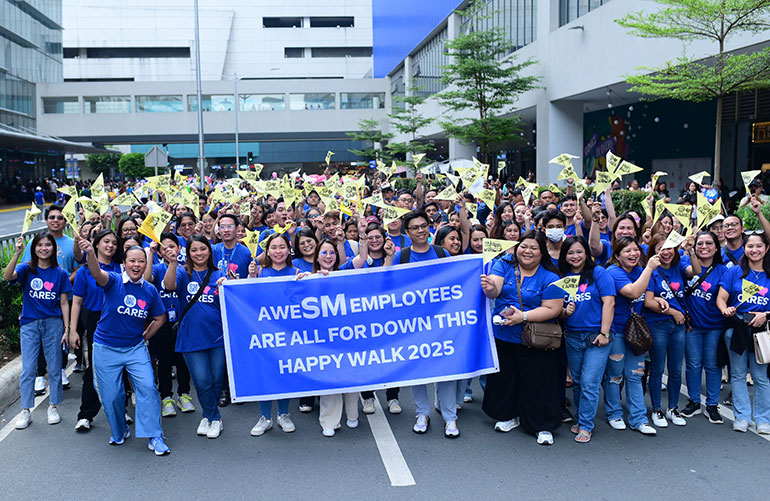
SM Cares and DSAPI with over 8,000 attendees during the Happy Walk 2025, inspiring acceptance and empowerment for individuals with Down Syndrome
In a powerful display of unity, inclusivity, and advocacy, Happy Walk 2025 successfully gathered thousands of individuals with Down Syndrome, their families, and supporters across the country on March 30, 2025. The nationwide event, hosted by SM Cares in partnership with the Down Syndrome Association of the Philippines, Inc. (DSAPI), was celebrated at SMX Manila (SM Mall of Asia Complex) and in simultaneous events at SM City Cebu and SM City Bacolod. Additionally, SM CDO Downtown Premier held its celebration earlier on March 23, 2025, while SM Center Ormoc joined the movement with the All for Down Night Run last March 27, 2025.
With the theme “321 & Beyond,”Happy Walk 2025 went beyond simply raising awareness — it inspired action, strengthened community ties, and reinforced the importance of inclusion and empowerment for individuals with Down Syndrome.
A father and child happily join the parade, giving us a touching moment and another reason to strengthen our commitment to inclusivity.
“Happy Walk is a reminder that inclusion is a shared responsibility. Every step we take today is a step toward a future, where individuals with Down Syndrome are recognized for their strengths and given the opportunities they deserve,” said Nill Patrick Arroyo, DSAPI Board Member and Head of Happy Walk 2025.
The event served as an opportunity for families and advocates to connect, learn from each other’s experiences, and celebrate the progress made in promoting inclusivity in the Philippines.
A happy walker gives her best smile as she leads this year’s parade.
Stronger Together: The Impact of Happy Walk 2025
The overwhelming turnout of over 8,000 attendees, our biggest to date, across all participating SM malls demonstrated the ever-growing support for individuals with Down Syndrome. Parents, educators, healthcare professionals, volunteers, and corporate partners walked hand in hand in a symbolic movement for acceptance and empowerment.
A beautiful milestone when SM Supermalls AVP for Marketing Hanna Carinna Sy takes after her father, Hans Sy, as she welcomes this year’s Happy Walk.
“SM Cares is honored to continue its long-standing partnership with DSAPI for Happy Walk. Every year, this event reaffirms our commitment to making our malls, and our society, more inclusive and welcoming for all,” said SM Supermalls Assistant Vice-President for Marketing Hanna Carinna Sy.
Hundreds of SM employee volunteers walk proudly with purpose for Happy Walk 2025 at SMX Manila.
Throughout the years, Happy Walk has played a crucial role in breaking down barriers and fostering a society that embraces individuals with Down Syndrome. The event has become a national tradition that uplifts communities and empowers families through education, support, and advocacy.
Beyond Happy Walk: Strengthening the Advocacy for Inclusion
SM City Cebu’s happy walkers showcase their awesome dance moves onstage, embracing their abilities.
While the event is an annual celebration, its mission extends far beyond a single day. SM Cares, together with DSAPI and its partners, remains committed to promoting inclusivity in everyday life. Through various programs, support initiatives, and community-building efforts, they continue to create safe, welcoming, and empowering spaces for individuals with Down Syndrome.
AweSM employees from SM City Bacolod walk with the Down Syndrome community, strengthening our commitment in promoting inclusivity and acceptance.
About SM Cares
SM Cares is the corporate social responsibility arm of SM Supermalls, championing inclusivity, sustainability, and community empowerment. Through its long-standing partnership with DSAPI, SM Cares continues to advocate for individuals with disabilities and ensure that every SM mall remains a safe and welcoming space for all.
About DSAPI
The Down Syndrome Association of the Philippines, Inc. (DSAPI) is a nonprofit organization dedicated to advocating for the rights, welfare, and inclusion of individuals with Down Syndrome. Through education, awareness campaigns, and community engagement, DSAPI works to create a society where individuals with Down Syndrome are empowered to thrive.
Spotlight is BusinessWorld’s sponsored section that allows advertisers to amplify their brand and connect with BusinessWorld’s audience by publishing their stories on the BusinessWorld Web site. For more information, send an email to online@bworldonline.com.
Join us on Viber at https://bit.ly/3hv6bLA to get more updates and subscribe to BusinessWorld’s titles and get exclusive content through www.bworld-x.com.
The Department of Health (DOH) said on Wednesday that it is considering a single-dose Human Papillomavirus (HPV) vaccine for young female students to expand immunization coverage.
During a media conference in Bataan, Dr. Carmina Paz Vera, Medical Officer IV of the DOH, said the agency received a recommendation from the World Health Organization about the single-dose HPV vaccine, as studies indicate, it has nearly the same efficacy as the standard two or three doses.
“The evidence for this is based on multiple cohort studies and follow-up studies. They administer the vaccine to girls at a certain age and then conduct follow-up studies after 10 or 12 years,” Ms. Vera said in both mixed English and Filipino.
“They found that the efficacy level based on the one-dose regimen was mostly the same as that of the two-dose regimen.”
Countries like the United Kingdom, Australia, and other Western nations have already implemented the one-dose HPV vaccine, Ms. Vera said.
In the Philippines, the DOH is expected to finalize its advisory on the one-dose regimen in the third or fourth quarter of 2025, after consultations with independent local experts, Ms. Vera told BusinessWorld.
“We are receptive to the WHO’s recommendation to shift to a one dose because if we able to shift to one, we can have wider reach—not just for the public but also for private sectors and other age groups that the vaccine can cover,” Ms. Vera said in both mixed English and Filipino.
As of January 6, the DOH announced that it is already more than halfway to its target of vaccinating over one million Grade 4 students with the first dose of the HPV vaccine.
In other news, the DOH also eyes expanding its school-based immunization (SBI) program to private schools to reach more young female students.
Ms. Vera told BusinessWorld the DOH is currently in talks with the Department of Education to determine the total number of students in private schools and which schools will receive allocations, given the limited supply.
She added that the agencies have yet to determine which regions will receive the vaccination, but they aim to roll out the expanded SBI in the upcoming school year.
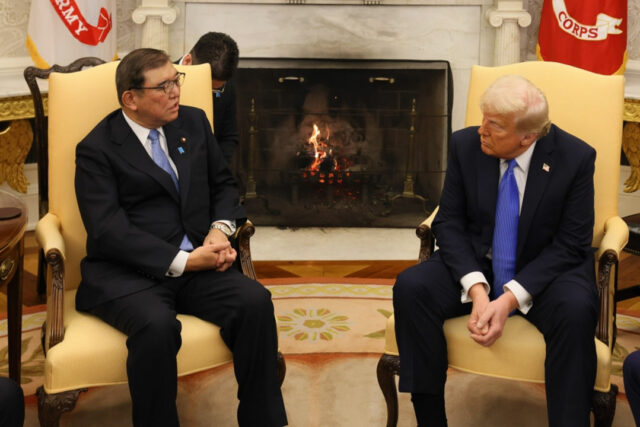
JAPANESE Prime Minister Shigeru Ishiba (L) with US President Donald Trump. — MOFA.GO.JP-CABINET PUBLIC AFFAIRS OFFICE
TOKYO – Japanese Prime Minister Shigeru Ishiba said on Monday the government will continue to ask U.S. President Donald Trump to lower tariffs against Japan, but acknowledged results “won’t come overnight.”
“As such, the government must take all available means” to cushion the economic blow from U.S. tariffs, such as offering funding support for domestic firms and taking measures to protect jobs, Mr. Ishiba told parliament.
Mr. Ishiba said Mr. Trump’s decision to slap tariffs on imports from Japan was “extremely disappointing and regrettable,” adding that Japan will continue to explain that it had done nothing unfair to the United States.
Mr. Ishiba also said he was willing to visit the United States for a meeting with Mr. Trump as soon as possible. “But in doing so, we must ready a package of steps on what Japan could do,” he added.
Mr. Trump’s decision to slap a 25% levy on auto imports, and a reciprocal 24% tariff on other Japanese goods, is expected to deal a huge blow to Japan’s export-heavy economy with analysts predicting the higher duties could knock up to 0.8% off economic growth.
Fears of a global recession have also led to steep declines in stock prices worldwide including Japan’s Nikkei share average, which tumbled nearly 9% early on Monday.
Mr. Ishiba summoned key economic ministers, including Finance Minister Katsunobu Kato, Sunday evening and instructed them to be vigilant and “respond appropriately” to market developments, according to Japan’s Nikkei newspaper. – Reuters