Home Blog Page 166

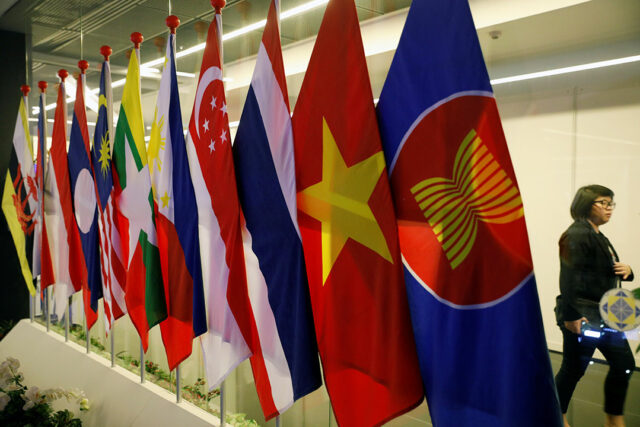
ASEAN calls for restraint, immediate cessation of hostilities in the Middle East

REUTERS

MANILA — ASEAN foreign and economic ministers on Friday called for an immediate halt to the war in the Middle East, and said the effects of surging oil prices and disrupted trade are already hitting Southeast Asia’s economies.

Several members of the Association of Southeast Asian Nations have begun rolling out measures to counter the economic impact, with governments moving quickly to conserve energy, stabilize
domestic markets, and protect vulnerable sectors such as tourism.

“We expressed serious concern over the situation in the Middle East and its impacts in the region, and emphasized the importance of the immediate cessation of hostilities,” Philippine Foreign Affairs Secretary Ma. Theresa Lazaro told a press conference after a special meeting on the crisis, adding that ASEAN called on all parties to exercise the utmost self-restraint.

The Philippines, which is chairing ASEAN this year, convened the special meeting as concerns over the Iran conflict deepened. The ministers called for global energy supply chains to be kept open and to activate regional mechanisms to mitigate the economic fallout.

Crude oil is trading near $100 a barrel on worries about supplies, which have been heightened by the vow from Iran’s new supreme leader to keep the Strait of Hormuz, the route for a fifth of global oil supply, closed.

“The escalating conflict has generated broader economic repercussions beyond the region, particularly through heightened volatility in global energy markets and disruption of key maritime and supply chain routes,” the economic ministers of the 11-member bloc said in a statement after a separate meeting.

Ms. Lazaro said the Philippines, which is heavily dependent on imported fuel from the Middle East, was considering buying oil from Russia, but she did not elaborate.

The economic ministers warned that the region’s exposure to global oil and liquefied natural gas (LNG) supply routes made it especially vulnerable to further shocks, adding that reinforcing supply chain resilience, accelerating renewable energy transitions, and deepening regional cooperation would be essential to preserving economic stability. — Reuters

Philippines looks to regulate power market as LNG prices surge

STOCK PHOTO | Image by Marcos Marcos Mark from Pixabay

SINGAPORE/MANILA – The Philippines plans to rein in power bills as Middle East shipping disruptions drive up LNG prices, its energy secretary told Reuters on Friday, by boosting coal-fired power output and by regulating electricity prices, maybe as soon as next week.

Shipping in the Gulf and through the narrow Strait of Hormuz has slowed sharply as the US-Israel war with Iran escalates, driving LNG prices to their highest since 2022, after an output halt by Qatar, which provides a fifth of global supply.

The Southeast Asian nation could face a rise of 16% in power prices by next month unless the government intervenes, Energy Secretary Sharon Garin told Reuters, adding that Manila was in talks with Indonesia to ensure steady supplies of coal.

“The basic idea is to ramp down liquefied natural gas and ramp up coal and renewables,” Ms. Garin said, flagging that LNG-fired power plants now supplying the grid can readily be replaced with electricity generated from coal in the short term.

“We’re asking for emergency powers in order to regulate the market,” she said, adding that the government’s effort to limit power prices at current levels could begin as soon as next week.
“Because the cost of living will increase, we are trying to do some temporary relief.”

In addition to measures such as speeding renewable linkages and rescheduling maintenance, the Philippines’s return to coal will follow its first annual decline in coal-fired output in nearly two decades last year.

That now stands to be reversed, highlighting Asia’s struggle with LNG price swings and supply disruptions.

After Qatar’s production halt, spot liquefied natural gas prices more than doubled to their highest in over three years.

RARE UNREGULATED POWER MARKET

The Philippine government’s plan to intervene in one of the few Asian markets where power prices are not regulated could begin as early as next week, Ms. Garin said.

Power tariffs in the archipelago of more than 100 million are already the second highest in the region, behind Singapore.

“With the exaggerated increase in fuel transportation costs, there’s a multiplier effect,” Ms. Garin said.

Some market rules might have to be suspended to afford temporary relief, Ms. Garin said, adding that distribution utilities had offered to boost coal-fired power in place of LNG.

“We’ll intervene in the market, or whatever is allowed by law, especially for Meralco, which is the biggest distribution utility we have,” she said.

The government was in talks with First Gas Power to supply any unused domestically extracted gas to power plants running purely on LNG, she added.

First Gas did not immediately respond to a request for comment.

In an email, Meralco told Reuters it supported the energy department’s initiatives to rein in prices, had sufficient contracted coal, and was coordinating with power suppliers to hold down generation charges. — Reuters

Lenovo Tech World ‘26 Hong Kong, a bold showcase for AI innovation in Asia Pacific

At Lenovo Tech World ‘26, AI took center stage in Hong Kong, a leading hub for innovation in the Asia Pacific region. — ED GERONIA

In a period defined by the rapid adoption of artificial intelligence across several industries, Lenovo has outlined its initiatives for a global AI deployment at Lenovo Tech World ‘26 Hong Kong. Held last March 10, the flagship event brought together Lenovo’s real-world AI-powered projects.

Moving from conceptual and basic implementation of AI, Lenovo presented its AI-driven strategy across several industries from consumer to industrial applications with equal focus on hardware and software that powers them. Through a series of keynote speeches, panel discussions, media roundtables, and experiential exhibits, Lenovo demonstrated its innovations with its Hybrid AI framework which integrates Personal AI, Public AI, and Enterprise AI.

WELCOME AND OPENING KEYNOTES

For his welcome keynote, Ken Wong, Lenovo Executive Vice President and President, Solutions & Services Group, said that AI has gone beyond just being a search tool. It can now reason and act in real time.

“For enterprises, this marks a new phase, where AI turns data into action, connecting digital and physical worlds,” Mr. Wong said.

“At Lenovo, this is how we bring AI to you: personal AI across devices and enterprise AI across value chains. Together, we call this Hybrid AI.”

As a framework, Hybrid AI considers the present reality that individuals and organizations have different demands when using artificial intelligence. There’s no one-size-fits all use case. With Hybrid AI, Lenovo gives the choice in using the large language model (LLM), data, deployment location, governance and security controls.

Mr. Wong also gave an example of Lenovo’s commitment to AI innovation. The company has invested in more than 300 technology, robotics, and large language model startups. Ten of these companies are in Hong Kong.
As the event’s guest of honor, Paul Chan, Financial Secretary of Hong Kong, delivered the opening keynote. In his speech, Mr. Chan cited the robotic performance during the Spring Festival Gala in China as an example of the future of embodied intelligence. He added that robotics and AI can be used for building a stronger economy.

“Ever major economy now recognizes AI’s strategic importance,” Mr. Chan said.

“It’s an unstoppable wave. We must embrace it with confidence and care.”

With industry leaders in attendance at the event, Mr. Chan reiterated Hong Kong’s role as an AI Hub which is connected to the Greater Bay Area’s cutting-edge research and manufacturing.

Just two weeks ago, the Committee on AI Plus and Industry Development Strategy was established to consolidate academia, industry, and technology parks for integrating AI into priority sectors such as health technology and embodied intelligence.

Near the end of his speech, Mr. Chan said, “Innovation flourishes when government, academia, and industry collaborate. Lenovo’s deep AI experience can strongly support Hong Kong’s ambitions.”

“This event is a living example of that ecosystem in action—bringing enterprises, startups, and researchers together to apply AI to real-world challenges.”

After Mr. Chan’s speech, Mr. Wong returned to the stage again to briefly talk about Hybrid AI as the new standard. Personal AI can connect multiple devices such as phones, tablets and PCs into a seamless experience. He presented Lenovo Qira as an example, it is a “Personal Ambient Intelligence” AI that can act as a personal AI double.

OTHER KEYNOTES

For the next keynote, Linda Yao, Lenovo Vice President and General Manager, Hybrid Cloud & AI Solutions, presented the Lenovo Hybrid AI framework is a full-stack approach that combines the AI Factory (infrastructure) with the AI Library (proven solutions), and services. As an example, she mentioned Supply Chain Super Agents which managed 2,700 components, and the Football AI Pro created for FIFA which securely process massive amounts of data for use by analysts and coaches globally.

Charles Ferland, Lenovo VP and GM, ISG ESMB Commercial Group, talked about the company’s ThinkSystem and ThinkEdge line of AI inferencing hardware that is optimized for deploying trained AI models.

Art Hu, Lenovo SVP and Global CIO discussed the company’s collaboration with FIFA on the technology side. He was joined on stage by Romy Gai, FIFA’s Chief Business Officer. One of their recent projects is the scanning of all the players’ 3D data for creating AI-enabled 3D avatars and the latest version of the Referee View which used AI-powered stabilization software to process first-person footage captured from the referee’s camera.
Lenovo’s President for Asia Pacific, Amar Babu presented the Lenovo Quira, a personal AI super-agent that can be accessed across all Lenovo and Motorola devices such as phones, tablets, wearables and PCs. According to Mr. Babu, Qira can learn from the user’s habits in line with Lenovo’s vision of “One Personal AI, Multiple Devices”.

RACE FOR ENTERPRISE PANEL

The keynotes were followed by a panel discussion on the “Race for Enterprise AI” moderated by David Rabin, Lenovo Chief Marketing Officer, Solutions & Services Group. The panelists included Kate Swanborg (SVP, Technology Communications and Strategic Alliances, DreamWorks Animation), Romy Gai (FIFA Chief Business Officer), and Gordon Orr (Lenovo Board Member and former McKinsey Asia Chair.

Ms. Swanborg was asked about where DreamWorks was in terms of AI readiness. According to her, they had to be cautious for a couple of years “because the artists and the actors are so critical to our business.”

She revealed that last year, they started a series of workshops with Lenovo’s AI Center of Excellence “to target specific areas within our production that we could then deploy AI.”

Mr. Gai said that FIFA used AI for event logistics, fan engagement, and broadcasting complexity at massive scale.

For the enterprise, different companies have different levels of AI readiness. They either had to act fast or fall behind. With the help of Lenovo, DreamWorks struck the balance by becoming ROI positive by deploying AI within their production pipeline while empowering their artists. — Ed G. Geronia Jr.

Rockwell Land and Juan D. Nepomuceno Realty top off Power Plant Mall Angeles in Rockwell at Nepo Center

Power Plant Mall Angeles’ topping off ceremony was led by (L-R) Mr. Eugenio L. Lopez III; JDN Realty Chairman, Mr. Arsenio N. Valdes; JDN Realty Chairman Emeritus, Engr. Peter G. Nepomuceno; Angeles City Mayor, Carmelo G. Lazatin II

Rockwell Land and Juan D. Nepomuceno (JDN) Realty, through their joint venture Rockwell Nepo Development Corporation (RNDC), officially marked a major construction milestone with the topping off ceremony of Power Plant Mall Angeles on March 10, 2026. This event signals the completion of structural works for the highly anticipated retail destination, which is scheduled to open its doors by the third quarter of 2027.

The ceremonial event was led by Angeles City Mayor Carmelo G. Lazatin II; Mr. Eugenio L. Lopez III, Mr. Nestor J. Padilla, Chairman and CEO of Rockwell Land; and Mr. Miguel Ernesto L. Lopez, Rockwell Land Treasurer and Senior Vice President for Office Development. Also in attendance were Engr. Peter G. Nepomuceno, Chairman Emeritus of JDN Realty; and Mr. Arsenio N. Valdes, JDN Realty Chairman. They were joined by prospective retail tenants, key project partners, consultants and contractors to celebrate this expansion of the iconic Rockwell lifestyle into Central Luzon.

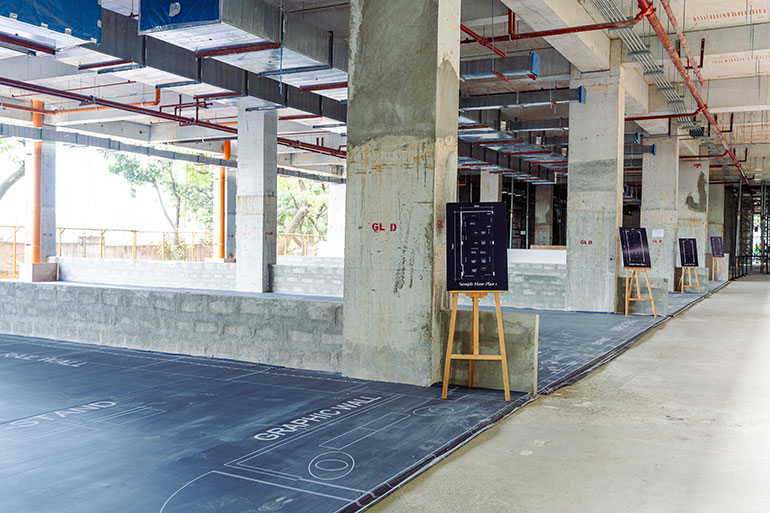
The event commenced with guests witnessing the ceremonial topping off of Power Plant Mall Angeles. They were also invited to an exclusive preview of the mall, staged to replicate its completed state, with exciting early mock-ups and samples of the upcoming store facades, finishes, and architraves — taking a glimpse of how the original experience at Power Plant Mall in Makati will be brought to life in Angeles.

The ceremonial topping off ceremony, held March 10, 2026, marks the structural completion of Power Plant Mall Angeles in Rockwell at Nepo Center, slated to open in Q3 of 2027.

A New Retail Landmark in Pampanga

With 32,000 square meters of leasable area, Power Plant Mall Angeles is the first expansion of the iconic Rockwell retail development outside of Metro Manila. Designed to mirror the signature elegance of its Makati flagship, the mall will feature a curated mix of international and local brands, daily essentials, and a dedicated al fresco dining scene that celebrates the rich culinary heritage of Pampanga.

“We are thrilled to bring the Power Plant Mall experience to Angeles,” says Tin Coqueiro, Rockwell Land Vice President for Retail Development. “Our goal is to blend our signature curated retail mix with local flavors, ensuring a destination that resonates deeply with the Kapampangan community.”

A Growing Community at Rockwell at Nepo Center

Power Plant Mall Angeles, which broke ground on October 12, 2023, is a key anchor of Rockwell and JDN Realty’s vision for the 4.6-hectare mixed-use development in the heart of Angeles, Pampanga, Rockwell at Nepo Center. The community has seen rapid growth since its June 2021 launch of Rockwell at Nepo Center’s first residential building, The Manansala, which was followed by The BenCab in September 2022 and The Aurelio last October 2025. The Manansala, which is fully sold out, has started turning over to residents in January of this year. The BenCab, now 87% sold, is scheduled for turnover in December 2026, while the recently launched The Aurelio continues the development’s upward trajectory.

Additional Expansion

The success of the joint venture has prompted an even bolder vision for the project.

“Because of the positive response to our residential and retail offerings, we are expanding Rockwell at Nepo Center with an additional 9,000 square meters of land,” says Padilla. “We are already planning on expanding the mall and adding other components that will make the development even more exciting.”

The topping off of Power Plant Mall Angeles marks a pivotal milestone in Rockwell Land and JDN Realty’s shared vision to cultivate a lifestyle destination in the North. Slated to open in the third quarter of 2027, the mall is set to become the centerpiece of a vibrant Angeles City community. This project, bolstered by a strategic land acquisition and an expanded partnership with JDN Realty, underscores Rockwell’s unwavering momentum in bringing its signature brand of luxury and convenience to the region.

For more news and information about Rockwell at Nepo Center, visit  https://e-rockwell.com/property/rockwell-at-nepo-center/.


Spotlight is BusinessWorld’s sponsored section that allows advertisers to amplify their brand and connect with BusinessWorld’s audience by publishing their stories on the BusinessWorld Web site. For more information, send an email to online@bworldonline.com.

Join us on Viber at https://bit.ly/3hv6bLA to get more updates and subscribe to BusinessWorld’s titles and get exclusive content through www.bworld-x.com.

PHL looking to join US’ Pax Silica initiative

The Pax Silica Summit is a historic gathering of nations at the forefront of the global AI supply chain. — OFFICE OF THE UNDER SECRETARY FOR ECONOMIC AFFAIRS, US DEPT. OF STATE OFFICIAL LINKEDIN PAGE

THE PHILIPPINES wants to join the United States’ Pax Silica initiative to boost its participation in the supply chain of critical minerals and artificial intelligence (AI) infrastructure, the Department of Trade and Industry (DTI) said.

“The Philippines is very much interested to be part of the Pax Silica initiative of the US,” Trade Undersecretary Ceferino S. Rodolfo told reporters on the sidelines of a forum on Friday.

“For us, Pax Silica rests on two pillars — to have a secure supply of critical minerals, rare earth elements that are needed for both defense and high-technology industries; and the second piece is on AI digital infrastructure.”

The country’s inclusion in the US-led Pax Silica partnership would also allow the Philippines to become a player in the production of digital infrastructure amid the AI boom, Mr. Rodolfo said.

“You will need the critical minerals for you to be able to produce all of necessary equipment, components for your digital infrastructure.”

Pax Silica is a US-led economic partnership seeking to build the global silicon supply chain across critical minerals, semiconductors, advanced manufacturing, transportation logistics, and AI infrastructure.

The framework also aims to promote “a shared and trusted ecosystem of AI developers and vendors to renew legacy industries and unlock new markets and services,” according to the US Department of State’s website.

Current signatories to the Pax Silica initiative include Australia, Greece, India, Israel, Japan, Qatar, Republic of Korea, Singapore, United Arab Emirates, and the United Kingdom. Meanwhile, Taiwan serves as a non-signatory participant to the agreement.

Mr. Rodolfo added that the country is interested in pursuing a critical minerals agreement with Canada.

This after the Philippines and US signed a memorandum of understanding in February to support the local processing of critical and rare earth minerals — key components to advanced manufacturing.

The Philippines also expects to conclude talks for a free trade agreement (FTA) with Canada this year, ahead of the Association of Southeast Asian Nations (ASEAN)-Canada FTA, Mr. Rodolfo said.

“The Philippines-Canada FTA is very important because that would be the framework where Canada could be our entry point to the broader CUSMA (Canada-United States-Mexico,)” he said.

Through the bilateral FTA, the Philippines could also serve as Canada’s entry point to the wider ASEAN bloc, Mr. Rodolfo said.

The Philippines and Canada are scheduled to hold its second round of FTA talks in April.

Canadian Ambassador to the Philippines David Hartman said it “remains fully committed” to seal negotiations for the Philippines-Canada FTA this year.

He cited the importance of an FTA with the Philippines to ensure economic security amid ongoing geopolitical tensions.

“In this environment, resilience cannot be built on isolation. Economic security increasingly depends on cooperation amongst trusted partners,” Mr. Hartman told the forum. — Beatriz Marie D. Cruz

Philippines jobless rate jumps to over three-year high of 5.8% in January

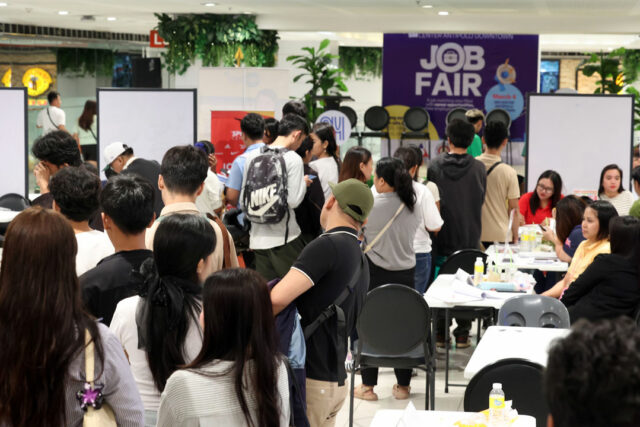
Applicants attend a job fair in Antipolo City, March 4, 2026. — PHILIPPINE STAR/MIGUEL DE GUZMAN

By Erika Mae P. Sinaking, Reporter

The Philippines’ unemployment rate climbed to 5.8% in January 2026, marking its highest level in more than three years, as the labor market cooled after the holidays, the Philippine Statistics Authority (PSA) said on Friday.

Preliminary results from the January 2026 Labor Force Survey (LFS) showed the number of unemployed Filipinos rose to 2.96 million, from 2.17 million in the same month last year, and 2.26 million in December 2025.

PSA Assistant Secretary Divina Gracia L. Del Prado said that the January unemployment rate was the highest recorded since June 2022, when unemployment stood at 6.0%.
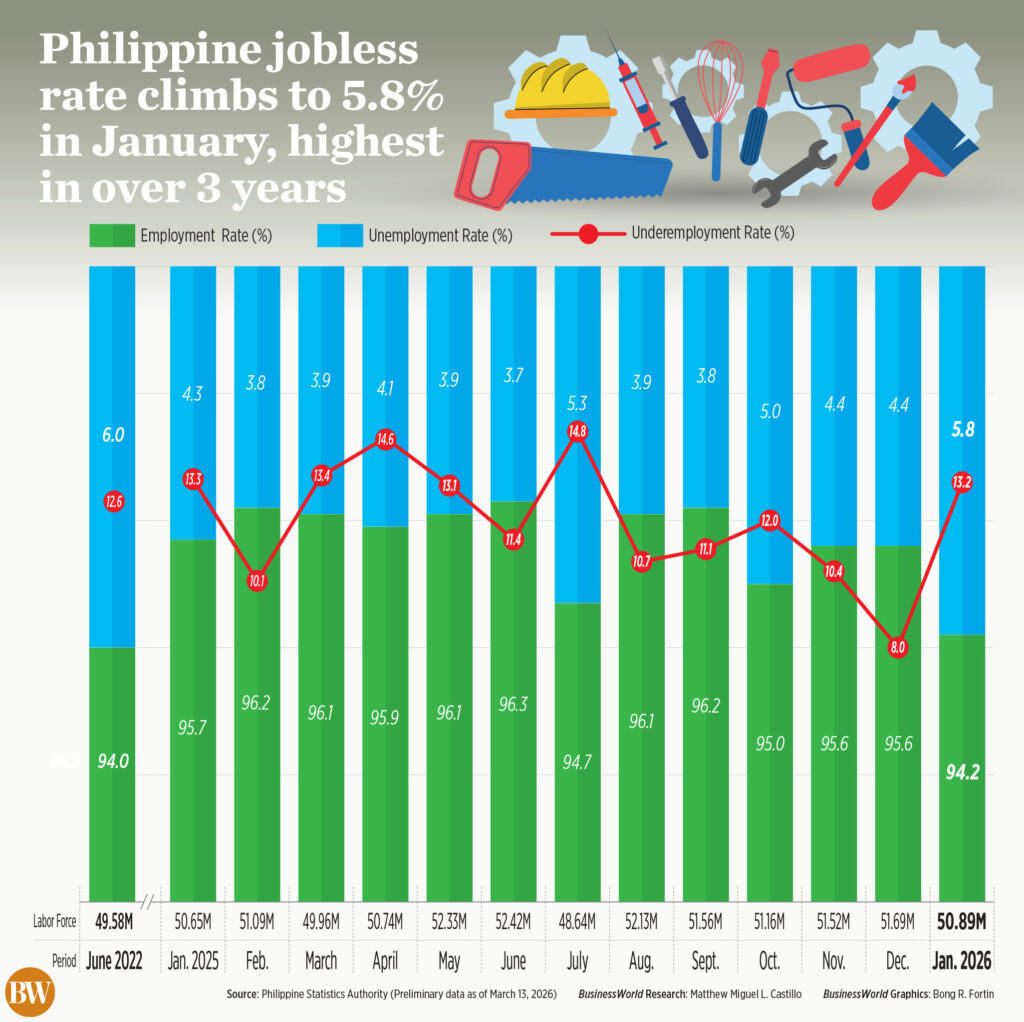
The January jobless rate was higher than the 4.3% in January 2025, and the 4.4% in December 2025.

“Usually in our time series, after the Christmas season, our employment rate really goes down… because there are no longer available jobs,” Ms. Del Prado told a livestreamed news briefing.

“Because in December, of course, there are lots of jobs available for our labor force. But month on month, the number of unemployed increased by 695,000. And most of the reasons for this are that people got tired — maybe they were exhausted from working in December, or believing that there are no jobs available,” she added.

The quality of employment also saw a shift, as the underemployment rate — the proportion of those with jobs but seeking more hours — stood at 13.2% in January 2026. This was a tad lower than the 13.3% underemployment rate in January 2025, but higher than the 8% in December 2025.

About 6.35 million Filipinos were considered underemployed persons in January, slightly decreased from the 6.47 million underemployed in January 2025, and 2.42 million seen in December 2025.

The country’s employment rate fell to 94.2% in January 2026, down from 95.7% in January 2025 and 95.6% in December 2025. This was also the lowest employment rate recorded since June 2022 when it stood at 94%.

The number of employed persons in January 2026 fell to 47.94 million, a decline from 48.49 million employed in the same month last year, and 49.43 million in December 2025.

The labor force participation rate (LFPR) eased to 62.3% in January 2026, translating to 50.89 million Filipinos in the labor force. This was lower than the 63.9% (50.65 million) recorded in January 2025, and the 64.4% in December 2025.

JOB LOSSES

On a year-on-year basis, the agriculture and forestry sub-sector lost 1.42 million jobs in January, driven by a drop in the cultivation of paddy rice, corn, and leafy vegetables. Wholesale and retail trade followed with the loss of 729,000 jobs, while fishing and aquaculture shed 140,000 positions.

On the other hand, several sectors posted annual gains in January, led by administrative and support service activities (+403,000), public administration and defense (+342,000), manufacturing (+326,000), and transportation and storage (+160,000).

Month on month, agriculture and forestry jobs plummeted by 1.76 million, while wholesale and retail trade also saw a month-on-month decrease of 888,000 jobs, followed by construction (-199,000), education (-154,000), and accommodation and food service activities (-140,000).

Ms. Del Prado pointed to weather disruptions as a contributing factor, specifically the impact of Typhoon Ada on regions such as Bicol, Eastern Visayas, and Caraga.

Despite the overall job losses, some sub-sectors showed resilience month-on-month. Manufacturing added 546,000 jobs, while other service activities grew by 248,000, and transportation and storage increased by 238,000 from December 2025 to January 2026.

Regarding the quality of remaining jobs, wage and salary workers continued to make up the bulk of the workforce at 68.8%, followed by the self-employed without employees at 24.7%. Within the wage-earner group, private establishments employed 78.5%, while the government accounted for 14.3%.

Among all regions, South Cotabato, Cotabato, Sultan Kudarat, Sarangani, and General Santos City (SOCCSKSARGEN) recorded the highest employment rate at 96.0% in January 2026, while Bicol region posted the lowest at 91.8%.

On the other hand, Bicol region logged the highest unemployment rate in the country at 8.2%.

Eight regions recorded unemployment rates exceeding the 5.8% national average, including Eastern Visayas (7.7%), Zamboanga Peninsula (6.7%), Caraga (6.53%), Negros Island Region (6.50%), provinces of Caveat, Laguna, Batangas, Rizal, and Quezon or CALABARZON at 6.4%, Northern Mindanao at 6.1%, and the National Capital Region at 6.0%.

SUPPORT FOR WORKERS

Department of Economy, Planning, and Development (DEPDev) Secretary Arsenio M. Balisacan said in a statement that the government is intensifying support for the workforce amid “elevated geopolitical tensions and global uncertainties” due to the Iran war.

“Our priority is clear: create more and better jobs at home, strengthen industries, equip our workers with the skills needed for higher-value employment, and ensure that those affected by global disruptions, including OFWs, can transition smoothly into productive opportunities here in the Philippines,” Mr. Balisacan said.

PSA’s Ms. Del Prado warned that the spike in fuel prices could further impact the labor market.

“When the price of oil spikes, businesses, some of them, no longer hire or some of them, lay off. So, it might affect our labor market,” she said.

“Those [migrant workers] who were repatriated [from the Middle East] will also come back home, they will become part of the labor force. Or some of them, not in the labor force, but if they will become part of the labor force and they are unemployed, then they will increase the total number of unemployed and of course the unemployment rate,” she said, adding this will be reflected in the data in the coming months.

Benjamin B. Velasco, an assistant professor at the University of the Philippines Diliman School of Labor and Industrial Relations, said that the big jump in the unemployment rate means that the private sector is not generating enough jobs.

“The unemployment rate for January 2026 should be a wakeup call to the Marcos Jr. administration to shift priorities in its economic and employment agenda,” Mr. Velasco told BusinessWorld in a Facebook messenger chat.

“In the long-term, we need an industrial policy that is state-led and incentivizes labor-intensive and jobs-creating industries and sectors that cater to the domestic market,” he said.

“Things are going to get even worse before they get any better given Trump’s war in Iran which has led to a global economic crisis,” he added.


Manila Water, Maynilad to raise water rates in April

Residents fetch water from a tanker in this file photo. -- Photo by Edd Gumban, The Philippine Star

By Sheldeen Joy Talavera, Reporter

Customers in Metro Manila and nearby areas will have to brace for higher water bills starting April as the regulator approved the two concessionaires’ applications for rate hikes due to foreign exchange movements.

The Metropolitan Waterworks and Sewerage System Regulatory Office (MWSS RO) approved a rate hike of P0.04 per cubic meter (cu.m.) for Manila Water Co. Inc., and an increase of P0.09 per cu.m. for Maynilad Water Services, Inc., the agency said in a statement on Friday.

Customers served by Manila Water in the east zone who consume 10 cu.m. or less will see their water bills go up by P0.14. Those consume up to 20 cu.m. and 30 cu.m. will have to pay an additional P0.29 and P0.58, respectively.

Meanwhile, Maynilad customers in the west zone who consume 10 cu.m. or less will see an upward adjustment of P0.27 in their bills next month. Those who consumes up to 20 cu.m. and 30 cu.m. will see their bills increase by P1 and P2.07, respectively.

The tariff increase will have less impact on low-income households who are beneficiaries of the enhanced lifeline program of Manila Water and Maynilad.
The upward adjustments were approved as part of the foreign currency differential adjustment (FCDA).

The FCDA is a tariff mechanism which allows water concessionaires to regain losses or return gains by the movement of peso against other foreign currencies. The companies pay foreign currency-denominated concession fees to MWSS, as well as loans that are used to finance projects to expand and improve water and sewerage services.

Meanwhile, the MWSS RO penalized Maynilad amounting to P42.57 million for the prolonged water service interruptions that occurred in the southern portion of the west concession area last month.

The regulator said that investigation showed that the company failed to meet its service obligation of providing uninterrupted 24-hour supply of water at a minimum pressure of seven pounds per square inch to 98,331 customers within the Putatan Water Treatment Plant and Poblacion Water Treatment Plant Supply Zones.

As a result, Maynilad will have to refund P432.92 per affected water service connection, to be reflected in customers’ water bills by next month.

Manila Water serves the east zone network of Metro Manila, covering parts of Marikina, Pasig, Makati, Taguig, Pateros, Mandaluyong, San Juan, portions of Quezon City and Manila, and several towns in Rizal province.

Maynilad serves parts of Manila, Quezon City, and Makati, as well as Caloocan, Pasay, Parañaque, Las Piñas, Muntinlupa, Valenzuela, Navotas, and Malabon. It also supplies water to the cities of Cavite, Bacoor, Imus, and the towns of Kawit, Noveleta, and Rosario in Cavite province.

Metro Pacific Investments Corp., which has a majority stake in Maynilad, is one of three Philippine units of First Pacific Co. Ltd., the others being Philex Mining Corp. and PLDT Inc.

Hastings Holdings, Inc., a unit of PLDT Beneficial Trust Fund subsidiary MediaQuest Holdings, Inc., has an interest in BusinessWorld through the Philippine Star Group, which it controls.

16 global microinsurance executives, regulators to learn from Pioneer Insurance

Pioneer Insurance welcomes international Microinsurance Master delegates representing 10 countries from across the globe.

Sixteen insurance executives, regulators, and market enablers representing 10 countries have arrived in the Philippines to learn about microinsurance practices from Pioneer Insurance as the company hosts Microinsurance Master 2026, a global accelerator program focused on advancing financial inclusion.

The Microinsurance Master program starts with a two-week immersion at Pioneer and is followed by three months of follow-up mentoring by industry leaders to help participants implement their key takeaways and accelerate their activities. It entails classroom learning, field immersion, and expert mentorship designed to deepen their understanding of inclusive insurance models and expand protection for the unserved and underserved.

The Philippines has become a regular venue for the international program. With Pioneer recognized as the global standard for microinsurance, it was the chosen host for Microinsurance Master program in 2018, 2019, 2022, and 2024, before welcoming another batch this year. This year’s cohort brings together participants from Belgium, Equatorial Guinea, Ethiopia, France, Ghana, Kenya, South Africa, United Kingdom, and Zambia.

Through the years, Pioneer has already inspired over 150 decision makers in 48 countries.

Microinsurance Master Founder Bert Opdebeeck shares, “We are delighted to return to Pioneer Insurance. What makes its microinsurance journey impressive is how they consistently put their clients at the center of all its decisions while building solid partnerships.”

Pioneer Insurance Group Head and CARD Pioneer Microinsurance, Inc. (CPMI) Co-Founder Lorenzo Chan welcomed the delegates and emphasized the importance of community immersions and customer-centricity in designing products that truly meet the needs of the underserved.

“People will say that you never know what it’s like to be in someone’s position unless you walk in their shoes. To serve our market better, we encourage our Microinsurance Team to go and live with our clients,” Mr. Chan shared.

Following this approach, the Microinsurance Master participants are scheduled to take part in a community immersion in Pampanga to meet farmer families who have benefitted from CPMI’s products. Field visits will also be held at key microinsurance touchpoints, including CARD MRI centers, Cebuana Lhuillier Pawnshop, SM Business Center, and Motortrade stores, giving them a closer look at how inclusive insurance solutions reach communities on the ground.

Mr. Chan added that Pioneer continues to pursue both sustainability and social impact through its work in microinsurance.

“We want to combine profit with purpose without losing sight of what really matters,” he said.

Meanwhile, Melinda Grace Labao, President and CEO of CARD Pioneer Microinsurance, Inc. (CPMI), expressed appreciation to fellow advocates of financial inclusion who traveled to the Philippines to participate in the program, challenging them to approach the program with an open mind and collaborative spirit.

“Together, through collaboration and shared purpose, we can continue to expand protection for those who need it most,” Ms. Labao said. “Together, we can strengthen partnerships, scale responsibly, and push the boundaries of what is possible in financial inclusion.”

Through Microinsurance Master 2026, Pioneer continues to inspire action by sharing firsthand insights on how microinsurance programs are designed, distributed, and delivered within communities. By opening its doors to global practitioners, Pioneer aims to strengthen collaboration and encourage the replication of its success for underserved populations around the world.


Spotlight is BusinessWorld’s sponsored section that allows advertisers to amplify their brand and connect with BusinessWorld’s audience by publishing their stories on the BusinessWorld Web site. For more information, send an email to online@bworldonline.com.

Join us on Viber at https://bit.ly/3hv6bLA to get more updates and subscribe to BusinessWorld’s titles and get exclusive content through www.bworld-x.com.

Philippines seeks oil law review as high prices threaten nation

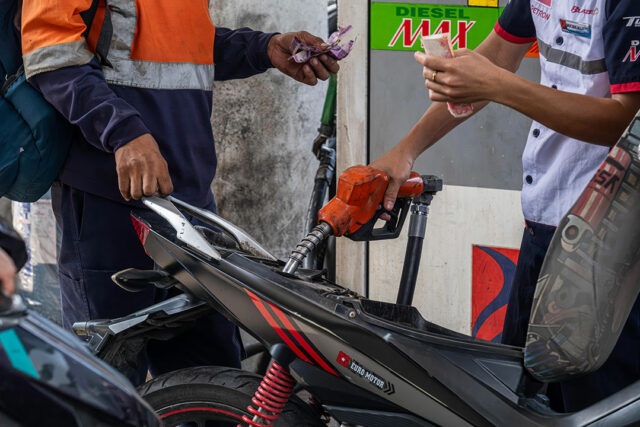
A motorist pays a gas attendant at a gas station on March 1, 2026. — PHILIPPINE STAR/RYAN BALDEMOR

The Philippines is looking to review a nearly 30-year old law that liberalized its oil industry, as the government aims to have a better grip on fuel prices that have shot higher due to the Iran war.

Energy Secretary Sharon Garin has backed proposals by some lawmakers to review a 1998 law that she said left the industry “totally unregulated,” threatening the import-dependent nation.

“It’s about time that we revisit that — learning from what’s happening now (and) in previous years when there were oil problems in the other side of the world,” Ms. Garin said in an interview with Bloomberg Television’s Yvonne Man and David Ingles on Friday.

“Unregulated market works when the circumstances are good. In good times, it’s a good market to have. In bad times, it’s a bad market to have,” she added. “There has to be a balance in the powers of the Department of Energy.”

The Philippines, which imports nearly all of its oil requirements, will likely see another round of substantial increase in fuel prices next week, with power costs set to rise by 16% in April, according to Ms. Garin. Those price spikes could fan inflation further, which already accelerated to the highest in more than a year in February.

“The Philippines cannot survive in an environment where the international market dictates its price,” she said, also pointing to efforts by the Southeast Asian nation to boost the share of renewable power in its energy mix.

Philippine oil companies are looking at sourcing supply from countries beyond the Middle East, but the energy chief said that’s proving to be difficult.

“It’s not about the supply, it’s about the price,” Ms. Garin said. “And if you do buy one, you have to find the ship that’s willing to sail to your country and the price of the logistics is increasing day to day. Insurance is high also. So there’s so much to consider.”

Other Asian countries are also restricting fuel use and telling citizens to avoid panic-buying as the world’s biggest energy-importing region is particularly exposed as the war in the Middle East curtails access to oil and fuel from the Persian Gulf. — Bloomberg

Philippine lawmaker raises alarm over obesity as study shows 41% of adults overweight

Rep. Janette L. Garin at the presentation of the Epidemiological Burden and Cost of Obesity in the Philippines (EpiCOb-PH) study in Mandaluyong City, Mar. 9, 2026. — EDG ADRIAN A. EVA

A Philippine lawmaker on Monday sounded the alarm over the country’s rising obesity problem, following a recent study that found about 41% of the 72 million Filipino adults — translating to 29.5 million people — are classified as overweight or obese.

“Forty-one percent is very alarming. I was surprised because I never expected it to be that high,” Janette L. Garin, Deputy Speaker and representative of Iloilo’s 1st district, said in reaction to the findings of the Epidemiological Burden and Cost of Obesity in the Philippines (EpiCOb-PH) study, which was also released on the same day during a multi-sectoral forum.

The study was led by Dr. Madeleine de Rosas-Valera and funded by Novo Nordisk Pharmaceutical (Philippines) Inc. It also found that more than four in 10 Filipino adults are already at increased risk of obesity-related health problems.

Ms. Garin said the findings of the study “are a sound of alarm and a red flag for our country,” noting that Filipinos currently face high out-of-pocket healthcare expenses, while public healthcare spending is largely directed toward curative care rather than preventive care.

The Iloilo representative said it is timely for the government to work together and address the problem of obesity by providing the right information down to schools and communities.

Ms. Garin committed to pushing for programs and budget allocations for health to curb the number of obese Filipinos to about 10% from 41%, noting that such a persistently high figure would be “a bad legacy for the country.”

Meanwhile, she told BusinessWorld that she is looking into including lessons about misleading marketing of food that contributes to obesity in the school curriculum. Ms. Garin said she will pursue this through legislation or through the lower house’s oversight powers.

“Pwede siyang ipasok sa curriculum. We have to start orienting the parents and teachers kasi doon magsisimula. We have to let them know what they are feeding or what they are eating [It can be included in the curriculum. We have to start orienting parents and teachers because that is where it begins. We have to let them know what they are feeding their children or what they themselves are eating],” Ms. Garin said on the sidelines of the presentation of the EpiCOb-PH study.

On the recent push to amend the Tax Reform for Acceleration and Inclusion (TRAIN) Law to raise taxes on sweetened beverages and include previously exempted sweetened and flavored milk, Ms. Garin said discussions on taxation are difficult to pursue amid ongoing global economic challenges.

“Napaka-mahirap na tumbukin natin ang taxes especially when it relates to food [It is very difficult to directly raise taxes, especially when it relates to food],” Ms. Garin said.

“Maybe we can discuss about taxation in the future kasi para ngayon, if we talk about that baka mamaya, mas malaking impact sa ekonomiya [Maybe we can discuss taxation the future, because for now, if we talk about that, it might have a bigger impact on the economy later],” she added.

The representative also said the lower house could explore other ways to curb obesity, such as imposing penalties on unhealthy foods and making measures to increase public awareness of foods that contribute to obesity.

The EpiCOb-PH study was conducted to address the gap in research on obesity’s demographic distribution and economic burden in the country. It used a modeling approach that combined multiple national data sources.

Researchers used data from the National Nutrition Survey and the Expanded National Nutrition Survey from 1993 to 2023 to estimate obesity’s current and future trends, as well as its health impacts.

TRILLION-PESO COST OF OBESITY

The EpiCOb-PH study also found that obesity is estimated to have cost the Philippines around P1.9 trillion in 2025, equivalent to 7.3% of the country’s gross domestic product (GDP) that year. The cost could rise to as much as P2.7 trillion if overweight-related expenses are also included.

Of the total cost, P551 billion was attributed to healthcare expenses, which could reach P790 billion when overweight cases are included.

These cover direct medical costs such as hospital confinement, based on normative estimates assuming patients are diagnosed and treated according to medical guidelines.

Non-medical costs were also taken into account, reaching P165.39 billion, including expenses such as transportation.

Productivity losses, including workdays missed due to obesity-related conditions, were estimated at P1.17 trillion.

The cost of obesity was computed through a specialized cost-of-illness model that integrated findings from a previous epidemiological burden study, Dr. John Paul Caesar delos Trinos, chief scientific officer and principal at metaHealth Insights and Innovations Inc., a consulting agency that organized the forum, said.

The analysis was also supported by secondary data, including published literature, online resources, and consultations with experts.

To curb the economic cost of obesity, Mr. delos Trinos said that food warning labels could be improved to indicate high levels of obesity-inducing ingredients such as fat, sugar, and salt.

Meanwhile, he urged the Philippine Health Insurance Corporation (PhilHealth) to include obesity in its primary care package, YAKAP.

For government offices and workplaces, he also suggested incorporating wellness initiatives for employees.

“This cannot be addressed by one institution or one sector alone. It cannot just be researchers conducting studies, publishing them, and then calling it a day. This will really require collaboration between different sectors,” Mr. delos Trinos said during his presentation in mixed English and Filipino. — Edg Adrian A. Eva

DITO shows support for MSMEs via local community flea market

Gabby Cui (extreme left), Head of MSME, DITO BizBayan, with STP founders at the South Trading Post milestone celebration. — DITO TELECOMMUNITY

DITO Telecommunity Corp. said it powered the connectivity needs of the local community flea market South Trading Post (STP) for its key events, reflecting its continued commitment to digitally empower local businesses.

Among these was STP’s milestone event on February 27, celebrating the second anniversary of its merchant community, powered by DITO BizBayan, the telco’s business unit for micro, small, and medium enterprises (MSMEs).

The event capped a series of STP activities over the past months, starting with the STP 2nd Southversary, which ended on November 9, 2025, and most recently the Love You So Matcha event, held until February 15, 2026.

DITO BizBayan powered all STP events’ connectivity needs by supporting merchant operations and event production, while enabling digital payments, the company said. It also assisted with social media engagement and other connectivity requirements for exhibitors and organizers.

Gabby Cui, head of MSME for DITO BizBayan, said STP shows how modern markets blend offline and online business seamlessly.

“With DITO’s 5G connectivity, we’re helping MSMEs power cashless payments, connect with customers in real time, and create meaningful experiences,” Mr. Cui said. He added that through the telco’s digital solutions, they aim to make every event successful and memorable for both merchants and their customers.

Meanwhile, Justin Francisco, co-founder of STP, described the telco’s support as “transformative” for the community and its stakeholders.

DITO said its strong and expanding 5G network enables businesses and communities to access stable, scalable digital infrastructure that drives growth and innovation. It added that the partnership with STP reflects its commitment to strengthening local business ecosystems and ensuring seamless, tech-enabled experiences for merchants and customers. — Edg Adrian A. Eva

ASEAN must strengthen resilience against shocks from Middle East crisis, Philippine trade secretary says

The ASEAN Philippines 2026 logo is seen in this file photo. — PPA POOL/NOEL B. PABALATE

MANILA — Philippine Trade Secretary Cristina Roque said on Friday the conflict in the Middle East underscores how deeply interconnected the global economy has become, with geopolitical tensions triggering immediate economic shocks.

Opening an ASEAN economic ministers’ meeting, she stressed that the goal is to strengthen regional resilience and deepen integration so the Southeast Asian bloc can navigate global shifts with coordination and foresight, rather than merely reacting to them. — Reuters

ADVERTISEMENT
ADVERTISEMENT