Home Blog Page 157

Revisiting VAT on digital services: When digital convenience meets tax complexity

For many taxpayers, the end of the first quarter of 2026 marks the filing of several tax returns, notably the filing of the Value-Added Tax (VAT) on Digital Services (VDS). Starting June 2, 2025, Republic Act (RA) No. 12023 took full effect. The law imposes a 12% VAT on “digital services.” Frankly, this imposition startled, and to some degree, upset business owners and consumers who rely heavily on digital platforms and media.

Early this year, reports emerged that certain members of the House of Representatives initiated House Bill No. 7844, which aims to repeal the VAT on digital services. The House bill explained that the signing of the law  raised the cost of essential services, such as Netflix and Shopee. They also explained that the imposition burdened digital media consumers, which is seen as regressive and burdensome.

In a world where daily life has become increasingly digitized, and in a country continuously being plagued by corruption scandals, the move to abolish an additional tax burden is seen as a light of hope for ordinary citizens.  However, the debate surrounding VAT on digital services warrants close examination, not only of its impact but also of its purpose and implementation.

To properly inform the taxpayers of this imposition, the Bureau of Internal Revenue (BIR) issued implementing rules and regulations to clarify how VAT on digital services would be applied. Yet, RA No. 12023 and its subsequent implementing rules raised additional questions and practical concerns and issues among taxpayers.

RA NO. 12023 AND ITS ORIGINS
RA No. 12023 expanded the Philippine Value-Added Tax system by imposing a 12% VAT on digital services consumed in the Philippines. Significantly, it requires not only resident but also nonresident digital service providers to register, collect, and remit VAT. The law further introduced rules on invoicing, withholding, compliance, and enforcement, effectively placing digital transactions on similar footing with traditional goods and services.

Under the law, “digital service” refers to any service supplied over the internet or other electronic network with the use of information technology and where the supply of the service is “essentially automated.” The law provides examples, such as online marketplaces, cloud platforms, streaming services, and other automated digital tools.

The accelerated growth of digital activity during the COVID-19 pandemic underscored the rationale for the law. With movement restricted, consumers and businesses alike shifted rapidly to digital platforms, embracing video conferencing, online games, streaming platforms, online marketplaces and e-commerce as daily necessities rather than conveniences.

The growth of the so-called “digital economy,” coupled with government need to generate income in a changing environment, pushed several countries to impose taxes on digital services. In Southeast Asia, Singapore, Malaysia, Thailand, Indonesia, and Vietnam have imposed taxes on digital services, with the Philippines following suit.

CHALLENGES IN IMPLEMENTING VAT ON DIGITAL SERVICES
Despite its policy rationale, the implementation of RA 12023 presents notable challenges. One recurring issue is the statutory use of the phrase “essentially automated,” which the law did not clearly define. While Revenue Regulations No. 003-2025 enumerated what constitutes digital services, the same regulation contained the phrase “includes, but are not limited to,” which means that the list of examples is not an exclusive list, leaving room for uncertainty. This lack of precision creates compliance concerns, particularly for digital service providers and consumers.

In a country where there are students who use online platforms for easy access to learning materials to a country where an ordinary citizen finds solace and amusement in consuming television series online, the sudden imposition of an additional tax could be burdensome as prices of certain services have significantly increased. Clearly, this burden is frowned upon by the ordinary consumer.

Thankfully, the BIR issued Revenue Memorandum Circular (RMC) No. 047‑2025, which clarified the registration, filing, and compliance requirements for non-resident digital service providers (NRDSPs), including mandatory registration through the VDS Portal or ORUS, even for purely B2B transactions. The circular also identified specific VAT-exempt transactions, including but not limited to services of educational institutions and IPA-registered enterprises for attributable services.

Overall, the RMC guides both NRDSPs and Philippine consumers on compliance requirements for the VAT on digital services. However, this RMC still leaves out grey areas that need to be addressed by the BIR, or the government in general.

To cite an example, a law student preparing for the bar examinations enrolled in a review center, which conducts most of its lectures online. The review center would then conduct its lecture live via a video conferencing platform. Given that the current laws on VDS do not clearly define what “essentially automated” means, the BIR could impose VAT on videoconferencing, as it could be within the “view” of what is “essentially automated.” This, among others, is an example of how broad the law is and how it imposes an additional burden on ordinary citizens.

Beyond definitional issues, compliance has also proven challenging. The requirement for NRDSPs to register and file returns through the BIR’s VDS portal introduced technical and operational difficulties. Multi-factor authentication, system downtime, and portal congestion have, at times, undermined the convenience expected of a digital system. To cite an example, every login made at the portal requires multi-factor authentication, with a One-Time Pin (OTP) sent via the taxpayer’s e-mail address needing to be entered. Likewise, BIR’s system suffers technical errors every time a number of taxpayers log in simultaneously.

An additional burden for non-resident digital service provider (NRDSP) corporations that have not registered with the BIR involves business-to-business (B2B) transactions. These NRDSPs find themselves suddenly required to register with the BIR to file nil returns. While they generally do not have to pay anything, this sudden move created a surprise obligation.

ANOTHER PERSPECTIVE
VAT on digital services, or taxes in general, are imposed by a government exercising its inherent powers. The government cannot function properly without any income, which is why it imposes taxes on individuals, corporations, and entities to generate income. This is what we call the “lifeblood theory,” where taxes keep a country alive.

While the digital economy is booming, governments see taxes on digital services as another way of generating revenue. In fact, digital services are taxed not only in the Philippines but also in several other countries. As early as 2019, France enacted a digital services tax. After the pandemic, the global population saw a dramatic increase in online use, which gave governments cover to tax digital services. Our Southeast Asian neighbors have followed suit: Singapore included digital services in its goods and services tax; Malaysia imposes a service tax on digital services; Indonesia imposes VAT on digital services; Thailand imposes VAT on foreign digital service providers; and Vietnam imposes VAT on cross-border digital service providers. In sum, a number of countries have imposed taxes on digital services.

Understandably, the Philippine government imposed a 12% VAT on digital services, as other jurisdictions already have. The VAT rate of 12% had been fixed as early as 2006. While there have been calls by private citizens and legislators to decrease the VAT rate, the BIR cannot act unilaterally to lower it, as this power lies with the legislative branch.

FINDING THE BALANCE
As digital services become further embedded in everyday life and while the government must continue generating revenue through taxes to sustain essential services, it must also weigh the burden these measures place on ordinary citizens. Striking a balance between fiscal responsibility and public welfare is crucial. Whether VAT on digital services ultimately promotes shared progress or is perceived merely as an added cost will depend on how thoughtfully the law and regulations are refined and implemented in the years ahead.


Marc Aaron G. Magbuhat is an associate from the Tax Advisory & Compliance Practice Area at P&A Grant Thornton.
pagrantthornton@ph.gt.com

www.grantthornton.com.ph

Philippine stocks slide as peso hits record low

REUTERS

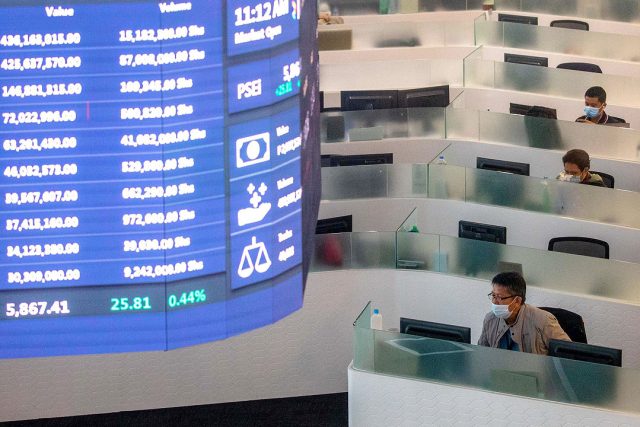
PHILIPPINE SHARES fell for a third straight session on Monday as investors stayed cautious, with the peso sinking to a record low of P59.87 against the dollar amid surging oil prices and the Middle East war.

The Philippine Stock Exchange index (PSEi) dropped 0.86% or 52.39 points to close at 6,006.55, while the broader all-share index fell 1.19% or 40.42 points to 3,341.69.

“The PSEi ended barely above the 6,000 mark, extending last week’s sell-off amid cautious sentiment, driven by elevated oil prices and the ongoing Middle East tensions,” Luis A. Limlingan, head of sales at Regina Capital Development Corp., said via Viber.

“The market remained pessimistic even after the central bank stepped in to support the peso, keeping traders defensive and wary of further downside if key support levels give way in the near term,” he added.

Investors are closely watching local economic implications of the Middle East war, including rising fuel and energy costs and a weaker peso, which could stoke inflation, Japhet Louis O. Tantiangco, research manager at Philstocks Financial, Inc., said in a Viber message.

Bangko Sentral ng Pilipinas (BSP) Governor Eli M. Remolona, Jr. said the central bank intervened in the foreign exchange market to prevent the peso from breaching P60 a dollar.

Most sectoral indexes ended lower. Mining and oil dropped 4.58% to 17,140.16; industrials fell 2.57% to 8,656.64; property declined 1.29% to 1,998.51; holding firms slid 1.02% to 4,629.17; and financials eased 0.64% to 1,922.95. On the other hand, services gained 0.16% to 2,722.37.

Losers beat winners, 153 to 53, with 53 stocks unchanged. International Container Terminal Services, Inc. led gainers with a 1.46% rise, followed by DMCI Holdings, Inc. at 0.41%. DigiPlus Interactive Corp. was the worst performer, plunging 5.66% to P18.

Value turnover fell to P9.53 billion, with 3.29 billion shares traded, down from P13.91 billion and 887.43 million shares last Friday.

Net foreign selling eased to P400.15 million from P3.66 billion in the previous session, suggesting some cautious inflows amid the broader market decline.

The combination of record peso depreciation and higher global energy costs continues to weigh on investor sentiment, leaving market participants defensive and selective in their trades. — Alexandria Grace C. Magno

Alex Eala rises to No. 29, ranking hangs in balance at Miami tourney

ALEX EALA — MIAMIOPEN.COM

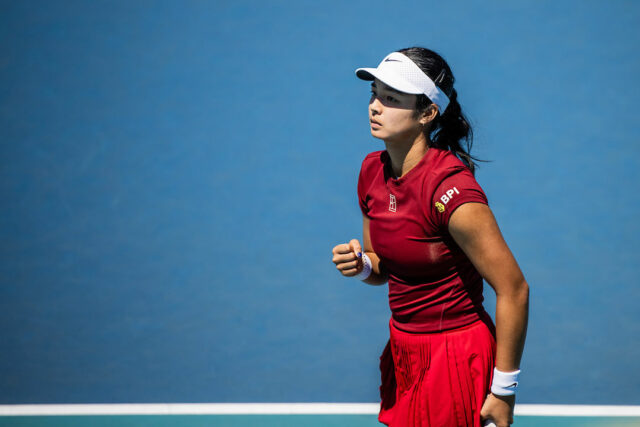
ALEXANDRA “ALEX” EALA leapt to a new career-best ranking ahead of her grand return to the Miami Open, where she’s also listed among the Top 32 seeds in the main draw.

From No. 32 last week, the 20-year-old Filipina pride improved three rungs to No. 29 in the Women’s Tennis Association (WTA) rankings following a Last 16 finish in the elite Indian Wells Open in California, considered as the “Fifth Grand Slam.”

Ms. Eala, the crowd darling of world tennis today, gained 120 additional points to jack up her harvest to 1,525 points but her stay inside the Top 30 for the first time ever in her budding career now hangs in the balance in Miami.

A total of 390 points from that collection came from the Miami Open, where she had a magical final four finish from being a wildcard entry in the qualifiers.

But those points will expire when the Miami Open officially rolls off on Wednesday, prompting Ms. Eala to replicate her semifinal campaign or lose said ranking points for a projected drastic drop in the world rankings.

An early exit for Ms. Eala, especially at a time when she’s already lurking outside the Top 20-25, would drag her all the way back to 1135 points or around the Top 50-60 mark, where she started this season.

Ms. Eala, however, is up for the tall order as the No. 32 seed with a first-round bye according to the official draw released by Miami on Monday.

With one round already off her checklist, Ms. Eala will face either No. 53 Laura Siegemund of Germany or No. 76 Petra Marcinko of Croatia in Round 2.

It gets tougher from there as no less than world No. 3 Iga Swiatek of Poland possibly awaits in Round 3. Ms. Swiatek, with a first-round bye as well, will battle either her compatriot Magda Linette (No. 50) or Varvara Gracheva of France (No. 60) in Round 2.

Ms. Swiatek was among the three Top 25 players and former Grand Slam champions slain by Ms. Eala in Miami last year to become the first Filipina WTA semifinalist and Top 100 player before climbing the ranks this season to Top 50, Top 40 and now Top 30.

“Miami last year was a beautiful time for me and it was the start of all of this. Since then, I’ve achieved a lot and I’ve grown a lot as well. I had so many good matches, tough losses and so much experience since then and that has helped me build confidence, self-esteem,” she said after a solid campaign in the BNP Paribas Open, a 1000-level tour like Miami.

“And I know that I belong here.” — John Bryan Ulanday

Creamline shoots for Top Four finish anew against Farm Fresh

CREAMLINE COOL SMASHERS — FACEBOOK.COM/PREMIERVOLLEYBALLLEAGUE

Games on Tuesday
(Sta. Rosa Sports Complex)
4 p.m. – Galeries Tower vs Akari
6:30 p.m. – Farm Fresh vs Creamline

CREAMLINE hopes to accomplish what it failed to do last time as it shoots for an outright qualifying round entry against Farm Fresh on Tuesday in the PVL All-Filipino Conference at the Sta. Rosa Sports Complex.

The Creamline Cool Smashers had a chance to advance to the four-team crossover phase but were denied by the Akari Chargers, who pulled off a 25-21, 26-24, 17-25, 25-21 win on Thursday at the FilOil Arena.

It sent the 10-time league champion to its second loss against five wins instead.

They will have another shot at 6:30 p.m. against the Farm Fresh Foxies, who own a 3-4 mark and an opportunity to also grab that important spot to the qualifying round where the two winners automatically advance to the semifinals.

“We just have to improve on some things and work harder in our next games,” said Creamline coach Sherwin Meneses.

Riding on the crest from that mammoth win over Creamline, Akari (4-3), clashes with Galeries Tower (2-5) at 4 p.m. with an eye at gatecrashing into the top four.

And expect Ivy Lacsina to be at the center of it all after she led the way for the Chargers last time with 20 points, including 18 kills.

That solid effort gained her the nod of the league scribes, who named her Player of the Week.

Ms. Lacsina vowed she isn’t stopping there.

“Everyday, even if we win, I always leave a space for learning,” she said. — Joey Villar

Filipinas eye 2027 FIFA Women’s World Cup ticket against Uzbekistan

THE Filipinas look to bring the lessons from the losses to mighty Japan in the quarterfinals and powerhouses Australia and South Korea in group play over to their most important game in the AFC Women’s Asian Cup (WAC) — the “Play-in” against Uzbekistan.

Thursday’s KO match against fellow losing quarterfinalist Uzbeks in Gold Coast offers the Pinay booters their last chance to clinch a coveted ticket to 2027 FIFA Women’s World Cup (WWC) in the WAC.

“That’s the big focus for us now because that game will allow us to go to the World Cup,” said Philippine coach Mark Torcaso, who’s aiming to bring the side to the global showpiece for a second time after its historic debut in 2023 under his predecessor Alen Stajcic.

“We’re disappointed we lost to Japan in the quarterfinals but we’re also very, very positive and determined to make sure we go to the World Cup,” he added.

If unsuccessful against Uzbekistan, the Philippines will proceed to the “Inter-confederation Play-offs” against aspirants from other continents in a final battle for three tickets to the WWC in Brazil.

Mr. Torcaso lauded the fight and the character his charges showed despite absorbing a 0-7 blanking from Japan in Sunday’s Last 8 and previously in the gigs in Group A that saw them lose to the host Matildas (0-1) and South Korea (0-3) before beating Iran (2-0) to advance to the quarters.

Australia, South Korea and Japan all made it to the semifinals, ensuring their World Cup qualifications.

“The team did well to hold Japan off for most of the first half (0-0 after the first 44 minutes) but with teams like these, it only takes one moment’s lapse and they take advantage, which was a learning for us,” said Mr. Torcaso.

“I can’t fault the players for their discipline and commitment. They fought hard and we want to keep closing the gap between us and the best teams in the world.” — Olmin Leyba

Venezuela stuns Japan to reach World Baseball Classic semifinals; Italy eliminates Puerto Rico

VENEZUELA stunned Japan, 8-5, to eliminate the defending champions from the World Baseball Classic quarterfinals on Saturday, while Italy also advanced to the last four by beating Puerto Rico, 8-6.

Venezuela’s Ronald Acuna, Jr. hit a solo home run off Yoshinobu Yamamoto in the first inning in Miami but Shohei Ohtani answered immediately with a solo shot off Ranger Suarez.

Shota Morishita hit a three-run homer in the third to give Japan a 5-2 lead but Venezuela refused to fold, Maikel Garcia hitting a two-run homer in the fifth to pull within one.

With Ezequiel Tovar and Gleyber Torres on base in the sixth, Wilyer Abreu launched a 409-foot, three-run home run to give Venezuela a 7-5 lead as the stadium erupted.

Torres added another run at the top of the eighth to give Venezuela some more breathing room and their bullpen shut Japan down, retiring 13 straight batters at one point before Angel Zerpa struck out Ohtani to seal it.

“Its very hard to describe what went through my mind when I hit that home run,” Abreu told a press conference. “It was definitely one of the best moments in my career.”

Venezuela clinched a place in the semis for the first time since 2009, while the win also secured a spot at the 2028 Los Angeles Olympics.

Three-time winners Japan were left to lick their wounds after failing to reach the final four for the first time.

At Daikin Park in Houston, surprise package Italy, who had already beaten the US and Mexico in pool play to go 4-0, did not need the long ball to get past Puerto Rico.

They chased ace Seth Lugo in the first inning and never looked back, turning a 1-0 deficit into a 4-1 lead.

JJ D’Orazio drove in three runs and Andrew Fischer knocked in two. A four-run fourth inning pushed the margin to 8-2 and effectively ended the contest, with all nine players in Italy’s starting lineup reaching base.

Puerto Rico mounted a late charge, capped by Christian Vazquez’ two-run single in the eighth that trimmed the deficit to 8-6, but reliever Greg Weissert retired five of six batters for his third save of the tournament.

“This team has been building character in the last couple of days,” Italy manager Francisco Cervelli, a Venezuelan-born former MLB catcher, said at a press conference.

“We have the same mission, which is to continue until the last day of the tournament.”

Venezuela meets Italy in the semifinals on Monday in Miami.

The United States faces Dominican Republic in the other semis on Sunday. — Reuters

Cameron Young wins The Players Championship by one shot in wild finish at TPC Sawgrass

PONTE VEDRA BEACH, Florida — Cameron Young clinched his second PGA Tour title and the biggest win of his career with a sensational one-shot victory at The Players Championship on Sunday after a drama-laden afternoon at TPC Sawgrass.

One stroke behind England’s Matt Fitzpatrick with two holes to play, Young drew level with a birdie at the par-3 17th after hitting a brilliant tee shot to 9 1/2 feet and then coolly parred the last to card a 4-under-par 68.

That left the New York native at 13-under 275 in the PGA Tour’s flagship event and one ahead of Fitzpatrick, who also closed with a 68 after his tee shot at the 18th wound up on pine straw in the tree line to the right of the fairway and led to a bogey 5.

Former US Open champion Fitzpatrick had a chance to force a three-hole playoff after lining up a par putt from 8 1/2 feet on the 18th green, but his attempt slid past the right edge of the cup and he had to settle for second place.

Two-time major champion Xander Schauffele closed with a 69 to claim third place at 11 under, a stroke in front of World No. 8 Robert MacIntyre of Scotland, who also signed off with a 69.

Young, whose first PGA Tour victory came at the 2025 Wyndham Championship, was delighted to emerge triumphant in a tournament that attracts one of the deepest fields in golf and is unofficially called the fifth major.

Fitzpatrick, in pursuit of a third PGA Tour win, made a fast start to the final round with three birdies in the first four holes and he led Young by a shot after sinking a 13-foot birdie putt at the par-4 15th.

The 31-year-old Englishman felt that he had hit a good tee shot on 18, given that the wind was coming in off the right.

Sweden’s Ludvig Aberg, who had led the tournament by three shots overnight, was two ahead with eight holes to play on Sunday before his title bid dramatically unraveled with a bogey at the par-5 11th and a double bogey at the par-4 12th. He had to settle for a share of fifth place at 9 under after returning a 76.

Aberg, the tournament leader after the second and third rounds, offset a birdie at the par-5 second with a bogey at the par-4 fourth to reach the turn two shots ahead of Fitzpatrick and MacIntyre.

However, his title bid was severely shaken when he bogeyed the 11th after his second shot sailed right into a water hazard. Fitzpatrick, in the group ahead, made a birdie at the par-4 12th after hitting his approach to 3 feet and that moved him into a two-way tie at the top with the Swede at 12 under.

Fitzpatrick then seized the outright lead at 13 under with another birdie at the par-3 13th, striking a superb tee shot there to 4 feet and coolly sinking the putt.

Even worse was to follow for Aberg at the 12th, where he ran up a double-bogey 6 after hooking his tee shot way left into water, and that dropped him to 10 under — three strokes off the pace.

From there, the tournament effectively came down to a battle between Young and Fitzpatrick.

“It got away from me quick there,” Aberg said of Nos. 11 and 12. “Yeah, it was just poor swings… Obviously really disappointed. I would have loved to be standing where Cameron is standing right now. But overall I still felt like I saw some nice things in my game this week.”

World No. 1 Scottie Scheffler, the Players champion in 2023 and 2024, ended his week at TPC Sawgrass with a 1-under 71 to finish in a tie for 22nd at 5 under.

Defending champion Rory McIlroy, the World No. 2, was left to reflect on “not the week that I wanted” after he signed off with a 71 and an even-par total, tied for 46th.

The Northern Irishman withdrew from last week’s Arnold Palmer Invitational after two rounds due to a back injury and he did not play a single practice round at TPC Sawgrass after only arriving at the venue on the eve of the tournament.

“Happy I got through four days and my body feels good,” McIlroy said after mixing five birdies with two double bogeys in the final round. “I feel like my game sort of progressively got a little bit better as the week went on, even though the scores probably didn’t reflect it over the weekend. I hit the ball well. I just didn’t make anything on the greens.”

Chad Ramey had a final round to remember, closing with a 71 that included an ace at the par-3 13th where he holed out with a 7-iron from 169 yards. It was the first ace of his PGA Tour career. — Reuters

New York Knicks survive 21-point deficit, hold off Golden State Warriors

JALEN BRUNSON scored 30 points and added nine assists for the host New York Knicks, who mounted their biggest comeback of the season and edged the undermanned Golden State Warriors, 110-107, on Sunday night.

The Knicks went 22 of 23 from the line — the third time this season they’ve had one miss or fewer from the line while hoisting at least 20 attempts — as they overcame a 21-point second-quarter deficit.

Karl-Anthony Towns posted a double-double with 17 points and 12 rebounds, while OG Anunoby had 14 points, including a pair of free throws for the game’s final points with 6.2 seconds left.

Jordan Clarkson (14 points) and Landry Shamet (10) each got into double figures off the bench. Josh Hart pulled down 12 boards, and Mitchell Robinson had 10.

Brandin Podziemski scored 25 points for the skidding Warriors, who played without injured leading scorers Stephen Curry, Jimmy Butler III and De’Anthony Melton as well as hobbled veterans Draymond Green, Seth Curry and Al Horford.

Quinten Post had 22 points while Gui Santos scored 20 and Gary Payton II added 19 as the Warriors suffered their fifth straight loss.

Podziemski hit a pair of free throws with 8:43 left in the first quarter to give the Warriors a 13-11 lead and start a stretch of 28-plus minutes in which the visitors never relinquished the lead.

Golden State scored the final 11 points of the first quarter to take a 35-21 lead and opened the second on an 11-4 run to take its biggest lead at 46-25 on Post’s putback with 9:30 left.

But the Knicks began cooling off the Warriors, who shot four of 13 the rest of the quarter as New York went into halftime with a 20-8 surge to pull within 54-45.

The Knicks got within two points five times before Mikal Bridges’ runner tied the score at 73-73 with 3:58 left in the third. The teams later traded the lead on four consecutive possessions, after which Robinson’s putback gave New York the lead for good at 81-80 with 1:07 remaining. Shamet ended the quarter with a layup.

The Knicks never trailed in the fourth, when the Warriors pulled within one point three times in the final 2:04. Golden State had a chance to tie it in the waning seconds, but Santos’ pass intended for Post glanced off his hands and Shamet collected the ball before running out the clock. — Reuters

The water stewardship journey continues for SM Supermalls

For three decades, SM Prime Holdings Inc. (SM Prime) has steadfastly advanced responsible water stewardship for a more resilient water future through SM Supermalls, its operating arm.

SM Prime invested in its first Sewage Treatment Plant (STP) in the late 90’s with SM Southmall. STPs are essential for protecting public health and the environment, along with supporting community development. Since then, STPs have become a standard fixture in all 89 malls, reducing water waste and pollution, and safeguarding water resources.

SM Supermalls embeds water conservation practices across its operations. Recycled water is used in water closets for flushing, cleaning, and watering greens. Additionally, efficient low-flow fixtures and water-saving technologies prevent unnecessary consumption at scale.

“SM had always been conscious of its environmental impact on shared social good. Our water journey is rooted in our commitment to maximize what we borrow from the environment, creating resiliency for future generations,” said Liza B. Silerio, SM Supermalls Vice President and Head of Sustainability and Resilience.

Today, SM is evaluating centralized STPs that can serve multiple developments and allow for inter-building treatment systems, lowering operational costs, and enhancing process efficiency. “Part of our water resilience framework is building long-term capacity for water disruptions. Since the standardization of STPs across our malls, SM took it a step further and scaled its water sustainability efforts,” said Silerio.

A first in the industry, SM City Baguio’s Rainwater Treatment Facility has already processed almost 20,000 cubic meters of rainwater into potable water since it was launched, providing 30% of the mall’s total monthly clean water requirement since 2023. This translates to saving the equivalent of 12.7 million, 1.5-liter mineral water bottles or almost eight Olympic-sized swimming pools of freshwater from the grid.

Leveraging the mall’s nationwide reach, SM further campaigns sustainable water use through consistent awareness and engagement, SM creates public awareness and education campaigns through its Corporate Social Responsibility arm, SM Cares to activate future water stewards in the community.

This proactive and efficient approach resulted in SM malls receiving multiple industry distinctions such as the Bantayog ng Lawa Award from the Laguna Lake Development Authority (LLDA) and the first ever Gawad Taga-Ilog Award bestowed upon a private entity by the Department of Environment and Natural Resources (DENR).

“We’ve come a long way since the 90’s. It’s heartwarming to be recognized by our community and peers, but we continue to work harder for future generations because water is a universal human right. By implementing these sustainability measures, SM aims to move forward with greater purpose and greater possibilities,” said Silerio.


Spotlight is BusinessWorld’s sponsored section that allows advertisers to amplify their brand and connect with BusinessWorld’s audience by publishing their stories on the BusinessWorld Web site. For more information, send an email to online@bworldonline.com.

Join us on Viber at https://bit.ly/3hv6bLA to get more updates and subscribe to BusinessWorld’s titles and get exclusive content through www.bworld-x.com.

Trump demands others help secure Strait of Hormuz; Japan and Australia say no plans to send ships

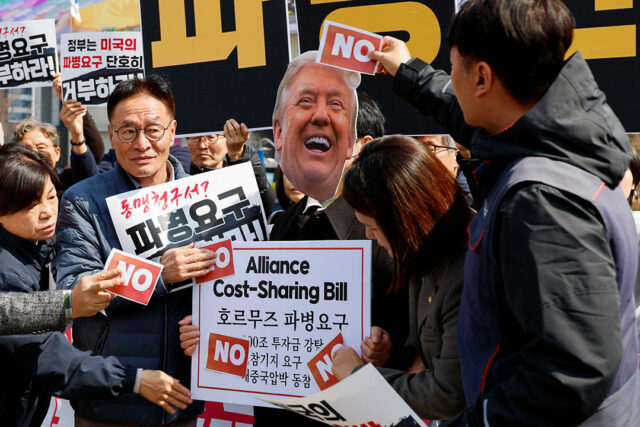
ACTIVISTS PLACE “No” stickers on a sign held by a person wearing a cutout mask depicting US President Donald J. Trump during a rally against the US demand for South Korea to deploy troops to the Strait of Hormuz, outside the US embassy in Seoul, South Korea, March 16, 2026. — REUTERS/KIM SOO-HYEON

TOKYO/PALM BEACH, Florida — US President Donald J. Trump’s demands for a coalition to help reopen the Strait of Hormuz appeared to fall on deaf ears on Monday as allies Japan and Australia said they were not planning to send navy vessels to the Middle East to escort ships through the vital waterway.

With the US-Israeli war on Iran creating turmoil across the Middle East and shaking up global energy markets in its third week, Mr. Trump on Sunday insisted that nations relying heavily on oil from the Gulf have a responsibility to protect the strait through which 20% of the world’s energy transits.

Markets in Asia reacted cautiously, with Brent crude LCOc1 rising more than 1% above $104.50 and regional share markets mostly weaker amid concerns about the risk to Middle East oil facilities and after Mr. Trump’s request for allies to get more involved.

“I’m demanding that these countries come in and protect their own territory because it is their territory,” Mr. Trump told reporters aboard Air Force One on the way from Florida to Washington. “It’s the place from which they get their energy.”

Mr. Trump said his administration has already contacted seven countries but did not identify the countries. In a weekend social media post, he hoped China, France, Japan, South Korea, Britain and others would participate.

Japanese Prime Minister Sanae Takaichi, a staunch Mr. Trump supporter, said on Monday her country, constrained by its war-renouncing constitution, has no plan to dispatch naval vessels to escort ships in the Middle East from where it gets 95% of its oil.

“We have not made any decisions whatsoever about dispatching escort ships. We are continuing to examine what Japan can do independently and what can be done within the legal framework,” Ms. Takaichi told parliament.

Australia, another key Indo-Pacific security ally to the US that also relies heavily on fuels made with Middle Eastern crude, said it will not send naval ships to assist in reopening the strait either.

“We know how incredibly important that is, but that’s not something that we’ve been asked or that we’re contributing to,” Catherine King, a member of Prime Minister Anthony Albanese’s cabinet, said in an interview with state broadcaster ABC.

TRUMP MAY DELAY BEIJING VISIT WITHOUT CHINA SUPPORT
Mr. Trump told the Financial Times on Sunday he was expecting China to help unblock the Strait before his scheduled meeting with Chinese President Xi Jinping in Beijing at the end of this month and might postpone his trip if it did not provide assistance.

“I think China should help too because China gets 90% of its oil from the Straits,” Mr. Trump said. “We may delay,” he said in reference to his visit if China did not offer support in the Gulf.

The Chinese foreign ministry did not immediately respond to a Reuters request for comment.

Mr. Trump also ratcheted up pressure on European allies to help protect the Strait, warning that the North Atlantic Treaty Organization faces a “very bad” future if its members fail to come to Washington’s aid.

European Union (EU) foreign ministers will discuss on Monday bolstering a small naval mission in the Middle East but are not expected to decide on extending its role to the choked-off Strait of Hormuz, diplomats and officials say.

British Prime Minister Keir Starmer discussed the need to reopen the Strait with Mr. Trump, and with Canadian Prime Minister Mark Carney, a Downing Street spokeswoman said on Sunday, while South Korea has said it would carefully review Mr. Trump’s request.

Global air travel remains severely disrupted due to the Iran war which has closed or restricted key Middle Eastern hubs including Dubai, Doha and Abu Dhabi, forcing airlines to cancel thousands of flights and stranding tens of thousands of passengers.

Supplies of jet fuel are also becoming a concern, with authorities in Vietnam warning the country’s aviation industry to prepare for potential flight reductions from April after China and Thailand halted exports of jet fuel due to the Iran war.

DRONES CAUSE FIRE, DISRUPT TRAFFIC AT DUBAI AIRPORT
The disruption to energy markets caused by the Iran war is an “abject lesson” in the risks of relying on fossil fuels, according to the United Nations (UN) climate secretary.

“Fossil fuel dependency is ripping away national security and sovereignty, and replacing it with subservience and rising costs,” Simon Stiell, executive secretary of the UN Framework Convention on Climate Change, will tell EU officials and government ministers at an event in Brussels on Monday.

Although some Iranian vessels have continued to pass and a few ships from other countries have successfully made the crossing, the passage has been effectively closed for most of the world’s tanker traffic since the United States and Israel attacked Iran on Feb. 28.

Israel continued to launch strikes on Iran as well as Lebanon and Gaza, targeting militants from the Iran-backed Hezbollah and Hamas. The Israeli military said on Monday its troops had begun limited ground operations against positions in southern Lebanon held by Hezbollah.

Despite repeated claims from US authorities to have destroyed Iran’s military capabilities, drone attacks continued to threaten Gulf states on Monday.

Dubai authorities said they had contained a fire but temporarily suspended flights at the airport after a drone attack hit a fuel tank. Saudi Arabia intercepted 34 drones in its eastern region in one hour, state media said. No injuries were reported in either incident.

US officials responding to economic uncertainty over high oil prices predicted on Sunday that the war on Iran would end within weeks and that a drop in energy costs would follow, despite Iran’s assertion that it remains “stable and strong” and ready to defend itself.

Mr. Trump, who threatened more strikes on Iran’s main oil export hub Kharg Island over the weekend, has said previously that Iran wants to negotiate and that the US was talking to Iran, but Iranian Foreign Minister Abbas Araghchi earlier on Sunday disputed that claim.

“We have never asked for a ceasefire, and we have never asked even for negotiations,” Mr. Araghchi told CBS’ Face the Nation program. “We are ready to defend ourselves for as long as it takes.” — Reuters

South Korea to lift coal cap, boost nuclear output amid Iran crisis, ruling party says

STOCK PHOTO | Image by Vitamin from Pixabay

SEOUL — South Korea’s ruling Democratic Party said on Monday that the government will lift limits on coal-fired power generation capacity and raise nuclear power plant utilization to as high as 80% as part of an energy response to the Middle East crisis.

Lawmakers in the party’s Middle East crisis economic response task force said in a briefing the measures are aimed at stabilizing energy supply and prices as oil and gas shipments to South Korea have been blocked by tensions in the Strait of Hormuz.

South Korea relies almost totally on imports for its energy, buying about 70% of its oil and 20% of its liquefied natural gas (LNG) from the Middle East, according to Korea International Trade Association data.

The government would prioritize managing LNG supplies by increasing coal and nuclear output while reducing reliance on LNG-fired power generation, Democratic Party lawmaker Ahn Do-geol said.

Limits capping coal power output at 80% of installed capacity would be lifted from Monday, Mr. Ahn said, while maintenance work at six nuclear reactors would be completed early to boost nuclear utilization from the high-60% range to 80%.

South Korea on Friday introduced a gasoline price cap at 1,724 won ($1.15) per liter. It will adjust these prices every two weeks to reflect changes in global oil prices.

Mr. Ahn said gasoline and diesel prices on Sunday had fallen by 58 won and 77 won per liter, respectively, since the price cap was implemented.

SUPPLEMENTARY BUDGET
A supplementary budget would be drawn up by the end of this month and submitted to parliament, Mr. Ahn said. The extra budget is expected to include compensation for refiners linked to the fuel price cap, energy voucher payments, logistics cost support for exporters, and expanded investment in renewable energy.

Democratic Party leader Jung Chung-rae said in a separate party meeting on Monday that it would fast-track passage of the extra budget proposal within 10 days after it is submitted.

The budget ministry said there had been no decision yet on a specific date for a supplementary budget but would prepare one as soon as possible.

The ruling party and government were also considering designating the Yeosu petrochemical complex as a special industrial crisis response zone, said Mr. Ahn.

Shortages of raw materials such as aluminum, sulfur and naphtha were severe, and that supply disruptions and price spikes for naphtha — 25% of which is imported from the Middle East — could force petrochemical companies to cut production, he said.

To address this, the government would freeze exports of domestically produced naphtha at last year’s levels and seek alternative import sources, Mr. Ahn said.

The task force also agreed to double the ceiling on export vouchers usable for international transport costs to 60 million won and to introduce emergency logistics support vouchers for exporters to the Middle East, providing 10 million won each to 1,000 companies, Mr. Ahn said. Reuters

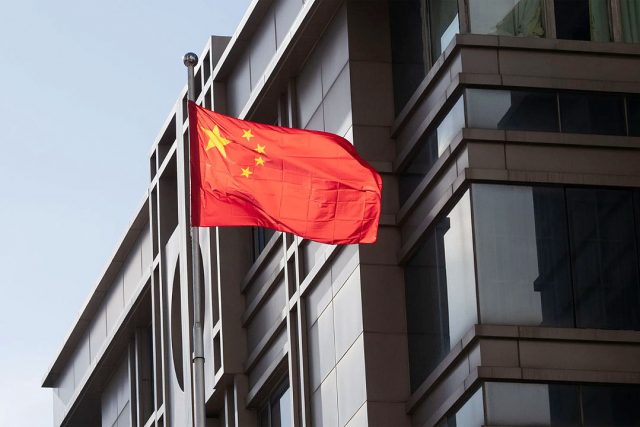
China’s economy builds early momentum in 2026 as risks mount

REUTERS

BEIJING — China’s factory output growth quickened in January-February while retail sales rebounded, in a steady start to the year for an economy confronting multiple challenges including the fallout from the US-Israeli war against Iran.

Industrial output rose 6.3% from the same period in the previous year, the National Bureau of Statistics (NBS) data showed on Monday, up from the 5.2% growth clocked in December. It beat a 5% expansion forecast in a Reuters poll and marked the quickest growth since September last year.

The figures follow data showing China’s exports blew past forecasts in the first two months, powered by surging artificial intelligence‑related technology demand that also lifted upstream manufacturing.

“While risks to the outlook have increased amid geopolitical tensions and disruptions to global trade and energy markets, the latest figures indicate that China entered the year with a firmer growth footing than previously thought,” said Hao Zhou, chief economist at Guotai Junan International.

Retail sales, a gauge of consumption, jumped 2.8%, quickening from the 0.9% pace in December for their biggest gain since October last year. Analysts had expected a 2.5% growth.

The strong impetus was driven in part by the country’s longest Lunar New Year holiday in February. The festivities helped boost total tourism spending by almost 19% from the same holiday period last year, which was one day shorter.

But domestic tourism spending per trip dipped 0.2%, suggesting consumers remain cautious.

Data from earlier last week, for instance, showed passenger vehicle sales at home tumbled 26% year on year in January-February, hurt by the end of a tax break and scaled-back government subsidies for electric vehicles.

China combines January and February data releases to smooth out distortions from the festival holidays, which can fall in either month.

Monday’s data provided another encouraging sign for policymakers as an unexpected upturn in investment took some of the sting off the challenge of a protracted downturn in the critical property sector.

Fixed asset investment, which includes property and infrastructure investment, expanded 1.8% in the first two months, versus expectations for a 2.1% drop. It fell 3.8% in 2025, the first annual drop in about three decades.

Infrastructure investment, in particular, grew 11.4%, as policy support including a new financing tool from banks to fund key investment projects started to take effect.

The overall data, while showing some positive momentum, still suggest a wide gap between robust external demand and sluggish household consumption that analysts warn could hamper China’s long-term growth prospects. Last week’s lending data pointed to a continued slump in household borrowing.

Also, worryingly for income generation, the survey-based nationwide jobless rate rose to 5.3% in the first two months from December’s 5.1%, the NBS data showed.

“It cannot be ruled out that domestic demand data in March will still face downward pressure,” said Zhaopeng Xing, senior China strategist at ANZ, though he added that the overall data do not support an interest rate cut in the near term.

WAR IMPACT TO START FEEDING THROUGH IN COMING MONTHS
At the annual parliament meeting that closed last week, policymakers set this year’s economic growth target at 4.5%-5%, down from last year’s “around 5%.” The target was met in 2025 largely on the back of a record trade surplus of just over $1 trillion, deepening unease among China’s trading partners.

Analysts say China faces significant challenges as it tries to foster sustainable longer-term growth.

While the government pledged a “notable” lift in household consumption, it spelled out a few measures to suggest a turn toward aggressive demand‑side reforms.

The Middle East conflict adds fresh uncertainty as it drives up energy prices and rattles global trade, raising the stakes for US President Donald J. Trump’s late-March trip to Beijing to meet President Xi Jinping.

“The turmoil in the Middle East is set to show its impact on the global economy in coming months… I expect policymakers to respond through fiscal policy, if necessary,” said Zhiwei Zhang, chief economist at Pinpoint Asset Management.

“The market will focus on the upcoming meeting between the Chinese and American leaders. While China will likely purchase more goods from the US to mitigate the trade imbalance, the war in the Middle East has made the meeting complicated.” Reuters

ADVERTISEMENT
ADVERTISEMENT