Home Blog Page 1461

Fil-Chinese firms told to support MSME
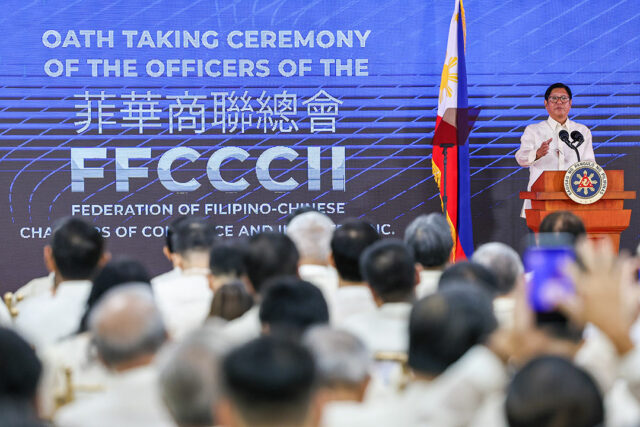
PHILIPPINE STAR/NOEL B. PABALATE

PRESIDENT Ferdinand R. Marcos, Jr. on Tuesday urged the newly elected officers of the Federation of Filipino-Chinese Chambers of Commerce and Industry, Inc. (FFCCCII), to champion micro, small and medium-sized enterprises (MSMEs), drive inclusive growth, and strengthen international trade ties.

“Your leadership should not only focus on large enterprises,” Mr. Marcos said during the oath-taking ceremony in Binondo, Manila, according to a transcript from the Presidential Palace.

“It is just as crucial that you empower small and medium-sized businesses. By uplifting them, you are also uplifting the entire economy and the entire nation,” he added.

MSMEs account for over 99% of registered businesses in the country and employ about 65% of the workforce.

The chief executive highlighted the group’s support for the Regional Comprehensive Economic Partnership (RCEP), which Manila ratified last year, calling it a “gateway to deeper regional integration and investment inflows.”

Mr. Marcos also noted that the group’s civic programs, such as building over 6,300 classrooms through its Operation Barrio Schools and conducting medical missions, demonstrate a fusion of economic influence and social commitment.

He also reiterated his administration’s push to modernize the country’s business climate, citing two initiatives: the CREATE MORE Act, which seeks to refine corporate tax incentives and promote greater transparency, and the Green Lanes for Strategic Investments, a reform aimed at fast-tracking approvals for high-impact foreign investments.

While not directly addressing rising geopolitical tensions in the region, the President underscored the value of business diplomacy and people-to-people ties, pointing to cultural exchange efforts and philanthropic initiatives, such as the recent distribution of gift bags to 2,000 families along the Pasig River, as evidence of the Federation’s grassroots reach.

The FFCCCII, established in 1954, comprises hundreds of member chambers and companies that are key drivers of Philippine trade and real estate development, especially in Metro Manila and emerging regional hubs. — Chloe Mari A. Hufana


House revocation of magna carta for health workers a ‘betrayal’ 

PHILIPPINE STAR/ MICHAEL VARCAS

A LABOR LEADER on Tuesday said they felt cheated over the House of Representatives’ decision to rescind a proposed Magna Carta for village healthcare workers that dealt a last-minute blow to the long-sought reform days before the 19th Congress ends.

“This is a gross betrayal of around 300,000 barangay healthcare workers across the country who have dedicated their lives to serving as the first line of healthcare in our communities,” Jillian Roque, chief of staff of Public Services Labor Independent Confederation, said in a statement.

The House approved the proposal, which sought to provide incentives and benefits for barangay healthcare workers, in December 2022, with a counterpart Senate bill approved in February. Congressmen rescinded the transmittal of the House bill to the Senate last week.

Village healthcare workers in cities and remote municipalities face stark wage disparities, with those in low-income areas earning as little as P50 per month, according to a UNI Global Union statement.

“This betrayal stings all the more because it came after their hopes were raised — especially before the elections — only to be crushed immediately after,” said Ms. Roque. “This cruel reversal exposes not only the low regard for our health and care workers, but also the glaring lack of political will to advance universal health care.” — Kenneth Christiane L. Basilio

PHL promotes migrant fishers’ safety

A FAMILY of siganids fishers in Eastern Samar. — MARCIAL VILLANIA BOLEN

THE PHILIPPINES is set to implement a labor plan that would ensure the safe migration and decent work for those in the fisheries sector, the International Labour Organizations (ILO) said.

“Through inclusive dialogue and evidence-based policymaking, we aim to create safer, fairer, and more sustainable conditions for all workers across the fish and seafood supply chain,” Khalid Hassan, director of the ILO Country Office for the Philippines said in a statement on Tuesday.

Mr. Hassan added that a project advisory committee would “serve as a vital mechanism for ensuring that our work is grounded in the realities of those most affected, our migrant fishers and their communities.”

The work plan will provide technical assistance to manning agencies, including the development of fair recruitment guidelines and support for due diligence measures, through a partnership with the Licensed Manning Agencies for Fishers.

It also seeks to strengthen regional cooperation on labor migration, reinforce national frameworks on fisheries, and promote responsible. — Adrian H. Halili

SIPCOR working to resolve Siquijor power woes

BW FILE PHOTO

POWER SUPPLIER Siquijor Island Power Corp. (SIPCOR) said it is working to fully restore the electricity in the province within the week as it resolves power supply woes.

In a statement on Tuesday, SIPCOR said it had completed maintenance on one of its service units, providing an increase of 7,550 kilowatts to the power plant’s total capacity.

The company is also evaluating and assessing another unit for corrective maintenance, which is expected to be completed by the middle of the week. An additional generator set is also being rented to cover the shortfall.

“With the increasing demand brought on by the growing economic activity and rising population in the province, the area is currently experiencing a power supply deficit resulting in a rotational power outage,” the firm said.

“We understand the inconvenience this may cause, and we assure our customers that our technical teams are working diligently to restore power as quickly and safely as possible.”

The island province has been placed under a state of calamity due to ongoing power interruptions.

According to the Electric Power Industry Management Bureau (EPIMB) of the Department of Energy (DoE), while SIPCOR has an installed capacity of 11.58 megawatts (MW), only 8.816 MW is being contracted to the Provincial Electric Cooperative of Siquijor (PROSIELCO).

EPIMB said that the power woes in the province stemmed from a combination of technical, operational, and regulatory issues that prevent the full utilization of SIPCOR’s generating capacity.

To address the issue, the DoE directed PROSIELCO to update its power supply procurement and distribution development plans to secure additional power supply.

It also tasked the National Electrification Administration to coordinate with the Palawan Electric Cooperative for the transfer of a 2-MW modular generator set, which is expected to arrive in the province within the week. — Sheldeen Joy Talavera

Traders welcome Abu Sayyaf-free Basilan declaration

COTABATO CITY — Officials of the Bangsamoro Autonomous Region in Muslim Mindanao and business groups are glad that Basilan had totally been cleared from the presence of the Abu Sayyaf terror group.

Basilan, which has 11 towns and two cities, Lamitan and Isabela, was declared Abu Sayyaf-free during a symbolic multi-sector rite on Monday.

Mohammad O. Pasigan, chairman of the Bangsamoro Regional Board of Investments, told reporters on Tuesday that the feat will certainly hasten their efforts to entice investors from other regions and from abroad to venture into viable, capital-intensive businesses in Basilan.

“The province has been rising fast, even before that ceremony, as a new investment hub in the Bangsamoro region. This positive development will make Basilan shine even more as an investment destination,” Mr. Pasigan, whose office is the conduit of the Bangsamoro government to local and foreign investors, said.

Gov. Hadjiman H. Salliman told reporters on Tuesday that it was the joint peacebuilding programs of their provincial government, the military’s Western Mindanao Command, the Army’s 101st Infantry Brigade led by Brig. Gen. Alvin V. Luzon, the Police Regional Office-Bangsamoro Autonomous Region (PRO-BAR) and local executives in Basilan that virtually liberated their province from the Abu Sayyaf terror group.

Merchants in Lamitan City and members of the Basilan Chamber of Commerce and Industry, whose president is Alex Abujen C. Jr., were quoted in Tuesday’s radio reports as saying that they are thankful to Mr. Salliman, the Army’s 101st Infantry Brigade, the PRO-BAR, the Police Regional Office-9 based in nearby Zamboanga City, Basilan Rep. Mujiv S. Hataman, the Moro National Liberation Front, the Moro Islamic Liberation Front and their 13 mayors for having secured the surrender of 523 Abu Sayyaf members in Basilan from 2016 to 2022 via backchannel dialogues.

Ronald Hallid D. Torres, chairman of the Bangsamoro Business Council, said on Tuesday that they are contemplating on formulating, along with experts in the trade and tourism and agriculture ministries in the regional government, comprehensive investment plans for Basilan that capitalists from outside can possibly engage in.

“We are certain that Basilan’s being Abu Sayyaf-free now will be a strong magnet that will attract them in,” Mr. Torres said. — John Felix M. Unson

PHL shares go down as US-China talks continue

BW FILE PHOTO

PHILIPPINE STOCKS dropped anew on Tuesday due to cautious trading as the United States and China were set to continue their trade negotiations.

The bellwether Philippine Stock Exchange index (PSEi) dropped by 0.91% or 58.46 points to close at 6,347.67, while the broader all shares index went down by 0.74% or 28.09 points to 3,758.50.

“Philippine shares fell back below 6,400 over the anxiety regarding the US-China dialogue and expectations of a rate cut from the Bangko Sentral ng Pilipinas in next week’s policy meeting,” Regina Capital Development Corp. Head of Sales Luis A. Limlingan said in a Viber message.

“Investors exited the local market, taking a cautious stance, amid the lack of fresh leads,” Philstocks Financial Inc. Research Manager Japhet Louis O. Tantiangco said in a Viber message.

Trade talks between the United States and China were set to extend to a second day, with tentative signs that tensions between the world’s two largest economies could be easing, Reuters reported.

US President Donald J. Trump put a positive spin on the talks, which wrapped up for the night on Monday and were set to resume on Tuesday.

Treasury Secretary Scott Bessent, Commerce Secretary Howard Lutnick and US Trade Representative Jamieson Greer were set to meet for the second day with their Chinese counterparts.

Any progress in the negotiations is likely to provide relief to markets given that Mr. Trump’s often shifting tariff announcements and swings in Sino-US ties have undermined the world’s two biggest economies, disrupted supply chains and threaten to hobble global growth.

All sectoral indices closed lower on Tuesday. Financials went down by 1.4% or 33.30 points to 2,330.79; property sank by 1.27% or 28.96 points to 2,241.80; mining and oil declined by 1.02% or 97.64 points to 9,425.51; services retreated by 0.8% or 17.86 points to 2,211.36; holding firms dropped by 0.64% or 35.59 points to 5,465.99; and industrials decreased by 0.31% or 28.02 points to 8,885.98.

Mr. Tantiangco said the financials sector was the biggest loser following the release of data showing that the Philippine banking system’s nonperforming loan ratio rose to a five-month high of 3.39% in April from 3.3% in March.

“LT Group, Inc. led the index gainers, climbing 2.38% to P12.92. Converge ICT Solutions, Inc. was the main index laggard, falling 5.14% to P20.30,” he added.

Value turnover went up to P9.39 billion on Tuesday with 1.45 billion shares traded from the P5.07 billion with 1.08 billion issues exchanged on Monday.

Decliners outnumbered advancers, 128 versus 65, while 49 names were unchanged.

Net foreign selling increased to P525.73 million on Tuesday from P205.02 million on Monday. — Revin Mikhael D. Ochave with Reuters

Peso weakens further amid US-China talks

BW FILE PHOTO

THE PESO dropped further against the dollar on Tuesday as markets awaited the outcome of the ongoing trade negotiations between the United States and China.

The local unit closed at P55.83 per dollar, dropping by two centavos from its P55.81 finish on Monday, Bankers Association of the Philippines data showed.

This was a fresh near one-month low for the peso, as this was its worst close since it ended at P55.855 on May 14.

The peso opened Tuesday’s session stronger at P55.75 against the dollar. It climbed to as high as P55.70 intraday but succumbed to weakness as it closed near its worst showing of P55.84 versus the greenback.

Dollars exchanged rose to $1.15 billion on Tuesday from $767.8 million the day prior.

“The peso weakened as the greenback gained from optimism on the US economy from the ongoing trade talks between US and China in London,” a trader said in an e-mail.

“The US dollar-peso exchange rate was slightly higher for the second straight trading day as US-China talks continued for the second day, but with no significant progress seen yet,” Rizal Commercial Banking Corp. Chief Economist Michael L. Ricafort said in a Viber message.

The US dollar firmed on Tuesday as talks between Beijing and Washington continued for a second day, stirring investors’ hopes of an easing in trade tensions, Reuters reported.

Officials from the world’s two largest economies were meeting in London to try to defuse a dispute that has widened from tariffs to restrictions over rare earths.

US President Donald J. Trump and his Chinese counterpart Xi Jinping spoke by phone last week at a crucial time for both economies that are showing signs of strain from Mr. Trump’s cascade of tariff orders since January.

The dollar index, which measures the US currency against six others, was 0.3% higher at 99.255, but remained close to a six-week low of 98.351 it touched last week.

The index is down 8.7% this year as investors, worried about the impact of tariffs and trade tensions on the US economy and growth, flee US assets and look for alternatives.

The yen was last little changed at 144.71 per dollar but has gained over 8% against the US currency this year on safe-haven flows during the market tumult unleashed by Mr. Trump’s tariff chaos.

Investor focus this week will be on the US consumer price index (CPI) report for May, due on Wednesday. The report could give insight into the tariff impact when investors are wary of any flare-ups in inflation ahead of the Federal Reserve’s policy meeting next week.

The US central bank is also expected to hold rates steady. Traders are pricing in nearly two 25-basis-point cuts by the end of the year.

The trader expects the peso to move between P55.70 and P55.95 per dollar on Wednesday, adding that a potential uptick in the US CPI may cause the local unit to extend its slide.

For his part, Mr. Ricafort said the peso could trade from P55.73 to P55.903. — Luisa Maria Jacinta C. Jocson with Reuters

99-year lease bicam report approved

REUTERS

By Adrian H. Halili, Reporter

THE SENATE and the House of Representatives approved a bicameral conference committee report late Monday on a measure extending the maximum land lease periods for foreigners.

“This is intended to provide a broad economic option for foreigners who can enter into business here without having to own land, which is prohibited by the Constitution,” Senate President Francis G. Escudero, the principal author of the Senate’s version of the bill, told reporters on Tuesday.

The measure was identified as a priority by President Ferdinand R. Marcos, Jr.’s Legislative-Executive Development Advisory Council for passage before the 19th Congress adjourns.

The measure will extend the term of foreign leases to 99 years from the current 75, placing the country in line with the practice of Singapore, Malaysia, and Indonesia.

The version agreed upon by the bicam includes a provision authorizing the President to impose a shorter lease period for certain investors, with prior approval from the Fiscal Incentives Review Board (FIRB).

The measure allows foreign investors to sublet properties unless prohibited under their contract. Sublease contracts longer than 25 years or more must be registered with the Register of Deeds, while contracts of less than 25 years are exempt.

It also allows for foreigners to acquire land leases for purposes like industry, agro-industrial, commercial, tourism, agriculture, agroforestry and ecological conservation.

The measure will impose a fine of between P1 million to P10 million on foreign investors that enter a lease contract illegally, or prison time of up to six years.

The Implementing Rules and Regulations of the measure will be drafted by the Board of Investments, and the Land Registration Authority, with input from the FIRB and other agencies.

“Extending the land lease for foreign investors to 99 years can help attract long-term foreign investment, particularly in capital-intensive sectors such as manufacturing, renewable energy, logistics, and tourism,” John Paolo R. Rivera, a senior research fellow at the Philippine Institute for Development Studies, said via Viber.

He added that the measure offers investors predictability, security, and time to recoup their investments, making the Philippines a better investment destination.

Mr. Rivera said the measure must be accompanied by “complementary reforms,” like streamlined land titling, reduced red tape, improved infrastructure, and regulatory clarity.

“Without these, the extended lease alone may not be enough to significantly boost foreign investor confidence,” he added.

Terry L. Ridon, convenor of think tank InfraWatch, said via Viber that investors remain impeded by red tape, corruption and high power costs, which are “real and immediate burdens to businesses.”

“99-year land leases are effective land ownership which may entice foreign investment into the country, as land ownership by foreigners remains prohibited by the 1987 Constitution,” Mr. Ridon added.

Foundation for Economic Freedom President Calixto V. Chikiamco said that the measure could expand the investment scope to agro-forestry and environment ventures.

“It will give long-term security of rights to foreign investors.  For example, foreign investors can lease private land to plant trees for carbon farming for 99 years,” Mr. Chikiamco said via Viber.

The measure addresses investor concerns about “uncertainty if the investment can be renewed,” he said.

The measure amends the 31-year-old Investors’ Lease Act or Republic Act No. 7652, which only allows foreign investors to lease private land for 50 years, renewable only once after 25 years.

Mr. Chikiamco added that the proposed law will also deter land speculation, or the purchase of land on the expectation that its value will increase.

Farm goods trade deficit tops $859M in April

REUTERS

THE agricultural goods trade deficit widened 12% year on year in April to $859.04 million, the Philippine Statistics Authority (PSA) said.

Agricultural exports in April rose 8.7% to $743.22 million, the PSA said, accounting for 11% of total exports. As a share of the $2.35 billion two-way trade in farm products, exports accounted for 31.7%.

Agricultural imports fell 3.5% year on year in April to $1.60 billion. Farm goods accounted for 15.6% of all Philippine imports that month.

The $2.35 billion in agriculture trade in April was up 1% year on year. In March 2025 and April 2024, trade had risen 16.5% and 25.6%, respectively.

“In March 2025 and April 2024, the trade deficit registered annual increases of 11.1% and 8.4%, respectively.”

The PSA said exports of animal, vegetable, or microbial fats and oils and their cleavage products, prepared edible fats, and animal or vegetable waxes were valued at $256.47 million, accounting for 34.5% of agricultural exports for the period.

Agricultural shipments to ASEAN in April hit $47.90 million, with Malaysia accounting for $15.25 million or 31.8% of the total.

The Netherlands accounted for $99.04 million or 63.6% of Philippine agricultural exports to the European Union (EU). EU purchases totaled $155.82 million.

The PSA said cereals accounted for $356.63 million or 22.3% of all agricultural imports in April.

Vietnam accounted for $276.73 million or 39.9% of Philippine agricultural imports from ASEAN.

Spain was the Philippines’ top EU supplier of agricultural commodities, with imports valued at $34.12 million.

The top agricultural commodities imported from the EU were meat and edible meat offal, dairy produce, birds’ eggs, natural honey, edible products of animal origin, and residues and waste from the food industries. — Kyle Aristophere T. Atienza

JICA to inventory potential large-scale hydro resources

THE Department of Energy (DoE) and the Japan International Cooperation Agency (JICA) have entered into a three-year partnership to identify and assess potential large-scale hydropower sites.

In a statement on Tuesday, the DoE said Energy Secretary Raphael P.M. Lotilla and JICA Chief Representative Baba Takashi signed the Records of Discussion for the Project on Resource Inventory of Hydropower Potential Sites.

The project will begin in September and focus on developing a national inventory of hydropower sites suitable for impounding and pumped-storage technologies with capacities over 100 megawatts.

The project will be implemented in three phases, beginning with the gathering of data such as topographic maps, rainfall and flow data and conduct of field survey of four priority sites. These sites will serve as pilot areas for pre-feasibility studies and potential future investment opportunities.

“This project marks a crucial step toward harnessing the full potential of hydropower, particularly pumped storage, as a strategic enabler of a power system that is clean, flexible, and resilient,” Mr. Lotilla said. 

He said JICA’s technical expertise will help identify and unlock untapped hydropower resources, laying a strong foundation for “long-term investments, rural development, and enhanced energy security.”

In a separate statement, JICA said it will deploy Japanese experts with specialized experience in hydropower development, who will work closely with the DoE officials and staff, offer technical assistance, and lead capacity-development activities.

JICA said that much of the country’s hydropower potential remains “either underutilized or insufficiently documented.”

“Upon its target completion in 2028, the hydropower inventory is envisioned as a valuable reference for future energy investments and policy decisions, laying the groundwork for a more secure, inclusive, and sustainable energy for the Philippines,” JICA said. — Sheldeen Joy Talavera

Port electronic gates project allocated P1.35 billion — DBM

PHILSTAR FILE PHOTO

THE Department of Budget and Management (DBM) on Tuesday said it disbursed nearly P1.35 billion for the multi-phase program to modernize electronic gates (e-gates) in airports and seaports.

“The DBM released the budget allocation for the E-gates Project for 2025 amounting to P1.347 billion,” Budget Secretary Amenah F. Pangandaman said in a statement.

Last year, the Bureau of Immigration (BI) obtained P1.976 billion to procure phase 1 of the project.

“This year, we are in Phase 2 and we are appealing to the BI to complete the procurement process immediately so that the E-gates Project can become fully operational as soon as possible,” she said.

The project will enter its third phase in 2026.

The project aims to digitize primary inspection procedures at international gateways, with a view towards bolstering national security, streamlining passenger processing, and addressing immigration congestion.

The previous generation of e-gates was installed at the Ninoy Aquino International Airport (NAIA).

The government hopes to eventually replace 50% of the manned inspection counters.

The current level of funding allows for e-gates in key airports and one seaport.

These include NAIA Terminals I & III, Clark International Airport, Mactan Cebu International Airport, Davao International Airport, Kalibo International Airport, Boracay-Caticlan International Airport, Laoag International Airport, Bohol-Panglao International Airport and Puerto Princesa International Airport.

The project will also re-equip the Zamboanga International Seaport.

Full deployment of the e-gates is targeted by Dec. 15, the DBM said. — Aubrey Rose A. Inosante

Aboitiz unit LIMA Infra enlisted as investment promotion partner

ABOITIZINFRACAPITAL.COM

THE Philippine Economic Zone Authority (PEZA) has tapped LIMA Infrastructure, Inc. as its investment promotion partner to assist in attracting locators.

In a statement on Tuesday, PEZA said it signed a memorandum of understanding (MoU) with the Aboitiz InfraCapital Economic Estates subsidiary, which will work to enhance investor services, streamline regulatory processes, and accelerate economic zone (ecozone) development.

“This MoU is more than a partnership; it is a bold step toward redefining how we attract and grow investments in the Philippines,” PEZA Director General Tereso O. Panga said. 

“By aligning PEZA’s regulatory strength with LIMA’s innovation-driven investor services, we are creating a dynamic, future-ready ecosystem that goes beyond compliance to deliver true business empowerment,” he added.

Under the partnership, PEZA will leverage LIMA’s EaseBiz Program, which reduces administrative barriers for investors.

“Through the EaseBiz initiative, we address real challenges investors face, like regulatory delays and permit bottlenecks. It sends a clear message: The Philippines is not only open for business but actively working to make doing business easier,” Aboitiz InfraCapital Economic Estates President Rafael Fernandez de Mesa said.

According to PEZA, LIMA’s EaseBiz will initially be rolled out in LIMA Estate in Batangas and soon to Mactan Economic Processing Zone 2, West Cebu Estate, and TARI Estate.

“PEZA’s program on investment promotion partnership is designed to engage the private sector in enhancing ecozone investment promotion and facilitation, making the agency more agile and competitive in attracting particularly foreign investors,” PEZA said.

“As an investment promotion partner, LIMA will help PEZA attract new locators, host investment forums, and support market development, setting a model for future ecozone partnerships anchored in innovation and efficiency,” it added. — Justine Irish D. Tabile

ADVERTISEMENT
ADVERTISEMENT