Home Blog Page 1458

AC Health says free HIV testing to roll out in over 220 clinics
ACHEALTH.COM

THE AYALA GROUP’s healthcare subsidiary Ayala Healthcare Holdings, Inc. (AC Health) said it is mobilizing its integrated healthcare network to help address the surge in human immunodeficiency virus (HIV) cases nationwide.

AC Health plans to roll out free HIV screening services across its network of more than 220 corporate clinics in the coming months, it said in an e-mail statement on Thursday.

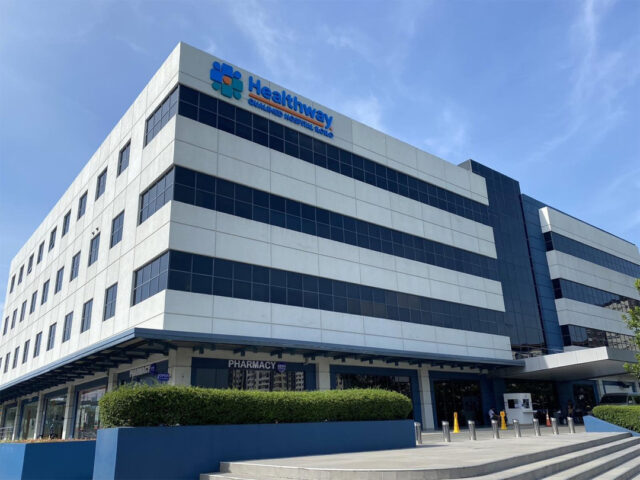
The company currently offers HIV health literacy programs throughout its network, with HIV screening available at 16 Healthway multi-specialty clinics.

“Workplace-based screening provides a convenient way for employees to get tested,” AC Health Chief Health Officer Beverly Lorraine C. Ho said.

“Early detection and proper treatment allow people living with HIV to lead long, healthy, and productive lives. That is our vision for the Filipino workforce,” she added.

On Tuesday, Health Secretary Teodoro J. Herbosa reported a 500% increase in HIV cases among individuals aged 15 to 25.

He said the Department of Health now records between 40 and 57 new cases daily, significantly higher than the six daily cases reported in 2010.

AC Health also said it trained 40 frontline medical professionals in HIV counseling last May through a partnership with Pilipinas Shell Foundation, with another 40 professionals scheduled for training this June.

Last year, AC Health signed a memorandum of understanding with the United States Agency for International Development (USAID) to expand HIV care in the Philippines.

HIV treatment services are also offered through the Healthway Medical Network. Healthway QualiMed Hospital in San Jose del Monte, Bulacan provides both inpatient and outpatient HIV care.

The company ensures access to essential medicines and lifesaving technologies through its pharmaceutical distribution arms, IE Medica and MedEthix.

“The government and civil society organizations have made significant progress in addressing the HIV epidemic. But with this looming public health emergency, the private sector must step up to complement existing efforts and help scale proven interventions,” Ms. Ho said.

AC Health’s portfolio includes Generika Drugstore, IE Medica, MedEthix, Healthway Medical Network, and St. Joseph Drug. — Revin Mikhael D. Ochave
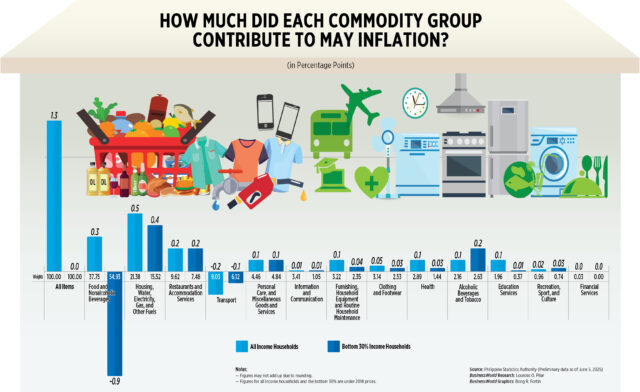
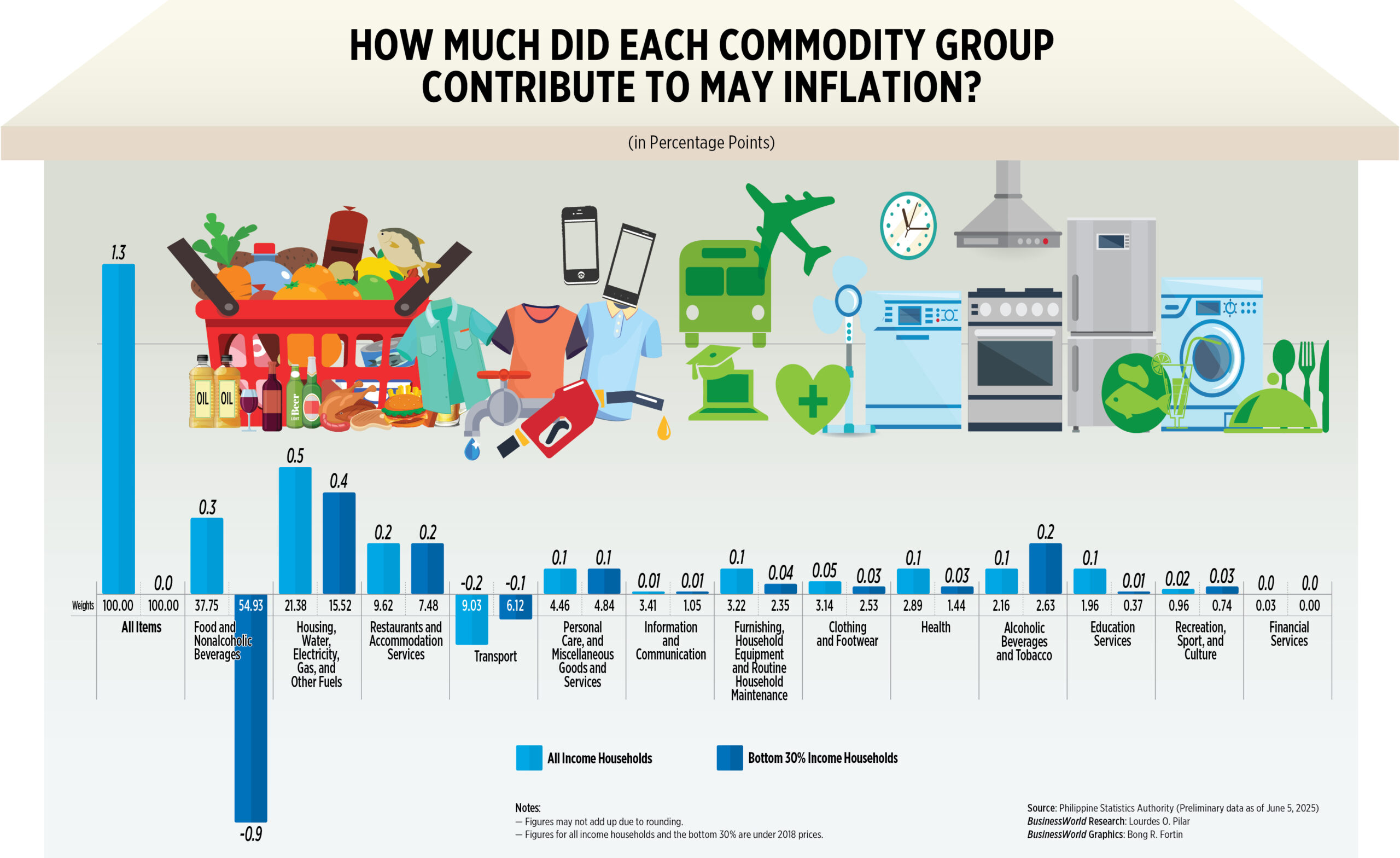
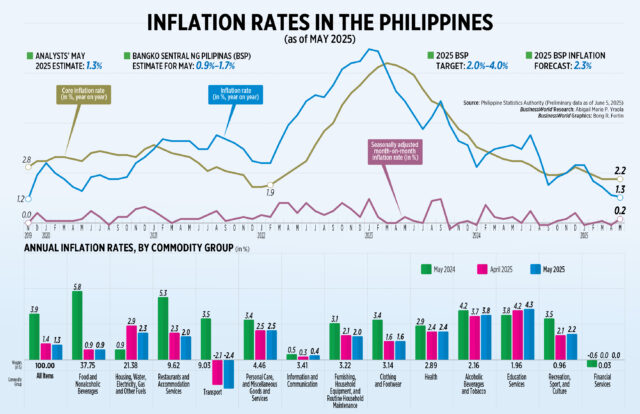
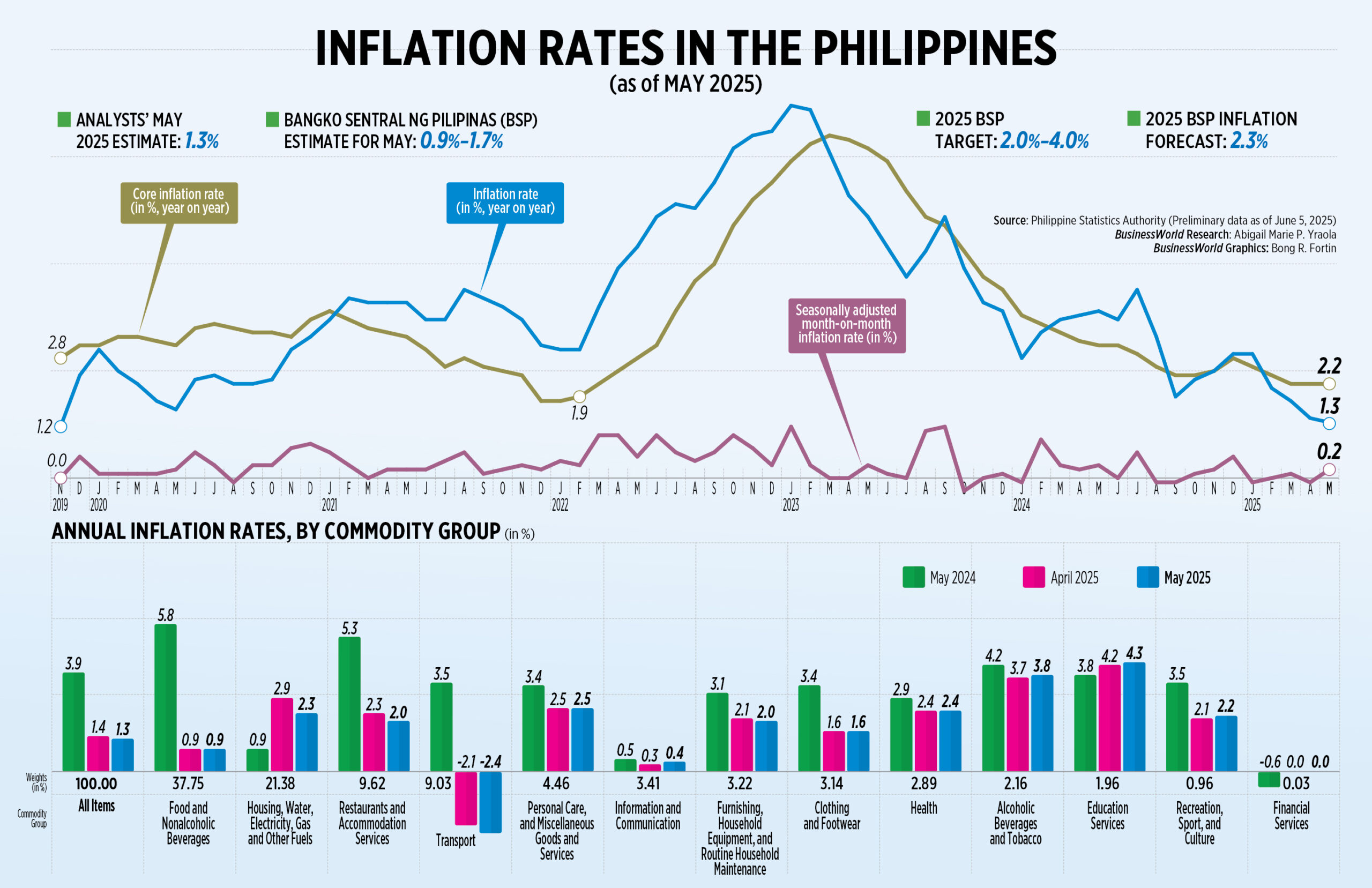
How much did each commodity group contribute to May inflation?

HEADLINE INFLATION eased to an over five-year low in May, as utility costs rose at a slower pace, the Philippine Statistics Authority (PSA) said on Thursday. Read the full story.

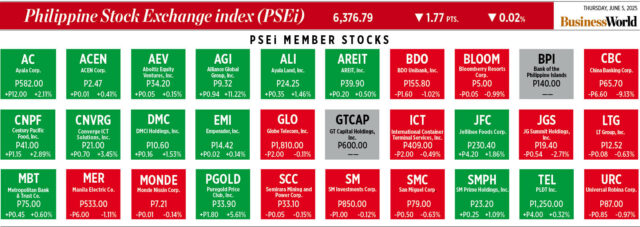
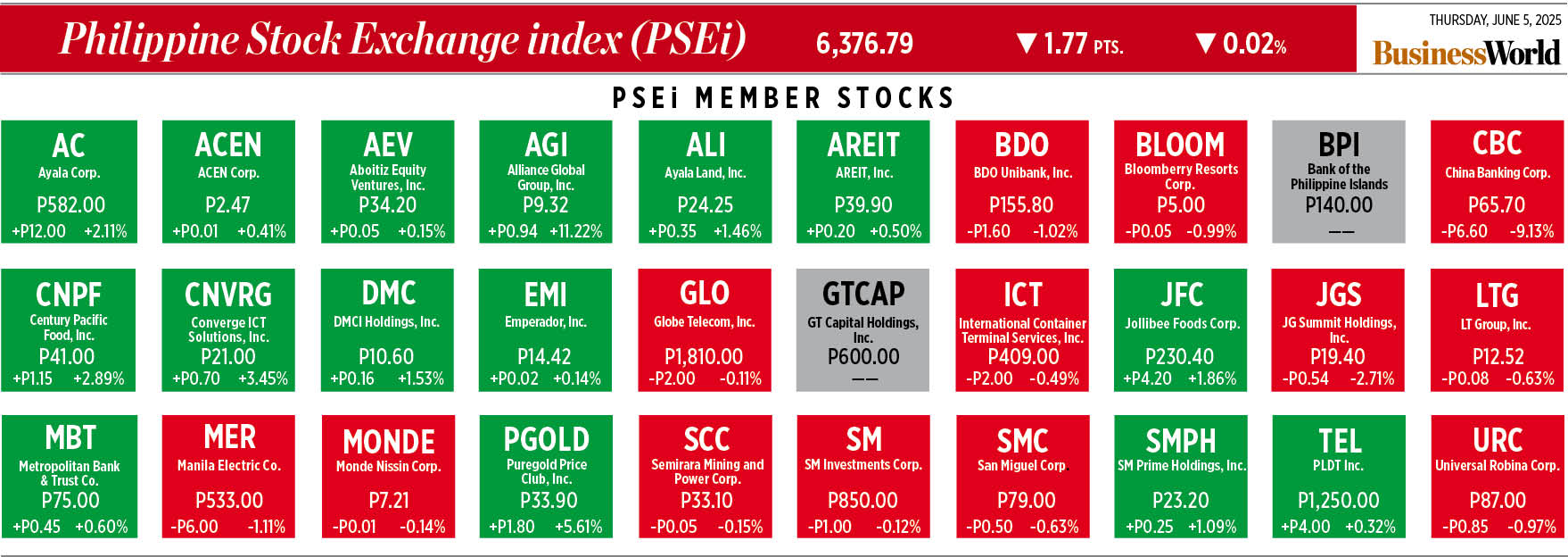
How PSEi member stocks performed — June 5, 2025

Here’s a quick glance at how PSEi stocks fared on ThursdayJune 5, 2025.


Inflation rates in the Philippines

HEADLINE INFLATION eased to an over five-year low in May, as utility costs rose at a slower pace, the Philippine Statistics Authority (PSA) said on Thursday. Read the full story.

ADB to fund four PHL RE, energy-efficiency projects

THE Asian Development Bank’s (ADB) clean energy pipeline for the Philippines covers four projects involving offshore wind, geothermal de-risking, and rural electrification.

“There’s a few investments that are still being prepared, designed, and discussed with the government. One is this de-risking investment that I spoke about,” ADB Country Director for the Philippines Pavit Ramachandran told reporters on June 3.

Mr. Ramachandran was referring to the multi-tranche Geothermal Resource De-Risking Facility, which is targeted for approval this year.

The facility will supply contingent convertibles up to 50% of total cost of drilling to reduce investment risk at the geothermal development exploration stage.

The Department of Energy said the project awaits the approval of the Investment Coordination Committee of the Department of Economy, Planning, and Development (DEPDev).

Some $190 million will be sourced from ADB’s ordinary capital resources. An additional $60 million will be funded by the Association of Southeast Asian Nations Catalytic Green Finance facility.

“The Energy Efficiency of Public Buildings Program was the other one,” Mr. Ramachandran said.

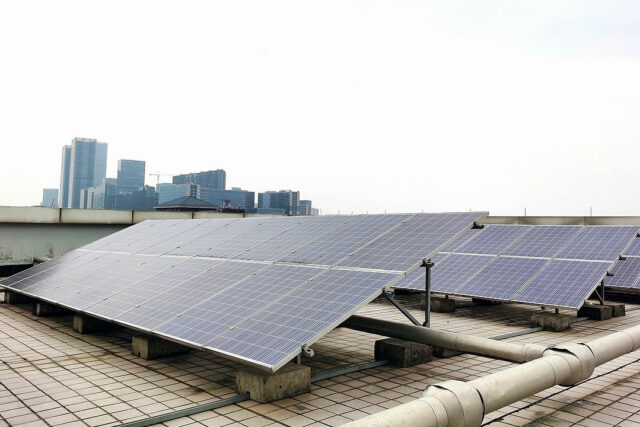
This $500-million project will focus on the procurement and installation of energy efficient lighting, high efficiency air conditioning, distributed solar photovoltaic modules, smart metering and/or electric vehicle charging stations.

Additionally, the ADB said it will be supporting the preparation of offshore wind projects and the National Total Electrification Support Program.

The Supporting Offshore Wind Port Development Planning technical assistance worth $400,000 will help government agencies prepare pre-feasibility study reports on offshore wind ports.

Meanwhile, the National Total Electrification Support Program, which has an indicated 2026 approval year, will require a $461-million loan from the ADB.

Under the Philippine Energy Plan 2020-2040, the government hopes to increase the share of renewable energy in the generation mix to 35% by 2030. — Aubrey Rose A. Inosante

German startup keen on tackling e-waste in developing countries

Photo Credit: Beatriz Marie D. Cruz

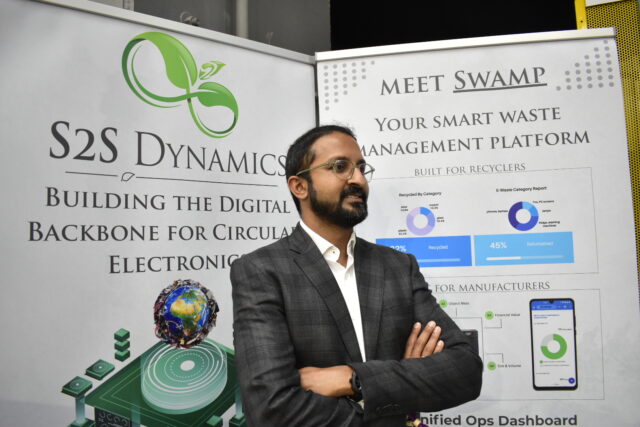
MADRID — S2S Dynamics, a German startup that tracks electronic waste (e-waste) through its artificial intelligence (AI)-powered platform, said developing countries have a worsening e-waste problem that can be addressed by connecting producers and recyclers.

“A lot of the waste that gets shipped from the developed world lands in the developing world, and that’s why we have these massive landfills full of waste,” Arjun Srihari, co-founder and chief commercial officer at S2S Dynamics, told BusinessWorld on the sidelines of the South Summit Madrid 2025 between June 4 and 6.

Founded in 2022, S2S Dynamics seeks to address the lack of data and transparency on e-waste, which is among the world’s fastest-growing waste streams.

“We started S2S Dynamics to create this data layer between the two most important stakeholders — the manufacturers who actually produce the devices, and the recyclers, where the devices end up,” Mr. Srihari said.

“These two stakeholders are very important in this recycling process, but they don’t speak to each other,” he added.

Less than 20% of electronic waste is documented and recycled, according to Mr. Srihari.

“That’s very troubling because that doesn’t mean that the waste disappears… and either in places like in India or even the Philippines, there are informal actors that are working with this waste and don’t have the benefits, tools, and the know-how that they should be getting,” he said.

The Philippines is among the top producers of e-waste in Southeast Asia, generating 537 million kilograms of e-waste in 2022, according to a joint report by the United Nations Institute for Training and Research and the International Telecommunication Union.

The Philippines was second only to Indonesia in the region. Indonesia had an estimated 1.886 billion kilograms of e-waste.

At end-of-life, e-waste is typically dumped in landfills, which generate greenhouse gas emissions and contribute to global warming.

“There’s a lot of valuable e-waste material that is lost and is not put back into the supply chain,” Mr. Srihari said, noting that $57 billion to $63 billion worth of e-waste is lost.

“I’m not saying that all of that money can be recovered through circular recycling, but a significant portion of it can,” Mr. Srihari said. “The main problem is that there’s no way to track the data.”

Mr. Srihari noted that the company’s learnings from the Indian market can provide insight in future expansions to developing markets.

Mr. Srihari said it has been in talks with potential investors from Europe, North America, India, and Southeast Asia.

S2S Dynamics is looking to scale its product across Europe before expanding globally, Mr. Srihari said. — Beatriz Marie D. Cruz

Solar, energy-efficiency program for schools, gov’t hospitals to get $300M

THE Department of Energy (DoE) said it is preparing an up to $300-million package to support rooftop solar and energy-efficient appliance use in public schools and government hospitals.

“The specifics are still for finalization and the loan itself is still for approval on the government side,” Patrick T. Aquino, director at the Energy Utilization Management Bureau, said via Viber.

Mr. Aquino said that the DoE obtained approval from the Asian Development Bank (ADB) for the facility.
However, it still needs the approval of the Department of Economy, Planning, and Development, formerly known as the National Economic and Development Authority, and the Department of Finance.

Once cleared, the program will be implemented by the DoE over five years.

“If it were to proceed, the capacities will contribute to the targets under the National Renewable Energy Program (NREP) and compliance with the Government Energy Management Program (GEMP),” Mr. Aquino said.

“We are grateful for the continued support of the ADB in our Government Energy Management Program,” Energy Undersecretary Rowena Cristina L. Guevara said at the ADB Asia Clean Energy Forum on Tuesday.

Ms. Guevara said green energy “can have a profound impact on public schools and government hospitals.” — Sheldeen Joy Talavera

Food and beverage tops list of leading FMCG products

BW FILE PHOTO

FOOD and beverage brands continued to dominate the fast-moving consumer goods (FMCG) segment, according to the 2025 Brand Footprint Report of Worldpanel by Kantar.

Laurice P. Obana, shopper insight director at Worldpanel by Kantar, said at a briefing on Thursday that the “economy is driven by a large socio-economic class D. Of course the preference is for the basics, which would be food and beverages,” she said.

Ms. Obana noted that mobility has improved with daily road traffic volume and Metro Rail Transit Line 3 ridership increasing.

She said this is reflected in household expenditures involving recreation, travel, and going out.

“We are seeing a bustling economy where Filipinos are more on-the-go and exposed to many options in the market. While shoppers are purchasing FMCG goods from multiple channels, they have become more discriminating with the brands they are buying,” she said.

“Filipinos look for packaged goods that are consistently available and accessible in the right format, at the right price, and for the right consumption occasion,” she added.

In 2024, she said shoppers visited more stores and shopped more frequently, with total shopping trips hitting 10.5 billion.

These frequent visits led to an increased number of occasions when shoppers were offered a choice to buy a brand. Such occasions rose 4% to approximately 16.9 billion in 2024.

“Competition in the marketplace is just so intense. So, there are more stores to cover, more buying occasions to win, but ultimately there are now fewer brands that are being purchased,” she said.

She said it is important for brands to carry products that consistently meet both customer and shopper needs, to put out the products in various channels, and maintain visibility and availability across these channels, and to deliver the right products.

“Based on data from Worldpanel by Kantar, FMCG brands that are bought by more homes and continue to increase penetration have a higher potential to drive growth,” Ms. Obana said.

“To reach more homes, accessibility is key. Brands which have presence in five or more channels set themselves up for success with more shopper touchpoints,” she added.

The 2025 Brand Footprint Report is based on a Worldpanel metric known as consumer reach points (CRP), which combines penetration and frequency. It represents a single instance of a shopper choosing a brand.

In the report, Lucky Me came out on top for most chosen FMCG brand, with a total of 903 million CRP.
It was followed by Nescafé with 785 million CRP, Kopiko (631 million), Coca-Cola (594 million), and Silver Swan (564 million).

The other most-chosen brands are Bear Brand, Surf, Maggi, Datu Puti, and Great Taste. — Justine Irish D. Tabile

Meanwhile, Nestea topped the fastest-rising list for FMCG brands in 2024, after posting 28% growth in CRP to 69 million.

It was followed by Mama Sita’s, with CRP growth of 26% at 69 million; Coca-Cola, up 24% at 594 million; Bioderm, up 24% at 161 million; and Energen, up 17% at 61 million.

The other fastest-rising brands were Lady’s Choice, Smart, Hapee, Datu Puti, and Tang.

“The market can get quite competitive with a slew of FMCG products to choose from,” Ms. Obana said.

“While short-term activations can be done to quickly win the attention of shoppers, strong brands that are able to evolve with consumer needs and prioritize accessibility will ultimately win the shopping baskets of Filipinos,” she added. — Justine Irish D. Tabile

La Union court rejects claim on Poro Point property

A REGIONAL trial court in San Fernando, La Union has dismissed a petition to register a parcel of land within the Poro Point Freeport Zone, the Bases Conversion and Development Authority (BCDA) said.

“The BCDA welcomes the favorable decision of the Regional Trial Court of San Fernando in La Union, which dismissed the Petition for Land Registration filed by Shipside, Inc.,” the BCDA said in a statement on Thursday.

“This legal affirmation strengthens the BCDA’s mandate over the property and paves the way for the continued advancement of its strategic development in Poro Point Freeport Zone.

The BCDA is planning to revitalize the San Fernando Seaport and enhance the freeport zone.

“Central to this vision is the San Fernando Seaport, whose continued operation and planned upgrades are vital to generating jobs, supporting livelihoods, and driving inclusive progress,” it added.

According to the BCDA, Shipside’s petition covers 543 square meters of land within the freeport zone.
“The court’s decision marks a critical milestone in unlocking the full potential of Northern Luzon,” BCDA said.

“With PPFZ poised to become a key hub for tourism, logistics, and investment, the region is set to benefit from increased economic activity and long-term growth,” it added.

BCDA oversees the Poro Point Freeport Zone through its subsidiary Poro Point Management Corp. — Justine Irish D. Tabile

CAB seeking to expand India air service agreement

REUTERS

THE Civil Aeronautics Board (CAB) wants to expand its air service agreement with India, as Air India launches a Delhi-Manila service by October.

“Air India is flying, that is good because India is a big market, a growing economy with a lot of outbound travelers,” CAB Executive Director Carmelo L. Arcilla told reporters on the sidelines of a briefing this week.

Air India announced that it is launching direct service five times a week between the two countries’ capitals starting Oct. 1.

Mr. Arcilla said the CAB is also in talks with India for possible air service to other destinations in India.

“I think that when the main gateway is developed, the secondary gateways will follow. It takes a lot of resources to develop secondary gateways,” he said.

The CAAP has said that Air India is optimistic about the possible economic and cultural impact of direct services.

The Department of Transportation has said that it is undertaking consultations for further air service agreements with India, the US, Australia, Thailand, the UK, Uzbekistan, Qatar, Ethiopia, Oman and the Seychelles. — Ashley Erika O. Jose

Gov’t-funded vessel to bring fish buyers to WPS fisherfolk

PHILIPPINE COAST GUARD FACEBOOK ACCOUNT

THE GOVERNMENT will fund a vessel, the MV Mamalakaya, that will carry fish buyers seeking to directly purchase the West Philippine Sea (WPS) catch.

The buyers on board will be ready “to purchase the fresh catch of Filipino fishermen at sea,” the Bureau of Fisheries and Aquatic Resources (BFAR) said in a statement.

The program is designed to reduce post-harvest losses and increase fisherfolk income, it added.

“In addition, fisherfolk will benefit from fuel and ice subsidies, enabling them to continue fishing activities in the WPS amid operational and environmental challenges.”

The BFAR said the WPS plays “a crucial role in national security and food sovereignty. — Kyle Aristophere T. Atienza

PEZA sees Chinese interest in locating, expanding in PHL

THE Philippine Economic Zone Authority (PEZA) said some Chinese companies have expressed interest in expanding current operations or locating in the Philippines.

“PEZA has received numerous inquiries lately, and we see the same sentiments coming from the companies we met in Shenzhen,” PEZA Director General Tereso O. Panga said in a statement on Thursday.

“Surely, this is the best time for the Philippines to host their operations, and we in PEZA assure that with the President at the forefront of this move, we will make it happen in the Philippines,” he added.

PEZA participated in a three-day investment mission organized by the Philippine Consulate General in Guangzhou and the American Chamber of Commerce in South China in partnership with the Philippine Trade and Investment Center (PTIC) in Guangzhou.

PEZA participated in a business forum and business-to-business (B2B) meetings during the event.

“Apart from the forum, PTIC Guangzhou also organized B2B meetings for the PEZA team to meet with companies interested in transferring their operations to the Philippines due to its proximity to China and the impact of the US-China trade war, among many other reasons,” PEZA said.

“These companies are into medical device manufacturing, garments, e-commerce, and electronics sectors and are yet to make any concrete decisions as they are still in the exploratory phase,” it added.

PEZA also conducted a facility tour with Shenzhen Grandsun Electronic Co., Ltd. which has a unit currently operating at the Lima Technology Center in Batangas.

“Grandsun reaffirmed its commitment to expanding operations in the Philippines in the coming years, with plans to bring their whole supply chain to the country and eventually manufacture their full product line domestically,” it said.

Meanwhile, PEZA also met with the China Chamber of International Commerce (CCOIC) Dongguan to discuss collaboration with Dongguan’s business community.

“Noteworthy, some members of CCOIC have conducted an exploratory business mission to the Philippines on April 25-26 to learn more about the business environment of the Philippines and to visit selected ecozones in Laguna and Batangas,” PEZA said.

PEZA said that it is bullish on the entry of multinational companies, especially those with operations in China.

“With the growing interest in the Philippines as the new ‘plus one’ preferred destination in ASEAN by relocating companies from China, we are confident that we can do a quick turnover and welcome these companies as new locators,” said Mr. Panga.

“We must not further delay the relocation of these companies from China to the Philippines in order to secure our position in this evolving regional market.”

According to PEZA, China remains one of the country’s top investment partners, accounting for 22% of total foreign investments.

Within economic zones, Chinese companies accounted for $406 million in exports and 16,000 jobs.

PEZA has achieved 24% of its approval target for the year, after greenlighting P66.34 billion worth of investment pledges in the first five months.

These investments feature companies from South Korea, the US, China, Japan, and the Netherlands.

“As the global business landscape shifts under the China+2 strategy, the Philippines stands ready to serve as a strategic partner in enhancing regional resilience,” Mr. Panga said.

“Through stronger economic ties with China, PEZA is committed to fostering mutual prosperity, fortifying supply chains, and creating a more agile and sustainable investment ecosystem in Asia,” he added. — Justine Irish D. Tabile