Home Blog Page 144

Fish imports, aquaculture counted on to provide price relief to consumers

PHILIPPINE STAR/ MICHAEL VARCAS

THE Department of Agriculture (DA) said it is boosting aquaculture and considering fish imports to stabilize prices of fisheries products, as fisherfolk face the risk of limited production due to the high price of fuel.

Agriculture Secretary Francisco P. Tiu Laurel, Jr. said fish supply remains sufficient, but rising fuel costs due to the war in the Middle East and the upcoming lean season could reduce availability.

“Fisheries is directly affected by oil prices. For now, however, it is in season. The catch is abundant,” he told reporters during a market visit in San Juan City on Wednesday.

While prices of fishery commodities have been rising, Mr. Laurel said they have eased compared to recent months due to improved supply arising from the ongoing harvest.

“I’ve noticed that the price of galunggong (round scad) is around P200 per kilo. Before, it was P350. It means that the harvest has started,” he said.

Mr. Laurel said, however, that a continued surge in fuel prices going into the lean season could reduce commercial fishing.

“Right now, our fishermen are still earning. But if fuel prices remain high by May or June, our fishermen may not be able to fish, which could lead to a shortage,” he said.

As a contingency, Mr. Laurel said the DA is prioritizing aquaculture, particularly tilapia and bangus (milkfish) production, to provide alternatives.

“We are pushing our aquaculture industry to seed more fingerlings this summer so that hopefully, by that time, May or June, we will have an ample supply of fish,” he said.

Mr. Laurel also cited the prospect of imports covering any shortfall in supply. The DA has approved the import of 250,000 metric tons of fish starting August.

However, Mr. Laurel said imports could be limited by global supply constraints.

“The problem is we might not be able to get supply because the situation of our fishermen here is the same problem for the fishermen in other countries,” he said. — Vonn Andrei E. Villamiel

Digital work, real taxes

Remote work, freelancing, and platform‑based businesses have reshaped how we earn our living. Enabled by technology and global connectivity, professionals can now provide services to foreign corporations, manage social media accounts, sell products through online marketplaces, or earn income from content creation — often without stepping into a traditional office, and instead, working from their own homes. This has expanded opportunities for many and improved economic participation, but it has also exposed some confusion about taxation for these arrangements.

A common misconception that seems to be circulating online is that income earned digitally, especially from foreign clients or platforms, is not taxable in the Philippines. Others assume that if no tax is withheld at source, or if the payment is received through digital wallets or in foreign currency, the income somehow falls outside the Philippine tax system. It is easy to see how these assumptions arise, particularly in arrangements that feel distant from traditional employment. However, Philippine tax laws also apply to digital work. If left unaddressed, these misconceptions can lead to costly penalties, interest, or registration issues later in the future.

For Philippine residents, the rule is straightforward: we are taxed on our worldwide income. This applies wherever income is earned, whether online or offline. The location of the employer or client does not change this. Likewise, the form of payment does not affect taxability. A resident earning income from services or employment is subject to Philippine taxes, even if the client is abroad and payment is in dollars through an online platform. For reporting purposes, income received in foreign currency must be converted to pesos using prevailing exchange rates.

Another frequent misunderstanding is the belief that tax obligations disappear when a client or employer does not withhold tax. In reality, the lack of withholding does not mean there is no tax due. For locally employed individuals, withholding tax simply functions as an advance collection mechanism that shifts much of the compliance burden to the employer, making tax payment simpler for the employee. Where no tax is withheld, or where income is earned from various sources (such as in many remote or offshore arrangements), the responsibility to file the returns and pay taxes rests more directly with the individual. In all cases, income must still be reported and the appropriate tax paid, regardless of whether tax was withheld at source.

What if taxes were already paid abroad? If the income has already been taxed in another country, Philippine tax rules generally allow that foreign tax to be taken into account when computing local taxes, if certain conditions are met. To be clear, the income still needs to be declared in the Philippines, but the taxes paid overseas may help reduce what is ultimately owed.

Expense deductions are another area of frequent confusion. Some assume they are not allowed to deduct any expenses at all, while others assume that all work‑related costs are automatically deductible. In practice, the rules depend on the nature of the work arrangement. Self‑employed individuals, freelancers, and online business owners may generally deduct ordinary and necessary business expenses, either as itemized deductions or as a standard deduction. Employees, however, are typically taxed on their gross compensation income and are not allowed to deduct work‑related expenses (whether working for a local company or remotely for a foreign employer).

To its credit, the Bureau of Internal Revenue has made notable efforts in recent years to bring digital earners into the formal tax system. Rules covering online sellers, platform‑based withholding, and guidance for influencers and content creators have sent a clear signal that digital income is not exempt. These measures reflect an acknowledgment that new work arrangements have been created, and the BIR continues to adapt accordingly.

Digital earning reflects a change in how many Filipinos work and earn income. While tax rules already exist, uncertainty around how those rules apply in practice can make compliance difficult — particularly for freelancers and small online businesses working through the system on their own. Many freelancers and micro‑entrepreneurs struggle with registration requirements, filing procedures, and the treatment of foreign or irregular payments. Questions around VAT thresholds, withholding obligations, and documentation requirements can discourage voluntary compliance or lead to errors.

When expectations are unclear, some choose not to register at all, while others risk making mistakes that could have been avoided with clearer guidance. In this sense, consolidated guidance, along with simplified processes and better alignment between digital platforms and reporting systems, may help reduce errors and lower the burden on small taxpayers. This would also allow the BIR to focus enforcement on higher risk areas.

For individuals, tax compliance is more than a legal requirement — it is a professional asset. Registered and compliant freelancers signal credibility and reliability to clients. Proper reporting and bookkeeping reduce exposure to penalties or audits, while a clear understanding of allowable deductions can help legitimately maximize net income. Compliance is not punitive — it is professional and protective.

In sum, consistent tax treatment helps keep things fair as the way we work continues to change. When digital earners are subject to the same basic tax principles as salaried employees and traditional businesses, competition is not distorted simply because of how income is earned. Clear rules reinforce confidence in the system. In this way, tax compliance is less about categorizing work as “old” or “new,” and more about ensuring that long‑standing rules continue to apply sensibly in a changing economy.

The views or opinions expressed in this article are solely those of the author and do not necessarily represent those of Isla Lipana & Co. The content is for general information purposes only and should not be used as a substitute for specific advice.


Olivia Erika R. Susa is a senior manager at the Tax Services department of Isla Lipana & Co., the Philippine member firm of the PwC network.

olivia.erika.susa@pwc.com

ACT warns against ‘potential displacement’ of private school teachers

RUBEN RODRIGUEZ-UNSPLASH

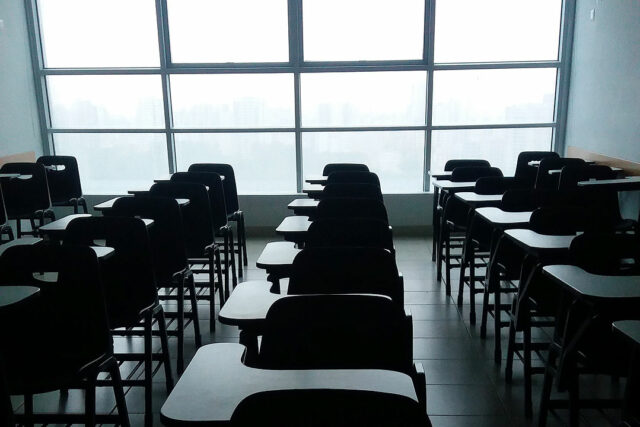
The ACT Teachers Party-list said on Tuesday that private school teachers could be displaced as the full implementation of the Strengthened Senior High School (SHS) curriculum rolls out nationwide.

“The lawmakers are warned of its direct threat to the job security of thousands of private school teachers who have specialized degrees and licenses that may not align with the newly combined subjects and tracks,” the group said in Filipino in a statement.

“The precarious situation of private school teachers – who already face lack of tenure and lower wages – puts them at greater risk amid sudden policy changes,” it added.

Under the new SHS curriculum, the four tracks were reduced to two: Academic and Technical Professional (TechPro), while core subjects were also cut from 15 to five to decongest learning content.

The five core subjects under the new curriculum are Effective Communication / Mabisang Komunikasyon, Life and Career Skills, General Mathematics, General Science; and Pag-aaral ng Kasaysayan at Lipunang Pilipino.

The Department of Education (DepEd) said the reform aims to foster mastery of foundational skills and improve students’ workforce readiness, both of which were criticized in the previous curriculum.

The new SHS curriculum was piloted in School Year (SY) 2025-2026 for Grade 11 students across 891 schools.

However, ACT noted that some private school teachers, along with other education stakeholders, claimed that DepEd did not conduct “genuine consultations” before and during the pilot implementation.

“They just created a week-long online survey and distributed a “consultation packet,” which denied stakeholders a meaningful opportunity to be heard and to provide feedback,” the group said.

Party-list Representative Antonio L. Tinio on Tuesday filed House Resolution No.836 urging the House Committee on Basic Education and Culture to investigate the “potential massive displacement”.

The full implementation of the revised SHS curriculum is scheduled in June 2026, as classes begin for SY 2026-2027. — Almira Louise S. Martinez

Eala faces Germany’s Siegemund in second round of Miami Open

ALEX EALA — FACEBOOK.COM/MIAMIOPENTENNIS

IT IS SHOWTIME for the Filipina tennis star in Miami.

Alexandra “Alex” Eala, at the jaws of an enormous pressure to protect her spot inside the Top 30, tussles with German ace Laura Siegemund in Round 2 of the Miami Open at the Hard Rock Stadium on Thursday in Florida.

The 20-year-old wunderkind faces a daunting task of replicating a final four finish she achieved last year or lose the precious rankings points of up to 390 for a projected drastic, free fall in the Women’s Tennis Association (WTA) list.

Ms. Eala currently sits at No. 29 with 1525 points for her new career-best following a Last 16 finish in the Indian Wells Open and 390 of those will expire at the close of the tourney as per WTA’s one-year ruling on ranking points.

Standing in between Ms. Eala and the retention of those points is a total of four wins to get into the semifinals starting against the 38-year-old German, WTA No. 53, following her 6-4, 6-4 sweep of No. 76 Petra Marcinko of Croatia, at a still to-be-determined game time on Thursday (Manila time).

Ms. Siegemund is a doubles specialist with career-high ranking of No. 4 laced by two WTA titles and three Grand Slam crowns (women’s and mixed). She’s also a quarterfinalist in the Tokyo Olympics.

And that should be enough warning on how steep the climb it would be for Ms. Eala, despite being ranked higher and seeded at No. 31 with a first-round bye.

It’s a full circle for the left ace, playing in the main draw right away with a bye after rising from being a wildcard qualifier last year to final four marked by wins against Grand Slam champions Iga Swiatek of Poland, Jelena Ostapenko of Latvia and Madison Keys of the United States to collect the said massive points — and more importantly barge into world’s Top 100.

At stake for Ms. Eala in Round 2 is only 35 ranking points plus 10 in Round 1, which would still be a far cry from the 390-point needed to stay in the Top 30.

To reach that, Ms. Eala has to score three more wins projectedly against world No. 3 Ms. Swiatek by the third round, No. 14 Karolina Muchova of Czechia or No. 16 Clara Tauson of Denmark by Round 4 and then either world No. 9 Victoria Mboko of Canada or No. 10 Mirra Andreeva of Russia in the quarterfinals.

A total of 65, 120 and 215 points are up for grabs in Rounds 3, 4 and quarterfinals, respectively.

And that’s the only time Ms. Eala could reach 390, regardless of the result in the semifinals against possibly her good friend and world No. 4 Coco Gauff or No. 6 Amanda Anisimova of the United States to complete the lower bracket.

Either reigning champion and world No. 1 Aryna Sabalenka of Belarus or No. 2 Elena Rybakina of Kazakhstan are expected to come out of the upper bracket for a slot in the finale.

Otherwise, Ms. Eala is projected to fall all the way to 1135 points, good at around Top 50-60 for a scratch at an unfortunate time when she’s about to crack Top 20.

It’s a long shot for Ms. Eala and as titanic is the hurdle is with the presence of Top 10-20 players and Grand Slam champions in her way, she’s ready now more than ever.

“I know that I belong here,” she beamed.

“It doesn’t matter if I win the tournament in Miami or if I lose in the first round. I know I’m here and I’m here to stay.” — John Bryan Ulanday

PLDT guns for PVL solo lead vs tough Nxled Chameleons

PLDT HIGH SPEED HITTERS — FACEBOOK.COM/PREMIERVOLLEYBALLLEAGUE

Games on Thursday
(FilOil Arena)
4 p.m. – Nxled vs PLDT
6:30 p.m. – Choco Mucho vs ZUS Coffee

PLDT hopes to build more momentum entering the qualifying round as it clashes with an unpredictable Nxled on Thursday in the PVL All-Filipino Conference at the FilOil Arena.

The PLDT High Speed Hitters, already ensured of a place in the four-team crossover phase, will shoot for a fourth straight win and seventh in all in eight outings and try to close out the classification phase atop the heap with another triumph in their 4 p.m. duel with the Chameleons.

Defense should be the focal point for the Manny V. Pangilinan franchise again on this one.

“We need to have more patience in our defense,” said PLDT coach Rald Ricafort, whose bunch had 12 blocks, including a combined eight from Majoy Baron and Kianna Dy, in their four-set triumph over Choco Mucho last time.

But it won’t be a walk in the park as the Nxled Chameleons have sprung back to life following their 20-25, 25-15, 25-23, 25-19 win over the ZUS Coffee Thunderbelles (1-7) a week ago that halted a four-game slide and got the former a 4-4 record.

A victory also by the electric lighting company would keep it in the tight race for the last spot to the qualifying round.

More than gatecrashing into the top four, Nxled is focused on rediscovering its old form when it started the conference with a scorching three-win streak before going on a free fall.

“I’m very proud of my team to be able to lock in, focus and bounce back,” said Nxled star Brooke Van Sickle, who pace her team’s attack with 20 points while presiding over their floor defense with 12 receptions and 10 digs. — Joey Villar

Filipinas clash with Uzbekistan for FIFA Women’s World Cup seat via AFC Women’s Asian Cup

FILIPINAS — FACEBOOK.COM/PILIPINASWNFT

Match on Thursday
(Gold Coast Stadium)
11 a.m. (Manila time) – Uzbekistan vs Philippines

IT IS their best chance at the coveted ticket to the 2027 FIFA Women’s World Cup (WC) via the AFC Women’s Asian Cup (WAC) pathway.

So expect the Filipinas to make a supreme effort to secure their second straight appearance in the global showpiece on Thursday when they clash with Uzbekistan in the Continental meet’s Play-in match in Australia.

The you-or-me fixture is set at 1 p.m. at the Gold Coast Stadium (11 a.m. Manila time) with the winner joining WAC semifinalists Australia, China, Japan and South Korea as well as the victor of the other Play-in showdown between North Korea and Chinese-Taipei to the Brazil worlds.

Losers of the two Play-in duels, meanwhile, will get a final crack at the WC via the Inter-confederation Play-offs where eligible aspirants from all the continents will dispute two additional spots.

“The players have done a fantastic job to put us in this position, they’ve given us a real opportunity to qualify for another World Cup,” said coach Mark Torcaso, who’s looking to bring the squad back to the elite stage after its historic debut in 2023 under his predecessor, Alen Stajcic.

“Now that we’re here, we’re determined to make the most of it and go again. The experience of a World Cup is something special and it’s something we want to bring back to the team. At the same time, we have players who are hungry to reach that stage for the first time.”

After taking a breather from the 0-7 loss to Japan in the quarterfinals last Sunday, veteran keeper Liv McDaniel is expected to lead the WC drive against the Uzbeks along with fellow World Cuppers Sara Eggesvik, Hali Long, Jaclyn Sawicki and Jessica Cowart.

Uzbekistan, which yielded to Korea in the quarters, 0-6, is in pursuit of history.

“We are in the playoff stage and one step to making history. That’s the spirit we bring into this playoff stage — we take it head-on,” said coach Kotryna Kulbyte. — Olmin Leyba

Kacey Dela Rosa, Gilas stun world No. 19 Colombia at FIBA Women’s World Cup qualifying

GILAS PILIPINAS WOMEN notched new heights by beating a non-Asian team for the first time ever despite an early exit in the FIBA Women’s World Cup Qualifying Tournament in Lyon, France.

Behind Kacey Dela Rosa’s monstrous outing, the undersized Nationals pulled off a stunning 74-59 win over South American squad Colombia, world No. 19, for a good exit in the world qualifiers.

Ms. Dela Rosa, a two-time UAAP MVP from Ateneo, collared 25 points and 19 rebounds laced by five blocks to lead the wards of coach Patrick Aquino to a historic win for a 1-4 slate.

“Looking at the matchups, the height gaps, and everything that happened, obviously, we are physically outmatched by everyone,” said Mr. Aquino.“But the girls proved that Filipinas can play basketball. Definitely, we’re up to this world-class level.”

Sumayah Sugapong added 21 points while veterans Afril Bernardino and Stefanie Berberabe chipped in eight and six points respectively as Gilas erased a 10-point halftime deficit.

Gilas outscored Colombia in the payoff period, 23-12, including 14 from Ms. Dela Rosa alone.

“We just told one another, we’re going to make history if we win this game. I think that woke the girls up and played well,” added Mr. Aquino.

“I think it’s huge, not only for the girls sitting in the locker room and the coaches but everybody watching back home in the Philippines and even in the United States,” beamed Ms. Sugapong.

Before pulling the rug from under Colombia, Gilas absorbed an average losing margin of 32.5 points against world No. 3 France, No. 8 Nigeria, No. 12 Germany, and No. 15 South Korea.

Gilas bowed to France, 115-66, Germany, 113-80, Nigeria, 101-84, and Korea, 105-74.

It’s a good morale-boosting win for Gilas women as the country hosts the 2027 FIBA Women’s Asia Cup, where the Nationals have been in the elite Division A since 2015. — John Bryan Ulanday

Eugenio Suarez, Venezuela edge USA to capture first World Baseball Classic championship crown

MIAMI — Eugenio Suarez’ double in the top of the ninth drove in the tiebreaking run that led Venezuela to its first-ever World Baseball Classic (WBC) championship with a 3-2 win over the United States on Tuesday night.

Daniel Palencia sealed the victory in the bottom of the ninth when he worked a 1-2-3 inning to pick up his second save in as many nights and third of the tournament.

Maikel Garcia, who drove in the game’s first run on a sacrifice fly, was named the MVP. He led the tournament with 10 hits while batting .385 with one homer and seven RBIs.

Team USA lost in the WBC final for the second consecutive time, again failing to win what would have been its second Classic championship. The United States, which won the 2017 title, lost 3-2 in the 2023 final to Japan.

“I would love to do it again. I would love to get over the finish line. Not only two times, but (losing) 3-2 each time,” USA manager Mark DeRosa said after the loss when asked if he would manage the team again if asked to do so.

Venezuela, which had never previously advanced to the final, beat defending champion Japan in the quarterfinals, then knocked out the Cinderella team of the tournament, first-time semifinalist Italy, before defeating the US.

Suarez belted a 3-2 changeup from Garrett Whitlock (0-1) into the left-center-field gap with no outs, driving in Javier Sanoja with the go-ahead run. Sanoja entered the game as a pinch runner after Luis Arraez worked a leadoff walk. Sanoja stole second, setting up the scoring opportunity for Venezuela.

“From the dugout, I was just making sure I supported my teammates and stayed ready,” Sanoja said. “My moment came and I was ready to steal that base. It was a pitch we felt we could run, and (Whitlock) made a slow delivery and I felt it was a perfect decision.”

Venezuela’s ninth-inning rally came immediately after Bryce Harper’s 432-foot, two-run homer off reliever Andres Machado (1-0) put Team USA on the board, tying the game at 2 in the eighth. The home run broke a string of 21-plus scoreless innings by Venezuelan relievers.

Other than Harper’s home run, Venezuela pitchers combined to allow only two hits to the powerful United States lineup.

Eduardo Rodriguez started for Venezuela and yielded just one hit and one walk over 4 1/3 scoreless innings, striking out four. Eduard Bazardo, Jose Butto and Angel Zerpa permitted only one hit over a combined 2 1/3 relief innings.

Venezuela struck first with a run in the third inning on a sacrifice fly by Garcia that scored Perez, who singled to start the frame.

Wilyer Abreu’s 414-foot solo home run to center field off USA starter Nolan McLean in the fifth gave Venezuela a 2-0 lead.

McLean gave up two runs on four hits and a walk in 4 2/3 innings. He fanned four. — Reuters

Japan’s leader faces high-wire act in Washington over Trump’s Iran demands

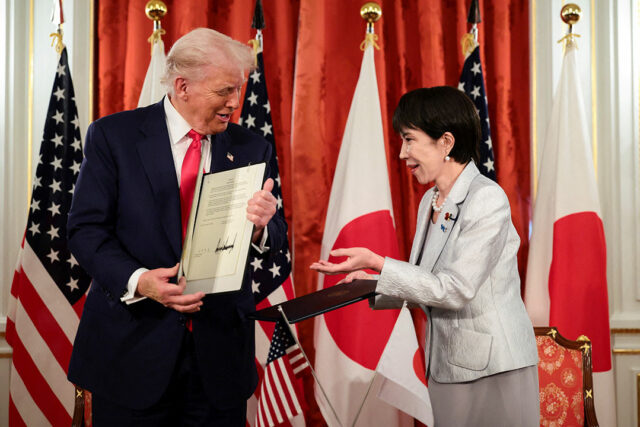
US PRESIDENT Donald J. Trump and Japanese Prime Minister Sanae Takaichi hold signed documents following a bilateral meeting at Akasaka Palace in Tokyo, Japan, Oct. 28, 2025. — REUTERS/EVELYN HOCKSTEIN

TOKYO — Japanese Prime Minister Sanae Takaichi visits the White House on Thursday for meetings that offer US President Donald J. Trump a chance to lean on a key security partner for support in his Iran war, threatening to strain a decades-old alliance.

Ms. Takaichi is the first major ally set for face-to-face talks with Mr. Trump since he demanded that Japan, among a coalition of nations, send ships to escort tankers through the Strait of Hormuz waterway, largely closed by Iran in the conflict.

“Takaichi is in a tight spot,” said David Boling, of the Asia Group consultancy in Tokyo and a former US trade negotiator with Japan during Mr. Trump’s first term as president.

“The biggest risk is that Trump publicly presses her for security commitments that she can’t deliver on.”

Japanese officials involved in the preparations said Ms. Takaichi had hoped to remind Mr. Trump of the dangers posed by a regionally assertive China prior to his visit there, initially planned near the end of March, but now delayed.

Instead, she will have to find a way of placating Mr. Trump over his demand for ships to guard the Strait, a conduit for a fifth of global energy, while avoiding legal and political pitfalls.

US allies such as Germany, Italy and Spain have ruled out participating in any Gulf mission, while Kaja Kallas, the European Union’s foreign policy chief, said on Tuesday, “Nobody is ready to put their people in harm’s way.”

Japan had received no official request from the United States, Ms. Takaichi told parliament on Monday but was checking the scope of possible action within the limits of its pacifist constitution.

Fewer than 10% of Japanese support the attacks by the United States and Israel on Iran, a poll by the Asahi newspaper showed this week.

MAKING AN EXAMPLE OF JAPAN
Mr. Trump has vacillated between chiding allies for their reticence to saying he does not need them, calling out those such as Japan that rely on the United States for their own defense and depend heavily on crude supplies through Hormuz.

About 90% of Japan’s oil shipments come through the Strait.

Tokyo has offered logistical support and intelligence gathering for previous US military efforts in the Middle East. But sending Japanese ships into a conflict area would be legally fraught and deeply unpopular, analysts say.

“It has turned into a discussion that shakes the very foundations of the Japan-US security alliance,” said Kazuhiro Maeshima, a politics professor at Sophia University in Tokyo.

But Mr. Trump has a lot of leverage when it comes to Japan, Mr. Maeshima added.

Japan relies on about 50,000 US troops, a carrier strike group and squadrons of fighter jets stationed in the country to deter threats from China and North Korea.

In addition, Mr. Trump has wielded tariffs to exact billions of dollars in investments, in his effort to adjust a massive trade imbalance with Tokyo.

“If he can bring Japan into the coalition of the willing, it will increase pressure on other countries,” Mr. Maeshima said. “Conversely, if Japan refuses, he can make an example of it — showing what happens when a country says no.”

Public support for Ms. Takaichi has slipped slightly since a barnstorming election win last month, polls show, as her government battles to hold down rising costs partly fueled by the Middle East energy shock.

STRUGGLING TO SATISFY TRUMP
Mr. Trump, who heaped praise on Japan’s first female leader when he visited in October, will have hours to press her on Iran during the summit, over talks, a working lunch and dinner.

With US allies in Asia fretting that the redeployment of US security assets from the region could weaken defenses against China, Japan had hoped dealing with Beijing would be top of the meeting’s agenda.

Tokyo is targeting a deal with Washington that would enable it to diversify supplies of critical minerals away from China and join Mr. Trump’s Golden Dome missile defense system against new hypersonic weapons being developed by China and Russia, said Japanese officials familiar with the preparations.

Anticipating the focus on Iran, Tokyo is scrambling for ways to offer help, but it is unclear if any will satisfy Mr. Trump, said another source, who spoke on condition of anonymity.

With limited military options, Tokyo could offer to be a go-between with Tehran, said Tsuneo Watanabe, senior fellow at Japanese think tank The Sasakawa Peace Foundation.

In 2019, Ms. Takaichi’s mentor and assassinated predecessor, Shinzo Abe, carried a message to Iran’s supreme leader during a failed peacekeeping mission, but this time around neither side appears ready for talks.

“I don’t think it’s going to be enough to talk to the Iranians,” said Kurt Campbell, a former deputy secretary of state under Mr. Trump’s predecessor, President Joseph R. Biden.

Mr. Trump was likely to have a very specific request for Ms. Takaichi, requiring an answer either “yes” or “no,” he added.

“This is a moment of enormous political peril.” Reuters

Vietnam faces falling oil production as Iran war disrupts global supplies

A VIETNAM DONG note is seen in this illustration photo May 31, 2017. — REUTERS

HANOI — Vietnam’s domestic crude oil production is expected to decline this decade, according to a government document released this week, increasing the country’s reliance on imports as its offshore fields mature and geopolitical tensions threaten global supplies.

The new forecasts for dwindling oil output come as Vietnam, a regional industrial hub hosting large manufacturing operations of electronics and garment multinationals, is bracing for oil shortages caused by the US-Israeli war on Iran and subsequent export bans from energy suppliers.

Crude output is projected to fall to 5.8 million-8.0 million metric tons a year during the 2026-2030 period, down from an average annual output of 8.6 million tons in the last five years, according to the figures released by the industry ministry.

The fall in domestic output is set to further increase reliance on imports which last year rose 5.3% to 14.2 million tons, according to Vietnam’s customs data.

Around 80% of the crude oil Vietnam imported last year came from Kuwait, whose exports are currently frozen by Iran’s closure of the Strait of Hormuz.

Vietnam also imports refined fuels, while its two refineries cover around 70% of the country’s needs, producing gasoline, diesel and other fuels mostly from imported crude.

Gasoline prices in Vietnam have risen by around 30% and diesel by about 40% since the start of the Iran war, while risks of shortages prompted the government to encourage people to work from home to cut fuel consumption.

Authorities also warned of potential flight reductions from April after China and Thailand halted exports of jet fuel due to the war, increasing the likelihood of shortages.

Vietnamese officials have over the past week reached out to Middle Eastern countries, as well as Japan, South Korea and Angola to secure crude oil supplies.

In a bid to boost domestic output, Vietnam will seek to boost exploration activities, including by offering incentives to international oil companies to invest in its offshore fields, the document said, without elaborating on the incentives.

It aims to raise the recoverable reserves by 13 million-17 million tons of crude oil equivalent a year during the 2026-2030 period, it said. Reuters

New Zealand to tighten immigration rules amid crime concerns

STOCK PHOTO | Image by Kerin Gedge from Unsplash

WELLINGTON — New Zealand’s government will introduce legislation on Wednesday to tighten deportation, asylum and immigration enforcement rules, saying the changes are needed to tackle serious offending, migrant exploitation and bad-faith claims.

Immigration Minister Erica Stanford said the changes would give authorities “proportionate tools” to manage immigration risks while ensuring the system is fair, functional, and effective.

The bill would extend from 10 to 20 years the period during which a resident can become liable for deportation for serious criminal offending, raise the maximum sentence for migrant exploitation to 10 years from seven, and widen powers to act on false or misleading information supplied during the immigration process.

The bill will have to pass three readings in parliament, but as the government has a majority, it will likely pass.

The move reflects a broader push by governments globally to strengthen immigration and asylum systems as they face political pressure to deter abuse, deport noncitizens convicted of serious crimes and preserve public support for refugee protections.

Alongside the bill, the government will table a parliamentary paper proposing further asylum changes, including allowing officials to consider serious crimes committed in New Zealand before refugee status is decided, according to the statement.

Ms. Stanford said 14 known refugee claimants had been convicted of serious offenses in New Zealand, including murder, serious sexual and drug crimes, and arson.

Other proposals would let authorities move more quickly against claimants deemed to be acting in bad faith, including those who deliberately seek publicity to bolster asylum claims, and against those who fail to attend biometric appointments without good reason, the statement said. — Reuters

Lawmakers urged to pass bill vs. unhealthy food marketing — NNC

FREEPIK

Philippine lawmakers are being urged to pass a measure that will protect children against the marketing of unhealthy foods to curb the rising cases of obesity among the age group, according to the National Nutrition Council (NNC) on Wednesday.
In a statement, the NNC said the proposed Healthy Food Environment bill will help protect children from “aggressive marketing” of foods high in sugar, salt, and unhealthy fats, and require front-of-pack labels.

“Obesity is not a failure of individuals—it is often a failure of systems. We must transform our food environments, strengthen our policies, and work together to ensure that healthy choices become the easiest choices for every Filipino,” Rosalina U. Bascao, officer-in-charge Executive Director IV of the NNC, said in a statement.

According to the United Nations Children’s Fund (UNICEF), 99% of social media marketing posts from the country’s top 20 most popular food products and brands were deemed unhealthy based on World Health Organization (WHO) standards.

The study analyzed 1,035 social media posts and videos from these brands across major social media platforms. It also found that unhealthy foods are heavily marketed as fun, tasty, family-oriented, and even healthy or nutritious.

As these unhealthy foods are heavily marketed, the NNC said that diets have shifted toward ultra-processed foods and sugary drinks, making it harder for families to choose healthier options and contributing to rising obesity.

The NNC said that the number of overweight and obese children continues to rise. Around 12.9% of school-age children are classified as overweight or obese, while the rate among adolescents is at 12.5%.

With the proposed Healthy Food Environment bill, the NNC said that food marketing safeguards for children will be established to help families make healthier choices.
At least 20 versions of the bill have been filed in the House of Representatives.

One of these is House Bill No. 7777, filed on Feb. 11 by Quezon City 1st District Representative Juan Carlos “Arjo” C. Atayde, which proposes that the Department of Health (DOH) develop a nutrient profile model to categorize food based on its nutrient composition and level of processing.

The measure also mandates the DOH to regulate both the exposure of children to and the persuasive power of marketing for unhealthy food, ensuring that products identified as unhealthy are prohibited from being marketed to minors.

Under the bill, these products must also carry a mandatory front-of-pack nutritional label, while child-directed marketing techniques, such as the use of cartoons, is strictly prohibited.

Meanwhile, Iloilo 1st District Representative and Deputy Speaker Janette L. Garin earlier recommended integrating lessons on misleading food marketing into the curriculum, citing its role in contributing to obesity.

She told BusinessWorld that this may be done through legislation or through the oversight powers of the House of Representatives.

“We have to start orienting parents and teachers because that is where it begins. We have to let them know what they are feeding their children or what they themselves are eating,” Ms. Garin said. — Edg Adrian A. Eva

ADVERTISEMENT
ADVERTISEMENT