Home Blog Page 1404

Strikes on Iran’s nuclear sites mark Trump’s riskiest foreign policy gamble

US PRESIDENT Donald J. Trump holds a meeting in the Situation Room at the White House in Washington, DC, US, June 21, 2025. — THE WHITE HOUSE/HANDOUT VIA REUTERS

WASHINGTON — With his unprecedented decision to bomb Iran’s nuclear sites, directly joining Israel’s air attack on its regional arch foe, US President Donald J. Trump has done something he had long vowed to avoid — intervene militarily in a major foreign war.

The dramatic US strike, including the targeting of Iran’s most heavily fortified nuclear installation deep underground, marks the biggest foreign policy gamble of Mr. Trump’s two presidencies and one fraught with risks and unknowns.

Mr. Trump, who insisted on Saturday that Iran must now make peace or face further attacks, could provoke Tehran into retaliating by closing the Strait of Hormuz, the world’s most important oil artery, attacking US military bases and allies in the Middle East, stepping up its missile barrage on Israel and activating proxy groups against American and Israeli interests worldwide, analysts said.

Such moves could escalate into a broader, more protracted conflict than Mr. Trump had envisioned, evoking echoes of the “forever wars” that America fought in Iraq and Afghanistan, which he had derided as “stupid” and promised never to be dragged into.

“The Iranians are seriously weakened and degraded in their military capabilities,” said Aaron David Miller, a former Middle East negotiator for Democratic and Republican administrations. “But they have all sorts of asymmetric ways that they can respond… This is not going to end quick.”

In the lead-up to the bombing that he announced late on Saturday, Mr. Trump had vacillated between threats of military action and appeals for renewed negotiation to persuade Iran to reach a deal to dismantle its nuclear program.

A senior White House official said that once Mr. Trump was convinced that Tehran had no interest in reaching a nuclear agreement, he decided the strikes were “the right thing to do.”

Mr. Trump gave the go-ahead once he was assured of a “high probability of success,” the official said — a determination reached after more than a week of Israeli air attacks on Iran’s nuclear and military facilities paved the way for the US to deliver the potentially crowning blow.

NUCLEAR THREAT REMAINS
Mr. Trump touted the “great success” of the strikes, which he said included the use of massive “bunker-buster bombs” on the main site at Fordow. But some experts suggested that while Iran’s nuclear program may have been set back for many years, the threat may be far from over.

Iran denies seeking a nuclear weapon, saying its program is for purely peaceful purposes.

“In the long term, military action is likely to push Iran to determine nuclear weapons are necessary for deterrence and that Washington is not interested in diplomacy,” the Arms Control Association, a non-partisan US-based organization that advocates for arms control legislation, said in a statement.

“Military strikes alone cannot destroy Iran’s extensive nuclear knowledge. The strikes will set Iran’s program back, but at the cost of strengthening Tehran’s resolve to reconstitute its sensitive nuclear activities,” the group said.

Eric Lob, assistant professor in the Department of Politics and International Relations at Florida International University, said Iran’s next move remains an open question and suggested that among its forms of retaliation could be to hit “soft targets” of the US and Israel inside and outside the region.

But he also said there was a possibility that Iran could return to the negotiating table — “though they would be doing so in an even weaker position” — or seek a diplomatic off-ramp.

In the immediate aftermath of the US strikes, however, Iran showed little appetite for concessions.

Iran’s Atomic Energy Organization said it would not allow development of its “national industry” to be stopped, and an Iranian state television commentator said every US citizen or military member in the region would now be legitimate targets.

Early on Sunday, Iran’s foreign ministry issued a statement warning that Tehran “considers it its right to resist with all its might against US military aggression.”

Karim Sadjadpour, an analyst at the Carnegie Endowment for International Peace, posted on X: “Trump indicated this is now the time for peace. It’s unclear and unlikely the Iranians will see it the same way. This is more likely to open a new chapter of the 46-year-old US-Iran war than conclude it.”

‘REGIME CHANGE’
Some analysts suggested that Mr. Trump, whose administration has previously disavowed any aim of dislodging the Iranian leadership, could be drawn into seeking “regime change” if Tehran carries out major reprisals or moves to build a nuclear weapon.

That, in turn, would bring additional risks.

“Beware mission creep, aiming for regime change and democratization campaigns,” said Laura Blumenfeld, a Middle East analyst at the Johns Hopkins School for Advanced International Studies in Washington. “You’ll find the bones of many failed US moral missions buried in Middle East sands.”

Jonathan Panikoff, a former US deputy intelligence officer for the Middle East, said Iran’s leadership would quickly engage in “disproportionate attacks” if it felt its survival was imperiled.

But Tehran will also have to be mindful of the consequences, he said. While actions such as closing the Strait of Hormuz would pose problems for Mr. Trump with the resulting higher oil prices and potential US inflationary impact, it would also hurt China, one of Iran’s few powerful allies.

At the same time, Mr. Trump is already facing strong push-back from congressional Democrats against the Iran attack and will also have to contend with opposition from the anti-interventionist wing of his Republican MAGA base.

Mr. Trump, who faced no major international crisis in his first term, is now embroiled in one just six months into his second.

Even if he hopes US military involvement can be limited in time and scope, the history of such conflicts often carries unintended consequences for American presidents.

Mr. Trump’s slogan of “peace through strength” will certainly be tested as never before, especially with his opening of a new military front after failing to meet his campaign promises to quickly end wars in Ukraine and Gaza.

“Trump is back in the war business,” said Richard Gowan, United Nations director at the International Crisis Group. “I am not sure anyone in Moscow, Tehran or Beijing ever believed his spiel that he is a peacemaker. It always looked more like a campaign phrase than a strategy.” — Reuters

US B-2 bombers and bunker-busters used in Iran strike

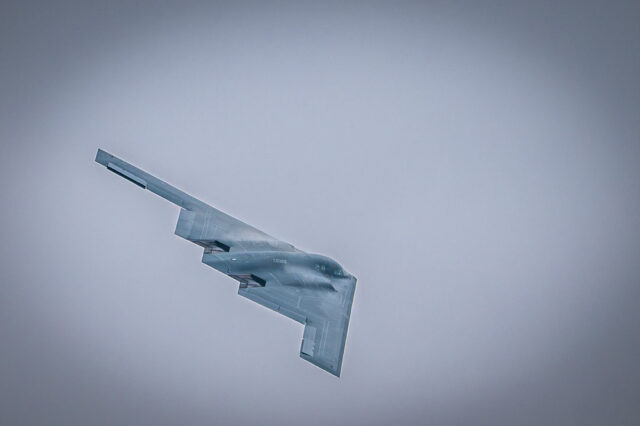
US Air Force B-2 Spirit bomber performs a fly-over during the Speed of Sound Airshow, at Rosecrans Air National Guard Base in St. Joseph, Missouri, US, Sept. 14, 2024. — US AIR NATIONAL GUARD/MASTER SGT. PATRICK EVENSON/HANDOUT VIA REUTERS

WASHINGTON — The US Air Force’s B-2 Spirit stealth bombers were involved in strikes on Iran’s nuclear sites on Saturday.

Three Iranian nuclear sites were struck in a “very successful attack,” President Donald J. Trump said on Saturday, adding that the crown jewel of Tehran’s nuclear program, Fordow, is gone.

The B-2 is one of America’s most advanced strategic weapons platforms, capable of entering sophisticated air defenses and delivering precision strikes against hardened targets such as Iran’s buried network of nuclear research facilities.

B-2 SPIRIT SPECIFICATIONS:
The US B-2 costs about $2.1 billion each, making it the most expensive military aircraft ever built. Made by Northrop Grumman, the bomber, with its cutting-edge stealth technology, began its production run in the late 1980s but was curbed by the fall of the Soviet Union. Only 21 were made after the Pentagon’s planned acquisition program was truncated.

The bomber’s range of over 6,000 nautical miles (11,112 kilometers) without refueling enables global strike capabilities from continental US bases. With aerial refueling, the B-2 can reach virtually any target worldwide, as demonstrated in missions from Missouri to Afghanistan and Libya and now Iran.

Its payload capacity of more than 40,000 pounds (18,144 kilograms) allows the aircraft to carry a diverse array of conventional and nuclear weapons. The bomber’s internal weapons bays are specifically designed to maintain stealth characteristics while accommodating large ordnance loads which could include two GBU-57A/B MOP (Massive Ordnance Penetrator), a 30,000-pound precision-guided “bunker-buster” bomb.

Reports said six bunker-buster bombs were used on Iran’s Fordow research site.

The B-2’s two-pilot crew configuration reduces personnel requirements while maintaining operational effectiveness through advanced automation systems.

The B-2’s stealth technology incorporates radar-absorbing materials and angular design features that minimize detection by enemy air defense systems. Its radar cross-section is reportedly comparable to that of a small bird, making it nearly invisible to conventional radar.

MASSIVE ORDNANCE PENETRATOR (MOP):
The 30,000-pound MOP represents the largest conventional bomb in the US arsenal, specifically engineered to defeat hardened underground bunkers. Its massive size requires the B-2 to carry only one or two MOPs per mission, but provides unmatched bunker-penetration capability.

The weapon’s 20.5-foot (6.25-meters) length and GPS-guided precision targeting system enable accurate strikes against specific underground facilities. Its penetration capability of over 200 feet through hardened concrete makes it effective against the world’s most protected underground installations.

CONVENTIONAL PAYLOADS:
Joint Direct Attack Munitions (JDAM) provide the B-2 with precision conventional strike capability against fixed targets. These GPS-guided weapons can be deployed in large numbers, with the bomber capable of simultaneously engaging multiple targets with high accuracy.

Joint Standoff Weapons (JSOW) extend the aircraft’s engagement range while maintaining stealth characteristics during approach. These glide bombs allow the B-2 to strike targets from outside heavily defended airspace perimeters.

Joint Air-to-Surface Standoff Missiles (JASSM) offer long-range precision strike capability with their own stealth features. The extended-range JASSM-ER variant provides strike options against targets over 500 miles (805 km) away.

NUCLEAR PAYLOAD CAPABILITIES:
The B-2 Spirit serves as a key component of America’s nuclear triad, capable of delivering strategic nuclear weapons with stealth and precision. The aircraft can carry up to 16 B83 nuclear bombs. — Reuters

Airlines keep avoiding Middle East airspace after US attack on Iran

STOCK PHOTO | Image from Pixabay

AIRLINES continued to avoid large parts of the Middle East on Sunday after US strikes on Iranian nuclear sites, according to flight tracking website FlightRadar24, with traffic already skirting airspace in the region due to recent missile exchanges.

“Following US attacks on Iranian nuclear facilities, commercial traffic in the region is operating as it has since new airspace restrictions were put into place last week,” FlightRadar24 said on social media platform X.

Its website showed airlines were not flying in the airspace over Iran, Iraq, Syria and Israel. They have chosen other routings such as north via the Caspian Sea or south via Egypt and Saudi Arabia, even if it results in higher fuel and crew costs and longer flight times.

Missile and drone barrages in an expanding number of conflict zones globally represent a high risk to airline traffic.

Since Israel launched strikes on Iran on June 13, carriers have suspended flights to destinations in the affected countries, though there have been some evacuation flights from neighboring nations and some bringing stranded Israelis home.

Israel’s two largest carriers, El Al Israel Airlines and Arkia, said on Sunday they were suspending rescue flights that allowed people to return to Israel until further notice. El Al said it would also extend its cancellation of scheduled flights through June 27.

Japan’s foreign ministry said on Sunday it had evacuated 21 people, including 16 Japanese nationals, from Iran overland to Azerbaijan. It said it was the second such evacuation since Thursday and that it would conduct further evacuations if necessary.

New Zealand’s government said on Sunday it would send a Hercules military transport plane to the Middle East on standby to evacuate New Zealanders from the region.

It said in a statement that government personnel and a C-130J Hercules aircraft would leave Auckland on Monday. The plane would take some days to reach the region, it said.

The government was also in talks with commercial airlines to assess how they may be able to assist, it added. — Reuters

Ukraine asks allies to allocate 0.25% of GDP to boost its weapon production

Army soldier figurines are displayed in front of the Ukrainian and Russian flag colors background in this illustration taken, Feb. 13, 2022. — REUTERS/DADO RUVIC/ILLUSTRATION

KYIV — President Volodymyr Zelensky has called on Ukraine’s Western partners to allocate 0.25% of their gross domestic product (GDP) to helping Kyiv ramp up weapons production and said the country plans to sign agreements this summer to start exporting weapon production technologies.

In remarks released for publication by his office on Saturday, Mr. Zelensky said Ukraine was in talks with Denmark, Norway, Germany, Canada, the United Kingdom, and Lithuania to launch joint weapon production.

“Ukraine is part of Europe’s security and we want 0.25% of the GDP of a particular partner country to be allocated for our defense industry and domestic production,” Mr. Zelensky said.

As the war with a bigger and better-equipped Russia has intensified in recent weeks, Ukraine’s need for new weapons and ammunition is constantly growing.

This year Kyiv had secured $43 billion to finance its domestic weapon production, Mr. Zelensky said.

Member nations of the NATO military alliance are expected to meet next week in The Hague, to discuss higher defense spending.

NATO Secretary General Mark Rutte has proposed that countries should each agree to spend 5% of their GDP on defense and security measures.

Mr. Zelensky said he was likely to visit the NATO summit, adding that several meetings with Western leaders had been set up on the sidelines. He also said that he hoped to meet US President Donald J. Trump.

Last week, Mr. Zelensky attended the Group of Seven summit in Canada as he sought to discuss stronger sanctions against Russia and more military support for Ukraine with Mr. Trump there.

But he failed to meet with the US President as Mr. Trump left a day early for Washington to address the Israel-Iran conflict.

Ukraine currently covers about 40% of its defense needs with domestic production, and the government is constantly looking for ways to increase production further.

Kyiv plans to launch joint weapon production outside of the country and will start exporting some of its military production technologies, Mr. Zelensky said.

“We have launched a program ‘Build with Ukraine’ and in summer we will sign relevant agreements to start exporting our technologies abroad in the format of opening production lines in European countries,” Mr. Zelensky said.

The discussions focused on producing different types of drones, missiles, and potentially artillery, he said. — Reuters

Israel under missile attack, Iran says all options open after US strikes

US, Israel and Iran flags are seen in this illustration taken June 18, 2025. — REUTERS/DADO RUVIC/ILLUSTRATION

JERUSALEM/WASHINGTON — Israel faced a missile attack on Sunday as Iran said it reserved all options to defend itself after unprecedented U.S. strikes that President Donald Trump said had “obliterated” its key nuclear facilities.

Hours after Trump dramatically escalated Middle East tensions by sending B-2 bombers to Iran, the Israeli military warned people to seek cover from a barrage that appeared heavier than the Iranian salvoes fired in the past few days.

“The events this morning are outrageous and will have everlasting consequences,” said Iranian Foreign Minister Abbas, calling the U.S. strikes a “grave violation” of the U.N. charter, international law and the nuclear Non-Proliferation Treaty.

“Iran reserves all options to defend its sovereignty, interest, and people,” Araqchi posted on X.

Iran’s Atomic Energy Organization said it would not allow development of its “national industry” to be stopped, and an Iranian state television commentator said every U.S. citizen or military member in the region would be legitimate targets.

Israel’s ambulance service said at least 16 people were hurt in the morning barrage.

Air raid sirens sounded across most of the country, sending millions of people to safe rooms and bomb shelters as explosions rang out and missile interceptions were seen above Jerusalem and in other parts of the country.

It was not immediately clear how many missiles had pierced Israel’s air defence systems, but police confirmed at least three impact sites in residential areas in central and northern Israel.

Video from Israel’s commercial hub Tel Aviv and the port city of Haifa further north showed rescue teams combing through debris, apartments reduced to rubble, mangled cars along a street filled with debris and medics evacuating injured people from a row of blown out houses.

Most airlines continued to avoid large parts of the Middle East after the U.S. strikes, according to flight tracking website FlightRadar24, with traffic already skirting airspace in the region due to recent missile exchanges.

TRUMP SAYS IRAN FACES ‘PEACE OR TRAGEDY’
Trump, in a televised address to the U.S. people, flanked by Vice President JD Vance, Defense Secretary Pete Hegseth and Secretary of State Marco Rubio, called the strikes a “spectacular military success” that had taken out Iran’s three principal nuclear sites: Natanz, Isfahan and Fordow.

He warned Tehran it would face more devastating attacks if it does not agree to peace.

After days of deliberation and long before his self-imposed two-week deadline, Trump’s decision to join Israel’s military campaign against its major rival Iran is the biggest foreign policy gamble of his two presidencies and one fraught with risks and unknowns.

The major escalation of armed conflict in the Middle East risks opening a new era of instability in the Middle East.

Trump said Iran’s future held “either peace or tragedy,” and there were many other targets that could be hit by the U.S. military. “If peace does not come quickly, we will go after those other targets with precision, speed and skill.”

The U.S. contacted Iran diplomatically on Saturday to say the strikes are all the U.S. plans and it does not aim for regime change, CBS News reported.

Trump told Fox News’ Sean Hannity show that six “bunker-buster” bombs were dropped on the deep-underground Fordow facility, while 30 Tomahawk missiles were fired against other nuclear sites. U.S. B-2 bombers were involved in the strikes, a U.S. official told Reuters, speaking on condition of anonymity.

Reuters had reported the movement of the B-2 bombers, which can be equipped to carry the massive bombs that experts say would be needed to strike Fordow, which is buried beneath a mountain south of Tehran. Given its fortification, it will likely be days, if not longer, before the impact of the strikes is known.

An Iranian official, cited by Tasnim news agency, confirmed part of the Fordow site was attacked by “enemy airstrikes.” However, Mohammad Manan Raisi, a lawmaker for Qom, near Fordow, told the semi-official Fars news agency the facility had not been seriously damaged.

A reporter from Iranian state media IRNA reporter said he had arrived near the Fordow site at 3 a.m. (2330 GMT on Saturday) and saw smoke that “seems to be related to air defences”. He quoted a nearby witness as reporting “six explosions were heard, but they said it wasn’t very loud.”

DIPLOMATIC FAILURE
The U.N. nuclear watchdog said no increases in off-site radiation levels had been reported after the U.S. strikes.

Hassan Abedini, deputy political head of Iran’s state broadcaster, said Iran had evacuated the three sites some time ago.

“The enriched uranium reserves had been transferred from the nuclear centres and there are no materials left there that, if targeted, would cause radiation and be harmful to our compatriots,” he told the channel.

Israeli Prime Minister Benjamin Netanyahu congratulated Trump on his “bold decision”, saying, “History will record that President Trump acted to deny the world’s most dangerous regime, the world’s most dangerous weapons.”

Israel and Iran have been engaged in more than a week of aerial combat that has resulted in deaths and injuries in both countries. Israel launched its attacks on June 13, saying Iran was on the verge of developing nuclear weapons.

Iran says its nuclear programme is for peaceful purposes only. Israel is widely assumed to possess nuclear weapons, which it neither confirms nor denies.

Diplomatic efforts by Western nations to stop the hostilities have so far failed. U.N. Secretary-General Antonio Guterres called the U.S. strikes a “dangerous escalation in a region already on the edge – and a direct threat to international peace and security.”

In the U.S., Democratic lawmakers and some from Trump’s Republican Party have argued that he must receive permission from Congress before committing the U.S. military to any combat against Iran.

At least 430 people have been killed and 3,500 injured in Iran since Israel began its attacks, Iranian state-run Nour News said, citing the health ministry.

In Israel, 24 civilians have been killed and 1,272 people injured, according to local authorities. — Reuters

Investors brace for oil price spike, rush to havens after US bombs Iran nuclear sites

MODELS of oil barrels and a pump jack are displayed in this illustration photo taken on Feb. 24, 2022. — REUTERS

NEW YORK — A US attack on Iranian nuclear sites could lead to a knee-jerk reaction in global markets when they reopen, sending oil prices higher and triggering a rush to safety, investors said, as they assessed how the latest escalation of tensions would ripple through the global economy.

The attack, which was announced by President Donald Trump on social media site Truth Social, deepens US involvement in the Middle East conflict. That was the question going into the weekend, when investors were mulling a host of different market scenarios.

In the immediate aftermath of the announcement, they expected the US involvement was likely to cause a selloff in equities and a possible bid for the dollar and other safe-haven assets when trading begins, but also said much uncertainty about the course of the conflict remained.

Trump called the attack “a spectacular military success” in a televised address to the nation and said Iran’s “key nuclear enrichment facilities have been completely and totally obliterated”. He said the US military could go after other targets in Iran if the country did not agree to peace.

“I think the markets are going to be initially alarmed, and I think oil will open higher,” said Mark Spindel, chief investment officer at Potomac River Capital.

“We don’t have any damage assessment and that will take some time. Even though he has described this as ‘done’, we’re engaged. What comes next?” Spindel said.

“I think the uncertainty is going to blanket the markets, as now Americans everywhere are going to be exposed. It’s going to raise uncertainty and volatility, particularly in oil,” he added.

Spindel, however, said there was time to digest the news before markets open and said he was making arrangements to talk to other market participants.

OIL PRICES, INFLATION
A key concern for markets would center around the potential impact of the developments in the Middle East on oil prices and thus on inflation. A rise in inflation could dampen consumer confidence and lessen the chance of near-term interest rate cuts.

“This adds a complicated new layer of risk that we’ll have to consider and pay attention to,” said Jack Ablin, chief investment officer of Cresset Capital. “This is definitely going to have an impact on energy prices and potentially on inflation as well.”

While global benchmark Brent crude futures have risen as much as 18% since June 10, hitting a near five-month high of $79.04 on Thursday, the S&P 500 has been little changed, following an initial drop when Israel launched its attacks on Iran on June 13.

Before the US attack on Saturday, analysts at Oxford Economics modeled three scenarios, including a de-escalation of the conflict, a complete shutdown in Iranian oil production and a closure of the Strait of Hormuz, “each with increasingly large impacts on global oil prices.”

In the most severe case, global oil prices jump to around $130 per barrel, driving US inflation near 6% by the end of this year, Oxford said in the note.

“Although the price shock inevitably dampens consumer spending because of the hit to real incomes, the scale of the rise in inflation and concerns about the potential for second-round inflation effects likely ruin any chance of rate cuts in the US this year,” Oxford said in the note, which was published before the US strikes.

In comments after the announcement on Saturday, Jamie Cox, managing partner at Harris Financial Group, agreed oil prices would likely spike on the initial news. But Cox said he expected prices to likely level in a few days as the attacks could lead Iran to seek a peace deal with Israel and the United States.

“With this demonstration of force and total annihilation of its nuclear capabilities, they’ve lost all of their leverage and will likely hit the escape button to a peace deal,” Cox said.

Economists warn that a dramatic rise in oil prices could damage a global economy already strained by Trump’s tariffs.

Still, any pullback in equities might be fleeting, history suggests. During past prominent instances of Middle East tensions coming to a boil, including the 2003 Iraq invasion and the 2019 attacks on Saudi oil facilities, stocks initially languished but soon recovered to trade higher in the months ahead.

On average, the S&P 500 slipped 0.3% in the three weeks following the start of conflict, but was 2.3% higher on average two months following the conflict, according to data from Wedbush Securities and CapIQ Pro.

DOLLAR WOES
An escalation in the conflict could have mixed implications for the US dollar, which has tumbled this year amid worries over diminished US exceptionalism.

In the event of US direct engagement in the Iran-Israel war, the dollar could initially benefit from a safety bid, analysts said.

“Do we see a flight to safety? That would signal yields going lower and the dollar getting stronger,” said Steve Sosnick, chief market strategist at IBKR in Greenwich, Connecticut. “It’s hard to imagine stocks not reacting negatively and the question is how much. It will depend on Iranian reaction and whether oil prices spike.” — Reuters

Panasonic Manufacturing Philippines Corp. to virtually convene stockholders for its Annual Meeting on July 18

PANASONIC MANUFACTURING PHILIPPINES CORPORATION

NOTICE OF ANNUAL STOCKHOLDERS’ MEETING

Notice is hereby given that the 2025 Annual Shareholders’ Meeting of PANASONIC MANUFACTURING PHILIPPINES CORPORATION (PMPC) will be held on July 18, 2025 (Friday) at 3:00 PM. The meeting will be conducted virtually via Microsoft Teams. Stockholders can therefore only attend the meeting by remote communication.

The following shall be the agenda of the meeting:

  1. National Anthem
  2. Call to Order
  3. Proof of Notice of the Annual Stockholders’ Meeting and Establishment of Quorum
  4. Approval of Minutes of July 19, 2024, Annual Stockholders’ Meeting
  5. President’s Annual Report
  6. Financial Reports
  7. Ratification of all acts, resolutions and proceedings of the Board of Directors and Management since 2024 Annual Stockholders’ Meeting
  8. Election of Directors
  9. Election of External Auditor
  10. Other Business
  11. Adjournment

The Board of Directors have fixed the close of business on June 27, 2025, as of the record date for the determination of stockholders entitled to notice of, to attend and vote at the said Annual Stockholders’ Meeting.

Stockholders who intend to participate or be represented in the virtual meeting shall first pre-register and submit the following requirements via email to asmregistration@ph.panasonic.com not later than July 15, 2025, subject to validation procedures to gain access to the secure on-line meeting link:

1. Individual Stockholders

i. Scanned copy of Stockholder’s valid and government-issued ID showing photo, signature and personal details, preferably with residential address.

ii. A valid and active email address and contact number.

2. Corporate Stockholders

i. A Secretary’s certificate attesting to the authority of the representative to participate by remote communication for, and on behalf of the Corporation.

ii. Scanned copy of Stockholder’s valid and government-issued ID showing photo, signature and personal details, preferably with residential address

iii. A valid and active email address and contact number

Once validated, the successful registrant will receive a confirmation and an electronic invitation via email with a complete guide on how to join the virtual meeting. For any registration concerns, you may get in touch with asmregistration@ph.panasonic.com care of Mr. Franciso Tolentino or go to https://www.panasonic.com/ph/corporate/profile/ir.html for reference and other details. A stockholder, who fails to comply with the registration requirement will not be able to participate in the virtual ASM.

Stockholders, who cannot join the virtual meeting may send their authorized representatives on their behalf. They may download, fill-out and sign the sample proxy form found in https://www.panasonic.com/ph/corporate/profile/ir.html and send a scanned copy to asmregistration@ph.panasonic.com not later than July 15, 2025.

Stockholders who provide their personal information shall be deemed to agree to the collection and processing of their personal information in accordance with Company’s privacy policy for its Regular Annual Stockholders’ Meeting posted on its website.

Electronic and relevant copies of the Notice of Meeting. Definitive Information Statement, and other related documents in connection with the meeting may be accessed through any of the following options:

  1. Go to the PMPC website via this link:
  2. Go to the PSE EDGE portal via https://edge.pse.com.ph/
  3. Request for a copy by sending an e-mail to: asmregistration@ph.panasonic.com

The Company shall entertain questions and comments from the stockholders only during discussion of other matters. Questions and comments must be submitted either in advance or during the meeting by e-mail to the Office of the Corporate Secretary at mzmlaw@yahoo.com. Questions, which will not be answered during the meeting shall be forwarded to the Office of the Corporate Secretary for the appropriate response.

Taytay, Rizal
13 June 2025

ATTY. MAMERTO Z. MONDRAGON

Corporate Secretary


Spotlight is BusinessWorld’s sponsored section that allows advertisers to amplify their brand and connect with BusinessWorld’s audience by publishing their stories on the BusinessWorld Web site. For more information, send an email to online@bworldonline.com.

Join us on Viber at https://bit.ly/3hv6bLA to get more updates and subscribe to BusinessWorld’s titles and get exclusive content through www.bworld-x.com.

Panasonic Manufacturing Philippines Corp. to virtually convene stockholders for its Annual Meeting on July 18

PANASONIC MANUFACTURING PHILIPPINES CORPORATION

NOTICE OF ANNUAL STOCKHOLDERS’ MEETING

Notice is hereby given that the 2025 Annual Shareholders’ Meeting of PANASONIC MANUFACTURING PHILIPPINES CORPORATION (PMPC) will be held on July 18, 2025 (Friday) at 3:00 PM. The meeting will be conducted virtually via Microsoft Teams. Stockholders can therefore only attend the meeting by remote communication.

The following shall be the agenda of the meeting:

  1. National Anthem
  2. Call to Order
  3. Proof of Notice of the Annual Stockholders’ Meeting and Establishment of Quorum
  4. Approval of Minutes of July 19, 2024, Annual Stockholders’ Meeting
  5. President’s Annual Report
  6. Financial Reports
  7. Ratification of all acts, resolutions and proceedings of the Board of Directors and Management since 2024 Annual Stockholders’ Meeting
  8. Election of Directors
  9. Election of External Auditor
  10. Other Business
  11. Adjournment

The Board of Directors have fixed the close of business on June 27, 2025, as of the record date for the determination of stockholders entitled to notice of, to attend and vote at the said Annual Stockholders’ Meeting.

Stockholders who intend to participate or be represented in the virtual meeting shall first pre-register and submit the following requirements via email to asmregistration@ph.panasonic.com not later than July 15, 2025, subject to validation procedures to gain access to the secure on-line meeting link:

1. Individual Stockholders

i. Scanned copy of Stockholder’s valid and government-issued ID showing photo, signature and personal details, preferably with residential address.

ii. A valid and active email address and contact number.

2. Corporate Stockholders

i. A Secretary’s certificate attesting to the authority of the representative to participate by remote communication for, and on behalf of the Corporation.

ii. Scanned copy of Stockholder’s valid and government-issued ID showing photo, signature and personal details, preferably with residential address

iii. A valid and active email address and contact number

Once validated, the successful registrant will receive a confirmation and an electronic invitation via email with a complete guide on how to join the virtual meeting. For any registration concerns, you may get in touch with asmregistration@ph.panasonic.com care of Mr. Franciso Tolentino or go to https://www.panasonic.com/ph/corporate/profile/ir.html for reference and other details. A stockholder, who fails to comply with the registration requirement will not be able to participate in the virtual ASM.

Stockholders, who cannot join the virtual meeting may send their authorized representatives on their behalf. They may download, fill-out and sign the sample proxy form found in https://www.panasonic.com/ph/corporate/profile/ir.html and send a scanned copy to asmregistration@ph.panasonic.com not later than July 15, 2025.

Stockholders who provide their personal information shall be deemed to agree to the collection and processing of their personal information in accordance with Company’s privacy policy for its Regular Annual Stockholders’ Meeting posted on its website.

Electronic and relevant copies of the Notice of Meeting. Definitive Information Statement, and other related documents in connection with the meeting may be accessed through any of the following options:

  1. Go to the PMPC website via this link:
  2. Go to the PSE EDGE portal via https://edge.pse.com.ph/
  3. Request for a copy by sending an e-mail to: asmregistration@ph.panasonic.com

The Company shall entertain questions and comments from the stockholders only during discussion of other matters. Questions and comments must be submitted either in advance or during the meeting by e-mail to the Office of the Corporate Secretary at mzmlaw@yahoo.com. Questions, which will not be answered during the meeting shall be forwarded to the Office of the Corporate Secretary for the appropriate response.

Taytay, Rizal
13 June 2025

ATTY. MAMERTO Z. MONDRAGON

Corporate Secretary


Spotlight is BusinessWorld’s sponsored section that allows advertisers to amplify their brand and connect with BusinessWorld’s audience by publishing their stories on the BusinessWorld Web site. For more information, send an email to online@bworldonline.com.

Join us on Viber at https://bit.ly/3hv6bLA to get more updates and subscribe to BusinessWorld’s titles and get exclusive content through www.bworld-x.com.

[B-SIDE Podcast] Beyond the hype: Building ethical AI for human flourishing

Follow us on Spotify BusinessWorld B-Side

“This B-Side episode delves into the world of AI and ethics with Carl M. Javier, chief AI ethicist and executive director of Data and AI Ethics PH. It explores how artificial intelligence, a technology disruptive in both good and bad ways, impacts human dignity.

While AI can worsen inequality – posing challenges for nations like the Philippines that still grapple with Internet access – making this technology “”more human”” depends on collective efforts to define humanity and build equitable systems.

Interview by Patricia Mirasol
Audio editing by Jayson Mariñas

Follow us on Spotify BusinessWorld B-Side

VIYLine MSME Caravan heads to SM City Fairview this June 18-24

Locally made goodies await you — discover your next favorite snack at the VIYLine MSME Caravan at SM City Fairview from June 18-24.

Quezon City, are you ready? From June 18 to 24, the VIYLine MSME Caravan is making its next big stop at SM City Fairview, bringing together some of the most exciting local brands in one dynamic celebration of Filipino entrepreneurship, creativity, and grit.

Following the success of its earlier legs in SM City Dasmariñas, SM City Bacoor, SM City San Pablo, SM City Santa Rosa, and SM City Calamba, the VIYLine MSME Caravan has been winning hearts — and carts — across the country. With each stop, the movement continues to shine a spotlight on micro, small, and medium enterprises (MSMEs) that represent the best of local innovation and style.

Support Filipino entrepreneurs and score your next wardrobe staple at the VIYLine MSME Caravan.

Organized by VIYline Group of Companies in partnership with SM Supermalls, this highly anticipated caravan gives MSMEs a platform to showcase their proudly Pinoy products — from beauty and skincare essentials, healthy snacks, fashion and lifestyle pieces, to charming home finds.

More than just a shopping destination, the VIYline MSME Caravan is a platform for discovery: of new favorites, of small business stories, and of the Filipino dream in action. With interactive booths, exclusive deals, and exciting surprises, this is the perfect place to support local and shop with purpose.

Spice up your meals with proudly Pinoy flavors, such as Cong TV’s King Sisig in a Jar: Pork BBQ and Lechon Sisig.

“SM remains committed to helping Filipino MSMEs thrive by giving them meaningful opportunities to grow in high-foot-traffic spaces,” said SM Supermalls Executive Vice-President for Marketing Jonjon San Agustin. “Through our collaboration with VIYline, we continue to create spaces where small businesses can shine and scale.”

So if you’re looking to explore new finds, meet local entrepreneurs, and celebrate Filipino talent, make sure to swing by the VIYline MSME Caravan at SM City Fairview from June 18 to 24.

The VIYLine MSME Caravan showcases exciting local brands and Filipino entrepreneurship.

Support local. Spark change. Be part of the VIYline MSME Caravan movement.

About SM Supermalls MSMEs

SM Supermalls, owned by SM Prime Holdings, is the leading mall developer and operator in the Philippines. As a staunch advocate for MSMEs, SM Supermalls is dedicated to helping Filipino entrepreneurs succeed. Join our thriving marketplace across 80+ malls nationwide. Visit msme.smsupermalls.com to download your MSME application or email us at customercare@smsupermalls.com with your most innovative product and preferred location. Don’t miss this opportunity to grow your business with SM Supermalls today!


Spotlight is BusinessWorld’s sponsored section that allows advertisers to amplify their brand and connect with BusinessWorld’s audience by publishing their stories on the BusinessWorld Web site. For more information, send an email to online@bworldonline.com.

Join us on Viber at https://bit.ly/3hv6bLA to get more updates and subscribe to BusinessWorld’s titles and get exclusive content through www.bworld-x.com.

Philippines to step in should peso weakness threaten prices

BW FILE PHOTO

Philippine central bank Governor Eli M. Remolona Jr. said authorities are prepared to intervene more strongly in the foreign-exchange market should the decline in the peso threaten inflation.

“The effect of the exchange rate on inflation depends on how big the depreciation is, and we have estimates of that threshold,” Mr. Remolona said in an interview with CNBC on Friday. “We would come in somewhat more forcefully than before” once such threshold is breached, he said.

While Mr. Remolona reiterated his comments this week that it would be futile to step in to defend the peso in the face of the dollar’s strength, he is also outlining the limit of the central bank’s tolerance for weakness in the currency.

“We do worry about the peso weakening too much; at some point it becomes inflationary,” the Bangko Sentral ng Pilipinas (BSP) governor said.

The peso slid about 2.6% this month, the worst performer in emerging markets, as higher oil prices fueled by the Israel-Iran tensions weighed on sentiment. The Philippines imports almost all of its oil requirement, making the currency vulnerable to rising energy costs globally.

The peso rose 0.5% to 57.15 per dollar on Friday, snapping eight days of losses. — Bloomberg

UK eyes to double bilateral trade with Philippines

REUTERS

By Justine Irish D. Tabile, Reporter

United Kingdom (UK) Trade Envoy George Freeman MP said that he is looking to identify deep partnership areas that could help double bilateral trade in the next three to four years.

“Over the next three or four years, I am looking to identify some strategic projects and deep partnership areas that we could develop,” Mr. Freeman told reporters in a roundtable discussion on Friday.

“There are a few areas that I am keen to explore. But by deepening and having a strategic partnership, I think that three billion number, I would like to increase that substantially over the next three or four years,” he added.

Bilateral trade between the Philippines and the UK reached an all-time high last year of 3 billion pounds.

Mr. Freeman is in the Philippines for a three-day mission to meet business leaders and government officials.

Asked if it is possible to double the bilateral trade in the next three to four years, he said, “Yes, is basically the answer. And this is really the point I was making about strategic partnerships.”

“If we develop a partnership around the digital economy, cybersecurity, tackling fraud, and giving Filipinos access to secure online trading, that alone, over the next five or ten years, if we are serious about it, can bring in a lot more UK investment into the Philippines,” he added.

He said that such fundamental and structural partnerships create a growth engine of their own.

In 2024, the Philippines ended at a surplus in terms of trade with the UK, exporting approximately 1.8 billion pounds.

Lindsey Gilbert-Crouch, director of trade and investment at the British Embassy Manila, said that the food industry is among the potential areas for growth in terms of Philippine exports to the UK.

“People in the UK are becoming ever more health conscious, and there is a lot of food in the Philippines that is incredibly in demand in the UK,” she said.

“So, I am thinking coconuts and coconut products, mangoes, dried fruits in particular, bananas, but really fruits and vegetables, particularly dried products, are a really key growth area,” she added.

She also said that there is also demand for Filipino artisanal products.

“They do not want fast fashion; they do not want mass-produced stuff. And this is something where Filipinos are incredibly talented,” she said.

“The most beautiful products are produced here, leather goods and other things in that area,” she added.

ADVERTISEMENT
ADVERTISEMENT