Home Blog Page 1370

Small businesses told to learn TikTok recommendation engine

MICRO, SMALL and medium enterprises (MSMEs) seeking to reach more customers should familiarize themselves with social media recommendation systems, according to TikTok.

Franco S. Aligaen, marketing lead for TikTok Shop, said they have a unique recommendation system that allows new sellers to be discovered by customers. He added that businesses with a basic understanding of how platform recommendations work could gain an edge.

“Knowing how content is recommended allows businesses to create posts that align with TikTok’s discovery system, increasing their chances of reaching a broader audience,” Mr. Aligaen said.

A social media recommendation system is an algorithm that curates content based on user interactions, preferences and engagement.

During a site visit to TikTok’s Transparency and Accountability Center in Singapore on Feb. 19, company officials shared insights into its For You Page (FYP), the platform’s main recommendation engine.

TikTok noted that while the FYP tailors content based on users’ previous engagements, it also diversifies the feed by introducing content from new or existing creators and sellers.

MSMEs can enhance their visibility on the FYP by creating high-quality, engaging and authentic content, Mr. Aligaen said.

This can include product demonstrations, behind-the-scenes content and customer testimonials to build trust and credibility.

Livestreaming also serves as a powerful tool for product discovery because its interactive nature fosters stronger customer connections, potentially driving higher conversion rates, he added.

“Sellers who go live regularly tend to gain more visibility because live sessions encourage direct engagement through comments and purchases,” he said.

Participating in TikTok Shop campaigns and seasonal sales also promises to improve sellers’ visibility.

TikTok Shop also offers sellers analytic tools like the ACE Indicator System, Mr. Aligaen said, where “sellers can identify trends, optimize their approach and focus on content that resonates most with their audience.”

To help MSMEs navigate the platform, TikTok Shop offers educational resources like the TikTok Shop Academy.

It has also partnered with the Department of Trade and Industry for workshops and training sessions, helping sellers optimize their TikTok Shop performance and refine their marketing strategies. — Edg Adrian A. Ava

Fed to deliver rapid-fire rate cuts if economic downturn happens, traders bet

REUTERS

THE US Federal Reserve won’t lower interest rates at its policy meeting next week, but could deliver the first of a set of rapid-fire reductions in borrowing costs in June if rising fears of an economic downturn triggered by a trade war materialize.

At least that’s where the betting is in futures markets, where contracts that settle to the Fed’s policy rate were increasingly priced for quarter-percentage-point reductions in June, July and October following US President Donald J. Trump’s remarks last weekend about a “period of transition” as he ratchets up tariffs on China, Canada and Mexico. US stocks and Treasury yields also dropped on Monday on concern that his comments signaled a coming recession.

Fed Chair Jerome H. Powell on Friday said the US central bank is in no rush to cut rates, with the labor market still strong, inflation on a bumpy path toward the US central bank’s 2% goal, and uncertainty high over the effect of Trump’s trade, fiscal, immigration and regulatory policies.

Economists say those policies could drive prices higher and slow the economy at least in the near term. Goldman Sachs economists on Monday cut their US growth forecast to 1.7%, and raised their inflation forecast. Such a scenario could force the Fed to make a tough choice between keeping pressure on inflation by leaving its policy rate in the current 4.25%-4.5% range or cutting rates to cushion the labor market against deterioration.

While markets are betting on the latter approach, some economists see the Fed slow-walking rate cuts to keep tariff-inflated prices from stoking household and business inflation expectations, which could deepen the chance of persistently high actual inflation.

“Despite a calm exterior, (Fed policy makers) grow increasingly anxious about the rising risks to both sides of the mandate and the institution’s ability to resist pressure from US President Donald J. Trump to cut rates should the labor or financial markets begin to slide before the Fed can gauge the inflationary impacts of not just tariffs, but the entire Trump agenda,” Tim Duy, chief US economist at SGH Macro Advisors, wrote in a note. “A slow-to-react Fed will draw the ire of the Trump administration.”

The Fed has kept its policy rate unchanged this year after cutting it by a full percentage point in 2024. Policy makers will have more data to sift through this week, with a report on job openings due on Tuesday and the release of the consumer price index for February on Wednesday. Reuters

AI in the 2025 Philippine Elections: A game-changer for campaigns and a tool for political warfare

As the Philippines gears up for the upcoming elections in May, artificial intelligence (AI) is set to play a defining role in shaping public perception, influencing voter behavior, and revolutionizing campaign strategies. While AI offers a powerful advantage for candidates to streamline operations, enhance voter engagement, and analyze public sentiment, it also presents a darker side — one that includes deepfake videos, misinformation, and AI-generated attacks aimed at discrediting political opponents. The country must brace for both the promise and the perils of AI-driven electioneering.

AI has already reshaped political campaigns globally, and the Philippines is no exception. The ability to process vast amounts of data in real time has enabled AI-driven strategies that personalize voter outreach, predict electoral trends, and optimize resource allocation. Political campaigns can now use AI to analyze social media activity, survey data, and online sentiment to craft highly targeted messages for different voter segments. AI algorithms can predict voter concerns based on location, demographic profile, and browsing habits, allowing candidates to tailor their speeches, ads, and social media engagement accordingly. In the United States, political campaigns have used AI-powered tools like Cambridge Analytica (notorious for its role in the 2016 elections) to influence voter preferences through microtargeting. In the Philippines, similar strategies have already been deployed since the last two national elections, turning our social media pages into a political battlefield.

AI-driven tools are also making voter engagement more efficient. Chatbots can respond to voter inquiries, simulate human-like conversations, and reinforce campaign messages around the clock. Generative AI tools can draft speeches, create slogans, and even produce campaign visuals at scale, reducing the time and effort required for traditional content creation. During the 2020 US elections, AI was widely used in social media outreach, with tools like Persuasion AI helping candidates tailor persuasive messaging for undecided voters. AI can also monitor public opinion in real time, scanning social media platforms, news articles, and forums for mentions of a candidate or campaign. If a controversy or negative sentiment spikes, AI-powered tools can provide instant analysis, helping campaign teams craft rapid responses to control the narrative. In India, political parties have used AI-based analytics to predict voter reactions and fine-tune their messaging before it goes live, ensuring minimal backlash.

While AI can enhance political campaigns, it is a double-edged sword. The same tools that optimize messaging and engagement can be weaponized to mislead, manipulate, and discredit political opponents. Deepfake videos — where a politician’s likeness and voice are manipulated to say or do things they never did — have already been used in elections in the United States and Europe. In the Philippines, where social media is a major battleground for political narratives, deepfakes can be used to fabricate scandalous remarks, false endorsements, or staged incidents. A notorious example was the 2020 US election, where deepfake technology was used to manipulate videos of both Joe Biden and Donald Trump, casting doubt on the authenticity of campaign messages.

AI-generated disinformation campaigns are another emerging threat. AI can mass-produce fake news articles, misleading images, and false narratives, which are then spread across social media to create confusion and sway public opinion. Automated bots can flood comment sections, amplifying false narratives while drowning out opposing views. In Brazil’s 2022 elections, AI-generated fake news campaigns spread on WhatsApp targeted voters with misleading information about candidates, influencing voter perception. The Philippines, with its high social media penetration, is at risk of similar tactics. While I have seen various AI videos bashing certain candidates on TikTok, I have yet to see fake ones discrediting a candidate during this election.

Another risk lies in the manipulation of search results and social media algorithms. AI-powered algorithms determine which news articles, videos, and posts appear in search results and recommendations. Political groups with the resources to exploit these algorithms can use AI to push favorable content while burying damaging news about their candidates. In past elections in India and the US, algorithmic manipulation has been used to promote partisan narratives, making it difficult for voters to access objective information.

The upcoming elections in the Philippines will likely see both the positive and negative applications of AI at play. With a digital-savvy population and a history of social media-driven campaigns, the country is particularly susceptible to AI-fueled election tactics. The Commission on Elections (Comelec) has yet to establish strict guidelines on the use of AI in campaigns, particularly in identifying and banning deepfake content. Fact-checking initiatives and partnerships with tech companies should be strengthened to detect AI-generated disinformation early.

Voters must also be educated on how AI can be used to deceive or manipulate political narratives. Public awareness campaigns can help Filipinos critically evaluate online content, especially during the election period. Political parties should be transparent about their use of AI in campaigns and commit to ethical AI-driven strategies. Independent watchdogs and cybersecurity experts should be engaged to monitor the use of AI in election propaganda.

AI is here to stay, and its role in elections will only grow stronger in the coming years. While it offers unprecedented opportunities to engage voters and streamline campaign efforts, its misuse can erode trust in democracy and fuel misinformation. Philippine politicians, regulators, and the public must work together to harness AI’s potential while safeguarding against its darker applications.

As May approaches, candidates who strategically and ethically leverage AI will have a competitive edge. However, the real test will be in ensuring that AI is used to inform and empower voters, rather than mislead and manipulate them. The challenge is clear: will AI elevate Philippine democracy, or will it be used to distort it? The answer depends on how we all act now, and the actions this year will serve as a springboard for the bigger 2028 presidential race.


Dr. Donald Lim is the founding president of the Global AI Council Philippines and the Blockchain Council of the Philippines, and the founding chair of the Cybersecurity Council, whose mission is to advocate the right use of emerging technologies to propel business organizations forward. He is currently the president and COO of DITO CME Holdings Corp.

NTC wants SIM registrants to show up in person

PHILSTAR FILE PHOTO

THE National Telecommunications Commission (NTC) is considering requiring personal appearance for SIM registration under the Subscriber Identity Module (SIM) Registration Act, which has been in effect for over two years since its implementation in December 2022.

This is part of NTC’s planned comprehensive review to amend the current online registration process under the SIM Registration Act, or Republic Act No. 11934.   

The proposal will be similar to the requirements for driver’s licenses and National Bureau of Investigation (NBI) clearance applications, the NTC said in a statement on Tuesday.

“The NTC remains committed to effectively implement the SIM Registration Act and achieve the declared objectives of the law.”

This follows rising concerns over fake identities and individuals selling their identities for potential illegal use, NTC said, adding that the proposal would also enhance security in the registration process.   

Currently, SIM card registration only requires individuals to take a photo, submit a government-issued identification card, and provide personal information.   

This process has been exploited by scammers, with some individuals selling their identities despite the existing penalties of imprisonment for two to six years and fines of up to P300,000.   

Last year, NTC proposed amendments to the SIM Registration Act to Congress. The commission sought provisions granting NTC the authority to regulate the number of SIMs an individual can own and the possibility of limiting valid government-issued ID cards.   

Additionally, NTC is recommending a provision mandating agencies responsible for issuing government-issued IDs to develop a validation platform accessible to public telecommunications entities (PTEs).   

In 2024, PTEs blocked 3.34 million scam messages and deactivated 3.12 million SIM cards, contributing to the overall reduction of text scams and SIM fraud.   

The SIM Registration Act requires mobile phone users to register their SIMs under their names or risk deactivation to deter text scams and other mobile phone-related crimes.   

For Terry L. Ridon, convenor of think tank InfraWatch, NTC’s proposal will severely limit the expansion of telecommunications companies, as personal appearance may be too cumbersome, particularly for minors, senior citizens, and persons with disabilities.   

“The onus to combat text and online fraud should rest mainly on the government and telcos, not end-users,” Mr. Ridon said in a Viber message.   

Digital Pinoys national campaigner Ronald B. Gustilo said the proposal would burden Filipinos, especially those in rural areas or those with limited mobility.   

“The SIM registration system should be able to detect registration attempts that may be considered questionable, such as mass registrations from a single device or location or the use of falsified identification cards,” he said. — Ashley Erika O. Jose

South Korean singer Wheesung found dead at home — Yonhap

EN.WIKIPEDIA.ORG

SEOUL — South Korean singer Wheesung has been found dead, Yonhap News reported citing police on Monday.

The 43-year-old’s body was discovered at his home in Seoul, less than a month after actress Kim Sae-ron was found dead after her career had taken a hit following a drunk driving incident in 2022.

Police were not immediately available for comment.

The singer’s management agency, Tajo Entertainment, issued a statement confirming his death. “We are deeply sorry to deliver such heartbreaking and tragic news,” said the statement. “On March 10th, our artist Wheesung has left us. He was found in cardiac arrest at his home in Seoul and was later pronounced deceased.”

The statement continued: “His bereaved family, fellow artists, and staff at Tajo Entertainment are all mourning this sudden and painful loss with heavy hearts.” — Reuters

Four H Handicraft empowers Ifugao women

FACEBOOK.COM/4HHANDICRAFT

FOUR H HANDICRAFT, a Nueva Vizcaya-based business, is empowering local women from the Ifugao ethnic group by involving them in the production of its handicrafts.

More than 20 Ifugao women including students are earning from the comfort of their homes by making kitchenware, furniture and other accessories.

“We call them partners and some of the people we work with are single moms and female senior citizens,” Honey Mae B. Cabbigat, head of sales and marketing at Four H Handicraft told BusinessWorld in Filipino.

The Philippines is the second-biggest producer of handicrafts in the world, mainly baskets made from indigenous materials, according to a 2019 study by De La Salle University. It has earned the respect of high-end markets in the US, European Union and Japan, it said.

Ms. Cabbigat, daughter of the owners who also have Ifugao roots, said they are partnering with the ethnic group, especially women, to help them take an active role in improving their lot. They want to get rid of the traditional role of women doing only housework, she added.

She said having a job would help single mothers whose husbands don’t earn much. It would also boost their confidence.

Making handicrafts has become the main source of livelihood for these single moms in the village of Abuyo in Alfonso Castañeda, Nueva Vizcaya, Ms. Cabbigat said, adding that they seek to train more Ifugao women.

Since 2002, Four H Handicraft has been harnessing the talent of Ifugao people in handicrafts, selling their creations primarily at bazaars and trade fairs across the Philippines.

But like most businesses, the company was affected by lockdowns during the global coronavirus pandemic.

The business is now recovering with the support of the Trade department, which organizes bazaars and trade fairs and helps MSMEs adopt digital payment systems.

Recently, Four H Handicraft participated in the International Women’s Bazaar at Farmers Plaza in Cubao, Quezon City, as well as at a community bazaar in SM Manila.

Ms. Cabbigat said she seeks to establish a permanent store location in Metro Manila in the next three to five years, since many of their customers come from the capital region and its nearby provinces. — Edg Adrian A. Ava

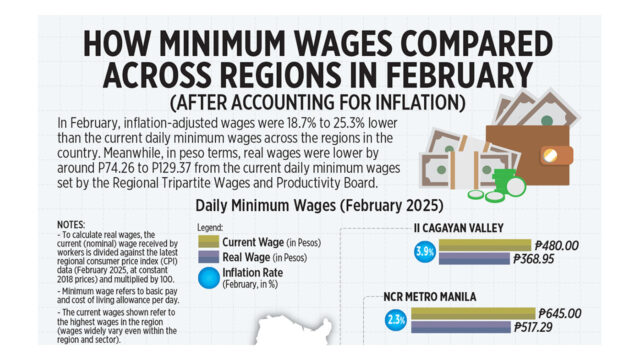
How minimum wages compared across regions in February

(After accounting for inflation)

In February, inflation-adjusted wages were 18.7% to 25.3% lower than the current daily minimum wages across the regions in the country. Meanwhile, in peso terms, real wages were lower by around P74.26 to P129.37 from the current daily minimum wages set by the Regional Tripartite Wages and Productivity Board.

How minimum wages compared across regions in February

How PSEi member stocks performed — March 11, 2025

Here’s a quick glance at how PSEi stocks fared on Tuesday, March 11, 2025.


Philippines’ Duterte arrested at ICC’s request over drug war-related killings

RODRIGO DUTERTE — PRESIDENTIAL PHOTO/ ROBINSON NIÑAL

By John Victor D. Ordoñez, Chloe Mari A. Hufana and Kenneth Christiane L. Basilio, Reporters

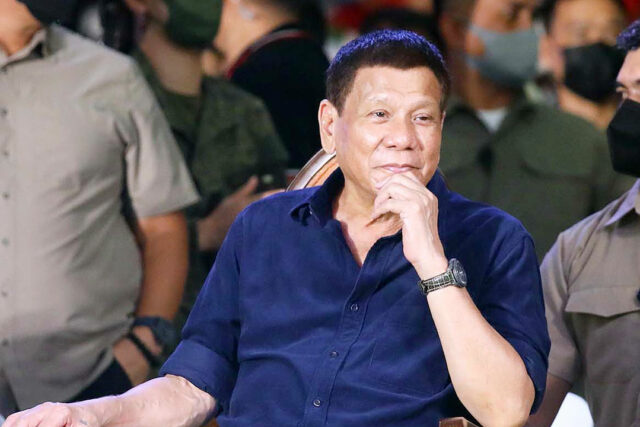
Philippine police arrested firebrand former President Rodrigo R. Duterte on Tuesday at the request of the International Criminal Court (ICC), a major step in the world body’s investigation into thousands of killings in a bloody “war on drugs” that defined his presidency. 

Mr. Duterte, the maverick former mayor who led the Philippines from 2016 to 2022, was served an arrest warrant on arrival from Hong Kong at Manila’s main airport and was now in custody, the office of his successor Ferdinand R. Marcos, Jr said in a statement. 

The tough-talking leader was taken to a chartered plane en route to the Hague later in the evening, his lawyer Israelito P. Torreon told reporters at the Supreme Court. 

Mr. Torreon earlier in the day asked the high court on behalf of Senator Ronald M. Dela Rosa — the national police chief who enforced the drug war — to stop the Marcos government from cooperating with the ICC, including the enforcement of Mr. Duterte’s arrest.  

The high court had raffled off the case, it said in a statement, without saying which division of the court would handle the lawsuit. 

The International Criminal Police Organization’s (Interpol) office in the Philippines got a copy of the ICC arrest warrant early Tuesday, and local police enforced it, the presidential palace said. 

The war on drugs was Mr. Duterte’s signature campaign platform that swept the mercurial, crime-busting former prosecutor to power in 2016, and he soon delivered on promises made during vitriolic speeches to kill thousands of drug dealers and users. 

If transferred to the Hague, he could become Asia’s first former head of state to go on trial at the ICC. 

The ICC has been investigating the ex-President for alleged crimes against humanity that he allegedly committed when he was Davao City mayor and during the first three years of his government, when the Philippines was still a party to the international tribunal. 

Mr. Duterte, 79, unilaterally withdrew the Philippines from the ICC’s founding treaty in 2019 when it started looking into allegations of systematic extrajudicial killings. 

Mr. Duterte has insisted he told police to kill only in self-defense and has repeatedly defended the crackdown, saying he was willing to “rot in jail” if it meant ridding the Philippines of illegal drugs. 

In a video posted on Instagram by daughter Veronica Duterte from Manila’s Villamor Air Base, where he was placed in custody, the former leader questioned the reason for his arrest. 

“What is the law and what is the crime that I committed?” he said in the video. It was unclear who he was talking to. “I was brought here not of my own volition, it is somebody else’s. You have to answer now for the deprivation of liberty.” 

In a 15-page warrant issued by the ICC Pre-Trial Chamber I on March 7, Presiding Judge Iulia Antoanella Motoc said at least 19 drug suspects were killed by members of the Davao Death Squad around Davao City when Mr. Duterte was still the mayor. 

The chamber also alleged that at least 24 drug suspects were killed by or under the supervision of members of Philippine law enforcers, sometimes with the help of people who were not part of the police, in various places across the Philippines. 


‘BLATANT AFFRONT’ 

“It’s an unlawful arrest,” Salvador S. Panelo, Mr. Duterte’s legal counsel, said in a statement. “The Philippine National Police didn’t allow one of his lawyers to meet him at the airport to question the legal basis for President Duterte’s arrest.” 

Human Rights Watch urged the Philippine government to immediately hand over Mr. Duterte to the ICC following his arrest at the Ninoy Aquino International Airport. “The Marcos government should swiftly surrender him to the ICC,” it said in a statement. 

Vice-President Sara Duterte-Carpio in a statement said the government’s surrender of his father to foreign powers is a “blatant affront to our sovereignty and an insult to every Filipino who believes in our nation’s independence.” 

She also said her father was being denied his fundamental rights. “Since he was taken this morning, he has not been brought before any competent judicial authority to assert his rights and to allow him to avail himself of reliefs provided by law.” 

“As I write this, he is being forcibly taken to the Hague tonight. This is not justice — this is oppression and persecution,” she added. 

The Armed Forces of the Philippines (AFP) said it was prepared to maintain national security and stability after Mr. Duterte’s arrest. It is ready to act on national security concerns, such as destabilization plots, military spokeswoman Francel Margareth Padilla-Taborlupa told a news briefing. 

According to police, 6,200 suspects were killed during anti-drug operations that they say ended in shootouts. But activists say the real toll of Duterte’s crackdown was far greater, with many thousands more slumland drug users, some named on community “watch lists,” killed in mysterious circumstances. 

The ICC’s prosecutor has said as many as 30,000 people may have been killed by police or unidentified people. 

Police have rejected allegations by human rights groups of systematic executions and cover-ups. 

Mr. Duterte’s arrest follows years of him rebuking and taunting the ICC since Philippine withdrawal from the tribunal. 

The Philippines had refused to cooperate, but the Marcos government changed tack in November and started signaling it would comply if an arrest warrant was issued. That came just hours after remarks by Mr. Duterte in a legislative enquiry when he urged the ICC to “hurry up” with its investigation. 

“I am already old; I might die soon. You might miss the pleasure of seeing me standing before the court hearing the judgment whatever it is,” he said at the time, adding that he assumed full responsibility for what happened. 


‘TRUE JUSTICE’ 

News outlets earlier on Tuesday showed video footage of Mr. Duterte dressed in a jacket and striped polo shirt and walking casually through a corridor at the airport upon his return from Hong Kong with several police officers behind him. 

Human rights groups said the arrest was a key step toward accountability for the killings of thousands of people in the Philippines. 

Randy delos Santos, the uncle of a high school student Kian delos Santos, whose killing by police captured national attention, called the arrest “true justice.” “At least he is given the chance to defend his side, unlike the victims of his war on drugs.” 

Leila M. de Lima, a former senator who was jailed for seven years months after she led an investigation into the drug killings, said the victims’ families had fought courageously for justice. 

“This is how justice should work — those in power must be held to the same standards as everyone else,” she said in a statement. “Duterte is being made to answer — not to me, but to the victims, to their families, to a world that refuses to forget.” 

“I’m expecting the Duterte camp to use his arrest to mobilize their supporters,” Arjan P. Aguirre, who teaches political science at the Ateneo de Manila University, said in a Facebook Messenger chat. “In the coming days, key figures allied with Duterte will try to influence the public and convince them to protest.” 

His supporters could paint him as a “political martyr,” Anthony Lawrence A. Borja, an associate political science professor at De La Salle University, said via Messenger chat. 

The Duterte camp would likely frame his arrest as political persecution, linking it to their deepening feud with the Marcoses, said Jean S. Encinas-Franco, a University of the Philippines political science professor. 

Mr. Duterte’s arrest is a step toward attaining justice for victims of his bloody drug war, House of Representatives Senior Deputy Speaker and Pampanga Rep. Aurelio D. Gonzales, Jr. said in a statement. 

“The arrest will also begin correcting our damaged institutions and weaponized policies against the perceived enemies of the government,” Gary D. Ador Dionisio, dean of the De La Salle College of Saint Benilde School of Diplomacy and Governance said in a Facebook Messenger chat. 

The Philippines should consider rejoining the ICC, Bataan Rep. Geraldine B. Roman told a news briefing. “We unilaterally withdrew from the ICC. I think it’s about time we rejoin and show the world that this nation respects both our laws and international law.” — with Reuters 

FACTBOX: What happened in drug war that led to Duterte’s arrest by law enforcers?

PHILSTAR FILE PHOTO

FORMER Philippine President Rodrigo Duterte was arrested and taken into custody on Tuesday in Manila on an International Criminal Court warrant for the “war on drugs” that defined his term in office and which killed thousands of Filipinos.

Here are some facts about the drug war during his presidency from 2016 to 2022:

CAMPAIGN VOWS TO ‘KILL’
As longtime mayor of the southern Philippine city of Davao, Rodrigo Duterte was known as “the punisher” for his harsh policies. His profanity-packed speeches and death threats to drug gangs were a feature of his successful campaign for the presidency in 2016.

Among his statements during the campaign were: “Forget the laws on human rights. If I make it to the presidential palace, I will do just what I did as mayor. You drug pushers, hold-up men and do-nothings, you better go out. Because I’d kill you.”

He said his campaign in Davao kept citizens safe from crime.  “I say let’s kill five criminals every week, so they will be eliminated,” he told Reuters.

NATIONWIDE ROLLOUT
It did not take long for the same kind of police crackdowns to be implemented nationwide.

By the end of 2016, Mr. Duterte’s war on drugs was well under way across the nation, and the body count was setting records.

Police killed more than 2,000 people in the months after he was inaugurated on June 30 until the end of the year. Most of the deaths were described as shootouts.

Human rights monitors believed many were carried out by vigilantes with official sanction and said the true figure of deaths was much higher, both accusations that the government denied.

The crackdown and death toll did not dent Mr. Duterte’s popularity.

An opinion poll published by the Social Weather Stations research agency in December 2016 showed 77% of Filipinos were satisfied with his performance.

FINAL TOLL
By the time Mr. Duterte left office in 2022, the drug war’s official toll had at least tripled. Police said 6,200 suspects were killed during anti-drug operations.

The Philippine government has officially acknowledged 6,248 deaths due to the anti-drug campaign.

But activists say the real toll of the crackdown was far greater, with thousands of urban and poor drug users, many placed on official “watch lists,” killed in mysterious circumstances.

Mr. Duterte was unapologetic in his defense of his campaign and says he told police to kill only in self-defense.

Families of some of those killed and human rights advocates later exhumed bodies, sometimes accompanied by Reuters journalists, and compared the remains with death certificates and official reports.

Dozens of cases showed violent deaths where the death certificates listed natural causes. In one case, the death certificate listed pneumonia as the cause of death, although the exhumed body had a bullet hole in the skull.

ICC PROBE
In February 2018, the ICC prosecutor’s office said it would conduct a preliminary investigation into deaths in the Philippines.

Barely a month later, Mr. Duterte said he would withdraw from the ICC. The exit took effect in March 2019.

The ICC investigation was suspended in 2021 after the Philippines claimed it had a functioning judicial system capable of investigating and prosecuting alleged abuses.

However, in 2023, the ICC investigation was reactivated after the court said it was unsatisfied with Philippine efforts.

The government of President Ferdinand R. Marcos, Jr. initially said it would not cooperate with the ICC, but said in late 2024 it would comply with any arrest warrant, and its Justice chief told Reuters in January the government was open to cooperate with the international body. — Reuters

Climate-resilient PHL schools sought amid heatwave

Students attend a class at the Commonwealth High School, in Quezon City, Metro Manila, April 18, 2024. — REUTERS

A PHILIPPINE senator on Tuesday urged the Department of Education and local governments to increase investments in climate-resilient infrastructure amid the suspension of classes due to high heat.

“I am reiterating the need to make our basic education sector more resilient,” Senator Sherwin T. Gatchalian said in a statement. “This requires investing in climate-resilient infrastructure, accelerating digital transformation, and ensuring the readiness of our teachers and learners to utilize alternative delivery modes.”

Last week, local government units in the National Capital Region and surrounding provinces suspended classes at all levels due to an expected heatwave.

The Philippine Atmospheric, Geophysical and Astronomical Services Administration (PAGASA) in an advisory issued on March 3 said Metro Manila was set to experience heat of up to 46°C, within the state weather bureau’s “danger level.”

“I recognize the concerns of our teachers on how the suspension of in-person classes due to extreme heat could further aggravate learning loss,” Mr. Gatchalian said. “While we should uphold the safety of learners, we should also make sure that learning outcomes are being achieved.”

He said local governments and schools should be proactive and agile in changing schedules or transitioning to the use of alternative teaching modes.

He also called on schools to have proper ventilation, cooling systems and water or hydration stations in place in cases of extreme heat.

“Suspending in-person classes due to extreme heat will be a recurring problem every year,” the lawmaker said. “We cannot just be business as usual in ensuring that education continues amidst increasing heat and disasters.”

Meanwhile, the Second Congressional Commission on Education (EDCOM-2) and Teacher Education Council are seeking better training for teachers to produce “highly qualified educators” and promote “continuous professional development and learning.”

“This involves providing initial training that equips teachers with the necessary knowledge and skills, as well as ongoing professional development opportunities that allow them to stay up to date on the latest research and best practices,” Jennie Jocson, executive director of the council, said in a statement posted on the Senate website.

“Additionally, we need to create a culture of learning within the teaching profession, where teachers are encouraged to reflect on their practice and continuously improve their skills,” she said.

EDCOM-2 Executive Director Karol Mark Yee said the commission had provided a roadmap for reforming teacher education and ensuring that it is aligned with student needs.

“With the Teacher Education Council operationalized, we are positioned better than ever to make significant changes to the preservice and in-service training of our teachers,” she added.

EDCOM-2 and the council are among the various education agencies crafting the national education plan, which seeks to tackle the Philippines’ learning crisis. — Adrian H. Halili

Reforms, crackdown pushed after bullet-planting incident

REUTERS

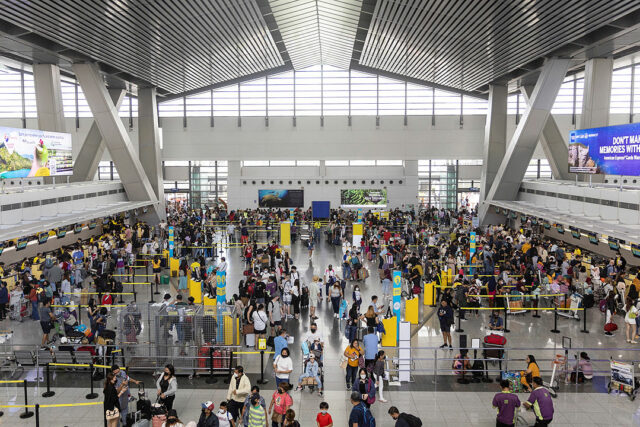
LAWMAKERS asked the Department of Transportation (DoTr) to introduce reforms and conduct a “top-to-bottom” crackdown on airport security personnel after the bullet-planting scheme in the country’s main gateway.

The DoTr’s Office for Transportation Security (OTS) should regularize thousands of its manpower, especially those involved with passenger screening to deter extortion schemes, such as bullet planting, Party-list Rep. Raymond Democrito C. Mendoza said in a statement on Tuesday.

“This is to protect the flying public, deter extortion of passengers and promote tourism by ensuring the professionalism of the OTS workforce,” Mr. Mendoza said.

This followed a March 6 Facebook post that went viral, in which a 69-year-old Filipina complained about an airport security officer supposedly found an amulet made out of an empty bullet in her luggage before her flight to Vietnam.

Transportation Secretary Vivencio B. Dizon on Monday said the three OTS personnel allegedly involved in the bullet-planting scheme have already been terminated. The agency is also investigating the incident.

The bullet-planting scheme issue started in 2015 after at least 30 cases were recorded of airport security officers allegedly targeting overseas Filipino workers.

“Many of these personnel may be tempted by need and opportunity to make the most out of a bad situation to engage in corruption and extortion of travelers,” Mr. Mendoza said.

In a separate statement, Senate President Francis G. Escudero urged the Transportation department to perform a “top-to-bottom” cleansing of their personnel to further crack down on the bullet-planting scheme.

In a separate statement, the Senate chief said the firing of OTS personnel could pave the way for the Transportation department to undertake more initiatives and reforms to improve the Philippines’ main airport.

“We have this window of opportunity to implement long-term initiatives that will transform the country’s image and enhance the experience of visitors and domestic travelers the moment they land and when they depart to their destinations,” he said. — Kenneth Christiane L. Basilio