Home Blog Page 1314

A tale of two Boutwoods (restaurants, that is)
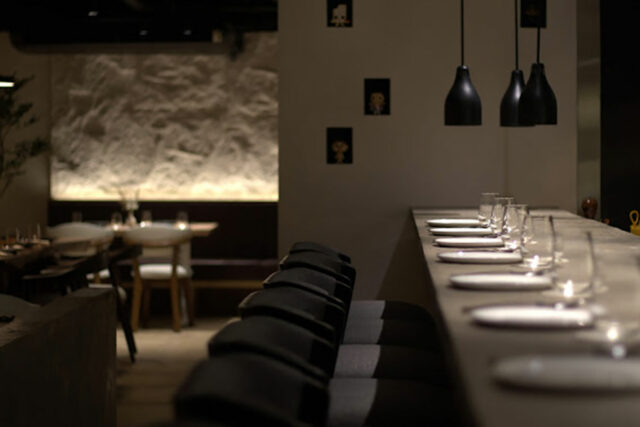
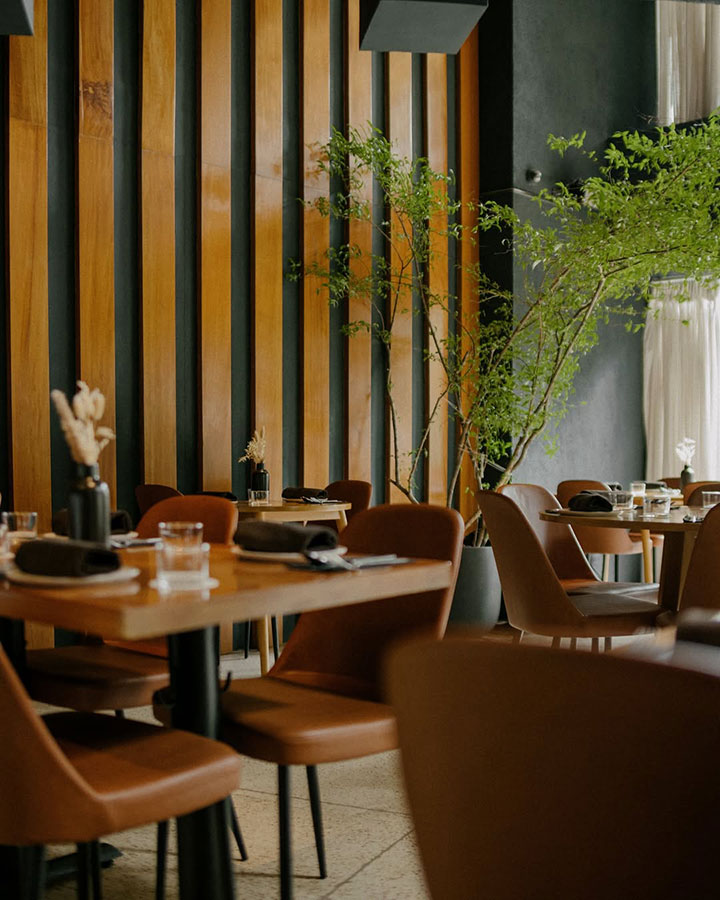
THE INTERIOR of Juniper

By Joseph L. Garcia, Senior Reporter

JUST edging his way into his 40s, you can say a lot about Josh Boutwood, but you can’t call him one-note. A visit to two of his restaurants weeks apart shows his own diversity and his own keen sense of balancing business and pleasure.

His restaurants — namely, The Test Kitchen, Juniper, Ember, and Helm (another, Savage, shuttered in 2024) — operate under the Bistro Elite line of the Bistro Group, due to his status as the restaurant group’s corporate chef, a position he has held since 2012.

JUNIPER
It sounds young and fresh, and opening just this year in the newly refurbished ground floor of the Shangri-La Plaza Mall, it certainly is. BusinessWorld visited the restaurant on June 19 to test their new lunch bowls, but not before a few nibbles.

We had had a disastrous time with a Tapioca and Cheese Fritter at another restaurant (which we will not name; it left us looking like a cow chewing their cud), but Mr. Boutwood’s version was exquisite. The pearls encased in the fried shell gave an excellent tactile experience and a comforting cheesy taste, erasing the memories of fritters past. Meanwhile, a guest at our table insisted we taste Mr. Boutwood’s signature sourdough bread, which had a consistently dense crumb and was delightfully spongy. This was served with whipped butter and olive oil.

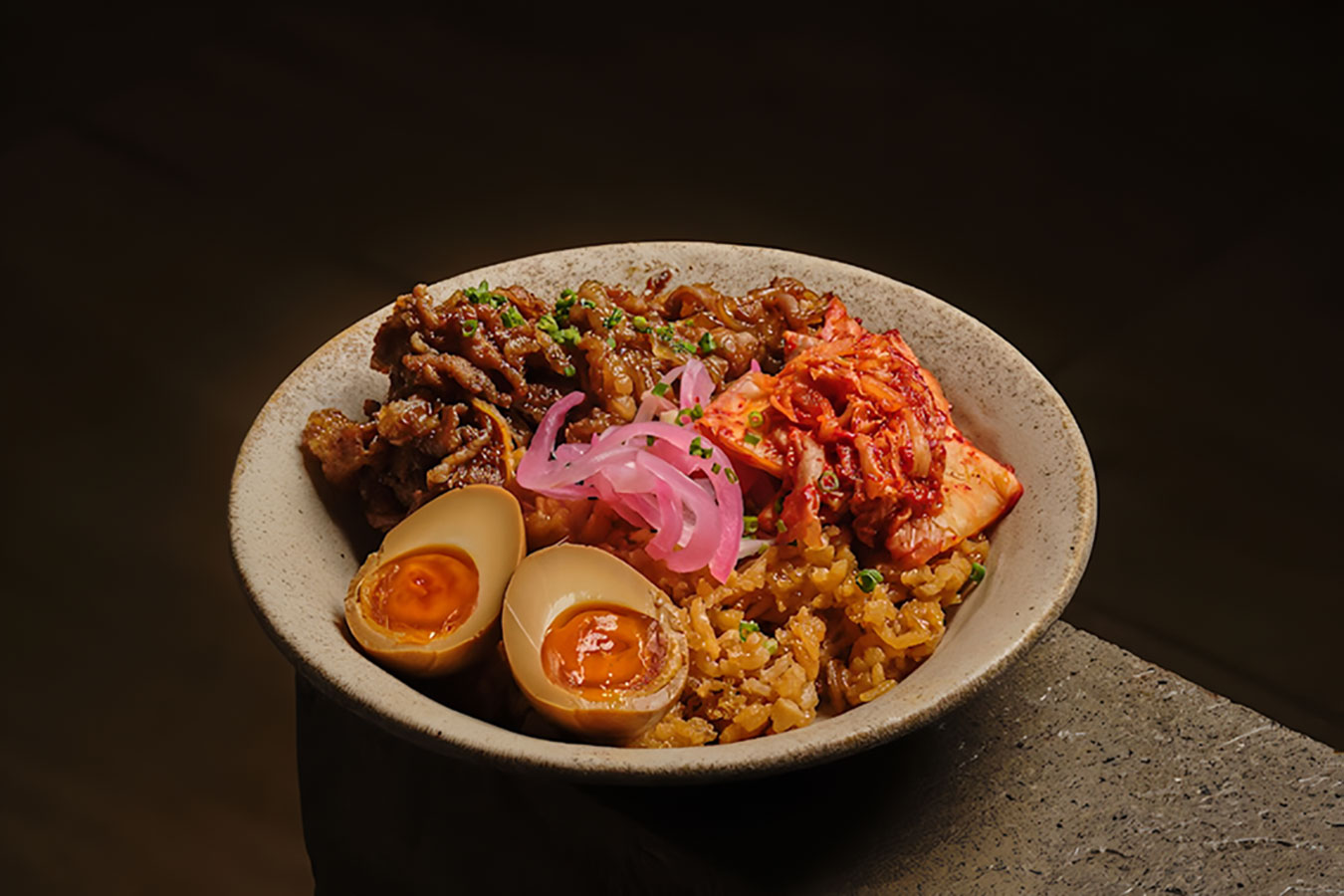
The lunch menu has six new items: four rice bowls (Gyudon, soy egg, kimchi; Soy glazed salmon, edamame, tapioca; Teriyaki pork belly, bean sprouts, pickled cucumber; Miso marinated wings, cabbage, sesame — the menu is straightforward with the names) and two sandwiches (Grilled cheese with cheddar and Gruyère, spiced tomato; Turkey ham, sun-dried tomato, arugula garlic aioli). Prices start at P375, with none of them over P600.

In a group interview, Mr. Boutwood said, “Opening a restaurant in this particular area was very different from my other locations — a different crowd,” alluding to the many offices forming the Ortigas skyline. “Lunches have to be speedy, fast, and in-and-out.”

That’s being modest: we’re sure the seats get warmed up.

We had our favorites: the pork bowl had rich, excellent pork with good rich fat, and tasted nourishing and filling with rice and pickles. The salmon bowl felt like it glistened with freshness, while we were very sure we’d love the Turkey Ham sandwich to-go, over and over.

As a treat, Mr. Boutwood cooked up a fresh batch of off-menu agnolotti (with an excellent meaty filling with a razor-sharp flavor of Parmigiano) and served us his porkchops; both dishes convinced us of his prowess.

“Juniper is a lot more casual,” he said about this outlet. “You don’t have to dress up to come here to enjoy a nice meal.”

THE TEST KITCHEN
After our June 19 visit, Mr. Boutwood flew off to Sweden for a vacation. “For me, that’s the best way to get excited about it again: it’s just to miss it for a bit,” he had said in that previous interview.

He was available for an interview on our July 8 visit to the Test Kitchen, his first chef-helmed restaurant.

When Mr. Boutwood first appeared on our radar in 2017 at the second Madrid Fusion Manila, he had been bypassed at the country’s first iteration of the international food conference due to not having his own restaurant, according to a previous BusinessWorld story. However, in 2017, having his own place (The Test Kitchen itself) got him qualified to take the stage.

“This is my little baby. It’s my first one, right?” he said during a Zoom interview from Sweden. The Test Kitchen moved to Rockwell in 2019 after an initial run in Makati’s Kamagong St. “It’s where the majority of our development for all of my other restaurants starts, and it gets moved down or up to the other restaurants as we see fit.”

While Mr. Boutwood was in Sweden during the interview, BusinessWorld was at The Test Kitchen’s Curing Room upstairs, and we saw hams and other treats hung up on hooks; as well as jars slowly fermenting pickles. This is a testament to his sometimes-unorthodox takes (that work). On fermenting, he says, “We’ve always said that time is an ingredient.”

“Some of the curing that we do can take up to six months, to a year; sometimes two years,” he said. He also has a predilection for open-flame cooking. It’s present in two of his kitchens: this restaurant’s and Ember (and the defunct Savage, then; more on that later). “Cooking with flame is so primal, and you have to rely on intuition to make it right,” he said when we last met at Juniper. Speaking of which, Savage has found a new location, but they’re planning to open next year.

The dinner this week for media and other guests was planned as a revisit of the restaurant, which is why they served familiar favorites. “As my oldest restaurant, over time, it gets shaded by the popularity of my newest restaurants. Does that make sense?” he said.

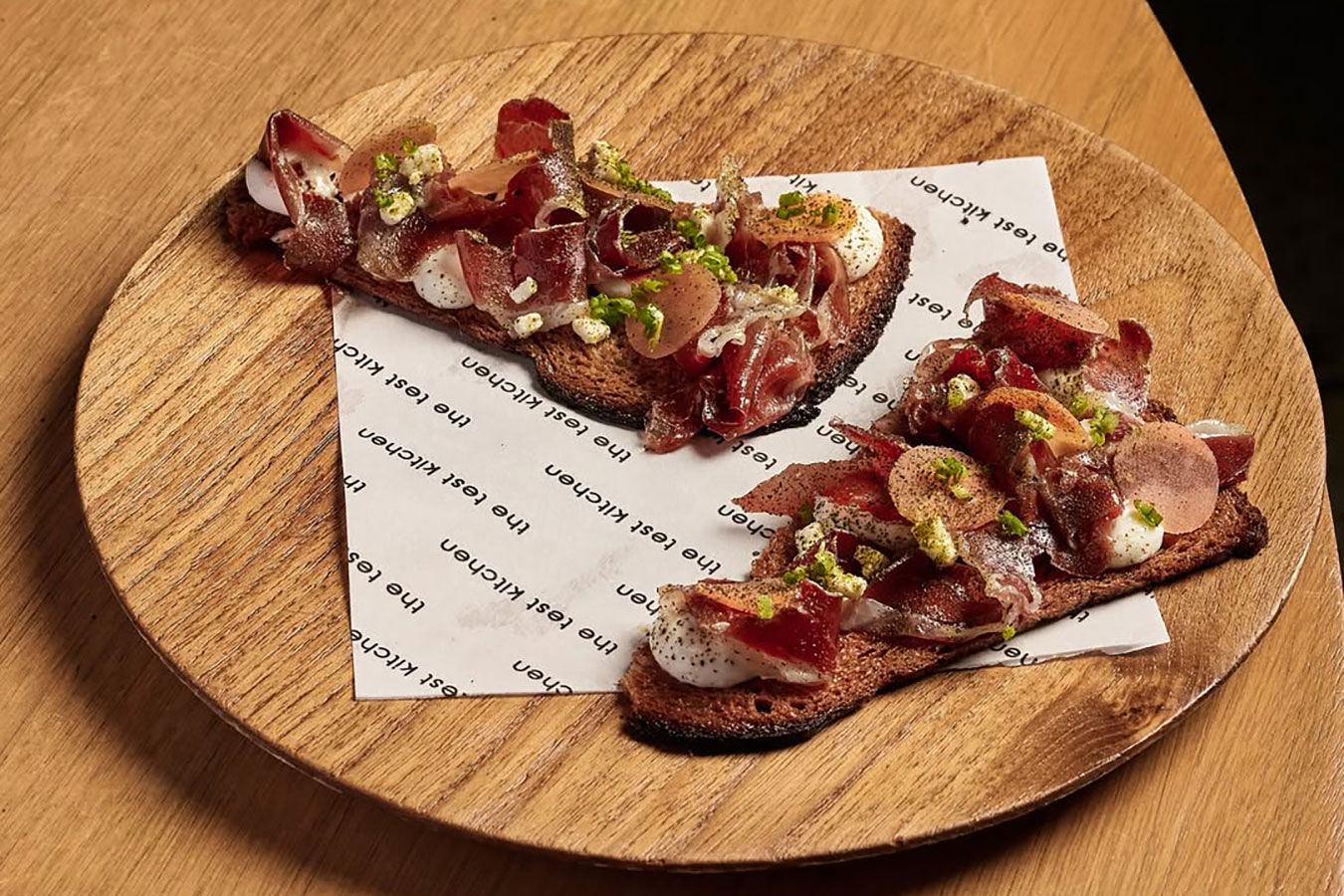
The meal started with Serrano ham, which we placed over his now-fabled sourdough. This was followed by Duck prosciutto on toast: everything sliced almost paper thin, but hefty with flavor. The duck, with the texture of fine leather, holds all the flavor of the curing process, accented by a punchy garlic emulsion. A delicate Cured Hamachi with ponzu, garlic, and orange segments served as a palate cleanser, and the fish felt velvety and sparkled with the marinade.

The mains included a Sea Bass, almost Lovecraftian in its presentation. Chilean sea bass and cauliflower puree, house-made XO sauce, and smoked dashi were capped with a freaky-looking black veil of squid ink and tapioca. This was divine, and we felt time slowing with every chew, the subtle soft flavor of the fish reflected in its fresh bounciness contrasted with the crispy black cap.

There was the Chicken, Truffle (truffle-stuffed chicken breasts with caramelized onion and white onion puree). The flesh, by itself, was already creamy, and reminded us heavily of a chicken dish we had inside the Eiffel Tower.

The Berkshire Pork was a pan-seared chop coated in a caper and mustard-cream sauce; the taut flesh basically squeezes out flavor every time it made contact with teeth and tongue. It tasted remarkably clean, and the caper sauce gave it zing. The Lamb Shank, sticky, soft, and rich with gelatin; evidence of the long, slow, and caring cooking it received, had a very mild flavor. Lamb jus and mint puree give it a little more bang.

Frankly, we thought that after all this, dessert would be a disappointment. Not one bit: he brought out Honey, Cream, with the cooked cream reduced almost to a solid, paired with wild honey and topped with honeycomb caramel. This resulted in a much denser cousin of clotted cream (reflective of Mr. Boutwood’s British roots): so dense, in fact, that it hardly wanted to leave the spoon. It’s basically just a big indulgent bite of cream; the idea of thrusting a can of whipped cream in your mouth made (almost) solid.

“The Test Kitchen still remains one of the most progressive restaurants in terms of our development ethos. It technically is the birthplace of all other creations we have in our restaurants,” he said. “It technically still is our test kitchen, and it carries the name quite strongly.”

Global fintech Revolut expands footprint with PHL tech hub

STOCK PHOTO | Image by David Milmont from Unsplash

REVOLUT, a global financial technology (fintech) company, is launching a technology hub in the Philippines to tap into the country’s skilled workforce and support its expansion across Southeast Asia.

The hub, located in Manila, will function as a global capability center, it said in a statement on Wednesday.

The Manila hub will work with Revolut’s teams in the UK, Europe, Asia-Pacific, and the Americas, it said.

Revolut’s latest expansion is expected to generate hundreds of jobs in the Philippines, which will follow a fully remote arrangement, according to the company.

“This investment reflects our long-term commitment to the Philippines and our confidence in its growth potential,” said Raymond Ng, chief executive officer for Southeast Asia at Revolut.

“The new hub will play a vital role in scaling our global capabilities while creating high-value jobs and driving digital upskilling locally,” he added.

Launched in 2015, Revolut is an all-in-one finance app offering key services such as mobile banking, card payments, money remittance, foreign exchange, and investments.

The Philippine expansion will serve as Revolut’s second hub in Asia, following the launch of its first hub in India in 2021.

The fintech company noted that both countries offer a highly skilled talent pool across product development, financial crime prevention, and customer support.

It also cited the Philippines’ digital readiness, as well as the government’s strong push for innovation, as key opportunities for its expansion plans.

Revolut’s latest expansion also signals investor confidence in the Philippines as a rising destination for global fintech and innovation, said Finance Secretary Ralph G. Recto.

“This investment sends a clear message to the world that the Philippines offers the strategic blend of world-class talent, digital readiness, and policy support to lead the future of global fintech,” Mr. Recto said.

Revolut said it serves more than 60 million customers in over 160 countries, generating over half a billion transactions monthly. — Beatriz Marie D. Cruz

Villar copper

STOCK PHOTO | Image by Paul-Alain Hunt from Unsplash

The Villar family is considering the acquisition of the Philippine Associated Smelting and Refining Corp. (PASAR), the country’s first copper smelter and refinery located in Leyte. This facility, established during the Marcos administration, is currently inactive due to unfavorable global market conditions. The Villar family’s interest in PASAR involves calculated risks, but these appear strategic, given their existing investments in mining.

PASAR was established in 1976, although its smelting and refining operations commenced only in 1983 during the Marcos government, at a cost of approximately $300 million. When it began operations, PASAR was the first and only copper smelter and refinery in Southeast Asia. Privatized under President Joseph Estrada in 1999, PASAR has since been controlled and managed by the global commodities trading giant Glencore, which has operated the facility for over 25 years.

However, since February, PASAR has been placed on “care and maintenance” status due to pressures from the global market and shortages in raw materials, resulting in the displacement of around 3,000 workers. Historically, the plant processed around 1.2 million metric tons of copper concentrate annually, producing approximately 200,000 tons of copper cathode for export. Under Glencore’s management, PASAR consistently ranked among the Philippines’ top exporters.

The PASAR sale, however, remains uncertain, with no definitive agreement yet announced between the Villar family and Glencore. From an external perspective, the potential sale appears mutually beneficial. Glencore seems eager to divest from PASAR to refocus on its core trading activities, while the Villar family, potentially holding negotiating leverage, could gain significant strategic advantages from the purchase.

For the Villars, acquiring PASAR makes strategic sense. Their ownership of PASAR would complement operations at their St. Augustine Mining, providing a local processor for mined copper and gold. This vertical integration would significantly reduce logistical costs and mitigate risks associated with export restrictions.

Additionally, the Villar family has the option to strategically delay restarting PASAR until global market conditions improve. This could involve waiting for margins to increase, restructuring operational costs, or allowing their mining operations sufficient time to produce adequate raw materials for PASAR’s large processing capacity.

The immediate risk is the potential for short-term financial losses, given current global market conditions. Nonetheless, long-term prospects appear favorable, driven by growing global demand for copper, particularly from renewable energy and electric vehicle (EV) sectors.

Further demand is expected from ongoing production in electronics, mobile phones, computers, data centers, and artificial intelligence.

If St. Augustine Mining and other Villar-owned mining investments can supply consistent raw materials to PASAR, the smelter under Villar ownership could achieve stable and sustainable operations. Ensuring a reliable local ore supply — the very issue Glencore struggled with — is crucial. Additionally, the potential development of the Tampakan mine project could significantly enhance PASAR’s operational sustainability.

Glencore’s divestment from PASAR was driven by persistently low smelting fees and a strategic decision to realign their focus toward commodities trading and mining, rather than refining operations. Given that Glencore’s mining operations are located outside the Philippines, maximizing PASAR’s capacity required significant logistical expenses. The scenario might have been different had PASAR had access to local mining operations.

Another important consideration is the quality of local mining output and its suitability for PASAR’s refining standards. Processing substandard or low-quality ore would result in poor product quality and higher operational and maintenance costs. It is reasonable to assume the Villars have thoroughly assessed the quality of ore from their mines prior to pursuing the acquisition of PASAR.

The Tampakan project, recognized as the country’s largest undeveloped copper-gold resource, holds substantial importance. If Tampakan becomes operational, it could significantly enhance PASAR’s capacity utilization rates, provided an agreement between PASAR and Tampakan’s owners materializes. Transporting ore domestically from South Cotabato to Leyte would also be cost-effective compared to overseas shipping.

Nevertheless, Tampakan’s operational status remains uncertain. Assuming its eventual development between now and 2028, PASAR’s strategic link with Tampakan and other domestic mines would considerably strengthen the Villar family’s market position by ensuring steady ore supplies.

A potential government policy banning raw ore exports could also significantly boost domestic demand for local processing facilities like PASAR. Such a policy shift, whether initiated by the executive branch or Congress, would benefit integrated operations like the St. Augustine-PASAR model. It is worth noting that the Romualdez family, another player in the local mining industry, could similarly benefit from such policy changes.

The national push toward local ore processing aligns with global trends emphasizing domestic value addition. Implementing mandates for local processing before export would substantially enhance PASAR’s business prospects, creating local jobs and generating income. Such policy adjustments could incentivize local and international miners to invest further in domestic smelting and refining infrastructure, potentially leading to expansion at PASAR or construction of additional facilities. This development would significantly advantage the Villar family.

Currently, copper smelters in China and Japan dominate the global market due to scale, advanced technology, and lower operational costs — at times even offering negative processing fees because of intense competition. China’s extensive global mining network further amplifies its competitive advantage. However, PASAR would not necessarily have to directly compete if local mining output sufficiently covers its processing needs.

Over the past five years, copper industry growth has been limited by oversupply and declining smelting fees, creating profitability challenges for facilities such as PASAR. Nevertheless, a robust surge in copper demand is anticipated annually through 2035, driven by EVs, renewable energy infrastructure, data centers, and advanced electronics.

Moreover, global copper prices could increase due to aging mines, decreasing ore grades, and reduced investments in new mining ventures. Continued constraints on copper supply could consequently drive prices higher, significantly benefiting integrated operators such as St. Augustine.

When comparing the export of raw ore versus refined copper cathodes processed by PASAR, cathodes offer higher profit margins, greater economic value, and reduced regulatory risks. This underscores the economic advantage of integrating PASAR with the Villar family’s existing mining operations.

Ultimately, the Villar family’s successful acquisition of PASAR will depend on securing additional reliable local ore sources and advocating for policies supportive of domestic refining. If strategically managed, PASAR could position the Villar family advantageously within a progressively tightening global copper market.


Marvin Tort is a former managing editor of BusinessWorld, and a former chairman of the Philippine Press Council

matort@yahoo.com

BDO targets to raise at least P5 billion from offering of sustainability bonds

BW FILE PHOTO

BDO UNIBANK, Inc. is targeting to raise at least P5 billion from its latest offering of peso sustainability bonds.

BDO on Wednesday kicked off its public offer of 1.5-year peso-denominated fixed-rate sustainability bonds, which is set to run until July 22, unless ended earlier by the bank.

“This marks the bank’s fourth peso-denominated sustainability bond following a P55.7-billion issue in July 2024, P63.3-billion issue in January 2024, and P52.7-billion issue in January 2022,” it said in a disclosure to the stock exchange.

“The net proceeds of the proposed issuance will be used to finance and/or refinance eligible assets as defined in the bank’s Sustainable Finance Framework, support the bank’s lending activities, and diversify the bank’s funding sources,” BDO said.

The bonds are priced at a coupon rate of 5.875% per annum. BDO will sell the notes for a minimum investment amount of P500,000 and in additional increments of multiples of P100,000 thereafter.

The papers are scheduled to be issued, settled, and listed on the Philippine Dealing and Exchange Corp. on July 29.

ING Bank N.V. Manila Branch is the sole arranger and sustainability coordinator for the issuance. It is also acting as a selling agent along with BDO.

Meanwhile, BDO Capital & Investment Corp. is the financial advisor for the transaction.

The bank added that the Securities and Exchange Commission (SEC) has issued confirmation that the issuance complies with requirements under the ASEAN Sustainability Bond Standards and the SEC’s ASEAN Sustainability Bond Circular.

BDO’s net income rose by 6.49% to P19.7 billion in the first quarter on the back of the sustained performance of its core businesses.

Its shares went down by P1.20 or 0.78% to close at P153.40 each on Wednesday. — Aaron Michael C. Sy

Content moderators for Big Tech unite to tackle mental trauma

STOCK PHOTO | Image by kiquebg from Pixabay

BRUSSELS — Content moderators from the Philippines to Turkey are uniting to push for greater mental health support to help them cope with the psychological effects of exposure to a rising tide of disturbing images online.

The people tasked with removing harmful content from tech giants like Meta Platforms or TikTok, report a range of noxious health effects from loss of appetite to anxiety and suicidal thoughts.

“Before I would sleep seven hours,” said one Filipino content moderator who asked to remain anonymous to avoid problems with their employer. “Now I only sleep around four hours.”

Workers are gagged by non-disclosure agreements with the tech platforms or companies that do the outsourced work, meaning they cannot discuss exact details of the content they are seeing.

But videos of people being burned alive by the Islamic State, babies dying in Gaza and gruesome pictures from the Air India crash in June were given as examples by moderators who spoke to the Thomson Reuters Foundation.

Social media companies, which often outsource content moderation to third parties, are facing increasing pressure to address the emotional toll of moderation.

Meta, which owns Facebook, WhatsApp and Instagram, has already been hit with workers’ rights lawsuits in Kenya and Ghana, and in 2020 the firm paid a $52-million settlement to American content moderators suffering long-term mental health issues.

The Global Trade Union Alliance of Content Moderators was launched in Nairobi in April to establish worker protections for what they dub “a 21st century hazardous job,” similar to the work of emergency responders.

Their first demand is for tech companies to adopt mental health protocols, such as exposure limits and trauma training, in their supply chains.

“They say we’re the ones protecting the internet, keeping kids safe online,” the Filipino worker said, “But we are not protected enough.”

SCROLLING TRAUMA
Globally, tens of thousands of content moderators spend up to 10 hours a day scrolling through social media posts to remove harmful content — and the mental toll is well-documented.

“I’ve had bad dreams because of the graphic content, and I’m smoking more, losing focus,” said Berfin Sirin Tunc, a content moderator for TikTok in Turkey employed via Telus Digital, a digital services subsidiary of Canadian telecom firm Telus, which also does work for Meta.

In a video call with the Thomson Reuters Foundation, she said the first time she saw graphic content as part of her job she had to leave the room and go home.

While some employers do provide psychological support, some workers say it is just for show — with advice to count numbers or do breathing exercises.

Therapy is limited to either group sessions or a recommendation to switch off for a certain number of “wellness break” minutes. But taking them is another thing.

“If you don’t go back to the computer, your team leader will ask where are you and (say) that the queue of videos is growing,” said Ms. Tunc, “Bosses see us just as machines.”

In e-mailed statements to the Thomson Reuters Foundation, Telus Digital and Meta said the well-being of their employees is a top priority and that employees should have access to 24/7 healthcare support.

RISING PRESSURE
Moderators have seen an uptick in violent videos. A report by Meta for the first quarter of 2025 showed a rise in the sharing of violent content on Facebook, after the company changed its content moderation policies in a commitment to “free expression.”

However, Telus Digital said in its e-mailed response that internal estimates show that distressing material represents less than 5% of the total content reviewed.

Adding to the pressure on moderators is a fear of losing jobs as companies shift towards artificial intelligence (AI)-powered moderation.

Meta, which invested billions and hired thousands of content moderators globally over the years to police extreme content, scrapped its US fact-checking program in January, following the election of Donald J. Trump.

In April, 2,000 Barcelona-based workers were sent home after Meta severed a contract with Telus, operating locally as CCC Barcelona Digital Services.

A Meta spokesperson said the company has moved the services that were being performed from Barcelona to other locations.

“I’m waiting for Telus to fire me,” said Ms. Tunc, “because they fired my friends from our union.” Fifteen workers in Turkey are suing the company after being dismissed, they say, after organizing a union and attending protests this year.

A spokesperson for Telus Digital said in an e-mailed response that the company “respects the rights of workers to organize.”

Telus Digital said a May report by Turkey’s Ministry of Labor found contract terminations were based on performance and it could not be concluded that the terminations were union-related.

The Labor Ministry did not immediately respond to a request for comment.

PROTECTION PROTOCOLS
Moderators in low-income countries say that the low wages, productivity pressure and inadequate mental health support can be remedied if companies sign up to the Global Alliance’s eight protocols.

These include limiting exposure time, making realistic quotas and 24/7 counseling, as well as living wages, mental health training and the right to join a union.

Telus Digital said in its statement that it was already in compliance with the demands, and Meta said it conducts audits to check that companies are providing required on-site support.

New European Union rules — such as the Digital Services Act, the AI Act and supply chain regulations which demand tech companies address risks to workers — should give stronger legal grounds to protect content moderators’ rights, according to labor experts.

“Bad things are happening in the world. Someone has to do this job and protect social media,” said Ms. Tunc.

“With better conditions, we can do this better. If you feel like a human, you can work like a human.” Thomson Reuters Foundation

From Delhi to Dubai: The global food trends to watch

By Matthew Kronsberg

EVEN in New York, the city with arguably the planet’s most diverse and dynamic food scene, the three days of the Summer Fancy Food Show stand out as a world-class pileup of cuisines and trends. African honeys endorsed by Jane Goodall, Indian spiced sodas, Dubai chocolates and protein-packed… everything were but a few of the thousands of products laid out to tempt buyers and distributors for grocery and gourmet stores.

If you want a window into America’s changing tastes and growing appetites, and a sense of how the country will be eating in the coming year, there’s no better place to be.

For me, no moment crystalized the show’s fantastical culture clash better than when I grabbed a sample of Korean carbonara-flavored ramen (ramen is a multibilliondollar industry there) from one exhibitor and walked straight into a nearby crowd watching rapt as an opera-singing Italian chef dramatically transferred servings of his own carbonara from pan to plates, handing each one to an assistant who shaved black truffles over them before giving them away.

When I last reported from the Fancy Food Show in 2023, it featured 2,000 companies exhibiting over about 300,000 square feet. This year it’s swelled to 2,500 companies (400 of which were first-timers) taking up 340,000 square feet. It’s the biggest show in nearly a decade, reported Bill Lynch, president of the event’s organizer, the Specialty Food Organization.

Sales of specialty foods — think gourmet chocolates, cheeses, snacks, and meats — are projected to grow 5.5% this year, according to the 2025 Specialty Food Industry Outlook Report, with “wellness”-oriented products being a key driver. That can mean lower sugar content (72% of Americans are seeking to limit sugar intake) or increased and more diverse sources of protein. But beneath this expected growth is a current of economic uncertainty, with 53% of US consumers expressing “mixed feelings or pessimism about the economy.”

INDIAN ACCENTS
One of the year’s standout flavor trends has been in Indian-influenced snacks, said Jessie Kimsey, senior manager for vendor strategy and category innovation for online grocer Misfits Market Inc. “We’ve seen salty snacks as a whole trending down, so I think brands are looking towards ways to make it more exciting and bring people back into the aisle,” she said.

Look no further than the excitement generated by startups such as Keya’s Snacks, which offered a pair of flavored potato chips: a complex Bombay Spice, and Kala Namak, the kiln-fired black salt, whose sulfurous notes evoke fried eggs. Along with samples, it offered up booklets titled Zen and the Art of Eating Chips: An Earthling’s Cultural Guide to Consumption and Gratification — Potato Chip Edition. Niranaya Foods from Philadelphia offered pretzels made from grain-free naan in flavors like Tandoori BBQ, Pink Salt, and Jalapeno Chutney. And Doosra snack mix, which made a splash last year with its blend of spiced chickpea puffs called boondi, roasted peanuts, and caramelized white chocolate, was back with an equally moreish mix of boondi, dark chocolate, and walnuts.

Indian flavors permeated more than just the crunchy aisles. Sach, the Bay Area paneer maker, introduced a new frozen pizza line in flavors like tikka masala, while Bollygood’s small stand was busy offering tastes of its reduced-sugar take on nimbu pani, Indian sparkling lemonades and limeades, flavored with fruit, spice, and a pinch of salt to enhance hydration.

Bollygood’s founder and Chief Executive Officer Maxine Henderson, a former electrical engineer, was pleasantly surprised that the New York crowd gravitated toward the lime-basil-cumin flavored drink — the foundational one based on her grandmother’s recipe — even more than her bestsellers, lemon-pomegranate-cardamom and lemon ginger. “These global flavors and functional ingredients are desired,” she said. “There’s been a demand, and retailers are seeing that.” Ms. Henderson came to the show looking to connect with both sellers and investors: “We’re ready to scale. We need some smart money to help us grow a business.” As she was pouring the last of her samples, she said the results of the show “exceeded my expectations.”

Bollygood’s nimbu pani wasn’t the only surprising sip of the show. Narichan introduced Kimchi Me, a kombucha-like drink made from white kimchi brine. Although it was a bit too intense to chug after a run, it would be a perfect addition for a dirty martini or bloody mary. Over in the sprawling Italian pavilion, Emilia-Romagna’s Terra del Tuono also featured an unusual beverage base — balsamic vinegar — in its Emilio sparkling aperitif, which balances the tartness with concentrated grape must.

CUT DOWN TO GLP-1 SIZE
Among Kimsey’s other takeaways is the continued strength of “little indulgences and sweet treats.” She sees “poppable format” snacks like Unreal’s “snacking chocolates,” as she calls them, fulfilling a newly relevant need in a market where GLP-1 treatments have curbed appetites but not desire. “You aren’t opening up a pint of ice cream and just diving in. You’re actually like, ‘I just want like two, and then that’ll tide me over.’” A favorite example was Baris, frozen chocolate-dipped raspberries from Patagonia (the place, not the brand), which she likens to a “high-end, luxury gusher experience.”

Rahul Sharma, director of marketing and partnerships at Source M, a packaging specialist, noticed that “more and more brands are adding more protein to still be relevant in the GLP-led diet.” Indeed, Barilla and Rummo prominently featured protein-packed pastas, while pizzas, chips, ice creams and even sprinkles were touting their protein premiums. In one of the show’s better examples of trend synergy, Alak Vasa, a former algorithmic trader turned owner of Elements ayurvedic chocolates, introduced a chai-spiced protein powder, flavored with (among other things) cinnamon, cardamom, black pepper, and cacao.

RAISING THE DUBAI BAR
When asked to sum up the biggest trends she saw, Melanie Bartelme, an associate director for food and drink at marketing intelligence firm Mintel, offered up three words: “Dubai, Dubai, Dubai.” Indeed the viral pistachio-and-shredded-phyllo-filled chocolate seemed only to be gaining momentum, despite skyrocketing cacao prices. Italian pastry producer Don Giovannino was serving up slices of holiday panettone flavored with the stuff, while Just the Fun Part, maker of poppable-format chocolate-filled waffle cone bottoms, touted a new Dubai flavor. Other makers deemphasized pistachio with flavors such as cherry, birthday cake, and tooth-achingly sweet cotton candy.

Respite from the Dubai deluge was found in Asian-accented luxury chocolate bars. Kesshō chocolate, from Austin, takes much of its influence from Japan and mainland China, where owners Liang Wang and Mark Huetsch own a chain of bakeries. Their black sesame and hojicha bars are the perfect first foray into unexpected flavors, while their goat’s-milk chocolate with cumin and chili “lamb skewer” spices rewards the daring. Marou combined Vietnamese cacao with flavors like Mekong kumquat. Nearby, elegantly packaged Fossa Chocolate from Singapore employed bold flavors in its bars like peanutty satay sauce, and subtle tastes with bold names like “Duck Sh** Dancong,” named for a variety of oolong tea that (thankfully) has nothing to do with ducks.

CRUNCH TIME
In the flood of new flavors and formats, it can be easy to overlook the satisfaction in straightforward snacks. Plain potato chips provided two of my favorite bites of the show. As someone who shamelessly roots around in chip bags for the superior crunch of creased and doubled-over ones (considered by chipmakers to be “defects”), I appreciated the vision of Folds, which makes those chips the majority, not the exception. And then there were Beefy’s Own chips, started by 21-year-old Ethan Bender when he was 17. An early adherent to the no-seed-oil trend, Bender fries his chips in beef tallow and offers them in crowd-pleasing flavors such as sour cream & onion and barbecue. But his simple sea salt chips won me over: The taste of the tallow shines, reminding me of McDonald’s fries back when they were cooked in beef fat.

THE T WORD
Every manufacturer, whether it made chips, cheese, or chocolate, had one common concern: tariffs. At a panel on the subject, Chitra Agrawal, co-founder and chief executive officer of Brooklyn Delhi, a maker of condiments, sauces, and heat-and-eat meals, lamented that “we have product innovation going on, but I’m not comfortable putting it forward because I can’t even pinpoint what my costs are right now.” Ori Zohar, co-founder and co-CEO of direct trade spice company Burlap & Barrel, which showcased African honeys produced in partnership with renowned primatologist Jane Goodall, and spice blends with Martha Stewart, also said that tariffs — actual and potential — were putting a dent in product development. “We were going to put out a really fun Advent calendar,” he said, “but the packaging was going to get printed in China, and we were like, ‘This is too messy right now.’”

Still, Mr. Zohar expressed hope that there would be growth opportunities in this rapidly changing market. “Bigger companies are not going to be able to pivot and to change their products, and their packaging and their messaging, because they’re locked into these multi-year relationships [with suppliers]. We’re really trying to find ways to be kind of crafty and nimble in this strange moment.”

Just before the show concluded, I stopped by the booth of Andre’s Confiserie Suisse of Kansas City, for one of its beautifully boozy KC Whiskey Caramel Drops and a taste of its (inevitable) new Dubai-chocolate-inspired Pistachio Crunch Bar, in which it replaces shredded phyllo with feuilletine — toasted flakes of caramelized crepes. As it happens, this family-owned producer of artisan chocolates is the perfect bellwether for the mood of the show at a time when challenges to small businesses predominate. René Bollier, who owns the 73-year-old company with his wife, Nancy, expressed a mix of anxiety and optimism. “I was apprehensive coming into the show because I was worried whether the buyers would really be here.” As it turns out, there were plenty of buyers, he said. “We are full steam ahead.” — Bloomberg

URC names new CMO amid regional brand growth push

KAREN ONG — UNIVERSAL ROBINA CORP.

GOKONGWEI-LED Universal Robina Corp. (URC) is aiming to expand its brands across the region after appointing veteran marketer Karen Ong as its new chief marketing officer (CMO).

Ms. Ong, who will report directly to URC President and Chief Executive Officer Irwin C. Lee, will oversee the company’s marketing operations, including consumer insights, advertising and public relations, media and digital marketing, and regional brand management, URC said in an e-mail statement on Wednesday.

She is expected to accelerate URC’s regional growth impact and strengthen brand equities in the Philippines and URC International, according to the company.

“Karen’s deep expertise, strategic mindset and passion for brand building will be invaluable to the expansion of URC across key regional markets including the Philippines,” Mr. Lee said.

“Her appointment is part of a broader push to strengthen regional brand presence and accelerate profitable growth across Southeast Asia,” he added.

Prior to her appointment, Ms. Ong was the senior marketing director for URMunchy’s Malaysia.

In May, URC launched a research and development facility under URM in Johor, Malaysia, which features advanced product testing and development technologies.

URM manufactures biscuit brands LEXUS and Oat Krunch, as well as URC snacks and confectionery brands Roller Coaster, Potato Chips, Cloud 9, Nips, and Dynamite.

Domestically, URC produces brands such as Great Taste coffee, C2 Cool & Clean drink, Piattos chips, Maxx candy, and Cream-O cookies.

URC shares rose by 2.13% or P2 to P96 apiece on Wednesday. — Revin Mikhael D. Ochave

Assessment of the economy after three years of the Marcos Jr. administration

On June 30, President Ferdinand R. Marcos, Jr. finished his third year in office. How has the Philippine economy performed during his administration compared with major economies in the world given continuing economic and global uncertainties?

To help answer this question I used four metrics or indicators: GDP growth, inflation rate, unemployment rate, and Debt/GDP ratio, and these are the results:

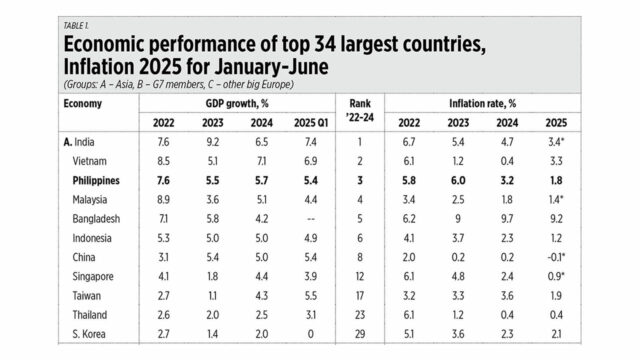
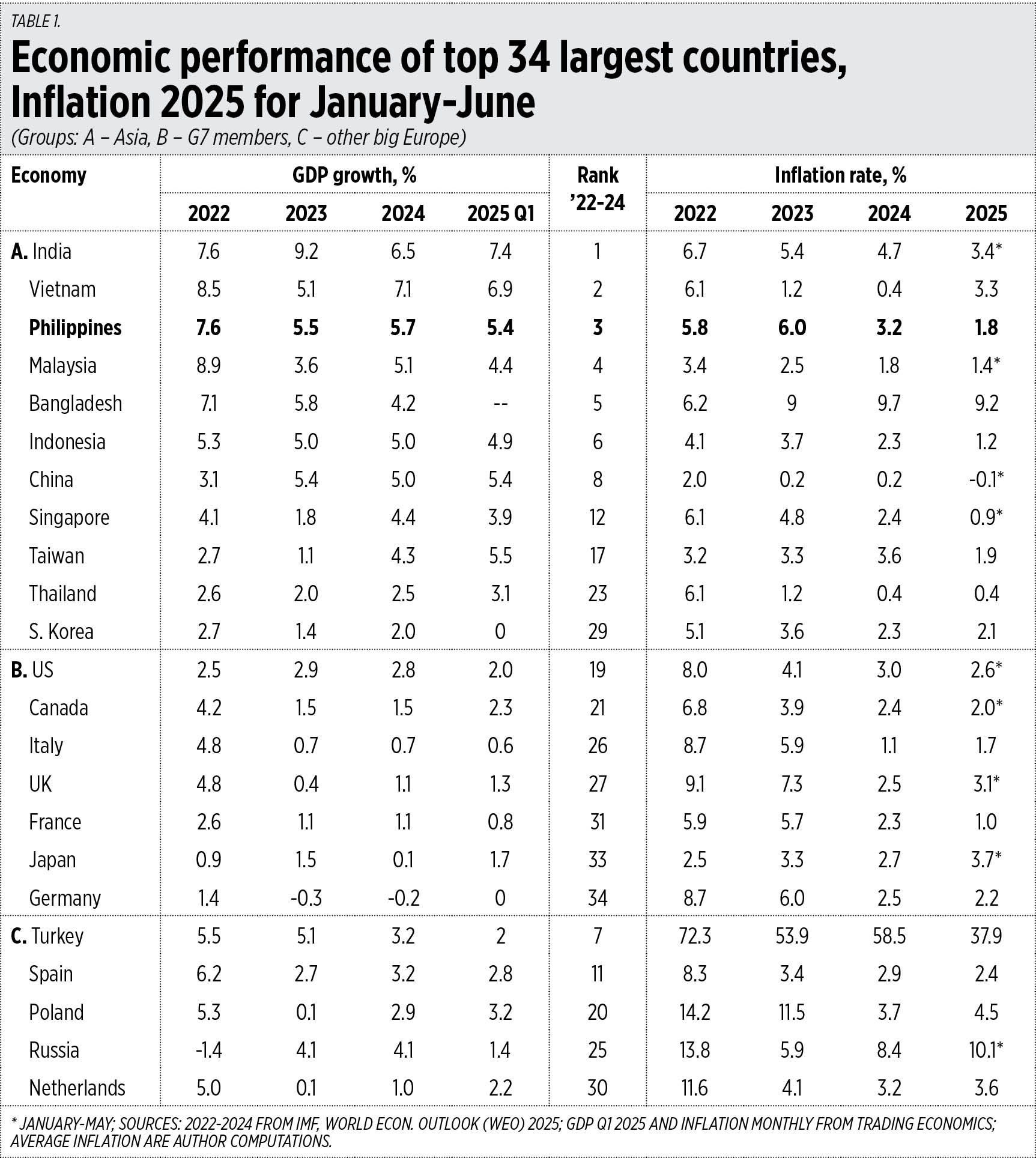
1. The Philippines was the third fastest growing economy among the top 34 largest economies in the world in terms of GDP size (at least $900 billion in 2024), average growth from 2022 to 2024. And even if extended to the top 50 largest economies, the Philippines was still the third fastest growing next to India and Vietnam. Malaysia, Bangladesh and Indonesia are 4th to 6th, Turkey is 7th, China is 8th. Egypt and Iran are 9th and 10th but I did not include them and several others in the accompanying table for the purpose of brevity.

2. The Philippines had among the highest inflation rates in Asia in 2022 to 2023, but this have been redeemed by low inflation rates of 3.2% in 2024 and 1.8% in January to June this year. When compared with G7 members and other big European countries, our inflation was mild, even in 2022, as they saw rates of 6-9% for G7 and 8-72% for other big European nations (see Table 1).

3. The Philippines’ unemployment rate has been on the decline, from 5.4% in 2022 to 3.9% in May 2025, which is lower than India, China, and Indonesia. It is also lower than the G7 members except Japan, and lower than other big European nations. Our labor force participation rate (LFPR) was a high of 65.8% in May 2025. The LFPR is an indicator of people’s optimism or pessimism about the labor market. If people think that there are more jobs available, they go out to seek jobs and the LFPR goes up. If people think there are few jobs available, they postpone joining the labor force and instead pursue more studies, or “standby” temporarily, and the LFPR goes down.

4. The Philippines’ public Debt/GDP ratio remained at 57% from 2021 to 2024. Half of the Asian countries in the list have reduced their ratios while half have increased. Those with ratios lower than 57% in 2024 are Indonesia, South Korea, Taiwan, and Vietnam (see Table 2).

So the Philippine economy under the Marcos Jr. administration has clearly performed well in three of four indicators — higher growth, lower inflation, lower unemployment — and has been neutral in the Debt/GDP ratio. Meaning that in the last three years, more Filipinos have experienced a higher standard of living, more stable prices, and have had more jobs to choose from.

The President’s economic team — led by Finance Secretary Ralph G. Recto, Economics Secretary Arsenio M. Balisacan, and Budget Secretary Amenah F. Pangandaman — has done their work well, regardless of what the pessimists and detractors claim.

In the next three years we should catch up when it comes to high growth with leaders Vietnam and India. Vietnam reported their second quarter (Q2) 2025 GDP and it is a whooping 8%, from an already high growth of 7.3% in Q2 2024 and 6.9% in Q1 2025.


Bienvenido S. Oplas, Jr. is the president of Bienvenido S. Oplas, Jr. Research Consultancy Services, and Minimal Government Thinkers. He is an international fellow of the Tholos Foundation.

minimalgovernment@gmail.com

House bill seeks to amend bank deposit secrecy law to boost BSP supervision

REUTERS

A BILL seeking to amend the Philippines’ decades-old bank deposit secrecy law to allow the central bank to examine select accounts to improve transparency in financial transactions has been filed at the House of Representatives.

Filed on June 30, House Bill (HB) No. 7 seeks to amend Republic Act No. 1405 or Law on Secrecy of Bank Deposits, which was enacted in September 1955, to allow the Bangko Sentral ng Pilipinas (BSP) to look into bank deposits, including those in foreign currency accounts, that are under suspicion of illegal activities.

“We want to send a clear message: the Philippines should no longer be a safe haven for dirty money,” Leyte Rep. Ferdinand Martin G. Romualdez, who authored the measure, said in a statement.

“If we want honest governance and a stronger financial system, we must update our laws and give our regulators the tools they need to protect the people’s money,” he added. “The bill is designed to bring the Philippines closer to international best practices and remove barriers that hinder the fight against illicit finance.”

A similar bill was made a priority measure by the Marcos administration in the 19th Congress. It was approved by the House, but its counterpart measure languished in the Senate’s banks committee.

Under the proposal, the BSP will be allowed to examine bank deposits “in specific circumstances.” These include investigations of closed banks or when its policy-setting Monetary Board finds reasonable ground to believe that “fraud, serious irregularity, or unlawful activity” was committed by officials, employees, or any related parties of entities under the central bank’s supervision.

BSP-supervised institutions are banks, nonbank financial institutions with quasi-banking functions, and other entities that are engaged in financial activities like pawnshops, electronic money issuers, money service business, and trust corporations.

Results of the BSP’s investigation may only be shared with the Securities and Exchange Commission, Philippine Deposit Insurance Corp. and the Anti-Money Laundering Council. The central bank may also provide information to the Justice department and courts for prosecution purposes.

The BSP has been pushing for amendments to the Philippines’ tight bank secrecy laws to boost its oversight of the financial sector by preventing cases of insider abuse, citing cases where bankers themselves borrow from their own banks or hide proceeds of fraudulent activities in their banks, which endanger depositors.

The International Monetary Fund said in reports released in 2020 and 2021 that the Philippines’ bank secrecy laws restrict the BSP’s supervisory ability and undermine financial stability and integrity, exposing the industry to reputational risk and affecting its development.

Still, under the Anti-Financial Account Scamming Act signed last year, the BSP can now investigate and inquire into financial accounts involved in prohibited acts or offenses under the law. These include money mule activities and social engineering schemes, mass mailers, or human trafficking, as well as other offenses such as opening a financial account under a fictitious name or using the identity or identification documents of another person.

The bill’s explanatory note said the measure seeks to promote transparent governance and institute “anti-corruption” mechanisms in financial institutions’ operations, adding that the current law’s provisions have weakened oversight as they have been exploited to conceal illegal activities like money laundering and tax evasion.

“By balancing the need for depositor privacy with the imperative of transparency and accountability, the bill modernizes the country’s bank secrecy framework while strengthening institutional efforts to detect and deter financial misconduct. It reinforces the State’s commitment to fight corruption and uphold public trust in financial institutions and regulatory agencies,” it said. — Kenneth Christiane L. Basilio

Dining In/Out (07/10/25)


The Whisky Library turns two

NEWPORT WORLD RESORTS’ The Whisky Library celebrates its second anniversary with an exclusive Dalmore flight on July 26. Marking this milestone, the home of Manila’s largest whisky collection invites enthusiasts to indulge in a tasting flight named “The Dalmore Decadence.” Dalmore, a Scottish distillery renowned for luxury and innovative maturation methods, offers a fitting tribute to the library. “The Dalmore Decadence” flight features a selection of three rare single malts selected for exclusivity. They are the Dalmore King Alexander III, a whisky matured in six distinctive cask varieties, boasting notes of citrus zest, crème caramel, vanilla pod, and crushed almonds; The Dalmore 25 Year Old, matured in American white oak ex-bourbon barrels, Palomino Fino sherry butts, and tawny Port pipes, delivering layers of Madagascar vanilla pods, thick treacle coffee, chocolate truffles, and dried figs; and The Dalmore Quintessence, finished in five California red-wine casks — Zinfandel, Pinot Noir, Cabernet Sauvignon, Syrah, and Merlot — imparting flavors of tropical fruits, ginger, and sun-dried raisins. The anniversary flight is available at P2,400+ for a 15ml pour of each whisky. For more information on Newport World Resorts, visit www.newportworldresorts.com and follow @newportworldresorts on Facebook, Instagram, and TikTok.


Celestial Cocktails at Solaire North’s Skybar

SOLAIRE Resorts North’s Skybar unveils its latest Celestial Cocktails with every sip thoughtfully designed to charm the senses. These are six exclusive new cocktails, alongside four Skybar classics enhanced with a stellar twist. Milkyway is a smooth, rich cocktail infused with buttery pandan flavors. Solar and Lunar are two citrus-infused blends that balance bright zest and delicate sweetness. Supernova is a bittersweet, fruit-forward creation featuring Apricot Liqueur, Hennessy VS, and Absinthe. Midgard is a tropical-meets-smoky blend while Rose Skies is a lush botanical blend. The Gemini cocktail is a salty-sweet combination while Synodic Dew is an umami-rich infusion with honeydew notes. For some effervescence, Harmony blends a mango soda base with mellow chocolate bitters. For reservations and inquiries, visit sn.solaireresort.com or sn.solaireresort.com/dining/skybar, call 8888-8888, or e-mail snrestaurantevents@solaireresort.com to book a table.


SaladStop! launches new signature items

SALADSTOP! has added several new items to its menu. Yasou!, a Mediterranean-inspired favorite turned permanent signature makes its return after strong demand from customers. It’s a mix of romaine and rocket, tossed with sundried tomatoes, grapes, candied walnuts, shaved Parmesan, and feta, paired with a Dijon Balsamic Vinaigrette. It is available as a salad, wrap, or party tray. Kokoro is a bowl with a base of quinoa topped with pan-seared salmon, soft-boiled egg, baby spinach, red and white cabbage, edamame, corn, radish pickles, alfalfa sprouts, and a sprinkle of furikake plus a sesame lime dressing. This is available in all SaladStop! stores except SaladStop! ADB. For the sweet tooth, Choco Loco is a smoothie that blends banana, oats, chocolate, peanut butter, and soy milk. It is available in all SaladStop! stores. They’re also introducing two new fruit-forward iced teas: Honey Calamansi (a blend of black tea, calamansi puree, honey, and lemon juice) and Raspberry (a mix of black tea, raspberry puree, raspberry syrup, and lemon juice). Both drinks are available in all SaladStop! stores.


Pasta tilt champion emerges

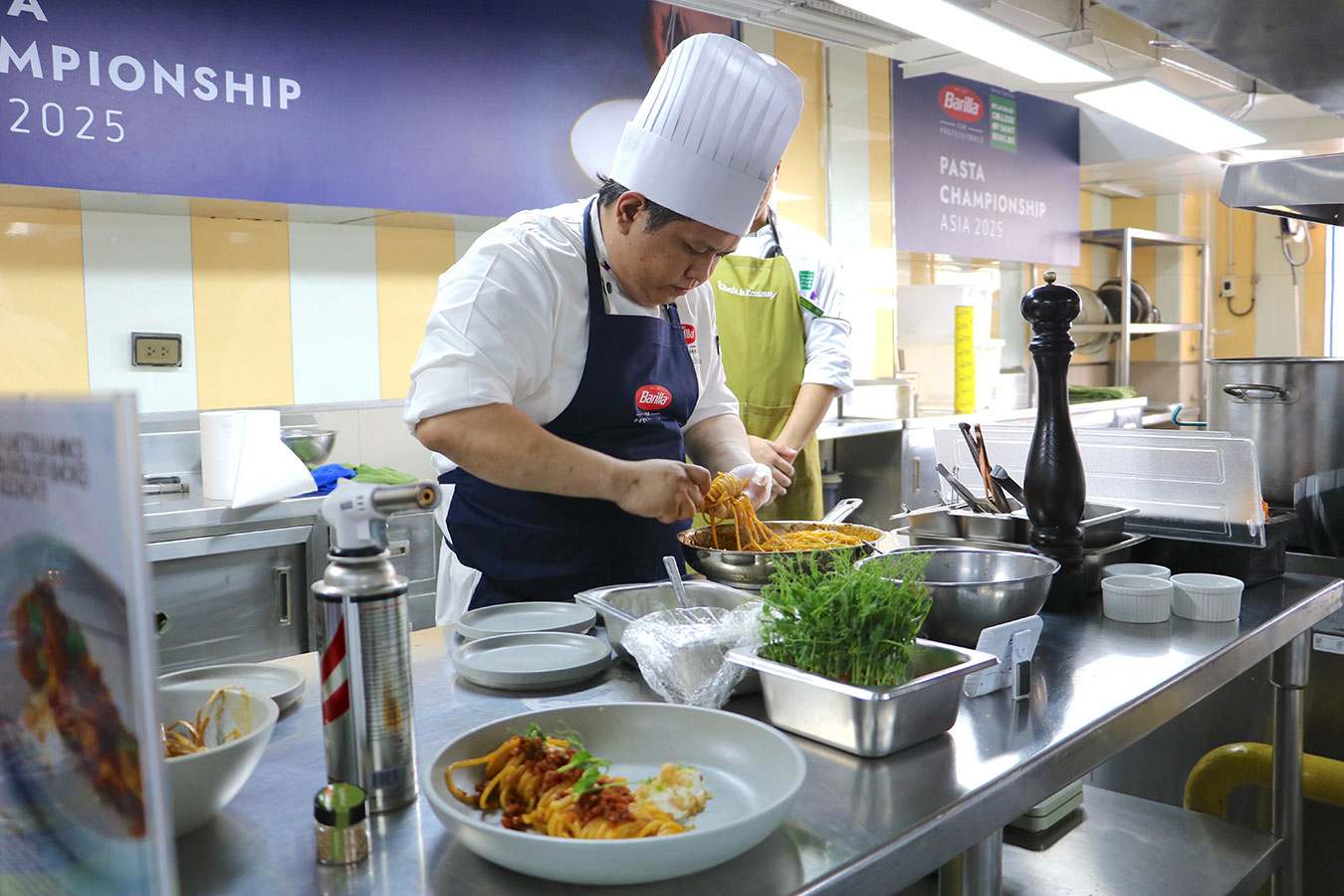
CHEFS from various restaurants and hotels across the country showcased their skills at the recently concluded Philippine finals of the 2025 Pasta Championship Asia. The tilt was spearheaded by Barilla Professionals. The Philippine version was organized in collaboration with Werdenberg International Corp., distributor of imported foods and wines and equipment, and was made possible with the support of Säntis Delicatessen, Barilla’s partner distributor in the Philippines. It was likewise led by Chefs in Progress, the professional Culinary Arts Management organization of the De La Salle-College of Saint Benilde (DLS-CSB) School of Hotel, Restaurant, and Institution Management (SHRIM). The event was held at the Angelo King International Center. The live cooking competition challenged participants to present their distinct and original creations which highlight pasta as the hero product. The entries had to include 85 grams of dry spaghetti pasta n.5 or penne rigate per portion. Aaron Joseph Gulinao of The Westin Manila emerged as the National Champion. His winning dish — dubbed Spaghetti in Alaminos Longganisa Ragu with Smoked Kesong Puti Mousse — married Italian tradition and culture with Filipino gastronomy and storytelling. Mr. Gulinao will represent the Philippines on the regional stage of the 2025 Pasta Championship Asia, in competition with fellow national winners from China, Vietnam, Malaysia, Korea, India, Japan, and Singapore. The grand finals will be held in Kuala Lumpur in November.


Chowking Chao Fan is now beefier

THE NEW Beefed-Up Chowking Beef Chao Fan now has more beefy flavor. Chowking’s signature fried rice is loaded with bigger beef bits, improved savory sauce, vegetables, and egg bits. These ingredients are tossed in a wok, giving it a rich and smoky flavor. Chowking’s new Beef Chao Fan is now at P89. For a limited time only, customers can get Buy 1 Take 1 Beef Chao Fan ala carte by using the code BEEFYWOKSARAP when they purchase one Beef Chao Fan (ala carte, with a drink or with Siomai platter). This exclusive promo runs until Aug. 31 and is valid only on delivery orders made via www.chowkingdelivery.com, the Chowking App, and at participating stores nationwide.


Subway brings back Pizza Melt sub

SUBWAY Philippines is bringing back one of its most requested sandwiches with the limited-time return of the Pizza Melt sub, available at all branches nationwide throughout July. The sub returns with its signature combination of pepperoni, salami, and bacon, layered with marinara sauce and melted cheese. Fresh white onions, black olives, and green peppers add texture and flavor. The sandwich uses Subway’s signature Parmesan Oregano bread. Subway is also introducing the Monday Refresh promo. The first nine customers to purchase a Footlong Pizza Melt will receive a free Sprite Zero or Royal (in can) on Mondays this month — July 14, 21, and 28. The promotion is available for both dine-in and takeout orders across all Subway Philippines restaurants. The Subway Pizza Melt is available as a six-inch sub (P210 a la carte, P315 meal), footlong (P400 a la carte, P505 meal), and wrap (P220 a la carte, P325 meal). Price may vary per restaurant location. The Pizza Melt sub is available until Aug. 4 at all Subway stores in the Philippines.


Julie’s has nine breads for kids’ baon

IT’S back-to-school season, which also means it’s back to the daily routine of preparing your kids’ baon (packed meal) for their break time. Parents and guardians searching for tasty, filling, and budget-friendly options can check out Julie’s for its fresh and affordable breads, and a wide range of treats for snacks. Among its favorites are Cheese Bread (a golden-brown crust hiding a serving of cheese), Cheese Streusel (its creamy and gritty topping complements the diced cheese filling), Milky Cheese De Sal (pandesal coated with milk powder and filled with creamy cheese), Choco Germa (a pastry with a creamy chocolate filling and topped with a mixture of sugar and margarine), Chocolate Crinkles (fudgey cookies), Mini Milky Donut (it comes in several flavors, chocolate, Bavarian, strawberry, and yema), Violet Cream Loaf (a white and violet braided loaf topped with a creamy topping and grated cheese), Spanish Bread (a crescent-shaped roll filled with a sweet and creamy mixture), and Ensaymada (soft, buttery bread with sugar and grated cheese). Check out Julie’s new PanBaon Bundles which are now available in select Julie’s branches around the country. PanBaon Bundles come with freebies in Luzon and Visayas for a limited time only.

Seagate’s new compact SSD now available in Philippines

SEAGATE TECHNOLOGY

SEAGATE Technology Holdings plc’s latest compact solid-state drive (SSD), targeted towards on-the-go professionals, is now available in the Philippines.

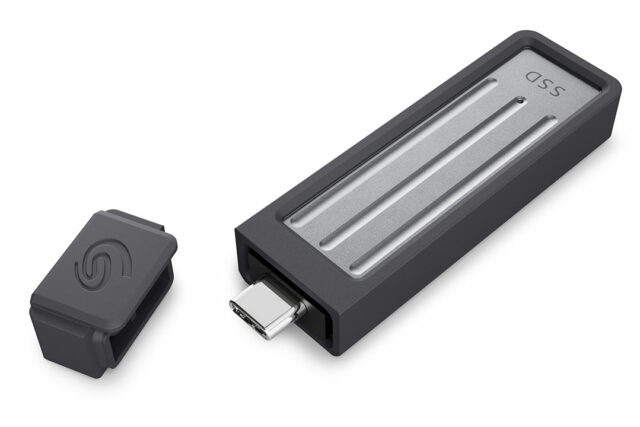
The Seagate Ultra Compact SSD is now available at all Seagate authorized retail and online stores in the Philippines. It is priced at P5,749.00 for the 1 terabyte (TB) model and P10,499.00 for the 2TB variant.

The SSD, which offers transfer speeds of up to 1,000 megabytes per second, is a compact SSD that is the size of a thumb drive.

It has direct USB-C port connectivity and is compatible with Windows, Mac, Android, iPhone, tablets, and gaming consoles.

The Seagate Ultra Compact SSD features three-meter drop resistance and has an IP54 dust and water resistance rating. It also comes with a removable rubber sleeve for extra protection and is made with a minimum of 35% recycled materials.

It also comes with a three-year limited warranty and three years of Seagate Rescue Data Recovery Services.

The SSD comes with Seagate Toolkit backup software, which allows users to backup and sync files.

It also offers six-month complimentary trials of Dropbox Backup, which lets users automatically backup one computer and one external drive, and Mylio Photos+, which is for organizing photos and videos. — BVR

NAVER Cloud’s former CEO joins Converge board

PARK WEONGI — CONVERGE ICT SOLUTIONS, INC.

CONVERGE ICT Solutions, Inc. said Park Weongi, former chief executive officer (CEO) of NAVER Cloud, has joined its board of directors.

In a media release on Wednesday, Converge said it appointed Mr. Park to its board on July 8 to support its shift from pure connectivity toward digital infrastructure and technology services.

“Converge is no longer just a connectivity company. We’re building the digital backbone of the future — and we need board-level guidance from leaders who’ve already built those foundations at a global scale,” said Converge CEO and Co-founder Dennis Anthony H. Uy.

Mr. Park will join the Board Risk Oversight Committee and the Remuneration Committee, Converge said, adding that he will serve the unexpired term of Francis Ed. Lim, who was appointed chairman of the Securities and Exchange Commission.

NAVER Cloud is a cloud service provider based in South Korea.

“Converge’s pivot to becoming a techco involves significant investment in digital platforms, data centers, cloud services, and AI (artificial intelligence)-based solutions. Park’s experience scaling NAVER’s cloud business and navigating fast-evolving technology markets will directly inform Converge’s strategy in these areas,” it said.

Further, Converge has appointed Arlene San Juan as its treasurer, following the designation of Christine R. Blabagno as chief risk officer, concurrent with her role as the company’s deputy chief financial officer. — Ashley Erika O. Jose