Home Blog Page 128

The move to a digital apostille system

STOCK PHOTO | Image by Wirestock from Freepik

The Philippines acceded to the Hague Apostille Convention on Sept. 12, 2018. The Convention took effect in the Philippines on May 14, 2019. The Convention was intended to simplify the authentication of public documents for use abroad by replacing the multi-step legalization process with a single certification known as an apostille. An apostille serves to authenticate the origin of a public document, and verify the signature, seal, or stamp of the issuing authority so that the document may be recognized in another contracting state without further authentication. For documents intended for use in countries that are not parties to the Convention, the traditional consular legalization through the relevant embassy or consulate remains necessary.

Following the Philippines’ accession to the Hague Apostille Convention, apostilles have been traditionally secured through a paper-based process with the Department of Foreign Affairs (DFA). Applicants are required to obtain the original document from the issuing agency, secure an online appointment with the DFA, and appear in person or through an authorized representative to submit the document for apostille.

In 2024, the DFA introduced the e-Apostille service for Philippine Statistics Authority (PSA) civil registry documents. This allowed applicants to obtain apostilles for PSA e-Certificates without the need for personal appearance, with the apostille issued and transmitted electronically. However, the system was limited in scope and applied only to PSA or civil registry documents.

On March 16, in addition to PSA e-Certificates, the DFA introduced a digital apostille system for Commission on Higher Education (CHED) Electronic Certification, Authentication, and Verification (eCAV) documents. Such a development in the apostille process framework allows the said public documents to be issued, apostilled, and thereafter transmitted entirely in their electronic form.

Under this system, documents such as birth, marriage, and death certificates which can be currently obtained as PSA e-Certificates may be subsequently apostilled without the need for their physical submission, within a shorter apostille process timeline. Academic records processed through CHED’s eCAV platform may also be e-Apostilled. The apostille is issued electronically and transmitted directly to the applicant. This start-to-finish digital process is aimed to minimize processing time and eliminating the need for personal appearance before the PSA, CHED, and the DFA.

It is important to note that e-Apostilles are intended only for electronic transmission to the applicant and should not be printed for use as the e-Apostille loses its validity when printed and submitted as hard copies.

To balance the efficiency and practicality that come with the transition to an e-Apostille digital system, the DFA put in place safeguards to preserve the integrity and authenticity of apostilled documents. Verification mechanisms — including QR codes, verification links, and a digital signature checker — are available to ensure that e-Apostilles remain secure and could be readily validated by their receiving authorities.

Although the e-Apostille is available for select public documents, the traditional apostille process for other documents remains available. Applicants who need the apostille of physically issued or executed documents or whose intended recipients do not accept electronic apostilles, may continue to avail of the online appointment system with the DFA and the physical submission of documents for apostille. These multiple modes of securing apostilles allow for flexibility, accommodating varying requirements across agencies and jurisdictions.

The introduction of the digital apostille system reflects a calibrated step toward greater efficiency and accessibility in public service. The DFA continues to exert recognizable efforts in streamlining the apostille process for documents while maintaining the safeguards necessary to keep the integrity of public documents used in cross-border transactions. The start of the e-Apostille system is a step forward to making processes simple, straightforward, and readily available to the public.

This article is only for general informational and educational purposes and is not offered as and does not constitute legal advice or opinion.


Christianna Manami Y. Salud is a senior associate of the Immigration department of the Angara Abello Concepcion Regala & Cruz Law Offices (ACCRALAW).

cysalud@accralaw.com

(632) 8830-8000

Rimini Street helps firms optimize legacy IT systems

UNSPLASH

By Edg Adrian A. Eva, Reporter

RIMINI STREET, INC., a global provider of enterprise software support, is helping companies extract more value from their existing information technology (IT) systems as many firms struggle to realize returns on artificial intelligence (AI) investments.

Michael L. Perica, executive vice-president and chief financial officer at Rimini Street, said many organizations fail to generate meaningful benefits from early AI initiatives due to the absence of a clear strategic roadmap and inadequate data infrastructure.

“One will not have success unless you have an overall roadmap, a strategy, and the appropriate preparedness to fully realize the benefits of investing in this technology,” he told BusinessWorld via Microsoft Teams.

“At Rimini Street, we support clients, optimize their existing systems, and then prepare them for innovation,” he added.

Only 20% of chief financial officers are satisfied with their technology investments including security, AI, customer-facing software-as-a-service (SaaS) platforms and enterprise resource planning systems, according to the Rimini Street Survey 2024, which polled almost 3,000 global finance and IT leaders.

The survey found that companies often experience negative consequences from these investments, such as rising costs, limited future flexibility and significant organizational disruption.

To address these challenges, Mr. Perica said Rimini Street offers a vendor‑independent support model that lets organizations continue using their software releases for as long as needed, without being forced into costly upgrades or system migrations.

“We have our own innovative solutions that use agentic AI and workflows on your own data and systems, maximizing your customizations or even those of others,” he said.

They also work with partners for agentic AI, allowing organizations to prioritize and invest at their own pace with their data, while achieving the appropriate level of preparedness, he pointed out.

This approach, he said, lets firms recover 80% to 90% of their maintenance and support spending, freeing up what he described as “sacred dollars” that could be redirected toward strategic initiatives such as digital transformation and AI deployment.

“Redeploying those savings is what puts one in a position to optimize preparedness and ultimately fund innovation,” he said.

Among Rimini Street’s offerings is Rimini Consult, an advisory service focused on preparing legacy systems for modern technologies.

The firm’s enterprise architects and data specialists clean and standardize existing databases and build custom digital integrations that allow older systems to work seamlessly with newer AI tools.

Among Rimini Street’s clients in the Philippines is Philippine Airlines, which it provided with third-party support for its core enterprise software, allowing the carrier to cut maintenance costs and fund its digital transformation, Mr. Perica said.

He advised companies to maintain control over their data and avoid “vendor lock‑in” arrangements that limit flexibility and long‑term value from technology investments, including AI.

He further urged firms to align technology spending with their own strategic priorities rather than adapting their business models to match a software provider’s roadmap.

The Philippines and the broader Southeast Asian region, Mr. Perica said, represent an “emerging and exciting market” for Rimini Street.

The company plans to deepen engagement with Filipino partners, monitor regional technology trends, and tap into local talent to support its global operations, he said.

Regulators warn online lenders over data privacy violations

STOCK PHOTO | Image by Yura Fresh from Unsplash

THE SECURITIES and Exchange Commission (SEC), Department of Information and Communications Technology (DICT), and National Privacy Commission (NPC) issued a joint advisory reminding online lending platforms (OLPs) to comply with data privacy and borrower protection rules.

“The government recently received numerous reports of [OLPs] engaging in harassment, intimidation, public shaming and unlawful use of personal data in their collection practices,” the advisory read.

“Digital transformation must protect — not prey upon — the Filipino people. The National Government stands firm in enforcing the law and safeguarding the rights, privacy, and dignity of every Filipino in the digital economy,” it added.

The advisory cited Republic Act No. 10173, or the Data Privacy Act of 2012, and Republic Act No. 11765, or the Financial Products and Services Consumer Protection Act. It also referenced SEC Memorandum Circulars No. 18 and 19 (both Series of 2019), which prohibit unfair debt collection practices and require disclosure of OLP operations by financing companies.

The SEC, DICT, and NPC said OLPs must not access borrowers’ contact lists or contact non-guarantors, as these practices may lead to harassment, unauthorized debt collection, and excessive processing of personal data.

The joint advisory also requires OLPs to securely dispose of data once it is no longer needed and to allow users to revoke application permissions after the purpose has been fulfilled, among other requirements.

“Violations of applicable laws, [implementing rules and regulations], and SEC regulations may subject the erring [financing and lending companies] to administrative sanctions, including fines, suspension or revocation of authority to operate, and other penalties provided under relevant laws,” the SEC, DICT, and NPC said.

The regulators also reminded OLP users to remain vigilant against risks to their personal data. They advised users to download applications only from official or verified sources linked to SEC-registered firms.

The advisory also emphasized the need to review privacy notices carefully, noting that some applications use deceptive tactics to process user data. It added that borrowers should check application permissions to prevent unnecessary access beyond legitimate needs.

“Borrowers must also inform and secure the express consent of their guarantors,” the three agencies said.

Victims of unfair debt collection may file complaints with the SEC Financing and Lending Companies Department through its e-mail address or hotline.

Harassment, threats, fraud, and scams should be reported to authorities, including the DICT, National Bureau of Investigation, and Philippine National Police. — Alexandria Grace C. Magno

Philippines improves in women’s health ranking but still lags among its peers in the region

The Philippines improved two places to 107th out of 144 countries and territories in the latest edition of The Hologic Global Women’s Health Index by global medical technology company Hologic, Inc. Out of a possible 100, where higher scores are better, the country got 46.36, below the global average of 53.96. This put the Philippines as the second worst among its peers in the East and Southeast Asian region. The index measures women’s health across the dimensions of preventive care, emotional health, opinions of health and safety, basic needs, and individual health.

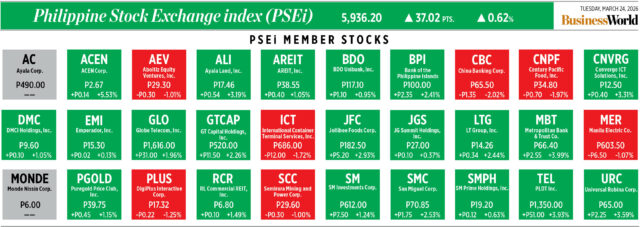
How PSEi member stocks performed — March 24, 2026

Here’s a quick glance at how PSEi stocks fared on Tuesday, March 24, 2026.


Japanese combat troops to join PHL Balikatan war games for first time

DVIDS/ LANCE CPL. ISAIAH CAMPBELL

By Kenneth Christiane L. Basilio, Reporter

JAPANESE combat troops are set to participate in annual war games in the Philippines for the first time next month as Manila and Tokyo seek to boost interoperability amid shared security concerns with China.

Japan’s combat forces will take part in the Philippines’ flagship Balikatan military exercises in April alongside US troops, in drills expected to be the most extensive in scope and intensity to date, Philippine military Chief of Staff General Romeo S. Brawner, Jr. said on Tuesday.

“For the very first time, after a very, very long time, combat troops from Japan, from the Japanese Self-Defense Forces, will be coming here to the Philippines to join us in the Balikatan exercise,” he told reporters on the sidelines of a forum organized by think tank Stratbase Institute.

“Aside from having more participants — we can see Japan’s participation — this will expand the scope of our defensive operations,” he said in mixed English and Filipino. “Our exercises will be broader, and we will be better prepared for any eventuality.”

The Armed Forces of the Philippines will launch Balikatan — Filipino for “shoulder‑to‑shoulder” — on April 20, Mr. Brawner said.

The annual drills have evolved into Southeast Asia’s premier combat rehearsal as the Philippines and its allies deepen security cooperation in response to China’s growing assertiveness in the region.

Philippine and US forces have traditionally anchored the exercises, but Japan’s participation this year highlights Manila’s efforts to expand its network of security partners beyond Washington.

Mr. Brawner declined to provide detailed information about the scale of Japan’s involvement but said the drills would be more intense and would include efforts to strengthen capabilities against emerging threats, including cyberwarfare. Japan is expected to take part in command‑and‑control exercises as well as live‑fire drills.

“I cannot divulge the exact numbers of what type of units are coming in or the equipment they’re going to bring here, but suffice to say that they will be sending a bigger contingent,” he said.

Japan’s participation is particularly notable given its pacifist Constitution, imposed by the US after World War II that renounces the use of military force. Japan invaded several Asian nations during the war, including the Philippines.

“In 1945, we found ourselves on opposite sides of the war,” Mr. Brawner said. “This time, we find ourselves on the side of efforts to promote a rules‑based international order.”

Japan has emerged as a “like‑minded partner” of the Philippines in promoting regional stability, Mr. Brawner said, as China intensifies what Manila describes as coercive actions in the South China Sea while Tokyo faces its own maritime disputes with Beijing.

“It is a partnership that not only responds to present challenges, but anticipates future demands that are anchored in mutual respect, guided by shared values and committed to lasting peace and stability,” he said.

China claims sovereignty over much of the South China Sea based on a so‑called nine‑dash line map that dates back to the 1940s.

The claim overlaps with the Philippines’ exclusive economic zone, where Beijing has deployed coast guard and maritime militia vessels despite a 2016 ruling by a United Nations‑backed arbitral tribunal that voided its claims. Beijing has continued to reject the ruling.

Like the Philippines, Japan is also embroiled in a dispute with China over the Senkaku Islands, which lie near key shipping lanes and are believed to be rich in marine resources.

“Some countries promote only their own interests and do this through coercion, forcing what they want to happen in the region,” Mr. Brawner said. “That cannot be allowed.”

“This is why the coalitions we are building are important, and one of our most significant partners is Japan,” he added.

Separately, the Philippine Coast Guard (PCG) said China’s coast guard plans to conduct a “clearing operation” near the disputed Scarborough Shoal, a traditional fishing ground for Filipino fishermen.

In a statement, the PCG said it deployed vessels to protect more than 20 Filipino fishing boats from harassment after monitoring a Chinese coast guard ship that broadcast its “intention to conduct a clearing operation” southeast of the shoal.

The Chinese Embassy in Manila did not immediately reply to a request for comment sent via Viber.

Two PCG vessels, along with five patrol boats from the Bureau of Fisheries and Aquatic Resources, were dispatched to escort Filipino fishermen in the area.

The deployment followed encounters last week in which Chinese coast guard ships allegedly used sirens and deployed rigid‑hull inflatable boats to drive Filipino fishermen away from the contested feature.

“The joint deployment ensured the safety and security of the Filipino fishermen,” the PCG said, adding that authorities also provided fuel, food packs, and ice bags to extend their fishing operations in the area.

Philippines declares energy emergency amid surging fuel prices 

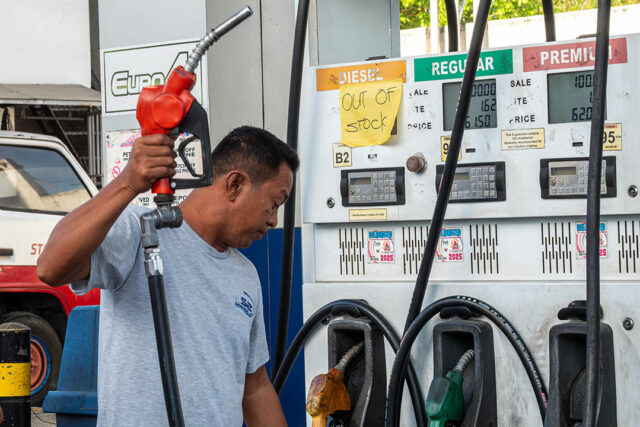
An attendant updates the fuel prices at a gas station in Cubao, Quezon City, March 10, 2026. — PHILIPPINE STAR/MIGUEL DE GUZMAN

By Chloe Mari A. Hufana, Reporter

Philippine President Ferdinand R. Marcos, Jr. declared a national state of energy emergency on Tuesday, which gives the government expanded powers to secure fuel supplies and shield the economy from surging oil prices triggered by the war involving Iran, Israel and the US. 

In Executive Order No. 110, Mr. Marcos said escalating hostilities in the Middle East and disruptions in critical shipping routes such as the Strait of Hormuz pose an “imminent danger” to the country’s energy security, underscoring the Philippines’ vulnerability as a major importer of petroleum products. 

The order activates a coordinated response framework known as UPLIFT or Unified Package for Livelihoods, Industry, Food and Transport, aimed at stabilizing fuel supply, sustaining economic activity and protecting sectors most exposed to rising energy costs. 

Global oil prices have surged since the conflict erupted late February, raising inflation risks for the Philippines, where fuel costs directly affect transportation fares, food prices and electricity rates. 

The move comes even as Malacaсang has maintained that the country is not facing an immediate fuel shortage, citing stable inventories and diversification of supply sources. 

The Palace said the government is negotiating with alternative suppliers including China, Russia, Japan, South Korea, Brunei and India to reduce reliance on Middle Eastern oil. Mr. Mr. Marcos earlier said talks with these countries had been “positive,” though no supply agreements have been announced. 

Under the executive order, the Department of Energy (DoE) may take emergency actions such as direct procurement of petroleum products and closer coordination with state‑owned companies, including the Philippine National Oil Co. Authorities are also empowered to tighten oversight of fuel pricing and crack down on hoarding, profiteering and market manipulation. 

The government will prioritize fuel allocation for critical sectors including public transport, healthcare, power generation and utilities. 

Approvals for energy projects will be fast‑tracked to boost domestic generation capacity, while government offices will implement stricter conservation measures, including a four‑day workweek to curb energy use. 

Short‑term relief measures include fuel subsidies for transport operators and drivers, fare support for commuters, expanded public transport services and targeted assistance for households and industries most exposed to higher fuel costs. 

The order also outlines longer‑term steps to reduce dependence on imported oil, including accelerating renewable energy development, expanding electric vehicle adoption in mass transport and promoting energy‑efficiency measures across sectors. 

A Cabinet‑level committee headed by Mr. Marcos will oversee implementation, bringing together officials from economic, transport, agriculture and social welfare agencies to coordinate supply‑side interventions and targeted relief. 

As the Iran war nears its one‑month mark, the Philippines has relied heavily on fuel and cash subsidies to cushion the impact on consumers. 

The President has asked Congress to grant him emergency powers to suspend or reduce excise taxes on petroleum products, though he has yet to sign the proposed measure and has cited complex fiscal calculations. 

Fuel prices rose again this week, extending one of the longest streaks of increases in recent years. Some oil companies raised diesel prices by as much as P18 per liter and gasoline by about P8, while government estimates pointed to increases of up to P11.88 for diesel, P6.47 for gasoline and P13.66 for kerosene. 

In Metro Manila, pump prices could climb to P126.78 per liter for diesel, P98.07 for gasoline and P157.45 for kerosene, marking the 13th straight weekly increase for diesel and kerosene and the 11th for gasoline. 

Fuel subsidies to be paid through digital platforms

MOTORISTS queue at a gasoline station along Norzagaray Road in San Jose del Monte on March 8, 2026. — PHILIPPINE STAR/RYAN BALDEMOR

THE Philippine government plans to use digital payment platforms to distribute fuel subsidies to transport workers, President Ferdinand R. Marcos, Jr. said on Tuesday, as authorities move to cushion the impact of rising oil prices on Filipinos.

Speaking during a fuel subsidy distribution event at the Parañaque Integrated Terminal Exchange, Mr. Marcos said the government would tap multiple payment channels, including digital wallets and traditional banks, to ensure faster and more convenient aid distribution.

“Maybe it’s more convenient, it’s easier, more practical, as much as possible, if we use digital payment,” the President told bus operators and drivers in Filipino, citing the mobile wallet application GCash.

The government has activated fuel and cash subsidy programs to help public utility vehicle (PUV) drivers and operators cope with surging fuel costs driven by war in the Middle East.

Mr. Marcos last week suspended a proposed fare increase for PUVs, citing the need to balance the welfare of commuters and transport workers, while assuring the latter of additional government support.

During Tuesday’s event, the President oversaw the distribution of fuel subsidies to at least 27 bus operators covering 1,096 units. Operators received P10,000 per unit, while drivers were given P5,000 each.

“There are still a few who really want it — they don’t want to go digital,” Mr. Marcos said. “It’s also possible that they can issue a check, and if it’s really necessary, even cash is still possible.”

The Department of Transportation has allocated P2.5 billion for PUVs under the Fuel Subsidy project, while the Department of Social Welfare and Development (DSWD) is implementing separate cash aid under its Assistance to Individuals in Crisis Situations program.

Also on Tuesday, the DSWD began distributing P5,000 in cash aid to ride-hailing drivers. About 27,000 drivers in Metro Manila are expected to benefit, according to DSWD Secretary Rexlon T. Gatchalian.

Mr. Marcos urged transport operators to work with the National Government to mitigate the impact of rising fuel prices on commuters.

“Please help us so that our riding public doesn’t have to suffer too much, and they don’t have to pay too much because we know what’s going on — oil prices are changing all over the world,” he said.

“With cooperation, I’m bold enough to say that as long as we work together — the private sector, operators, and government — we can ensure commuters’ travel is smooth,” he added.

Several transport groups have scheduled nationwide strikes to protest rising fuel prices and to press the President to sign a measure suspending or reducing excise taxes on fuel.

The subsidy program covers multiple transport sectors, including jeepneys, buses, taxis, ride‑hailing platforms, tricycles and delivery services. More than 245,000 drivers and operators of over 1.18 million vehicles are expected to benefit.

The government began distributing P5,000 subsidies in Metro Manila on March 17, with provincial rollouts set for April.

Fuel prices surged following the outbreak of the Iran war on Feb. 28, after coordinated US and Israeli airstrikes on Iranian targets triggered retaliatory attacks and disrupted key oil supply routes, including the Strait of Hormuz.

Local pump prices are set to rise again this week, extending a streak of weekly increases, although officials said the pace of hikes is beginning to slow as global oil markets show signs of stabilizing.

The Department of Energy said gasoline prices could increase by as much as P6.47 per liter, diesel by up to P11.88, and kerosene by as much as P13.66.

These adjustments would mark the 13th consecutive weekly increase for diesel and kerosene, and the 11th straight week of hikes for gasoline. — Chloe Mari A. Hufana

PHL‑China pact to omit sensitive operations

PHILIPPINE COAST GUARD PHOTO

THE Department of Foreign Affairs (DFA) said the proposed memorandum of understanding (MoU) between the Philippine Coast Guard (PCG) and China Coast Guard would be limited in scope and exclude sensitive operations.

“The proposed amendments are limited in scope,” DFA Maritime Affairs spokesman Rogelio E. Villanueva, Jr. said in a statement late on Monday. “They are focused on reestablishing the Joint Coast Guard Committee, which is intended to serve as a formalized channel of communication between the two coast guards.”

Mr. Villanueva stressed that the agreement would not involve sensitive operational areas such as joint patrols between Philippine and Chinese vessels.

The DFA earlier disclosed plans to draft an MoU between the PCG and the China Coast Guard aimed at addressing operational concerns and preventing further incidents in the South China Sea, where encounters between vessels of the two countries have intensified in recent years.

Manila and Beijing signed a memorandum in 2016 to establish a Joint Coast Guard Committee on Maritime Cooperation, which was designed to provide a mechanism for communication and coordination between the two sides.

“Since 2024, both parties have been engaged in discussions to amend and update that agreement,” Mr. Villanueva said.

Earlier, Chinese Ambassador to the Philippines Jing Quan said the MoU was almost complete and would be finalized soon.

His remarks were later contradicted by Philippine Coast Guard spokesman Jay Tristan Tarriela, who said the PCG commandant was not involved in the negotiations.

Mr. Villanueva, however, said discussions had been conducted through proper diplomatic channels and were not confined to meetings under the Bilateral Consultation Mechanism.

“They have been duly reported to and are known by all relevant principals including the national security adviser, the secretary of Foreign Affairs and the PCG commandant,” he said.

The mechanism was established in 2017 as a diplomatic platform for the Philippines and China to discuss issues of mutual concern and explore areas of cooperation, particularly in oil and gas development. The two countries last held a meeting in January 2025.

DFA officials said the discussions are in line with President Ferdinand R. Marcos, Jr.’s order to maintain open lines of communication and engagement with China despite persistent tensions in the South China Sea.

Relations between Manila and Beijing have deteriorated amid repeated confrontations at sea, as China continues to assert and expand its presence in disputed waters.

This is despite a 2016 ruling by a United Nations‑backed arbitral tribunal that voided its expansive maritime claims — a decision Beijing has continued to reject.

“The department reaffirms that engagement and vigilance are complementary, not contradictory,” Mr. Villanueva said, adding that the Philippine government would continue to pursue practical maritime cooperation while upholding national interests.

Philippine authorities have reported multiple incidents involving Chinese coast guard and maritime militia vessels, including harassment through water cannon use, dangerous maneuvers and swarming near maritime features that Manila considers part of its exclusive economic zone. — Adrian H. Halili

House committee to keep inviting Duterte despite silence on impeachment

VICE-PRESIDENT SARA DUTERTE-CARPIO — FACEBOOK.COM/MAYORINDAYSARADUTERTEOFFICIAL

A HOUSE OF REPRESENTATIVES committee handling the impeachment complaints against Vice‑President Sara Duterte‑Carpio will continue sending invitations despite her failure to respond, a congressman said on Tuesday, as hearings on the charges are set to begin.

The House Justice Committee will persist in inviting Ms. Duterte to attend the proceedings so she could answer the allegations if she chooses to do so, Batangas Rep. Gerville R. Luistro said, noting that the Vice‑President had yet to confirm her attendance at Wednesday’s hearing.

“As long as the hearing proper has not yet concluded, we will keep on sending her invitations so that at any point during the proceedings, she can actually come,” Ms. Luistro, who heads the committee, said in a statement in mixed English and Filipino.

Michael T. Poa, spokesman for Ms. Duterte’s legal team, did not immediately reply to a Viber message seeking comment.

The 39‑member House panel is set to begin hearings on Wednesday, in proceedings expected to be politically charged as they could affect Ms. Duterte’s presidential ambitions.

The Vice‑President has announced plans to run for President amid impeachment complaints that, if elevated to the Senate, could result in her removal from office and permanent disqualification from holding public office.

The complaints accuse Ms. Duterte of conspiring to have President Ferdinand R. Marcos, Jr., the First Lady and a former Speaker killed, and of misusing hundreds of millions of pesos in confidential funds — allegations she has denied.

Last week, Ms. Duterte asked the Justice committee to dismiss the complaints, saying the accusations were unsupported by evidence and based largely on speculation.

She said the cases failed to state “ultimate facts” and merely recycled allegations raised during a previous impeachment attempt last year.

“If you’re claiming innocence, you should take advantage of all opportunities to prove your innocence,” Ms. Luistro said. “The hearing proper is the best opportunity for her to defend herself from the allegations in the complaints.”

In early March, the Justice committee advanced two of the four impeachment complaints against Ms. Duterte.

One complaint was dismissed for violating the constitutional ban on filing multiple impeachment cases against the same official within a one‑year period, while another was withdrawn by the complainants.

Lawmakers will now determine whether sufficient evidence exists to support the charges and whether they should be endorsed for a vote in the House plenary.

At least 106 lawmakers must vote in favor for the articles of impeachment to be sent to the Senate, which would convene as an impeachment court.

Ms. Luistro said the committee would also act on several motions related to the cases, including requests to subpoena documents from Ms. Duterte.

Party‑list Rep. Terry L. Ridon said last week these records could include the Vice‑President’s statements of assets, liabilities and net worth, as well as bank, tax and corporate documents.

Resolving these motions would allow the panel to proceed to the “evidentiary phase,” during which lawmakers would assess the merits of the impeachment complaints, Ms. Luistro said.

“If the complainants are ready, we can proceed with the presentation of evidence and witnesses,” she said. “Members will study all the evidence by both the complainants and the respondent.” — Kenneth Christiane L. Basilio

Excise tax bill sent to Palace

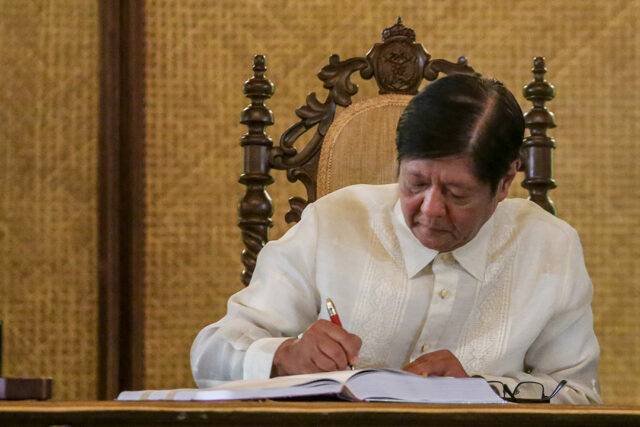
PRESIDENT FERDINAND R. MARCOS, JR. — PHILIPPINE STAR/NOEL PABALATE

SENATE President Vicente C. Sotto III on Tuesday said that he has transmitted to Malacañang a bill that would allow the President to suspend or cut the excise tax on petroleum products.

In a Viber message to reporters, the Senate chief said that he has transmitted to the Office of the President the enrolled copies of the excise tax bill.

The House of Representatives, last week, adopted Senate Bill No. 1982 which bypassed the bicameral conference committee.

The measure would provide President Ferdinand R. Marcos, Jr. authority to reduce or halt collection of taxes imposed on fuel and other petroleum product, to respond to rising fuel prices amid the Middle East crisis.

Mr. Sotto on Monday night said that he has signed the measure and had sent it to the House of Representatives for signing. This was signed and transferred to the Senate on Tuesday afternoon.

In a separate message, Palace Press Officer Clarissa A. Castro said that the Presidential Palace has not yet received a copy of the enrolled bill, as of press time.

Also included in the Senate transmittal is a measure that sets the first election of the Bangsamoro Autonomous Region of Muslim Mindanao to Sept. 14, and every three years after. — Adrian H. Halili

DMW helps 2,630 overseas Filipinos

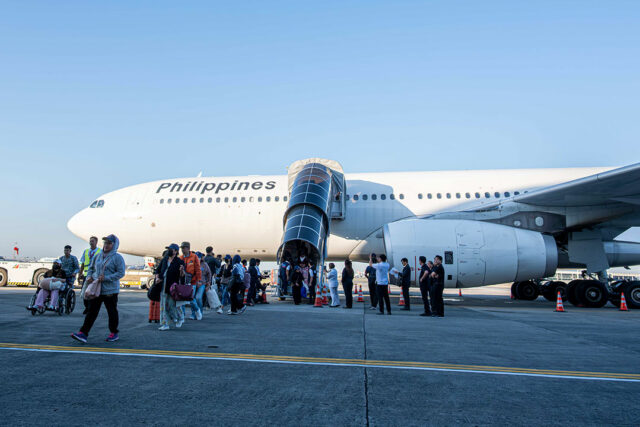
More than 300 Filipinos repatriated from the Middle East arrived at Villamor Airbase, March 23, 2026. — PHILIPPINE STAR/RYAN BALDEMOR

THE Department of Migrant Workers (DMW) on Tuesday reported a total of 2,630 Filipinos have been assisted with their pre-repatriation and post-repatriation needs.

Of this, the government has provided government-funded flights to 1,837 Filipinos, including 1,407 overseas Filipino workers and 430 dependents, Migrant Workers Secretary Hans Leo J. Cacdac told the newly created Proactive Response and Oversight for Timely and Effective Crisis Strategy ad hoc committee in the Senate.

The department has also provided food, transport, and cash aid to 16,660 Filipinos.

The Overseas Workers Welfare Administration (OWWA) also told the panel it has approximately P1.7 billion funds for the repatriation program, of which 20% have already been utilized for commercial and chartered flights, land transportation, and temporary accommodation of the Filipinos requesting to return to the Philippines.

OWWA Administrator Patricia Yvonne M. Caunan said the repatriation costs P175,000 to P190,000 per person inclusive of financial assistance and initial reintegration assistance.

The agency said it would need approximately P4.8 billion to repatriate 1% of overseas Filipinos in the affected region.

According to the Department of Foreign Affairs, 2.4 million Filipinos live in the Middle East. — Kaela Patricia B. Gabriel