Home Blog Page 1249

US tariff to have limited impact on PHL firms’ dollar bond issuances — CreditSights

PCO.GOV.PH

THE 19% tariff set by United States President Donald J. Trump on Philippine goods will have a limited impact on the planned dollar bond issuances by local companies, financial research firm CreditSights said.

“We expect the US tariffs to have a limited impact on the Philippine corporate dollar bond issuers,” CreditSights said in a report.

“We maintain our existing recommendations for the Philippine corporates under our coverage. We do not deem the 19% tariff imposition by the US on good imports from the Philippines as material enough, given their very limited export exposure to the US,” it added.

CreditSights said companies such as ACEN Corp., Globe Telecom, Inc., Manila Water Co., Inc., Petron Corp., PLDT, Inc., and SMC Global Power Holdings Corp. are largely focused on the domestic market.

It added that conglomerates Aboitiz Equity Ventures, Inc. and JG Summit Holdings, Inc. have export-heavy food manufacturing businesses primarily across Asia, and not to the US.

“Aboitiz’s animal feed business may face increased competition from higher US feed imports. JG Summit’s snack foods business could see lower wheat input costs from higher wheat imports from the US,” it said.

Ayala Corp. also has minimal export exposure to the US through its semiconductor subsidiary Integrated Micro-Electronics, Inc., which contributes only a small portion of its total revenue, CreditSights said.

The research firm also said that the Ang-led conglomerate San Miguel Corp. faces marginal export exposure to the US that can be offset by its diversified business portfolio.

“We acknowledge SMC could face weakened domestic competitiveness and pricing for its poultry and animal feed units, given the US is a major supplier of chicken, pork, and animal feed to the Philippines. That said, we deem the impact manageable, supported by SMC’s strong domestic brand equity, well-established presence and its diversified business portfolio,” CreditSights said.

Oil refiner Petron, another Ang-led company, might see higher logistics costs as it may be compelled to source crude oil and gas from the US. However, the company enjoys a full market pass-through mechanism to protect its margins.

CreditSights said the domestic ports of the Razon-led International Container Terminal Services, Inc. (ICTSI) could see higher volume with the expected increased imports of US goods into the Philippines.

“ICTSI has limited direct trade exposure to the US. While it could see some throughput weakness at its Mexico port, we take good comfort in ICTSI’s strong global geographical diversification and ability to preserve margins by hiking port fees,” it said.

The local business of fastfood giant Jollibee Foods Corp. also stands to benefit from lower input costs of wheat and poultry due to higher US imports.

Mr. Trump recently announced a 19% tariff on Philippine goods entering the US, a step down from the 20% duty set earlier this month. However, it is higher than the 17% tariff announced by Mr. Trump as part of his Liberation Day tariffs in April. — Revin Mikhael D. Ochave

Change of heart, or getting real?

PHILIPPINE STAR/EDD GUMBAN

We monitored, and even took notes of, the several Supreme Court oral arguments on the Philippine Health Insurance Corp. (PhilHealth) issue, that because of what the Palace and Congress thought a surplus fund existed, P60 billion was remitted to the National Treasury and the proposed subsidy of P74.43 billion was zeroed out.

Some justices of the High Court illustrated with their own personal experience that no matter how much one makes of PhilHealth’s reserve fund of P600 billion and the reported P150 billion surplus from its 2024 budget, the health corporation, which is funded by members’ contributions, is absolutely short of fulfilling its legal mandate of providing more health cover to more Filipinos. So many out-of-pocket expenses in the hospital have to be paid by members when they get sick. Many kinds of health issues remain outside PhilHealth coverage including procedures and therapies. Those “surplus” funds existed, and continue to exist, because PhilHealth has yet to settle its old and new obligations with both its members and hospitals. The deficit in its delivery to implement the Universal Health Care Act keeps on bloating.

The picture is no different from a man traveling with a full tank of gas, but he has a few thousand kilometers to travel. Even if he goes hybrid, he would still have to plug in, or rely on gas to recharge.

Up to the last of the oral arguments in Baguio City, the National Government insisted to the Supreme Court that the state health insurer enjoyed surplus funds and therefore sequestering P60 billion was more than justified, that the same amount was anyway channeled to health-related public spending.

This could have escaped the attention of the nation previously glued to the PhilHealth controversy for months, but in the 2026 proposed national budget, the Palace and the Department of Budget and Management seemed to have a sudden change of heart. Finance Secretary Ralph Recto himself announced that “in 2026, there is a subsidy for PhilHealth.”

As the media commented, such a subsidy allocation reversed the policy adopted during the finalization of the 2025 budget when the health agency was denied any subsidy. The numbers cited then and today don’t fit in.

PhilHealth’s fund balance is projected at P348 billion by the end of 2025, more than double the level last year, yet the health insurer is deemed entitled to a subsidy? The proposal to restore the subsidy next year is aimed at covering benefit payouts next year and, in the words of the Finance Secretary, “to support an increase of 30% to 50% in benefit packages, broadening coverage and enhancing service delivery across the country.”

What?

We don’t expect to hear mea culpa among policymakers. But no matter how they conceal it, the arguments of the petitioners against the Government and Congress are now being marshalled in support of restoring the subsidy and the higher allocation for the Department of Health. Unwittingly, the respondents are admitting that PhilHealth had no surplus funds, that any reserve balance would have to be used to settle its obligations with its members and partner health institutions, whether public or private, and the universal healthcare system is yet to fully see the light of day. Only a small portion of the population is covered, only a limited range of health problems and procedures could be financed.

On top of these, PhilHealth announced new-found good governance. With the subsidy, there will be no increase in members’ contributions, collections are to be streamlined and strengthened.

Nothing is new here.

As early as eight years ago, the World Health Organization (WHO) spelled out some five strategic priorities for the Philippines in the context of the country’s cooperation with WHO. Priority 1 is to save lives by ensuring a full access to immediate-impact interventions. Priority 2 is the promotion of well-being by empowering people to lead healthy lives and enjoy responsive health services. Priority 3 is health protection through anticipation and mitigation of disasters, and environmental and emerging health threats. Priority 4 is to optimize the health architecture by overcoming fragmentation and achieving universal health coverage. And Priority 5 is to use platforms for health through support in all aspects, settings, policies, and sectors.

These strategic priorities also resonate in various laws and executive orders on the universal healthcare system, and many of the policy implications have been funded by the National Budget. But it took a pandemic in 2020 and 2021 for public spending to start adhering to the constitutional and statutory provisions on the priority that should have been given to the health sector, in the first place.

In 2021 for instance, current health expenditure (CHE) reached P1.09 trillion or some 18.5% higher compared with P917.15 billion in 2020. But then, as reported by the Philippine Statistics Authority, investment or capital formation in health (HK) amounting to P71.15 billion actually declined from P88.54 billion in 2020, or by nearly 20%. Without such investment in health infrastructure, public health would not even be viable.

If not for health spending financed through government schemes and compulsory contributory healthcare financing schemes, public health would have been of arguably poorer quality. All in, they accounted for P546.64 billion or more than half of CHE. Most important, if the public sector is short of what needs to be delivered to the Filipino people in public health, and health insurance schemes are short of what is required, definitely it is the Filipino households who have to pick up the tab.

The last component should be very familiar to us, even to some jurists in the High Court who had to go through medical procedures in the past. Household out-of-pocket payment (OOP) stood at P451 billion — yes, that much. This is not too much of a stretch, but any deficit in budgetary allocation to the health sector, whether to the Department of Health or PhilHealth, will have to be absorbed by the poor Filipino households. Either by way of a bigger out-of-pocket expense, or by denied health services.

For hospitals and other partner health institutions, any unsettled accounts could ultimately lead to their inability to deliver health services to their constituency, or else, they close down.

Talo ang Pilipino! (Filipinos lose!)

It is not therefore surprising that the new head of PhilHealth Edwin Mercado should appeal to the private sector during the weekend “to help address gaps in the country’s healthcare system.” He correctly pointed out that while the demand for health services continues to rise, supply remains so much behind. Mercado is for strengthening primary care to keep members healthy in order to reduce the need for in-patient services.

As we wrote last week, this year’s budget was challenged at the Supreme Court for some unconstitutional provisions put together in an unconstitutional process. It would be difficult for this year’s budget to pass the ideal standard in the allocation of public resources, namely, that it should be “strategic, transparent, accountable, fair, and democratic.” Every peso squandered, or repurposed to serve bad governance, or dedicated to the politics of patronage and corruption is every peso denied an ordinary Filipino in terms of getting good public health or public education.

It’s a good sign that the subsidy to PhilHealth is to be restored and the health sector is to be given a higher allocation in next year’s budget. But like in the theater, we must suspend our applause until the fat lady sings.

Will we ever again see enormous allocations to flood control projects only to be flooded ourselves on the streets or in the privacy of our own homes? Will we ever again see congressional and senatorial allocations of pork while we hear moral praises to the highest? Will we ever again see corruption in the purchase of educational equipment, gadgets and supplies at the Education department while our senior high school students rank lowest in science, reading, and mathematics, and are bottom dwellers in creative thinking? Will we ever again see unconscionable wastage in public resources when they could instead be used to digitalize the delivery of public services and establish greater connectivity in government and industries?

It will be good to hear Senator Risa Hontiveros fiscalize the national budget and Senator Ping Lacson scrutinize each and every allocation in infrastructure, and institutionalize transparency and openness in the bicameral conference on the final shape of the 2026 national budget.

It would be unprecedented if this case of PhilHealth symbolizes a change of heart, or the policy makers are just getting real. Our wish is for the legislature to do its job on the budget while fulfilling their constitutional duty to hear the Articles of Impeachment against the Vice-President. Holding the purse hostage to dispose of the impeachment complaint would indeed be theatrical!


Diwa C. Guinigundo is the former deputy governor for the Monetary and Economics Sector, the Bangko Sentral ng Pilipinas (BSP). He served the BSP for 41 years. In 2001-2003, he was alternate executive director at the International Monetary Fund in Washington, DC. He is the senior pastor of the Fullness of Christ International Ministries in Mandaluyong.

BSP, BTr working to strengthen payments, settlements systems

By Luisa Maria Jacinta C. Jocson, Senior Reporter

THE BANGKO SENTRAL ng Pilipinas (BSP) and the Bureau of the Treasury (BTr) have signed a memorandum of understanding (MoU) to strengthen their payments and settlements systems.

“We are creating a safer and more efficient securities market that enables the government to raise funds more effectively, supporting vital public investments in education, infrastructure, healthcare, and more,” BSP Deputy Governor Mamerto E. Tangonan said during the MoU signing on Thursday.

The MoU aims to promote safety and resilience of the interconnected financial market infrastructures (FMIs) operated by the BSP and the BTr. Under the agreement, the agencies will link the central bank’s Peso Real-Time Gross Settlement (RTGS) System and the Treasury’s National Registry of Scripless Securities (NROSS).

“This collaboration also aims to align operational practices with international standards, enhancing our ability to manage risk, secure transactions, and build market confidence,” Mr. Tangonan said.

The agreement also covers other systems related to the Peso RTGS and NROSS, such as the Delivery versus Payment system and Intraday Settlement Facility.

National Treasurer Sharon P. Almanza said the signing “formalizes our mutual intent toward a more robust, secure, reliable, and resilient financial market infrastructure.”

“As the operator of the NROSS, which is the central securities depository and securities settlement system for all government securities and BSP securities, the BTr recognizes the vital role we play in ensuring the integrity of our system and maintaining financial market confidence and stability.”

Ms. Almanza said the partnership also strengthens their commitment to adhere to the financial market infrastructure principles issued by the Bank for International Settlements and the International Organization of Securities Commissions.

“Let me mention (the ways) in which the Treasury and the BSP could work together. In the BSP, we worry about systemic risk. We worry about big banks suddenly getting problems. And then we have to lend liquidity to those banks,” BSP Governor Eli M. Remolona, Jr. said.

“It would be nice if in lending that liquidity, all we had to do was look at NROSS. And we know exactly what the banks held. And we know exactly how much collateral the bank would have, that we can lend without worrying too much about the lawyers,” he added.

Ayala companies retain spots on FTSE4Good Index Series

Ayala Corp. President and Chief Executive Officer Cezar P. Consing — GLOBE.COM.PH

THE AYALA GROUP said its companies have once again been listed in the FTSE4Good Index Series for their respective environmental, social, and governance (ESG) practices.

The companies that remained on the list are holding company Ayala Corp., as well as core businesses ACEN Corp., Ayala Land, Inc. (ALI), Bank of the Philippine Islands (BPI), and Globe Telecom, Inc.

Ayala Corp., ALI, and BPI have been included since 2015. Globe has been part of the index since 2016, while ACEN has been cited since 2023.

“Our inclusion in the index reflects the commitment of our whole group to sustainability. For a developing country like ours, sustainability means investing in a future where every Filipino can thrive. We want to be part of that future,” Ayala Corp. President and Chief Executive Officer Cezar P. Consing said in an e-mailed statement on Thursday.

The FTSE4Good Index Series is a semi-annually reviewed index by global index and data provider FTSE Russell, a unit of the London Stock Exchange Group that periodically distributes stock market indices.

The index series measures the performance of companies demonstrating strong ESG practices.

Companies are evaluated on corporate governance, health and safety, anti-corruption, and climate change. Businesses included in the FTSE4Good Index Series meet a variety of environmental, social, and governance criteria.

As of end-2024, the Ayala group’s total sustainable finance transactions stood at $6.2 billion. — Revin Mikhael D. Ochave

Abacore Capital Holdings, Inc. to hold 2025 Annual Stockholders’ Meeting on Aug. 14


Spotlight is BusinessWorld’s sponsored section that allows advertisers to amplify their brand and connect with BusinessWorld’s audience by publishing their stories on the BusinessWorld Web site. For more information, send an email to online@bworldonline.com.

Join us on Viber at https://bit.ly/3hv6bLA to get more updates and subscribe to BusinessWorld’s titles and get exclusive content through www.bworld-x.com.

Film and TV director Fritz Ynfante, 84

VETERAN director Francisco “Fritz” Ynfante passed away on July 21 at the age of 84. His death was confirmed by a family member, Peachy Ynfante-Talanay, in an interview with ABS-CBN News the next day.

Singers Martin Nievera and Pops Fernandez both posted Facebook tributes to the man who was once their director for the late-night TV show Penthouse Live in the 1980s.

Tito Fritz, I will forever be grateful. I will miss you. Thank you for all you did not just for me, but for all of us whose careers you scolded and molded until each of our dreams came true. I love you!,” Mr. Nievera said in his post.

Meanwhile, Ms. Fernandez shared a poster of the late director that read, “With deep sorrow, we announce the passing of our beloved Fritz Ynfante, who peacefully returned to his creator.

“Rest in Peace, Direk Fritz Ynfante. Thank you for everything,” she said in her post.

Mr. Ynfante directed many weekly television musical programs, variety shows, beauty pageants, and commercials over the years.

He was born on Aug. 4, 1940, and was in theater productions at a young age as the female lead in high school plays at De La Salle College in Manila. After obtaining a Bachelor of Arts degree, Major in Philosophy, from the Ateneo de Manila University, he completed an MA in Film and Television Production at the University of California in Los Angeles (UCLA) in the early 1960s.

His television musical programs were known for their party atmosphere, with extravagant visuals and music inspired by Broadway musicals, with rhythmic editing and stage choreography.

In the 1960s, Mr. Ynfnate also had under his belt the famous Zoom-Zoom Super Shell TV commercial that he directed for J. Walter Thompson, a fashion musical for Pond’s Cream, and a series of musicals for ABC TV 5. During the early years of Martial Law, he directed TV drama anthologies for BBC-2 and GMA-7.

From the 1970s to the 1980s, he directed multiple TV specials for singers Jose Mari Chan and Rico J. Puno. His most popular work would be the dance program Penthouse Live, hosted by Archie Lacson and produced by Freddie Garcia.

Over the years, he revived commercials, directed comedic episodes of TV musicals, and helmed multiple hit variety shows. He was creative consultant on the National Broadcasting Network, the former PTV-4, in the early 2000s.

Mr. Ynfante also directed stage musicals, including Jesus Christ Superstar, staged in 1971 and 1985, and appeared in drama movies: Lino Brocka’s Mananayaw (1978) and Gumising Ka… Maruja (1978); Marilou Diaz-Abaya’s Jose Rizal (1998); and comedies like Enteng ng Ina Mo (2011).

“Today we lost one of the industry’s best and most demanding directors. There was no compromise. It was his way or the super highway! He was a perfectionist to a fault, but that was only because he knew he could get the very best out of all those he directed, mentored and loved,” Mr. Nievera wrote.

“His attention to detail was second to none and he spared no one’s feelings when defending what he knew in his heart was right. All of these ingredients mixed with love and passion were the makings of a director. I am blessed to say he was instrumental with my career on television.” — Brontë H. Lacsamana

A green agenda for the new Congress: 10 laws the Philippines must enact now

STOCK PHOTO | Image by Vectorjuice from Freepik

(Part 1)

As a new Congress convenes, the Philippines continues to find itself battling the impact of the global climate crisis. With typhoons intensifying, natural resources depleting, and inequality widening, newly elected lawmakers face a historic opportunity: to legislate sustainability not as an option, but as the backbone of national development. This is a golden opportunity for all to stand up and turn the spotlight away from themselves and on to all issues that matter.

They should all realize that sustainability is not a buzzword, a slogan, and, worse, an empty promise. It is no longer just a conviction for environmentalists. It has become an economic, social, and moral imperative for all. The choices this Congress makes will determine if we continue to chase short-term growth or build a resilient, inclusive, and low-carbon future.

This space offers 10 legislative proposals that the new Philippine Congress should consider enacting immediately:

1. Philippine Sustainable Finance Act. This law would mandate all financial institutions to embed Environmental, Social, and Governance (ESG) principles into their lending, investment, and risk management strategies.

Key provisions:

• Climate risk disclosures;

• Incentives for green bonds and loans;

• Creation of a transition fund for carbon-heavy industries;

• Alignment with global green taxonomies.

This complements the Bangko Sentral ng Pilipinas’ sustainable finance guidelines by giving them statutory backing.

2. National Waste Reduction and Reuse Act. Despite RA 9003, poor implementation has led to growing waste problems. A stronger law must reinforce extended producer responsibility (EPR) across all sectors.

What it should include:

• EPR compliance for all businesses, not just large corporations;

• Mandatory reusable or compostable packaging standards;

• Tax perks for circular businesses;

• A national “Materials Marketplace” platform.

3. Just Energy Transition Framework Act. A clean energy shift cannot come at the cost of jobs. This act ensures fossil fuel-dependent communities are protected during the renewable energy transition.

Key elements:

• Coal worker retraining and relocation support;

• Just Transition Fund for vulnerable regions;

• Hiring quotas for local workers in renewable energy projects;

• Clear phaseout timelines for coal-fired plants.

4. Philippine Blue Economy Act. With one of the world’s richest marine ecosystems, a national law should prioritize ocean protection and livelihood preservation.

Main proposals:

• Legal recognition of marine spatial planning;

• Incentives for sustainable fisheries and eco-tourism;

• Blue carbon credit trading for mangrove and reef conservation;

• Fisherfolk access to credit, training, and tech.

5. Revised Climate Change Act. The current Climate Change Commission needs decentralization and better implementation.

Legislative fixes:

• Institutionalization of Local Climate Change Action Plans (LCCAPs);

• Climate risk zoning for LGUs;

• Climate innovation grants for local governments;

• Climate education in civil service and public schools.

6. National Green Jobs and Skills Development Act. To prepare for green economic sectors, this act will train Filipinos for jobs in renewable energy, organic agriculture, green construction, and environmental services.

Components:

• TESDA (the Technical Education and Skills Development Authority) and state university green skills programs;

• Industry incentives for offering apprenticeships;

• A National Green Workforce Development Council;

• Labor market forecasts for emerging green sectors.

7. Corporate ESG Disclosure Act. While some firms voluntarily report on ESG, many still do not. This law mandates ESG reporting for large corporations.

Details:

• Alignment with global standards (Global Reporting Initiative or GRI, Sustainability Accounting Standards Board or SASB, Task Force on Climate-related Financial Disclosures or TCFD);

• Securities and Exchange Commission oversight and audit mechanisms;

• Capacity-building for small- and medium-sized enterprises;

• Penalties for greenwashing and non-disclosure.

8. Urban Sustainability and Green Infrastructure Act. Metro Manila and other cities need urgent greening. This law would mandate sustainable urban planning.

Policy priorities:

• Green building codes;

• Rainwater collection, bike lanes, and public parks;

• Urban heat island mitigation plans;

• Incentives for private sector green developments.

9. Green Fiscal Incentives Reform Act. Tax reform can support green growth and penalize polluters.

Proposal highlights:

• Carbon taxes and cap-and-trade schemes;

• Higher taxes on single-use plastics;

• Tax holidays for sustainable enterprises;

• “Polluter Pays Fund” for rehabilitation and recovery.

10. Legislative Sustainability and Futures Office Act. Modeled after Finland’s Parliamentary Committee for the Future, this body will ensure long-term thinking in legislation.

Mandates:

• Assessing intergenerational impact of all proposed laws;

• Futures scenario planning;

• SDG integration into budgets;

• Annual sustainability review of government programs.

The time to legislate is now.

These aren’t just ideas. They are national imperatives. The science is clear, the risks are real, and the window for meaningful action is rapidly closing.

What this Congress enacts today will define the future we bequeath to our children. And for a nation as climate-vulnerable as the Philippines, that future depends on what we legislate now.

Next: In Part 2, I will present some successful international models of sustainability legislation and how the Philippines can adapt them to our local context.


Dr. Ron F. Jabal, APR, is the CEO of PAGEONE Group (www.pageonegroup.ph) and founder of Advocacy Partners Asia (www.advocacy.ph).

ron.jabal@pageone.ph

rfjabal@gmail.com

Stuff to Do (07/25/25)


Watch Israeli films

NOW in its 18th year, the Israeli Film Festival in the Philippines is a celebration of award-winning films exploring identity, motherhood, the freedom to choose, and the universal impact of women’s stories. The festival is ongoing at the BHS Cinemas, Central Square, Bonifacio Global City, Taguig until July 27. Five films are being screened: The Art of Waitin, Milky Way, Zero Motivation, Golda, and Marrying Myself. All films are in Hebrew with English subtitles except Golda, which is entirely in English. The screenings are free and open to the public on a first come, first seated basis. As a bonus for early birds: the first 12 audience members to arrive at each screening will receive complimentary popcorn.


Go to a rondalla concert at Yuchengco Museum

TO CELEBRATE Linggo ng Musikang Pilipino, the concert DILAAB at the Yuchengco Museum will offer an evening surrounded by over a thousand candles and the warm, nostalgic sounds of the Musiko Filipino Rondalla. The group will perform beloved Filipino folk, traditional, and pop songs. It will take place on July 26, with two performances at 6 and 8:30 p.m. at the Main Gallery, YSpace at the Yuchengco Museum, RCBC Plaza, Makati City. Presented by Sanghimig Performing Arts Events, each show will have limited seats. Guests must reserve online beforehand, with tickets costing P2,000 at regular price, P1,600 for seniors and persons with disabilities, and P1,000 for students.


Join fans to celebrate Kai from EXO

ON July 27, fans of K-pop idol Kai, from the group EXO, will be coming together at the Quantum Skyview of Gateway Mall 2 in Cubao, Quezon City. The event, “KAION Fanzone,” which will run from 10 a.m. to 5 p.m., is a fan-powered experience where the public can drop by and enjoy Kai’s music with other fans. There will be a photobooth, standee displays, and a Kai-themed exhibit, alongside other fan projects.


Watch Hamlet, A Streetcar Named Desire

THE Cultural Center of the Philippines’ National Theatre Live program is set to premiere another pair of cutting-edge plays on screen this July: Hamlet and A Streetcar Named Desire. The former follows Prince Hamlet’s slow descent to madness after his father’s ghosts reveal the truth about his own death. The play stars Benedict Cumberbatch as the titular character. This Shakespeare play was directed by Lyndsey Turner in 2015. It will be screened on July 29, 6 p.m., at Glorietta 4, Cinema 4, in Makati City. Meanwhile, Gillian Anderson, Vanessa Kirby, and Ben Foster lead the cast in Tennessee Williams’ masterpiece A Streetcar Named Desire. It centers on a Southern belle who seeks refuge with her sister and her brother-in-law. From director Benedict Andrews, this production was filmed in 2014. It will be screened at Ayala Malls Vertis North, Quezon City, and Ayala Malls Central Bloc, Cebu, both on July 29, 6 p.m. Regular ticket prices are P300 in Makati and Cebu, and P350 in Vertis North, with student ticket prices at P150 upon presentation of valid ID.   


Listen to Young Cocoa, DEMI’s new track

RISING Filipino artists Young Cocoa and DEMI have teamed up on their latest single, “Cheap Thrills,” a track that captures the lighthearted rush of young romance. Released via Sony Music Entertainment, the smooth jam started as a solo demo and quickly evolved into a joint production that the two artists worked on remotely. Helmed by producer JGreg, the song evokes Y2K R&B/hip-hop. “Cheap Thrills” is out now on all digital music streaming platforms.


Check out Neth Macam, Wickermoss’ duet

FILIPINO band Wickermoss has released “Sa Wala,” a collaboration single with Neth Macam of fellow OPM band SALA. Produced by Kedy Sanchez and Wickermoss under AltG Records, a sublabel of GMA Music, the track was composed by Mr. Macam, who was inspired by his college experiences with love. For Wickermoss, it will be their first pop song and their first duet. The track was mixed by Russell delos Santos. It is out now on all digital music streaming platforms.

Green bond issuances dive by almost a third this year amid climate backtracking

STOCK PHOTO | Image by micheile henderson from Unsplash

LONDON — The amount of “green” bonds sold by governments, banks and companies has slumped by almost a third this year amid the rollback of climate change policies in the United States and Europe, new figures show.

Data published by Fitch Ratings agency showed overall “labelled” bond issuance, which also includes other types of sustainability-focused bonds, was down 25% year on year to $440 billion, with Q2 also the weakest quarter since 2019.

Green bonds — where the money raised is earmarked for environmental or climate projects — had a near $100 billion, or 32% drop in the year, while the overall share of environmental, social and governance (ESG)-labeled bonds has fallen back to 10.2% of total global bond issuance from 11.7% for 2024.

The drop off comes as the US under President Donald J. Trump withdraws from a raft of global sustainability initiatives and rolls back environmental standards.

European Union (EU) policymakers are also negotiating proposals that would loosen the bloc’s corporate sustainability reporting rules for a large majority of businesses.

Fitch said the main factor impacting the market was the uncertainty around capital expenditure, driven by macro challenges and geopolitical instability.

“Ongoing uncertainty over ESG-related regulations — amid implementation delays and rollbacks in the US and EU — may be prompting issuers to wait for regulatory clarity,” it added. — Reuters

Basic Energy to spend up to P300M on RE project pre-development

STOCK PHOTO | Image from Pixabay

LISTED renewable energy (RE) firm Basic Energy Corp. (BEC) has earmarked up to P300 million to finance the pre-development activities for its renewable energy projects in the pipeline over the next two to three years.

“For the ongoing projects, plus maybe pre-development on the others, we’re looking somewhere around 300 million in the next two to three years,” BEC President and Chief Executive Officer Oscar L. De Venecia, Jr. told reporters on Wednesday.

Mr. De Venecia said the company is pursuing three solar power projects with a combined potential capacity of around 150 megawatts (MW).

BEC is in full swing with its other ongoing solar projects in Bataan, Negros Occidental, and Pangasinan, according to the company.

These include the 60.5-megawatt peak (MWp) Mariveles Solar Power Plant in Bataan, the 43.41-MWp Cadiz 1 Solar Power Plant in Negros Occidental, and the 46.993-MWp solar project in Pangasinan.

In the onshore wind space, Mr. De Venecia said the company has completed the wind resource assessment and permitting process for the Mabini Wind Energy Project, which is expected to generate 50 MW.

The project is being developed under a joint venture with Renova, a publicly listed renewable energy company in Japan.

Slated for commissioning by the second half of 2028, the wind farm is expected to generate approximately 199 gigawatt-hours annually, enough to serve around 61,400 households.

BEC is also conducting pre-development activities for the Panay Wind Energy Project, which straddles the municipalities of San Joaquin in Iloilo and Hamtic in Antique. The company said the wind site may accommodate an installed capacity of up to 194 MW.

“While recent years have posed some challenges, we are confident in the direction we are taking… With several key projects now underway, we believe the future of Basic Energy is brighter than ever,” Mr. De Venecia said at a recent annual stockholders’ meeting.

BEC is aiming to build a 1-gigawatt renewable energy portfolio by 2030. — Sheldeen Joy Talavera

Stop politicizing virtue, fix the economy

By Jam Magdaleno and Cesar Ilao III

RECENTLY, the proposed Parents Welfare Bill surfaced in Congress. This bill seeks to “further strengthen filial responsibility and to make it a criminal offense in case of flagrant violation thereof.” Unsurprisingly, it has triggered fiery debates and vitriol online. The idea of punishing children who fail to support their aging parents touches a cultural nerve. But while much has already been said, the discourse generated by the proposal functions more as a political distraction.

It frames the issue almost entirely as a matter of moral responsibility, raising the wrong questions while ignoring a simple truth: it’s our protectionist economy that condemns many Filipinos to undignified aging. This, precisely, is what (dis)incentivizes filial piety.

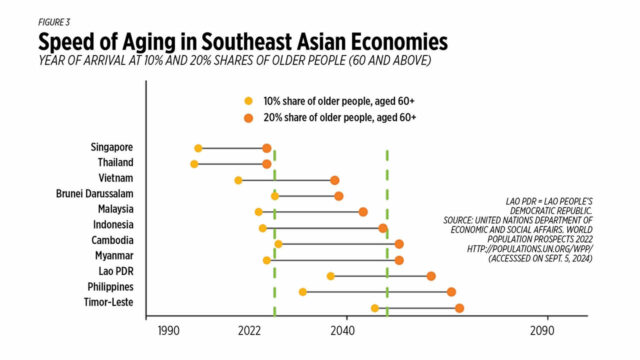
What the debate overlooks is a more honest reckoning with long-term demographic projections and structural realities. Two weeks before the bill went viral, the World Bank released a timely report on the demographic and poverty trends among older Filipinos. Current projections estimate that by 2029 and 2066, older Filipinos aged 60 years and over will comprise 10% and 20% of the total population, respectively. These findings are aligned with the Commission on Population and Development’s projection last year that the country will become an “aging population” by 2030. This means that while the population continues to grow — albeit more slowly — the count of older people is increasing.

The World Bank report classified the Philippines as an early-transition economy. This means that it continues to demonstrate rapid population growth and boasts a high number of young people. But the crisis is already here, we’re already facing the challenges of an aging population. Many retirees are living with meager or non-existent savings and pension payouts, forcing them to rely on their children for financial support and skyrocketing healthcare expenses.

The report comes with a stark warning: If not addressed, demographic transition marked by an increasing population of older people can place a significant strain on an economy’s fiscal resources.

And this is the elephant in the room: It’s not simply that parents’ children or the State refuse to neglect elders. Both public and private pockets are running empty.

On the State’s side, the country’s social protection institutions are struggling. The Social Security System (SSS) is projected to be shaky starting 2039, as benefit payouts begin to outpace contributions due to worsening worker-to-pensioner ratios. Currently at six contributors per pensioner, the ratio will fall to 3:1 within two decades. The core issue is under-contribution: you have too few workers, paying too little, into a fund meant to support too many. While the P700-billion reserve fund remains stable in the short term, it’s projected to be depleted by 2054, after which the SSS will carry a P4-trillion unfunded liability, leaving it unable to fully pay future benefits.

The Government Service Insurance System (GSIS), which serves public-sector workers, is in relatively better shape. Its fund life is projected to last until 2058, bolstered by consistent employer contributions, mandatory coverage, and a smaller pool of retirees. However, GSIS covers only 2.7 million members who are mostly permanent government employees, a fraction of the country’s total workforce. The GSIS model is only stable because its membership is small, formal, and backed by the state’s taxing power.

On the side of Filipino children — those meant to share the legal and moral duty — the challenges are equally severe. Four in 10 Filipino workers are part of the informal economy, which means exclusion from regular pensions and health insurance. Even formal workers are burdened by the rising cost of living. Many belong to the so-called “sandwich generation,” caring for both their children and their aging parents, while trying to build their own future. What’s more, a single hospitalization in a private facility can cost anywhere from P250,000 to over P1,000,000, depending on the critical care availed, far exceeding the approximately P227,000 average annual income per capita.

The current debate distracts us from asking the relevant questions. Why does the state lack money for social services? Because its economy is too feeble to generate enough taxes and contributions. Why is the economy weak? Because we block investments, restrict trade, and stifle industries instead of opening them. This isn’t just cultural neglect, but economic failure. We failed to design an economy that makes aging secure and dignified.

But our young population remains a silver lining. Our demographic window gives us a rare chance to act early. Unlike its neighbors, already in later-transition stages of demographic shift, the Philippines can still build an inclusive system for aging.

Why does this matter? Having a young population means two things: One, more people can work and earn. Two, younger citizens generally mean fewer medical needs, keeping healthcare costs down and the system more manageable. But this opportunity comes with a caveat. A young population can only become an asset if it’s empowered to work productively. This means creating high-quality jobs, attracting more investment, improving the business climate, and strengthening education. When workers thrive, the State collects more taxes and contributions. Those collections fund public services, including hospitalization, elderly care centers, and pensions.

The path forward must be two-pronged.

First, we need to raise real disposable income. This means ensuring that Filipino families earn more and spend less on basic needs. One way is by attracting higher-quality, better-paying jobs through economic openness. Despite reforms in recent years, the Philippines lags behind its ASEAN neighbors in investment: foreign direct investment (FDI) inflows to the country were only $9.2 billion in 2023, compared to $20.2 billion for Vietnam and $22.4 billion for Indonesia. Further liberalizing our investment climate, expanding the coverage of free trade agreements (FTAs), and removing constitutional restrictions on foreign participation are essential for economic dynamism and job creation. This will result in more formality in the labor market, as higher-value industries absorb workers and incentivize compliance with labor regulations. Formal employment means that workers are included in the pension system and have access to health insurance, social security, and stable wages.

We also need to address the high cost of living, especially food. The Philippines has among the highest food inflation rates in Southeast Asia. In 2023, food inflation peaked at 11.2%, disproportionately affecting poor and lower-middle-income families. Lowering agricultural input prices — especially for corn, which directly affects feed and meat prices — through deregulation and reduced tariffs will help stabilize food costs. Encouraging land consolidation for economies of scale and investing in rural infrastructure will also improve farm productivity and lower food prices.

At the same time, open-access reforms in sectors like telecommunications and transportation are long overdue. Filipinos pay some of the highest internet costs per Mbps in the region, limiting access to online learning and e-commerce. Liberalizing these sectors and improving infrastructure will reduce consumer costs and make services more inclusive.

Investments in education and upskilling are equally vital. As of 2022, one in five Filipino youths aged 15 to 24 was not in education, employment, or training (NEET). Strengthening vocational education, supporting industry-academe linkages, and implementing voucher-based systems for skills training can help equip the young labor force to meet future economic demands.

Second, we must sustain greater funding for social infrastructure for the elderly through smarter and efficient tax administration.

Despite having one of the highest value-added tax (VAT) rates in Southeast Asia, the Philippines only collects about 40% of its potential VAT revenue. In 2018, for example, the government missed out on roughly P1.06 trillion, equivalent to 4% of GDP. Part of the problem lies in abuse and inefficiencies: fake PWD cards, numbering up to eight million despite only 1.8 million registered PWDs, result in around P88 billion in foregone revenues annually. Ghost receipts and fictitious VAT deductions are estimated to cost the country over P300 billion, or 1.2% of GDP.

To address this, we must broaden the tax base and review outdated exemptions. While politically sensitive, removing privileges that no longer serve their intended purpose can significantly boost revenues for social protection. A unified digital registry for all tax discount IDs — PWDs, senior citizens, solo parents — linked with the National ID system can help curb abuse. Expanding electronic invoicing and digitizing tax enforcement can reduce fraud and improve compliance. And as more commerce shifts online, capturing e-commerce transactions through smart regulation will help close the leakage gap while leveling the playing field.

When the economy fails to generate these opportunities, caring for the elderly becomes a private burden. Families are forced to fill the gaps. Resentment builds. Intergenerational conflict grows. Legislators respond with policies that politicize virtue rather than address structural problems. Children who earn well will naturally help their struggling parents, with or without a law that forces them to do so.

At the end of the day, genuine social protection rests on one thing: a working economy. When the economy grows, so does parents’ children and the State’s ability to provide care.

The choices are simple yet consequential: liberalize or let the gray wave crush us.

Given our policy trajectory, how are we faring? Right now, the answer is: not well enough.


Jam Magdaleno is a political and economic researcher, writer, and communication strategist. He is the head of Information and Communications of the Foundation for Economic Freedom (FEF), a Philippine-based think tank. Cesar Ilao III is a researcher and communications specialist for FEF. He was formerly a researcher at Monash University, Australia.


National Government fiscal performance

THE NATIONAL Government’s (NG) budget deficit ballooned to P241.6 billion in June as state spending outpaced revenue collections, the Bureau of the Treasury (BTr) said on Thursday. Read the full story.

National Government fiscal performance

ADVERTISEMENT
ADVERTISEMENT