Home Blog Page 124

PAGASA declares end of Amihan, marks starts of dry season

REUTERS

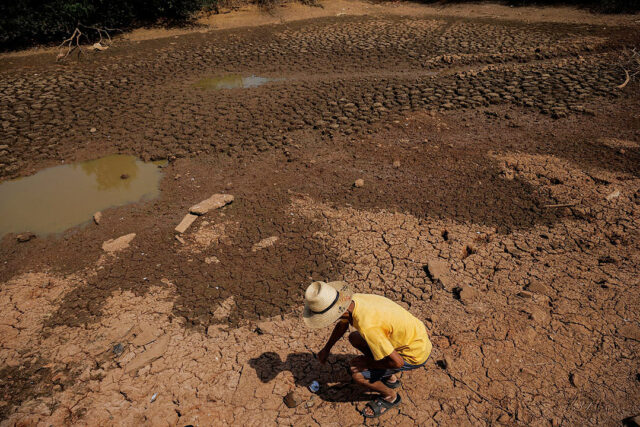
The Philippine Atmospheric, Geophysical and Astronomical Services Administration (PAGASA) on Monday announced the end of the northeast monsoon, locally known as Amihan, signaling the start of the warm and dry season.

“The shift in wind direction from northeasterly to easterly, caused by the formation of a High Pressure Area (HPA) over the northwestern Pacific, signifies the end of the northeast monsoon and the beginning of the warm and dry season,” PAGASA said in an official statement.

However, PAGASA noted that some areas in Northern Luzon may still experience occasional northeasterly winds.

“With these developments, the day-to-day weather across the country will generally be fair and gradually warmer, although isolated thunderstorms may still occur,” it added.

The state weather bureau said it will continue to closely monitor the country’s weather and climate conditions and their potential impacts. — Edg Adrian A. Eva

Staff absences soar at some US airports as ICE agents prepare to screen travelers

Masked law enforcement officers, including Immigration and Customs Enforcement agents, walk into an immigration court in Phoenix, Arizona, US, May 21, 2025. — REUTERS/CAITLIN O’HARA

Absences among transportation security workers this weekend reached their highest since a partial government shutdown began five weeks ago, the Department of Homeland Security said on Sunday, as immigration enforcement agents prepared to fill in for them at some of the busiest US airports.

Nationwide, about 11.5% of Transportation Security Administration staff were absent on Saturday, DHS said, but that figure soared to 42.4% at George Bush Intercontinental Airport in Houston, 33.4% at John F. Kennedy International Airport in New York and 33.6% at Hartsfield-Jackson Atlanta International Airport.

Overall, more than 9% of TSA employees have been absent from work over the past seven days, leading to lengthy lines for passengers trying to get to their gates, according to DHS.

To help fill the staffing gaps, hundreds of Immigration and Customs Enforcement (ICE) agents will deploy to airports starting on Monday, officials have said.

DHS said on Sunday it would not publicly share details about the ICE deployment, in order to preserve operational security. Sources briefed on the matter said the current plan calls for deploying ICE agents to 14 locations, although that figure may change.

Tens of thousands of airport security personnel have been working without pay for weeks while congressional Democrats and Republicans argue over a budget for DHS.

WORKERS WITHOUT PAY FOR WEEKS
“Many TSA officers cannot pay their rent, buy food, or afford to put gas in their cars — forcing them to call out sick from work,” a DHS spokesperson said on Sunday.

Mr. Trump announced on Saturday that ICE agents would be sent to airports unless Democratic lawmakers agree to fund DHS. Democrats have criticized the department’s immigration operations, which have killed US citizens and sparked public outrage, and are demanding a change in rules.

For now, ICE agents will not be deployed in areas behind security checkpoints because they lack the specific clearance needed, the sources said.

Border czar Tom Homan said on Sunday that sending out immigration agents to bolster short-staffed TSA teams will speed up airport lines, but the union for TSA workers said that does not solve what they see as the underlying problem of pay.

HOMAN, DUFFY DEFEND ICE AIRPORT DEPLOYMENT
In appearances on Sunday news shows, Homan and Transportation Secretary Sean Duffy argued that ICE personnel can help with airport security screening, starting on Monday, even though they have not been specifically trained for it.

“When we deploy tomorrow, we’ll have a well thought-out plan to execute,” Mr. Homan said on CNN’s “State of the Union” program.

Hundreds of TSA agents have simply resigned, according to their labor union and TSA.

“ICE will do the job far better than ever done before!” Mr. Trump wrote in a Sunday morning social media post.

Details of how ICE agents would help with the lines were scant, although Mr. Homan told CNN a plan would be in place by the end of the day “to move those lines along.”

Mr. Homan and Mr. Duffy, in separate interviews, had different ideas about how the ICE agents might be deployed. Mr. Homan said he doubted ICE agents would operate X-ray baggage and passenger screening machines because they did not have experience. Mr. Duffy, in contrast, said ICE agents “know how to pat people down, they know how to run the X-ray machines.”

TSA WORKERS’ UNION OBJECTS TO REPLACEMENT PLAN
The labor union representing TSA workers criticized Mr. Trump’s decision, saying their members spend months in training learning to detect explosives and weapons.

“Our members at TSA have been showing up every day, without a paycheck, because they believe in the mission of keeping the flying public safe,” Everett Kelley, National President of the American Federation of Government Employees, said in a statement. “They deserve to be paid, not replaced by untrained, armed agents who have shown how dangerous they can be.”

Unlike TSA employees, ICE agents have continued to get paid by the government through a separate funding provision while lawmakers debate whether ICE funding should be tied to new rules and procedures.

Democrats have said new rules are needed after masked ICE agents fatally shot two US citizens in the streets of Minneapolis earlier this year. The two had come out to protest or observe Mr. Trump’s unprecedented deportation surge in Minnesota.

Hakeem Jeffries, a New York Democrat and the minority leader in the US House of Representatives, told CNN that his caucus is open to a separate funding agreement for TSA employees while lawmakers debate measures to “get ICE under control.” But there has been little movement on an actual deal so far, especially in the Senate.

“We have an obligation to not fund an agency that is acting this lawlessly,” Senator Chris Murphy, a Connecticut Democrat, told NBC’s “Meet the Press” program. — Reuters

French far right’s mixed local elections results offer mainstream rivals hope

FRENCH PRESIDENT EMMANUEL MACRON — REUTERS

PARIS/MARSEILLE — France’s far-right National Rally (RN) failed to win the cities of Marseille and Toulon which they had hoped to claim in Sunday’s municipal votes, a setback that gave hope to embattled mainstream parties ahead of next year’s presidential election.

In another key battleground, Socialist Party candidate Emmanuel Gregoire won Paris’ mayoral race, beating conservative former minister Rachida Dati and ensuring the French capital remains left-wing.

The municipal elections were closely watched across France for clues ahead of the 2027 presidential election, which opinion polls have shown the anti-immigration, euroskeptic RN could win.

The thousands of separate municipal ballots are often focused on very local issues and their outcome does not forecast who will succeed centrist President Emmanuel Macron.

But they show trends in popularity and in the type of alliances that can be struck in an increasingly fragmented political landscape, and senior politicians from all parties were quick to claim Sunday’s outcomewas good news for them.

NEXT STEP: THE PRESIDENTIAL ELECTION
Senior RN officials rejected suggestions the party’s defeat in Toulon showed it had hit a “glass ceiling” ahead of the presidential election, saying it had won dozens of local constituencies where it previously had no presence.

“The National Rally and its candidates have achieved tonight, in this municipal election, the biggest breakthrough in its entire history,” RN chief Jordan Bardella said.

His anti-immigration party won re-election in the southern city of Perpignan in the first round, and won smaller cities, too. Eric Ciotti, a former mainstream conservative who is now an ally of the RN, won in Nice on Sunday, bringing France’s fifth-biggest city under far-right control.

But the RN’s failure to win several other larger cities, and in particular in Marseille, its most coveted prize, may show limits to its growing popularity.

Meanwhile, with wins projected in France’s two biggest cities, the Socialist Party, long weakened nationally, saw reasons for hope.

“Paris will be the heart of the resistance” to any union of the mainstream right and far-right, Socialist winner Gregoire said after he crossed Paris on a bicycle – a nod to the left’s green policies in the French capital.

Senior politicians on the mainstream right said the municipal elections showed they needed to be united to win – especially in next year’s presidential election.

Former Prime Minister Edouard Philippe said he was re-elected mayor in his northern city of Le Havre, in a boost to his hopes of running for president in 2027.

Mr. Philippe, a center-right politician who served as prime minister under the centrist Mr. Macron, said “there were reasons to be hopeful” in the values of France and that the extremes can be beaten.

MARSEILLE, PARIS
In the second-biggest city Marseille, the incumbent, Socialist Mayor Benoit Payan, was re-elected with just under 54% of the votes, according to an Elabe poll for BFM TV. Other polls also showed him winning. He had been neck-and-neck with the RN in the first round, and was boosted after his hard-left rival pulled out of the run-off to prevent a far-right victory.

“This city, which some believed lost, showed its most beautiful face, showed that it was capable of resisting,” said Mr. Payan.

The Socialist Party said it had also beaten Francois Bayrou, a center-right former prime minister of Mr. Macron, in the city of Pau.

The hard-left France Unbowed (LFI) looked set to win in Roubaix, a city of nearly 100,000 in northern France, an Ifop-Fiducial poll for TF1, LCI, and Sud Radio showed, in good news for a party that had so far not focused much on local elections.

“Traditional parties are losing ground,” Manuel Bompard, of LFI, said. — Reuters

BSP may pause in April — Moody’s

BW FILE PHOTO

By Katherine K. Chan, Reporter

THE BANGKO SENTRAL ng Pilipinas (BSP) may pause at its next meeting rather than immediately reverse its easing cycle amid oil price spikes and the peso’s depreciation, Moody’s Analytics said.   

“I think it is unlikely for the BSP to immediately shift back to a tightening cycle while it is still on an easing path, but the risk of a prudent and prolonged pause has clearly increased,” Moody’s Analytics Assistant Director and Economist Sarah Tan told BusinessWorld in an e-mail.

Ms. Tan noted that the central bank can tolerate temporary oil price spikes, but a sustained uptrend in oil prices potentially driving transport and electricity costs higher would raise the odds of monetary policy tightening. 

“The key issue is whether the rise in oil prices proves temporary or sustained,” she said.

“A short-lived spike is something the BSP can usually look through, but persistently elevated oil prices that push the inflation outlook materially above the BSP’s 2%-4% target range would likely lead to a longer pause, and eventually raise the possibility of a hike if second-round effects begin to appear in transport fares, electricity rates, and inflation expectations.”

This month, the Manila Electric Co. (Meralco) hiked electricity rates by 64.27 centavos per kilowatt-hour (kWh) to P13.8161 per kWh from P13.1734 per kWh in February. This means households consuming an average of 200 kWh monthly will pay about P129 more in their electricity bill.

Meralco said electricity rates may surge further in April as soaring global fuel costs risk pushing coal and gas prices up, which the company uses for its power supply.

BSP Governor Eli M. Remolona, Jr. earlier said they could be forced to hike rates once oil price hits $100 per barrel as it could bring inflation past 4% or the upper end of their target range.

The Monetary Board may consider tightening as early as its April meeting if oil prices stay elevated for long, Finance Secretary Frederick D. Go also said last week.

If realized, the central bank would be raising its policy rate for the first time since October 2023.

The BSP has followed an easing path since August 2024, delivering a cumulative 225-basis-point cut which brought the key interest rate down to an over three-year low of 4.25%.

The threat of Iran’s attacks has kept most ships from getting through the Strait of Hormuz, a vital oil transit point.

On Friday, the price of international benchmark Brent crude climbed 3.26% or $3.54 to a near  four-year high of $112.19 a barrel, Reuters reported.

In a separate report, Nomura Global Markets Research said the ongoing oil crisis could lead to a fuel shortage and eventually weigh on local consumer prices. 

“Headline inflation could surge well above BSP’s 2-4% target and household purchasing power could be further eroded, hurting consumption spending,” Nomura analysts said.

“The country does not maintain strategic oil reserves, so a prolonged conflict could lead to energy supply shortages, which may also be exacerbated by export bans in other sources, particularly China, which accounts for 25% of the Philippines’ refined petroleum imports,” they added. 

The Philippines imports over 90% of its oil supply from the Middle East, making it vulnerable to current energy price and supply shocks.

Nomura said the BSP will likely hike the policy rate aligned with its price stability mandate, but it may opt to hold if the oil-driven inflation uptick ends up short-lived.

“BSP remains orthodox in its inflation-targeting mandate and will hike the policy rate aggressively, adding to growth headwinds,” it said.

“In the positive scenario, we see only a temporary breach of the inflation target, which BSP will likely look through, especially when the output gap remains negative, allowing it to maintain policy settings,” it added.

In an e-mailed response to questions from BusinessWorld, an International Monetary Fund spokesperson said they are currently “assessing the potential impact on the global economy and the region, including the Philippines” of the ongoing oil crisis from the Middle East conflict.

PESO SLUMP
Meanwhile, the peso’s recent slump amid the US-Israeli war on Iran could also push the BSP to stand pat at its April 23 meeting, Moody’s Ms. Tan noted.

“Aside from the inflation risks stemming from the Middle East conflict, which could justify a prudent pause, the peso’s depreciation and the Fed’s decision to stay on hold also support a cautious stance at the next BSP meeting,” she said.

Uncertainties surrounding the war in Iran ignited safe-haven demand for the US dollar, reversing the peso’s short-lived recovery in February as it sank to new record-lows this month.

On Thursday, the peso closed at a new all-time low of P60.10 against the greenback, falling by 58 centavos from its P59.52 finish on Wednesday, Bankers Association of the Philippines data showed.

The BSP has affirmed that it remains present in the foreign exchange (FX) market to prevent sharp movements that could impact inflation, a stance Nomura analysts said the central bank will likely maintain.

“On FX policy, we think BSP has relatively high reserve adequacy and will therefore likely maintain active interventions to stem FX volatility,” Nomura said.

NO STAGFLATION
Meanwhile, Ms. Tan ruled out potential stagflation as inflation is unlikely to remain high for long on expectations of a short-lived oil crisis.

“As for stagflation, this is not our baseline,” she said. “We expect the impact of the Middle East conflict on oil prices to be temporary and do not see it causing a sustained rise in inflation.”

“However, a prolonged supply shock would raise production costs, weaken demand, and push inflation higher. For the Philippines, which imports more than half of its energy requirements, higher global commodity prices remain a significant risk to both growth and price stability,” Ms. Tan added.

Inflation averaged 2.2% as of February, with the monthly figure settling within the central bank’s target band for two straight months.

The Philippine Statistics Authority will release the March inflation report on April 7.

DoE clears limited rollout of Euro II fuels

A barge is seen along the Pasig River in Manila, March 1, 2026. — PHILIPPINE STAR/RYAN BALDEMOR

THE DEPARTMENT of Energy (DoE) is allowing the temporary rollout of Euro II, or fuels that meet an older emission standard with higher sulfur content, for select transport and industrial uses to augment fuel supply.

In a statement on Sunday, the DoE said it has issued a department circular authorizing the “temporary and controlled” introduction of Euro II petroleum products in response to the ongoing conflict in the Middle East, which continue to strain global petroleum markets.

The measure aims to help keep adequate fuel supply, while allowing limited flexibility for sectors that may be affected, the department said.

The DoE said that the rollout is “interim, narrowly targeted, and strictly regulated.”

Under the circular, only in-use vehicle models from 2015 and earlier, traditional jeepneys, industrial applications such as power plants and generators, and the marine and shipping industry are allowed to temporarily use Euro II fuels.

To avoid misuse and ensure product integrity, downstream oil industry players are required to keep Euro II and Euro IV fuels fully segregated across storage, transport, and retail systems.

Fuel companies intending to offer Euro II fuels must also notify the DoE, through the Oil Industry Management Bureau, and identify the retail outlets where such products will be made available.

The DoE said it will conduct random product sampling and testing across downstream oil facilities to ensure compliance.

To keep consumers informed, the circular requires the posting of clear and prominent advisories at fuel stations and other retail outlets offering Euro II products.

The DoE said the measure was adopted following consultations with the oil and automotive industries from March 16-18 to ensure that the policy is technically feasible and operationally manageable.

It clarified that the rollout does not replace the country’s Euro IV fuel standards, which remain in force under existing laws and regulations.

“We are adopting a prudent and temporary measure to help ensure an adequate and accessible fuel supply for sectors that may require limited flexibility during this period,” Energy Secretary Sharon S. Garin said.

Ms. Garin said this measure is subject to strict quality controls, clear notification requirements, and appropriate consumer protection measures.

“Our objective is to uphold fuel supply security while remaining guided by safety, regulatory discipline, and the broader public interest,” she said.

Since 2015, the Philippines has limited the motoring industry to the use of Euro IV fuels, a globally accepted standard that has a significantly lower sulfur content.

The ongoing US-Israeli war against Iran continues to raise supply concerns, which continues to drive prices to historic levels.

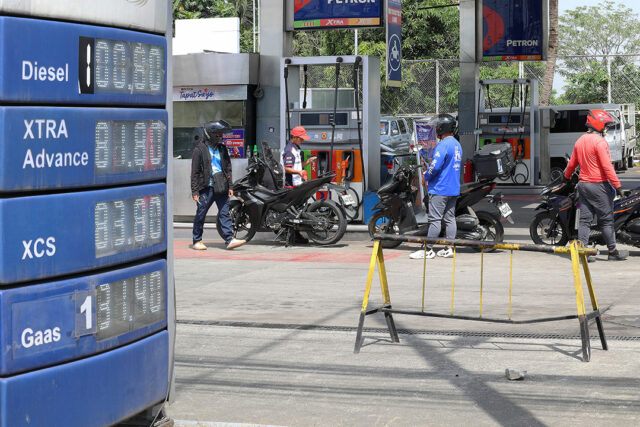
Last week, several oil companies implemented another round of double-digit increases in pump prices, pushing diesel costs above P100 per liter.

An industry source earlier said that initial estimates point to another fuel hike this week, extending the recent sharp increases as the war continues to fuel volatility in global energy markets. — Sheldeen Joy Talavera

DBM eyes cost-cutting measures if fuel excise tax is suspended

A GASOLINE attendant fills a motorcycle’s tank at a gasoline station. — PHILIPPINE STAR/MIGUEL DE GUZMAN

By Justine Irish D. Tabile, Senior Reporter

THE DEPARTMENT of Budget and Management (DBM) said that it is looking at cost-cutting measures should the revenue losses from the proposed suspension of excise tax on fuel are not fully offset.

“At this stage, there is no automatic or immediate shift in expenditure priorities,” Budget Undersecretary Goddes Hope O. Libiran told BusinessWorld via Viber.

“Should the projected revenue losses from the proposed excise tax suspension not be offset by compensatory revenue measures, the government will need to adopt targeted efficiency-enhancing interventions to remain consistent with its fiscal deficit objectives,” she added.

In particular, Ms. Libiran said that the department is looking at the rationalization of nonessential operational expenditures to safeguard priority and high-impact programs. Nonessential spending includes travel, training, consultancy services, and discretionary spending on materials and supplies.

“The ongoing implementation of a uniform four-day workweek is likewise being assessed as part of a broader expenditure optimization strategy,” she said.

However, the DBM official said that the full fiscal implications of the potential fuel excise tax suspension and corresponding policy responses are likely to be addressed at the next Development Budget Coordination Committee meeting in April.

“The DBM remains committed to ensuring that any course of action achieves a prudent balance between delivering immediate economic relief and maintaining medium-term fiscal sustainability and macroeconomic stability,” Ms. Libiran said.

Last week, Finance Secretary Frederick D. Go said that the government is looking at how to delay non-urgent programs and capital outlays that the government does not need at this point.

In particular, he said that these non-urgent capital outlays include those with an economic rate of return of only slightly above 10%.

“So, if the economic rate of return is, say, 19% or 20%, I think we should just pursue it because it is a great return for the investment the country puts in,” he told reporters.

The suspension of the excise tax on fuel products is among the interventions being looked at by the Philippine government amid oil price shocks and supply chain disruptions due to the war in the Middle East.

The House of Representatives and the Senate last week approved a bill that authorizes the President to suspend or reduce excise taxes on petroleum products during national or global economic emergencies as urgent.

The bill is now awaiting President Ferdinand R. Marcos, Jr.’s signature.

BAND-AID SOLUTION?
However, some economists see the measure as a band-aid solution, citing the fuel tax suspension’s potential impact on the country’s already tight fiscal space.

“The suspension of excise fuel taxes while providing short-term relief will also impact the country’s fiscal space,” Philip Arnold “Randy” P. Tuaño, president of the Philippine Institute for Development Studies, told BusinessWorld via e-mail.

Citing data from the Department of Finance, he said that the suspension of fuel excise tax will result in revenue losses of around P136 billion if implemented from May to December 2026.

This excludes the additional P10 billion in value-added tax  revenues, he said.

“The total amount is around 8-9% of our projected deficit for the year. Thus, while lower fuel taxes will support household consumption and will provide some slight relief on transportation and logistics costs, this may be offset by lower government spending or even delays in disbursements following lower revenues,” he added.

Peter Lee U, associate professor and dean of the University of Asia and the Pacific School of Economics, said that the lower tax collections will push the government to borrow more to finance projects that were originally planned.

“This will lessen fiscal space in the future as the national debt as a percentage of gross domestic product (GDP) will grow. If GDP will grow more slowly (a possible, at least, if not likely scenario), then the ratio will grow even faster,” he said.

Nevertheless, he said that the measure will help slow down the increase in pump prices.

Economic managers are targeting 5-6% GDP growth this year.

However, Jose Enrique “Sonny” A. Africa, executive director of the think tank IBON Foundation, said that he disagrees with the argument that the excise tax on fuel should not be suspended, as it disproportionately benefits richer households.

“This is blind to how oil excise taxes eat up a larger share of the income of poorer households and also fails to understand that poorer households are more exposed to second-round inflation effects on food, transport fares, and basic goods and services,” he said in a Viber message.

Mr. Africa said that suspending fuel excise taxes even for a full year will not dramatically affect GDP growth.

“Oil excise tax collections are less than P15 billion monthly on average and don’t even reach two-thirds of a percentage point of annual GDP,” he said.

Mr. Africa said that the main benefit of the measure is to provide relief for poor and middle-class Filipinos who are reeling from spiraling costs.

“The real issue is not the revenue loss, but why the government chooses to rely on regressive taxes instead of taxing extreme wealth and windfall profits to finance critical relief,” he said.

Mr. Africa said that the Marcos administration can choose to expand the fiscal space by taxing billionaires’ wealth, restoring previous income tax rates on large corporations and the richest families, and windfall taxes on energy and real estate.

He said that the rational response is for the government to absorb the cost-push, supply-side oil price shock by implementing measures such as cutting taxes to help protect the purchasing power of poor and middle-class households.

BUDGET RELEASES
Meanwhile, the DBM said 63.5% of the 2026 national budget has been released as of the end of February, reflecting a slower disbursement rate compared to the previous year.

In its Status of Allotment release report, the DBM said that P4.31 trillion of the budget had been released to national agencies and local government units as of Feb. 28.

This leaves P2.48 trillion remaining undistributed from the P6.793-trillion budget for the year.

The pace of releases was slower than the 67% rate posted a year earlier.

Releases to government agencies and departments amounted to P2.77 trillion, equivalent to 75.2% of their allocations.

Special purpose funds released by the end of the month stood at P141.9 billion, representing 19.7% of the funds allocated.

Meanwhile, automatic appropriation releases were at 58% or P1.387 trillion.

These include P1.19 trillion for National Tax Allotment, P93.98 billion for block grant, and P82.21 billion for the retirement and life insurance premiums.

Excluding the other releases worth P14.417 billion, the budget release rate is 63.3%, as the released funds reached P4.297 trillion out of the P6.793-trillion original program.

The other releases include unprogrammed appropriations worth P9.55 billion, 2025 continuing appropriations of P4.816 billion, and special purpose funds worth P4.58 billion.

“The slower February allotment release looks more like timing and prudence than a policy change,” Reyes Tacandong & Co. Senior Adviser Jonathan L. Ravelas said in a Viber message.

He said that agencies are still aligning cash plans, procurement, and safeguards by February, which is why the DBM releases carefully while watching out for revenues and global risks. 

“For March, I expect releases to stay measured, not frozen, with a pickup once clearances are completed, particularly for infrastructure and priority programs,” he added.

Michael L. Ricafort, chief economist at Rizal Commercial Banking Corp., said that the slower disbursement rate still reflects some government underspending in view of the anomalous flood control projects.

“Anti-corruption measures and other reforms to further level up governance standards may have caused greater caution on some government spending, especially on infrastructure, to prevent the risk of corruption,” he said in a Viber message.

For the coming months, he said that the government’s catch-up spending could lead to a higher disbursement rate.

“But (this) could still be offset by more cautious government spending to prevent risk of corruption and leakages,” he added.


Manila’s slow response to oil price spike exposes economy to energy shock

Motorcycle riders queue at a gasoline station in Quezon City, March 20, 2026. — PHILIPPINE STAR/MIGUEL DE GUZMAN

By Chloe Mari A. Hufana, Reporter 

THE PHILIPPINE government’s slow response to surging oil prices risks worsening the economic impact of the latest energy shock, analysts said, as elevated global crude costs begin to filter through to transport fares and supply chains.

This as President Ferdinand R. Marcos, Jr. on Sunday said discussions regarding oil supply with China, South Korea, India, Thailand, Brunei and Japan are “going well.”

“It’s a good thing we have truly built strong friendships with them and that they are willing to help us,” he said in a video message in Filipino, without giving details.

Mr. Marcos had earlier said the government is looking for alternative sources of petroleum products as global supply was disrupted by the conflict in the Middle East.

“The government is moving too slowly,” Noel M. Baga, co-convenor of the Center for Energy Research and Policy think tank, said via Facebook Messenger.

Dubai crude oil has traded between $130 and $153 per barrel in recent weeks, far exceeding the $80 threshold set by the government, while local diesel prices have climbed to as high as P114 per liter.

The oil price surge, driven by the Iran war, is beginning to push up the cost of basic goods and expose gaps in the government’s response framework.

As an oil importer, the country is vulnerable to external shocks, as global price swings, driven by supply-demand imbalances, geopolitical tensions and the Organization of the Petroleum Exporting Countries’ decisions, directly impact domestic fuel costs and inflation.

Despite certifying as urgent a bill granting him emergency powers to suspend excise taxes on petroleum products, Mr. Marcos last week said he was unsure whether he would use them.

He pointed to the uncertainty of global oil prices, saying there are “complicated calculations” that must be made before he uses such power.

Analysts said the hesitation could delay relief measures at a time when higher fuel costs are already feeding into inflation through transport and logistics.

Clarity from the Executive branch is now essential, according to Mr. Baga.

“The President must also be clear about his timeline: at what price level and when will the government move from monitoring to acting,” he said, adding that a suspension on fuel taxes alone will not be sufficient.

“The President must immediately declare a state of emergency and impose oil price ceilings under the Price Act and the Disaster Risk Reduction and Management Act.”

Malacañang last week said there is no need to declare a national state of emergency, as the supplies of basic goods are enough, and the government is maintaining constant communication with industry players.

If Mr. Marcos declares a national state of calamity, several immediate and legal consequences would follow, designed to give the government greater flexibility to respond to emergencies.

Josue Raphael J. Cortez, a diplomacy lecturer at De La Salle-College of St. Benilde, said regional coordination is emerging as a critical pillar of the Philippines’ forward strategy.

As this year’s chair of the Association of Southeast Asian Nations (ASEAN), Mr. Cortez said the bloc’s shared exposure to supply disruptions underscores the urgency of joint action.

“ASEAN can undoubtedly play an integral role in coordinating energy security,” he said via Facebook Messenger, noting that the bloc has convened foreign and economic ministers as the crisis unfolds.

He noted that 60% of ASEAN’s oil needs pass through the Strait of Hormuz, a critical waterway controlled by Iran.

“Information sharing and looking into alternatives together is certainly of the essence in these dire times,” he added, pointing to initiatives such as the ASEAN Power Grid as part of a longer-term solution.

The Philippines is also expected to pursue a more pragmatic supplier diversification strategy, even as it maintains its independent foreign policy stance, according to Mr. Cortez.

“The fact that our relations politically with these two (Russia and China) heavily allied countries are in the colder scheme of things, yet we are still open to collaborating with them economically, goes to show that our conduct of foreign policy is not merely limited to political lines,” he added.

Still, Mr. Cortez emphasized that diversification should not be misconstrued as a geopolitical pivot.

“Diversification of suppliers cannot be fully depicted as a foreign policy maneuver as well,” he said, adding that “our course of action is merely rooted in the context we are presently facing, which is highly economic in nature.”

TALKS WITH POWER GENERATORS
At the same time, Mr. Marcos said the National Government is also in talks with local power generators to boost grid capacity for the next 60 days, with 23 projects totaling 900 megawatts set to come online, alongside efforts to maximize Malampaya gas field output to shore up electricity supply.

The Philippine government has resorted to government subsidies and fare discounts to cushion Filipinos from the impact of the Iran war.

While Mr. Marcos suspended a planned fare increase among public utility vehicles, he vowed that transport workers would receive more support from the government, including agricultural workers.

Over two million overseas Filipino workers (OFWs) still reside in the war-stricken Middle East, even as waves of repatriation continue.

“Many of them will be returning to the Visayas and Mindanao. That’s why we ensured they could stay in hotels first and booked them on flights to their home provinces. We are making sure they are well taken care of,” Mr. Marcos said.

He reported that over 1,400 OFWs and 332 dependents have already returned to the country as of March 17. A third government-chartered flight arrived last March 18 with 153 more OFWs, 114 dependents and 50 stranded Filipinos.

DoST launches sustainable innovation, agriculture hubs in Cagayan

The Department of Science and Technology (DoST), in partnership with the Provincial Government of Cagayan, formally launched the Cagayan Innovation Hub, the SARAI Provincial Hub, and the SciTech Philippines Awards on March 16, strengthening efforts to promote innovation, data-driven governance, and climate-resilient agriculture in the province.

The initiative is anchored on Project SARAI and aims to position Cagayan as a model for smart and sustainable provincial development by integrating science, technology, and innovation into local planning and economic growth.

Leading the launch was DoST Secretary Renato U. Solidum, Jr., who highlighted the province’s strong partnership with the National Government in advancing innovation-driven development. Innovation hubs are envisioned as spaces where students, researchers, startups, and communities collaborate to transform ideas into practical solutions and technology-based enterprises.

At the center of the initiative is the Cagayan Innovation Hub, which will serve as a platform for enterprise incubation, modernization of micro, small, and medium enterprises (MSMEs), and collaborative innovation. The facility will connect industry, academe, and government to provide mentoring, technical support, and digital transformation opportunities for entrepreneurs and emerging enterprises in the province.

Supporting this effort is the Cagayan Decision Intelligence Center, a facility designed to strengthen local governance through real-time analytics and integrated data systems. The center enables provincial leaders to make evidence-based decisions, improve resource allocation, and respond more effectively to development and disaster-related challenges.

Meanwhile, the SARAI Regional Hub brings science-based agricultural information closer to farmers. Through satellite data, climate modeling, crop forecasting, and suitability analysis, the hub delivers localized advisories on crop selection, planting schedules, and risk management to help farmers improve productivity and adapt to climate variability.

The initiative comes as the Philippines continues to face increasing climate risks. The country experiences around 20 tropical cyclones annually, with the agriculture sector accounting for more than sixty percent of disaster-related economic losses. In provinces like Cagayan, where agriculture remains a primary economic driver, these challenges directly affect rural livelihoods and food security.

Cagayan Governor Edgar Aglipay acknowledged the initiative as a major opportunity to strengthen local enterprises and bring innovation directly to farming communities.

DoST Undersecretary for Regional Operations Sancho A. Mabborang and Virginia G. Bilgera also emphasized the strong collaboration between DoST and its partners in advancing the initiative, noting that the hubs are expected to help transform various sectors and industries in the region through science, technology, and innovation.

Together, the facilities support the vision of ONE Cagayan D.R.I.V.E.S. (Development of Rural Industries through Value Chain Enhancement and Sustainability), demonstrating how integrated science and technology systems can strengthen agriculture, empower enterprises, and enable smarter governance at the provincial level.

Through the Cagayan Innovation Hub and SARAI Provincial Hub, DoST and its partners aim to establish Cagayan as a Smart Province where data-informed decisions, innovation-driven enterprises, and science-based solutions contribute to inclusive and sustainable development.


SparkUp is BusinessWorld’s multimedia brand created to inform, inspire, and empower the Philippine startups; micro, small and medium enterprises (MSMEs); and future business leaders. This section will be published every other Monday. For pitches and releases about startups, e-mail to bmbeltran@bworldonline.com (cc: abconoza@bworldonline.com). Materials sent become BW property.

Xpress Super App doubles down on EV-powered mobility solutions

Xpress Super App is increasing its focus on electric vehicle (EV) mobility solutions as it marks its first year of operations. Launched in Metro Manila in 2024, the platform has transitioned from a ride-hailing service into a mobility network that integrates taxis, motorcycles, and digital booking services.

In 2025, the company was included in Forbes Asia’s “100 to Watch” list, which recognizes small companies in the Asia-Pacific region for growth and innovation.

The platform supports different transport categories depending on the location. In Metro Manila, services include ride-hailing for cars and motorcycles. In tourism destinations such as Boracay, the system organizes local transport including electric tricycles, vans, and shuttles.

The company has expanded its presence to major transport gateways, including integrated land terminals in the city, commuter rail stations, and transport corridors in Central Luzon near Clark.

As part of its push towards electrification, Xpress has integrated electric taxis into its network through a partnership with manufacturer BYD. These vehicles feature digital booking systems and cashless fare integration. The company stated that the move toward EV deployment was planned to address rising fuel costs and long-term operational efficiency.

Additionally, the platform has begun a limited deployment of electric motorcycles through a partnership with Voltai, a part of the AboitizPower group.

Moving forward, the company plans to expand into additional cities, increase the number of electric vehicles in its fleet, and establish new partnerships with transport hubs, tourism operators, and corporate clients. Several new markets are currently under preparation for the next stage of the company’s growth.


SparkUp is BusinessWorld’s multimedia brand created to inform, inspire, and empower the Philippine startups; micro, small and medium enterprises (MSMEs); and future business leaders. This section will be published every other Monday. For pitches and releases about startups, e-mail to bmbeltran@bworldonline.com (cc: abconoza@bworldonline.com). Materials sent become BW property.

SEC’s Lim firm on broker-director term limits

FRANCISCO ED. LIM — THE SECURITIES AND EXCHANGE COMMISSION/BW FILE PHOTO

SECURITIES and Exchange Commission (SEC) Chairman Francisco Ed. Lim said the proposed 10-year cumulative term limit for broker-directors of an exchange remains firm, while noting that the Commission is open to valid feedback from market participants.

“As far as I’m concerned, the term limits are non-negotiable, but I’m still listening to their comments. If they have a valid comment, we’ll consider it,” he told reporters on the sidelines of an event last week.

In a draft memorandum circular released on March 3, the Commission said it plans to limit broker-directors, or individuals representing trading participants on an exchange board, to a maximum cumulative service period of 10 years.

The proposal aims to ensure “fair and effective representation” and allow more qualified brokers to bring “new perspectives” to exchange boards.

Mr. Lim also underscored the importance of public consultation on the proposal. “We have to listen to them [the public] and we will discuss it. Not only me, but the En Banc — it’s an En Banc decision,” he said.

The Commission invited stakeholders to submit comments, suggestions, and inputs on the draft until March 19, 2026.

Under the proposed guidelines, a broker-director may be elected for a one-year term. After serving a cumulative period of five years, whether consecutive or intermittent, the director must observe a mandatory two-year cooling-off period before becoming eligible for re-election.

After completing the cooling-off period, a director may serve an additional term of up to five years, provided the overall 10-year cumulative limit is not exceeded.

If implemented, the proposal would affect several long-serving broker-directors at the Philippine Stock Exchange (PSE), including Ma. Vivian Yuchengco (28 years), Eddie Gobing (25 years), Wilson Sy (12 years), and Diosdado Arroyo (six years).

Mr. Lim said the draft does not violate existing laws. “I’m very sure of that. I’m not a lawyer for nothing,” he said.

Market participants said the proposal could help balance board renewal with continuity.

“I am sure they’re [the SEC] just following the Global standards to make sure we are in compliance to avoid being downgraded, similar to what happened to Indonesia last month,” COL Financial Group, Inc. Chairman Edward K. Lee said in a Viber message.

“The SEC’s proposal aims to keep the PSE board fresh without losing too much experience. By limiting broker-directors to a maximum of 10 years total and requiring a two-year break after five years of service, the SEC creates more chances for new people with fresh/up to date ideas to govern and contribute,” BDO Securities Corp. President John Tristan D. Reyes said in a Viber message.

“At the same time, the rules still allow experienced directors to serve for a reasonable amount of time to share their knowledge and even return after a break, so boards don’t lose all their expertise at once and ensure continuity,” he added.

The Shareholders’ Association of the Philippines (SharePHIL) also expressed support for the proposed circular imposing a 10-year cumulative term limit and a cooling-off period for broker-directors of an exchange.

“SharePHIL welcomes the Commission’s initiative to strengthen good corporate governance and protect minority investors,” the organization said in a statement on Friday.

“By instituting these limits, the SEC is laying the groundwork for meaningful board refreshment, preventing entrenchment, and ensuring that new perspectives are consistently integrated into the governance structure of the PSE,” it added.

SharePHIL said it supports measures that promote board renewal and investor confidence, and committed to work with regulators and stakeholders to help develop a fair capital market. It also noted that the proposal aligns with International Organization of Securities Commissions (IOSCO) principles on board terms and the Revised Corporation Code’s mandate to adopt internationally accepted best practices.

Similar views were expressed by other business groups, including the Financial Executives Institute of the Philippines (FINEX), Institute of Corporate Directors (ICD), Management Association of the Philippines (MAP), Capital Markets Development Foundation, Inc. (CMDFI), and the Insurance Brokers Association of the Philippines (IBAP).

SharePHIL also called on listed companies, brokers, institutional investors, and the public to participate in the SEC’s consultation process. — Alexandria Grace C. Magno

Masculinity gets a new look

Senior couturier Randy Ortiz takes military inspiration and saturates it with color

WE LEARNED a new word: lampasse. It’s the strip of fabric that decorates the sides of military trousers, which has since bled into menswear. It was a visual motif for Randy Ortiz Man, the designer’s first major menswear show, held on March 19 at the Peninsula Manila.

“Young and Beautiful” by Lana Del Rey was playing on a video used to introduce the show. The men stood outside the windows, by the pool, invoking the sunset waited for to start and color the show. We noticed a periwinkle tuxedo, appliquéd in the same material and color, and bellbottom trousers paired with a Cordillera fabric.

Mr. Ortiz played with expectations, such as showing military-style jackets with whimsical prints like palm trees. Many, if not almost all the pants, came with the lampasse strip running down the sides of the pants, emphasizing and giving further length to legs.

Masculine outfits like tuxedos (seen executed as a cape) and safari suits were seen on women.

Another subversion of masculinity was seen in a gorgeous Nehru jacket of lilac brocade, while my seatmate noticed a bubblegum pink suit — but according to her, the darts on the jacket are meant for female figures. That instead shaped the jacket’s drape over the male model in a more sensuous way.

In some matters, Mr. Ortiz can’t help his affection for the female form: aside from the women wearing the aforementioned tuxedo cape and safari suits, we saw an aviator-style suit on a woman, and an oversized zoot suit in a windowpane print on another. Finally, there was a ballgown skirt appliquéd all over with flowers and spangled in silver, paired with a tweed jacket threaded in the same metallic color.

There was also a series of tweed coats (adapted in the 1920s by Coco Chanel from hunting outfits to womenswear), in brightly colored threads. Past-the-knee coats were seen often on the runway: think denim trenches, trenchcoats slashed at the back, and the like.

We also saw variations on traditional menswear: think suit jackets tied with drawstrings and pulls at the bottom. The hardness of menswear was tempered through colors and silhouettes: the looks took on mod themes and 1970s shapes in bellbottoms, and graceful draping where there should be sharpness. We saw jackets and suits in russet red and soft greens.

However, Mr. Ortiz went classic with some of his former models: we saw actor John Estrada in a cool blue coat (cool as in it felt two degrees lower when we saw it on the runway) paired with a paisley scarf.

Actor Dingdong Dantes took the final walk, dressed in a tan double-breasted suit with peak lapels, all under a chic wine-red coat. Taken collectively, the collection is surprisingly youthful and fresh, despite Mr. Ortiz’s almost 40 years in fashion (he celebrated his 30th anniversary in 2018).

Asked after the show what keeps him young, Mr. Ortiz said, “It’s all about my love for fashion. It’s all about my love for my craft. It’s all about creating new things beyond my imagination. For me, this is a love letter to all Filipino males. To everyone: there is life more than just ordinary men’s clothes. There’s so much that we can offer.” — Joseph L. Garcia

University of Nueva Caceres breaks ground on Learning and Innovation Center in Naga City

The University of Nueva Caceres (UNC) has formally broken ground on its new Learning and Innovation Center (LINC), a multi-storey academic facility designed to support technology-enabled education, research collaboration, and industry aligned learning for students in the Bicol Region.

Scheduled for completion in 2027, the LINC Building is part of UNC’s long-term academic infrastructure investment strategy to strengthen higher education in the Philippines and enhance learning environments for future generations of students.

Strategic Investment in Academic Infrastructure University President Dr. Fay Lea Patria M. Lauraya said the project reflects the institution’s response to evolving global education demands.

“The LINC Building represents our commitment to preparing students for a rapidly evolving and technology-driven world,” Dr. Lauraya said. “This facility is not simply an expansion of space, but a strategic investment in the quality, relevance, and accessibility of higher education in our region.”

The new center will feature technology-enabled classrooms, flexible and collaborative learning spaces, research and innovation hubs, interdisciplinary engagement areas, and industry-aligned instructional facilities. University officials said the building is designed to encourage experiential learning, research productivity, and cross-disciplinary collaboration among students and faculty.

The ceremony was attended by members of the UNC Board of Trustees and executives from iPeople, Inc., the university’s education management partner.

Also in attendance was UNC’s Most Outstanding Alumni Awardee, Hon. Maria Leonor G. Robredo, Mayor of Naga City, along with representatives from local government, business sectors, and media organizations.

Mayor Robredo underscored the importance of institutional development within the city. “Universities play a vital role in regional progress,” she said. “Projects like the LINC Building contribute to economic activity, innovation, and opportunities for young people in Naga City and the wider Bicol Region.”

As higher education institutions adapt to digital transformation and interdisciplinary learning models, UNC stated that the LINC Building is intended to serve as a central hub for research development, entrepreneurship initiatives, and community engagement programs.

The facility is expected to support expanded academic offerings and strengthen UNC’s position as a key contributor to educational advancement in Southern Luzon.


SparkUp is BusinessWorld’s multimedia brand created to inform, inspire, and empower the Philippine startups; micro, small and medium enterprises (MSMEs); and future business leaders. This section will be published every other Monday. For pitches and releases about startups, e-mail to bmbeltran@bworldonline.com (cc: abconoza@bworldonline.com). Materials sent become BW property.